



%20--%3e%3c!DOCTYPE%20svg%20PUBLIC%20'-//W3C//DTD%20SVG%201.0//EN'%20'http://www.w3.org/TR/2001/REC-SVG-20010904/DTD/svg10.dtd'%3e%3csvg%20version='1.0'%20id='Layer_1'%20xmlns='http://www.w3.org/2000/svg'%20xmlns:xlink='http://www.w3.org/1999/xlink'%20x='0px'%20y='0px'%20width='64px'%20height='64px'%20viewBox='5.5%20-3.5%2064%2064'%20enable-background='new%205.5%20-3.5%2064%2064'%20xml:space='preserve'%3e%3cg%3e%3ccircle%20fill='%23FFFFFF'%20fill-opacity='0'%20cx='37.785'%20cy='28.501'%20r='28.836'/%3e%3cpath%20fill='%23595959'%20d='M37.441-3.5c8.951,0,16.572,3.125,22.857,9.372c3.008,3.009,5.295,6.448,6.857,10.314%20c1.561,3.867,2.344,7.971,2.344,12.314c0,4.381-0.773,8.486-2.314,12.313c-1.543,3.828-3.82,7.21-6.828,10.143%20c-3.123,3.085-6.666,5.448-10.629,7.086c-3.961,1.638-8.057,2.457-12.285,2.457s-8.276-0.808-12.143-2.429%20c-3.866-1.618-7.333-3.961-10.4-7.027c-3.067-3.066-5.4-6.524-7-10.372S5.5,32.767,5.5,28.5c0-4.229,0.809-8.295,2.428-12.2%20c1.619-3.905,3.972-7.4,7.057-10.486C21.08-0.394,28.565-3.5,37.441-3.5z%20M37.557,2.272c-7.314,0-13.467,2.553-18.458,7.657%20c-2.515,2.553-4.448,5.419-5.8,8.6c-1.354,3.181-2.029,6.505-2.029,9.972c0,3.429,0.675,6.734,2.029,9.913%20c1.353,3.183,3.285,6.021,5.8,8.516c2.514,2.496,5.351,4.399,8.515,5.715c3.161,1.314,6.476,1.971,9.943,1.971%20c3.428,0,6.75-0.665,9.973-1.999c3.219-1.335,6.121-3.257,8.713-5.771c4.99-4.876,7.484-10.99,7.484-18.344%20c0-3.543-0.648-6.895-1.943-10.057c-1.293-3.162-3.18-5.98-5.654-8.458C50.984,4.844,44.795,2.272,37.557,2.272z%20M37.156,23.187%20l-4.287,2.229c-0.458-0.951-1.019-1.619-1.685-2c-0.667-0.38-1.286-0.571-1.858-0.571c-2.856,0-4.286,1.885-4.286,5.657%20c0,1.714,0.362,3.084,1.085,4.113c0.724,1.029,1.791,1.544,3.201,1.544c1.867,0,3.181-0.915,3.944-2.743l3.942,2%20c-0.838,1.563-2,2.791-3.486,3.686c-1.484,0.896-3.123,1.343-4.914,1.343c-2.857,0-5.163-0.875-6.915-2.629%20c-1.752-1.752-2.628-4.19-2.628-7.313c0-3.048,0.886-5.466,2.657-7.257c1.771-1.79,4.009-2.686,6.715-2.686%20C32.604,18.558,35.441,20.101,37.156,23.187z%20M55.613,23.187l-4.229,2.229c-0.457-0.951-1.02-1.619-1.686-2%20c-0.668-0.38-1.307-0.571-1.914-0.571c-2.857,0-4.287,1.885-4.287,5.657c0,1.714,0.363,3.084,1.086,4.113%20c0.723,1.029,1.789,1.544,3.201,1.544c1.865,0,3.18-0.915,3.941-2.743l4,2c-0.875,1.563-2.057,2.791-3.541,3.686%20c-1.486,0.896-3.105,1.343-4.857,1.343c-2.896,0-5.209-0.875-6.941-2.629c-1.736-1.752-2.602-4.19-2.602-7.313%20c0-3.048,0.885-5.466,2.658-7.257c1.77-1.79,4.008-2.686,6.713-2.686C51.117,18.558,53.938,20.101,55.613,23.187z'/%3e%3c/g%3e%3c/svg%3e)
%20--%3e%3c!DOCTYPE%20svg%20PUBLIC%20'-//W3C//DTD%20SVG%201.0//EN'%20'http://www.w3.org/TR/2001/REC-SVG-20010904/DTD/svg10.dtd'%3e%3csvg%20version='1.0'%20id='Layer_1'%20xmlns='http://www.w3.org/2000/svg'%20xmlns:xlink='http://www.w3.org/1999/xlink'%20x='0px'%20y='0px'%20width='64px'%20height='64px'%20viewBox='5.5%20-3.5%2064%2064'%20enable-background='new%205.5%20-3.5%2064%2064'%20xml:space='preserve'%3e%3cg%3e%3ccircle%20fill='%23FFFFFF'%20fill-opacity='0'%20cx='37.637'%20cy='28.806'%20r='28.276'/%3e%3cg%3e%3cpath%20fill='%23595959'%20d='M37.443-3.5c8.988,0,16.57,3.085,22.742,9.257C66.393,11.967,69.5,19.548,69.5,28.5c0,8.991-3.049,16.476-9.145,22.456%20C53.879,57.319,46.242,60.5,37.443,60.5c-8.649,0-16.153-3.144-22.514-9.43C8.644,44.784,5.5,37.262,5.5,28.5%20c0-8.761,3.144-16.342,9.429-22.742C21.101-0.415,28.604-3.5,37.443-3.5z%20M37.557,2.272c-7.276,0-13.428,2.553-18.457,7.657%20c-5.22,5.334-7.829,11.525-7.829,18.572c0,7.086,2.59,13.22,7.77,18.398c5.181,5.182,11.352,7.771,18.514,7.771%20c7.123,0,13.334-2.607,18.629-7.828c5.029-4.838,7.543-10.952,7.543-18.343c0-7.276-2.553-13.465-7.656-18.571%20C50.967,4.824,44.795,2.272,37.557,2.272z%20M46.129,20.557v13.085h-3.656v15.542h-9.944V33.643h-3.656V20.557%20c0-0.572,0.2-1.057,0.599-1.457c0.401-0.399,0.887-0.6,1.457-0.6h13.144c0.533,0,1.01,0.2,1.428,0.6%20C45.918,19.5,46.129,19.986,46.129,20.557z%20M33.042,12.329c0-3.008,1.485-4.514,4.458-4.514s4.457,1.504,4.457,4.514%20c0,2.971-1.486,4.457-4.457,4.457S33.042,15.3,33.042,12.329z'/%3e%3c/g%3e%3c/g%3e%3c/svg%3e)
1. Introduction
The JWST has revealed the existence of large number of galaxies at high redshift, in excess of
 $z=14$
. Many of these galaxies are expected to be young galaxies in the reionization-era. In the rest-frame these galaxies are observed in the ultraviolet (UV) with exquisite signal-to-noise-ratio. The interpretation of these data requires reliable predictions of the UV properties of young and metal poor stellar populations. Single star stellar population synthesis models (e.g., Bruzual & Charlot Reference Bruzual and Charlot2003) most likely under-predict the UV-flux and number of ionizing photons for these populations, hampering detailed studies of the emission-line properties of these galaxies. It is well established by now that population synthesis models that include the presence of interacting (mass exchanging) massive binary stars predict higher UV fluxes and larger number of ionizing photons and massive stars that last for longer periods of time than single star models, e.g., BPASS (Stanway & Eldridge Reference Stanway and Eldridge2018), MESA (MESA team) and GALSEVN (Lecroq et al. Reference Lecroq, Charlot and Bressan2024) models. Due to lack of space, only a few results from the GALSEVN models of interest for the audience of this symposium are discussed in this paper.
2. GALSEVN models
We study the spectral evolution of stellar populations that include single and binary stars by combining the GALAXEV (Bruzual & Charlot Reference Bruzual and Charlot2003; Plat et al. Reference Plat, Charlot and Bruzual2019, CB19 hereafter) and the SEVN (Spera et al. Reference Spera, Mapelli and Bressan2015; Spera & Mapelli Reference Spera and Mapelli2017; Spera et al. Reference Spera, Mapelli and Giacobbo2019; Mapelli et al. Reference Mapelli, Spera and Montanari2020; Iorio et al. Reference Iorio, Mapelli and Costa2023) codes. The open-source code SEVN interpolates on the fly the stellar properties of each companion in a binary pair from available evolutionary tracks for single stars, PARSEC (Chen et al. Reference Chen, Bressan and Girardi2015) in our case, making it faster and more flexible than other binary stellar evolution codes like BPASS or MESA that follow the detailed evolution of each star in the pair. The SEVN code provides the position in the HR-diagram (HRD) at different ages of binary pairs with initial primary and secondary star mass
 $(m_1,m_2)$
, where
 $2 \le m_1 \le 300$
 $M_\odot$
and
 $m_2 = qm_1$
. For q we adopt the probability density function PDF
 $(q) \propto q^{-1}$
with
 $q \in [0.1,1]$
as in Sana et al. (Reference Sana, de Mink and de Koter2012). To each of these stars we assign the corresponding spectral energy distribution (SED) using the GALAXEV compilation of stellar spectral libraries listed in (Sánchez et al. Reference Sánchez, Barrera-Ballesteros and Lacerda2022, tables 8 to 12). Additionally, for main sequence stars hotter than
 $T_{eff} = 50,000$
K we use the WM-BASIC spectral models computed by Chen et al. (Reference Chen, Bressan and Girardi2015). The resulting models are dubbed GALSEVN models (Lecroq et al. Reference Lecroq, Charlot and Bressan2024). The GALSEVN models also include the emission by hot accretion discs formed around X-ray binaries (XRBs) where a compact object (neutron star or stellar-mass black hole) accretes material from a companion. The GALSEVN models have been computed for 15 different values of the stellar metallicity Z ranging from
 $Z = 10^{-11}$
to
 $Z=0.04$
. Results are presented here only for the
 $Z=0.001$
GALSEVN model, computed for one million binary pairs. For more details on the GALSEVN models see Lecroq et al. (Reference Lecroq, Charlot and Bressan2024); Lecroq et al. (Reference Lecroq, Charlot and Bressan2025).
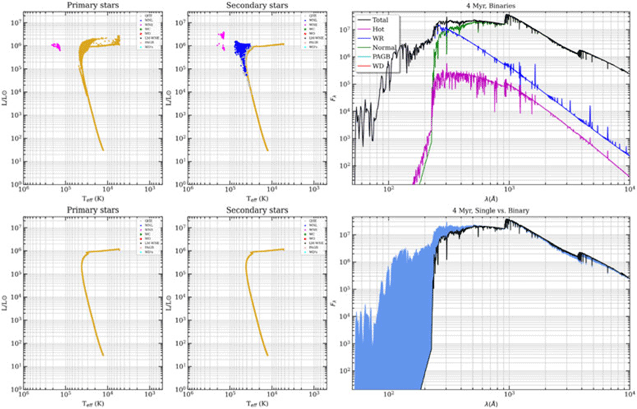
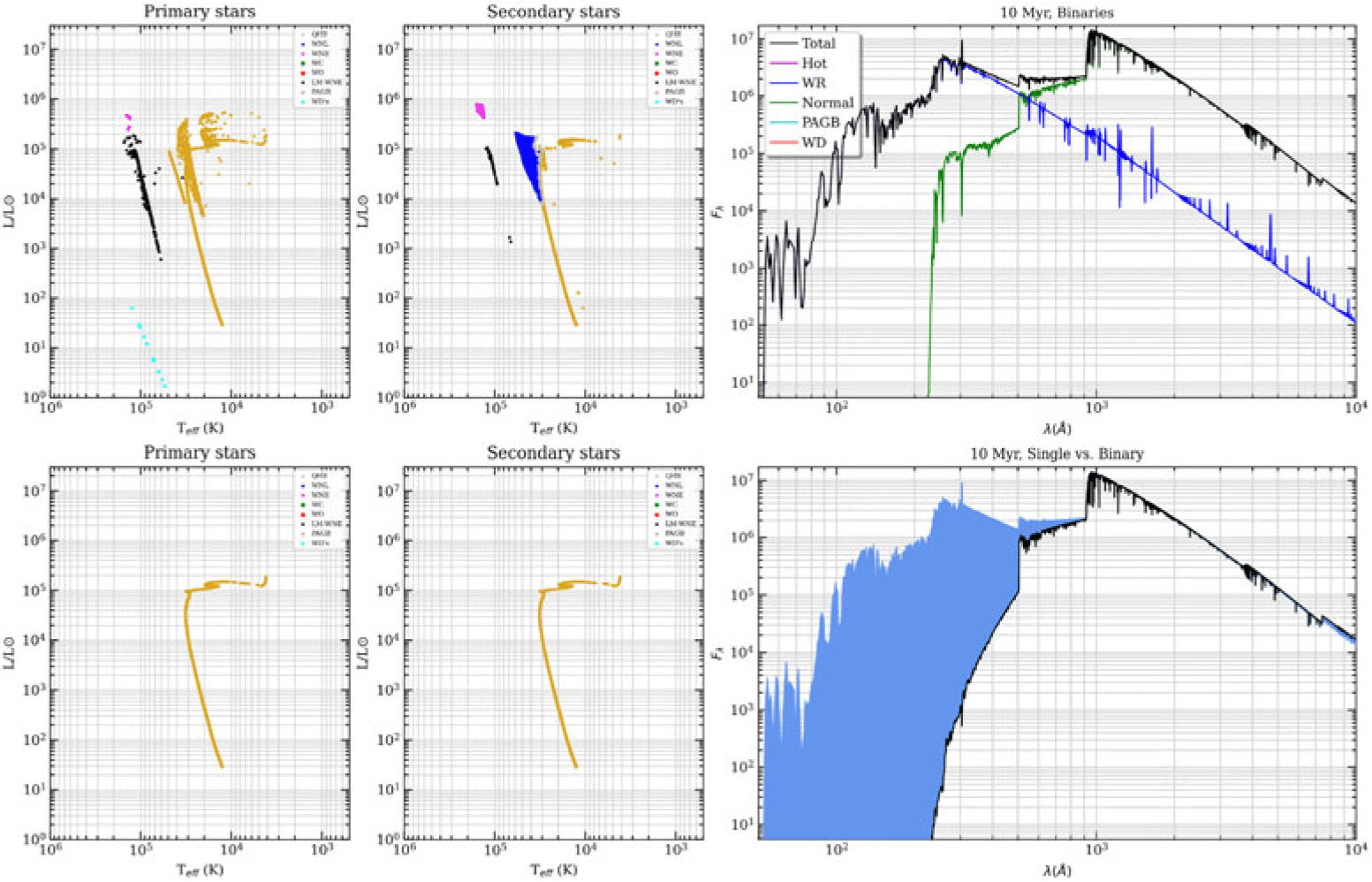
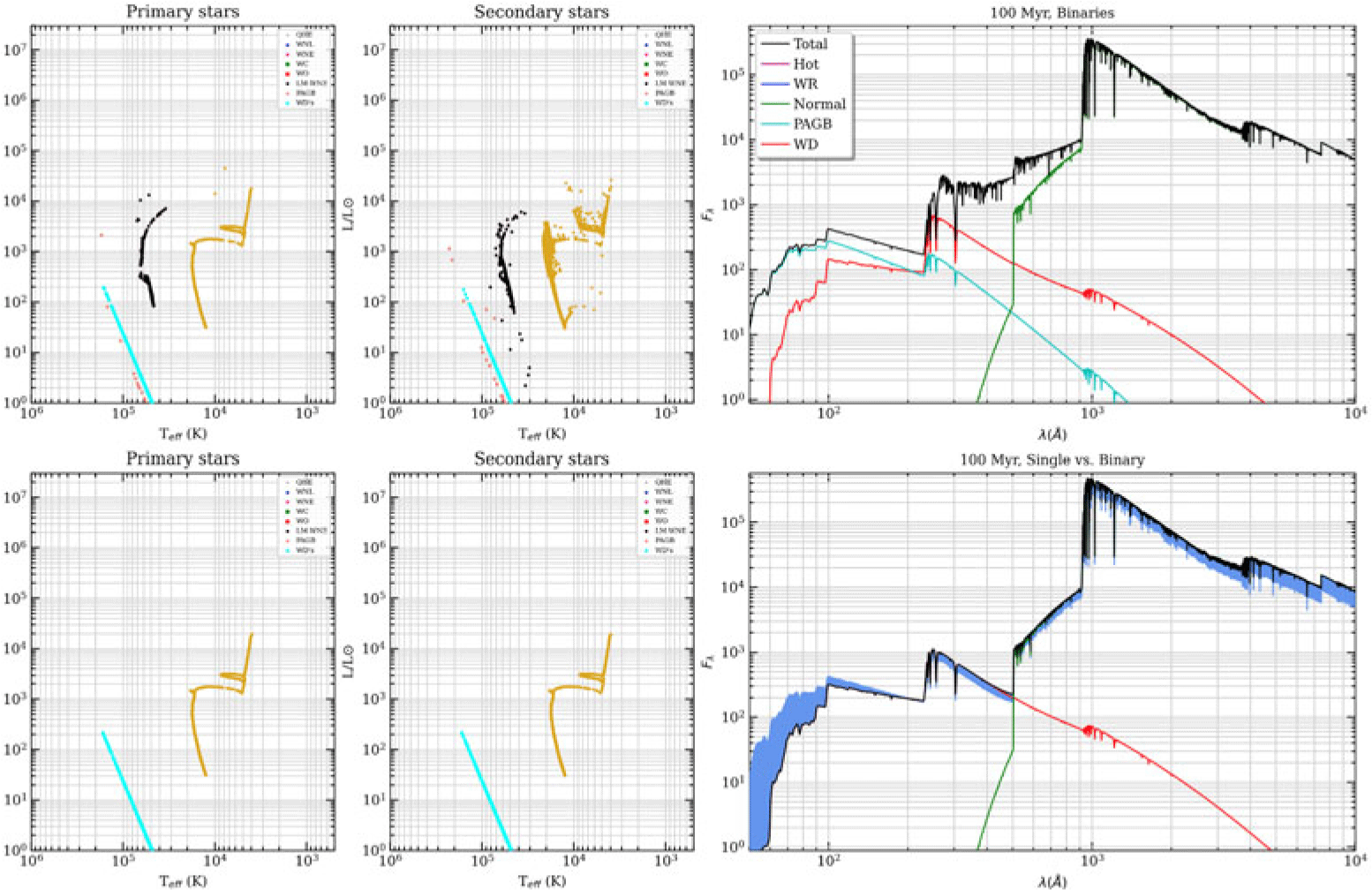
Figures 1, 2 and 3 show the isochrones in the HRD described by the primary and secondary stars in the
 $Z=0.001$
GALSEVN model at 4, 10, and 100 Myr, respectively, together with the resulting SED in the range from 50 Å to 1
 $\mu$
m. For the bottom panels in these figures, the stars in each pair are evolved as single stars, suppressing mass transfer between them, which is apparent from the differences in the isochrones in the top and bottom panels. The blue shaded area in the bottom RHS panels of these figures show the difference in the UV range shortward of 912 Å between the GALSEVN SED including binary evolution (black line in the top RHS panel) and the corresponding SED when stars are evolved as single (black line in the bottom RHS panel). The contribution to the SED of different stellar groups is shown in the RHS panels of these Figures. Not all groups contribute at all ages, cf. Figures 1, 2 and 6. See captions to Figures 3 and 6.
Same as Figure 3 but for 4 Myr.

Same as Figure 3 but for 10 Myr.

100 Myr isochrones in the HRD described by the primary (LHS panels) and secondary stars (central panels) in the
 $Z=0.001$
GALSEVN model. The corresponding SED in the range from 50 Å to 1
 $\mu$
m is shown in the RHS panels. The binary pairs in the bottom panels are evolved as single stars, suppressing mass transfer between them, which is apparent from the differences in the isochrones in the top (
 $\mathcal{B}=1$
model, see below) and bottom (
 $\mathcal{B}=0$
model) panels. The blue shaded area in the bottom RHS panel shows the difference in the UV range shortward of 912 Å between the GALSEVN SED including binary evolution (black line in the top RHS panel) and the corresponding SED when stars are evolved as single (black line in the bottom RHS panel). The contribution to the SED of stars of different groups is shown in the RHS panels. Not all groups contribute at all ages, cf. Figures 1, 2 and 6.

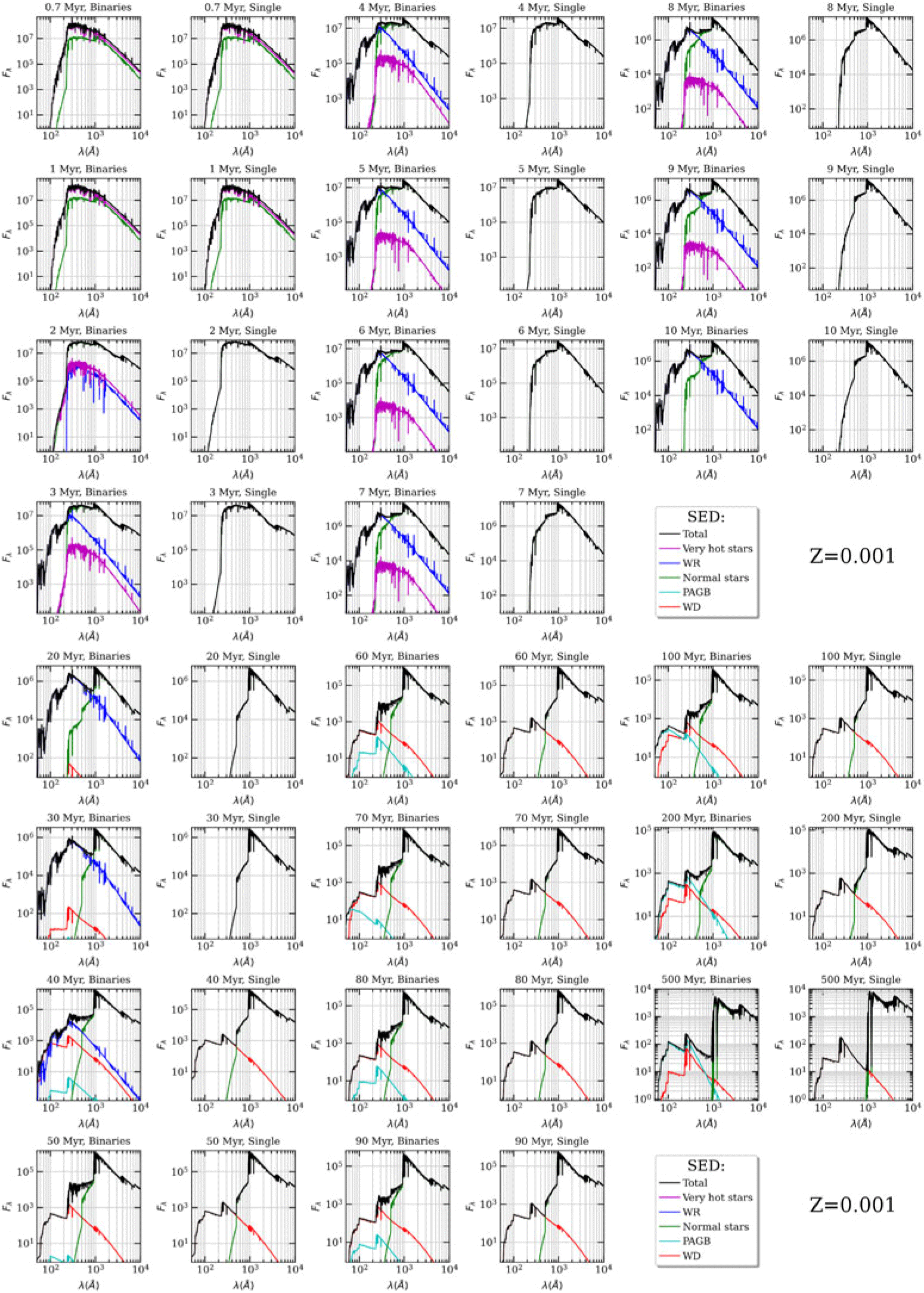
Contribution of different stellar groups to the total SED in the
 $\mathcal{B}$
= 1 (odd column panels) and the
 $\mathcal{B}$
= 0 (even column panels) GALSEVN models in the age range from 0.7 to 500 Myr (from top to bottom). WR stars (in blue) and stars hotter than 50,000 K (in magenta) that have an important contribution in the
 $\mathcal{B}$
= 1 model are absent in the
 $\mathcal{B}$
= 0 model. As shown in Figure 7, no WR stars are formed when binary pairs are evolved as single stars (
 $\mathcal{B}$
= 0). Massive stars (
 $m \ge 300$
 $M_\odot$
), formed in binary interactions in the
 $\mathcal{B}$
= 1 model at early ages, are responsible of the magenta SED denoted
 $very\ hot\ stars$
. Age is indicated at the top of each panel

Combining the
 $\mathcal{B}=1$
(100% binary) and the
 $\mathcal{B}=0$
(100% single) star models in the top and bottom panels of Figures 1, 2 and 3, respectively, we can model stellar populations with an arbitrary binary fraction
 $\mathcal{B}.$
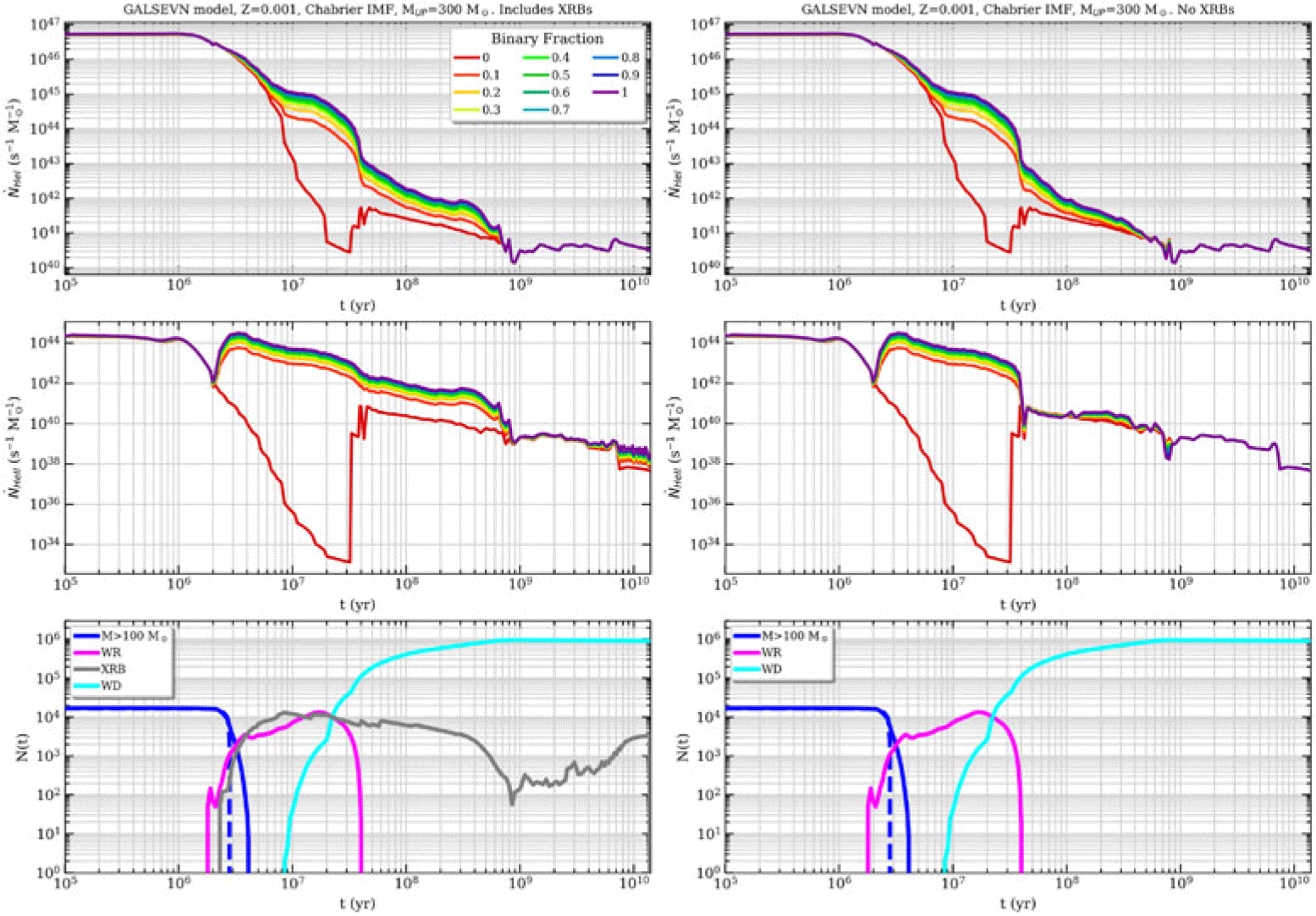
Footnote † Figure 4 shows the production rate of He i and He ii ionizing photons vs. age for
 $Z=0.001$
GALSEVN models with
 $\mathcal{B} \in [0,1]$
(Lecroq et al. Reference Lecroq, Charlot and Bressan2024). The panels on the LHS/RHS include/exclude the emission by accretion discs around XRBs. The two bottom panels show the number of stars of various types in the
 $\mathcal{B}=1$
model responsible of producing the ionizing photons.
Production rate of He i and He ii ionizing photons per unit stellar mass vs. age for
 $Z=0.001$
GALSEVN models for
 $\mathcal{B} \in [0,1]$
. The panels on the LHS/RHS include/exclude the emission by accretion discs around XRBs. The two bottom panels show the number of stars of various types responsible for producing the ionizing photons in the
 $\mathcal{B}=1$
model. The
 $dashed-blue$
line corresponds to the
 $\mathcal{B}=0$
model. The excess of massive stars in the
 $\mathcal{B}=1$
model and the role played by the XRB disks are clearly noticeable.

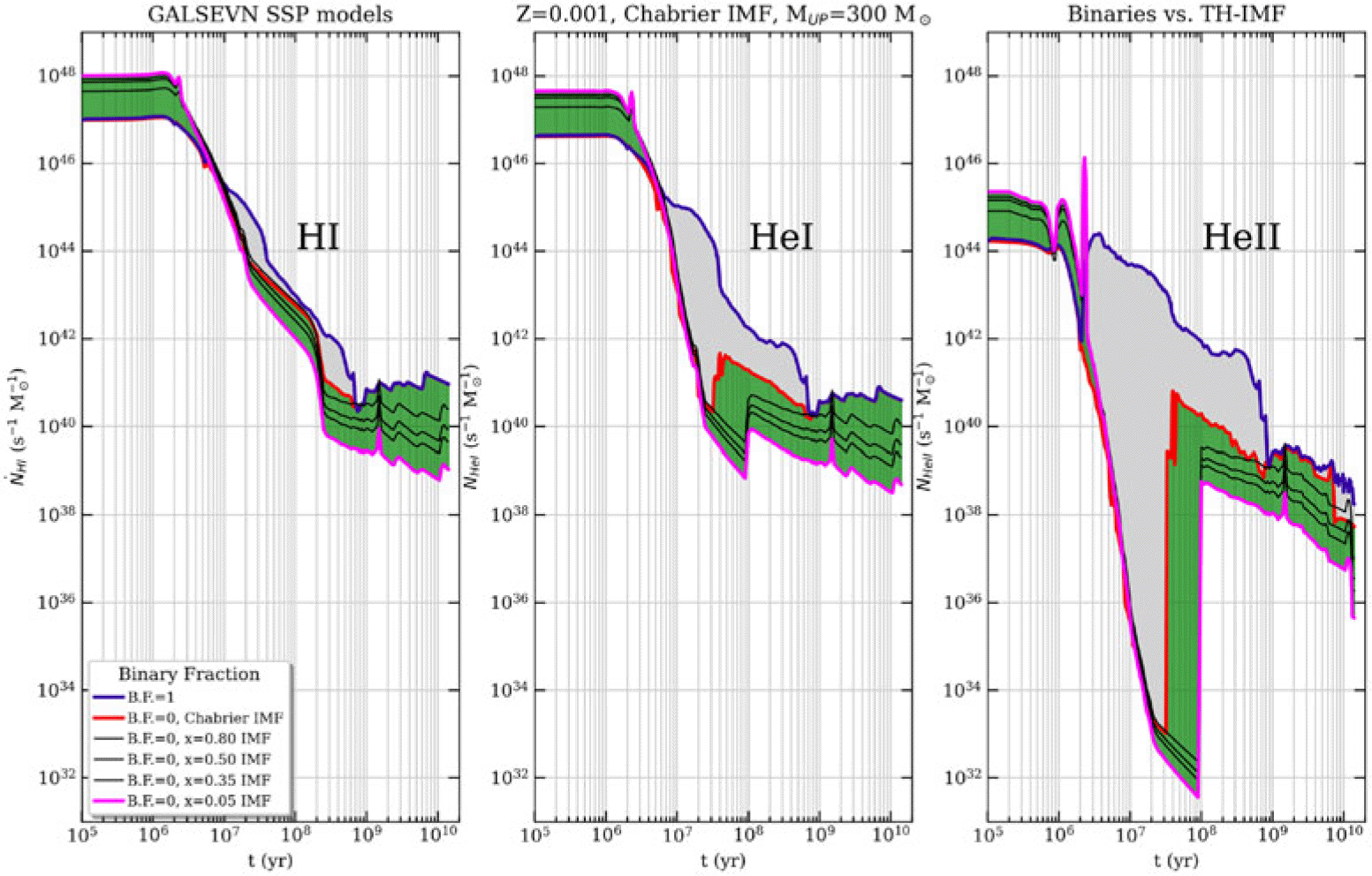
Figure 5 compares the production rate of H i, He i and He ii ionizing photons vs. age for the
 $\mathcal{B}$
= 1 Z =
 $0.001$
GALSEVN model (Lecroq et al. Reference Lecroq, Charlot and Bressan2024) with CB19 GALAXEV models computed for the Chabrier IMF and 4 different top-heavy IMFs, as indicated in the LHS panel. As expected, at early ages (below a few Myr) the top-heaviest IMF model produces more ionizing photons than the other models. As binary interactions set in, the production rate of ionizing photons by the GALSEVN model exceeds that of the Chabrier and the top-heavy IMF models.
Comparison of the production rate of H i, He i and He ii ionizing photons vs. age for the
 $\mathcal{B}$
= 1 Z =
 $0.001$
GALSEVN model (Lecroq et al. Reference Lecroq, Charlot and Bressan2024) and CB19 GALAXEV models computed for the Chabrier IMF and 4 different top-heavy IMFs, as indicated in the legend in LHS panel. The green shaded area indicates the range covered by the top-heavy IMF models. The gray shaded area shows the excess of photons in the GALSEVN model with respect to the Chabrier IMF GALAXEV model.

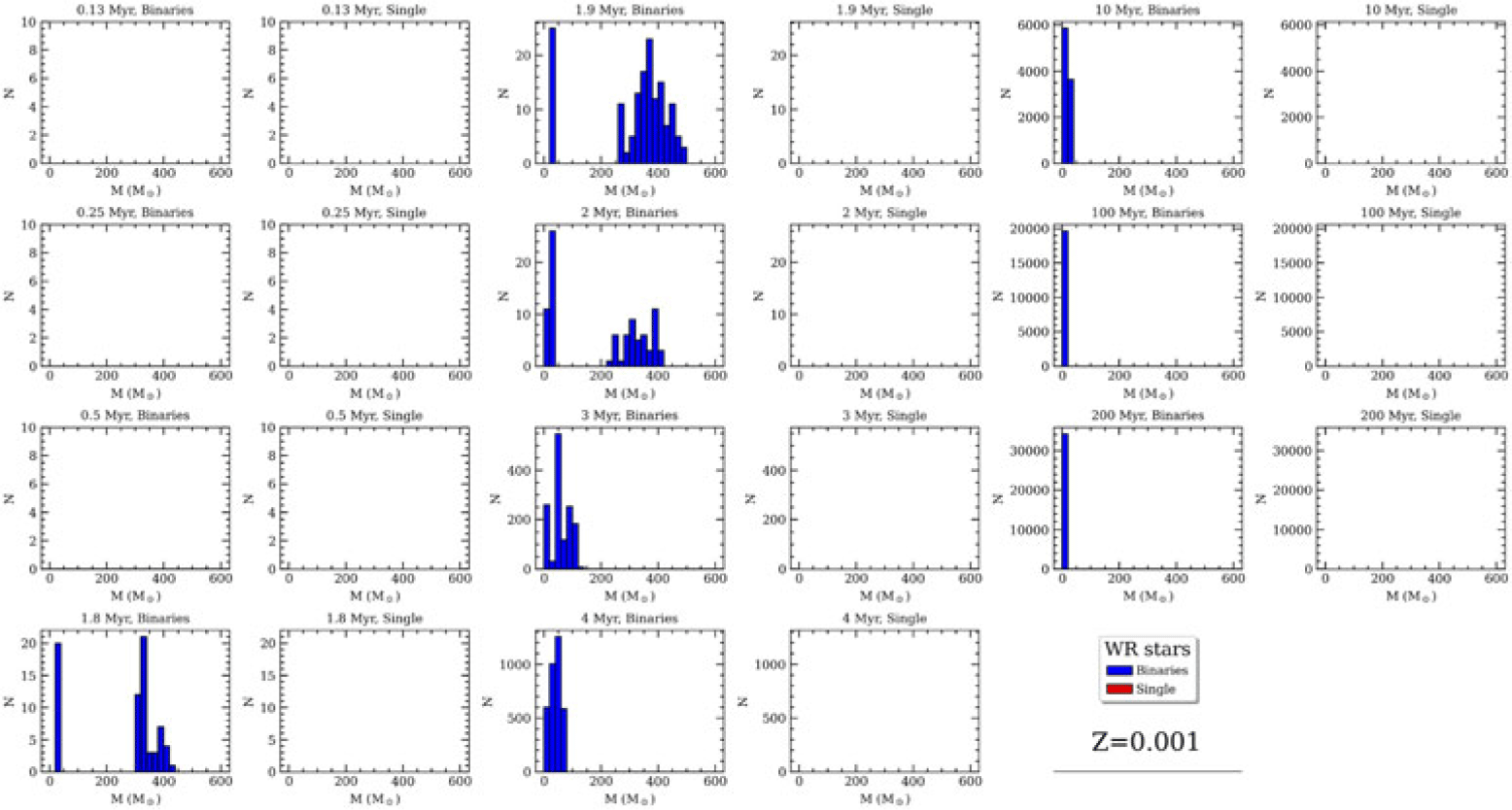
Figure 6 shows the contribution of different stellar groups to the total SED in the
 $\mathcal{B}$
= 1 and
 $\mathcal{B}$
= 0 GALSEVN models in the age range from 0.7 to 500 Myr. WR and stars hotter than 50,000 K that have an important contribution in the
 $\mathcal{B}$
= 1 model are absent in the
 $\mathcal{B}$
= 0 model. Figure 7 shows that no WR stars are formed in the GALSEVN model when binary pairs are evolved as single stars (
 $\mathcal{B}$
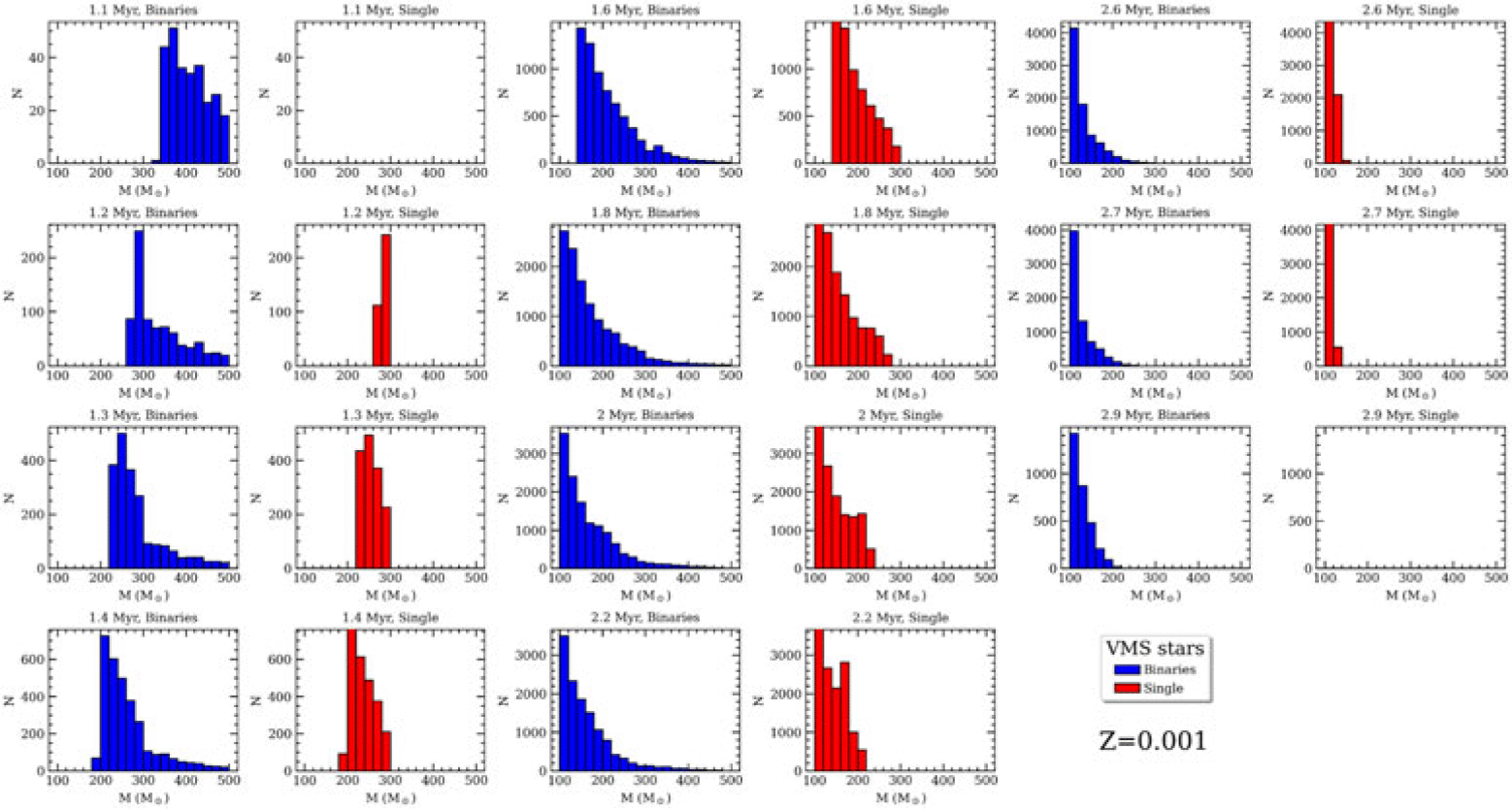
= 0). Figure 8 compares the number distribution of massive stars (
 $m \ge 100$
 $M_\odot$
) vs. age for both models. By construction, no stars with
 $m \ge 300$
 $M_\odot$
are present in the
 $\mathcal{B}$
= 0 model but there are plentiful of them, formed in binary interactions, in the
 $\mathcal{B}$
= 1 model at early ages.
Number distribution of WR stars vs. age for the
 $\mathcal{B}$
= 1 (blue histograms) and
 $\mathcal{B}$
= 0 (red histograms) GALSEVN models. No WR stars appear when the binary pairs are evolved as single stars (
 $\mathcal{B}$
= 0) according to the tracks used in the GALSEVN models for
 $Z=0.001$
. Age is indicated at the top of each panel.

Number distribution of massive stars (
 $m \ge 100$
 $M_\odot$
) vs. age for the
 $\mathcal{B}$
= 1 (blue histograms) and
 $\mathcal{B}$
= 0 (red histograms) GALSEVN models. By construction, no stars with
 $m \ge 300$
 $M_\odot$
(upper mass limit of the IMF) exist in the
 $\mathcal{B}$
= 0 model, but many of them are formed by binary interactions in the
 $\mathcal{B}$
= 1 model at early ages. Age is indicated at the top of each panel.

3. Summary
Including the evolution of interacting massive binary star pairs in population synthesis models introduces important differences in the SEDs of young stellar populations, especially in the UV range below 912 Å. It is important that this kind of models are used when interpreting data of young galaxies, possibly seen in the reionization-era. Some applications of the GALSEVN models are discussed in Lecroq et al. (Reference Lecroq, Charlot and Bressan2024); Lecroq et al. (Reference Lecroq, Charlot and Bressan2025).


 Z=0.001
 μ
 B=1
 B=0
 B
 B
 B
 B
 B
 m≥300
 M⊙
 B
 very hot stars
 Z=0.001
 B∈[0,1]
 B=1
 dashed−blue
 B=0
 B=1
 B
 0.001
 B
 B
 B
 Z=0.001
 m≥100
 M⊙
 B
 B
 m≥300
 M⊙
 B
 B

 Open access

