

Introduction
On 8 May 2018 Valentin Inzko, the High Representative for Bosnia and Herzegovina, warned the United Nations Security Council that progress in this country could not be taken for granted.Footnote 1 Speaking candidly about rising political tensions, he registered explicit concern about,
the recent readiness among some politicians to refer to the possibility of a renewed conflict, including controversial statements by senior Bosniak politicians suggesting that a rearming effort was underway to ‘respond’ in case of a hypothetical war.Footnote 2
The fact that rearmamentFootnote 3 and renewed conflict cannot be dismissed over a decade after the end of the 1995 conflict that resulted in the death of an estimated 100,000 people is alarming.Footnote 4 It also illustrates that history does not simply reside in the past. On the contrary, Inzko's report reveals that the boundaries between what happened ‘then’ and what is happening ‘now’ are hard to draw with any precision. The events that he documented also weave the past, present, and future together. Evidently, what happened ‘then’ and what is happening ‘now’ will actively inform how this country will negotiate processes of collective remembering and reconciliation going forward.
This article is prompted by a wish to explore how histories are never fully secure. At first glance, this objective may appear to be too simple. Everyone knows that history does not abide to a linear arc even if victors construct it. It is also plain that ‘facts do not speak for themselves’.Footnote 5 On the contrary, a wide canon of scholarly work has already exposed how histories are told, remembered, and forgotten in selective ways.Footnote 6 As Jenny Edkins put it, ‘producing a narrative is a form of forgetting’.Footnote 7 Related works have shown that processes of memorialisation and commemoration are sites of political power struggles. As Jay Winter surmises, ‘a cacophony is inevitable’.Footnote 8 However, the former bodies of work tend to pay less attention to the specific entanglement of history and security. What is equally surprising is that very few critical security studies scholars have explicitly foregrounded the intricate interrelations that exist between history and security. Certainly Thierry Balzacq's claim that ‘every securitization is a historical process that occurs between antecedent influential set of events and their impact on interactions; that involves concurrent acts carrying reinforcing or aversive consequences for securitization’ remains overlooked.Footnote 9 Arguably then both sets of literature fall short of offering a CSH conceptual framework.
Recently, Brent J. Steele sketched what this kind of framework might entail.Footnote 10 One of his studies focused on how the United States collectively ‘remembers’ the atomic bombings as being ‘necessary’ to ‘save lives’ that would have otherwise been lost in an invasion of the Japanese main islands. According to Steele, however, this process of collective remembering reinforces powerful security logics and ‘master narratives’Footnote 11 that justify the use of overwhelming force in wars.Footnote 12 To disrupt these linkages he draws from additional historical accounts. This generates alternative ‘if-then’ propositions that allow readers to imagine another cause for why the Japanese surrendered.Footnote 13 In a follow-up study, Steele noted that CSH would involve, ‘focusing on the ways in which history is recalled and remembered’.Footnote 14 However, neither of his studies brings different critical security approaches into conversation with each other. Nor do they fully address the inherent difficulties posed by doing CSH in theory and in practice.
To overcome these limitations, this article engages with two central approaches in critical security studies – securitisation and ontological security. Obviously, these are not the only two approaches we could have chosen. Postcolonial security studies continue to challenge Western centric accounts of history and International Relations.Footnote 15 As Tarak Barkawi and Mark Laffey point out, ‘Eurocentric historical geographies and periodisations are very much in evidence in the common narratives of world history that underpin security studies.’Footnote 16 Feminist security studies have also sought to challenge hegemonic and masculinised histories.Footnote 17 Cynthia Enloe, for instance, purposefully documents wartime lives that ‘make it harder for listeners to deny that Iraqi women had their own stories’.Footnote 18 In sync, poststructural security studies explicitly interrogate and deconstruct historical narratives and the insecurity they create.Footnote 19 For similar reasons David Campbell argues that ‘to proclaim the end of the cold war assumes that we know what the cold war was’.Footnote 20 A systematic presentation of how CSH could and should engage with all these approaches is beyond the scope of our study. Yet we do hope that this article will provide an invitation for such studies to be undertaken. In short, this piece represents the start of ongoing CSH conversations rather than a definitive end. Read in this way, our article offers a particularly promising avenue to break down oppositional thinking across the field of critical security studies.Footnote 21
Before outlining how the present article contributes to securitisation and ontological security studies it is necessary to explain why these two security approaches were selected.Footnote 22 First, both fields of study have been influenced by the central zeitgeist of critical security studies – namely that security is a social construct that is inescapably open to contestation. Working from this baseline, securitisation and ontological security scholars have highlighted the powerful role played by language, images,Footnote 23 and material actants.Footnote 24 All of these features are compatible with our attempt to develop a more robust CSH approach. Second, we argue that securitisation and ontological security approaches contain a limited focus on history that can be further developed via CSH. Engaging with securitisation, for instance, reminds us that the legacies of (de)securitisation are all difficult to leave behind or navigate going forwards. Turning towards ontological security studies we remake the case for starting with the concept of ‘historicity’ left unproblematised and unpacked in earlier studies.Footnote 25
The remainder of article proceeds as follows. First, we make a case for why CSH is necessary to unpack causal historical narratives in IR. The next section focuses on the implications of placing history centre stage in the lively debates occurring in securitisation studies. The third section explores the productive inroads that become possible when CSH and ontological security are put into conversation with one another. Building on Halvard Leira's notion of ‘engaged historical amateurism’,Footnote 26 the final section reflects on the 2012 Sarajevo Red Line project to tentatively illustrate how these ideas might be put into action. The conclusion draws together the major claims of the article and reflects on how to continue CSH conversations in critical security studies and beyond.
Making a case for Critical Security History
Conceptually, the meaning of Critical Security History is layered. By design, it seeks to acknowledge that history is inescapably told, experienced, remembered, and felt differently by different groups of people at different points in time. This is why David L. Blaney and Naeem Inayatullah sought to make ‘a conversation of equal but different cultures’ possible.Footnote 27 Motivated by a similar goal, CSH seeks to carve out spaces in which alternative voices, stories, memories, and feelings can surface. At its core, it is ‘critical’Footnote 28 in its scepticism of causality and unproblematic historical storylines. Ironically, however, CSH also calls us to take causality very seriously, perhaps much more seriously than the ways in which it is casually invoked by political leaders and/or laypeople and/or social scientists. As Milja Kurki argues, ‘we can, in fact, think of causation as a “common-sensical” intuitive notion with a multiplicity of different meanings, none of which entail laws or determinism’.Footnote 29
CSH engages causal historical narratives through two levels of analysis. The thinner, and far more common, critique challenges the dominant ‘cause’ of a historical event by proposing a different one. Daniel Deudney and G. John Ikenberry 1992 study falls into this category. Challenging the storylines espoused by the ‘Reagan Victory School,Footnote 30 they simply moved to study other causes. By extension, their ‘new’ perspective foregrounded additional factors, including Mikhail Gorbachev's reform efforts and the ‘increasingly superior performance of the Western economic system’, to determine why the Cold War ended and who ‘won’.Footnote 31
Most ‘critical’ security history is of this nature – exchanging one cause for another. Hidemi Suganami believes that all social scientific explanations rely on some form of narration like this.Footnote 32 Yet this thin type of CSH still accepts that causes can be linked to outcomes. The problem with this kind of positivist explanation is that it overlooks the ways in which these causal narratives become politicised and mobilised. Put another way, it occludes the reflexive feedback loops that occur between the subjects and objects of politics.Footnote 33 Once again Deudney's and Ikenberry's argument epitomises this limitation. In the end, they were interested in reconsidering, ‘the emerging conventional wisdom before it truly becomes an article of faith on Cold War history and comes to distort the thinking of policymakers in America and elsewhere’.Footnote 34
Lucian Ashworth's engagement with the ‘Appeasement’ mythFootnote 35 provides a richer template for critiquing historical narratives and the tendency, ‘[t]o tell the story as though the ending is an inevitability.’Footnote 36 Although it is not explicitly labelled as a CSH study, he seeks to challenge the historiography of IR by calling our attention to contingency.Footnote 37 As Ashworth argues, ‘it does not matter how in tune with the realities of power you are [when] the complexities of human political life can often give a high premium to plain dumb luck’.Footnote 38 That said, Ashworth deploys contingency to call out the importance of agency versus structure in historical narratives.Footnote 39 Naturally, we welcome his focus on agency as a key factor shaping the drive to deploy causal narratives. Even so, we believe that the restating and reinforcement of narratives can happen through the interplay of agency and structure.
The limitations outlined above alert us to the fact that Steele's accounts still offer the best place to begin considering how to create ‘a cottage field of critical studies on security history’.Footnote 40 Nevertheless, as noted in the introduction, his accounts also need to be developed. First, it is helpful to extend his analysis by illustrating how a CSH perspective can enrich and converse with different CSS approaches. This is the purpose of the next two sections. Understanding this pursuit also makes it necessary for scholars to analyse ‘the various places and spaces where historical interpretations are reinforced and/or disrupted’.Footnote 41 The final section of the article is thus dedicated to pinpointing one illustrative case study – the 2012 Sarajevo Red Line project – where security and history are mutually reinforcing yet highly contested.
Looking for Critical Security History in securitisation studies
According to the Copenhagen School, security pivots around the social construction of threats. Adopting a speech act approach, they analyse how agents speak security to convince audiences that extraordinary measures may need to be used to ensure the survival of a valued referent object.Footnote 42 While advancing this agenda, however, the Copenhagen School openly cautions against security being ‘idealized’.Footnote 43 Desecuritisation is therefore presented as an ‘optimal long-range’ strategy for returning issues back into the political realm.Footnote 44 The inclusion of this exit strategy in their original framework implies that they never intended for securitisation to last forever. Jumping to this conclusion, however, does not help us to consider the legacies of securitisation, let alone how they are selectively remembered and forgotten. What happens if securitised processes of the past seep into desecuritisation strategies? What if securitisation creates toxic memories that cannot be erased? What happens when older securitisation processes are ritualistically commemorated? As demonstrated below, CSH offers an excellent opportunity to explore these questions.
In parallel, it is well placed to contributes to ‘second generations’ claims that (de)securitisation does not unfold in a linear way.Footnote 45 Subsequent literature has framed securitisation as an ongoing process with no clear beginning or ending.Footnote 46 In this vein, Philippe Bourbeau and Juha A. Vuori have suggested that very little attention has been paid to instances in which ‘desecuritization arise before security – when securitization is brewing’.Footnote 47 At the same time, Jonathan Luke Austin and Philippe Beaulieu-Brossard have suggested that securitisation and desecuritisation can occur simultaneously.Footnote 48 For them, simultaneity can occur through ‘splitting speech acts’.Footnote 49
We believe that CSH complements Bourbeu and Vuori's attempt to excavate the ‘formative powers’ that precede and condition (de)securitisation processes from the start.Footnote 50 Nevertheless, one could still clarify how we go about accumulating clues of what counts as ‘prior’ and ‘where exactly to temporarily locate a [causal] mechanism’.Footnote 51 From a CSH perspective it is essential that we do not romanticise vocabularies that draw clear lines between (de)securitising moves because we all speak with ‘an inherited set of voices’.Footnote 52 We also propose that CSH pushes us to acknowledge that neat splits are almost impossible to accomplish. From this perspective, every synergy and/or rupture that emerges during a (de)securitisation processes is shaped by an unacknowledged yet omnipresent historicity.
In many ways these discussions merge into earlier concerns around the Copenhagen School's approach to context.Footnote 53 However, while context has become a buzzword in ‘second generation’ debates, far less calls have been made for (de)securitisation processes to be historicised. The point being made here is emphatically not that that history has been completely written out of securitisation studies. Certainly Matti Jutila has already explored the relationships between history, securitisation, and identity.Footnote 54 His work has also identified that ‘political actors use various historical narratives to justify their present position and to build their desired futures’.Footnote 55 Going further still Jutila has asked if history can be securitised.Footnote 56
In a similar vein, Bezen Balamir Coskun states that ‘historians, as well as the power elite, play a significant role in construction and reconstruction of the security discourse’.Footnote 57 Another trend is for historical events and empirical references points to form the backdrop for theorising how securitisation works in practice. Take for example, Vuori's analysis of the Doomsday Clock as a ‘longstanding process of securitization in which speech acts have been interwoven with a powerful symbol’.Footnote 58 Elsewhere Maria Mälksoo has begun to, ‘critically engage the securitization of memory as a means of making certain historical remembrances secure by delegitimizing or outright criminalizing others’.Footnote 59 Her conceptualisation of mnemonical security allows for the possibility that securitisation lingers in antagonistic ways that can ‘produce circular security dilemmas’.Footnote 60
It is also misplaced to claim that history cannot be brought into securitisation studies under the rubric of context. ‘Second generation’ debates are not looking for the context in which securitisation occurs. Instead they are looking for any and every context in which (de)securitisation is contested, negotiated, imagined, visualised, and resisted.Footnote 61 Yet, as important as these developments are, they can be further developed by centralising history even more. A cursory glance at the exiting debates, for example, illustrates that very few scholars have examined The French Revolutionary and Napoleonic Wars from a securitisation perspective.Footnote 62 What has also not been fully acknowledged is that all contexts must be viewed as a ‘ritual chain of resignification whose origins and end remain unfixed and unfixable’.Footnote 63
One explanation for why history is not always adequately captured is our preoccupation with ‘securing catastrophic futures’.Footnote 64 Our hunch, however, is that this line of argument starts to unravel very quickly when it is put into a broader context. In the end, futuristic gazes do not make history redundant. This is because discussions and visions of the future always interact and coexist with past experiences, memories, disputes, and struggles. To mention just one example, Martin Shaw has noted, ‘the Second World War remains the main historical reference point for understanding contemporary warfare and, relatedly, the international system in the twenty-first century’.Footnote 65 This observation reminds us that war does not simply reside on the battlefield or end. Their legacies can linger and be experienced by different people in elusive ways.Footnote 66 As Duncan Bell notes, ‘the fugitive traces of memory long outlast the sound of the guns’.Footnote 67 If this point holds, then the links between (de)securitisation and commemoration warrant much greater attention than they are currently afforded.
Taking these ideas in a slightly different direction brings us in contact with what we term mutual (de)securitisation processes. While the concept of countermoves and contestation has gained a lot of traction in securitisation studies, far less attention has been given to the layers of mutual (re)enactment, (re)telling, and (re)calling that are often in play in every securitisation game.Footnote 68 Even when securitisation is ‘declared’ to be over, we still find highly institutionalised, choreographed, and ritualised process of recalling and reliving what happened during securitisation. As Maria Mälksoo has already noted, ‘“our memory must be defended” emerges as a variation of the omnipresent security discourse, as another ringtone of the familiar “society” must be defended “logic”’.Footnote 69 Paying attention to how older securitisations are relived and retold opens up the possibility for intergenerational (de)securitisation processes through which images, beliefs, experiences, objects, lessons, traumas, and much more get passed down from one generation to the next. These encounters do not have to be explicit. Instead, they may become ‘mundane matters’Footnote 70 or ‘little security nothings’Footnote 71 that become woven into the fabric of our lives in ways that are rarely articulated. For example, by participating in commemorative practices, like wearing a red poppy, actors and actant become somewhat complicit in the reproduction of ritualised stories, mythologies, and ceremonies.
These observations raise anew the question of whether or not desecuritisation is possible. For Andreas Behnke, the goal is to break the ritualistic chain in order to allow securitisation to fade away.Footnote 72 For if we continue to participate in the same securitised game (whether they are historical or contemporary) there is a real danger that we never exit securitisation. This echoes Catherine Charrett's claim that ‘securitisation is maintained through its own ritualised mechanisms of measuring and judging the performance of the marked threat’.Footnote 73 Taking these repetitive aspects a step further she argues that securitising actors find it difficult to step outside their prior ‘discursive order’ or provide dissenting views.Footnote 74 Understanding securitisation in this way, however, downplays and precludes the constant possibility for contestation and even fissures in the ritual. As Ido Oren and Ty Solomon note, ‘the audience is not akin to students in an academic lecture hall or to theatergoers who are mostly performed to’.Footnote 75 As such, their discussion of ritual allows for multivocality and, in turn, contestation since ‘the complexity and uncertainty of securitising phrases thus make it possible for them to be adopted and chanted by people who do not share political values and who do not see eye to eye on the securitisation of the issue at stake’.Footnote 76
Two implications follow from this section. First, CSH calls attention to how certain securitised stories become ritualised and collectively remembered. Second, it establishes that there is no straightforward way to understand how history is securitised or desecuritised at a particular point in time or in a particular place. Looking at such dynamics is likely to make CSH a valuable area of future research for ontological security studies, to which we now turn.
Recollecting historicity and Critical Security History in ontological security studies
Ontological security studies (OSS) is another evolving field in critical security studies.Footnote 77 As Stuart Croft notes, ‘it has become as multidisciplinary work space’.Footnote 78 Overall, these debates focus on the practices through which agents order their environments and their Selves. As Steele suggests, ‘the mere act of recognizing ourselves is the first of many in a process meant to extract who we are from what surrounds us’.Footnote 79 Of course, narration is an act of representation – not only of the Self (as fleeting as that may be), but of others and all within the social environment. It allows actors to acquire and maintain a consistent biographical narrative and identity, even if they are harmful or self-defeating.Footnote 80
Yet the striving for ontological security does not guarantee its attainment. The chaos and speed of late modernity, and bewildering variety of methods and avenues for representation and counter-representation, place any narrative ordering under constant attack. Within OSS these critical situations are theorised as moments of ‘radical disjunctions of an unpredictable kind affecting substantial numbers of individuals’, disturbing the routines so vital to ordering the Self and (with) its environment.Footnote 81 Such critical situations – likened to the crises theorised in IR – disrupt narratives and conceptualisations of the Self.Footnote 82 In these moments, new models or analogies can take hold for agents seeking to reorder the Self in the face of a critical situation, lest identity be upended altogether.
Two key concepts within Giddensian-inspired uses of OSS relate to CSH, namely (auto)biographical narratives and ‘historicity’ (the use of history to make history). The biographical narrative is what Giddens also terms the ‘narrative of the self’: the story or stories through which self-identity is reflexively understood, both by the individual concerned and by others.Footnote 83 In general, OSS has centralised this aspect from both conventional (taking the narrative as an analytical given) and critical (treating it as a politically problematic device) angles.Footnote 84 Less acknowledged but still found in OSS work is the concept of historicity.Footnote 85 For Giddens, two conditions of modernity are responsible for the ‘use of history to make history’.Footnote 86 The first is literacy and the development of the printing press.Footnote 87 The second is the importance of electronic communication that made the retrieval of information and, in turn, everyday meanings possible. According to Giddens, these two trends spur agents to use history to create and maintain ontological security. In short, historical ties reduce the anxiety and fears produced by critical situations.Footnote 88
Championing a complex understanding of CSH, however, opens up four new lines of inquiry for OSS scholars interested in historicity. First, it reminds us that the process of narrating history is an expression of agency that transcends a singular level of analysis or socialisation. As Friedrich Kratochwil notes, ‘while history cannot be the “teacher” of all things practical, the critical reflection on our historicity is an indispensable precondition for grasping our predicament as agents’.Footnote 89 Second, adopting a CSH lens allows us to appreciate that ‘history’ itself is an actant, a collective force exerting pressure upon individuals and groups. This assertion requires some clarification since ‘agency’ is typically assumed to be both the property and outcome of human action. At the broadest level, ‘we need to start theorizing … assemblages of non-human and human actants’.Footnote 90 Agency thus needs to be considered ‘not just in terms of human or intersubjective intentionality … but as a kind of emergent swarm effect’.Footnote 91 This effect is similar to what we speak of when referring to how the ‘weight’ of the ‘past’ influences the present. The core point is not to occlude the role of humans. What it does mean is that the long-lasting consequences of our actions in any moment can be judged by history. This is the background against which the trail of former Bosnian Serb commander Ratko Mladić should be seen, although some years on the ground has shifted fundamentally.Footnote 92
Third, OSS focuses on the ways in which insecurity is generated by a whole host of factors not all connected to ‘conventional’ security stories. Just like its ability to order a social world that seems chaotic and beyond our control, narratives (including master narratives) help to order a past that seems endless and infinite in its details and trajectories. Ontological insecurity about the present can thus be attended to through a connection to the past. Fourth, and related, OSS calls our attention to the politics of identity involved in the making of history, and why the dynamics of causal narratives regarding specific historical events is about more than ‘just’ those events. To begin, they are about narrating a past Self as an aspirational one. As Steele noted, ‘historical narratives function to order and routinize the Self of individuals and collectives’.Footnote 93 In doing so, they can, ‘paper over particular urges. These urges can be ever-so-slightly revealed when narratives are disturbed, including emotional drives connected to notions of revenge and lost honor.’Footnote 94
Taking all of these points into consideration, a CSH approach drawn from OSS has to not only be aware of the importance of narratives for all agents who engage them for organising the past in the context of a security-seeking present. It also has to acknowledge recent critiques that have emerged within ontological security studies over problems of narration.Footnote 95 First, narratives are exclusive not only of the events that they select against others, but also of the others against which the narrative finds its political power. Will K. Delehanty and Brent J. Steele have pointed out the importance of gender in the constitution of biographical narratives of political communities. Chris Rossdale goes further, suggesting that the ‘contiguous and stable narratives of selfhood, can (violently) obscure the ways in which such narratives are themselves implicated in power relations’.Footnote 96 Elsewhere Nick Vaughan-Williams has called for a ‘hauntological security’ approach, ‘that pays keen interest in what is left out, unsaid, excluded, and/or undermined in service of claims made to secure a biographical narrative of the self’.Footnote 97 This requires looking into how ‘fixing a certain understanding of the past and defending it may take the form of active forgetting and/or remembering’.Footnote 98
CSH opens up a striking way for these recent critiques within or against OSS to gain continual momentum, especially the recent attempts to problematise the notion of a coherent ‘Self’ being possible in the first place.Footnote 99 While OSS scholars simplify the link between ontological security and history to biographic narratives and routines, CSH calls attention to some of the broader ‘stakes’ of those links. Building on the previous sections, it seeks to highlight the importance of reinstating the fine line between who speaks and who is silenced. Some of the work on vernacular security is already making progress in this direction,Footnote 100 demonstrating the ways in which ‘political discourses’ can ‘disrupt dominant understandings of threat and insecurity’.Footnote 101 Building on these conversations, the next section provides some ways to ‘do’ Critical Security History.
How to ‘do’ Critical Security History: an illustration of ‘engaged historical amateurism’
So far this article has highlighted that securitisation and ontological security scholars could benefit from engaging with a CSH approach. But what about the actual ‘doing’ of CSH? How can scholars, students, and everyday people ‘do’ this type of work? On the surface, CSH appears to leave us with several dilemmas. The first pertains to the near impossibility of studying historical narratives ‘critically’ when they are always incomplete and in the process of becoming. The second hinges on methodological challenges pertaining to where and how this kind of work should be done. Of course, as scholars, we would focus on the practicing CSH in our studies. However, in reality, it can be ‘done’ almost anywhere.
Although this article does not attempt to overcome these dilemmas, we believe that CSH is still a useful approach in thinking about how to address them. As previous sections have already shown, the role of history forces us to pay closer attention to the ambiguities, inconsistencies, and uncertainties that constantly reside in and shape an array of narratives. This awareness is already critical. In another way, it nudges those interested in ‘doing’ CSH to unapologetically embrace pluralistic methodologies and multidisciplinary outlooks.Footnote 102 Following Claudia Aradau, Jef Huysmans, Andrew Neal, and Nadine Voelkner we would advise people not to rush to define what a method is before they use it.Footnote 103 Ultimately each actor who uses a CSH approach will have to be reflexive enough to acknowledge that ‘all methods are in a sense historical’.Footnote 104 In this respect, we find that Halvard Leira's advice to embrace a ‘spirit of engaged amateurism in dealing with history’Footnote 105 provides a vitally important sensibility for pursuing CSH. Applied here, amateurism is recognition that we are more equipped than we realise to engage history as a social, and even collegial, activity.
In no particular order, we would suggest three entangled steps for ‘doing’ CSH. These steps would include, first, finding the master narrative being invoked/evoked. This is perhaps the most straightforward step. Nevertheless, it still requires careful documentation and/or citation and reflexive analysis on the part of the actor. On a constant basis they must ask, is this the ‘only story’ that could be told about the event in question?Footnote 106 In the first instance, discourse analysis, oral histories, and ethnography may provide useful methods for identifying and unpacking the master narratives and the dominant themes that emerge wherever they reside.
A related step is to try establish the particular causal factors ‘at play’ in the master narrative.Footnote 107 Interpretivist ‘process-tracing’ appears to be a suitable beginning point to investigate the powerful role of causal claims in securitised realms.Footnote 108 Care must be taken here. Let us recall, the goal of CSH is not to establish causality or determination per se. The goal is to examine how causal narratives persuade people that certain historical events happened in a certain way. What follows is the daunting task of discovering how this happened. This step is difficult. Master narratives maintain a seemingly concrete authority. By extension, it is likely that doing CSH will involve travelling ‘through a winding path that touches on core issues related to memories, with many side trails and detours’.Footnote 109 However, the third step is to remain alert to fissures that are always possible in these master narratives once we travel down these winding paths.Footnote 110 Importantly, routinised and ritualised security-seeking actions and relationships can be disturbed precisely because they have gone unquestioned for so long, lacking a type of flexibility and adaptability in the face of questioning.
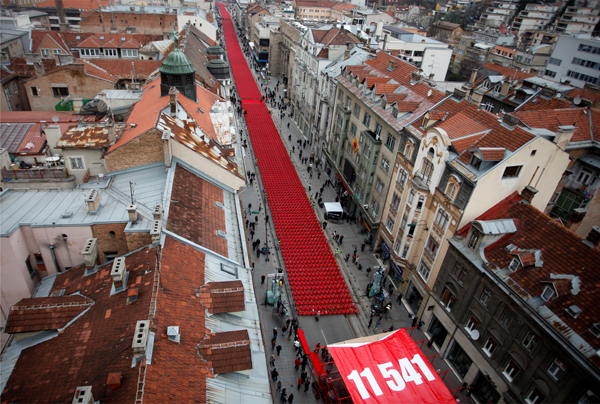
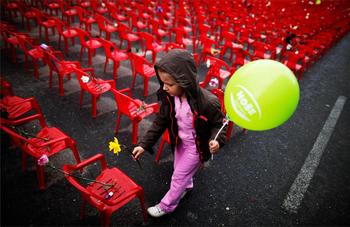
The 2012 Sarajevo Red Line is a good illustration of the complexity of trying to ‘do’ CSH. To commemorate the twentieth anniversary of the start of the Bosnian War, 11,541 empty red chairs were carefully placed in 825 rows on Titova Street in Sarajevo to create a ‘red river’Footnote 111 seen in the Figures 1 and 2 below.Footnote 112 The installation, designed by Haris Pašoviü, was dedicated to the Sarajevo citizens killed during the 1992–6 siege of their city.Footnote 113 Each red chair was there to symbolise a life lost during the siege. Poignantly, ‘a teddy bear, toys, and schoolbooks were placed on the smaller ones that symbolize the hundreds of children killed during the four-year siege by Serbian forces’.Footnote 114
Titova Street, Sarajevo, 2012. Photo by Dado Ruvic, Reuters.

Titova Street, Sarajevo, 2012. Photo by Dado Ruvic, Reuters.

This temporary installation illustrates the inherent difficulties of leaving what happened ‘then’ in the past. As Katelyn E. Giovannucci writes, ‘Red plastic chairs seem so simple, but 11,541 of them can be overwhelming. A stage full of performers also seems ordinary, but the fact that they are playing to a dead audience is anything but that.’Footnote 115 What is equally apparent in this particular case is how older securitisation stories and biographic narratives are passed down from one generation to the next. These active processes of collective (re)telling reaffirm that desecuritisation is difficult to achieve. For example, although the installation presented an opportunity to commemorate those who had died, the effects made it difficult to ignore the issues of trauma, loss, and victimhood it raised.
Trying to remember what happened in the streets of Sarajevo complicates any attempts to split securitising and desecuritising plotlines or determine what counts as a ‘prior’ experience. In reality, we cannot rule out the possibility this space may always contain securitised stories even if they change over time. Put differently, peace and war may have to coexist awkwardly. This may make us uncomfortable. It is not the typical way we have been socialised into thinking about peace, (de)securitisation, or ontological (in)security. However, this article has already shown that memory, securitisation, and historicity intersect in ways that does not guarantee stability. Their interrelationship is ambiguous precisely because no guidelines exist a priori.
Adopting a CSH perspective, it is important to acknowledge what we do not see or hear in these images. To be sure, ‘the photograph provides a quick way of apprehending something and a compact form for memorizing it’.Footnote 116 In contexts like Bosnia, however, they also have the potential to perpetuate threat perceptions and ontological insecurity. Rather than trying to run away from this reality, CSH allows for the possibility that these images will affect certain groups and individuals in different ways and at different times. Other questions also arise. What do these images tell us about the conflict? Whose stories do they tell? Whose chair is missing?Footnote 117 What remains invisible in these snapshots? Do they allow us to access the soundscape of the choir, classical music, and 750 school children singing during this commemoration? Did this commemoration create reconciliation and desecuritisation? Time should be dedicated to answering these questions in the classroom, conference, and everyday sites. More broadly, we need to be realistic enough in these conversations to realise that these images can only ever attempt to convey a snapshot of a much larger picture that we may never fully know, see, feel, or touch.
On some level, CSH provides security scholars with a way to address this reality. It opens a pathway for histories, identities, and memories to remain insecure. From a linguistic perspective, this approach acknowledges that speech acts and (de)securitisation can empower certain speaker while diluting the voice of others.Footnote 118 Equally, it confronts the question of silence from another angle. As notes Jay Winter, imagery can (and frequently does) escape the confines of written language. The Sarajevo Red Line is a strong example of how visuals demand attention.Footnote 119 Perhaps, however, we need to take this idea further. On a deeper level, this memorial reflects that history has a mysterious ability to stir up emotions that transcend any singular medium, time, or place. Viewed in this way, the Sarajevo Red Line offers us a glimpse into a different kind of storytelling, one that is open to contestation as much as causation. As the ReCall project has already stated, ‘this points to the need for every individual to take critical responsibility … for envisioning new ways of handling painful places and stories’.Footnote 120 For us, adopting a CSH approach may provide one stepping stone in that direction.
Continued and continual CSH conversations
Security and history are topics that people will perennially encounter. Despite our best efforts, we cannot leave either of them behind. Evidently, the end of the Cold War continues to shape disciplinary debates in security studies and public perceptions of fear in ways that are hard to measure. As John Gerard Ruggie argues, ‘the year 1989 has already become a convenient historical marker … to indicate the end of the postwar era’.Footnote 121 Reflecting on how the ‘war on terrorism’ was constructed, Richard Jackson also suggests that this phrase has become ‘accepted as part of the way things naturally are and should be’.Footnote 122 Throughout this article, we have shown that such master narratives help to ensure ontological security, routines, and identities. As such, they often ‘become a powerful tool for authorities as well as other social groups to preserve certain memories and conceal others’.Footnote 123
Our aim in this article has been to develop a CSH approach that can question master narratives. We can see from the example of the Bosnian conflict that there is no automaticity in how security stories are told or remembered. This gives us room to unsettle and potentially transform the engrained assumptions about well-known historical events. At the same time, we have been careful not to leapfrog over the question of causality altogether. CSH openly acknowledges that reified, routinised, and ritualised narratives have ‘fostered certainty about how one could define, prosecute and win future conflicts’.Footnote 124 Given that causal narratives play an important role in developing that certainty, it is not enough to simply try to substitute one cause with another cause or foreground agency.
This focus has broader implications for security studies. In the first instance, this article adds substantially to our understanding of securitisation and ontological security studies. By foregrounding the powerful role that history continues to play in the social construction of threats fear, we contributed to recent efforts to frame (de)securitisation as an ongoing process with no clear beginning or ending. Rather than assuming that actors can successfully close one securitisation story or split simultaneous (de)securitising moves, we need to be vigilant and open-minded when it comes to placing ambiguity rather than causality at the centre of discussions about ritualised histories, commemorations, and contexts.
An additional promise we have identified in this article is the ability of CSH to unsettle biographic narratives and identities that hold special significance because they offer a ‘useable past’.Footnote 125 In this respect, it can contribute to recent trends in OSS to investigate the history, memory, and emotions via the concept of nostalgia.Footnote 126 Our analysis has also shown that CSH opens up a way for more research to be done on the concept of historicity. This connects to recent attempts in OSS to problematise the notion of a coherent ‘Self’ being possible in the first place.
It also seems quite clear that a fuller understanding of CSH necessitates cultivating ‘a spirit of engaged amateurism’Footnote 127 that can be practiced in a wide variety of micropolitical settings. In this light, events that unfold in our research conversations with fellow scholars, students, and even strangers hold implications for exploring how master narratives are learnt, told, remembered, and challenged. Moreover, we believe that the critical security studies approaches beyond the scope this article offer versatile entry points to study and ‘do’ CSH in a number of relational spaces and interconnected sites. Taking this invitation seriously creates another avenue of future research; the silences that all stories produce and the (in)visibility of who is left out. To illustrate why these issues matter to CSH, it is worthwhile to return briefly to what happened and is happening in Bosnia.
Using the two photographs of the 2012 Sarajevo Red Line project, we demonstrated that history and security are interconnected in complex ways. In this context, their interplay pushes us to reconsider how justice and reconciliation can be achieved in this region. As Jasna Dragovic-Soso notes, ‘the history of the failed TRC project in Bosnia holds important lessons for ongoing truth-seeking attempts’.Footnote 128 Further research needs to be carried out to uncover how past atrocities will be collectively remembered, narrated, and contested in Bosnia. Looking ahead, it is not clear whether overt practices of memorialisation will upset and discredit official attempts to narrate this conflict as something that happened in the past. Our analysis definitely speaks to a more complex story of desecuritisation and biographical continuity, one that pays tribute to the unassailable struggles over the senses of wrong and injustices produced to establish an ‘official history/memory’.Footnote 129
All of this brings us back to where we began. Quite unexpectedly, Valentin Inzko's premonitions may have come at precisely the right time. If we listen, they testify to the unmistakably difficulties of burying ‘traumatic fragments that still defy narrative reconstruction and exceed comprehension’.Footnote 130 Instead of implying that a harmonious community can be restored in Bosnia, CSH endorses multivocal and multiperspectivst approaches that elide any ‘“policing” mentality that denotes the limitations of what is sayable or thinkable and the boundaries beyond which the unsayable lies’.Footnote 131 In this effort, we invite readers to constantly question who is narrating security stories and history in this context and elsewhere. Is it a speaker? Or an image? Or a chair? Or history itself?
Acknowledgements
We thank the reviewers and editors of EJIS for their extensive feedback during the review process. We especially thank Timothy Edmunds for his insights and counsel throughout. An earlier version of this article was presented at the 2017 annual meeting of the International Studies Association in Baltimore. We especially thank Jarrod Hayes for his helpful, detailed, and insightful comments during that panel, as well as comments from Kurt Bassuener, Lydia Cole, William Eliason, Jasmine K. Gani, Sean Giavanello, Maria Mälksoo, Steven Metz, Mateja Peter, and Christopher Peys, which all helped sharpen the focus of the article. Our thanks also go to Krishan Kuruppu for his research assistance on an earlier version of the article. We should also acknowledge the copyright holder in a reference as usual too. Any flaws, mistake, and errors remain our own.
Faye Donnelly is a Lecturer in the School of International Relations at the University of St Andrews. She is the author of Securitization and the Iraq War: The Rules of Engagement in World Politics (Routledge, 2013). Her article, ‘The Queen's Speech: Desecuritizing the past, present and future of Anglo-Irish relations’ has been published in the European Journal of International Relations. Author's email: fd47@st-andrews.ac.uk
Brent J. Steele is the Francis D. Wormuth Presidential Chair and Professor of Political Science at the University of Utah. He teaches courses on US foreign policy, international security, International Relations theory, and international ethics. He is the author of four books, including the forthcoming Restraint in International Politics (Cambridge University Press). He is also the co-editor of several books and journal special issues, and has published articles in a number of international studies and political science journals, most recently in the European Journal of International Relations and Cooperation and Conflict. Author's email: brent.steele@utah.edu