Adolescence is a developmental period accompanied by increased stress in close relationships, such as those with parents and peers at school (Smetana, Campione-Barr, & Metzger, Reference Smetana, Campione-Barr and Metzger2006). Although some interpersonal difficulties are thought to be normative for this age, severe and persistent interpersonal stressors put adolescents at risk for a variety of poor outcomes, including depression and anxiety, substance use, and deficits in academic achievement (Barrera & Garrison-Jones, Reference Barrera and Garrison-Jones1992; Branstetter, Furman, & Cottrell, Reference Branstetter, Furman and Cottrell2009; Wentzel & Caldwell, Reference Wentzel and Caldwell1997). Further, several studies have found evidence for the role of interpersonal problems in childhood and adolescence in the prediction of later physical health problems, such as metabolic and cardiovascular abnormalities (e.g., Caspi, Harrington, Moffitt, Milne, & Poulton, Reference Caspi, Harrington, Moffitt, Milne and Poulton2006; Gustafsson, Janlert, Theorell, Westerlund, & Hammarström, Reference Gustafsson, Janlert, Theorell, Westerlund and Hammarström2012). These findings have led many researchers to suggest that abrasive relationship experiences can undermine both current and long-term physical health (e.g., Kiecolt-Glaser, Gouin, & Hantsoo, Reference Kiecolt-Glaser, Gouin and Hantsoo2010).
This evidence for a connection between difficult social relationships and worse subsequent health raises questions about underlying mechanisms. How does stress in close relationships “get under the skin” of youth and initiate predisease processes that might put children and adolescents at risk for health problems later in life? One possibility is that these relationship experiences engender physiological changes in children's endocrine and immune systems. Relationship stress is thought to modulate the hypothalamic–pituitary–adrenal axis (Flinn & England, Reference Flinn and England1995; Miller, Chen, & Zhou, Reference Miller, Chen and Zhou2007; Pendry & Adam, Reference Pendry and Adam2007) and change output patterns of its primary hormonal end product, cortisol. One of cortisol's many roles in the body is to help regulate immune responses, particularly inflammation. Cortisol binds to glucocorticoid receptors located in immune cells and, under normal circumstances, this complex regulates the magnitude and duration of inflammation, helping to insure the response does not overshoot in a manner that causes tissue damage (Sapolsky, Romero, & Munck, Reference Sapolsky, Romero and Munck2000; Sternberg, Reference Sternberg2006). Over time, however, long-term exposure to stress can result in the desensitization of glucocorticoid receptors to cortisol, particularly in the cells (monocytes and macrophages) that initiate and sustain most inflammatory responses (e.g., Marques, Silverman, & Sternberg, Reference Marques, Silverman and Sternberg2009; Miller et al., Reference Miller, Chen, Sze, Marin, Arevalo and Doll2008; Raison & Miller, Reference Raison and Miller2003; Rohleder, Marin, Ma, & Miller, Reference Rohleder, Marin, Ma and Miller2009). One result of this desensitization is that cortisol has a reduced ability to regulate these cells' responses to infections and injuries, which gives rise to chronic low-grade inflammation even in the absence of acute events (Miller, Cohen, & Ritchey, Reference Miller, Cohen and Ritchey2002; Raison & Miller, Reference Raison and Miller2003). For example, when macrophages encounter microorganisms that cause infectious diseases, one of their initial responses is to secrete proteins, called proinflammatory cytokines, which can include interleukin-6 (IL-6), IL-1β, and tumor necrosis factor-alpha (TNF-α). These molecules attract cells to the site of the infection, activate their killing functions, call in other more specialized cells, and initiate systemic processes like fever that decapacitate the invading microorganisms. This inflammatory response is critical for surviving acute infections and injuries. However, it must be carefully regulated because, if sustained in an unchecked manner, inflammation can bring about tissue damage and contribute to chronic diseases, such as metabolic disorders and cardiovascular disease (Hotamisligil, Reference Hotamisligil2006; Libby & Theroux, Reference Libby and Theroux2005). Thus, reduced sensitivity to the anti-inflammatory effects of cortisol may contribute to a poorly regulated inflammatory response to injuries, infections, and other stimuli.
There is emerging evidence for a connection between abrasive interpersonal relationships and chronic, low-grade inflammation. Much of this evidence comes from studies of adults (e.g., Gouin et al., Reference Gouin, Glaser, Loving, Malarkey, Stowell and Houts2009; Kiecolt-Glaser et al., Reference Kiecolt-Glaser, Loving, Stowell, Malarkey, Lemeshow and Dickinson2005). In one particularly rigorous study, married couples who were rated as high in hostility during a laboratory-based conflict discussion had greater increases in circulating IL-6 and TNF-α relative to less hostile couples (e.g., Kiecolt-Glaser et al., Reference Kiecolt-Glaser, Loving, Stowell, Malarkey, Lemeshow and Dickinson2005). Although fewer in number, several studies of youth have found support for the notion that chronic relationship stressors in childhood and adolescence are associated with greater inflammatory activity (e.g., Dixon, Meng, Goldberg, Schneiderman, & Delamater, Reference Dixon, Meng, Goldberg, Schneiderman and Delamater2009; Low, Matthews, & Hall, Reference Low, Matthews and Hall2013; Miller, Rohleder, & Cole, Reference Miller, Rohleder and Cole2009). Interpersonal stress in children has been associated with several biomarkers that reflect chronic, low-grade, inflammation, including TNF-α (Dixon et al., Reference Dixon, Meng, Goldberg, Schneiderman and Delamater2009) and C-reactive protein (CRP; Fuligni et al., Reference Fuligni, Telzer, Bower, Cole, Kiang and Irwin2009). Further evidence comes from Miller et al. (Reference Miller, Maletic and Raison2009), who found that across a 6-month period, adolescents who experienced chronic interpersonal stress had larger in vitro IL-6 responses to a bacterial stimulus, suggesting that relationship difficulties may have primed their cells to respond aggressively.
This growing body of research suggests that exposure to stressful interpersonal relationships in childhood and adolescence contributes to a proinflammatory tendency. Despite this preliminary support, these studies have several limitations that should not be overlooked. It is important to note that these studies rely heavily on cross-sectional designs, which cannot establish whether interpersonal stress precedes the inflammatory state or shed light on how changing relationship dynamics, for better or worse, might impact these immune responses. Further, many of these studies utilize composite measures of interpersonal stress that reflect the sum of children's experiences across family and peer domains. Thus, it is unclear whether interpersonal stress of any form has consequences for inflammation or whether only particular relationship domains can get under the skin. Studies of biomarkers of low-grade inflammation (e.g., Dixon et al., Reference Dixon, Meng, Goldberg, Schneiderman and Delamater2009; Fuligni et al., Reference Fuligni, Telzer, Bower, Cole, Kiang and Irwin2009) also leave open the question of what underlying processes are taking place in the body that might contribute to inflammation. It may be that stress leads monocytes and macrophages to become overly aggressive towards pathogens, and secrete greater quantities of cytokines that eventually contribute to systemic inflammation. Another possibility is that, as a result of chronic interpersonal stress, these cells' glucocorticoid receptors become less sensitive to cortisol's signals to dampen inflammation.
The present study was designed with three primary goals in mind. First, we examine the separate role that adolescents' experiences with family members and peers play in predicting subsequent inflammatory processes. This approach reflects an understanding that adolescents' relationships within family and peer domains might vary substantially in the how much stress they generate and how this affects inflammation. Although the quality of adolescents' relationships is thought to be related in meaningful ways (e.g., Elicker, Englund, & Sroufe, Reference Elicker, Englund, Sroufe, Parke and Ladd1992; Furman, Simon, Shaffer, & Bouchey, Reference Furman, Simon, Shaffer and Bouchey2002), researchers have noted important differences across the family and peer domains. For example, adolescents tend to report more conflicts with parents than with peers (Laursen & Collins, Reference Laursen and Collins1994), and adolescents report more companionship with peers than with parents (Furman & Burhmester, Reference Furman and Buhrmester1985).
These differences might have consequences for how relationship stress relates to various inflammatory processes. On the one hand, given the normative increase in family conflict in adolescence, it may be that family stress has relatively little effect on adolescents' inflammatory processes, relative to difficulties within increasingly emotionally significant and typically less conflictual peer relationships (Brown, Reference Brown, Lerner and Steinberg2004). On the other hand, adolescents' relationships within the family remain an important source of emotional support (Collins & Laursen, Reference Collins, Laursen, Lerner and Steinberg2004), so difficulties in this context might be expected to influence inflammatory processes. Given that both family and peer relationships play an important role in adolescents' lives, we hypothesized that stress within each relationship context would be predictive of an increasingly proinflammatory state over time, characterized by more low-grade inflammation, reduced glucocorticoid sensitivity, and greater IL-6 production in response to bacterial challenge, relative to adolescents who have lower levels of stress in their close relationships. We also examine whether there are additive or interactive effects of stress across relationship domains. There are several scenarios depicting how stress domains could relate to inflammatory parameters. For example, each relationship domain could be uniquely predictive of changes in inflammatory parameters over time, thus representing additive sources of risk for stressful relationships. Another possibility is that stressors interact across domains, such that adolescents who experience high levels of stress across family and peer relationship contexts are especially prone to increases in inflammation, relative to adolescents who experience high levels of stress in only one domain.
Second, in the present study we take a closer look at the role of race/ethnicity as a potential moderator of the connection between relationship stress and inflammatory processes. Cultural norms and values are thought to shape the salience and importance of relationship qualities (Chen & French, Reference Chen and French2008; Chen & Rubin, Reference Chen and Rubin2011; Fuligni, Tseng, & Lam, Reference Fuligni, Tseng and Lam1999). Across cultures, there is widespread variation in beliefs about relationships and behaviors within relationship contexts, and these differences may influence the extent to which relationship stress shapes outcomes across development. For example, some researchers have suggested that in cultures where family systems and intimacy take precedence (such as East and South Asian cultures), the relative importance of relationships outside the family may be minimized (Rubin, Oh, Menzer, & Ellison, Reference Rubin, Oh, Menzer, Ellison, Chen and Rubin2011). Thus, for adolescents embedded within a cultural context that prioritizes family relationships over peer relationships, stressful experiences within the family might have a larger negative impact, relative to adolescents for whom family and peer relationships are equally prioritized.
Researchers have also argued that children's peer interactions should be considered in light of their cultural contexts (Ogbu, Reference Ogbu1981). A large body of research has documented notable cultural differences in children's sociability and peer behavior (for a review, see Chen, French, & Schneider, Reference Chen, French and Schneider2006), and these studies have also demonstrated that developmental outcomes associated with particular social behaviors depend on the cultural context in which they take place. For example, behavioral inhibition is a risk factor for peer rejection for children in Western cultures but has not been associated with peer rejection in Eastern cultures, in part because shy, reserved behaviors in Eastern cultures are interpreted as evidence of children's respect and self-control and not as a deficit in social competence (Chen, DeSouza, Chen, & Wang, Reference Chen, DeSouza, Chen and Wang2006). In the present study, we hypothesized that adolescents in Asian families would be more susceptible to inflammatory changes associated with family stress relative to peer stress, whereas White adolescents would be equally susceptible to negative consequences associated with chronic stress across family and peer relationship contexts.
Third, the present study investigates how different trajectories of adolescents' relationship stress across a 2.5-year period might influence changes in inflammatory parameters over that same period of time. The findings from previous cross-sectional or brief longitudinal studies suggest that the magnitude of interpersonal stress is linked to markers of inflammation, but these studies do not capture the duration of time during which adolescents are experiencing significant interpersonal stress. Thus, the present study seeks to address this question by categorizing adolescents based on the magnitude and duration of their stress across this transitional period of development. To do this, we used a statistical approach that categorizes individuals based on the similarity of their trajectories of relationship stress (Jones, Nagin, & Roeder, Reference Jones, Nagin and Roeder2001). This trajectory modeling procedure allows us to take a person-centered approach to understanding whether there might be particular individuals for whom their relationship stress is predictive of later inflammatory parameters. By modeling adolescents' stress across six time points, we are able to map the trajectories of both the magnitude and the duration of adolescents' interpersonal stress across a 2.5-year period. This approach is particularly useful when variables are relatively stable over time, as is often the case with relationship qualities (e.g., Seiffge-Krenke, Overbeek, & Vermulst, Reference Seiffge-Krenke, Overbeek and Vermulst2010). We hypothesized that adolescents who were classified into trajectory groups characterized by chronically high levels of stress would be more likely to show signs of a proinflammatory phenotype, relative to individuals classified into groups with lower stress trajectories over the same time period.
Method
Participants
Participants from the Vancouver, British Columbia, community were recruited for a larger study of depression and atherosclerosis among women at risk for affective disorders. We placed advertisements for the study in schools, newspapers, and local magazines. Interested adolescents were directed to a website, where they completed applications to determine eligibility for the study. Out of the 757 online applications we received, 376 applicants met initial eligibility criteria and were further screened in a follow-up telephone interview. Of those, 147 participants met criteria and were successfully enrolled in the study. Participants were between 15 and 19 years old at the start of the study (M age = 17.0, SD = 1.33), were free of acute illness, reported no chronic medical conditions or standing medications, other than oral contraceptives, and were at high risk for developing a first episode of major depression. The Structured Clinical Interview for DSM-IV Nonpatient Edition (First, Spitzer, Gibbon, & Williams, Reference First, Spitzer, Gibbon and Williams2002) was administered at baseline; none of the participants had a lifetime history of major depression or any major psychiatric disorder at baseline. Girls were considered to be at high risk for depression if they reported that they had a first-degree relative with a history of affective disorder (9.1% of participants), scored in the top quartile on one of two indices of cognitive vulnerability to depression (i.e., the Dysfunctional Attitudes Scale or the Cognitive Style Questionnaire; 71.9% of participants), or had both a family history of depression and cognitive vulnerability (19.0% of participants). Family psychiatric history was ascertained during screening interviews with participants, using standardized probes from the National Comorbidity Study (Kessler et al., Reference Kessler, McGonagle, Zhao, Nelson, Hughes and Eshleman1994). Collectively, these risk factors represent two of the best known predictors of future onset of depression (Alloy et al., Reference Alloy, Abramson, Whitehouse, Hogan, Panzarella and Rose2006; Barnett & Gotlib, Reference Barnett and Gotlib1988; Goodman & Gotlib, Reference Goodman and Gotlib1999).
Participants were invited to participate in six laboratory visits over a 2.5-year period, with visits taking place approximately 6 months apart. The present study focuses on 121 White and Asian participants who completed at least three assessments over the 2.5-year course of the study. We chose this criterion because we needed at least three points at which to estimate relationship trajectories for participants (91% of participants completed at least three laboratory visits). Participants were roughly evenly split between European (53.7%) or Asian (46.3%) descent and largely came from married families (77.2%); 17.4% of participants' parents were divorced. On average, parents had 14.8 years of education (SD = 3.00).
Measures
Relationship stress
We measured chronic relationship stress using the UCLA Life Stress Interview—Adolescent Version (LSI; Hammen, Reference Hammen1991). The LSI has been used widely to assess chronic stress in an objective, contextually sensitive manner (Rudolph & Hammen, Reference Rudolph and Hammen1999; Shih, Eberhart, Hammen, & Brennan, Reference Shih, Eberhart, Hammen and Brennan2006). This semistructured interview documents the experience of stressors across different domains, including interpersonal relationships, academic functioning, and health. In each domain, an interviewer asks a series of open-ended questions that are designed to probe for the existence of problems and strains over the prior 6 months. For example, during the interpersonal modules, the interviewer inquires about the degree of trust, intimacy, support, and conflict in each of the adolescent's major relationships (i.e., family, peer, and romantic relationships) and attempts to elicit concrete behavioral examples. We focused on adolescents' experiences of chronic stress across family and peer domains. Trained interviewers provided ratings of chronic stress, which could range from 1 to 5. Lower scores indicated supportive, warm, and high-quality relationships, and higher scores reflected evidence of conflict, mistrust, instability, or loneliness. Interviewers were reliable across the interpersonal domains, with intraclass correlations ranging from 0.65 (family stress) to 0.80 (peer stress). Intercorrelations among the ratings across the relationship domains at each visit varied considerably (correlations ranging from r = .26, p = .006, to r = .38, p < .001), suggesting that stressful experiences across girls' relationships were distinct.
Inflammatory parameters
At each visit, we collected peripheral blood at the morning laboratory visits following an overnight fast to measure three aspects of inflammation. We first measured serum levels of CRP, which is an index of low-grade, chronic, inflammation (Miller, Maletic, & Raison, Reference Miller, Maletic and Raison2009). CRP was measured by high-sensitivity chemiluminescence on an Immulite 2000 (Diagnostic Products Corporation, Los Angeles, CA). This assay has a minimum detection threshold of 0.20 mg/l and intraassay coefficient of variation of 2.2%.
Next, we assessed the extent to which participants' monocytes reacted to microbial challenge by culturing whole blood with lipopolysaccharide (LPS), a bacterial stimulus that selectively engages these cells. Whole blood was drawn into lithium-heparin Vacutainers (Becton-Dickinson, Oakville, ON, Canada), diluted in a 10:1 ratio with saline, and incubated with 50 ng/ml of LPS (Sigma, St. Louis, MO) for 6 hr at 37 °C in 5% carbon dioxide. The supernatants were collected and frozen at –80 °C until analysis. We measured IL-6 production in duplicate with DuoSet ELISA Development Systems kits (R&D Systems, Minneapolis, MN), which have a minimum detection threshold of 0.7 pg/ml.
We also measured the extent to which participants' monocytes were sensitive to anti-inflammatory signals from cortisol. To do this, we quantified IL-6 production in cells that had been coincubated with LPS and cortisol. As noted, cortisol conveys anti-inflammatory signals to immune cells, and this assay measured the monocytes' ability to respond to those signals by dampening IL-6 production. Blood was diluted in a 10:1 ratio with saline and dispensed into culture plates (Sigma) with LPS (50 ng/ml). Doses of hydrocortisone were added to four of the wells in varying concentrations (2.76 × 10⁻⁵ M, 2.76 × 10⁻⁶ M, 2.76 × 10⁻⁷ M, 2.76 × 10⁻⁸ M). The fifth well contained only LPS. After 6 hr of incubation at 37 °C in 5% CO2, the supernatants were collected and frozen until analysis. IL-6 levels were measured in duplicate using the DuoSet ELISA Development Systems kits described above (R&D Systems). We created dose-response curves for each participant and used these curves to calculate the area under the curve. This value is inversely proportional to glucocorticoid sensitivity, such larger values indicate that the immune cells are less sensitive to cortisol's anti-inflammatory signals.
Samples were processed in batches as they became available over the course of the study. Across runs, the average intraassay coefficient of variation for IL-6 measurements was 1.85%. Measures of inflammation were checked for departures from normality. Variables were normally distributed and no outliers were detected.
Covariates
We collected information about a number of demographic factors and health behaviors that could potentially account for observed associations between relationship stress trajectories and the inflammatory parameters of interest. Following standard practices in behavioral immunology research with humans (O'Connor et al., Reference O'Connor, Bower, Cho, Creswell, Dimitrov and Hamby2009), we modeled the following variables as potential confounders.Footnote 1
Family socioeconomic status
We defined socioeconomic status as the highest years of education completed by either the participant's mother or father.
Oral contraceptives
Adolescents reported on their oral contraceptive use at each study visit. Medication use was stable over the course of the study, and most participants (72%) maintained the same medication status across the 2.5 years. Forty-one (33.9%) participants were on oral contraceptives at T6. Contraceptive use differed by race, χ2 (1) = 9.44, p = .002, with more White than Asian adolescents taking oral contraceptives. Contraceptive use did not differ as a function of family stress, χ2 (2) = 0.60, p = .74, or peer stress, χ2 (2) = 4.02, p = .13, however.
Cigarette and alcohol use
Cigarette and alcohol use was defined as number of cigarettes and drinks per week (Miller, Cohen, & Herbert, Reference Miller, Cohen and Herbert1999). Notably, however, only three participants reported being regular smokers, so there was too little variance to warrant inclusion of cigarette usage as a covariate in these analyses.
Exercise
Physical activity was measured using an item from the Paffenbarger Physical Activity Questionnaire, which asked adolescents about the frequency of “regular activity akin to brisk walking, jogging, bicycling, etc., long enough to work up a sweat” (Paffenbarger, Blair, Lee, & Hyde, Reference Paffenbarger, Blair, Lee and Hyde1993, p. 63). Participants varied in activity levels, with weekly exercise ranging from 0 to 540 min (M = 84.5, SD = 113.9).
Waist circumference
Fat in the abdominal region generates proinflammatory activity (Hotamisligil, Reference Hotamisligil2006). Thus, waist circumference was measured from the side of the midpoint between the upper iliac crest and lower costal margin at the midaxillary line using a standard measuring tape. Measures were taken at least twice, and were repeated until a consistent reading was obtained.
Results
Missing data
The majority of participants included in the present analyses (64%) completed all six laboratory visits. Twenty-three of the included participants were unable to complete the T6 laboratory assessment; for these participants, we used their final lab visit data in analyses.Footnote 2
Trajectories of relationship stress
We first sought to identify distinct subgroups of adolescents who varied in their trajectories of relationship stress across the six study visits. We used group-based trajectory modeling (PROC TRAJ; Jones et al., Reference Jones, Nagin and Roeder2001; Jones & Nagin, Reference Jones and Nagin2007; Nagin, Reference Nagin1999) to create separate trajectories across relationship domains using participants' LSI chronic stress ratings at each visit. Given the normal distribution of the ratings, we used the CNORM model to create the trajectories (Jones et al., Reference Jones, Nagin and Roeder2001). We first determined the most appropriate number of groups underlying the distribution for the family and peer relationship stress domains on the LSI. As recommended by Nagin (Reference Nagin1999), we selected models based on the number of groups and the largest (least negative) Bayesian information criterion. For both relationship stress domains, a three-group model yielded the maximum Bayesian information criterion (–618.88 for the family model and –683.89 for the peer model).
After determining the appropriate number of groups for the family and peer domains, we discerned the shapes of the trajectories. This process was done in a stepwise manner, such that each trajectory shape was initially set to a cubic parameter and progressively simplified to quadratic, linear, and then intercept-only parameters if the higher order parameters were not significant. It should be noted that participants' trajectory membership is based on the best fit, so it is possible that not all adolescents in each group follow the exact trajectory modeled at the group level.
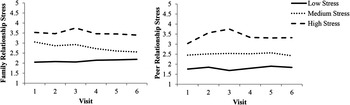
Figure 1 depicts the course of the trajectories across the three relationship domains. Three family stress trajectories emerged: a stable low trajectory (39.7% of the sample), a linear medium stress trajectory (48.8% of the sample), and a stable high stress trajectory (11.6% of the sample). Similarly, three peer stress trajectories emerged: a stable low trajectory (23.1% of the sample), a stable medium stress trajectory (66.1% of the sample), and a cubic high stress trajectory (10.7% of the sample).
Adolescents' family and peer relationship stress trajectories across a 2.5-year period. Values on the y axis represent the average Life Stress Interview—Adolescent Version (LSI) score for participants in each category. Although the trajectory patterns are similar across relationship domains, only about half of the participants (48%) were classified into the same stress group across the two relationship domains.

As expected, there was moderate overlap in classification across the two domains. Just under half of the sample (48%) received the same classification for their family and peer stress trajectories. The distribution of girls in the parent and peer trajectory groups did not differ as a function of race, χ2 (2) < 3.86, ps > .14.
Preliminary analyses
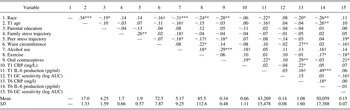
We first compared racial and trajectory groups on demographic characteristics. Several differences emerged as a function of race. Unexpectedly, White adolescents were older than Asian adolescents at study entry, t (119) = 3.67, p = .001. White adolescents also were more likely than Asian adolescents to use contraceptives, χ2 (1) = 9.44, p = .002. White adolescents also exercised more, t (119) = 2.78, p < .001, drank more alcohol, t (131) = 3.57, p < .001, and had more educated parents, t (119) = 3.67, p < .001, compared with Asian adolescents. Family and peer stress trajectory groups did not differ on any demographic characteristics or health behaviors (all ps > .15). Descriptive statistics and intercorrelations among the variables are presented in Table 1.
Descriptive statistics and intercorrelations among principal variables

Note: T1, Time 1; CRP, C-reactive protein; IL-6, interleukin-6; GC, glucocorticoid; AUC, area under the curve.
†p < .10. *p < .05. **p < .01. ***p < .001.
Relationship stress trajectories and inflammatory processes
Next, we used analyses of covariance to examine how adolescents' relationship stress trajectories mapped on to changes in the inflammatory outcomes, which include CRP, IL-6 production following LPS stimulation, and glucocorticoid sensitivity. Each analysis included baseline (Time 1) measures of the inflammatory parameter, as well as covariates and possible confounds (i.e., age, waist circumference, alcohol use, exercise, and birth control). Further, we included variables reflecting the main effects of race and stress as well as Stress × Race interaction terms that tested for differences in stress-inflammation associations between White and Asian participants. Finally, we included a Family Stress × Peer Stress interaction term to test the interactive effects of stress on changes in inflammation across the 2.5-year period.
CRP
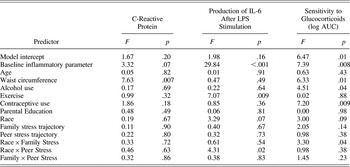
After adjusting for demographic characteristics and health behaviors, family and peer relationship stress trajectories were not associated with CRP. Similarly, no Race × Stress interactions emerged. Likewise, the Family × Peer Stress interaction was not significant (see Table 2).
Race and family stress trajectories as predictors of change in inflammatory parameters

Note: IL-6, Interleukin-6; LPS, lipopolysaccharide; AUC, area under the curve.
Stimulated IL-6 production
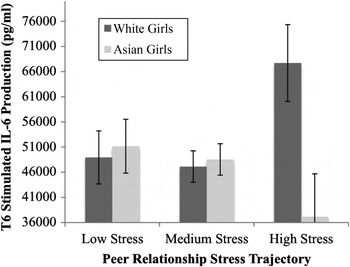
After adjustment for demographic characteristics and health behaviors, a significant Race × Peer Stress Trajectory interaction emerged in the prediction of stimulated IL-6 production (Figure 2). Post hoc probing of the estimated marginal means revealed that White girls in the high peer-stress group (M = 67,718, SD = 17,050) had significantly greater IL-6 production relative to White girls in the medium-stress (M = 47,120, SD = 34,200) and low-stress (M = 48,942, SD = 13248) groups (ps < .05). White girls in the low and medium peer-stress groups did not significantly differ from each other, however (p = .74). Further, Asian girls did not differ in their IL-6 production as a function of peer stress. Adolescents did not vary in their changes in IL-6 production as a function of their family stress trajectories. The Family × Peer Stress interaction was not significant.
Interleukin-6 (IL-6) production following lipopolysaccharide (LPS) stimulation as a function of peer relationship stress and race. White girls in the high peer stress trajectory group had significantly greater IL-6 production than White girls in the low or medium peer stress trajectory groups. Asian girls did not differ in IL-6 production as a function of peer relationship stress.

Glucocorticoid sensitivity
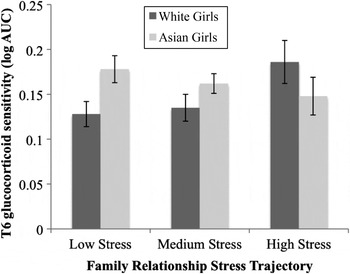
After adjusting for demographic characteristics and health behaviors, T6 glucocorticoid sensitivity was predicted by a significant Race × Family Stress Trajectory interaction (Figure 3). Post hoc probing of the estimated marginal means revealed that White girls in the high family-stress trajectory group (M = 0.19, SD = 0.13) had significantly less glucocorticoid sensitivity than White girls in the low family-stress trajectory group (M = 0.13, SD = 0.04; p = .03). Similarly, White girls in the high family-stress trajectory group had marginally less glucocorticoid sensitivity than White girls in the medium family-stress trajectory group (M = 0.14, SD = 0.08; p = .057). White girls in the low and medium family-stress groups did not differ in their glucocorticoid sensitivity. Asian girls, in contrast, did not differ in their glucocorticoid sensitivity as a function of family stress. Peer stress was not predictive of changes in glucocorticoid sensitivity. The Family × Peer Stress interaction was not significant.
Glucocorticoid sensitivity as a function of family relationship stress and race. Larger values on the y axis indicate less glucocorticoid sensitivity. White girls in the high family stress trajectory group had less glucocorticoid sensitivity than White girls in the low or medium family stress trajectory groups. Asian girls did not differ in glucocorticoid sensitivity as a function of family relationship stress.

Discussion
The present study examined whether trajectories of adolescents' interpersonal stress with family members and peers over a 2.5-year period were predictive of inflammatory processes, including CRP, stimulated IL-6 production after exposure to a bacterial product, and glucocorticoid sensitivity. White girls who were categorized into the high chronic peer stress groups had greater IL-6 responses to LPS stimulation, relative to White girls in the low or medium stress groups. Similarly, White girls who were categorized into the high chronic family stress group had significantly lower glucocorticoid sensitivity than White girls in the low and medium family-stress groups. These findings emerged even when controlling for baseline levels of the inflammatory markers, demographic variables, and potential behavioral confounds (e.g., concurrent alcohol use, exercise). These findings are consistent with the hypothesis that the course of interpersonal stress across the adolescent years plays a role in shaping subsequent inflammatory responding.
Across analyses, we did not find a main effect of family or peer relationship stress. Rather, the risk for proinflammatory tendencies was most apparent in the group with most severe and chronic stress, that is, girls who consistently experienced (relatively) significant interpersonal difficulties across the 2.5-year period. That girls in the low and medium stress groups were generally similar in terms of proinflammatory profiles is consistent with a threshold model of risk, which proposes that only after people pass a certain level of negative experiences will their risk for poor outcomes increase (Rutter, Reference Rutter, Kent and Rolf1979). This interpretation is promising with respect to positive youth development, as it suggests that moderate increases in stress might not have relevance for inflammatory responding. We are cautious about this interpretation, however, because the procedure for grouping adolescents based on their relationship stress trajectories is sample-dependent. As a whole, participants in our sample had relatively low levels of interpersonal stress and came from largely stable, middle class families. In samples with a larger distribution of relationship stress, it is possible that differences between low and medium stress trajectories would emerge.
Across models, we did not find support for additive or interactive effects of family and peer relationship stress in the prediction of changes in inflammatory parameters. It may be that mild stressors across relationships with parents and peers do not confer the same risks that occur when adolescents experience major stressors within one relationship domain. Mild stress, including conflict, within relationships is widely viewed as a normative feature of adolescents' social worlds, and there are a range of both positive and negative consequences associated with moderate levels of conflict in relationships (e.g., Laursen & Hafen, Reference Laursen and Hafen2010). It is possible that the negative consequences associated with moderate interpersonal stress depend, at least in part, on other features of the relationship (e.g., trust, intimacy), features of the adolescent (e.g., attachment security, personality), or other compensatory resources (e.g., emotion regulation skills).
It is interesting that in our sample the associations between high interpersonal stress and inflammatory processes were limited to White girls. As predicted, White girls' relationships with family members and peers each related to inflammatory tendencies, a pattern that reflects White girls' equal focus on family and peer relationships. For these adolescents, lasting interpersonal stress may lead to changes in hormonal activity that ultimately affects immune cell functioning, a possibility that should be explored more thoroughly in future research.Footnote 3 Contrary to our predictions, however, we found no evidence for a connection between family stress trajectories and inflammation for Asian girls. Given the limited research in this area, we can only speculate about why this may have been the case. The distribution of high stress group classifications did not differ as a function of race, so the observed patterns are not due to the fact that White girls are overrepresented in the high stress groups. Several race differences did emerge, however, which might have played a role in the patterns observed in this study. Compared to White girls, Asian girls had significantly lower IL-6 responses to LPS stimulation, which may have created a floor effect and limited our ability to detect a connection between stress trajectories and inflammatory tendencies. Similarly, Asian girls reported having approximately six fewer alcoholic drinks per week and were less likely to use oral contraceptives than White girls, both of which are known contributors to inflammation. It may be that Asian girls have better health practices that offset the influence of interpersonal stress on the immune system. It is also possible that some other unmeasured stressor leads to changes in Asian girls' inflammatory responses. Future research should consider whether there might be race-specific stressors that contribute to inflammation or behaviors that amplify or buffer against these effects.
It is also possible that experiences rated as highly stressful social experiences by our coding team were not perceived to be stressful for Asian participants. As mentioned earlier, other research has shown that cultural norms shape individuals' interpretations of social experiences (e.g., Chen, French, & Schneider, Reference Chen, French and Schneider2006). It may be that some social characteristics rated as stressful by objective observers, such as social reticence and authoritarian parenting, are perceived as normative experiences for Asian adolescents. Even if these experiences are viewed as negative or unpleasant for Asian adolescents, it is possible that the experiences do not carry the same emotional burden that they do for White adolescents because of participants' cultural contexts. Another possibility is that White and Asian adolescents may respond differently to the same relationship experiences. Some evidence suggests that Whites and Asians do not benefit equally from the same types of social support, as evidenced by cortisol reactivity during a stressful laboratory task (Taylor, Welch, Kim, & Sherman, Reference Taylor, Welch, Kim and Sherman2007). Future research should examine how interviewer ratings of stressful experiences map on to participant ratings, and whether there are systematic differences in perceptions of stress as a function of race.
To date, few studies have charted the trajectories of adolescents' relationship experiences using the person-centered trajectory modeling techniques employed in this study (but, for a notable exception, see Seiffge-Krenke et al., Reference Seiffge-Krenke, Overbeek and Vermulst2010). Our findings, which are consistent with Seiffge-Krenke et al. (Reference Seiffge-Krenke, Overbeek and Vermulst2010), suggest that adolescents can be meaningfully grouped according to their chronic stress. In our sample these groupings were fairly stable over time and, as a result, we cannot ascertain whether inflammatory disparities are a consequence of cumulative stress exposure versus trajectories over time. Although levels of stress were quite stable in our sample, researchers working with other samples may not find such stability in the characteristics of adolescents' interpersonal relationships, particularly if the sample includes adolescents with chaotic or inconsistent experiences with others. It will be interesting to examine whether this particular subgroup of adolescents, with sharply fluctuating levels of chronic stress in their relationships, is at risk for a heightened proinflammatory tendencies, relative to adolescents who experience more consistent levels of stress in their relationships. Given that their relationships are less predictable than adolescents with consistent levels of stress, it is possible that adolescents who experience such dramatic fluctuations in relationship stress are at even greater risk for a proinflammatory phenotype than adolescents who experience chronically high levels of stress in their close relationships.
One particularly important question for future research will be to determine why stress-related differences in functional indicators of inflammatory responding (i.e., glucocorticoid sensitivity and stimulated IL-6 production) did not translate into disparities in chronic, low-grade inflammation, as has been seen in other studies (e.g., Fuligni et al., Reference Fuligni, Telzer, Bower, Cole, Kiang and Irwin2009; Low et al., Reference Low, Matthews and Hall2013). It may be a sampling artifact or an evolving development process. The adolescents in our sample were selected to be in excellent health, both mentally and physically, and their bodies may have been able to compensate for any stress-related changes in proinflammatory response tendencies. As they grow older and face more stress, however, these compensatory processes may become less effective, which could translate into chronic, low-grade, inflammation.
Limitations and future directions
Although this study adds insight into the ways in which adolescents' interpersonal relationships are associated with inflammatory processes, several limitations should be addressed in future research. In the present study, we tried to control for dietary variations by scheduling laboratory visits in the morning following an overnight fast, but we were unable to control for long-term differences in diet. Diets that are high in fat and sugar promote inflammation (Yudkin, Kumari, Humphries, & Mohamed-Ali, Reference Yudkin, Kumari, Humphries and Mohamed-Ali2000), and do so in a manner that acts synergistically with stress (Kiecolt-Glaser, Reference Kiecolt-Glaser2010). Thus, stress-related changes in dietary composition may have been one mechanism by which chronic stress contributed to inflammatory processes in this study.
The original study was designed to examine depression in adolescence, and because sex differences in the rates of depression emerge during this developmental period (Nolen-Hoeksema & Girgus, Reference Nolen-Hoeksema and Girgus1994), this study recruited only females who were at risk for depression. Thus, the resulting sample may not be representative of adolescents from the larger population. Our sampling strategy may have produced a sample wherein stress and inflammation covary because of a shared genetic vulnerability. Further, the extent to which adolescent boys' relationship stress contributes to proinflammatory markers will be an important area for future research. As Shih et al. (Reference Shih, Eberhart, Hammen and Brennan2006) and others have shown, interpersonal problems are thought to be particularly salient and stressful for adolescent girls, so it is possible that the effects observed in this study would not emerge in a sample of adolescent boys. On the other hand, gender differences in the extent to which interpersonal stress is associated with inflammation in adolescence have not been reported consistently, so adolescent boys who experience chronic stress in their relationships may be similarly at risk for heightened inflammatory responses.
One remaining question that will be important to address in future research is how trajectories of relationship stress and their associated proinflammatory processes affect the risk for depression over time. Recent efforts have been made to develop integrated theories that connect interpersonal stress to inflammation and major depressive disorder (for a review, see Slavich & Irwin, Reference Slavich and Irwin2014). However, the links among interpersonal stress, inflammation, and depression are far from simple (Glassman & Miller, Reference Glassman and Miller2007), and it is possible that the connection between inflammation and depression is limited to certain subgroups of people with various vulnerability factors (e.g., early adversity or medical illnesses like heart disease or an autoimmune condition; see Danese et al., Reference Danese, Moffitt, Pariante, Ambler, Poulton and Caspi2008, Reference Danese, Caspi, Williams, Ambler, Sugden and Mika2010; Miller & Cole, Reference Miller and Cole2012; Slavich & Irwin, Reference Slavich and Irwin2014). Continued research on the links among stress, inflammation, and depression is needed in order to better understand the role that inflammation plays in the risk for psychopathology. In particular, it would be valuable to conduct multiwave studies with frequent assessments of stress, inflammation, and depressive symptoms because it is likely that these dynamic processes unfold quickly over time.
As discussed earlier, one of the consistent findings in this study was that relationship stress trajectories predicted inflammatory responses for White but not Asian girls. It will be important for other studies to examine the connections between interpersonal stress and inflammation in samples with participants from other ethnic backgrounds. Researchers have previously identified ethnic differences in adolescent reports of parenting styles, with Black, Hispanic, and Asian adolescents reporting that their parents engage in more authoritarian and less authoritative parenting than White adolescents report about their parents (e.g., Dornbusch, Ritter, Leiderman, Roberts, & Fraleigh, Reference Dornbusch, Ritter, Leiderman, Roberts and Fraleigh1987). These ethnic differences in adolescent perceptions of parenting might translate into differences in how such stressful experiences are interpreted and internalized, which could ultimately lead to differences in the ways in which these relationship experiences influence inflammatory responses.
One interesting difference between our study and other studies that have reported links between interpersonal stress and inflammation is that we used observer ratings of interpersonal stress based on a structured interview rather than on participant self-reports of interpersonal stress. One strength of the structured interview approach is that it minimizes the reporting biases inherent in self-report measures. However, it may be that self-reports of interpersonal stress, rather than ratings from structured interviews, better reflect individuals' internalized experience of stress within their relationships, which might ultimately matter most when trying to understand how interpersonal experiences get under the skin to influence health. For instance, an individual who perceives a minor slight within a relationship (e.g., a small disagreement with a close friend) as a major threat to the relationship might experience significant distress that could have observable consequences for individuals' immune functioning. Future research that can directly compare objective ratings of stress with participant perceptions will help shed light on how these different assessments are able to predict inflammatory processes.
In summary, the findings from the present study suggest that even in adolescence, when children are still relatively healthy, relationship stress is associated with a proinflammatory response for White girls that, if sustained, could contribute to more serious health problems over time. Adolescents who consistently experience significant problems in their relationships might be most likely to exhibit this tendency.