Over the past 2 years, several reports have detailed cases of sterile site infection in patients after cardiac surgery caused by Mycobacterium chimaera.Reference Sax, Bloemberg and Hasse 1 – Reference Haller, Holler and Jacobshagen 3 These infections occurred after a latency period of between a few months and several years in patients having previously undergone open-chest heart surgery.Reference Chand, Lamagni and Kranzer 4 All of the reports attribute these infections to the transmission of organisms from contaminated heater-cooler units (HCUs) used in surgery theatres during cardiothoracic surgery, via production of an aerosol of contaminated water from the device.Reference Sommerstein, Ruegg, Kohler, Bloemberg, Kuster and Sax 5 , Reference Götting, Klassen and Jonas 6 HCUs are used to regulate the temperature of the blood during extracorporeal circulation using filtered tap water as a heat exchanger.Reference Garvey, Ashford, Bradley, Martin, Walker and Jumaa 7 , 8
Mycobacterium chimaera is a slow-growing nontuberculous mycobacterium (NTM) belonging to the M. avium complex (MAC) (M. avium and M. intracellulare).Reference Haller, Holler and Jacobshagen 3 , Reference Tortoli, Rindi and Garcia 9 Mycobacterium chimaera may cause lung infections, especially in patients with underlying lung disease, as well as disseminated infections in immunocompromised patients, and it has been found in skin and bone infections.Reference Haller, Holler and Jacobshagen 3 In the environment, it has been identified in biofilms and has been detected in water sources such as household water.Reference Haller, Holler and Jacobshagen 3 NTM are a recognized constituent of hospital water systems that form biofilm and can result in patient infections, primarily via an aerosol route.Reference Kanamori, Weber and Rutala 10 – Reference Wallace, Brown and Griffith 13 While the number of confirmed M. chimaera cases is currently small relative to the large number of patients receiving open-heart surgery, the extent of the outbreak is not yet known, and the number of cases may increase due to the longevity of the infection phase.Reference Chand, Lamagni and Kranzer 4
University Hospitals Birmingham (UHB) NHS Foundation Trust is a tertiary referral teaching hospital in Birmingham, United Kingdom, that provides clinical services to nearly 1 million patients every year. The UHB Cardiac department is one of the largest in the United Kingdom, and it provides treatment for adult patients with a wide range of cardiac disease. In 2015 UHB were notified via national and international alerts 14 , 15 , 17 , 18 to cases of sterile-site M. chimaera infection in patients after cardiac surgery being attributed to contaminated HCUs. Before this notification, UHB had never identified M. chimaera infections in UHB patients who had cardiac surgery. HCUs are used in cardiopulmonary bypass surgeries at UHB. Here, we report the results of weekly microbiological water sampling of the HCUs for over a year and our comparison of different decontamination strategies based on the manufacturer’s (LivaNova’s) guidance. 8 , 14 , 16
MATERIALS AND METHODS
Water Sampling
Water samples (100 mL) were collected from the water in the HCUs used at UHB. Water samples were collected weekly both from the patient and cardioplegia circuit. 8 , 14 , 16 Per the manufacturer’s guidance during decontamination, all tanks are interlinked by tubing. 8 , 14 , 16 All samples were tested for the enumeration of microorganisms by membrane filtration. Tryptone Soya Agar plates and cysteine lactose electrolyte–deficient agar plates were incubated for 3 days at 30°C. Results were expressed as total viable count (TVC)/100 mL. Selected water samples (100 mL) were also sent on the day of testing (at 4°C) to the Mycobacterium Reference Laboratory (MRL, Public Health England, Heart of England NHS Foundation Trust, Birmingham) for Mycobacterium testing every 2 weeks, where samples were assessed using standard operating procedures. 15
Isolation and Characterization of Coliforms per Guidance
Any suspected coliforms growing on the membrane filtration agar plates were identified using matrix-assisted laser desorption/ionization time of flight (MALDI-TOF) mass spectroscopy (Vitek, Biomerieux, Marcy-l'Étoile, France) and Vitek 2 Systems (Biomerieux). 8
Sorin Heater-Cooler Unit
The Stöckert 3T Heater-Cooler System is a 3-circuit heating and cooling system with 3 independent tanks, each with a volume of 6 liters. A compressor-based interchangeable heating (15°C to 41°C) and cooling (2°C to 10°C) circuit system is connected via tubing to the oxygenator or cardioplegia heat exchangers. 8 , 14 , 16 UHB has 4 of these HCUs; they were commissioned in 2012 and are used daily.
Decontamination
The following decontamination methods of the HCUs were carried out at UHB. Decontamination was based on guidance from LivaNova. 8 , 14 , 16
Manufacturer’s Guidance on Decontamination Before 2015
In terms of the 3T HCU, before national notification of M. chimaera contamination, LivaNova advised the following: decant HCUs of water every 2 weeks and refill with filtered (PALL filter, 0.2 µm) tap water with 100 mL medical grade 3% hydrogen peroxide (Care Plus, UK) to the HCU tanks. Thereafter, 50 mL of 3% hydrogen peroxide should then be added every 5 days. A full-system HCU decontamination using Maranon (Ecolab, Northwich, UK; >30% sodium hypochlorite) was advised every 3 months. 8 , 14 UHB undertook this decontamination regimen upon purchase of the HCUs in 2012 and continued it until April 2015.
Decontamination of the HCU June 2015 to September 2015
Between June 2015 and September 2015, the HCUs at UHB were decontaminated following the protocol previously described by Garvey et al.Reference Garvey, Ashford, Bradley, Martin, Walker and Jumaa 7 Following notification of the problem nationally, UHB decided to carry out 2 full-system decontamination cycles consecutively on the HCU with Maranon to reduce the bioburden.Reference Garvey, Ashford, Bradley, Martin, Walker and Jumaa 7 We then adapted the manufacturer’s guidance as follows: the HCUs were decanted of water weekly and refilled with filtered tap water, with a daily addition of medical grade 3% hydrogen peroxide (100 mL) to the HCU tanks, and weekly full-system decontaminations using Maranon.Reference Garvey, Ashford, Bradley, Martin, Walker and Jumaa 7
Manufacturer’s Guidance on Decontamination After 2015
Following notification, there was a change in the manufacturer’s cleaning and disinfection guidance to require (1) more frequent disinfection of the water circuit (eg, disinfection every 2 weeks rather than quarterly) with specified disinfectant solutions including peracetic acid (Puristeril 340; Fresenius Medical Care, Germany); (2) weekly water changes; and (3) the addition of hydrogen peroxide solution to the water to act as a preservative and to further prevent biofilm formation. 14
Decontamination of the HCU September 2015 to June 16
Between September 2015 and June 2016, the HCUs at UHB were decontaminated following the protocol previously described by Garvey et al.Reference Garvey, Ashford, Bradley, Martin, Walker and Jumaa 7 Briefly, we adapted the manufacturer’s guidance as follows: the HCUs were decanted of water daily and refilled with filtered tap water, with a daily addition of medical grade 3% hydrogen peroxide (100 mL) to the HCU tanks, and weekly full-system decontaminations using peracetic acid were performed.Reference Garvey, Ashford, Bradley, Martin, Walker and Jumaa 7 Each weekly full-system decontamination included the following procedures: water tanks were drained and refilled with filtered tap water; peracetic acid (450 mL) was added to the tanks and run through the HCU circuits; each HCU was then drained of peracetic acid and refilled with filtered tap water.Reference Garvey, Ashford, Bradley, Martin, Walker and Jumaa 7 From June 2016, due to degradation and breakdown of the internal components of the HCU, UHB changed the cleaning regimen to match the new guidance as described by LivaNova. 16
Tubing Replacement
During the study period, the HCUs were stripped down to the components, and all internal pipe work was replaced by LivaNova to remove the source of biofilm in the HCUs used by UHB, as previously reported by Garvey et al.Reference Garvey, Ashford, Bradley, Martin, Walker and Jumaa 7 This procedure now forms part of LivaNova’s annual service plan for all of their HCUs.
RESULTS
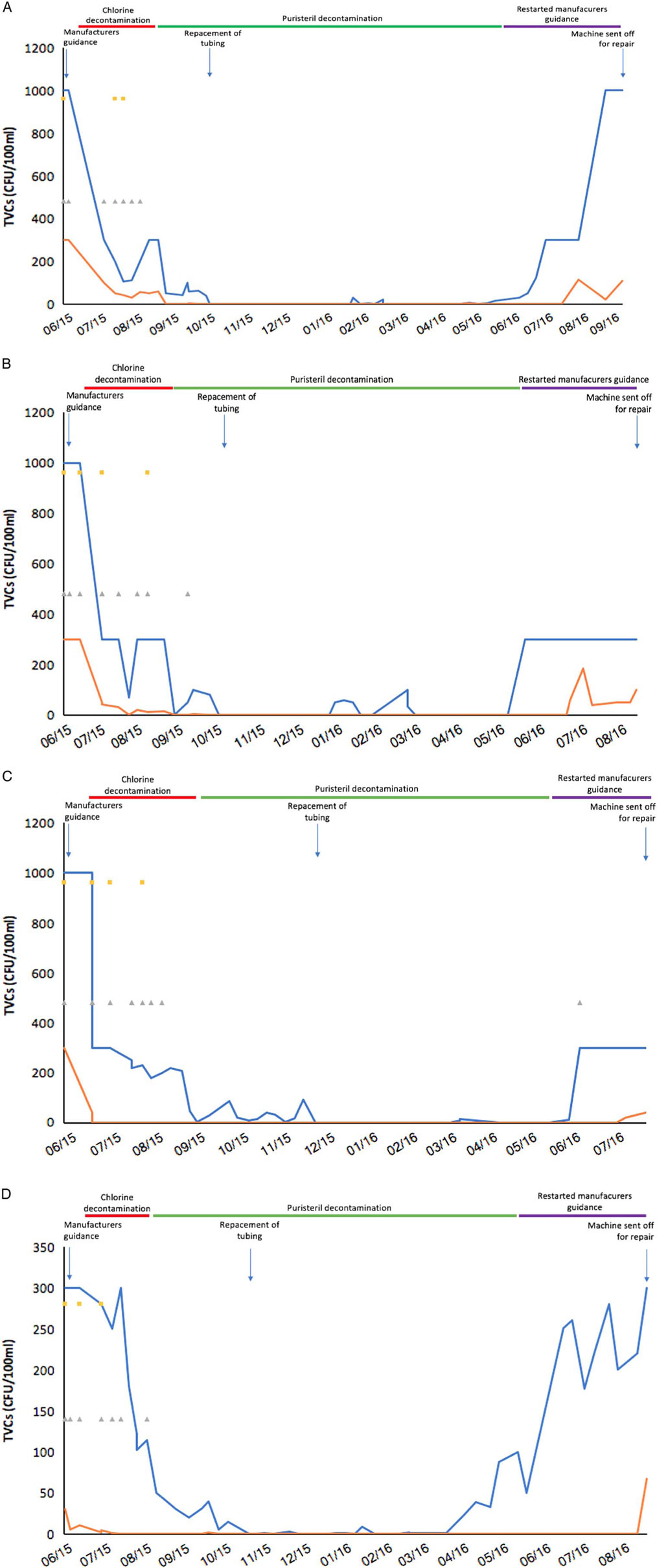
May 2015. Weekly water sampling has been undertaken on all 4 Sorin 3T HCU systems used at UHB for the previous year up to May 2015. On national notification of the potential problem with the HCUs, 17 – Reference Sommerstein, Schreiber and Diekema 19 water counts from all 4 HCUs yielded total viable counts (TVCs) >300 CFUs/100 mL including a range of environmental gram-negatives including Pseudomonas aeruginosa as well as non-Aspergillus moulds (Paecilomyces) (Figure 1). The water samples were sent to the MRL for culturing of MAC complex, and they were subsequently positive for M. chimaera.
(A–D) Microbial counts (total viable counts and Pseudomonas aeruginosa CFU/100 mL) from weekly water sampling before full-system decontaminations of all 4 heating-cooling units (HCUs) used at University Hospitals Birmingham (UHB). Details of the various decontamination protocols of the HCUs are depicted. Triangle shape represents non-Aspergillus molds (Paecilomyces) cultured from the weekly water samples; square shape represents M. chimaera cultured from the weekly water samples.

June 2015 to October 2015
From June onward, full-system decontaminations of the HCUs were undertaken weekly (involving either >30% sodium hypochlorite or later peracetic acid).Reference Garvey, Ashford, Bradley, Martin, Walker and Jumaa 7 Weekly water samples were taken before and after the full-system decontaminations (using peracetic acid and replacement of the HCU tubing by the manufacturer). The results in Figure 1 show the microbial loads in the 4 HCUs (Figure 1A–D) before the weekly full-system decontaminations. Various decontamination regimens were implemented at UHB to reduce the microbial loads in the HCUs, yielding reductions in TVCs but without totally eradicating the bioburden.Reference Garvey, Ashford, Bradley, Martin, Walker and Jumaa 7 Only after the decontamination regimen was undertaken as described by Garvey et al (ie, a full-system decontamination using peracetic acid and replacement of the HCU tubing by the manufacturer) did the weekly microbial counts indicate that the microorganisms were not detectable (Figure 1).Reference Garvey, Ashford, Bradley, Martin, Walker and Jumaa 7
October 2015 to June 2016
Following the protocol as described by Garvey et al, weekly microbial enumerations, before the full-system decontaminations, had shown 0–10 CFUs/100 mL for ~7 months.Reference Garvey, Ashford, Bradley, Martin, Walker and Jumaa 7 Occasionally, a range of environmental gram-negatives were obtained, but no atypical mycobacteria were isolated from selected weekly water samples.
July to September 2016
Due to the labor-intensive nature of the decontamination process undertaken at UHB and the fact that there was increased discoloration of water and observed copper particles coming out of the machines (implying damage), the decontamination process at UHB was changed. The new process entailed changing the water within each HCU every 7 days and the addition of hydrogen peroxide, which was followed every 14 days by a full-system disinfection with peracetic acid. Weekly water samples yielded TVCs 1–300 CFUs/100 mL, including a range of environmental gram-negatives organisms. No atypical mycobacteria were isolated from the weekly water samples. In addition, 3 of the HCUs showed damage and leakage that required refurbishment. These HCUs were sent back to the manufacturers for repair.
September to December 2016
The 3 new (or loaned) HCUs from the manufacturers were decontaminated following the manufacturers guidance: the water within each HCU was changed and hydrogen-peroxide was added every 7 days, and every 14 days a full-system disinfection with peracetic acid was performed. Presently, weekly microbial counts indicate that microorganisms are not detectable.
DISCUSSION
The data reported here indicate that decontamination procedures are essential to reducing the microbial load in HCUs and that weekly microbiological sampling is required to monitor the bioburden in an HCU. We have demonstrated that weekly decontamination with peracetic acid can maintain low microbial loads; however, prolonged decontamination resulted in degradation and damage to the HCUs, which resulted in their being sent to the manufacturer for repair.
At UHB, all the tubing within the HCUs was replaced with assistance from the manufacturers, after which UHB implemented a decontamination regimen consisting of 2 consecutive decontamination cycles with peracetic acid.Reference Garvey, Ashford, Bradley, Martin, Walker and Jumaa 7 Following this initial decontamination, the water in each HCU was decanted daily and refilled with filtered tap water, and 100 mL of medical grade 3% hydrogen peroxide was added to each HCU tank. In addition, weekly full-system decontaminations using peracetic acid were performed. Following this decontamination regimen, water sampling revealed minimal water counts for 5–7 months.Reference Garvey, Ashford, Bradley, Martin, Walker and Jumaa 7 During this period, green discoloration was observed within the HCUs and in the weekly water samples. The particles were revealed to be copper (personal communication with the University of Birmingham), and we hypothesize that they represented damage to copper components caused by the decontamination regimens. This damage would partly explain why the HCUs started to leak water after 7 months of this regimen, which required refurbishment by the manufacturers.
The enhanced decontamination strategies do appear to have been successful at UHB; there have been no cases of M. chimaera infections identified as originating from surgery. Surveillance of sterile-site infections after cardiac surgery at UHB via 16sRNA PCR from 2015 to the present has revealed no cases of M. chimaera. In addition, the decontamination regimen UHB implemented had been effective in reducing the bioburden within the HCUs for 5–7 months. However, the ongoing maintenance to eliminate biofilm required extra resources and resulted in degradation of the HCUs. As a result, UHB changed the cleaning regimen back to the manufacturer’s cleaning guidance, which consisted of weekly water changes and weekly additions of hydrogen peroxide to the HCUs, followed by full-system decontamination with peracetic acid every 2 weeks. Reverting back to this regimen resulted in increases in the microbial load, as was observed in the weekly water counts.
Clearly, the increased disinfection and sampling regimens recommended by the manufacturer have added a considerable burden of duties and costs for perfusionists as well as cardiology and theatre staff. The decontamination guidance recommend by the manufacturers is time consuming; it requires 30 minutes per HCU to change the water weekly and 90 minutes per HCU for a full-system decontamination. At UHB, the enhanced decontamination has often entailed daily water changes and a weekly full-system decontamination, increasing the weekly decontamination time from 2 hours to 5 hours per HCU, substantially impacting perfusionists time and resources.
A recent review by Sommerstein et alReference Sommerstein, Schreiber and Diekema 19 suggested that routine HCU water cultures for M. chimaera are unlikely to be helpful for 3 reasons: (1) few laboratories are equipped to perform environmental mycobacterial cultures, (2) there is a long incubation period for cultures, and (3) the characterization of M. chimaera is technically difficult. The results presented here also suggest that water culture for M. chimaera is not helpful. Our water sampling results show that M. chimaera was only cultured at the beginning of this study when the units were heavily bio-fouled. Only when heterotrophic plate counts were high (ie, 400–1,000 CFU/100 mL) was M. chimaera cultured. Upon enhanced decontamination of the HCUs, M. chimaera was not cultured from water samples. By monitoring heterotrophic plate counts, biofilm formation could be identified sooner, leading to intervention by the manufacturer earlier, such as removal of tubing or decontamination of the HCU by the manufacturer. In July 2016, UHB reverted to the manufacturer’s guidance and in the following 3 months heterotrophic counts increased, indicating build-up of biofilm.
Sommerstein et alReference Sommerstein, Schreiber and Diekema 19 stated that a minimal acceptable water quality standard should be maintained. Monitoring after disinfection procedures by heterotrophic plate count could be considered, with 100–500 cfu/mL being considered acceptable.Reference Sommerstein, Schreiber and Diekema 19
Water and air sampling places a considerable cost on hospitals. The microbiological analysis and air sampling costs have been estimated at US$25,654 (£20,548) per year for 1 UK hospital with 8 LivaNova HCUs. Current FDA guidance does not recommend culturing for Mycobacteria; however, the guidance recommends that heterotrophic plate counts are performed every 2 weeks for 3 months, and if counts are <100–500 CFU, then quarterly. 20 , 21 Our results indicate that weekly water sampling for TVC is important in a known contaminated HCU, even with the internal tubing replaced. Our results also suggest that the internal tubing may need to be replaced every 6 months in a known contaminated HCU. In new or refurbished HCUs, weekly water samples at first are important (including 1 water sample for mycobacteria), and, if no organisms are cultured, then the frequency of water sampling could be decreased as per the FDA guidance, 20 as water sampling is costly and time consuming. The new or refurbished HCUs have not yielded any microorganisms.
We believe that this is the first report demonstrating yearlong water surveillance of HCUs. The results demonstrate that an effective decontamination process can reduce the microbial load within the units; however, at UHB the increased decontamination resulted in damage to the HCUs. Chand et alReference Chand, Lamagni and Kranzer 4 undertook a national investigation to quantify the risk from the HCUs and identified a significantly elevated and increasing risk of M. chimaera infection after cardiothoracic surgery compared to the general population.Reference Chand, Lamagni and Kranzer 4 The risk of infections from M. chimaera is still low in the context of other risks; of 10,000 patients undergoing such procedures, 120 could expect to experience a surgical site infection, 300–400 endocarditis and 1 to develop M. chimaera infection by 5 years postsurgery.Reference Chand, Lamagni and Kranzer 4 However, as Chand et al point out, the risk increases when these HCUs are older and heavily bio-fouled, with more potential to aerosolize.Reference Chand, Lamagni and Kranzer 4 The CDC estimates that a higher ratio in hospitals where at least 1 infection has been identified, with the risk of a patient getting an infection from the M. chimaera during open-heart or open-chest surgery being ~1 in 100 and ~1 in 1,000. 21
However, clinicians also need to consider the mitigation of risk of getting infection versus the need to maintain cardiothoracic operating capacity.Reference Chand, Lamagni and Kranzer 4 , 17 The HCUs used at UHB were manufactured in 2012 and were considered to be at a lower risk of aerosolizing. However, with the decontamination of these units, we have demonstrated that damage is likely to occur and needs to be managed.
Fundamentally, more work is required to ensure that there are effective decontamination processes to reduce the microbial load and to control the presence of M. chimaera and that the HCUs do not aerosolize water. However, our studies indicate that weekly water sampling for TVC is required indefinitely to monitor the water quality in these units as well as regular replacement of the tubing to control the buildup of biofilm.
ACKNOWLEDGMENTS
The authors would like to thank the Infection Prevention and Control and Clinical Perfusion Teams at the University Hospitals Birmingham NHS Foundation Trust.
Financial support: No financial support was provided relevant to this article.
Potential conflicts of interest: All authors report no conflicts of interest relevant to this article.