Introduction
Social network analysis (SNA) has received more and more attention from historians over the past two decades, leading historical social network analysis—or HSNAFootnote 1 —to become a significant subdiscipline within the field of history. Charles Wetherell was amongst the first to bring the approach to the attention of historians, laying out several important questions that could be addressed through HSNA and introducing many of the key concepts that historians now find useful. He also pointed out some of the problems with the approach (the availability of source material, unsurprisingly, ranking highly amongst them).Footnote 2 The discipline has come a long way since, advancing alongside a broader development in the “digital humanities.”Footnote 3 This article concerns itself in particular with the development of HSNA within the field of business history, in which the use of the “network” as a concept has already been well established. Previous debates have, for example, concerned the definition of “networks.” Further debate has concerned the tendency of historians, eagerly adopting the concept, to see networks in a broadly positive light. Both of these debates have benefited from interventions by scholars such as David Hancock and Sheryllynne Haggerty, who have sought to properly define the conceptualization of networks, and who have both underscored the problems that contemporaries experienced with networks.Footnote 4 A network, as this debate has shown us, is only as “good” as the quality of the relationships and the socioeconomic contexts that allow poor relationships to persist.
Although HSNA has been recognized for its ability to help historians make sense of large communities of people, and identify within these communities individuals of importance who might otherwise go unnoticed by researchers using more conventional methodologies, its wider adoption has been limited by concerns over how well the tool can deal with patchy historical data, and how well it can handle change over time. Historians are starting to address the former of these concerns. For example, Robert Michael Morrissey, in his examination of a French-Indian community in the colonial Mississippi Valley, builds a whole network using a wide range of baptismal and marriage records to gain insights into mixed-race families. Morrissey advocates for such records, and for whole network perspectives, as a means for overcoming the egocentricity inherent in using records such as personal correspondence, and he points out that the relative abundance of these community-level sources (and the fact that they indicate relationships that mattered to contemporaries) makes them ideal for HSNA applications. Additionally, Joe Chick, in a social network analysis of Reading’s civic elite from the fourteenth to sixteenth centuries, uses guild-level data (e.g., minutes and petitions) and parish accounts to recreate a series of whole networks, and cites the greater likelihood of source survival and the comparative completeness of these records as advantages for using them with HSNA.Footnote 5 Whereas issues with big data and change over time intersect (as Chick shows), I deal here principally with the latter concern: How can historians use SNA to properly measure change over time as we attempt to identify underrepresented individuals of interest within historical communities?
Indeed, a key problem with the use of SNA as a tool for historical analysis is that it does not inherently lend itself to measuring change in networks over time. Earlier works, and especially those adopting visual analysis, took a “snapshot” of a contemporary network at a select point. This was the approach of John and Sheryllynne Haggerty in their paper on slave trader Samuel Rainford, and was since emulated by Cheryl McWatters and Yannick Lemarchand, as well as Pierre Gervais. The ends that this satisfied were varied, but the approach broadly allowed the researchers to identify particular clusters within the networks and bring their attention to key individuals, helping them to distinguish between those individuals by recognizing certain characteristics, as well as the relationships between these characteristics and their position within the network.Footnote 6 The natural evolution of this approach has been to take several snapshots for multiple periods and make comparisons between them. Significant contributions came from Emily Buchnea and the scholarship of Edmond Smith.Footnote 7 The results have been insightful, and experiments with other approaches, such as regression analysis and textual analysis, have shown how social network analysis does not have to be used in isolation as the starting point for an iterative investigation into primary sources.Footnote 8
The snapshot approach is not without its problems, however. Historians may struggle to make the periodization meaningful—it could be, as Haggerty and Haggerty suggest, “an arbitrary process.”Footnote 9 Their own approach to periodization when recreating the network of Joshua Johnson, an American merchant based in London before the American Revolution, was effective. Their approach might be termed contextual periodization: The periods into which they divided the timeline of snapshots were based on relevant contextual events. In creating the “network narrative” and successfully implementing textual/sentiment analysis, they were able to generate some deep insights into the network. However, the network is still recreated as the researcher sees it, with strict distinctions drawn between periods based on ex post knowledge of key contextual moments. Importantly, the snapshot approach does not always account for change within periods and, especially if there are gaps between the snapshots, it might miss elements of the transition between periods. Indeed, a preoccupation with visualizing the networks themselves—and drawing comparisons between visual materials—makes a more granular assessment of the network difficult. As Kate Davison has recently emphasized, network graphs such as these “are snapshots of an inherently unstable and uncertain reality,” even if different snapshots are used for different points in time.Footnote 10
This article builds on this historiography by shifting how the networks, and in particular the data that we glean from the networks, are represented. I do so with a case study on a historical figure, who has already received significant attention, to show how this approach can yield new insights. I demonstrate that, by using historical social network analysis to read against the grain of this set of historical sources, HSNA must be recognized as an integral part of the historian’s tool kit. I build on the previous studies by introducing a novel two-year moving total, which I will explain in more detail shortly. Not only can this approach enhance the ability of the historian to identify underrepresented historical actors within a community, but it can be used to explore the ways in which the influence of these individuals ebbed and flowed over time. This approach alters the questions we ask of the networks, which, in turn, better guides our iterative approach to the source material.
I will begin by explaining the conceptual foundations of this methodology, linking an appreciation for the historical context within which actors operated with the practicalities faced by researchers trying to understand their networks. I will then outline and explore the case study, which is focused on Bristol merchant John Pinney. This will demonstrate the validity of the approach, and also contribute to the historiography by exploring cases of individuals whose experience and activity can shape our understanding of the eighteenth-century commercial world. John Pinney was, as previous studies have explored, a merchant in Bristol who owned a plantation on the island of Nevis. Although others, such as Richard Pares and Albane Forestier, have analyzed his business activity, they have focused predominantly on Pinney and his partner, James Tobin, neglecting to explore in full the experience of enslaved people on the plantation and the role that women played in making the business work. Pinney’s relationship to enslavement has been addressed in depth by Christine Eickelmann, whereas the latter issue remains unexplored.Footnote 11 This case study will use HSNA, first, to show that Pinney’s personal network was the basis of his business network, demonstrating that this methodology provides a substantially different perspective to that offered by Forestier’s frequency analysis of Pinney’s letters. Second, I will show how HSNA can nuance our understanding of the experience of enslaved people on plantations, augmenting the work of Eickelmann. Third, I will show how HSNA can highlight and underscore the importance of women, such as Jane Pinney (John’s wife), to the functioning of early modern business networks, contributing to a burgeoning and deeply significant historiographical discussion on the role of women in eighteenth-century commerce. I therefore make an active intervention in the historiography in two ways, first, by modifying HSNA to better accommodate change over time and, second, by using this approach in a meaningful case study that speaks more broadly to our understanding of early modern business networks. I will begin by explaining the methodology.
Methodology
SNA and the “Network Memory”
Networks are made up of two principal elements: nodes and edges.Footnote 12 Nodes represent actors, whereas edges represent relational ties (i.e., the relationships that bind these actors together). The actors that nodes represent can be people, countries, and firms. In collating a series of nodes and edges, the researcher is able to do two things: First, they can visualize the relationships in a network diagram; second, they can perform a series of mathematical functions that will indicate qualities about the network itself and about the actors that make up the network. Significant qualities about the network include how dense it is, how clustered it is, and so on, and those about the actors include measures of importance and prestigiousness. The visualization can be altered to reflect the mathematical measures and, in this way, visual analysis and mathematical analysis are symbiotic.
Importantly for the historian, as the network changes over time, so too will the set of measures that make up the network. Historians have generally been reluctant to make use of the data that this generates, however. The key impediment is finding a periodization that, first, is meaningful for the researcher and, second, would have been meaningful for historical contemporaries. I propose to square this circle by introducing into this mathematical aspect of historical social network analysis a conceptualization of the network memory as finite and fading. Historians have long recognized the importance of a network memory for influencing decisions. As David Hancock observes, “network memory, whether imprinted in the human brain or recorded in correspondence and account books, informed a trader whom he could trust. It also provided rewards and sanctions.”Footnote 13 Memories fade, however, and what is missing from this definition is a sense of when actors are forgotten about, thought less of, or generally seen as no longer valid options for future interactions. The importance of memory length is a significant subject of conceptualization within game theory, and historians would do well to integrate this concept into HSNA.Footnote 14 However, demonstrating memory length empirically is difficult, meaning that modeling it appropriately is difficult too. Recreating historical networks generally relies on scant material, so finding evidence for when someone ceased to be within a network makes this all the more challenging. Historians must rely on the better-documented events—explosive fallings-out between partners, bankruptcy, or death—to explain why people ceased to be within the network.Footnote 15 Otherwise, their persistence is assumed as a given.
Historians can represent the effects of the fading network memory by constructing a series of networks using a moving total, drawing on the data that they might otherwise use to create a series of large-scale snapshots.Footnote 16 The periodization used in this case study is a two-year moving total. This helps model the lasting impression that ephemeral instances of interaction had on network actors. It is assumed therein that such instances formed the basis for long-term relationships, which existed in the minds of contemporaries for a time that extended much further than the first point of contact. This amends significant inconsistencies in the snapshot approach. If the historian takes two snapshots of consecutive decades, for example, evidence of a relationship at the very start of the first, which is repeated at the very end of the second, is treated the same as a relationship that is evidenced at the end of the first and again at the start of the second. The two-year moving total treats the former as two separate instances of the same relationship, and the latter as a single, longer relationship.
My use of a two-year period for the moving total is justified with reference to research that has shown that credit relationships in the early modern period would carry on longer than initially contracted for, lasting for up to a couple of years.Footnote 17 The moving total is adaptable: A researcher could use whatever periodization they see fit within this framework. If I were modeling a correspondence network, rather than a network based on transacting relationships, I might, for example, count the time in between letters being sent, and use this as the window for the network memory. If the average or typical length of time had passed without a letter being sent, one might assume, within that model, that the actor had been “forgotten.” Conceptually, the two-year moving total takes the latter year of each period as “the present” and the former year as “the past.” This is especially valuable when using evidence of single, discreet events, such as evidence of a transaction, a record of a meeting, or a single letter being sent, because it balances the ephemeral and instantaneous nature of these encounters against their time, weight, and complexity, all of which will have left a lasting impression on the actors, and all of which will have potentially influenced their future decision-making. For example, it will influence the decision regarding whether to repeat the transaction or meet again. Here, then, the moving total is calculated in the period 1783–1784 by taking all of the unique nodes and edges evidenced in these two years and treating them as a single network. Measures are then derived at both the network and actor level, including the overall number of nodes in each two-year period, the network density in each, the degree of each actor, etc., just as one would derive them for any network. The same is done for the period 1784–1785, and 1785–1786, and so on, and the measures thus derived are collated and can be represented graphically, or otherwise analyzed statistically.
Sources, and the Ego at the Center of the Network
The case study used here is an “ego network” centered around John Pinney, the West India merchant and planter who worked in partnership with James Tobin (another Bristol-based merchant-planter) from 1784. Pinney retired, or at least attempted to retire, from mercantile business, leaving his son, Azariah, as the junior partner with Tobin in 1789, though he still remained heavily involved in the firm’s day-to-day business.Footnote 18 Significantly, John Pinney owned a plantation in the West Indies on the island of Nevis. The plantation was modestly sized by comparison to West Indian estates generally, but was large for a Nevis estate, with 190 acres of cane land and 202 working enslaved laborers in 1788.Footnote 19 The source material for Pinney’s network, as recreated here, is a set of his account books. These cover the years 1783–1803. They concern his plantation activities and provide a window into the island community of Nevis. The records are strongest before 1801, after which they indicate fewer transactions and less activity.Footnote 20 This coincides with John Frederick Pinney’s indication that he wanted to sell his father’s plantation (John Frederick was John Pinney’s son, and he was given nominal ownership of the plantation in 1795).Footnote 21 The account books are very detailed. Pinney is noted by Richard Pares for demanding from his managers “absolute exactness in their presentation,” even to the point where his procedures seemed “unnecessarily meticulous.” As unpleasant as it was for his attorneys to be harassed into “compliance with the elaborate ritual of book-keeping,” it means that historians have been left with source material that appears to be relatively complete for a broad period.Footnote 22
The network is centered around Pinney’s plantation on Nevis, and it is used to explore important figures within the Nevis community. There are clear problems with trying to understand the community beyond this ego that must be noted here, however. Our understanding is best framed as a view through the eyes of this one person, much as a diary offers historians a view of the world through the eyes of a single ego. This can distort our impression: As we shall see, this view reveals to us that Jane Pinney, John Pinney’s wife, was more heavily involved in this network than James Tobin’s wife, Elizabeth Tobin. This is no coincidence; if we had access to Tobin’s accounts, Elizabeth may well appear to be just as influential. Having a “whole network”—that is, a network that represents a “social system” that is recorded independently of any particular individualFootnote 23 —would appear to offer a clear advantage here. Whole networks avoid egocentrism and, on the face of it, avoid the perspective bias that follows. However, one must not assume that whole network graphs are better by default, as some scholars imply.Footnote 24 Institutional or organizational networks, for example, may be limited to only those involved within the institution, meaning that they do not include others involved in the broader community, especially if the institution’s own records are used as the predominant or sole source; it may give the networks, as Kate Davison emphasizes, “an impression of completeness, which should not disguise the fact that other possible contacts will have been missed simply because of the source base.”Footnote 25 A wider source base can help with the recreation of such networks. Emily Buchnea, for example, recreated several snapshots of Liverpool–New York trading networks by examining mercantile correspondence, customs records, and newspaper advertisements. There may well be residual issues with surviving source materials that render this whole network still incomplete, however.Footnote 26 I contend that whole networks offer breadth, and ego networks depth; thus, relying on one or several egos, though biased in their own way, can facilitate a deeper view into a community.
Given the egocentric nature of this network, it comes as no surprise that John Pinney dominates it. In the network in its most raw form (i.e., before cleaning the data, removing Pinney’s accounts, and removing other problematic nodes), Pinney’s individual node is connected to 786 actors out of a total of 1,465 network actors. This figure does not include Pinney’s various accounts, which serve as extensions of his own interests and activity.Footnote 27 I reconstructed this network because I wanted to create a window into the Nevis community, and the presence of John Pinney obscures this. For that reason, I removed Pinney and all of his associated accounts. This is not an unusual approach—Haggerty and Haggerty have done this with their reconstruction of the Rainford network. As they note, however, one still has the problem of source centricity, even if egocentricity is accounted for.Footnote 28 Despite these benefits, this approach purposefully distorts our impression of the network by removing the very person whose activity within the community helps us see the community. The relationships that we view through Pinney’s accounts may well have existed without his intervention, but it remains the case that we can only see them because of their interaction with Pinney and his plantation. There is, therefore, a trade-off between having greater clarity—a better view of the Nevis community—and losing something of the importance of Pinney. However, we know this despite removing Pinney from the graphs, so as long as this is kept in mind, our analysis should not suffer.
The Unit of Analysis and Considerations on Weighting Relationships
In keeping with the use of Pinney’s accounts, I use the “transaction”—defined as a transfer of goods, services, cash, or credit—as the relationship between network actors on which I focus the analysis. Because transactions were recorded ex post facto, it is firm evidence of an interaction, and indicative of some form of business relationship. The relationships have not been weighted. Weighting gives the edge a value that sits on a continuous scale, rather than a binary 1 (on) or 0 (off), so that the relationship can be said to be “stronger” or “weaker” than others. They might have been weighted—this is one way of modeling the “strength” of ties. However, modeling “strong” and “weak” ties is not without its own problems. These concepts are based on the work of Mark Granovetter and the scholarship on “the strength of weak ties,” and this has been expanded upon considerably by other scholars.Footnote 29 Sheryllynne Haggerty, for example, defines “a strong tie as an emotionally-intensive tie as opposed to one based on frequency or financial value” in the context of eighteenth-century commerce.Footnote 30 However, this presents a false dichotomy. What if these ties were both emotionally intensive and financially valuable? Can a tie that is financially valuable but not emotionally intensive not be considered strong?
Significantly, there are key evidentiary problems with quantifying “strength.” The data, in this case, are not strong enough to weight either by the number of repeated interactions or by the volume of transactions, given the egocentric nature of the sources, and so weighting along these lines would reinforce the biases already present with source centricity. Because the aim of using this approach is to identify individuals who are underrepresented in the historical records and who might otherwise be missed by conventional historical analysis (especially those who are enslaved, female, or lower down the socioeconomic strata), weighting the relationships risks obscuring these actors still further by entrenching the biases that exist within the original source material. That is, weighting by the value of each transaction will only serve to emphasize the white men who moved money and credit around. Their importance is already well established in the surviving sources that they themselves created and is, thus, well established within the historical record. Not weighting will, however, introduce its own biases by overemphasizing marginal actors who may have had little influence over how the network functioned. As the goal of this research is to identify people underrepresented in the historical record, on balance, not weighting is, in this case, the preferable option.
Problematic Nodes
Other issues, endemic in historical social network analysis and the construction of historical databases more broadly, include the identification of actors. A particular example from this case study is the presence of George Webbe Senior, George Webbe Junior, and George Webbe Minimus: A simple reference to George Webbe might be to any of these individuals.Footnote 31 In some of these cases in which the name is obscured, I used a best guess, or where it is simply not clear, I added a node with its problematic nature indicated by a question mark. Problematic or unclear nodes represented about 4.5 percent of the nodes before I cleaned the data and removed John Pinney and his associated accounts. Where nodes probably represent the same person or firm, I have merged them. This is the case for nodes with initials instead of first names, or nodes in which there is inconsistency with the spelling, but the names are essentially the same. I have kept some unclear nodes, bearing in mind that they still represent a network actor, even if they cannot be fully identified. After cleaning, the percentage of problematic nodes is reduced to approximately 2 percent. I merged the nodes “Pinney & Tobin,” “Tobin & Pinney,” and “Tobin, Pinney & Tobin” in the overview for analytical clarity. It is evident, then, that part of what makes HSNA distinct from SNA is that significance of the imprecision that historical sources introduce when used with a methodology that was born in the social sciences, and which assumes a neater set of data. The solution to this is the same as with other quantitative approaches to history, however: the careful use of caveats and rigorous debate.Footnote 32 Much of what goes into the recreation of networks is, of course, a matter of judgement—my “best guess” may be different from someone else’s. In being transparent, however, I aim to make sure that this “experiment” is reproducible. Furthermore, as John McCusker said of his estimates regarding the money supply in France,
there are several things to notice about the data cited here. The first is that they represent best-informed estimates. Measurement errors are likely, but in our judgment corrections will not significantly change the basic trends … that are observed and inferred here.Footnote 33
I feel much the same way about this network. There may be disagreements regarding one or two individuals, or one or two relationships, but these will not alter the basic trends: The most influential individuals are still very likely to rank highly in the measures, regardless of the researcher’s personal judgement.
The networks, thus reconstructed, are interpreted using graph theory.Footnote 34 Descriptive features of the graphs include its size in number of nodes and number of edges, its density, its diameter, and the distribution of various measures of centrality. I use three key measures of centrality to generate data about the network structure and to identify important or noteworthy individuals: degree, closeness centrality, and betweenness centrality. Degree refers to the number of connections each node has; closeness centrality is a function of the length of the shortest paths between one node and others (i.e., the distance between one node and others); and betweenness centrality is a function of the number of unique paths each node sits on that links any two others (i.e., assessing whether that node acts as a more or less unique bridge between other nodes). These values are used to infer importance, influence, or prestigiousness within the network (key assumptions embedded within graph theory). The graphs have been rendered using Gephi, and the algorithms used to calculate these measures come built into the software.Footnote 35 With all this in mind, along with the aforementioned caveats, we can now consider how this approach can be used iteratively alongside a close reading of other primary sources to enhance our understanding of business networks in the early modern period.
The Nevis–Bristol Network of John Pinney
Pinney and the Firm
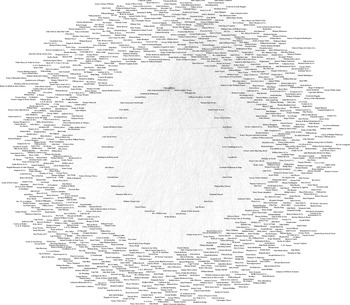
Figure 1 shows an overview of John Pinney’s Nevis–Bristol network, with Pinney himself removed. The network is large. It covers a twenty-year period and includes every transaction that is made explicit (e.g., transfers between accounts) and implicit (e.g., transfers using bills of exchange). There are 1,130 nodes, representing individuals, firms, and accounts (e.g., for estates owned by individuals), with 2,675 unique edges. It is not densely connected, with an average degree per node of 4.735, a density measure of 0.004 (meaning 0.4 percent of all potential connections are evidenced), and a diameter of 10. This is representative of (a) the nature of the source material, and (b) the nature of the relational tie that demands evidence of a transacting relationship between two individuals, firms, or accounts. The source material affects interconnectedness in two ways, first, because we only see the network from the perspective of the ego, where the ego is unlikely to record transactions that had little relevance to them. Second, a low level of interconnectedness is exacerbated by the fact that transactions are not always explicit, especially in the context of multilateral exchanges. Transactions involving bills of exchange, for example, may list who the bill was drawn on and in favor of, and who gave it to John Pinney, but may leave out the steps in between as the bill was presumably passed from person to person. Cash transactions can be similarly problematic, as accounts could be debited “to cash” without indicating who the cash was going to, and vice versa. In the minority of cases in which there appears to be a transaction, but this is not completely clear, I have had to use my judgement based on the contextual evidence to decide whether or not to record this as a transacting relationship.
John Pinney’s Nevis–Bristol network (JP removed), 1783–1803.
Note: rendered in Gephi.

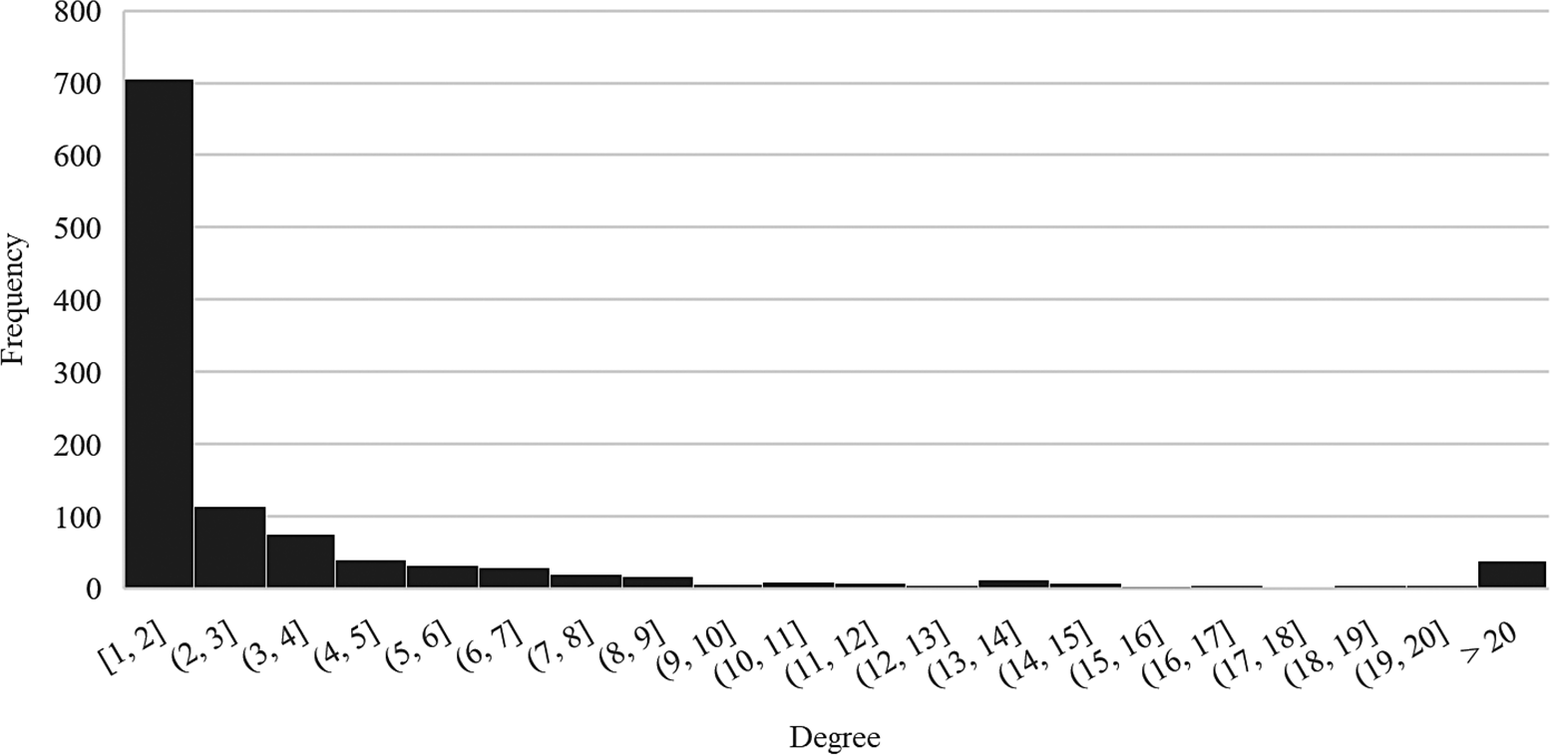
Given its size, the network is difficult to display in a way that maximises visual analysis. Reference to network measures can help—Graph 1 shows the distribution of the degree scores. It reveals a heavy imbalance in the network: An overwhelming majority were only connected to one or two other actors, whereas only thirty-eight nodes had over twenty connections. Given this, I have opted for a dual circle layout in Figure 1, with the center circle made up of the top thirty-eight nodes ranked by degree. The inner circle moves clockwise, with the most well-connected node at twelve o’clock. This helps the researcher identify the most important nodes (by degree) at a glance. Figure 1, thus arranged, shows that Tobin & Pinney were connected to the most other actors within the network. This is unsurprising: Tobin & Pinney was John Pinney’s firm, which John Pinney was a partner in from 1784 to 1789, and which he remained heavily involved in, supervising his son, Azariah, who became the junior partner to Tobin from 1789. Other important nodes include John Frederick Pinney, John’s son; William Coker, one of the plantation’s managers; Williams, Son, Drury & Moffat, Tobin & Pinney’s London bankers; Thomas Pym Weekes, another manager; Simon Pretor & Sons and Pretor, Pew & Whitty, two iterations of Pinney’s personal bankers; and John Pinney’s wife, Jane Pinney.
John Pinney’s Nevis–Bristol network (JP removed), 1783–1803—degree distribution.

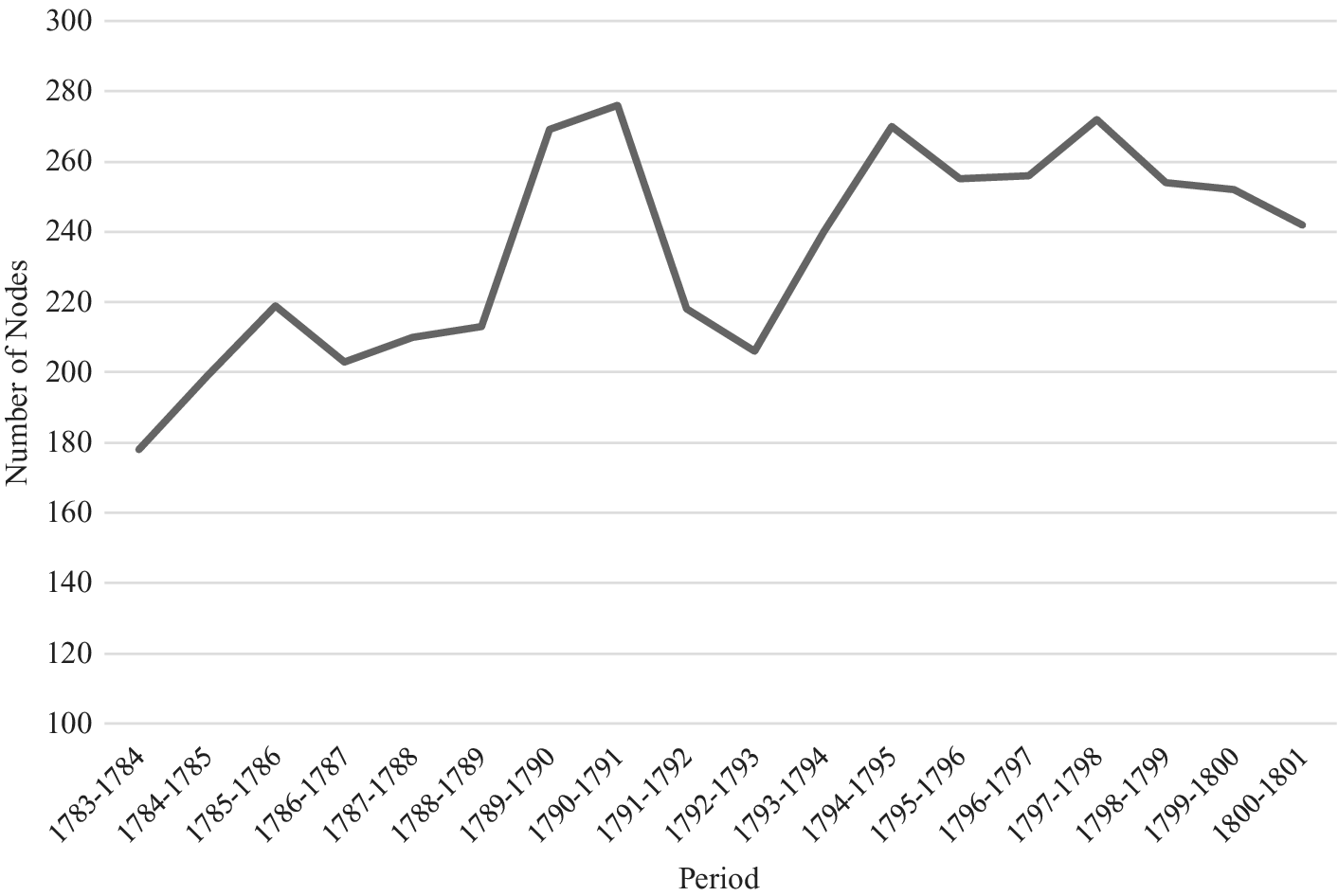
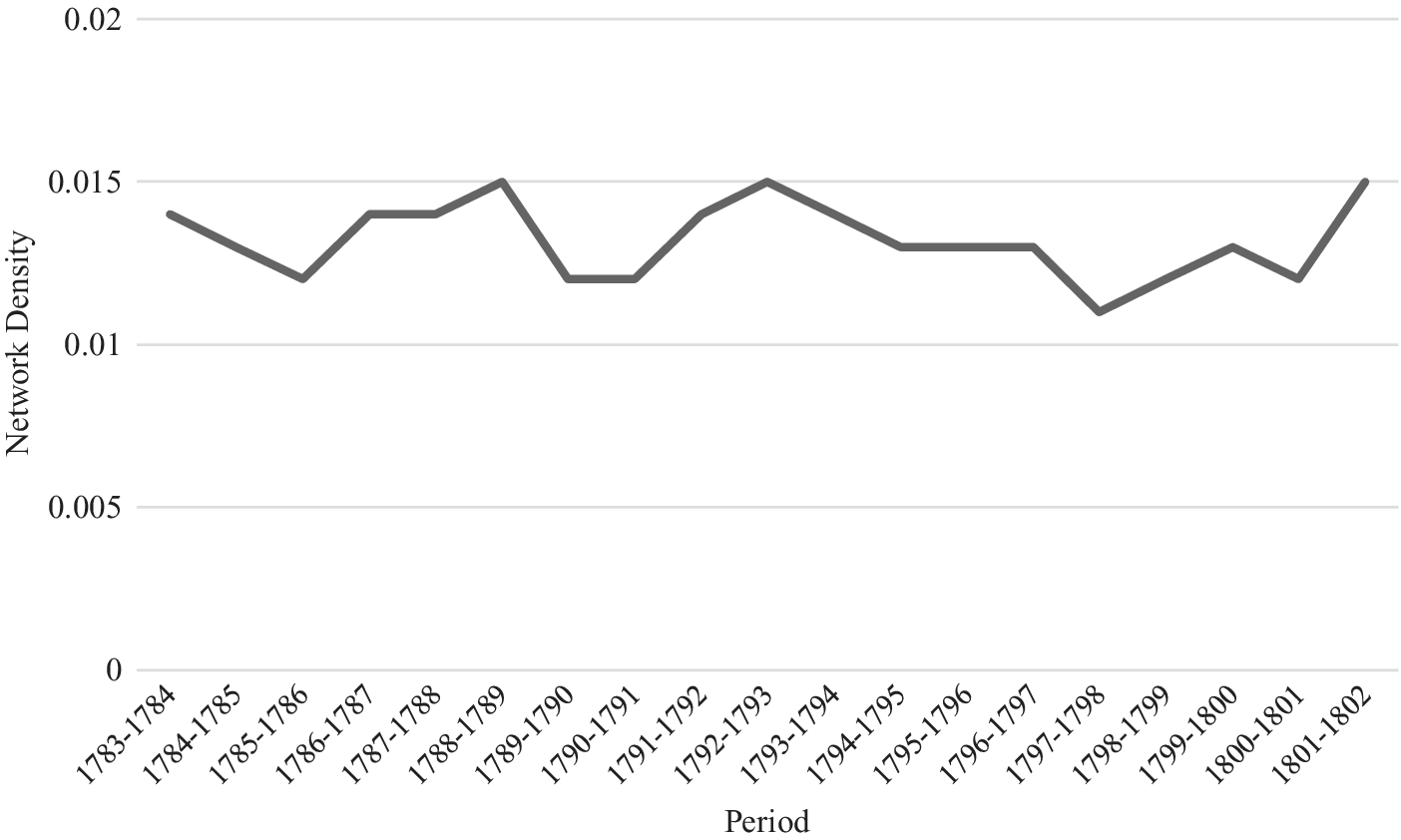
However, this overview of the network masks changes over time, and snapshots of the period would be unsatisfactory for representing such change. The network can, however, be separated into overlapping periods with totals representing the network as it may have been conceived by contemporaries. The periods are, as stated above, two-year moving totals. Graph 2 shows the size of the network as it fluctuated over time. It shows the network expanding, with a peak from 1789–1790 to 1790–1791 that was not sustained, and a peak again in 1794–1795 that was. Graph 3 shows the density of the network over time. The network density was reasonably consistent, though as the network grew larger, the density became lower in relation, albeit marginally.Footnote 36 We can also rearrange the network around particular individuals who appear to be significant. A visual inspection of these graphs immediately reveals the most connected and, therefore, by proxy, the most active actors (active in this context meaning that they were interacting with more people, without the transactional relationship weighted by repeat interaction or monetary value). This visual inspection is confirmed with reference to the data concerning the network measures.
John Pinney’s Nevis–Bristol network (JP removed), 1783–1801—number of nodes per two-year period.

John Pinney’s Nevis–Bristol network (JP removed), 1783–1802—network density.

At this point, it is worth exploring the immediate benefits we gain from using HSNA as an approach to understanding early modern business networks. This can be achieved through a comparison with a case study that is already focused on John Pinney. Albane Forestier’s research into the expansion of Tobin & Pinney’s business network has shown how the firm used their previous connections with Nevis as a basis for expansion. Forestier argues that the presence of James Tobin and John Pinney on the island as planters before 1783 helped them to cement relationships that would later become significant for their consignment business in Bristol. Indeed, their records show how they advertised their services to the planters of Nevis with circular letters and relied on them for recommendations to help expand their network.Footnote 37 Through the circulars, Tobin & Pinney advertised their unique selling point: the fact that they were the only firm shipping directly to Nevis. They appealed to planters tired “of shippg their sugars by way of St Christopher at a considerable expense” (an expense they were aware of themselves from personal experience).Footnote 38 Forestier argues that this aspect of their networking activity was based on the overlap between the personal correspondents of John Pinney and the correspondents of the firm: Forestier observes that Pinney “was already in contact with 11 of the 25 regular clients” of the firm. Forestier further acknowledges that “this is certainly an underestimate as the contacts John Pinney had with his immediate neighbours in Nevis are not recorded in the letterbooks.”Footnote 39 We can expand on this understanding by drawing on Pinney’s account books, in which Pinney was more likely to record his neighborly connections.
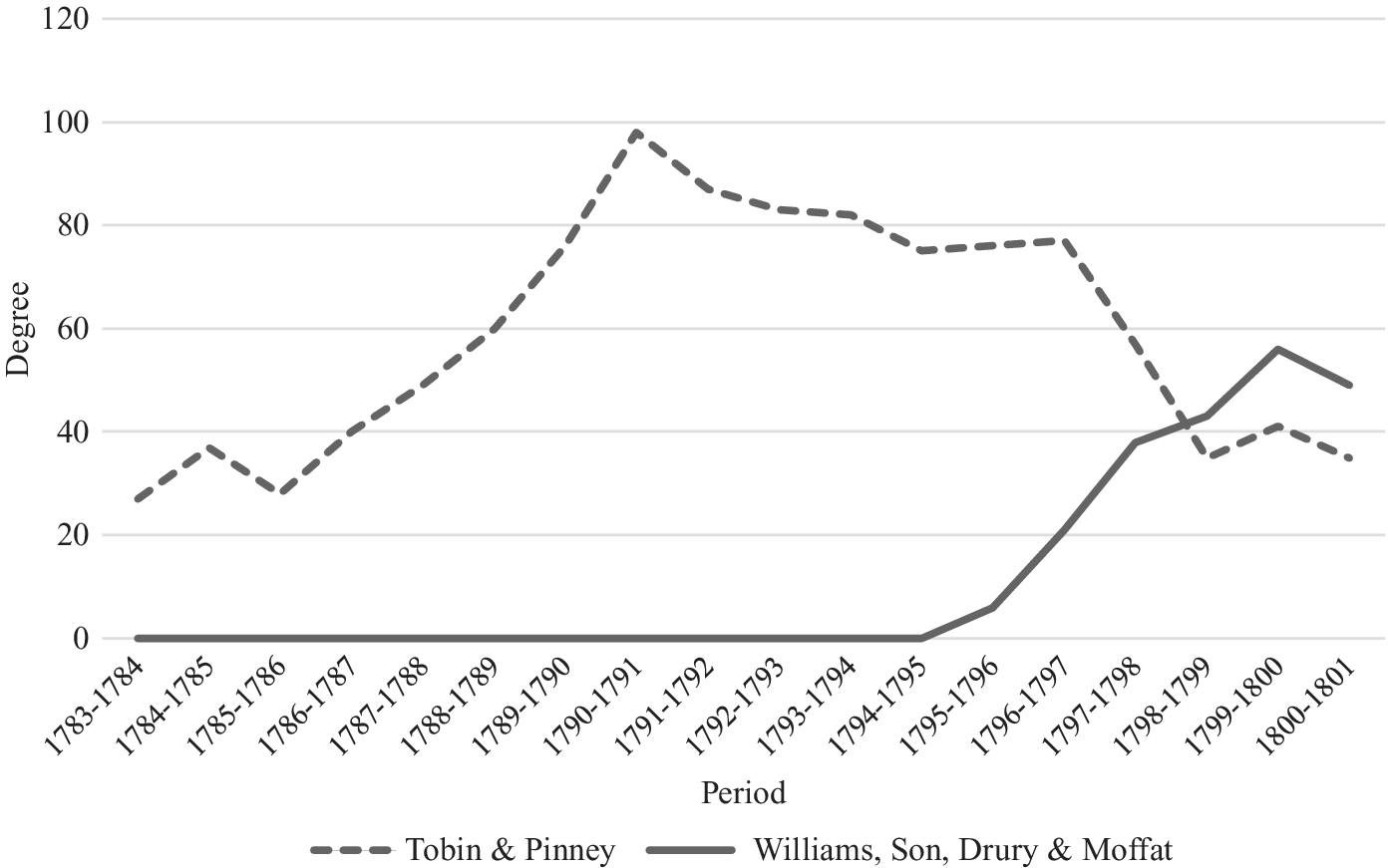
Tobin & Pinney were connected to 306 other individuals, firms, and planters within John Pinney’s Nevis–Bristol network. This does not represent the extent of their connections, but rather their involvement in this network from John Pinney’s perspective. As Forestier has shown, the firm’s network was more extensive. Using the number of recipients of the firm’s letters as a proxy for the size of their network, Forestier has identified periods of expansion and consolidation, with the firm’s network expanding over 1784–1790, reaching just over one hundred people a year, and consolidating thereafter.Footnote 40 Graph 4 shows the expansion of Tobin & Pinney’s network within John Pinney’s Nevis–Bristol network, with a steady expansion until the 1790–1791 period, then a gentle decline to 1796–1797, and a steeper decline thereafter. This appearance of decline comes from John Pinney’s personal decision to hand his plantations over to his son, John Frederick, coupled with his increasing use of Williams, Son, Drury & Moffat (shown as a solid line) as his personal bankers. Their activity in the network increased as Tobin & Pinney’s declined. Tobin & Pinney began expanding operations in Saint Kitts, Saint Vincent, and Saint Croix, and their interests, therefore, appear to have diverged from John Pinney’s, especially as Azariah became a more central figure in the firm’s operations as he came of age. However, by both measures, their initial wave of expansion was impressive. How were Tobin & Pinney able to achieve this level of growth?
Tobin & Pinney and William, Son, Drury & Moffat’s networks within John Pinney’s Nevis–Bristol network (JP removed), 1783–1801—degree score per two-year period.

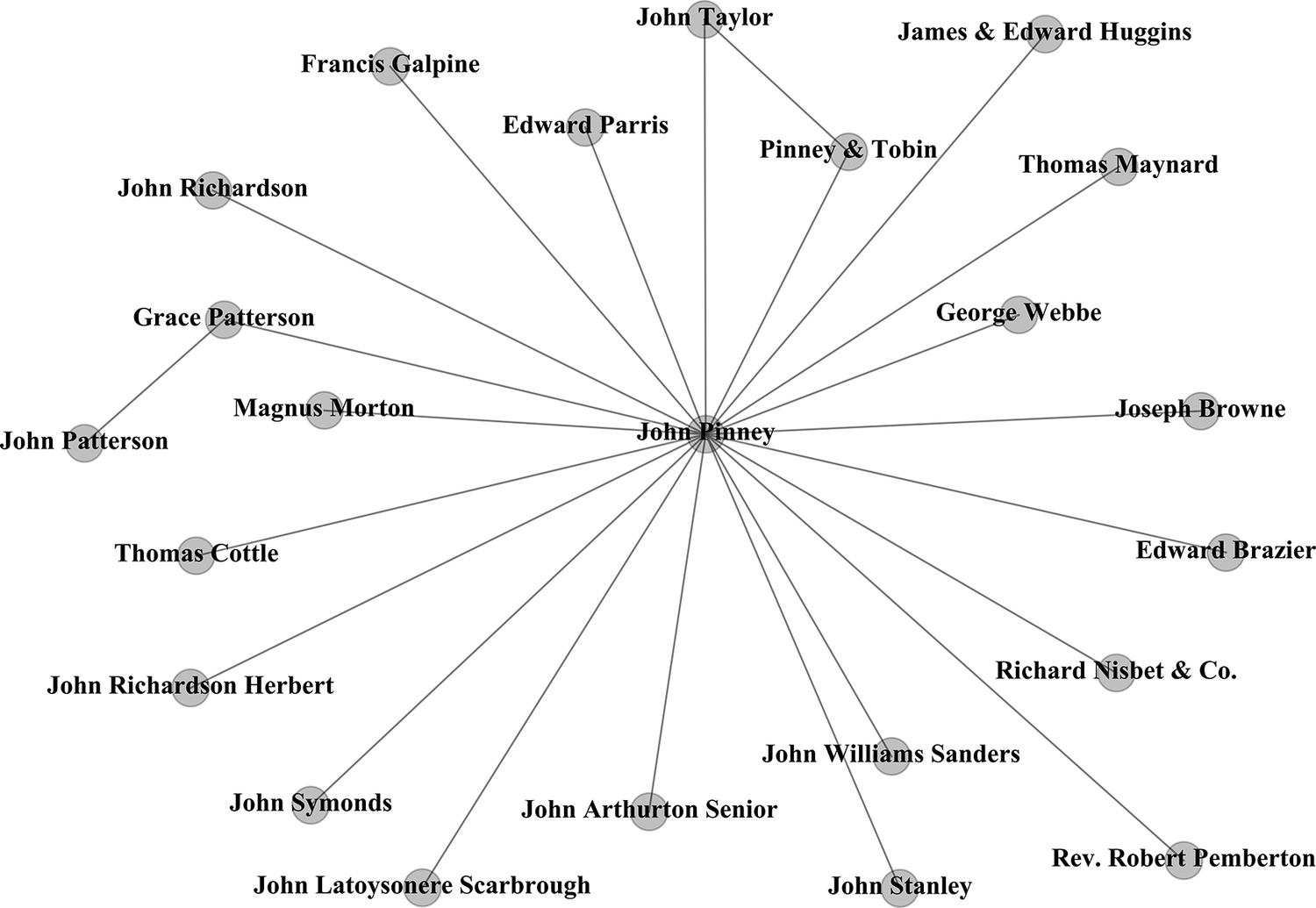
Figure 2 shows the planters to whom the circular letters were sent out at the start of Tobin & Pinney’s expansion (when their name was stylized as Pinney & Tobin) and who were also in John Pinney’s network. The circulars were addressed to twenty-nine unique actors.Footnote 41 Here, twenty of these can be positively identified within John Pinney’s network in 1783–1784. Only one person of these twenty is not directly connected to Pinney himself, John Patterson, who is connected to Pinney through Grace Patterson. This graph confirms this aspect of Tobin & Pinney’s networking strategy: John Pinney’s personal network was used to a significant degree as the basis for expansion, with twenty of the twenty-nine people (69 percent) to whom the circulars were addressed already in a transacting relationship with John Pinney. This is greater than Forestier’s estimate of eleven out of twenty-five, or 44 percent, and confirms her suspicions about the importance of neighborly connections. More strikingly, the unit of analysis here sets a higher bar: Conversation or correspondence was more likely than a transaction, given that the former typically precedes the latter; it may well be the case that Pinney was in face-to-face discussion with all twenty-nine. The causality is fairly clear. The circulars, sent in October 1784 and October 1785, targeted mostly clients who were present in Pinney’s network, and who were connected to Pinney (showing that Pinney not just knew them but transacted directly with them) in 1783–1784. Only one of these individuals, John Taylor, was already connected directly to the firm.
Recipients of circular letters within John Pinney’s Nevis–Bristol network, 1783–1784.
Note: rendered in Gephi.

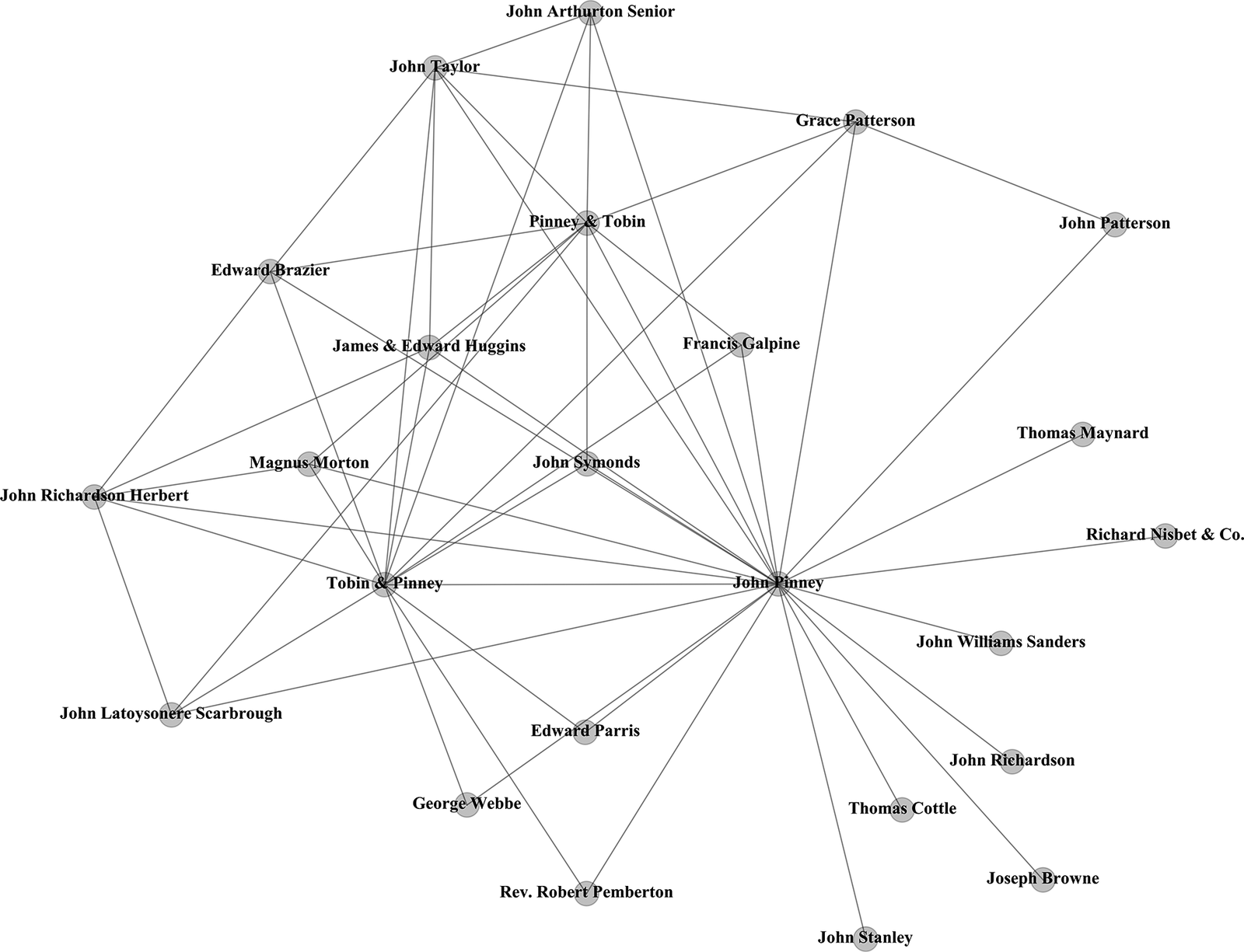
Figure 3 shows the same network with the relationships from the entire period (1783–1803) included, and with the addition of Tobin & Pinney, the later stylization of the firm over 1789–1796. This functions as a proxy for the “conversion rate,” or the success of the circulars. Of the twenty individuals connected to Pinney, eight were not connected to the firm in one form or another; one of these, again John Patterson, was connected to the firm through Grace (suggesting that Grace was more integrated into Pinney’s network that he was). From John Pinney’s network, the firm therefore managed to generate twelve connections out of the twenty connected to Pinney personally—thirteen if Grace is included. Several of those planters were significant correspondents of the firm, especially James and Edward Huggins, George Webbe, John Scarbrough, John Arthurton, John Symonds, and John Richardson Herbert. This finding therefore reinforces Forestier’s analysis by providing another means by which we might answer the same question. It further shows that the firm targeted planters with whom Pinney had established not just a corresponding relationship but a transacting relationship. Thus, we can confirm that this approach has immediate and direct value in reshaping our understanding and providing unique, alternative perspectives.
Recipients of circular letters within John Pinney’s Nevis–Bristol network, 1783–1784, with edges from 1783–1803 and Tobin & Pinney included.
Note: rendered in Gephi.

Enslaved People within the Plantation Network
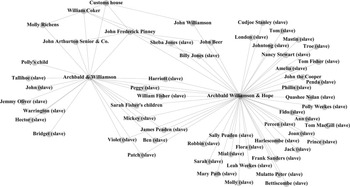
Given their subjection within colonial society—demonstrated in both the level of violence that they endured and their relative obscurity in historical sources, composed as they were overwhelmingly by the enslavers—the lives of enslaved people have been difficult for historians to reconstruct. Indeed, historians have dedicated their lives to bringing their stories to light.Footnote 42 The methodology I demonstrate in this article illustrates how enslaved people can be made visible through HSNA by focusing on significant individuals: in this case, the plantation’s managers and the plantation’s doctors. It is worth noting here that, at least in this instance, we are turning the logic of SNA on its head—we are still looking at those who are better connected but, rather than thinking about what this meant for the better-connected individual, we are thinking about what it meant for the individuals with whom they were connected. Looking, for example, at Thomas Pym Weekes, one of John Pinney’s plantation managers, we can see that he was connected to several individuals who can be identified as enslaved people (see Figure 4: Weekes is the larger node on the left; node size has been adjusted according to betweenness centrality, which makes the more central nodes easier to see at a glance—adjusting for degree would, in this case, have had a similar effect). This speaks in part to Weekes’s style of management—he was criticized by Pinney for hiring enslaved masons to perform “unnecessary work.” Furthermore, some of these enslaved men, for example, a man named Charloe, were owned by Weekes personally, and their labor was charged to the plantation.Footnote 43 Whereas Pinney felt that Weekes’s tendency to hire additional enslaved people added unnecessarily to the costs of the plantation, their inclusion in the account books does reveal this particular dynamic of the network and how enslaved people interacted with their enslavers.
Managers’ network within John Pinney’s Nevis–Bristol network (JP removed), 1783–1803.
Note: Managers are James Williams (top/north), Joseph Gill (right/east), William Coker (bottom/south), and Thomas Pym Weekes (left/west). Their node sizes have been adjusted according to betweenness centrality. Rendered in Gephi.

There were around two hundred enslaved people working on John Pinney’s plantation; his account books include their names in inventories in the back, even if they are not directly included in any of the accounts. However, thanks to the interactions of various individuals connected to the plantation with these enslaved people, we can identify them within the network: Their names come up in the accounts, and the information entered thereof reveals elements about their experience. An important caveat is necessary here. I have used the “transaction” as the unit of analysis, but this does not mean that I have assumed that each transaction was entered into willingly. The very presence of enslaved people in this network recognizes that they provided services for their enslavers, but I must emphasize that they did so under terrible conditions. This is significant for how we understand their involvement in the network; it defined their interactions with the plantation’s doctors, for example. Indeed, as Stephen Kenny summarises, slavery, as “a profoundly oppressive, destabilizing, and deeply exploitative social system … guaranteed negative health outcomes and enduring health problems in all of its geopolitical and historical contexts.”Footnote 44 Enslaved people continually suffered high mortality rates, even without the influence of devastating hurricanes, which itself speaks to the conditions that they faced. Seemingly oblivious to the effects of their treatment, planters considered death and disease to be the natural state of life for enslaved people in the West Indies.Footnote 45 Moreover, violence was commonplace. Whipping was used liberally as a punishment, and trials, executions, and torture were easily resorted to, while spiritual terror through the mutilation of bodies was used to prevent suicides.Footnote 46 John Pinney considered himself to be a more lenient planter, yet he had no objection to flogging, despite his objections to “excessive cruelty” (i.e., flogging slaves to death).Footnote 47 When examining how enslaved people were involved in the network and the nature of their interactions, this context is important. Significantly, this further “problematizes” networks in ways historians have not yet considered.Footnote 48
Indeed, if we examine the network of the island’s doctors, Archbald & Williamson (later styled Archbald, Williamson & Hope, who were the twelfth-best-connected node in Figure 1), this brings the experience of plantation life for enslaved people into sharp focus. Figure 5 shows the network for these doctors. It has 60 nodes, with 78 edges, meaning that there is an average degree per node of 2.6; this figure obfuscates more than it reveals, however, given that most of the connections are present between the doctors and others, rather than between the enslaved people. This is due to the source material, which was overwhelmingly concerned with plantation matters and not interactions or transactions between the enslaved people, of which no doubt there were many. However, more so than Weekes’s network, theirs was dominated by people who can be identified as enslaved. By examining the accounts of the doctors as part of this iterative analysis, we can capture elements of what life was like for the enslaved people working on John Pinney’s plantation. Archbald, Williamson & Hope’s role as plantation doctors involved providing “services,” including extracting teeth; concocting mixtures; administering liniment oils, lotions, ointments, powders, pills, boluses, anodynes, diuretics, and febrifuges; performing surgery, scarification, bleedings, and purges; extracting tumours; providing stitches and dressings; and delivering children for the enslaved people. They also gave inoculations and treated venereal diseases. One entry states that the doctors came in the night for Mary Path, who had “suffocated by going to sleep with fire in the house” when she was “big with child.” Additional tasks included healing gunshot wounds and dealing with broken bones. Although the accounts do not specify how these injuries were incurred, given our understanding of the violence of plantation life, we can probably guess. In one instance, they visited Bettiscombe, an enslaved boy who was injured by the mill.Footnote 49 It appears he succumbed to these wounds: Records show that he died at the age of sixteen of a fractured skull.Footnote 50 Patch, an enslaved woman who had attempted to run away, was treated with a series of pills for what seems to have been a mental illness; she was described as “mad” when she was sold.Footnote 51
Archbald & Williamson and Archbald, Williamson & Hope’s network within John Pinney’s Nevis–Bristol network (JP removed), 1783–1803.
Note: rendered in Gephi.

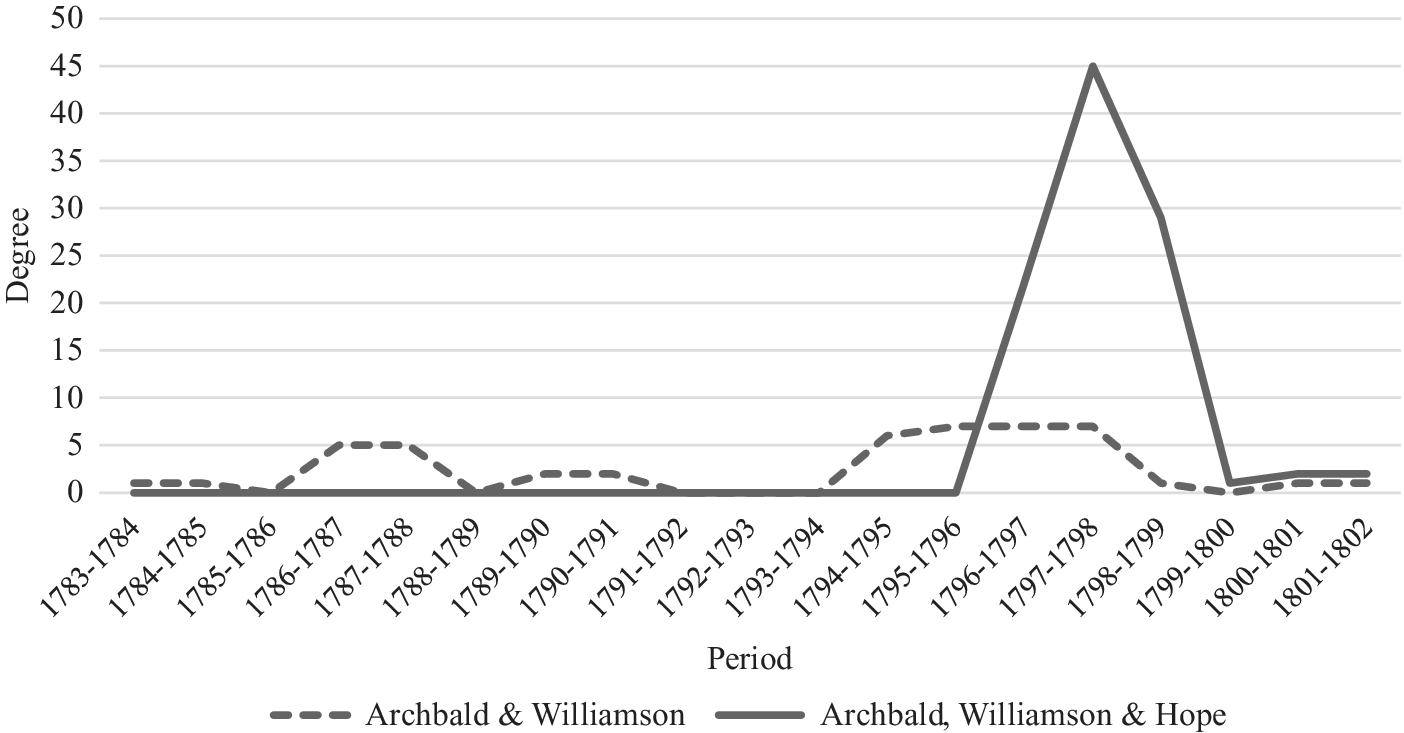
Again, this view does not allow an analysis of change over time. Graph 5 shows the sharp increase in the number of connections that Archbald, Williamson & Hope (the later iteration of the firm) had from the 1796–1797 period onward. The use of the two-year rolling total draws our attention to the startling peak in 1797–1798. This shows a dramatic increase in the number of people the doctors interacted with in 1797, and a further increase in 1798 with new people that built on the memory of those interacted with in 1797. This makes the follow-up question that we can ask of the sources fairly clear: What explains this sudden spike? It may well indicate that the enslaved people were experiencing worse conditions, and thus suffering more from diseases and injuries; conversely, it might suggest that they were being given more medical attention, which in turn might suggest some amelioration—indeed, the Leeward Islands passed its “Melioration Act” in April 1798, which probably had some influence. This was a broad act that dealt with a variety of issues, including the material and physical well-being of enslaved people, their legal status, and measures to improve their “moral standards and conduct.” As Eickelmann points out,
Slaveholders were required to provide their sick people with medical help. The Act also made it mandatory for estates to provide a “commodious hospital or sick house” with a sufficient number of attendants.… In addition, slaveholders had to employ doctors on an annual basis. Doctors were obliged to attend each estate twice a week.Footnote 52
Archbald & Williamson and Archbald, Williamson & Hope’s networks within John Pinney’s Nevis–Bristol network (JP removed), 1783–1802—degree score per two-year period.

Another significant factor in Archbald, Williamson & Hope’s increased involvement is the eventual dismissal of Thomas Pym Weekes, the plantation’s original doctor, who later became its manager and who was let go in 1794 because of incompetence.Footnote 53 This meant that the plantation no longer had an in-house doctor, which increased costs. As Eickelmann notes:
When Dr Weekes was the manager, he could attend to people around the clock, but now each time someone was ill a doctor had to be called, and now doctors were paid for each visit and for each treatment. This arrangement could not have been a cost-cutting exercise because by 1799 the medical bills had doubled.Footnote 54
The brevity of the peak of Archbald, Williamson & Hope’s involvement with the plantation may have been due to the realization of these increased costs. The decline also coincides with a fall in the number of people being recorded as “sick or lame.” Curiously, in 1798, pages of the plantation diary’s sickness record have been torn out—only fifteen full weeks have survived, along with seventy-five “odd days.” This is probably not nefarious—despite this, the average figures are still high, and the increased activity of Archbald, Williamson & Hope coincides with this increased rate of sickness.Footnote 55 Examining the plantation doctors, and focusing on their network (and in particular how it changed over time), has guided our approach to the primary and secondary sources here. It has drawn our attention to the experience of the enslaved people and demonstrated the ways in which the death and disability that they endured linked them to the network. The analysis has also revealed particular timings, and how changes in the plantation manifested into changes with whom they interacted.
As well as suggesting that we look closely at the doctors, this approach also reveals to us the names of enslaved people who appear more frequently in the sources, and whose experiences we can learn more about. By making note of the names of those connected to the plantation’s managers and doctors in Figures 4 and 5, and then searching for them in the plantation’s accounts, we can, for example, identify the skilled enslaved men and the boys that they were apprenticing. These included Tom Jones, who was a mason, and Primus, a carpenter. John Keepe, a white mason, was apprenticing a “negro boy” called Almond. John French was a “negro cooper,” and was apprenticing Billy Jones, a “mulatto” (and allegedly a product of John Pinney’s affair with an enslaved woman called Black Polly).Footnote 56 The accounts also reveal to us the means by which these enslaved people resisted their captivity by running away: Actions of resistance generated costs for the plantation, which are recorded in the accounts, and which, therefore, linked the enslaved people to the network. John Pinney’s accounts are not unusual in this regard.Footnote 57
These records reveal that, in August 1791, Patch, an enslaved woman, ran away and was “caught in Mr Taylor’s Mountain and harboured there by a Negro of his called Joe.”Footnote 58 We can only imagine the kind of relationship Joe and Patch had, and what risks Joe took in harbouring her. In July 1791, the plantation paid out 2s. 1½d. in cash for catching Violet, one of two African-born women given that name. Violet had undergone physical punishment for some infraction—she was shackled to blocks of wood—and ran away as a result. She was caught again by two hunters after escaping the plantation for four months in June 1801, and again in November the same year.Footnote 59 Acree, a Creole and serial absconder, was caught by five hunters in August 1800. He “ran away & had been continually robbing the Negro-houses & at last attempted to Escape off the island” before being caught. James Peaden, a “mulatto” carpenter, was more successful. Hunters were sent to Saint Kitts, Saint Martin, and Saint Eustatius “in quest” of him. He had been badly treated by the manager at the time, James Williams, and left behind several children. He does not appear to have been recaptured. Resistance by the enslaved also came in the form of thefts. In two instances in 1795, victims were compensated by the plantation. Messrs. Peter and William Fisher were given £1 13s. for two goats stolen by Philip, an enslaved Creole. Philip had a reputation for being “troublesome”: He was returned to the plantation by John Keepe, the white mason who had apprenticed him. He was also later recorded as a runaway. In addition, £1 18s. was paid for a hat that Billy Herbert, another enslaved man, “robbed a white-man of on the Highway.”Footnote 60 The difficult working conditions drove some of the enslaved people to do what they could to escape and resist. Their experience of harsh and violent plantation life, their interaction with the plantation doctors and with one another, and their means of resistance, which incurred costs for the plantation, defined their connection to the plantation accounts, and thus to the commercial network that the accounts evidence.
The Role of Women within the Plantation Network
I focus in this section on Jane Pinney, John Pinney’s wife. One of the most interesting observations from the network overview was that Jane is shown to have ranked very highly. Her high ranking, despite the fact that little scholarly attention has been paid to her, further underscores the observations of other historical social network analysts, for example Catherine Medici, who argues that SNA “has the ability to reveal the agency of lesser-known actors and to facilitate the study of early modern women.”Footnote 61 Forestier’s analysis of John Pinney and his firm does not include an assessment of Jane Pinney,Footnote 62 while what follows challenges earlier portrayals of Jane—she is unflatteringly described by Richard Pares (writing in 1950) as a “plain, dumpy woman with reddish hair.” According to Pares, “her sole achievement of any importance was to bring [her] children into the world.”Footnote 63 This assessment, undoubtedly of its time, is not supported by a closer examination of the evidence. My contribution here builds on a growing historiography that increasingly demonstrates the importance of women as economic actors across the socioeconomic spectrum.Footnote 64 Recently, for example, Sophie Jones and Siobhan Talbott have shown how women were autonomous and frequently independent actors across many facets of the eighteenth-century commercial world.Footnote 65 This case study builds on this body of research by demonstrating the ability of historical social network analysis to (a) uncover the role of women as network actors and (b) provide quantitative evidence that demonstrates their importance.
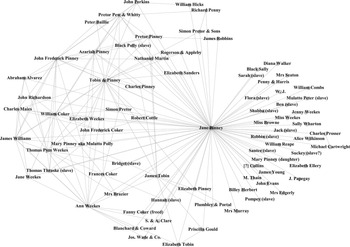
Figure 6 shows the Nevis–Bristol network reorganized around Jane Pinney: It shows Jane Pinney’s node, all other nodes connected to her, and the connections between those nodes. The network contains a total of 78 nodes, with 191 unique edges. The average degree is 4.897, the network diameter is 2, and the network density is 0.064 (6.4 percent of all potential connections are present) showing that, by all accounts, this subnetwork was more interconnected than the network overall. There were a significant number of individuals only connected to Jane Pinney, however, indicating that this was still a loosely connected subnetwork that reflected the centrality of Jane Pinney’s activities or interests.
Jane Pinney’s network within John Pinney’s Nevis–Bristol network (JP removed), 1783–1803.
Note: rendered in Gephi.

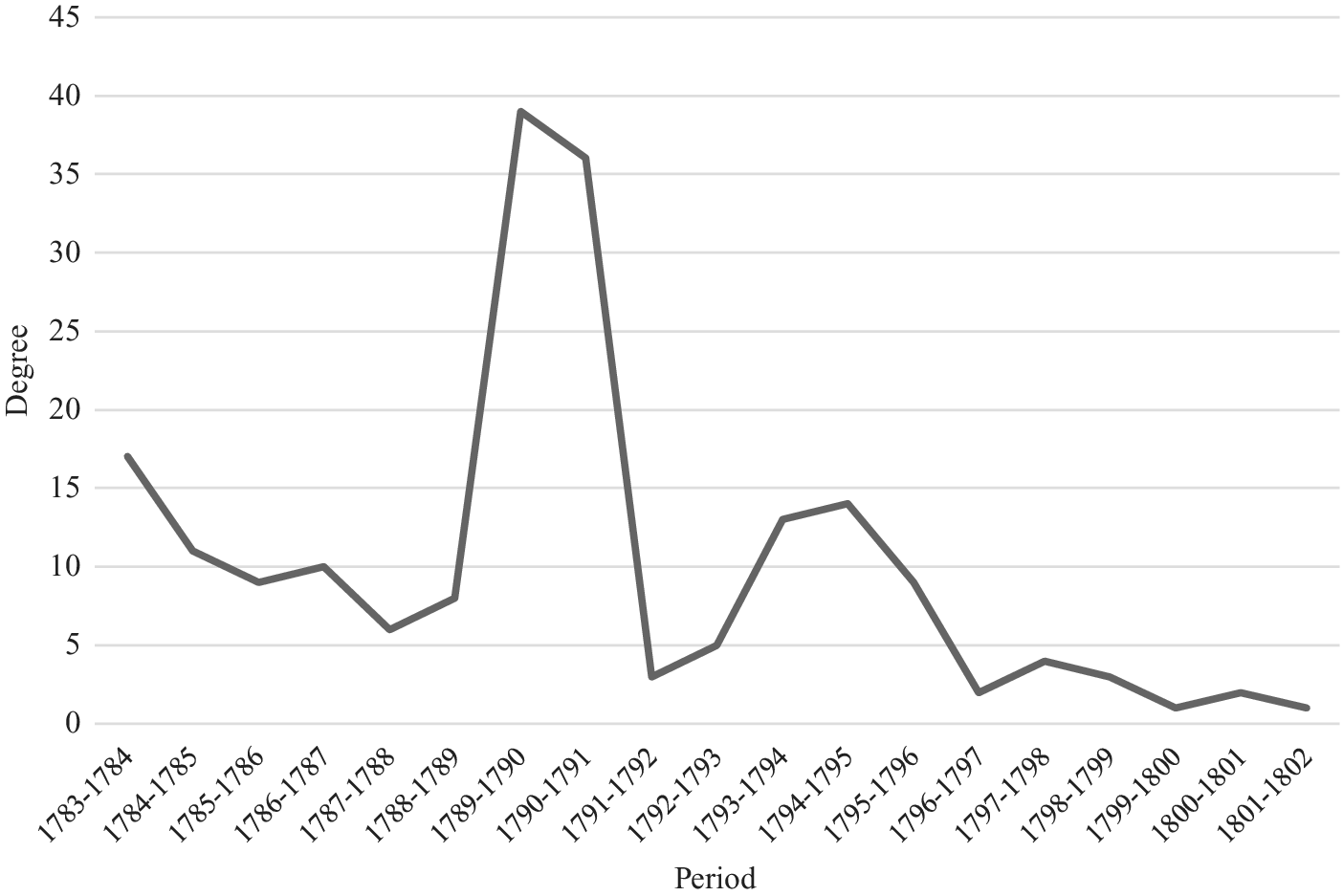
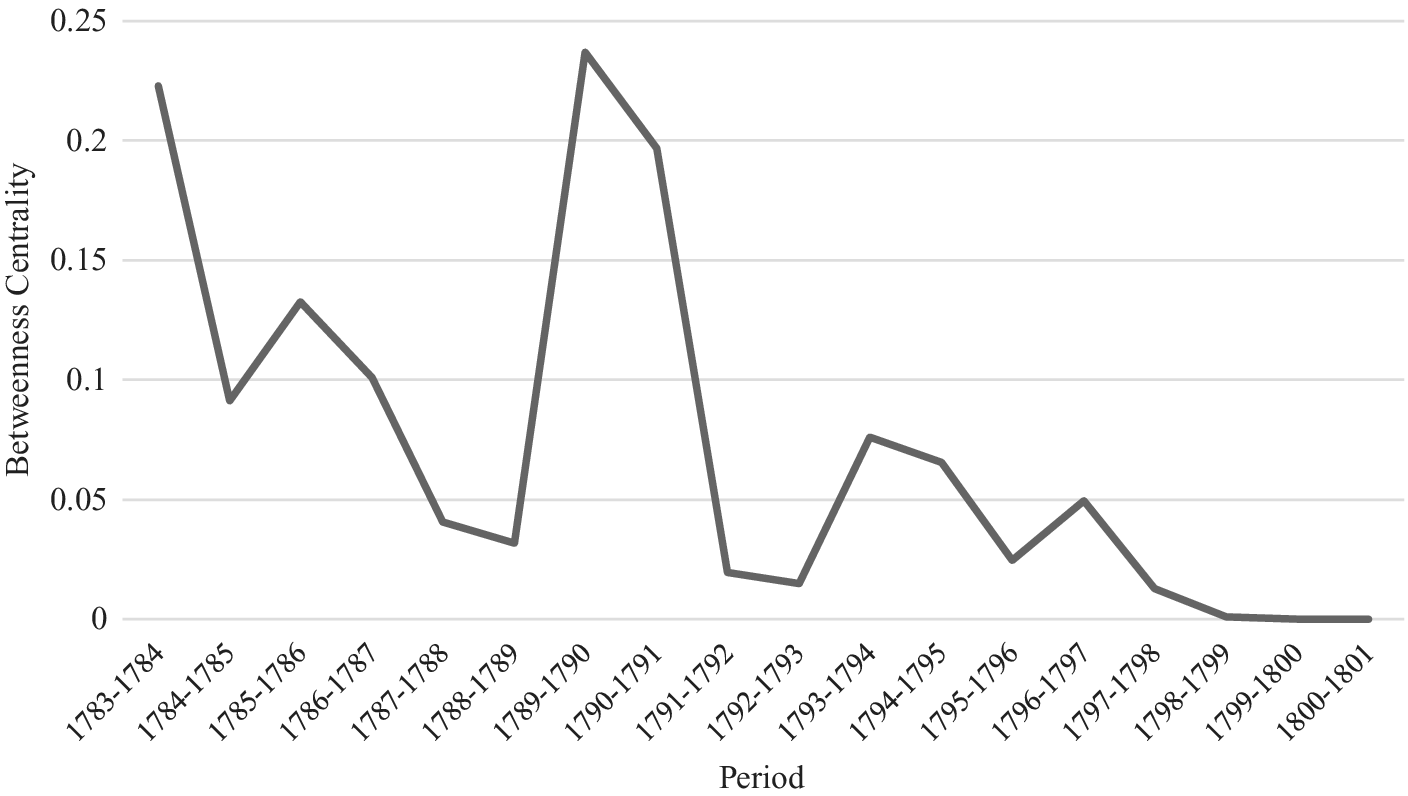
Graph 6 shows the changes in the size of her network over time. With this reformatting of the data, our interpretation of the network changes fairly dramatically. As with the plantation doctors, there is a key moment within this period that led to the dramatic expansion of her network. For the rest of the period, she was seemingly unimportant in the context of the Nevis community. Other data of her interaction with the main network over time show a similar phenomenon. Graph 7 shows her betweenness centrality rating over time, which confirms the same trend. At distinct points in time, not only did Jane become more active within the community, forming connections with more people, but she also acted as a bridge, linking more people to others through her. The framing of the periods indicates that, in 1790, her activity led to the growth of her network, leading to growth in the 1789–1790 period, and sustaining its size in 1790–1791 as the memory of this activity is assumed by the model to carry on. The lack of re-interaction in 1791 meant that, by the 1791–1792 period, these ties appear to fade. The key research questions this suggests are: What happened in 1790 that caused her network to grow so rapidly, and why were these connections so ephemeral? As with the doctors’ network, these questions can be answered by returning to the primary sources.
Jane Pinney’s network within John Pinney’s Nevis–Bristol network (JP removed), 1783–1802—degree score per two-year period.

Jane Pinney’s position within John Pinney’s Nevis–Bristol network (JP removed), 1783–1801—betweenness centrality score per two-year period.

Pinney’s account books show that Jane was commercially active in her visit to Nevis in 1790, when she accompanied her husband, John, who was dealing with issues of plantation mismanagement. This explains why there is a sudden increase in the size of her network in the periods constructed with data inputted for this year: Jane travelled from Bristol to Nevis. When in Nevis, Jane bought items from local merchants. She bought various fabrics and accessories from John Richardson in March 1790, for example, including buckles, bombazine, lutestring, ribbon, and pieces of calico and silk, amongst other things.Footnote 66 She bought “sundries” from Ann Weekes and a piece of chintz from Frances Coker.Footnote 67 She also took goods out with her to sell on behalf of the Pinneys’ maid, Priscilla Gould.Footnote 68 Significantly, Jane bought foodstuffs from various islanders. She bought pigs from Jane Weekes and Mrs. Ellery, chickens from Mrs. Edgerly, and ducks from Sally Wharton, for example. She also purchased foodstuffs from enslaved people, including Alvarez, Santee, Sarah, Peter, Jack, Black Polly, Suckey, Betty, Pompey, Shabba, Flora, Black Sally, and Ben, amongst others.Footnote 69 This again speaks to the position of enslaved people within the network, revealing yet another dynamic concerning the relations between enslaved people and free whites in the islands: Allowance was made for enslaved men and women to grow and market their own produce, typically on Sundays.Footnote 70 There must have been more people who have gone unnamed, given that John Pinney preferred to record in the account books the goods purchased more often than the people they were purchased from. Cash was, at one point, given to Mrs. Pinney for “House use,” for example.Footnote 71 This demonstrates the importance of women like Jane Pinney to the economic lives of their families—it is not a coincidence that most of the purchases were for food. As Claire Walsh argues, shopping generally “was associated with women in the period, because women bore the brunt of shopping for the household and were particularly burdened with shopping for foodstuffs on a daily basis.”Footnote 72 This extended to women of high socioeconomic status like Jane Pinney.
Jane Pinney also handled a lot of the cash, acting as an intermediary between John Pinney and others in his network, especially the women. Frequently, John gave Jane cash, either for her own personal use or to distribute to various people. John also gave cash to others “by Mrs Pinneys direction,” showing that she had a level of control over her husband’s finances.Footnote 73 Further demonstrating her influence in financial matters, John gave up a debt owed by Sarah Murray, a resident of Nevis, at the behest of Jane.Footnote 74 Other women gave Jane cash, sometimes as dollar coins to be converted into pounds sterling on her husband’s account. Jane Pinney, when in Nevis, received money on behalf of both Elizabeth Tobin and Priscilla Gould.Footnote 75 Money was given to her by Mrs. Murray, “Mulatto” Polly, Miss Browne, Elizabeth Weekes, Jenny Weekes, Elizabeth Sanders, and John Coker to give to John.Footnote 76
The account books also show that Jane Pinney was commercially active in Bristol. When John returned to Nevis in 1794 (to similarly deal with the mismanagement of his plantation), Jane did not accompany him, though she still organized gifts and orders for friends, which explains the modest increase in the size of her network around this period. John Pinney’s cash accounts record Jane buying goods for herself at visits to the linendraper, milliner, mercer, and jeweler. She bought various items of jewelry and textiles, including lace and silk garments. She also bought items for John, including a morning cap and waistcoat patterns.Footnote 77 Significantly, Jane bought goods for consumers and clients resident in the West Indies, helping her to maintain her connection to the islands, even when she was not there. However, these links are obscured again by the tendency for John Pinney to record goods rather than people, meaning that the size of her network, as shown in the graph, does not represent the full extent of her activity. Cash was given to Jane by John “to supply a west india order,” for example, which consisted of silk and muslin handkerchiefs, ribbon, buckles, and buttons, amongst other things.Footnote 78 Similarly, John recorded Jane’s visit to the Bristol Fair, where she bought, “for exportation,” handkerchiefs, printed cotton, muslin, ribbon, velvet, various other textiles and patterns, an assortment of knives, combs (including “1 doz. Negro [combs]” and ivory combs), and a pair of silver buckles. This demonstrates not only the variety of items available at the fair, but the tastes and living standards of those resident in the West Indies for whom these goods were destined.Footnote 79 The importance of their wives was fully recognized by Tobin and Pinney. As they admitted to a client, “We are not such good judges of female Articles & must therefore be obliged to the Ladies for their assistance.”Footnote 80 The “Ladies” had to be good judges for, as Christine Eickelmann has observed, “customers in the West Indies were very discerning.”Footnote 81
Although the importance of Jane Pinney within the network reinforces the emphasis on the importance of women to business more broadly, her role within the economy differed from other women. She was, in Bristol, shopping on behalf of her counterparts in the West Indies. This is markedly different from the women who performed manual roles, and especially women of color, who worked domestically as seamstresses, hairdressers, cooks, housekeepers, nannies, and midwives. Jane Pinney’s role was of a more elite status than the white hoteliers, tavern keepers, and teachers, especially those living in the West Indies (though these were the women who may well have formed her consumer base). She was dissimilar, also, to the widows who took over their deceased husbands’ shops.Footnote 82 This was not the “cooking and cleaning … trading and selling, sewing and educating” that “formed the core repertoire for white and black urban women.” This was closer to the shopping by proxy through “consumer networks” as described by Ellen Hartigan-O’Connor. It was Jane Pinney who acted as a “professional agent,” and who was rewarded with “continued business for successfully gauging the needs and desires of [her] clients.”Footnote 83 Her successes, in turn, rewarded her husband’s firm.
Conclusion
The network graphs are, therefore, important for directing our attention toward important actors. They show not only who was important but when they were important: This is aided by the use of time series graphs, which are organized in a manner that complements the ways that contemporaries envisioned their networks. This is followed by a qualitative assessment of the networks, using an investigation into available source material to understand the nature of these relationships. This article has built on the scholarship concerned with historical social network analysis by introducing a means of measuring change over time that provides better insights than the snapshot approach. It does this in a way that makes periodization meaningful to both contemporaries and researchers. This has been achieved with the use of a two-year moving total to analyze quantitative data gleaned from the networks through the process of social network analysis. In order to demonstrate the efficacy of this approach, I have explored a case study of John Pinney’s Nevis–Bristol network, a case that itself builds upon the historiography in a number of ways. In particular, I have shown how this approach can be used to identify individuals who might otherwise be underrepresented in historical works. The data justify claims about their importance and influence—though we are prompted to question the specific interactions that lead to these claims—and have guided an iterative approach into the primary sources. I have shown, through direct comparison with other methodologies, how this approach can expand on our understanding of historical business networks. I have then explored the experience of enslaved people with reference to the networks of managers and doctors, and I have demonstrated the importance of women like Jane Pinney to their commercial world, contributing to an expanding historiography on this topic.
This article has also raised issues to be aware of when conducting HSNA. The most significant problem facing researchers in this field—and what renders HSNA as a particular subfield within SNA—is the use of archival material. The material we have shapes the questions we can ask of the network. We are not always able, as our colleagues elsewhere in the social sciences often are, to use surveys or ask whatever questions we want of our sources.Footnote 84 This shapes the relational ties we can analyze. We will face problems identifying actors, a problem felt by all historians, but more so when it comes to the “demanding data requirements” of SNA, which often requires exactness in spelling and actor identification.Footnote 85 There will be imprecision, and this is the caveat that all historical social network analysts must provide. We must be mindful of how various egos influence our networks, and we must be wary of giving an unwarranted impression of completeness. Above all, we must remember that HSNA is a first step in an iterative process, allowing us to ask particular questions of historical sources that we might not otherwise have asked. At the same time, it provides us with data that can be used as evidence to justify claims of importance. As this article has shown, the use of time series data, modelled around an appreciation for how contemporaries saw their networks, provides us with another important set of questions to ask. Historical social network analysis, thus used, sits alongside geospatial analysis, textual analysis, statistical analysis, and other digital and computational tools as another key asset for historical research.
Acknowledgements
I would like to thank the three anonymous reviewers for their feedback on this article, and Prof Andrew Popp for his help and guidance. I would also like to thank Dr William J. Ashworth, Dr Siobhan Talbott, Dr Aashish Velkar, Dr Sheryllynne Haggerty, and Dr Laura Sandy, who have all commented on earlier versions of this work. This research would not have been possible without the support of the ESRC NWSSDTP. Special thanks to the archivists at the University of Bristol Special Collections. All mistakes remain my own.