INTRODUCTION
Ecteinascidia turbinata (Herdman, Reference Herdman1882) has attracted much attention from within the biological and medical fields as it has been found to be a source of several metabolites, some of which may act as anti-cancer agents (Rinehart et al., Reference Rinehart, Holt, Fregeau, Stroh, Keiper, Sun, Li and Martin1990). Foremost amongst these is ET-743 which has a unique mode of action, targeting DNA repair (D'Incalci & Galmatini, Reference D'Incalci and Galmarini2010). ET-743 is now authorized by the European Commission under the name ‘Trabectedin’ for use to treat ovarian cancer. It is now known that ET-743 is not produced by the tunicate itself but rather is the product of the intracellular bacterium Endoecteinascidia frumentensis (Moss et al., Reference Moss, Green, Perez, Velasco, Henriquez and McKenzie2003; Pérez-Matos et al., Reference Pérez-Matos, Rosado and Govind2007; Elbaz, Reference Elbaz2009).
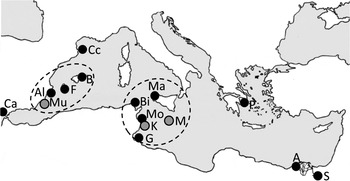
The main worldwide population of E. turbinata is centred on the tropical Western Atlantic (Caribbean) region with what are presumed to be satellite populations occurring elsewhere. However, according to Van Name (Reference Van Name1945) ‘Reports of it from Old World localities … are to be mistrusted, as very probably referring to allied species’. It is now known that this is the same species which occurs in West Africa at Joal and Dakar in Senegal (Pérès, Reference Pérès1948, Reference Pérès1949), the Cape Verde Islands (Rennie & Wiseman, Reference Rennie and Wiseman1906), the Suez Canal and into the Red Sea (Elbaz, Reference Elbaz2009), and there are also populations in the Mediterranean (Pérès, Reference Pérès1958) (Figure 1). This observation has led to the assumption that E. turbinata has expanded its area of distribution, probably through human activity, from the Caribbean area but this has not been confirmed. The Mediterranean Sea has long been a major route for maritime traffic and around 680 alien species have successfully colonized it (Galil et al., Reference Galil, Marchini, Occhipinti-Ambrogi, Minchin, Narščius, Ojaveer and Olenin2014), with 66 alien species colonizing the Maltese Islands alone (Evans et al., Reference Evans, Barbara and Schembri2015). It is generally assumed that vessels have facilitated the transport of these species (Zenetos et al., Reference Zenetos, Gofas, Morri, Rosso, Violanti, Çinar, Almogi-Labin, Ates, Azzurro, Ballesteros, Bianchi, Bilecenoglu, Gambi, Giangrande, Gravili, Hyams-Kaphzan, Karachle, Katsanevakis, Lipej, Mastrototaro, Mineur, Pancucci-Papadopoulou, Ramos-Esplá, Salas, San Martin, Sfriso, Streftaris and Verlaque2012), as components of fouling communities on the hulls (Galil, Reference Galil2012) and perhaps more recently through ballast water discharge. Either way, harbours have become hotspots for alien species (Hulme, Reference Hulme2009).
A map of the Mediterranean Sea and the immediate areas, showing the positions of known Ecteinascidia turbinata populations (Black circle – previous reports, Grey circles – this study). Two main areas are highlighted (dashed ovals). A, Alexandria, Egypt (Herdman Reference Herdman1880); Al, Alicante (Cornet & Ramos, Reference Cornet and Ramos1980; Carballo et al., Reference Carballo, Naranjo, Hernández-Zanuy and Kukurtzii1997); B, Balearics, Spain including Majorca (Ramos et al., Reference Ramos, Turon, Wahl, Banaigs and Lafargue1991; Carballo et al., Reference Carballo, Naranjo, Hernández-Zanuy and Kukurtzii1997); Bi, Bizerte (Pérès, Reference Pérès1956; Ca, Cadiz (Ramos, Reference Ramos1988; López-Legentil & Turon, Reference López-Legentil and Turon2007); Cc, Cape Creus (Harant & Vernières, Reference Harant and Vernières1933); F, Formentera Island (Ramos et al., Reference Ramos, Turon, Wahl, Banaigs and Lafargue1991; Carballo et al., Reference Carballo, Naranjo, Hernández-Zanuy and Kukurtzii1997); G, Gulf of Gabès (Pérès, Reference Pérès1954, Reference Pérès1956; Ben Mustapha et al., Reference Ben Mustapha, Komatsu, Hattour, Sammari, Zarrouk, Souissi and El Abed2002); Mo, Monastir (Ben Mustapha et al., Reference Ben Mustapha, Komatsu, Hattour, Sammari, Zarrouk, Souissi and El Abed2002); K, Kuriat Island, Tunisia (this study); M, Malta (this study); Ma, Marsala (Pérès, Reference Pérès1954); Mu, Murcia, Spain (this study); P, Argolikos Gulf, Peloponnese, Greece (Monniot, Reference Monniot1983; Koutsogiannopoulos et al., Reference Koutsogiannopoulos, Zenetos, Ramos-Esplá and Thessalou-Legaki2012); and S, the Suez Canal (Harant, Reference Harant1927b; Elbaz, Reference Elbaz2009).

Ascidians are particularly good colonizers and many alien ascidians are now found in the Mediterranean, some of which have become invasive (Izquierdo-Muñoz et al., Reference Izquierdo-Muñoz, Díaz-Valdés and Ramos-Esplá2009). The opening of the Suez Canal in 1869 has allowed immigration from the Red Sea, and another member of the genus, E. thurstoni, has colonized locations in the eastern Mediterranean presumably through this route (Shenkar & Loya, Reference Shenkar and Loya2009). This colonization process has been enhanced by temperature increases in the Mediterranean (Nykjaer, Reference Nykjaer2009; Raitsos et al., Reference Raitsos, Beaugrand, Georgopoulos, Zenetos, Pancucci-Papadopoulou, Theocharis and Papathanassiou2010). The enlargement of the Canal in 2015 is likely to increase the invasion rate further (Galil et al., Reference Galil, Boero, Fraschetti, Piraino, Campbell, Hewitt, Carlton, Cook, Jelmert, MacPherson, Marchini, Occhipinti-Ambrogi, McKenzie, Minchin, Ojaveer, Olenin and Ruiz2015). It is not completely clear if alien ascidians in the Mediterranean represent a significant threat to indigenous species or if they may result in inconvenience to human activities, as has been the case with many other ascidian species across the world (Adams et al., Reference Adams, Shumway, Whitlatch and Getchis2011).
METHODS AND MATERIALS
Ecteinascidia turbinata was discovered at three sites in Malta. Several colonies of this species were found and photographed on 10 September 2015 by scuba diving at depths of ~20 m. The mature colonies (Figure 2) were attached to the wreck of the SS ‘Margit’ at Kalkara Creek (35.8907°N 14.5224°E), in the Grand Harbour, Valletta. The wreck lies on a sand and silt bottom and the water was turbid, with visibility estimated at between 3 and 4 m. The water temperature at 20 m was measured to be 26°C. This finding prompted a retrospective investigation of photographs recorded at various other sites; these included images in the authors’ libraries or published online by local divers. We also contacted several underwater nature photographers directly to check if they had ever encountered this species but only considered records as ‘confirmed’ if supported by photographic evidence. Through this exercise, we came across additional images of E. turbinata taken on the wreck of the ‘Tug 2’ tugboat off Exiles, Sliema (35.9197°N 14.4988°E) and from St. George's Bay (35.9264°N 14.4891°E), with the earliest record being made at the latter site in August 2008 (Table 1). The ‘Tug 2’ wreck is located ~4 km away from that of the SS ‘Margit’ and was scuttled as a scuba diving attraction in June 2013, so the tunicates appeared on the wreck within 16 months of its sinking. This wreck lies over a sandy bottom at a depth of 21 m, with a rocky reef in the vicinity; the area is generally characterized by clear waters with a typical visibility of 15–25 m.
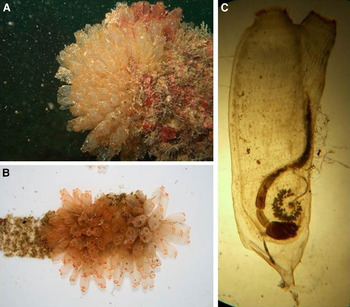
(A, B) Two mature colonies of the ascidian Ecteinascidia turbinata photographed on the wreck of the SS ‘Margit’ in Kalkara Creek, Grand Harbour, Malta on 10 September 2015 (A), and a sample taken from ‘tug 2’ on 28 October 2015 (B). (C) A single mature zooid with testes and ovary. The external appearance of the colonies match the differential descriptions for the genus (Goodbody & Cole, Reference Goodbody and Cole2006). The main distinguishing features include the close position of the orange coloured exhalant and inhalant siphons at the top of the zooid, the lack of red pigment spots between the lobes of the siphon edge and the relative straightness of the intestine (Berrill, Reference Berrill1932). Each individual zooid in both photographs is between 1 and 2 cm in length.

A summary of the sites at which Ecteinascidia turbinata was recorded in Malta.

a Samples taken.
Twelve sampled colonies were fixed with 10% formalin in seawater. Some zooids of each colony have been dissected, stained with Masson's haemalum and mounted on permanent slides. Taxonomic identification was carried out using original descriptions (Herdman, Reference Herdman1882, Reference Herdman1890, Reference Herdman1891; Van Name, Reference Van Name1945). The specimens have been deposited in the Department of Marine Sciences of the University of Alicante (DCMBA, ET-Mt01-12).
RESULTS
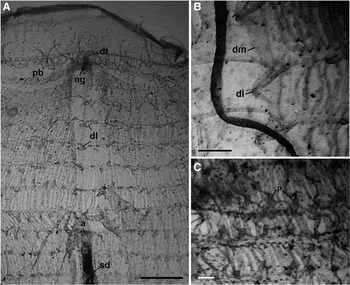
In general the tunicate described here corresponded closely to former descriptions of E. turbinata (Herdman, Reference Herdman1882, Reference Herdman1890; Berrill, Reference Berrill1932; Van Name, Reference Van Name1945). However some of the zooids investigated microscopically were similar to the original description of E. moorei (Herdman, Reference Herdman1890). This finding explains the disagreement in the published descriptions of E. moorei and E. turbinata and confirms their synonymy. The most striking features of these colonial tunicates are the bright orange siphons and the translucent tunic of the zooids. The colonies are made of spherical or hemispherical (depending on attachment) bunches of tight erect zooids, attached by a web of anastomosed stolons (Figure 2A, B). The zooids from the sample taken from the ‘Tug 2’ site are 6–15 mm long and have gonads in different stages of development. The tunic is naked and transparent. The siphons are close together, with some of the orange colour remaining after formalin fixation. When contracted, the siphons are still apparent (Figure 2C) (not invaginated as is typical in E. thurstoni). The siphonal musculature is marked (not weak as in E. thurstoni); the transverse muscles do not cross the intersiphonal space (as in E. thurstoni). The muscles are not interrupted between the two sides before the 11th row of stigmata, but extend farther on the right side. In agreement with others (e.g. Van Name, Reference Van Name1921) there are about 40–50 tentacles present in three to four distinct lengths. The prepharyngeal band has a high anterior blade and a posterior ribbon. There is no dorsal indentation. The dorsal tubercle is small and oval (as in E. thurstoni), located under the prepharyngeal band (Figure 3A). The dorsal lamina has elongated and flattened languets with or without a membrane (Figure 3A, B).
Branchial sac of Ecteinascidia turbinata from Malta: (A) anterior-dorsal part of the zooid showing perypherical band (pb), dorsal tubercle (dt), neural gland (ng), dorsal languets (dl), anus (a) and sperm duct (sd); (B) dorsal continuous membrane (dm) with languets (dl); (C) papillae (p) cylindrical and triangular. Bars: 1 mm (A); 0.5 mm (B, C).

The branchial sac has 15–16 rows of stigmata on the left side and 16–17 on the right. Flat or cylindrical papillae (Figure 3C) are united by 15–16 longitudinal vessels on each side, but some papillae, such as those closest to the dorsal lamina, lack vessels. The vessel close to the endostyle is made of T-shaped papillae, sometimes arranged two by two. The longitudinal vessels are very regular, the meshes containing 2–4 stigmata. The gut forms an open loop without a flat secondary curve (unlike E. thurstoni) (Figure 2C). The oval stomach shows two wide oblique bands (Figure 2C) and there is a post-stomach. The intestine ascends at first along the dorsal side but does not become parallel to the dorsal lamina (as in E. thurstoni). The anus has two lobes at the level of the 6–7th stigmata row. The male gonad is developed with small and numerous vesicles in concentric rings around the ovary (Figure 2C). The sperm duct converges towards the left side of the rectum at the level of 10–11th stigmata row, and ends close to the anus (Figure 3A). Some zooids presented fertilized ovules and one early larva was observed.
DISCUSSION
Classification of E. turbinata
The genus Ecteinascidia was formed by Herdman (Reference Herdman1882) from specimens obtained during the ‘Challenger’ expedition. In this initial report, Herdman reported that tunicate samples from Alexandria harbour (Egypt) were the same species, E. turbinata, as he had found in the Caribbean. However, he later (Herdman, Reference Herdman1890), reported that the tunicate from Alexandria was in fact a related but distinct species, which he named E. moorei in honour of Mr T.J. Moore, curator of the Liverpool Free Public Museum, who had passed the sample to him. There is confusion as to the taxonomic status of E. moorei as some authors state that E. moorei is a junior synonym of E. turbinata. Harant (Reference Harant1927a) includes it as a synonym stating that he had studied both and concluded that they were the same species but did not provide the evidence. Later Harant & Vernières (Reference Harant and Vernières1933) stated the synonymy but the reference given for this (Van Name, Reference Van Name1930) was incorrect. However, Van Name (Reference Van Name1921: 378) makes the following statement about the dorsal lamina in E. turbinata: ‘… a continuous membrane which is extended into a well-developed languet at each transverse vessel. Or it may be described as a series of languets connected by a basal membrane. It lies turned over toward the right side of the body’. One of the characteristics that separate E. turbinata from E. moorei is the development of the dorsal membrane, but in E. turbinata the two types of development of the membrane occur.
In Herdman's dichotomic key (1890: 160), the main characters that separate E. moorei from E. turbinata and E. thurstoni are: dorsal languets and connecting ducts are wide and membranous; whereas E. turbinata and E. thurstoni present dorsal languets and connecting ducts that are narrow and papilliform. Moreover, Kott (Reference Kott1952: 316) adds the following characters to E. moorei: zooids clustered into dense hemisphere, vas deferens ends ventral to rectum; whereas in E. turbinata and E. thurstoni: zooids clustered into irregular mass, vas deferens ends dorsal to rectum. The specimens from Malta can form dense masses of zooids (Figure 2), present dorsal languets and connecting ducts both narrow and wide (Figure 3A–C), and have a spermiduct that ends ventral or lateral to rectum (Figure 3A).
Others treated E. moorei as a full species (Garstang, Reference Garstang1891; Sluiter, Reference Sluiter1905; Michaelsen, Reference Michaelsen1918; Harant, Reference Harant1927b), a few after it had been synonymized (Kott, Reference Kott1952, Reference Kott1964; Por, Reference Por1978). To further complicate the matter, Monniot & Monniot (Reference Monniot and Monniot1997) are of the opinion that the E. moorei of Sluiter (Reference Sluiter1905) is in fact E. thurstoni while Pérès (Reference Pérès1954) considers another species, E. herdmanni as young specimens of E. turbinata. Our finding that some zooids within the same colony conform to the descriptions of both E. turbinata and E. moorei, confirms that E. moorei is a junior synonym of E. turbinata. This explains why Herdman (Reference Herdman1890) apparently changed his mind about the identity of the sample from Alexandria and why there is no presently known population of E. moorei. It remains to be seen if E. moorei-like zooids also exist in E. turbinata colonies in the Caribbean population.
Two different colour varieties have been identified in E. turbinata across the range in the Caribbean, Atlantic and the Mediterranean (López-Legentil & Turon, Reference López-Legentil and Turon2007). Colonies occur as ‘orange’ or ‘white’ especially when photographed against a white background and all those in the Spanish Mediterranean so far described have been the white variety. The colonies that we have found were also of the white (translucent) type. Colony colour may be determined by environmental factors as it has been noted that the colour of E. thurstoni colonies was dependent on the available light with poor illumination resulting in colourless animals (Por & Dor, Reference Por and Dor1975). The natural situation in which E. turbinata is found in its Caribbean range and in the Red Sea, is the submerged roots of mangrove trees where ambient conditions are similar to those found in the SS ‘Margit’ site in Kalkara Creek, where low light levels were caused by a high silt sediment burden with relatively high temperatures; however, in Cuba it is also found in clean water attached to hard coral between 22 and 38 m depth (Hernández-Zanuy et al., Reference Hernández-Zanuy, Carballo, García-Cagide, Naranjo and Esquivel2007), which is closer to the conditions found in St George's Bay and on the ‘Tug 2’ wreck (Table 1). Ecteinascidia turbinata is also found on wrecks in Bermuda (Berrill, Reference Berrill1932).
The status of E. turbinata in the Mediterranean
It is now evident that E. turbinata has existed in the Mediterranean since at least the late 1800s but was listed as a non-indigenous species (as E. moorei) in the Mediterranean (Streftaris et al., Reference Streftaris, Zenetos and Papathanassiou2005) and as alien in the WoRMS database (Sanamyan, Reference Sanamyan, Shenkar, Gittenberger, Lambert, Rius, Moreira Da Rocha, Swalla and Turon2015). However, it was not included in the lists of recent non-indigenous ascidians by Izquierdo-Muñoz et al. (Reference Izquierdo-Muñoz, Díaz-Valdés and Ramos-Esplá2009) and Zenetos et al. (Reference Zenetos, Gofas, Verlaque, Cinar, García Raso, Bianchi, Morri, Azzurro, Bilecenoglu, Froglia, Siokou, Violanti, Sfriso, San Martín, Giangrande, Katagan, Ballesteros, Ramos-Esplá, Mastrototaro, Ocaña, Zingone, Gambi and Streftaris2010) on the basis that there are old records of this species and that it is circumtropical. On the other hand, some have described E. turbinata as a ‘probably native species’ (Chebbi et al., Reference Chebbi, Mastrototaro and Missaoui2010). The EASIN database gives this species as ‘cryptogenic’ and we feel that this is the safest description. It is also possible that E. turbinata survives as relic populations such as those we have found in Malta, from warmer periods in the distant past.
Distribution of E. turbinata in the Mediterranean and neighbouring areas
Ecteinascidia turbinata has been described as being rare in the Mediterranean (Pérès, Reference Pérès1949) but it is known (Figure 1) from many localities as follows. The Western Mediterranean: Balearic Islands (Rodriguez, Reference Rodriguez1922; Pérès, Reference Pérès1954; Ramos et al., Reference Ramos, Turon, Wahl, Banaigs and Lafargue1991; Carballo et al., Reference Carballo, Naranjo, Hernández-Zanuy and Kukurtzii1997), Alicante (Cornet & Ramos, Reference Cornet and Ramos1980; Ramos, Reference Ramos1988; Luján, Reference Luján1995), Marsala in Sicily (Pérès, Reference Pérès1954) and Bizerte in Tunisia (Pérès, Reference Pérès1956). Central Mediterranean (Ionian Sea) in southern and eastern Tunisia, in the Gulf of Gabès (Pérès, Reference Pérès1954, Reference Pérès1956; Zaouali, Reference Zaouali1976; Ben Mustapha et al., Reference Ben Mustapha, Komatsu, Hattour, Sammari, Zarrouk, Souissi and El Abed2002; Meliane, Reference Meliane2002; Chebbi et al., Reference Chebbi2010) and Kuriat Islands (Ramos & Ben Mustapha, Reference Ramos and Ben Moustapha2010). Aegean Sea (Monniot, Reference Monniot1983; Koutsogiannopoulos et al., Reference Koutsogiannopoulos, Zenetos, Ramos-Esplá and Thessalou-Legaki2012). With respect to the Levantine basin (Eastern Mediterranean), apart from the old records from Alexandria (Herdman, Reference Herdman1882, Reference Herdman1891; Harant, Reference Harant1939), no further citations have been made, despite a number of studies carried out in the area (Sedra & Khalil, Reference Sedra and Khalil1972; Abdel-Messeih, Reference Abdel-Messeih1982; Ghobashy & Abdel-Messeih, Reference Ghobashy and Abdel-Messeih1991; Ramadan et al., Reference Ramadan, Kheirallah and Abdel-Salam2006; Shenkar & Loya, Reference Shenkar and Loya2009). Regarding the NW Mediterranean, Harant (Reference Harant1927a) reported E. turbinata from Cap Creus (NE Spain). However, no later studies in this Mediterranean sector have observed this species (Cornet & Ramos, Reference Cornet and Ramos1980; Ramos, Reference Ramos, Ros, Olivella and Gili1984; Lafargue et al., Reference Lafargue, Ramos, Turon, Banaigs and Whal1986; Turón, Reference Turon1987). Ecteinascidia turbinata has also been reported in areas neighbouring the Mediterranean Sea (Figure 2): the Bay of Cadiz (Ramos, Reference Ramos1988; Ramos et al., Reference Ramos, Buencuero, Vázquez and Lafargue1992; Naranjo, Reference Naranjo1995), quite near to the Gibraltar Strait; and the Suez Canal and the Red Sea (Harant, Reference Harant1927b; Elbaz, Reference Elbaz2009).
Prospects for the Mediterranean E. turbinata populations
Despite the fact that E. turbinata larvae are relatively large (4.5 mm), active swimmers that are protected to some extent from fish predation through toxins and aposematic colouration (Young & Bingham, Reference Young and Bingham1987), long-range dispersal of this tunicate is reported to be primarily due to rafting of adult colonies (Bingham & Young, Reference Bingham and Young1991), with larval dispersal limited to a few 100 m (Carballo, Reference Carballo2000). The nearest previously known location of E. turbinata to Malta is in the Gulf of Gabès, Tunisia (Figure 1). However it is not likely to have spread to Malta from this location due to the limited autonomous larval dispersion and the hydrographic isolation of Gulf waters. It is possible that this tunicate may have been transported to its present Maltese site by shipping, as two other ascidians are proposed to have been (Evans et al., Reference Evans, Barbara and Schembri2015), either in ballast water or as adult colonies with fouling assemblages (Izquierdo Muñoz et al., Reference Izquierdo-Muñoz, Díaz-Valdés and Ramos-Esplá2009).
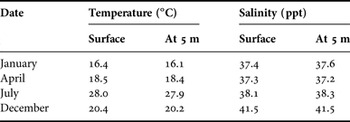
Whereas E. turbinata colonies grow all year round in the El Bibane lagoon, Tunisia (Chebbi, Reference Chebbi2010; Chebbi et al., Reference Chebbi, Mastrototaro and Missaoui2010), populations in Alicante and the island of Formentera are seasonal (Luján, Reference Luján1995; Carballo et al., Reference Carballo, Naranjio, Kukurtzü, De La Calle and Hernández-Zanuy2000) and survive winter months as quiescent bodies derived from the stolons. The crucial temperature below which zooids regress appears to be around 17–18°C (Carballo et al., Reference Carballo, Naranjo, Hernández-Zanuy and Kukurtzii1997). It remains to be determined if the recently discovered colonies are seasonal in Malta, where fertilized ova and larvae have been observed in late October; in Alicante this happens a month before, in late September (Luján, Reference Luján1995). However, the data for the SS ‘Margit’ site (Table 2) indicate that the temperature drops below the threshold for the winter months, making it very likely that E. turbinata is seasonal. It is of course possible that this particular population has adapted to growth in colder waters (but we note that this has not occurred in the Spanish populations). The colonies present at the Peloponnese site in Greece were large and numerous in July 2011, but very small and sparse in July 2012 (Koutsogiannopoulos et al., Reference Koutsogiannopoulos, Zenetos, Ramos-Esplá and Thessalou-Legaki2012), indicating that conditions (probably temperature) result in these populations too being seasonal and perhaps often marginal.
Temperature and salinity measurements from outer Kalkara Creek, site of the wreck of the SS ‘Margit’, measured in 2010 (Gianella Pisani, unpublished).

CONCLUSIONS
We have recorded several live colonies of E. turbinata on two Maltese shipwrecks and in one case in a neighbouring inlet. This is the first report of this ascidian in Maltese waters. All our records so far have been made in summer and early autumn months (mid-July to late October) but we suspect that this species will reproduce seasonally around Malta due to the winter water temperatures falling below the 17–18°C threshold below which zooids regress to resting stolons. We expect that conditions will prove suitable for E. turbinata across Malta and that the ‘Tug 2’ site will be particularly valuable for monitoring its establishment success over time and studying how the presence of this tunicate influences existing species assemblages. Since around 2009, E. turbinata seems to be expanding into new areas, and it has now colonized Posidonia oceanica meadows and the infralittoral rock of Mar Menor, a coastal lagoon in SE Spain outside the previously recorded areas (A.A.R.E., personal observation), the Aegean Sea (Koutsogiannopoulos et al., Reference Koutsogiannopoulos, Zenetos, Ramos-Esplá and Thessalou-Legaki2012) and Malta (present work). The question as to the origins of the present-day populations of Mediterranean E. turbinata may be resolved by phylogeographic analysis (López-Legentil & Turon, Reference López-Legentil and Turon2005; Elbaz, Reference Elbaz2009), comparing variations in suitable genes from across its present range. The available information indicates that the status of E. turbinata in Malta and the Mediterranean is best described as being cryptogenic, and yet the possibility of it being a relic population cannot be ruled out.
ACKNOWLEDGEMENTS
The authors thank Professor Victor Axiak and Giannella Pisani for the temperature and salinity data, Prof. Françoise Monniot for her valuable information about E. turbinata and E. moorei; ‘Aquatica’ of St Paul's Bay, Malta and the Pentland Sub-Aqua Club (Edinburgh, Scotland) for dive support, and Anne-Marie Damiano, from the Musée Océanographique de Monaco, for providing documents. A local diver, David Aguis, is gratefully acknowledged for providing photographic evidence.