INTRODUCTION
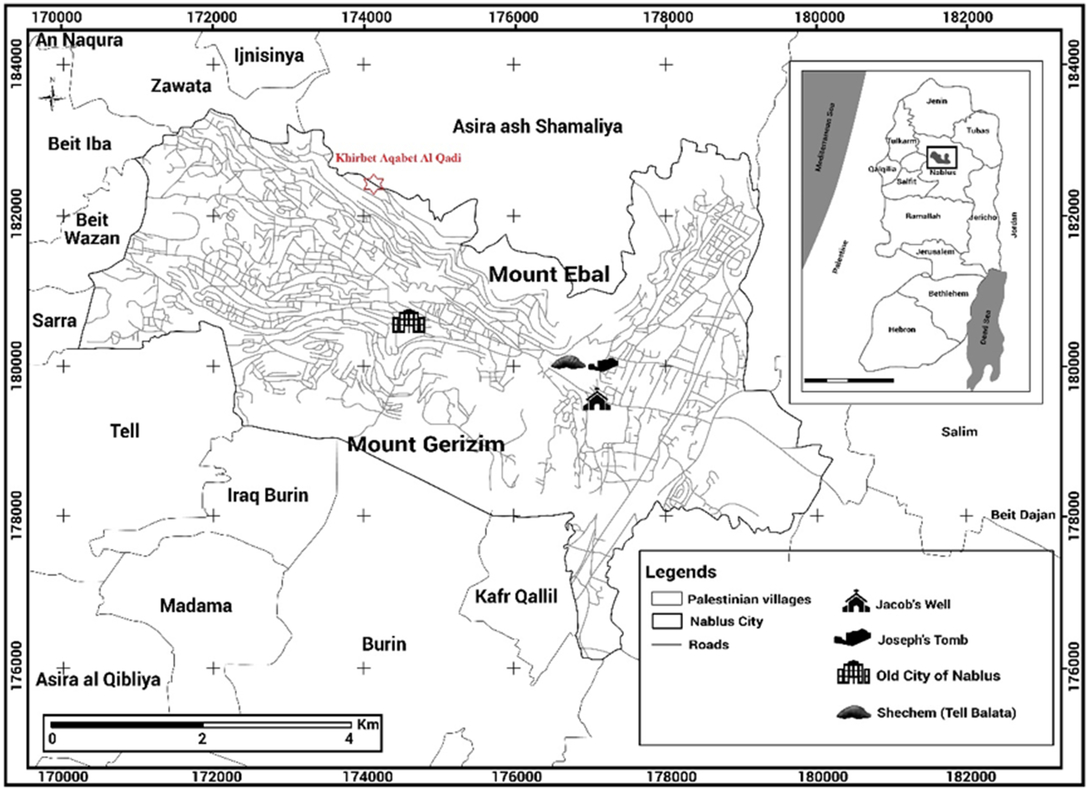
A burial chamber was discovered at Khirbet Aqabet Al Qadi in 2016. It is located 2 km north of the city center of Nablus on the northwestern slope of Mount Ebal. At 600 m above sea level, the site overlooks the city and is 1 km north of the Western Mausoleum and 3–4 km northwest of the Eastern Mausoleum (Figures 1 and 2). The fact that there were significant archaeological remains on the site was first discovered when the owner of the land was clearing the site to build a house. At the time, a small-scale salvage operation was undertaken. The Palestinian Ministry of Tourism and Antiquities requested that the archaeological team from the Department of Tourism and Archaeology at An-Najah National University examine the site. The aims of the salvage excavation were firstly to ensure that the burial chamber and its content remained intact by preventing construction work on the site and secondly to record descriptions of the archaeological structures and remains. Destruction of the landscape and building expansion on archaeological sites in the Nablus area and issues of frequent looting at burial sites made this an important undertaking.
Map of Nablus showing distribution of mausoleums.

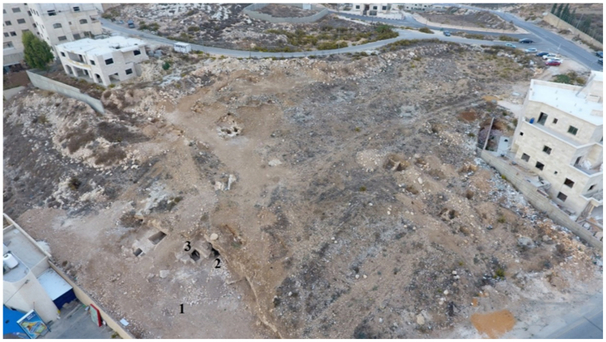
Aerial photo of the site: 1) courtyard, 2) cave, 3) burial chamber. (Photo by M. Barghothi.)

During our exploration of the site, we found a large courtyard leading to the underground burial chamber mentioned, in which four sarcophagi covered most of the floor space. The chamber was in the form of a cave hewn into the limestone rock from which five loculi or niche graves were hewn, extending outward from the central chamber. Another cave was found that was also entered from the courtyard. It contained a large number of artifacts, demonstrating evidence of inhabitation.
Funerary studies have the potential to reconstruct past cultures, in particular, in terms of social organization and ritual. Based on this assumption, our study includes analysis of human bones—the first time this has been undertaken in the Nablus area—as well as information sourced from published archaeological reports and manuscripts on Palestinian archaeological sites during the period between the early Roman period (approximately 63 BC) and the late Byzantine period (AD 638/16Hijra) in Palestine.
Our tasks included comparing the four sarcophagi we found with other examples in the Nablus area and the rest of Palestine in order to ascertain their historical and archaeological context. With regard to the analysis of human skeletal remains found in the sarcophagi, we organized radiocarbon (14C) dating with the intention, if possible, of proceeding to stable isotope analysis. We were seeking more precise information on chronology, dietary habits, and the social-economic status of the individuals concerned.
BACKGROUND
Necropolises and burial chambers can be found dispersed across outlying areas of Nablus. The most significant include our burial chamber at Khirbet Aqabet Al Qadi and the Eastern and Western mausoleums found at the entrances to the city (Magen Reference Magen1987). Mausoleums were built along the most important trade routes in the area, eastward toward the Jordan Valley, westward toward the Mediterranean, and northward toward Sebastia in ancient Samaria (Magen Reference Magen1987). In recent years, several articles have been published on the Askar Mausoleum (the Eastern Mausoleum of Nablus). The most notable among these is that by Damati (Reference Damati1985–1986). Roman sarcophagi were made of several materials, including wood, lead and stone—the most valuable were of marble and the least valuable of limestone. Stone sarcophagi were highly valued due to their more elaborate decoration. Plain stone sarcophagi survived in lesser numbers as they were not valued in later periods and were reused as building material (Nadal Reference Nadal, Celdrán and Guerri2001: 19). The Askar Mausoleum and funerary complex, considered the most important in Nablus, is found on Mount Ebal. Roman tombs evolved in NeapolisFootnote 1 in two phases. The first phase, from the 1st century BC to the 1st century AD, related to the use of loculi, and the second, sarcophagi. The sarcophagi would be placed in the burial chamber along with the existing tombs. This practice occurred until the beginning of the 2nd century AD (Magen Reference Magen and Stern1993a: 1354).
Clermont-Ganneau (Reference Clermont-Ganneau1896) was the first to publish a reference to sarcophagi in the region when he mentioned a small lid at Shechem (modern Balatah). Later, Vincent (Reference Vincent1920: 135) was the first to describe fragments from sarcophagi on the slopes of Mount Ebal in 1919. He thought they were similar to sarcophagi in Jerusalem. He described the walls as fine, the frame as distinctive and the decoration as in the form of friezes; he suggested the sarcophagi belonged to the Jewish community or perhaps the Samaritans, dating them to the early 1st century AD. Abel (Reference Abel1923) attributes the Askar Mausoleum to the Jewish-Samaritan population, at the time of Hadrian and Marcus Aurelius (134–50 AD). However, Avi-Yohah (Reference Avi-Yonah1946) suggests the sarcophagi belonged to the Samaritan community. According to Smith (Reference Smith1973: 76), either the sarcophagi date to between the late 1st century BC and the early 2nd century AD or the Crusader period. Damati (Reference Damati1972: 174, Reference Damati1973: 118–119, Reference Damati1985–1986), suggests the Mausoleum belonged to a Samaritan family living in Askar in the late 2nd to early 3rd centuries AD; support for this lies in the fact that two sarcophagi are inscribed with names. Barkay (Reference Barkay1991b) dates the sarcophagi to the late 2nd to 3rd centuries AD when the Samaritan community prospered and spread after the Bar Khoba revolt.
Of seven coins found alongside the Samaritan sarcophagi, three date to the Severan dynasty. Another three belong to the second half of the 4th century. Sarcophagi used in the western Nablus region during the Roman period were found at Škem in Sebastia and other places, in chambers carved into rock—the lengthwise front panels were decorated with an ornamental frieze in relief with column motifs. Magen (Reference Magen and Stern1993a) suggested the sarcophagi thought to be Samaritan would have imitated the Jewish sarcophagi from the second Jerusalem period. He also suggested this imitation was a common practice in Nablus among the Samaritan and pagan populations (Magen Reference Magen, Manns and Alliata1993b: 165). However, we do not believe this to be the case. The sarcophagi from Nablus are either undecorated or the panels are decorated with discs, friezes, rectangular shapes and wreaths or partial circles over ivy leaves. Also, in Jerusalem, the Samaritans did not accept the usual Jewish style of burial during Roman rule (the ossuaries of Jerusalem are an example) (Magen Reference Magen1987: 11).
The Samaritans usually buried their dead in a type of hut (according to a Greek style) and this was witnessed in the Hellenistic burials on Mount Ebal (Magen Reference Magen1987: 12). While the dating and whether Jewish or Samaritan is unclear, Magen (Reference Magen, Manns and Alliata1993b: 163) believes the Samaritans did not develop a distinctive model and the sarcophagi date to the early 2nd century AD. The finding of materials from later periods in some tombs reinforces the fact that caves continued to be used for burial until the early Arab period (Magen Reference Magen, Manns and Alliata1993b: 163). Al-Fanni (Reference Al-Fanni1998, Reference Al-Fanni1999) also suggests the Askar Mausoleum dates to the 2nd century AD. He refers to the finding of a large quantity of bones and black Greek painted pottery at the site, suggesting reuse of the sarcophagi. This may be the case when considering the intensive building activity in Nablus at that time. The sarcophagi cannot be dated to the time of Hadrian and his successors as Able (Reference Abel1923) believes. Those buried may have been Samaritan, Jewish, or even pagan, but, without evidence for exact dating, we cannot make any conclusive assertion. The debate about whether the sarcophagi are Jewish or Samaritan may be affected by the history of Palestine, due to political, religious, geostrategic, and economic reasons.
More accurate dating, bearing in mind the scarcity of archaeological information, would need to come from future regional studies of the different workshops and import systems in place in ancient Palestine. In regard to similarities in design and decoration between sarcophagi, a local workshop is indicated, operational during a relatively short period of time.
Burial Chamber and Sarcophagi
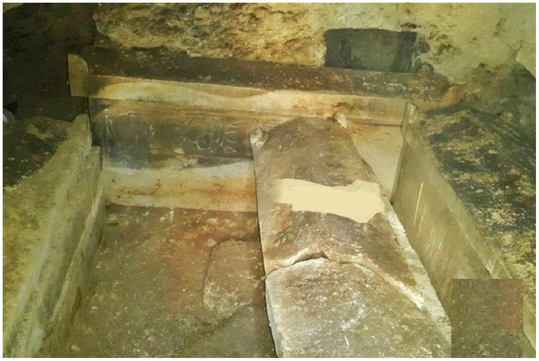
The burial chamber, hewn into limestone rock, has a nearly square floor measuring 3.15 × 2.9 m and has an average height of 1.8 m (Figure 8). The circular limestone entrance block could be rolled back and forth. There are two stone pillars 0.15 m × 0.15 m framing either side of the entrance. The rolling stone is 1.2 m in diameter and 0.25 m deep and when found still rolled in its trough. The entrance is formed by a gap between two walls of hewn stone. The width is 0.7 m, and the depth, 1.1 m, while the width of each sarcophagus is approximately 0.6 m, indicating they were built elsewhere and later taken into the chamber. There are two steps (0.6 m wide × 0.2 m deep) leading downward from the entrance where five niche tombs carved in rock extend approximately 0.2 m outward from the central chamber. Four of them are 0.53–0.7 m in width and one has a width of 1.8 m (Figure 3). There four sarcophagi standing on the floor of the chamber (Figure 5). They were made of soft limestone, identified as from Mount Ebal (Figures 4 and 5). We have numbered them from one to four for identification purposes and describe them as follows.
Overhead and cross-section views of the burial chamber.

The four sarcophagi found in burial chamber. (Drawing: I Iqtiat.)

Sarcophagi in burial chamber showing distinctive decoration on Sarcophagus 1.

Sarcophagus 1, located on the western side of the burial chamber, has a north–south orientation. On the front panel, four vine leaf motifs are carved on either side of a central carved vessel, signifying plenty. The sarcophagus is 2.07 m long, 0.56 m wide, and 0.67 m deep. (Figures 4:1 and 5). Sarcophagus 2 was found on the northern side of the burial chamber and lies east-west. The decoration consists of three geometric squares on the front panel and a geometric square on each of the end panels. It is 2.07 m long, 0.58 m wide, and 0.71 m deep (Figures 4:2 and 5). Sarcophagus 3 was in a central position in the chamber lying parallel to Sarcophagus 2. It is decorated with a carved geometric square on either side of the front panel and is 1.82 m long, 0.51 m wide, and 0.48 m deep (Figures 4:3 and 5). Sarcophagus 4, also parallel to the previous two, is found on the southern side of the chamber and has three carved geometric squares on both longitudinal side panels. It is 2.01 m long, 0.58 m wide, and 0.7 m deep (Figures 4:4 and 5).
Other Structures and Material Finds
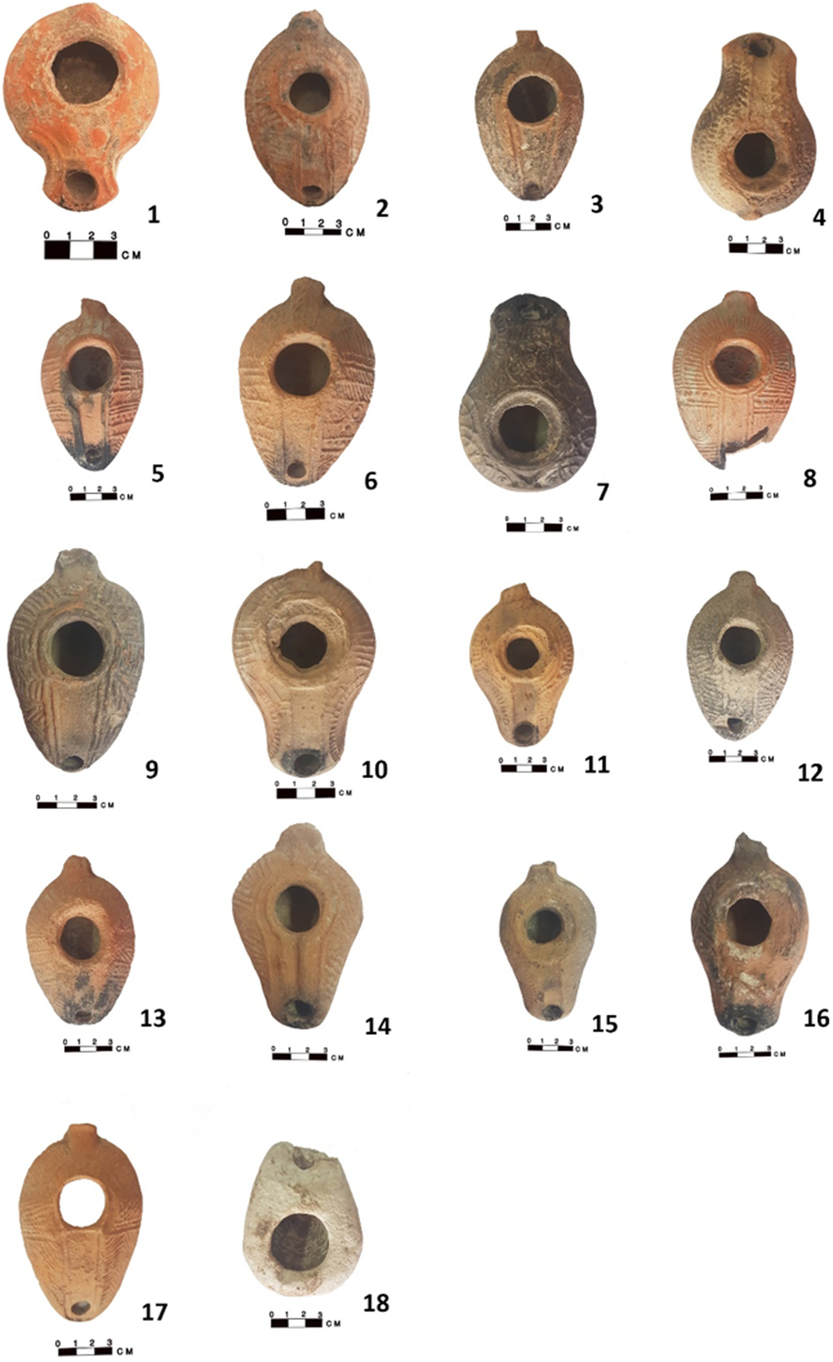
Artifacts were found in the burial chamber and the cave. The courtyard leading to both of them measures 18 × 10 m and the floor is of hewn rock in some parts and paved with flagstones in others and has not been excavated. The burial chamber entrance is on the western boundary and the entrance to the cave on the northwestern one (Figure 3). In the cave measuring 6 × 5 m, numerous pottery shards were found among a large quantity of debris and earth. The shards were from jars, cookware, and tableware, as well as from a large number of oil lamps dating from the Roman and Byzantine periods to the early and middle Islamic periods (Figures 2, 3, and 8: 1–18).
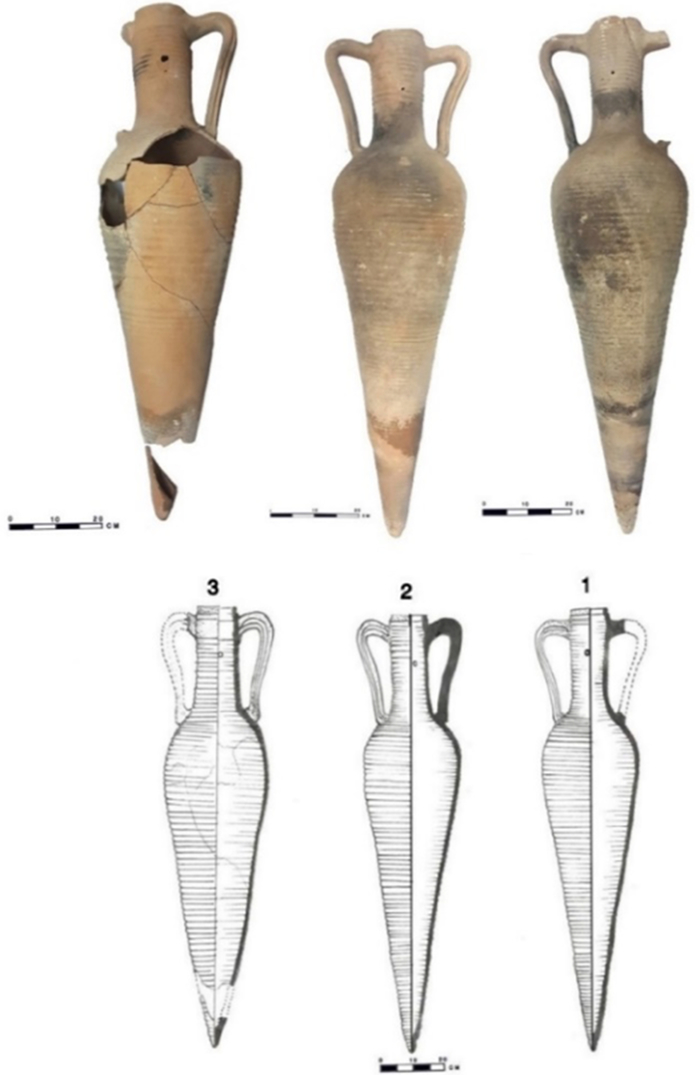
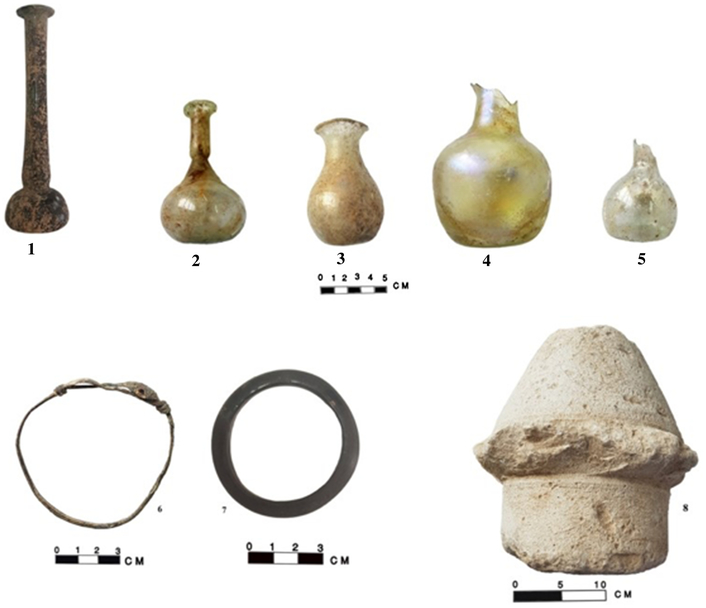
Three amphorae were found in the burial chamber. They were in the western corner and two of them were intact and the other one was broken. They all have long, conical bodies, horizontally ribbed, curving inward to long, narrow cylindrical necks and have long handles on either side. A very small hole is found in the center of each neck that would have been inserted after manufacture, suggesting they were probably originally produced for wine, but later used for vinegar with the air holes aiding fermentation. Five olive stones and a grape seed were found in the base of the broken amphora. Their stoppers would have been of stone or mud. A carved hard white limestone stopper was found near them. Some scholars suggest this type of stopper was used from the mid-5th to mid-6th centuries AD (Wicenciak Reference Wicenciak2016: 658; Figure 6: 1–3). This type of wine amphora was manufactured from the 4th to 5th centuries AD and small quantities are found to the north and west of the Black Sea and in the eastern Mediterranean, in Athens and Palestine (Opaiţ Reference Opait2010: 371). Two bracelets were also found in the burial chamber: one was metal with an ornamental snake design and the other of plain blue glass (Figure 7: 1–5). Five glass bottles of different shapes and colors were found, of which, three were found in the burial chamber and two in the cave (Figure 7: 6–7). The characteristics of the bracelets and the bottles indicate they date from the early Roman period (63 BC–135 AD).
Amphorae found in burial chamber. (Drawing: I Iqtait.)

Glass bottles found in burial chamber (1–3) and cave (4–5); bracelets (6–7), funerary marker (8).

In addition to these artifacts, a funerary marker carved from hard limestone was found near the burial chamber. It is in the form of a pyramid on a cylindrical base—the pyramid symbolizing the soul of the deceased. Pyramids were also an emblem on funerary markers found in Jericho (Toynbee Reference Toynbee1971:245; Hachlili and Killebrew Reference Hachlili and Killebrew1999: 162–163; Figure 7: 8). Furthermore, divided between the burial chamber and the cave, 18 oil lamps of Samaritan typological characteristics were found, all but one made from moulds, with the exception carved from white limestone. Three were found in the burial chamber and 15 in the cave. Samaritans, Christians, and pagans in Palestine and Jordan used Samaritan oil lamps from the late Roman to the early Islamic periods (Adler Reference Adler2004: 96). Examples were found in Nablus and Apollonia-Arsuf (Sussman Reference Sussman1983; Magen Reference Magen2009). We identified four types: A–D (Figure 8: 1–18).
Oil lamps found in burial chamber (1–3) and cave (4–18).

Chronological and Dietary Analysis of Human Remains
The number of studies on health and diet related to newly discovered necropolises has increased significantly in recent years, where researchers have attempted to analyze the social structure of settlements (Sánchez Romero Reference Romero2008: 25). The distribution of wealth is related to the variables of health and diet (Sánchez Romero Reference Romero2008: 26). Despite our sample size limiting our options for analysis, we present it as pioneer research for this study area. Two of the sarcophagi contained human skeletal remains, but the poor state of preservation of the bones and the high fracture rate prevented the undertaking of a pathological study relating health condition to diet and social status. Nevertheless, our analysis of carbon and nitrogen stable isotopes in the collagen from our bones permitted reconstruction of the paleo diet of one of the individuals in the sarcophagi.
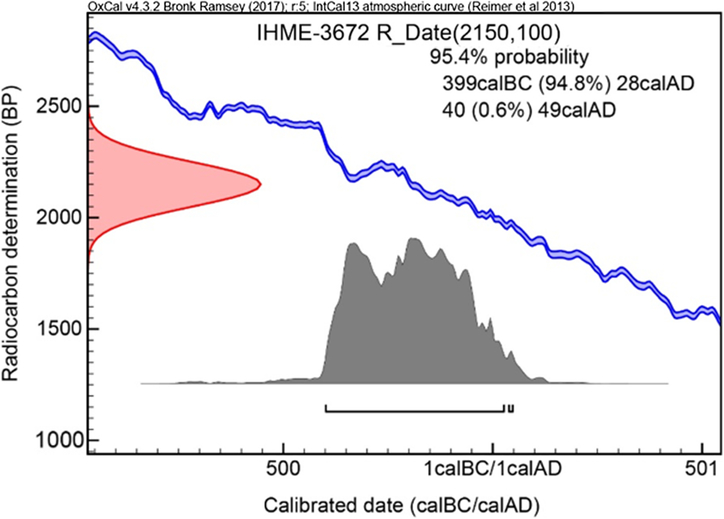
We used rib samples from the individuals in Sarcophagus 1 (2150 ± 100 BP; see Figure 9) and in Sarcophagus 2 (14C dated to approximately 400–300 BC but this age is not considered reliable due to low collagen content)Footnote 2 . The extraction of collagen and stable-istope mass spectrometry were performed at the laboratories of the Isidro Parga Pondal Geological Institute, at A Coruña University, Spain, while the 14C samples were analyzed by Mykhailo Buzinny at a laboratory in Ukraine.
Radiocarbon calibration for Khirbet bone sample (K1).

Before extracting collagen from the bones following the Longin method (Reference Longin1971), the bones were decontaminated by alternately cleaning them in H2O and acetone baths. Subsequently, the two samples were pulverized, obtaining 250–300 mg of bone powder. A small amount (20 mg) was subjected to carbon and nitrogen elemental analysis. In Sample 2, the amount of nitrogen was very low at 0.17%. This indicated poor collagen preservation and limited possibilities for stable isotope analysis. However, the amount of nitrogen in Sample 1 was sufficient for analysis at 0.55%.
Sample 1 was subjected to digestion and filtration procedures. The sample was demineralized in HCI 1 M and then in NaOH 0.125 M to eliminate organic contaminants. Subsequently, microfiltration was carried out in which insoluble residues were dissolved in mild HCI 0.01 M in a 100ºC oven for 17 hr. After lyophilization, the bone collagen was combusted and the CO2 and N2 measured in a mass spectrometer for the stable-isotope composition (Longin Reference Longin1971; Bocherens et al. Reference Bocherens1997).
For validity, we needed results within the collagen performance parameters of carbon and nitrogen content percentages of the C: N atomic ratio. According to Van Klinken (Reference Van Klinken1999), the content needs to be above 1.5%, and our sample met this target: carbon and nitrogen percentages were low, but acceptable with the C: N atomic ratio within established limits (De Niro Reference De Niro1985; Ambrose Reference Ambrose1990).
The information from the stable isotopes (δ13C) demonstrates that the individual’s (Sample 1) diet was derived mainly from C3 plants, which could include wheat, olive and grape, characteristic of the fertile Nablus valley, and the low δ15N values could indicate a legume-based diet. The δ13C values indicate the diet was not meat-based, nor was it marine or C4 plant. This diet suggests the individual was from a middle socio-economic group, as the burial style indicates (Table 1).
Results of elementary analysis of C and N values per sample.

However, analysis of a greater number of bone samples from individuals with age and gender determined would be needed for a wider view. Diet, age, and gender variables might determine social status. However, archaeological stable isotope research goes beyond human diet and mobility; crop and livestock analysis could give valuable archaeological knowledge (Tables 1 and 2).
Results of stable isotope analyses.

Underground Burial Chamber Tradition
The building of burial chambers and artificial caves for different purposes began in Neolithic times in Palestine. During the Iron Age (1200–538 BC) the number of caves used as dwellings decreased (Mati Reference Mati2001: 12). Semi-habitational forms appeared during the Iron Age, and later, Hellenistic and classical cultures influenced design and rituals. However, Iron Age underground construction became more generalized with large underground storage and water supply systems. An example is the 700 m of tunnelling underneath old Jerusalem (Gill Reference Gill1991: 1467). Construction of artificial caves for funerary purposes became widespread and their functional use continued until the beginning of Christianity, as demonstrated by the Holy Sepulchre in Jerusalem (Broshi Reference Broshi1991: 83). During this period, artificial burial caves were used by single families. The remains of libations, ritual fires and offerings of food and beverages are found with the human remains (Barkay Reference Barkay1991a: 92; Kloner and Davies Reference Kloner and Davis1991: 108).
In general, from the 7th to 6th centuries BC, we see large burial chambers of wealthy families excavated in rock. A staircase led down from an entrance of one square metre to a chamber with carved niches radiating outward (Barkay Reference Barkay1991b: 93). In the 5th century, we see Hellenistic influences and in the beginning of the 3rd century, the accumulation of human remains led to the use of ossuaries and there is an increase in finds of household items that would continue throughout most of the Roman era. Numerous cave finds, now believed to have been for funerary rituals rather than inhabitation, resulted from the Roman war in Palestine (Aviam Reference Aviam and Goren-Rosen1997: 8; Stern and Gorin-Rosen Reference Stern and Gorin-Rosen1997: 7). During the 1st century AD with the advent of Christianity, the use of ancient burial chambers as community meeting places for rituals increased. (Sutcliffe Reference Sutcliffe1960: 82; Avi-Yonah Reference Avi-Yohah2001: 149). In the Byzantine era (4th–5th centuries AD), major underground projects, as in the case of caves at Tefen, show complex constructions for family use (Lederman and Aviam Reference Lederman and Aviam1997: 138). The entrance was designed to prevent theft.
Hundreds of rock-cut tombs were constructed south of the Levant in ancient times, sometimes with elaborate facades and multiple burial chambers (Al-Houdalieh Reference Al-Houdalieh2009: 338). Some were above ground, but most were caves. Each usually belonged to a wealthy family, while poorer inhabitants were buried in the earth. Bodies were placed in the loculi and after a generation the bones were moved to bone chambers or, later, placed in sarcophagi to allow the loculi to be used for new burials.
In ancient Palestine, cemeteries were built outside the city walls because burials were forbidden inside the city (Loffreda Reference Loffreda1968: 244). Almost all of the tombs in the area of our chamber have been illegally excavated; this has resulted in the finding of very few skeletal remains in their original burial position and thus the samples are few for reconstruction of demographic, nutritional and palaeopathological information. Advantage was taken of the soft limestone for the construction of burial chambers, loculi and sarcophagi in the area. The entrances to all the burial chambers face east. Some of them have a circular rolling stone entrance and others a moveable square block closing the gap between the hewn stone walls. Descriptions are found in the Four Gospels, describing how the body of Jesus was wrapped in a clean linen cloth and placed it in a new tomb cut from the rock, and then rolled a large stone across the entrance and went away (Matthew 27: 57–66, 28: 1–2; Mark 15: 42–47, 16: 1–8; Luke 24: 1–2, 10–11; and John 20: 1, 11–18). The burial chamber at Nablus is very similar to those found at other sites in Palestine and Jordan, such as Khirbat Medras, Khirbat Umm Tuba near Jerusalem, the cemetery at Yasileh, north of Jordan and other cemeteries in Jenin and Ramallah (Al-Muheisen Reference Al-Muheisen2008: 315–337).
CONCLUSION
Khirbet Aqabet Al-Qadi is an important Roman site in the Nablus area. The rock-hewn burial chamber included five loculi and contained four sarcophagi. Information was gathered from the analysis of two samples of human bones from two different sarcophagi. After 14C analysis of the samples, we decided to focus on the results from Sample 1, due the poor state of preservation and high fracture rate of Sample 2. The sample demonstrated the diet of the individual—a diet that reinforces other evidence pointing to agricultural use of the land. We suggest that the burial chamber was first used in the 1st century AD, due to the fact that there is an inconsistency between the dating of the remains found in the burial chamber and the architectural design. In the analysis, the low collagen content prevented accurate dating of our sample but based on the results we were able to suggest a dating between 50 BC and 50 AD. This is chronologically in accordance with the other information gained from material and structural remains. The burial chamber, loculi and sarcophagi and the numerous artifacts found provide evidence to conclude that the hamlet was inhabited between the 1st and 3rd centuries AD. The depiction of a vase and grapevine motifs on Sarcophagus 1, and the amphorae found nearby are representative of symbolism of the early Christian and Samaritan eras.
SUPPLEMENTARY MATERIAL
To view supplementary material for this article, please visit https://doi.org/10.1017/RDC.2019.65
ACKNOWLEDGMENTS
Special thanks go to the field team from the Ministry of Tourism and Antiquities, to the reviewers, and to Bassam Nasasrah, Saleh Awad, and Mahmoud Al-Birawi, for providing comments that improved the manuscript, to our translator and editor, Mary-Lou Crane, and to Dr. Aurora Grandal D´Anglade from the Isidro Parga Pondal Geological Institute, A Coruña, Spain, for providing paleo diet analysis, and to Dr. Mykhailo Buzinny from the laboratory of the Academy of Medical Sciences of Ukraine, Kiev; Dr. A. J. Timothy Jull, editor of Radiocarbon journal, and Ms. Kimberley T. Elliott, managing editor. Finally, we would like also to thank the acting president at An-Najah National University Dr. Maher Al-Natsheh, and the Deanship of the Scientific Research Dr. Naji Qatanani, for their supporting to the team and the investigation.