Introduction
China has a complex history of relations with ethnic minorities, shaped by conflict and struggle between several ethnic minority groups and the Han ethnic majority. Since the fall of the Manchurian-led Qing dynasty in 1912, China's top leaders have been Han, while the Han have also been overrepresented amongst the political, economic and social elites. The history of China's modern policies pertaining to ethnic minorities can be traced back to the early 1950s, after the establishment of the People's Republic of China (PRC). It was then that the definition and identification of ethnic minorities was outlined. It was also then when social welfare policies designed to improve human capital accumulation for ethnic minorities were put into place.
These formal programmes to assist ethnic minorities have been relatively successful at boosting minority participation in higher education and other important sectors of the Chinese state and society (Hasmath, Reference Hasmath2008, Reference Hasmath2011a; Hasmath and Ho, Reference Hasmath and Ho2015; Cherng et al., Reference Cherng, Hasmath and Ho.2016). However, there is also a new wave of social welfare programmes, aimed primarily at urban residents, which provide more opportunities to analyse their impact on ethnic minority cohorts. Using data from the 2011 China Household Ethnicity Survey (CHES) we find, by comparing mean social welfare transfers, that the minimum livelihood guarantee programme – the dibao for short – has generally been pro-minority, while other new social welfare programmes still tend to favour Han residents, even when they are conditional on need. These disparate findings highlight the importance of local government officials’ incentive structure when implementing the new social welfare programmes.
We reach these conclusions after first reviewing the historical position and spatial location of ethnic minorities in China. We then examine the slate of social welfare policies the Chinese government has enacted specifically to benefit ethnic minorities. From this analysis arises our central analytical query: to what extent are ethnic minorities favoured in social welfare schemes?
Ethnic minority classification
In comparison to other nations where an individual self-identifies as an ethnic minority, minority nationality (shaoshu minzu) status is fixed at birth in China (see Hasmath, Reference Hasmath2010). This practice can be traced to the foundation of the PRC. When the Communist Party of China (CPC) came into power they commissioned studies to categorise and delineate ethnic groups. Teams were sent into regions heavily populated with ethnic minorities to conduct field work investigating minorities’ social history, economic life, language, and religion. As a result, 39 ethnic groups were officially recognised in 1954 and, by 1964, another 15 were identified. The Lhoba ethnic group was added in 1965, and the Jino in 1979, bringing the present-day count to 56 official ethnic groups (see Hasmath, Reference Hasmath2015). All Chinese citizens were subsequently registered by ‘nationality’ status in their household registration (hukou) and personal identification – a practice that still remains.
In determining what constituted an ethnic group, the CPC leaders followed the Soviet model, which politicised and institutionalised the identification and categorisation of ethnic minority groups (Ma, Reference Ma2007). Inspired by Joseph Stalin's (Reference Stalin1953) ‘four commons’, the criteria to identify an ethnic group included: (1) a distinct language; (2) a recognized indigenous homeland or common territory; (3) a common economic life; and, (4) a strong sense of identity and distinctive customs, including dress, religion, and foods. Interestingly enough, the dominant majority Han nationality, which has a population of 1.22 billion (National Bureau of Statistics, 2012), groups together a wide array of culturally diverse populations, including eight vastly different linguistic groups (Mandarin, Gan, Hakka, Southern and Northern Min, Wu, Xiang, Yue).
There is an acute pragmatism behind the policy for ethnic minority group classification in China, compared to the self-identification style used in many Western nations (see Hasmath, Reference Hasmath2011c). This is partially rooted in the history of the CPC, and the social policies that afford benefits to ethnic minorities. During the ‘Long March’ of 1934–35, Chinese Communist leaders became aware first-hand of the ethnic diversity and cultures of China as they moved from the southwest to northwest China. Facing near defeat by the Japanese and the Nationalists (Guomindang) on one side, and ‘barbarian tribesmen’ on the other, the Communists made promises of special treatment, and recognition, as well as the promise to establish autonomous regions for minorities – notably the Miao, Yi, Tibetans, Mongols and Hui – in exchange for their support (Snow, Reference Snow1994). It is from this experience that ethnic nationality identification and ethnic minority policies emerged.
Prior to the founding of the People's Republic, it was out of political necessity that the Communists sought to secure the support of ethnic minorities, in order to ensure their very survival against the Nationalists and Japanese forces. However, with China no longer facing these ‘foreign’ threats, the CPC turned its attention to ‘modernizing’ and ‘improving the livelihoods’ of ethnic minorities through social welfare policies (see Hasmath, Reference Hasmath2014a). As a consequence, ethnic minorities today are guaranteed ‘special rights’ and preferential treatment under China's Constitution, reaffirmed in various national (e.g. 1999 National Minorities Policy) and local (e.g. Beijing Minority Rights Protection Policies) public policies. While special exemptions vary by province, autonomous regions and municipalities, these special rights often include exemptions on the number of children an ethnic minority family can have, lower tax thresholds, lower required scores for entry into university and funding to express their cultural difference through the arts and sports (see Hasmath, Reference Hasmath2011b). Due to these advantages and preferential treatment afforded to ethnic minorities in China, the status of an ethnic citizen cannot be altered at his/her discretion, save in limited scenarios.
Spatial distribution
A fundamental characteristic of China's ethnic minority population is that it has a different spatial distribution from the majority, Han population. Among the estimated 113.79 million ethnic minorities, constituting approximately 8.5 per cent of the total population in the 2010 Census, the majority have traditionally been concentrated in the resource-rich provinces of Western China (Maurer-Fazio and Hasmath, Reference Maurer-Fazio and Hasmath2015). Suffice to say that these outsider minorities live far from the political and economic centres, but their locations are nationally strategic in nature. In contrast, most Han people live in the eastern, more economically developed, part of the nation.
The different regional distribution of the minority and majority populations existed prior to the establishment of the People's Republic. The introduction of the hukou system during the 1950s, which registered each citizen in China according to their local jurisdiction, limited population mobility during the initial decades of the PRC. The clearest exception to this was the in-migration of Han people to the Xinjiang Uyghur Autonomous Region (XUAR), Tibetan Autonomous Region (TAR) and other areas far from the political centre (see Hasmath, Reference Hasmath2014b). When the PRC ‘opened up’ for international trade and foreign investments in the 1980s and 1990s, it occurred in the eastern part of the nation, where the economy grew more rapidly than in the western region. The Central government policy of ‘opening up’ thus benefited the Han majority more than the outsider ethnic minority population and, as a consequence, gaps in opportunities and income between China's minority and majority populations increased during this period (see Gustafsson and Li, Reference Gustafsson and Li2003).
Policies targeting ethnic minorities
A number of policies in contemporary China focus specifically on ethnic minorities. Such policies can potentially affect how people of different ethnicities are able to succeed in obtaining social welfare benefits from the State. Foremost, the Constitution of the People's Republic of China, adopted in 1982, outlines the State's official goals and policies related to ethnic minorities. Chapter One, Article 4, is quite instructive in this regard:
. . . The state [will] assist [in] areas inhabited by minority nationalities, accelerating their economic and cultural development according to the characteristics and needs of the various minority nationalities.
A major policy instrument in this pursuit is the administrative spatial autonomy for areas where minority persons live, for example in XUAR and TAR. China's autonomous areas have limited administrative autonomy, but can design their own laws and regulations. The Constitution defines a number of details on what spatial autonomy means in the Chinese context. For instance, Article 114 stipulates that the head of an autonomous region shall be a citizen of the nationality exercising regional autonomy in the area concerned. Article 117 suggests that autonomous regions have the power to administer the finances of their areas. Finally, Article 119 outlines self-government of the autonomous region, notably in terms of educational, scientific, cultural, public health and physical culture affairs.
It should be added that, in the sections cited, the Constitution does not specify that China has a double structure of command: the State and the Communist Party of China. This effectively means that while an ethnic minority person must lead an ethnic minority administrative area (as mentioned previously in Article 114), there are no provisions to establish this requirement for the CPC branch at the same level.
Of further interest is how resources from the public budget flow between the central government and minority areas. For instance, it is possible to direct resources from the central government's budget to the local areas where many ethnic minorities live, and specifically to those areas where they are economically lagging behind the Han majority. There is no doubt that this has actually happened in a number of cases. For example, TAR is a net gainer when it comes to the resources it received from the central government (see Hasmath and Hsu, Reference Hasmath and Hsu2007). Notwithstanding, the fact that a minority area is a net gainer of resources from the central government does not necessarily mean that individual minority persons are benefiting from these resources. For instance, some of the resources are not always used to advance the socio-economic situation of local ethnic minorities, and corruption among government cadres is a barrier to the development of ethnic minority areas.
Education
China has over the years designed several policies aimed at benefiting ethnic minorities, with a prime example found in policies pertaining to tertiary level education. The Chinese government views itself as the ‘enlightened element’ (read: a paternalistic polity) and perceives its mandate as raising the standards of the people (see National Minorities Policy, Section IV, Paragraph 23–26). This has been the onus behind the oscillating egalitarian and hierarchical strategies employed in education development post-1949 (see Hasmath, Reference Hasmath2011b).
One current measure the state has taken in pursuing this mandate is to raise ethnic minorities’ human capital, in the form of formal education. In this vein, the government views tertiary education as an important outlet to improve the economic development of ethnic minorities and, in the long term, to attain a xiaokang or well-off society that promotes ‘equitable’ and ‘harmonious’ stability among the ethnic minority population (see Hasmath, Reference Hasmath2010). Universities are expected to ‘contribute to national integration and the breaking down of ethnic hatred, and to help encourage a national identity’ (Mauch, Reference Mauch, McMullen, Mauch and Donnorummo2000: 26).
As part of this effort to raise the human capital of minorities, the government has sought to increase opportunities and expand access for minority students at the tertiary level with a battery of carefully designed policies. One such measure is the establishment of national minority universities. The formation of national minority universities was an opportunity for minorities to be educated based on Communist ideologies, and to provide a platform to integrate minorities into the mainstream. The first of these, Minzu University (formerly the Central University for Nationalities), was established in Beijing in 1951 and was originally designed to train minority cadres whose familiarity with local languages and customs would, it was thought, serve as a liaison between local ethnic minorities and the government (see Hasmath, Reference Hasmath2011b). Minzu University became part of Project 211, a strategic initiative initiated in 1995, by which 116 universities obtained additional funding from the central government to groom talented students. Project 211 universities hold 70 per cent of state funding for scientific research, and are responsible for training four-fifths of doctoral students and two-thirds of graduate students (see Hasmath, Reference Hasmath2010). In addition to traditional course offerings, Minzu University makes available subjects and majors in minority literature, ethnic languages and ethnology.
Another measure is to provide preferential treatment in university admissions. This usually equates to lowering minimum requirements on the National University Entrance Examination (scored out of 900), which is a mandatory exam for all students entering university. Highly selective universities such as Peking University and Tsinghua University may lower their threshold slightly from its normal requirement of a score of 850 (99.98 percentile); while other non-elite universities may lower the threshold from their normal requirements of only 600 (85.31 percentile) (see Hasmath, Reference Hasmath2010). At Minzu University, a minimum score in the mid-400s (< 50 percentile) is accepted, ranking it as one of the lowest minimum entrance requirements among all universities in the nation's capital. In exceptional individual circumstances, if a student scores slightly lower than the minimum entrance score they may be accepted at the discretion of the university (see Hasmath, Reference Hasmath2011b).
Some universities may set ratios between ethnic minorities and Han applicants for their incoming class. Minzu University, for example, allocates fixed quotas to ensure each of the 55 ethnic minority groups are represented each year, to the extent that on several occasions minimum university entrance scores are lowered additionally to ensure that the least represented ethnic groups are admitted (see Hasmath, Reference Hasmath2011b). Furthermore, minority students enrolled in ethnic minority-oriented specialties, in practice mostly relating to ethnic languages and literature, are provided with generous scholarships and often pay no tuition and are granted monthly stipends (see Hasmath, Reference Hasmath2011b). There are even bridging programmes – with tuition paid in full by the State – designed to select high-achieving ethnic minority secondary school students to attend Minzu University and to ultimately prepare them to enter the nation's top universities. Conversely, there are additional preparatory courses for minority students who were not adequately prepared in secondary school for university, including remedial Mandarin Chinese language tutorials; and a one-year tutorial course that revisits the last year of secondary school to enable minority students to enroll in university (see Hasmath, Reference Hasmath2011b).
Beyond special privileges: discretionary treatment of minorities in the welfare system
Beyond these relatively straightforward policies and preferences lies a more complicated question – to what extent can minorities access government and company-provided social insurance and safety net programmes, and, when accessing them, do they receive equal benefits relative to the Han majority? The answer to this question is not clear, and addressing it is becoming more pressing given that the central government is quickly expanding its urban safety net. Minorities can potentially face a threat from the possible cross-cutting effects of differential treatment and outcomes, relative to the Han, on one hand, while on the other they are meant to receive greater official government support. To arbitrate between these possibilities, we review a slate of new social welfare policy initiatives proposed by the central government and then use data from the 2011 CHES to evaluate the claims.
China's new urban welfare state
The social welfare schemes introduced by the Hu Jintao regime (2003–13) and continued and expanded by the Xi Jinping regime (2013–present) include several much remarked-upon urban programmes, as well as a few initiatives that have received less fanfare. The combination of these programmes aims to revolutionise the urban safety net and social insurance contract in China (Hussain and Stern, Reference Hussain, Stern, Lou and Wang2008). The goals for the expansion of the new social welfare programmes have been much remarked upon by scholars of China. In general, much of the literature on the welfare state expansion has viewed this policy change as a type of authoritarian responsiveness (Truex, Reference Truex2014). Authoritarian responsiveness hypothesizes that the regime's basic overarching goal for these programmes is to elicit support for the regime from programme participants, crucially attempting to expand welfare benefits to politically more problematic citizens.
However, little has been written about how these programmes differentially affect minorities or in what way authoritarian responsiveness interacts with minority status. However, based on the differential experiences of minorities in other areas of daily life in China, we generate three sets of hypotheses regarding minority participation in the new social welfare state: (1) that official rhetoric matches reality and minorities receive the extra helping hand to which they are entitled, based on their disadvantaged status or (2) that minorities, conditional on need, are treated with indifference (same as Han) or suffer local level discrimination or (3) based on recent work by China scholars, local agents strategically use the welfare state to buy off minorities when possible.
Before describing these programmes in the next section, we acknowledge that there has also been significant progress in implementing a new rural social safety net regime. However, we primarily focus on urban welfare schemes for three reasons. The first is because the urban programmes are, on average, much more generous than their rural counterparts. Since many of these programmes require at least some level of local funding match, many rural areas (being poorer) are not able to provide equal levels of benefits (Lin and Wong, Reference Lin and Wong2012).
The second reason is that, as Gustafsson and Sai (Reference Gustafsson and Sai2009) note, in rural regions minorities and Han do not generally live in the same types of areas, making inter-group comparisons difficult or nearly impossible. In urban areas it is much more common to find mixed cities and districts, making comparisons between participation and benefits levels across groups more relevant. Finally, the central government of China clearly sees the urban programmes as a leading version of what they ultimately hope to achieve in rural areas. If there are discrepancies in programme access and benefit levels in urban areas between Han and minorities, it should serve as a warning to policymakers before fully extending these programmes to rural areas.
Furthermore, it is important to note that these programmes can be divided between social insurance schemes, which aim to provide pooled risk reduction for illness or disability, and traditional welfare payments. In many respects, the emerging Chinese welfare state is similar to many Western systems in that programme location and type comes from a mix of employer and local government inputs. Therefore, there are many points at which minorities’ experiences of the welfare system can vary from the Han experience. Thus, it is important to acknowledge that expectations about minority treatment can vary by scheme type and provider type.
Overall, however, there are three basic sets of expectations. The first, based on official rhetoric, is that minorities are especially disadvantaged and therefore should receive additional social welfare benefits from the State to compensate for their status. Similar to the benefits provided in education, for a similar level of need, minorities should receive additional benefits and participate at a higher rate relative to Han urban residents. The second possible expectation is that minorities are treated the same (or perhaps worse, depending on the level of local bias against minorities) as Han urban residents given a certain level of need. The final expectation, based on significant new research in the field on both authoritarian responsiveness and the specific implementation of the dibao, is that social welfare programs are strategically employed when possible to buy off minorities as a boost to social stability. With these factors in mind, we next introduce the details of the Hu-Xi urban welfare expansion programmes.
New urban welfare programmes
First among the Hu-Xi urban social welfare programmes is the dibao programme.
The urban dibao programme was piloted in Shanghai in 1993 and then launched nationwide in 1999. By 2012, the number of urban dibao recipients had reached nearly 20 million (Li and Sicular, Reference Li and Sicular2014). The basic programme concept is that every urban household is entitled to a basic subsistence living, regardless of previous occupation or means of coming into hardship (see Hasmath, Reference Hasmath2015). In theory, each locality sets its own dibao income qualification threshold according to local conditions, such as the local prevailing wage and price levels. In reality, dibao income thresholds are often set according to government resources rather than objective local conditions (see Solinger, Reference Solinger2008).
The implementation of the dibao programme has been problematic for a number of different reasons, both theoretical and practical. Scholars have found evidence that the dibao programme has encountered significant levels of mistargeting – that households that should be ineligible are receiving subsidies while other households that are eligible are not included in the programme (Gao et al., Reference Gao, Yang and Li2014). These errors of implementation, in part, stem from the discretionary nature of the dibao application process. As Solinger (Reference Solinger2008) has noted, access to the dibao is predicated in part on knowledge of the programme's existence, and the willingness of cadres to seek out and help poor applicants navigate the application process.
Relevant to the data in this study is the hypothesis that the dibao and other discretionary forms of government attention have been used selectively to stave off threats to the local government, particularly threats that are likely to generate unrest (Chen et al., Reference Chen, Pan and Xu2016). Such realised threats may include local officials and agents of the state receiving negative performance evaluations, lower chances for promotion, and potential reprimands (Smith, Reference Smith2013). Given the high level of discretion in implementing the dibao, the programme may be especially susceptible to this pressure.
The second, more widely discussed, safety-net programme is the introduction of a comprehensive medical insurance scheme. In 2009, the central government launched a large new initiative to provide free or low-cost insurance to both urban and rural residents. A key part of the plan in urban areas is to dramatically increase the enrolment in the Urban Resident Basic Medical Insurance Scheme (URBMI). This publicly funded scheme intends to cover those usually not employed or not covered by the Urban Employee Basic Medical Insurance (UEBMI). Premiums are paid, in part, by the government and, for the poorest, the premiums are waived. While the scheme is relatively modest by Western standards, it marks a significant increase in social safety net spending and paves the way for future reforms.
So far scholarly evidence has suggested that the programme has generally rolled out successfully (Li et al., Reference Li, Chen and Powers2012), although no one has yet investigated whether this new scheme has had a disparate impact on ethnic minorities. More importantly, and unlike the dibao, this programme is meant to be universal in implementation and not conditional on need (other than not being captured by the formal sector UEBMI scheme). There is less street-level discretion, as the only barrier to participating in the scheme is a household paying the required participation fee, which is not supposed to vary from household to household (Liu and Zhao, Reference Liu and Zhao2012). In other words, if there is an intent to use the URBMI to buy off potentially troublesome societal members, it is a poor vehicle with which to accomplish this. The other major programmes that have been either substantially reworked or factor heavily in the social safety net are unemployment insurance and the urban pension. The unemployment insurance system was first promulgated in 1999 and reforms since then have sought to extend the scope of participation and the portability of benefits (Meng, Reference Meng2012). The urban pension scheme received a major increase in state funding and citizen participation rates with the 2011 rollout of the Urban Resident Pension Scheme (URPS). This scheme sought to extend pensions to all urban residents and to increase contribution levels (Dorfman et al., Reference Dorfman, Wang, O'Keefe, Cheng, Hinz, Holzmann, Tuesta and Takayama2012). These programmes are more akin to social insurance rather than social welfare programmes and are generally implemented at the work site, rather than being universally provided. Therefore, only those in the formal economy have access to these schemes. In the results section below, these programmes are discussed briefly.
Overall, the different programme structures between the dibao programme and the URBMI provide an interesting variation with which to examine the various hypotheses regarding how service provision varies across the Han/minority divide. On one hand, if state rhetoric is to be believed, local agents make extra efforts to reach out to minorities across all social welfare programmes to fulfill the state's promise to improve the lives of disadvantaged minorities, as has been done with state preferences for minorities in university education. In this scenario, we should expect minority participation rates in the URBMI and the dibao programme to be high, and conditional on participation; benefits will be higher for minorities. Another possibility, backed by literature on how minorities are often disadvantaged by subtle and implicit bias by local level officials, is that the state and its local agents are actually indifferent to minorities or perhaps even discriminatory against them despite official rhetoric to the contrary.
Finally, there is a possibility that local agents are attuned to the incentives regarding promotion and perceive minorities as a potential threat. If this were true, local agents would use discretionary aspects of the welfare system (dibao) to buy off minorities. This behaviour would not, however, be evident in more broadly inclusive welfare schemes (such as the URBMI).
Data Analysis
We examine the differential access to these programmes using the China Household Ethnicity Survey. This survey, conducted in 2012 for the reference year 2011, uses cluster sampling techniques, interviewing thousands of households across China as a means to understand the determinants of household wages, educational outcomes, and other household economic issues. The stratum of China surveyed (Western China) included the following provinces: Guangxi, Guizhou, Hunan, Inner Mongolia, Ningxia, Qinghai, and Xinjiang. Within these provinces, local areas were selected from the National Bureau of Statistics’ Urban Household Survey pools that had roughly similar amounts of Han and minority residents. Due to this selection criterion, the survey was not a simple random sample, so population weights are needed to correct for overrepresentation of minorities. All data analysed below utilises appropriate survey weights derived from the 2010 census to make this correction. The total number of households surveyed was 3,259 and the number of individuals within those households totaled 10,062.
One set of questions asked by the survey included whether residents participated in various relevant social welfare programmes and, if so, how much money the household received. The list of the programmes investigated includes:
-
• Urban employee basic medical insurance (UEBMI)
-
• Urban resident basic medical insurance (URBMI)
-
• Unemployment insurance
-
• Minimum livelihood guarantee (dibao) allowance
-
• Urban resident pension programme
-
• Insurance for accidents at work
The surveyed forms of social insurance included all of the major programmes launched by the central government to build a stronger urban social safety net. In addition, the survey collected detailed demographic variables about each household. It is important to note that some of these programmes are benefits that are to be provided by employers (UEBMI, unemployment insurance, disability insurance) and some are provided directly by the State (dibao, URBMI, urban resident pension plan). We are primarily interested in the benefits provided by the State although we also take note of the benefits provided by employers. Furthermore, eligibility and participation rates can vary across locales for the same programme, especially so for the dibao. We can only speak in aggregate terms with the CHES dataset but it is important to note that there is likely to be significant street-level variation in the application of these programmes across localities.
To analyse the relationship between minority status and social welfare benefits, we first examine summary data and average levels of participation and benefits provided. We then utilise a regression approach to differentiate the impact of demographic variables on social welfare programme participation. Finally, we employ a matching estimator to confirm the results provided by the regression approach.
Results
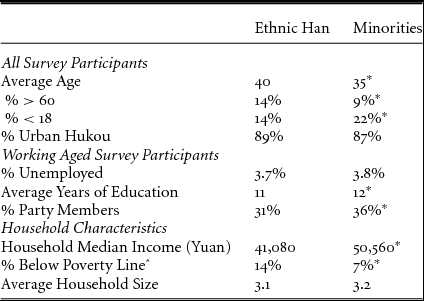
Before considering the specific participation rates in various social insurances and social welfare programmes, it is worth considering the demographics of those surveyed. As mentioned, the central government's discourse surrounding minorities is that they are generally poorer and needier than the average population due to their less advanced development status. The demographics from the CHES sample, presented in Table 1, strongly contest/challenge this assumption.
Demographics (Averages)

^ Poverty Line defined as below 50% of median survey income
* significant difference at the 0.05 level
+ significant difference at the 0.10 level
Source: China Household Ethnicity Survey 2011
Minorities, including outsider minorities, have a higher level of household income relative to Han residents; this despite the fact that they have fewer working years and the accompanying remuneration rewards associated with a longer work experience. Moreover, their education levels are higher than Han respondents, their unemployment rate is lower, while they are also more likely to hold Party membership.
The results presented in Table 1 seem at first counterintuitive. However, as MacDonald and Hasmath (Reference MacDonald and Hasmath2015) suggest, the likely cause of these incongruities is found in the average age variable. Many minorities are relatively young and came of age during the economic boom following the 1978 reforms. The average Han respondent was more likely to have grown up during the later stages of the Cultural Revolution, and to have less access to educational opportunities and therefore not have benefited as strongly from the post-1978 reforms. These considerations thus suggest very strong cohort and income effects.
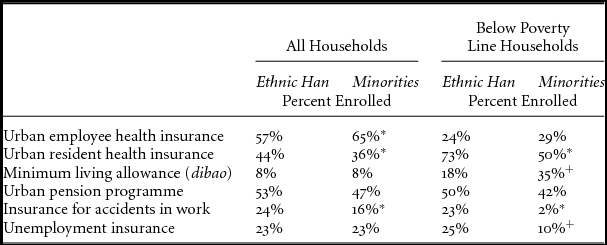
More pertinent to the hypotheses posed in the previous section is not only whether minorities participate at a greater or lesser rate in social safety net programmes, but also whether, conditional on being poor, minorities participate to a greater or lesser extent. Table 2 specifically addresses the participation rate, both in general and conditional on being below the poverty line – defined as below 50 per cent of median urban income (see Li and Sicular, Reference Li and Sicular2014) – in major social welfare programmes.
Participation Rate in Social Insurance and Welfare Programmes at Household Level

* significant difference at the 0.05 level
+ significant difference at the 0.10 level
Source: China Household Ethnicity Survey 2011
As seen in Table 2, the overall rollout of the URBMI appears to have been relatively successful, almost all households are covered by either the URBMI or the UEBMI, even for those below the poverty level. However, dibao coverage for those below the poverty line remains relatively poor, averaging around 20 per cent, consistent with the findings of Solinger and Jiang (Reference Solinger and Jiang2013). Participation in the social insurance programmes varies wildly, and is likely influenced by how integrated citizens are into the formal economy.
With respect to the hypotheses proposed in the previous section, minority respondents participate in social insurance programmes at a lower rate than Han respondents, and are particularly under-represented in the worker's compensation programme and the unemployment insurance scheme. Minorities are less likely to participate in the URBMI program, particularly for those households below the poverty line, as the difference in participation is not offset by joining the UEBMI scheme. However, minorities are significantly more likely to receive dibao benefits. These participation rate statistics are consistent with our third hypothesis – that minorities are bought off in discretionary programmes but are otherwise treated equally or worse in universal/non-governmental administered programmes. To fully interrogate this question, however, requires a regression context.
Regressions
The results of several different statistical tests generally conform to Table 2’s findings. In the previous section, we reviewed the summary statistics on both social insurance programmes and social welfare programmes. We are now primarily concerned about differential participation rates in government-provided welfare schemes. Thus, in this section we limit our attention to the URBMI and dibao programmes – both of which are major policy initiatives of the central government but implemented primarily at the local government level. As a first-cut analysis, we run several different regression models on participation in the dibao and URBMI programmes with a multiply imputed dataset. To better compare similarly situated households, we then employ a nearest-neighbour matching strategy to estimate the impact of minority status on programme participation. Finally, we analyse the amount of dibao funds received, conditional on programme participation.
One of the major problems with using a regression approach in a survey context is the problem of missing data. With standard regression techniques, any observation missing a response on any variable included in the regression is deleted from the regression calculation, resulting in significant loss of information if the amount of missing data is more than trivial. The CHES dataset is relatively complete but some variables, such as work situation, have more than a handful of missing responses. To account for this problem, in line with King et al. (Reference King, Honaker, Joseph and Scheve2001), we implement a multiple imputation process that estimates the missing responses across all variables of interest. This process is repeated 50 times and regressions are run across all imputed datasets and then averaged according to Rubin's Rules (Graham et al., Reference Graham, Olchowski and Gilreath2007).
To ensure a more representative sample response, it is necessary to weight the survey respondent data. The CHES survey was non-random across villages in Western China in an attempt to include a large and diverse number of minorities in the dataset. To prevent this oversampling from biasing the data, household population weights are employed to correct for this problem and are employed in all of the regressions and matching strategies used in the following tables and graphs. Household weights are calculated using Chinese 2010 Census data to estimate the likelihood of a minority or Han resident from a particular urban area being selected for survey inclusion in order to generate a probability weight that estimates how representative the household is. In this way, when utilising the weight file, the survey and the following analysis should be broadly representative of Western China.
As a final note, some of the regression variables are household variables while others are individual level variables. The regressions below use households as the unit of analysis for two reasons. First, the dibao and, in some cases, the URBMI participation decisions are made at the household level and participation in these programmes is the dependent variable in the regressions below. Second, one of the major independent variables, income, is only measured at the household level. For the rest of the variables, the head of household's characteristics are used to represent the entire household. Averaging household characteristics, or alternate identification strategies for household characteristics, does not generally yield significantly different results from simply using the head of household's characteristics. Moreover, since participation decisions for the two programmes in question are often made at a household level – assuming the head of the household's characteristics have a major influence in the ultimate decision – it can therefore serve as a household proxy for variables such as minority and party member.
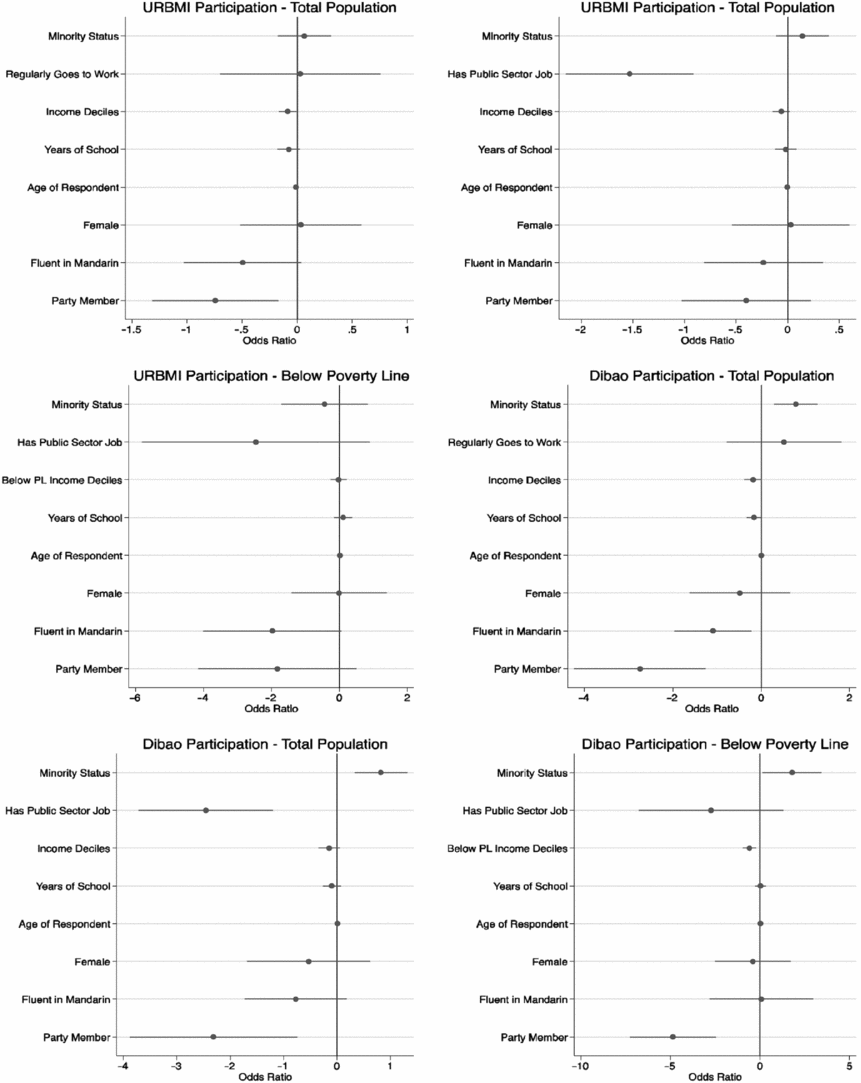
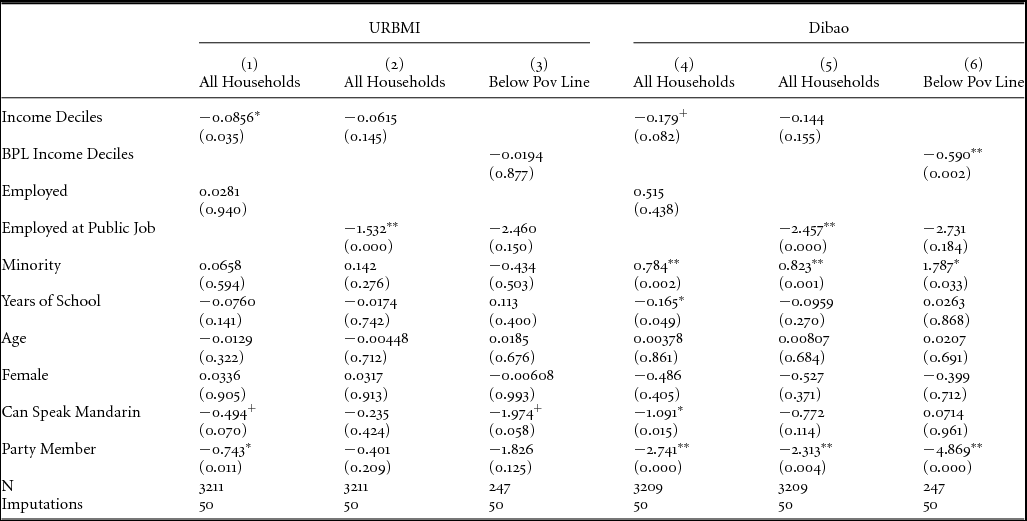
With these qualifications in mind, the regressions below generally confirm an interpretation of politically motivated implementation of social safety net programmes. Figure 1 above shows the regression coefficient point estimates and the 95 per cent confidence interval for these estimates. Table 3 fully describes these results. Different job status variables constitute the difference between models 1 and 2 and also 4 and 5; the first set (1 and 4) tests whether simply having a job impacts on programme participation while the second set (2 and 5) tests whether having a public sector job influences participation. Models 3 and 6 restrict attention to households below the poverty line while including the public sector job variable.
Coefficient Estimates on URBMI and Dibao Participation Rates

Multiple Imputation Regression on URBMI and Dibao Participation

p-values in parentheses
province dummies and constant not displayed
+ p < 0.10, * p < 0.05, ** p < 0.01
In the models including all households, minority status does not have a statistically significant effect on participation in the URBMI programme, while it consistently does for the dibao programme. For those households below the poverty line, the pattern remains largely the same. Unsurprisingly, having a public sector job (meaning having access to the formal social insurance and safety net programmes) is a significant negative predictor of programme participation. In line with hypothesis three, that dibao funds are directed toward the most threatening members of society, is the negative coefficient in models 4–6 on party membership.
Party members are much less likely to participate in the dibao programme ceteris paribus.
In general, the results described in Figure 1 and Table 3 are again consistent with an interpretation that dibao funds are dispersed in a way to buy off threatening members of society, while URBMI participation appears to be less dependent on household demographics. Rather than minorities being universally helped or discriminated against, these results suggest that minorities’ experience with the welfare system varies on a programme-by-programme basis.
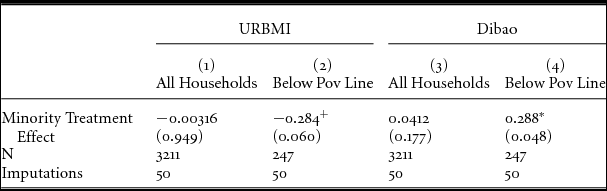
Another approach to understanding the relationship between minority status and social safety net participation is to employ a matching estimator. This involves matching attempts to find similar observations on both sides of a treatment variable (in this case minority status) and then using matched comparisons of these similar households to generate an estimate of the impact of the treatment variable. We utilise a nearest neighbour matching algorithm that attempts to find matches using all of the demographic variables included in the previous regressions to find the most similar observations across control (Han) and treated (minorities) cases.Footnote 1 Differences in the outcome variable (programme participation) between these matches are then used to calculate the estimated treatment effect; thereafter, we ran the matching estimator over the same previous 50 multiply imputed datasets to arrive at Table 4.
Nearest Neighbor Matching Estimate of Participation Rates

p-values in parentheses
+ p < 0.10, * p < 0.05, ** p < 0.01
Table 4 is generally consistent with the third hypothesis.Footnote 2 Minority status has a positive effect on dibao participation for households under the poverty line (those households for which dibao subsidies are intended) while minority status, if anything, is negatively associated with programme participation in the URBMI scheme. The URBMI finding further reinforces a programme-by-programme differential minority experience interfacing with the welfare state, but also suggests that, outside of the relatively unique dibao programme, minorities may experience difficulty in participating in the Chinese urban welfare state.
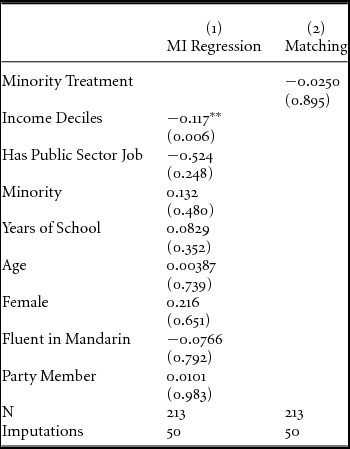
One additional interesting question to ask is, conditional on participation in the dibao scheme, whether minorities receive similar levels of funds conditional on need. As the dibao disbursements do have some degree of discretion, not only in which households to include but also the amount of money to give, there is the possibility of minorities receiving differential treatment. Regarding the three hypotheses described earlier in this article, a hypothesis that minorities receive extra support conditional on need would suggest that minorities receive more dibao funds when compared to Han residents. The hypothesis that minorities have difficulty participating in the social welfare system would most likely generate a finding of receiving the same or less amount of dibao funds in a fully controlled model. If local officials are using dibao funds to buy off troublesome groups, including minorities, then the expectation would probably be that minorities receive the same or more funds as similarly situated households. To test these predictions, we ran both a traditional regression across the multiply imputed datasets and ran a matching algorithm. The dependent variable in both cases was log dibao funds and only households that received any dibao funds were included in the regression.
The results of Table 5 suggest that minority status does not appear to impact dibao funds received conditional on programme participation. This result is both statistically and substantively indeterminate with regard to support for any of the hypotheses, although it does not contradict any of the findings of the previous statistical tests. In total, the amount of dibao funds received does not, unlike programme participation, seem dependent on any covariate except income.
Estimates of Log Dibao Receipts

p-values in parentheses
+ p < 0.10, * p < 0.05, ** p < 0.01
Taken as a whole, however, the findings of this article do suggest that minorities generally participate in social welfare and social insurance schemes at the same or lower rates than do Han residents. Crucially, however, minorities do appear to be more likely to be enrolled in the dibao programme, one in which there is a high level of street-level discretion by local officials in selecting recipients. Our results suggest that officials use discretionary welfare programmes to buy off potentially troublesome poorer minority households at a higher rate than Han households. At the same time, in a more universalistic programme such as the URBMI, minorities do not appear to be advantaged, and may in fact participate at a lower rate than Han residents.
Conclusion
Minorities have generally benefitted significantly from the formal privileges allocated to them by the state. Beyond the formal privileges, in regards to social welfare provision outcomes, our findings suggest that the treatment of minorities is heavily influenced by the incentive structure of local state agents. We arrive at this conclusion after reviewing summary participation data and the results of more advanced econometric strategies.
While minorities have been, and continue to be, significantly advantaged in the education system, the new urban welfare system highlights the importance of street-level discretion in how minorities interface with the state. The key differentiating feature that separates education from welfare policies is, in fact, the importance of local agents. Whereas an education points system that assists minorities can be easily promulgated and pushed by national-level officials without significant input or assistance from local government officials, some parts of the urban welfare state instead places a heavy implementation burden on local officials.
In the case of the dibao, this local discretion actually appears to benefit minority households, as local agents – applying the logic of authoritarian responsiveness – may be using the social welfare system to pacify potentially unruly members of society. Other programmes, such as the URBMI, do not appear to be used in a similar way, in part due to the programme's structure that guarantees universal participation, rather than leaving inclusion into the programme to be decided on a case-by-case basis.
Overall, these results reinforce other findings suggesting that social welfare programmes follow a logic akin to research on political business cycles (Dahlberg and Johansson, Reference Dahlberg and Johansson2002) in the literature on welfare systems in Western democracies. The end result of this process is the somewhat counter-intuitive finding that negatively stereotyped minorities actually end up with higher participation rates in certain situations. If future research confirms this result, it would suggest caution in drawing simple lines between negative imagery and portrayals of minorities and potential outcomes regarding their interaction with the state.
Acknowledgements
The authors are grateful for the valuable feedback received at the 2016 International Political Science Association World Congress (Poznan, Poland) and American Political Science Association (Philadelphia, USA) Annual Meeting.