Introduction
Ecologically diverse and widely distributed in its native Eurasian range, the European fire ant, Myrmica rubra (Linnaeus) (Hymenoptera: Formicidae) was first recorded in North America in 1900 in Massachusetts, United States of America (Wheeler Reference Wheeler1908). The ant has since become established in Massachusetts and in five additional eastern states in the United States of America (New York, Rhode Island, Vermont, New Hampshire, and Maine) as well as the western state of Washington (Wetterer and Radchenko Reference Wetterer and Radchenko2010). In Canada, it is established in British Columbia (R. Higgins, Thompson Rivers University, personal communication), Ontario, Québec, New Brunswick, Nova Scotia, Prince Edward Island (Wetterer and Radchenko Reference Wetterer and Radchenko2010), and Newfoundland (Hicks Reference Hicks2012). The North American range of M. rubra has apparently increased slowly, with many range extensions officially documented only in the last 15 years. Groden et al. (Reference Groden, Drummond, Garnas and Francoeur2005), using importation records into United States of America ports, suggested that there have been multiple introductions of M. rubra to North America. Wetterer and Radchenko (Reference Wetterer and Radchenko2010) postulated that the present North American population may have been introduced more recently from a narrow latitudinal range from within Europe. This is because the ant is found at a narrower latitudinal range (41.5°N–46.8°N) in North America than in the native range (39°N–70°N).
Myrmica rubra ants are known for their aggressive behaviour and painful sting and will readily sting humans and pets that are near their nests, affecting quality of life of residents in areas where the ants have become established. The habitats that M. rubra ants occur in are similar between their native and invasive ranges. In the ants’ native range, Donisthorpe (Reference Donisthorpe1915) recorded that they preferred moist habitat and nesting under stones or decayed logs. In Maine, Groden et al. (Reference Groden, Drummond, Garnas and Francoeur2005) recorded ants in lawns, and gardens, old field habitats, shrubland, wetland, and deciduous forest, with the majority of nests (88%) under or within woody debris or leaf litter. A recent study in Halifax (Nova Scotia, Canada) showed a preference to nest in soil associated with herbaceous plant roots (Horton Reference Horton2011). The anthropogenic movement of contaminated soil as nursery stock is believed to be the most common method of ongoing introduction to new regions (Groden et al. Reference Groden, Drummond, Garnas and Francoeur2005) and Wetterer and Radchenko (Reference Wetterer and Radchenko2010) suggested that this route of introduction will continue to spread and enlarge the range of the ant in North America.
Recently, Leppänen et al. (Reference Leppänen, Vepsäläinen and Savolainen2011) investigated the postglacial colonisation of M. rubra in the Palaearctic using mtDNA. They inferred that ants survived the last glacial period in several refugia scattered over an extensive area ranging from the Iberian Peninsula in the west to Siberia in the east. Included in this study were ants from two northeastern states in the United States of America, Massachusetts and Maine; these contained haplotypes from three haplogroups common in western and central Europe, suggesting an origin for the introduction of M. rubra to North America.
Newfoundland is North America's most easterly point. As an island, its flora and fauna have been shaped extensively by anthropomorphic introduction events over the 500 years since its discovery by Giovanni Caboto in 1497. Since that time, Newfoundland's closest European connection has been with the southwest English ports of Devon and Dorset. Until the advent of steam shipping, fishing ships departed the English ports in the spring empty and returned from Newfoundland in the autumn full of dried, salted codfish. The empty ships sailed westward laden with ballast that often consisted of soil from around the English ports (Lindroth Reference Lindroth1957). Upon reaching Newfoundland, this ballast was dumped on shore, providing an excellent mechanism for introducing plants and insects to North America, and in particular Newfoundland. This mechanism of introduction is clearly outlined by Lindroth (Reference Lindroth1957).
Anecdotal observations have indicated that M. rubra ants have been in Newfoundland for at least 45 years and maybe longer (B.J.H., personal observation); however, no specimens were collected from the island until 2000 and the ant's official recognition did not occur until 2010 (Hicks Reference Hicks2012). The distribution is presently restricted to the west coast (Corner Brook) and Avalon Peninsula (Carbonear, Brigus, Avondale, Salmonier Nature Park, Seal Cove, Torbay, and St. John's), regions separated by ∼500 km. While reports have been made by the general public in central Newfoundland, no specimens have been found at the sites explored. Since M. rubra may have originated directly from England many years ago, our purpose was to sequence the same two regions of the mtDNA genome analysed by Leppänen et al. (Reference Leppänen, Vepsäläinen and Savolainen2011) for samples of European fire ants from all known locations in Newfoundland, to determine the most likely number of introductions and their geographic sources. Because of the well-known history of commercial fishing activity and ballast movement to Newfoundland, we hypothesise that there may have been numerous introductions to the island from England.
Methods
Sampling
Worker ants were collected and preserved in 95% ethanol from six locations in Newfoundland, Canada: Corner Brook, Glynmill Inn (CBG); Corner Brook, Country Road (CBC); Carbonear, St. James Church (CSJ); Seal Cove (SCS); St. John's, Torbay Road (SJT); St. John's, Bowring Park (SJB). In addition, we received samples from Halifax, Nova Scotia, Canada (NSH), Ville de Québec, Québec, Canada (QC), Acadian National Park, Maine, United States of America (USA), Görlitz, Germany (GGC), and Dorset, United Kingdom (UK).
DNA extraction, polymerase chain reaction (PCR), and sequencing
DNA was extracted from the legs of 141 M. rubra using the Qiagen QIAamp DNA Mini Kit (Qiagen Inc., Toronto, Ontario, Canada) following the manufacturer's tissue protocol.
A segment of the mitochondrial cytochrome c oxidase I (COI) gene was amplified in 25 μL reactions containing 1X PCR Master Mix (Promega Corp., Madison, Wisconsin, United States of America), 0.5 μM of each primer (LCO1490 and HCO2198; Folmer et al. Reference Folmer, Black, Hoeh, Lutz and Vrijen-Hoek1994), 0.6 mM MgCl2 and 2–18 μg DNA. PCR were carried out a GeneAmp9700 (Applied Biosystems Inc., Foster City, California, United States of America) under the following conditions: an initial denaturation at 95 °C for two minutes, 30 cycles at 94 °C for 30 seconds, 49 °C for 45 seconds, and 72 °C for two minutes, and a final extension at 72 °C for five minutes. A portion of the mitochondrial cytochrome b (Cyt b) gene was amplified using 0.5 μM of the primers CB7 and tRs (Tay et al. Reference Tay, Cook, Rowe and Crozier1997), 1X PCR Master Mix (Promega Corp.), 3 mM MgCl2 and 2–18 μg DNA in 25 μL reactions. PCR conditions consisted of an initial denaturation at 95 °C for 5 minutes, 30 cycles at 94 °C for 30 seconds, 47 °C for 30 seconds, and 65 °C for 1.5 minutes, with a final extension at 65 °C for seven minutes.
PCR products were purified for cycle sequencing using Pall AcroPrep 96 Multi-Well filter plates (Pall Life Sciences, Port Washington, New York, United States of America) following the manufacturer's instructions. Sequencing was carried out using the BigDye® Terminator v3.1 Cycle Sequencing Kit (Applied Biosystems Inc.) following the manufacturer's protocol, and purified via ethanol precipitation. Sequencing products were electrophoresed in an Applied Biosystems 3730 DNA Analyzer using Sequencing Analysis v. 5.2 Software.
Data analysis
Sequences were aligned and edited using Sequencher 4.9 (GeneCodes Corporation) and exported to MEGA 5 for variable site identification and inference of haplotypes. Sequences obtained here were compared with GenBank accessions referenced in Leppänen et al. (Reference Leppänen, Vepsäläinen and Savolainen2011). A minimum spanning network among haplotypes was inferred, and adjusted manually to reflect the relationships depicted in Leppänen et al. (Reference Leppänen, Vepsäläinen and Savolainen2011).
Results
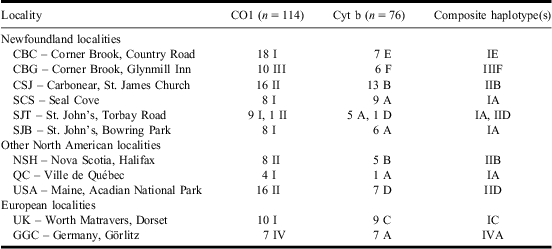
COI sequences of length 618 base pairs (bp) were obtained for 114 ants from 11 localities (6–18 ants per locality; Table 1). Six variable sites at positions 177(R), 276(W), 330(W), 423(Y), 468(M), and 585(R) of this sequence (numbered from the first base after the primer; symbols are the nucleotide ambiguity codes) were found among individuals and these defined four haplotypes. The most common of these was I (sequence TATACA at the six variable sites), found in 57 ants from six locations (CBC, SCS, SJT, SJB, QC, UK). The next most frequent haplotype, II (CGAAAA), was found in 41 individuals from four locations (CSJ, SJT, NSH, USA). Two rarer haplotypes, III (TATTCA) and IV (TATACG), were found in 10 from CBG and seven individuals from GGC, respectively. Notably, each location contained only a single haplotype with the sole exception of SJT where a second haplotype was found in a single individual (Table 1). Haplotypes are numbered according to frequency.
Haplotypes of mitochondrial COI and Cyt b genes from worker ants of Myrmica rubra from selected locations in eastern North America and western Europe

Note: Haplotype designations are explained in the text; composite haplotypes refers are the combinations of COI and Cyt b haplotypes found in individual ants. Numbers indicate the frequency of ants carrying the particular haplotype.
COI, cytochrome c oxidase I; Cyt b, cytochrome b.
Approximately 630-bp Cyt b sequences were obtained for 76 ants from 11 localities (1–13 ants per locality; Table 1). Here, seven variable sites were located at positions 68(Y), 191(Y), 197(R), 443(Y), 563(Y), 617(Y), and 620(R), and these defined six haplotypes. The most common of these, A (sequence CCGCCCG at the seven variable sites), was found in 28 individuals from five localities (SCS, SJT, SJB, QC, GGC), while the next most common, B (CCACTCA), was found in 18 individuals from two locations (CSJ, NSH; Table 1). One other haplotype, D (CTACTCA), was shared between two locations (SJT, USA), while the remaining three (C = TCGCCCG [UK], E = CCGCCTG [CBC], and F = CCGTCCG [CBG]) were found in single locations only. Again, each location was characterised by a single haplotype, except SJT where a second haplotype was found, in the same individual as for COI. Haplotypes are lettered according to frequency.
Jointly, the 13 variable sites defined seven composite haplotypes among the individuals for which both COI and Cyt b data were available (Table 1 and Fig. 1). Again, each locality with the exception of SJT is associated with only one composite haplotype. The two common composite haplotypes (IA and IIB) are separated by seven mutational differences and there are two distinct clusters of haplotypes centred around each of them, separated by one or two mutational events each (Fig. 1).
Minimum spanning network and distribution of composite cytochrome c oxidase (COI) and cytochrome b (Cyt b) haplotypes among populations of Myrmica rubra in Newfoundland and eastern North America. The minimum spanning network was adjusted manually to match the arrangement of haplotypes shown by Leppänen et al. (Reference Leppänen, Vepsäläinen and Savolainen2011). Our haplotype designations are given in Table 1; where haplotypes matched those found by Leppänen et al. (Reference Leppänen, Vepsäläinen and Savolainen2011) their designation is also given. Sizes of haplotype symbols are proportional to their approximate frequency in our study. Haplotypes IIB = 1 and IVA = 45 were widespread and found in 53 and 40 ants, respectively, in Leppänen et al. (Reference Leppänen, Vepsäläinen and Savolainen2011), while IA = 81 and IID = 7 were found in only seven and two ants, respectively, and were geographically restricted to Dorset and Maine.
The most common and widespread composite haplotypes in this study, haplotypes IA and IIB, match haplotypes 81 (found in Dorset, United Kingdom; Genbank Accessions JF779199 and JF779571) and 1 (widespread; JF779068 and JF779440) of Leppanin et al. (2011) while haplotype IID, found in the USA sample and in one ant in SJT, is the same as haplotype 7 (Maine, United States of America; JF778892 and JF779264) and IVA, found in GGC in our study, matches haplotype 45 (widespread; JF779064 and JF779436). Haplotypes IIIF, IE, and IC are new.
Discussion
The goals of the present study were to investigate the origins of M. rubra ants in Newfoundland. To do this, we analysed mtDNA sequences from the Cyt b and COI genes from six localities in Newfoundland, and neighbouring regions of eastern Canada and the United States of America, and compared them with mtDNA data from a recent wide-scale phylogeographical study of the ant throughout Europe (Leppänen et al. Reference Leppänen, Vepsäläinen and Savolainen2011). We determined that there is evidence for at least four distinct sources of ants on the island. Herein we discuss these putative routes of colonisation and why the population of the ant was slow to expand and only to become noticed relatively recently.
Mitochondrial haplotypes
The most widespread haplotype observed in our data (haplotype IA; Fig. 1), found in ants from Seal Cove, both St. John's locations, and Ville de Québec, corresponds to haplotype 81 of Leppänen et al. (Reference Leppänen, Vepsäläinen and Savolainen2011; hereafter we refer to this haplotype as IA = 81). They observed it only in ants from Dorset, United Kingdom. Our study did not show haplotype IA = 81 in the Dorset, United Kingdom, sample we analysed; instead, we observed a different previously unrecorded haplotype (haplotype IC; Fig. 1) that was mutated by one nucleotide in the Cyt b gene sequence compared with IA = 81. The other common haplotype recorded in our study (haplotype IIB; Fig. 1), found in specimens from Carbonear and Halifax, Nova Scotia, corresponds to haplotype 1 of Leppänen et al. (Reference Leppänen, Vepsäläinen and Savolainen2011; hereafter IIB = 1) where it was found to be widespread among European ants from Austria, Belgium, Denmark, France, Germany, Switzerland, Spain, and United Kingdom (Dorset). The haplotype IID that we recorded from one ant in St. John's-Torbay Road and from all of the ants analysed from USA-Maine is the same as haplotype 7 of Leppänen et al. (Reference Leppänen, Vepsäläinen and Savolainen2011; hereafter IID = 7). They found this haplotype exclusively in two ants in Maine. Our haplotype IVA, found only in our sample from Germany, was recorded by Leppänen et al. (Reference Leppänen, Vepsäläinen and Savolainen2011) as haplotype 45 (hereafter IVA = 45) and was found in one USA-Cambridge ant and ants occurring throughout Europe (Austria; Belgium; France; Germany; Netherlands; Sweden; and Norwich, United Kingdom). Finally two haplotypes (IE and IIIF, Fig. 1) were found discretely in two populations from Corner Brook (CB-Country Road and CB-Glynmill Inn). These have not been recorded before and are one and two mutational differences from our common haplotype IA = 81. Whether the haplotypes that are new to our study originated in Newfoundland or simply were not sampled by Leppänen et al. (Reference Leppänen, Vepsäläinen and Savolainen2011). We cannot be certain, but the latter hypothesis seems most likely. These haplotypes closely related to haplotype IA = 81, and the time scale of mtDNA mutation is much longer than the time frame of the ant's introduction to Newfoundland. All haplotypes identified in this study belong to haplogroups 3-1 (IIB = 1, IID = 7), or 3-7 (IA = 81, IVA = 45, IC, IE, IIIF) of Leppänen et al. (Reference Leppänen, Vepsäläinen and Savolainen2011) (Fig. 1). According to Leppänen et al. (Reference Leppänen, Vepsäläinen and Savolainen2011), these haplogroups are most likely to have expanded post-glacially (within the last 10–15 ka BP) and thus haplotypes within these groups are post-glacially derived.
Putative sources of Newfoundland populations of Myrmica rubra
Three composite haplotypes were observed in the Avalon Peninsula populations: IA = 81 in Seal Cove and the two St. John's locations; IIB = 1 in the Carbonear population, and IID = 7 in one St. John's Torbay Road ant. We propose that the Avalon Peninsula populations of the ant originated from the southwest region (Dorset County) of the United Kingdom, where both IA = 81 and IIB = 1 are found. This proposition is based on the combined haplotype data and on historical records showing that the majority of fishing traffic originated from Dorset County. Lindroth (Reference Lindroth1957) outlines this historical connection and suggests that the movement of soil ballast from the Dorset ports was an important mechanism in introducing many plants and insects to Newfoundland. Additional support comes from Cooper (Reference Cooper1981) who showed that the harbours of St John's and Carbonear/Harbour Grace have the greatest abundance of introduced weed species from the United Kingdom. It is interesting to note that M. rubra is located at these ports and in other ports that are considered the oldest in Newfoundland and that saw considerable transatlantic ballast unloaded on their shores. Since we found IID = 7 in only one ant in Newfoundland, but it is common in the USA-Maine ants, we can speculate that this haplotype was introduced to Newfoundland from a United States of America source. The sample location of the ant in Newfoundland is directly adjacent to a former United States air force base, Fort Pepperall (1941–1960). This base once housed United States airman during and after World War II and considerable material would have been imported during that time to supply these soldiers. This would have setup an ideal mechanism for introducing soil-dwelling ants to this area from a United States of America source.
The Glynmill Inn population (haplotype IIIF) is believed to have originated on the grounds of Corner Brook House, a mansion built at the same time as the paper mill in 1928. Sir Eric Vansittart Bowater, the mill owner, was a gentleman farmer who not only raised cattle but also cultivated ornamental gardens at his Surrey (United Kingdom) home. The Bowater family resided at Corner Brook house during WWII to escape wartime threats. Sir Eric commissioned the planting of numerous species of trees and shrubs throughout the newly constructed town. The tree species came from various locations including the United States of America, Canada, and the United Kingdom. The population of M. rubra located at Corner Brook House/Glynmill Inn may have originated when trees were planted on the grounds, most likely from the United Kingdom. The mtDNA data of the present study supports this mechanism of introduction since the haplotype reported showed only two mutational differences from a haplotype reported exclusively in ants from Dorset. We cannot rule out the possibility that the Corner Brook ants may have been introduced from the east coast population of Newfoundland. This seems unlikely as the ants only occur on the east and west coast of Newfoundland (500 km between the populations) with no known populations in the interior of the island. One would expect the distribution of the ants to include intermediate locations if human transport was the mechanism.
The Corner Brook Country Road population did not come from the Glynmill Inn population; instead it is one mutational difference in the Cyt b gene from ants in eastern Newfoundland, Québec, and Dorset, England (according to Leppänen et al. Reference Leppänen, Vepsäläinen and Savolainen2011). Historically there has not been much connection between Newfoundland and Québec so it is unlikely to have originated from Québec. At this point, we cannot rule out the possibility that it may have originated from other Newfoundland populations. However, we feel this route is unlikely since again we would expect to find the ants in other central locations. For this reason we suspect that this Corner Brook population may also have originated directly from the United Kingdom.
Temporal scale of colonisation history of Myrmica rubra in Newfoundland
If these ants were introduced so many years ago, why are we only seeing them in recent years and why is their distribution so restricted? Not all introductions of species become invasive. Williamson and Fetter (Reference Williamson and Fitter1996) suggested that of the species introduced into new habitats, 10% or less may become established, and of those, approximately 10% become invasive. Introduction can be a single event but multiple introductions often increase the success of non-native species establishment and invasiveness. Often, the rate of spread is slowed after establishment and a lag in population growth is experienced prior to range expansion. Lags in the establishment of several invertebrates have been recorded in Newfoundland. The copse snail, Arianta arbustorum (Linnaeus) (Mollusca: Gastropoda), was first recorded near the Narrows of St. John's harbour in 1885, but was not found again until 1986 (McAlpine et al. Reference McAlpine, Schueler, Maunder, Noseworthy and Sollows2009). The European Earwig, Forficula auricularia Linnaeus (Dermaptera: Forticulidae), was recorded in 1830 when it was painted by Philip Henry Gosse at Carbonear but it did not become widely established in Newfoundland until 1947 (Morris Reference Morris1983). For ants, Ward (Reference Ward2007) determined a time lag in exotic ant species in New Zealand. He suggested that there was a considerable time lag in the ants spread after introduction. It took many species several decades (40–60 years) to spread to 17–25% of all regions. Ward (Reference Ward2007) noted that even after 100 years, the number of regions occupied by exotic ants was ∼50% of maximum.
Thus, it is possible that M. rubra was introduced many years ago, and that its abundance remained low over an extended time. For unknown reasons, it escaped the factors that limited its population growth and then population grew to a noticeable level. Invasive ants generally negatively impact ecosystems and have tremendous economic and human-health-related impacts (see Rabitsch (Reference Rabitsch2011) for a good review). Native ant species in Maine were most affected by the direct competition with M. rubra ants (Garnas Reference Garnas2005). In Newfoundland, M. rubra workers negatively impacted the abundance of the native Formica fusca Linnaeus (Hymenoptera: Formicidae) ants but also a number of non-ant invertebrates (B.J.H., personal observation). In fact, Holway et al. (Reference Holway, Lach, Suarez, Tsutsui and Case2002) suggested that every species of known invasive ant has been implicated in the decline of non-ant invertebrate fauna. With its polygynous and polydomous nature, and the fact that it has no known natural enemies in its invasive range, M. rubra will likely continue to spread and be difficult to control.
To further clarify the population structure, relatedness, and sources of origin of ant populations in Newfoundland on a finer microevolutionary scale, we are currently analysing microsatellite profiles from the ants investigated in this study.
Acknowledgements
Worker ant specimens were donated by: Eleanor Groden (Maine), Graham Elmes (United Kingdom), Bernhard Seifert (Germany), Susan Horton (Halifax), André Francoeur (Québec). The author thanks David Mercer, Map Room, Queen Elizabeth II Library, Memorial University of Newfoundland. Financial support came from a Small Research Grant from the College of the North Atlantic to B.J.H.