Introduction
Antimicrobial resistance (AMR) is a major global public health threatReference Carlet1 that has only recently spurred international dialogue2 and calls for action.3 Despite the growing public health concern,Reference Adegoke, Frieri, Lammie and Hughes4 pharmaceutical and biotechnology companies face major hurdles when it comes to resource allocation for antibiotic research and development (R&D).Reference Mossialos, Morel, Edwards, Berensen, Gemmill-Toyama and Brogen5 Major risks and bottlenecks in antibiotic R&D are usually grouped into three categories: scientific, financial, and regulatory.Reference Rex, Silver, Spellberg and Zorzet6
There is a conflict between the society, which perceives and expects antibiotics to be inexpensive, the public health institutions, which demand equitable access and stringent conservation/stewardship,Reference Micallef7 that inevitably restrict sales, and developers (either industry or non-profit organizations) expecting an adequate return on investment (ROI) for antibiotic R&D, which is usually recouped through (volume) sales. Intrinsic to antibiotic use is the development of resistance,Reference Castro-Sanchez and Holmes8 which has outpaced the rate of antibiotic development over the past 20 years nullifying their effectiveness.Reference Bush, Page and Chen9 Due to aforementioned characteristics, the antibiotics market today is financially unattractive to developers. In most cases, antibiotics are prescribed for a short-term use and reimbursement systems encourage the use of the cheapest alternative (usually generic if available),Reference Power10 thus preventing developers from capitalizing on the antibiotic value and recouping R&D costs. Finally, the regulatory requirements for market approval in the US and European Union were prone to changes that created additional development risks in the past. This situation has partially improved through the Generating Antibiotic Incentives Now (GAIN) Act of 2012 in the US, which ensures expedited review times by the US Food and Drug Administration (FDA), and five additional years of market exclusivity for new small molecule drugs.Reference Tillotson11 Likewise, the 21st Century Cures Act, enacted in the US in 2016, permits approval of an antimicrobial on the basis of preclinical data and preliminary studies in a small number of patients.12 Nevertheless, even if the regulatory context is improving, it cannot, by itself, offset (and correct) most causes of market failure inherent to the antibiotic market. Both the GAIN and 21st Century Cures Acts have been criticized for neglecting antibiotic stewardship, and enabling antibiotics approval outside conventional clinical trials.Reference Avorn, Kesselheim and Outterson13 Therefore, a comprehensive financial incentives system is needed to stimulate companies towards R&D of innovative antibiotics. Ideally, these incentives should come with commitment from both public and private partners to use antibiotics responsibly and sustainably.
The European Commission's Innovative Medicines Initiative (IMI), one of the largest public-private partnerships focused on the development of safe and effective medicines, has established the New Drugs for Bad Bugs (ND4BB) initiativeReference Kostyanev14 to remove barriers to antibiotic R&D by establishing academic and industry partnerships across Europe. One of the ND4BB programs is DRIVE-AB, which focused on developing economic incentives for antibiotics development, their sustainable use and equitable availability.15
The antibiotics market can be incentivized through push and pull strategiesReference Morel and Mossialos16 (for a review of incentive strategies, see Renwick et al.Reference Renwick17 and the DRIVE-AB final report18). Push mechanisms pay directly for R&D. They can be implemented, for example, through research grants, tax incentives, or public-private partnerships in R&D. Grants in particular are an important financial instrument that increase opportunities for research and create temporary jobs for young scientists. Calls for grant applications can be tailored in different ways, but ideally should target public health needs (e.g., in the case of antibiotics the pathogens defined by the WHO Priority Pathogen List (WHO PPL)19), and major scientific bottlenecks (e.g., antibiotic delivery in Gram-negative bacteria, and antibiotic cross-resistance), and/or development of alternative strategies to combat antibiotic resistance (e.g., nano-technology, antibodies, etc.). Additionally, different actors in the antibiotic R&D can be incentivized from research teams at academia, small- and medium-sized companies to large pharmaceutical industry. In contrast, pull mechanisms reward for specific outcomes like regulatory approval, thus ensuring (or increasing) future revenue.
After extensive review and assessment of possible push and pull incentives, DRIVE-AB has prioritized two push mechanisms (grants and pipeline coordinators), and two pull mechanisms (market entry rewards and long-term supply continuity model). These incentives are envisioned to support the entire antibiotic value chain from R&D efforts to post-marketing whilst ensuring sustainable use and equitable availability of innovative antibiotic. This article will focus on grants, first looking at the current global status of grants available for antibiotics R&D and the associated gaps, and second proposing a new grant framework that will support innovative antibiotic R&D to address unmet public health needs, and how this framework could be implemented in current initiatives.
Methods
The findings in this article are based on a review of publicly available databases and a stakeholder meeting of small- to medium-sized enterprises (SMEs) focused on antibacterial R&D.
National and international databases were queried in the period September 2016 to January 2017, covering 2010-2016 fiscal years for retrospective grant funding. Calls for grant applications, as well as individual applications, were included in the final analysis.
In the US, retrospective grant funding from following agencies and public-private partnerships was analyzed: National Institutes of Health (NIH) and National Institute of Allergy and Infectious Diseases (NIAID), Biomedical Advanced Research and Development Authority (BARDA), and Accelerating Global Antibacterial Innovation (CARB-X).
The NIH database was searched using the NIH Research Portfolio Online Reporting Tool (RePORT), and the following search scheme:
1. search terms: bacteria OR antibiotic OR (“antibiotic resistance”) OR (“bacterial antibiotic resistance”) NOT HIV/AIDS NOT TB NOT tuberculosis NOT mycobacteria NOT mycobacterium NOT cancer NOT tumor NOT non-communicable,
2. the National Institute of Allergy and Infectious Diseases (NIAID) as the administrator or funding agency,
3. research project grant programs R01, and R41-44, programs in the NIH categories: C, D, E, F, G, K, L and O were excluded.
In the European Union (EU), national funding mechanisms and opportunities for antibacterial/antimicrobial resistance (ABR/AMR) R&D were assessed by retrospective calls for grant funding. In the UK, the Medical Research Council (MRC)'s and the Bio-technology and Biological Sciences Research Council (BBSRC)'s available public databases were queried. In France and Germany, the French National Agency for Research (ANR)'s and the German Research Foundation (DFG)'s retrospective grant calls and alternative funding opportunities were included. At the EU level, focus was on retrospective and ongoing calls for grant funding in the AMR/ABR R&D, funded under the Seventh Framework Programme for Research and Technological Development (FP7) (period 2007-2013), and the Innovative Medicines Initiative (IMI) public-private partnership and IMI's New Drugs for Bad Bugs (ND4BB) program.
The Joint Programming Initiative on Antimicrobial Resistance (JPIAMR) database20 was used to assess grant calls (period 2014-2016), and individual grants awarded in the period 2007-2013 for research on antibacterial resistance in the participating countries. The Japan Agency for Medical Research and Development (AMED) publicly available database was queried for grants and funding mechanisms for infectious diseases.
Eleven EU-based SMEs, the Biotech companies in Europe combating AntiMicrobial Resistance (BEAM) Alliance, and the UK AMR Centre representatives attended a stakeholder meeting at the Chatham House in London (January 2017). The purpose was to receive feedback on two main aspects of DRIVE-AB's proposed push incentives: (a) the overall structure and combination of incentives across the antibiotic R&D pipeline, and (b) the details of the incentives.
The initial presentation of the push mechanism and incentives for antibiotic R&D was followed by an open discussion with particular focus on how the incentives fit with each other and how they address the challenges faced by SMEs. In addition, advantages and barriers to existing NIH, BARDA, JPIAMR, CARB-X, and IMI push funding mechanisms were discussed. To encourage openness and sharing of information, the discussion followed the Chatham House Rule.
Results
National Grant Schemes
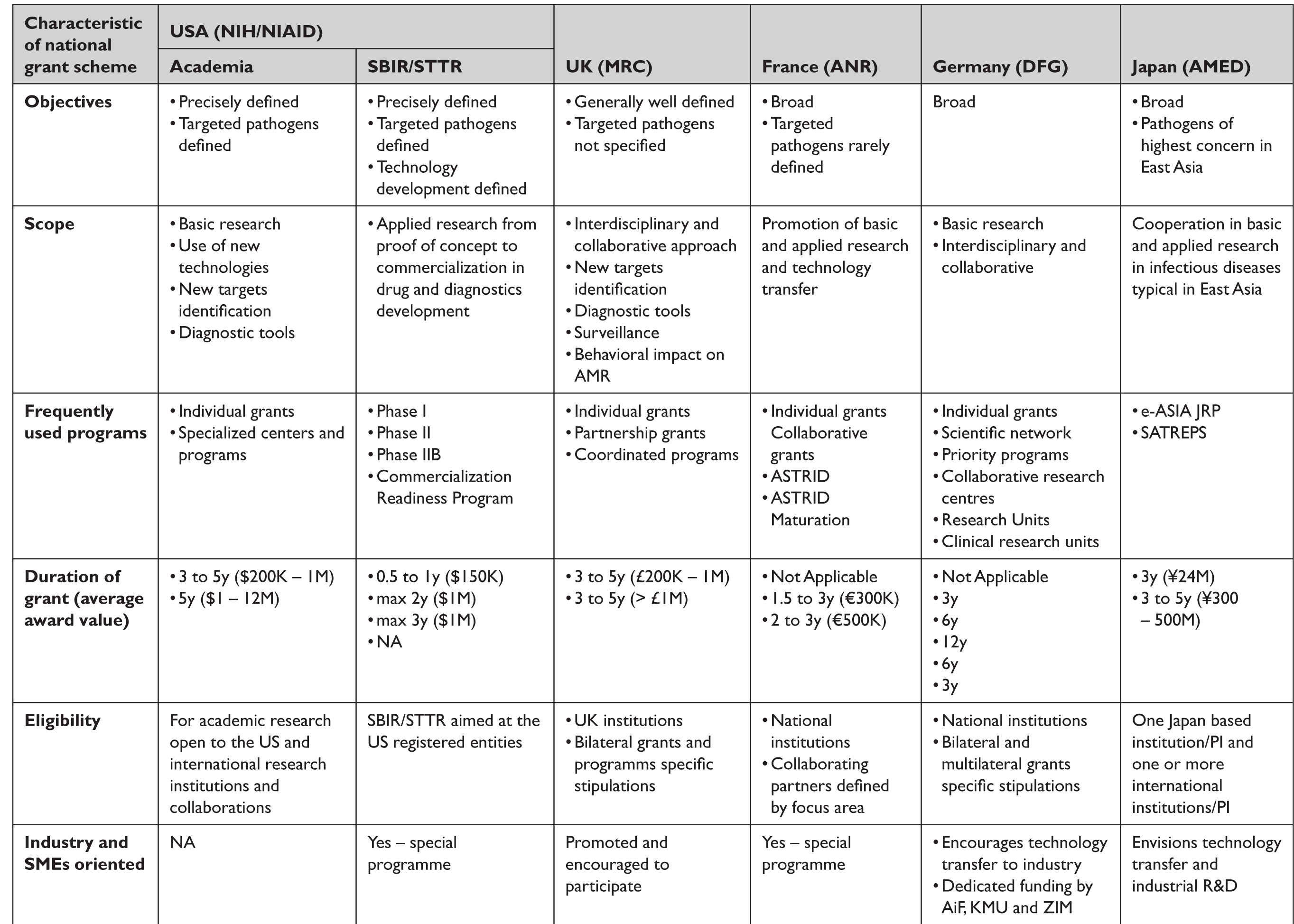
We first analyzed national funding agencies in the US, Europe, and Japan that provide grants to support scientific R&D (Supplementary Material and Supplementary Table S1). National R&D funding aims to improve national research capacity. Grant sizes are moderate (less than USD 1 million) with the exception of the US' NIH and the UK's MRC. The US and UK are also unique in that they specifically target grants towards R&D on priority pathogens (more details are provided in Supplementary Materials).
Multi-national Organizations
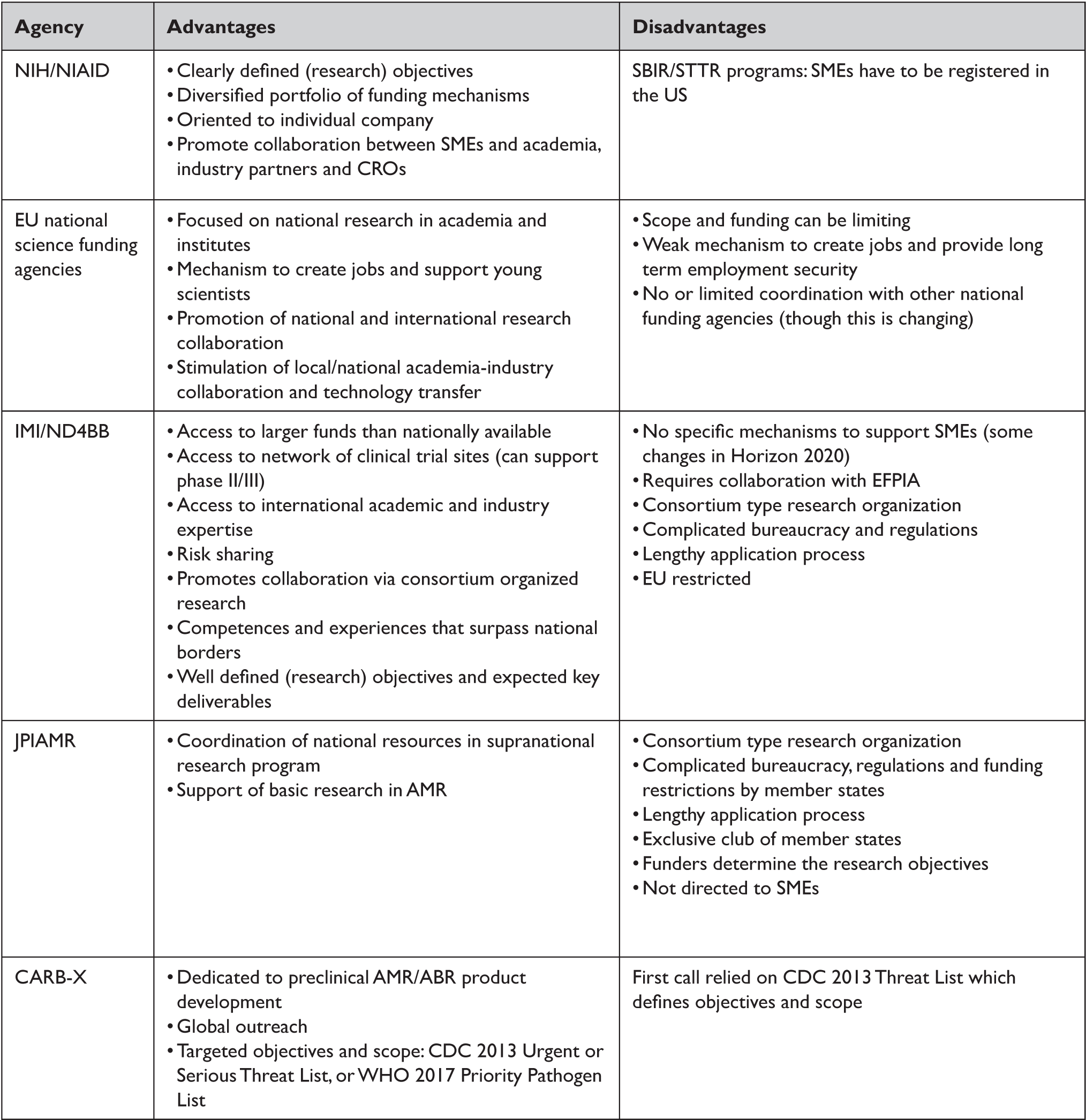
Secondly, we focused on four multi-national organizations that support exclusively R&D activities related to antibiotic resistance, JPIAMR, CARB-X, ND4BB, and BARDA (Supplementary Table S2). We examined their research grants and timing along the R&D pipeline, the phases of R&D that the funder was targeting (i.e., technology readiness level (TRL), also see Figure 1 for more details on TRL), which pathogens were prioritized, and any requirements for co-financing and collaboration (Table 1). Based on this information and feedback from stakeholders, we identified gaps in the current grant funding landscape and made suggestions for improvements.
Overview of Selected National and International Funders Investing in Antibiotics R&D

Antibiotic R&D Grants as Push Incentives and Associated Risks and Bottlenecks
Grants address primarily scientific and methodological bottlenecks, and clinical development costs. The technology readiness levels (TRL) are an alternative way to delineate R&D phases in drug discovery (for levels definitions, see33). Push incentives are envisioned as complementary early-, mid-stage, clinical development and priorities grants. The link between the mid-stage and clinical development grants indicate that a developer can obtain direct support for clinical development conditional on successful phase I clinical trial supported by a mid-stage grant.

Joint Programming Initiative on Antimicrobial Resistance (JPIAMR)
JPIAMR is a European initiative with the objective to overcome the fragmentation of national research programs and to provide better coordination of efforts in the AMR field. Today, JPIAMR surpasses the EU borders with total of 26 member states: 16 from the EU, Argentina, Canada, Egypt, India, Israel, Japan, Norway, Turkey, South Africa and Switzerland. It publishes consolidated calls for proposals where individual countries may join together to fund specified research topics. JPIAMR does not pool members funds; R&D financing is paid to researchers by the national research agency (e.g., the Norwegian Research Council pays Norwegian researchers). This means that researchers outside the 26 member states are excluded from financing.
One of the strengths of JPIAMR is that it coordinates its member states around priority research topics. To do so, it has documented priority, open research questions in its Strategic Research Agenda (SRA). The first version was published in 2013, and it is due to be revised shortly. One of the priority topics of the SRA is therapeutics, and two of the research objectives are “to find new targets for antibiotics” and “to develop new antibiotics.” The SRA does not prioritize specific pathogens. Within these two research objectives, JPIAMR has held two joint calls on these topics. Both of these have financed academic and research institutes to perform early phase research (TRL 1-3).
The average budget size per actor for these two calls is about €200,000 to 250,000 with the average project size of €1.2 to 1.5 million. JPIAMR requires collaboration, encouraging widespread collaboration across member states. Whereas the overall project financing levels are in line with average costs for these phases of research, the amount per participating organization is too low to attract industry partners. SMEs are particularly reluctant to join a consortia, given the additional project costs due to collaboration, including additional meetings, consensus processes, and other communication exercises. JPIAMR generally does not require co-financing of projects which is appropriate for TRL 1-3. Academics and research institutes struggle to cofinance, as potential funders perceive co-financing as duplicative.
Companies are often specifically excluded by member states, with a few exceptions. Nevertheless, companies report that collaborative requirements and open exchange of knowledge are barriers for their participation, not only because SMEs cannot afford the extra burden caused by collaboration particularly during the application process, but also because they are cautious about sharing any potential intellectual property. As such no company has been financed by JPIAMR to date.
Combatting Antibiotic-Resistant Bacteria Biopharmaceutical Accelerator (CARB-X)
CARB-X was launched in 2016 as an accelerator to spur preclinical product development (e.g., antibiotics, vaccines, diagnostic tools in TRL 3-6). It is funded by BARDA and NIH with matching funds from the Wellcome Trust and the UK's AMR Centre. CARBX only finances companies but with no geographical restrictions. It requires co-financing as well as the achievement of scientific milestones in order to award subsequent financing. This necessitates companies to also secure private sector financing. Grantees to CARB-X also commit to sell, promote, and distribute antibiotics responsibly and make efforts to ensure equitable availability.
In its first year, CARB-X issued two calls for funding with a primary focus on therapeutics to treat Gram-negative bacteria and/or bacteria on the CDC list of serious or urgent threat.21 It received 368 applications from researchers around the world and awarded 18 projects in six countries (in Asia, Europe, and North America) for USD 42 million (with an additional USD 53 million available if milestones are met). Individual projects, all awarded to SMEs, received from USD 1 to 6 million which represents only a portion of financing needed for R&D. For example, it is estimated that an antibiotic Phase I clinical trial costs on average USD 9.6 million.Reference Jimena, Ferraro and Mestre-Ferrandiz22 CARB-X has awarded two grants for Phase I clinical trials, one for up to USD 1.5 million and the other for USD 4 million.
Innovative Medicines Initiative (IMI) Public-Private Partnership and IMI's New Drugs for Bad Bugs (ND4BB) Program
IMI is the largest public-private partnership in Europe.23 Funded jointly by public funds of the European Commission and ‘in-kind’ contribution from the European Federation of Pharmaceutical Industries and Associations (EFPIA), with a total budget of over €5 billion in the period of 2008 to 2024, the objectives of IMI 1 and 2 programs were to speed up development of better and safe medicines. IMI supports collaborative research projects and networks of industrial and academic experts, research and patient organizations, and (under IMI2) mid-sized companies (if they are not affiliated entities of companies with an annual turnover of more than €500 million), in order to boost pharmaceutical innovation in Europe. EFPIA is involved in prioritizing research calls which has led to criticisms, particularly by SMEs, that IMI is too focused on the agendas of large pharmaceutical companies.
In response to the EU's action plan against rising threats from antibiotic and antimicrobial resistance,24 the IMI launched the New Drugs 4 Bad Bugs (ND4BB) program to “combat antibiotic resistance in Europe by tackling the scientific, regulatory, and business challenges that are hampering the development of new antibiotics,” with a total budget of approximately €700 million.25 The ND4BB initiative has seven projects, which include preclinical and clinical programs, new business models for stimulating antibiotic R&D, and responsible use of antibiotics. ND4BB financing through three main projects spans all R&D phases. TRANSLOCATION with a total budget of €24 million, focuses on early discovery, aiming to gain a better understanding of delivering antibiotics through drug resistant Gram-negative bacteria cell walls. ENABLE, with a total budget of €89 million, focuses on companies in late discovery and preclinical development phases. COMBACTE, with three underlying projects and a total budget of €452 million, focuses on facilitating antibiotic development projects through clinical trials and network of clinical investigators, and a complementary laboratory network. Whereas all three of these projects may significantly enable faster and more affordable R&D, they do not necessarily support the R&D of specific innovative and/or public health-targeted antibacterial candidates since it is the companies who decide to enter IMI call with their compounds.
Pros, Cons, and Gaps of Current Grant Schemes
New push initiatives for antibacterial innovation have been launched in the past five years, including CARB-X, EIB's InnovFin, and GARDP (Global Antibiotic Research and Development Partnership), which does not provide R&D grants but rather partners directly with organizations working within its specified scope (its support is both technical and financial). These come in addition to many existing national funding mechanisms and the multi-national collaborations like JPIAMR and ND4BB. These granting mechanisms function for the most part effectively; however, there are gaps that need to be filled, primarily within the European context (Table 2). At the EU national level, funding for R&D in antibiotic resistance is primarily through untargeted calls and financing that cannot support clinical development. Several national agencies adopted an integrated approach trying to better connect academic and industry partners through joint R&D initiatives (e.g., ASTRID in France). At this point in time, only BARDA actively targets and finances clinical development for priority pathogens with a high risk profile. Given the high cost of late stage clinical trials, greater investments are needed in parallel with clearly defined public health priorities embodied in an antibiotic TPP. Also, better coordination of national R&D efforts is needed, through programs like JPIAMR, but with less bureaucratic obstacles, larger inclusion of SMEs, targeted objectives (e.g., WHO PPL), and inclusion of non-member states and developers from various geographic locations.
Strengths and Weaknesses of Existing Grant Funding Mechanisms

An Assessment of Existing Push Mechanisms by European SMEs
SMEs are currently considered the main drivers of antibiotic innovation. Out of the eight antibiotics approved by the FDA from 2010 to 2015, six were developed by SMEs.Reference Deak26 Yet European SMEs report that there was a lack of incentives for early stage companies and projects, and lack of independence in R&D programs sponsored by the EU initiatives (e.g., IMI programs are seen as dominated by EFPIA partners and interests, and needs of SMEs are largely neglected). They state that public R&D incentives should aim to stimulate greater investment from private sources (e.g., venture capital) by de-risking investments in SMEs,27 similar to US' NIH SBIR/STTR grants. In contrast, JPIAMR and IMI with their consortia requirements are seen as bureaucratic and sluggish. SMEs are concerned that the lengthy application process and consortia requirements may increase the cost of the research and jeopardize their IP rights. Lack of financial incentives for European SMEs has been somewhat remedied by the European Investment Bank's InnovFin Infectious Diseases Finance Facility (IDFF).28 However, the maturity of the technology required to apply for IDFF and conservative approach to financing high-risk projects were indicated as major obstacles for many (early-stage) drug development SMEs. This is evidenced with only one antibiotic award since launch. European SMEs are strong proponents of BARDA and CARB-X and would like to see greater European financing into these types of models.
Proposed Grant Incentives Framework
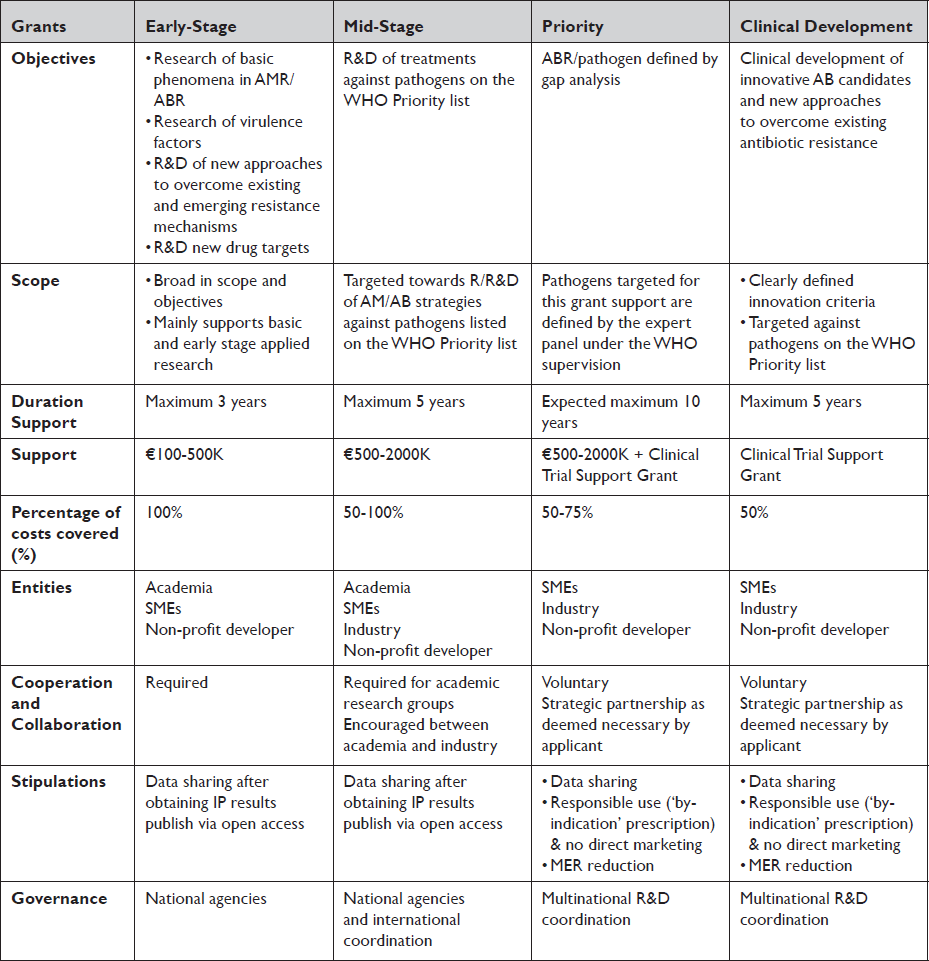
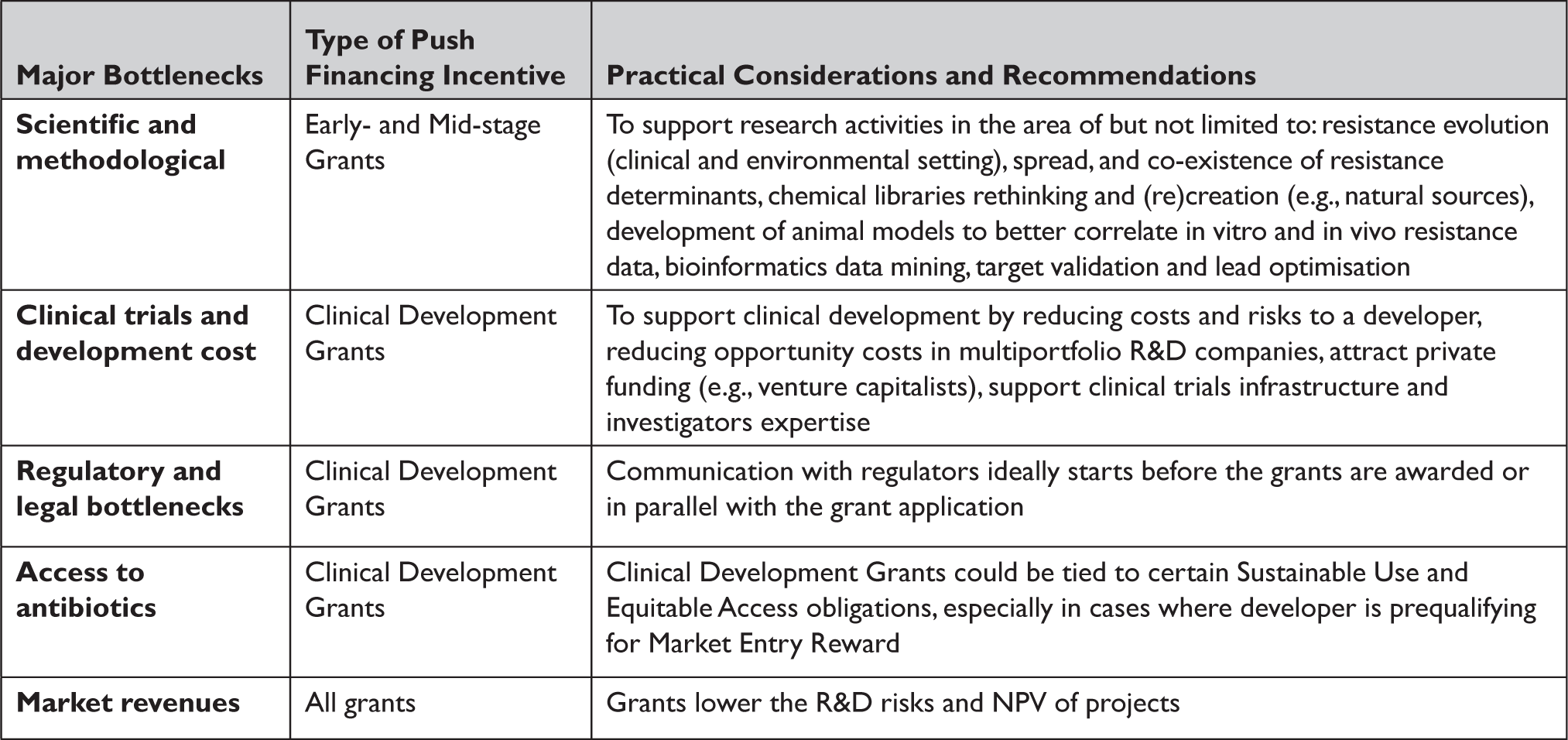
While AMR is increasing, the number of innovative products coming to the market is decreasing.Reference Freire-Moran, Aronsson, Manz, Gyssens, So, Monnet, Cars and Theuretzbacher29 Push incentives, by their support along the antibiotic value chain, are mitigating two major R&D bottlenecks: scientific (including methodological), and clinical development costs. To address these bottlenecks, we propose a model of four inter-related and partially overlapping grant incentives with the aim to stimulate antibacterial R&D (Figure 1). Key characteristics of incentives are summarized in Table 3, and Table 4 encapsulates how grants address major antibiotic R&D bottlenecks.
Characteristics of Proposed Push Funding Incentives
Between 50-70% initial grant investment should be returned to funder during FY 2-6 post MER (those receiving support for phase II & III clinical trials). If MER awarded after supporting phase II & III via grants, MER will be reduced by the full amount received in grants (see Stipulations). MER: market entry reward; R&D: research and development; ABR: antibiotic resistance; AMR: antimicrobial resistance; AB: antibiotic; FY: fiscal year.

Addressing R&D Risks and Bottlenecks with Proposed Grant Framework

Early-stage grants are envisioned as broad in their research objective, mainly focused on basic scientific research including drug discovery (TRL 1 to 3). With an attrition rate of more than 95%, it is important that the early stage pipeline is sufficiently large and diverse. Research objectives can be targeted towards public health needs (e.g., identification and investigation of new antibiotic resistance mechanisms, research related to resistant organisms on the WHO PPL). The main recipients of early-stage grants tend to be academic research groups and institutes. At this early stage, collaboration is useful as different competencies can facilitate problem-solving of scientific problems and creative solutions. This is also an ideal phase where young scientists can be trained. The funding priorities should direct a portion of R&D to pathogens on the WHO Critical Pathogen Priority List, but also allow for funding of general innovative approaches for future public health needs (an example of funding mechanism could be NIH SBIR/STTR or French ASTRID Programme). Likely implementers could be JPIAMR, national research councils and foundations including philanthropic institutions. With the next revision of the SRA, JPIAMR should begin to priori-tize antibiotic innovation towards the WHO PPL, and consider coordinating national R&D efforts towards the public health needs with specific and targeted grant call objectives.
Mid-stage grants should be designed to help project advancement from the preclinical stage to the end of phase I clinical trials (TRL 3 to 6). They should be targeted towards R&D of treatments against pathogens on the WHO PPL or promising alternative therapies. They are ideally positioned to direct efforts towards the research on, but not limited to: pathogens from the WHO PPL, and their resistance evolution, rethinking of chemical and/or natural products libraries synthesis and screening, encouraging hit-to-lead R&D activities and proposals for innovative approaches integrating ‘omics’ technologies and (chemical) libraries screening, and development of new bioinformatics tools to aid lead compounds optimization.
The main recipients of these grants would be SMEs, industry, public-private consortia and also non-profit research groups and institutes. Mid-stage grants should only require collaboration among research groups, and academia-SME/industry cooperation when there is a specific need that collaboration can facilitate. A developer should be able to apply for a mid-stage grant at any point of its technology readiness (from TRL 3 to 6; e.g., GLP toxicology and/or manufacturing stage). After successfully accomplishing phase I clinical trial milestone, there should be graduation to clinical development (phase II and III) by utilizing clinical development grant funding. CARB-X and IMI through the ENABLE project are the principal funders today (though the ENABLE will finish in 2020 and a long-term program with stable financing and clear objectives is needed). National programs like NIH SBIR/STTR or French ASTRID are also well positioned to administer this type of grants.
Priority grants are targeted towards development of innovative antibiotics and therapeutics. These grants are strictly focused on antibiotic-resistant bacteria that pose immediate and/or emerging threats due to increased incidence. It is anticipated that the majority of these pathogens will be included on the WHO PPL. A panel of experts, perhaps organized through the G20's AMR R&D Hub or WHO Antimicrobial Resistance Secretariat, should assess the priority list, surveillance data and antibiotic R&D pipeline to identify the gaps and inform the funding agency(s) about the public health needs. This grant scheme has an option for long term duration (10 years or more if starting at preclinical research/TRL 3 and supporting the project to completion of phase III clinical development/TRL 8), and contract arrangement between the funding agency and the developer. The contract stipulations should include installment payments based on successful accomplishment of agreed milestones (e.g., successful termination of one TRL stage and readiness to proceed to the next stage). To support phase II and III of clinical trials additional funds are proposed in the form of a clinical trial support grant (CTSG). The amount of CTSG financial support is determined upon clinical trial cost estimation (which mainly will be determined by the intended clinical indication and the size of a clinical trial). Additionally if the developer receives an award from the pull mechanism (e.g., Market Entry Award (MER)), the developer is required to pay back the grants received for clinical trials. Since priority grant(s) span long time periods and many R&D phases, an ideal implementer would be a Pipeline Coordinator (an organization that actively works with developers and funds the R&D, see article by Baraldi et al., in this issueReference Baraldi, Lindahl, Savic, Findlay and Årdal30). Currently, several organizations support different phases of the R&D pipeline but very few have focused, long-term and coordinated approach to AMR, with the exception of NIH/NIAID and Well-come Trust. CARB-X in partnership with BARDA could also award priority grants, but it would be useful if there was also a European equivalent to BARDA to focus on late stage clinical trials.
Clinical development grants are designed to support projects through clinical development phases II and III (TRL 7 and 8), by utilizing the CTSG financing mechanism (see above). These grants are targeted towards public health needs defined through a target product profile (TPP) for one, or more, pathogens on the WHO PPL, and for clinical development of novel antibiotics and therapeutics. Clinical development grants help developers reduce opportunity costs to progress antibiotics towards clinical development in situations when a developer has competing projects in its portfolio and limited financial resources. In addition, it is expected that this incentive will attract private capital by reducing the investment risk in clinical trials.
The developer can apply for this financing mechanism directly, and be subject to peer review, or could directly proceed from mid-stage grant funding without the need for a new peer review process (conditional of successfully accomplishing a phase I milestone). The contract stipulations for clinical development grants are the same as for the priority grants (see above). These type of grants are already implemented by BARDA, but EU public funds are mostly lacking. One alternative for the EU could be to secure sustainable financing for COMBACTE-NET project and transforming it into a permanent clinical trial network, which would facilitate clinical trials of novel antibiotics.
Conclusion
Antibiotic resistance (and more broadly antimicrobial resistance) has been recognized as a threat not only to human life and health care systems but also to sustainability, economic development, and poverty reduction.31 Since antibiotic resistance constitutes a highly complex scientific challenge, in conjunction with multiple market failure issues, the consequence is a financially unattractive pharmaceutical R&D field for developers and investors. An additional layer of complexity was the absence of consensus on what are the (global) public health needs; this problem has been resolved (at least temporarily) by the publication of the WHO PPL for R&D in February 2017.
As means of push funding, we propose four financial incentives to support early- and mid-stage R&D, complemented with two highly focused incentives: priority and clinical development grants. Our aim was to design push incentives that focus R&D towards unmet public health needs in antimicrobial R&D. However, we propose that early-stage R&D grants retain some ‘degree of freedom’ in their research scope and objectives which can diverge from the WHO PPL. Early-stage grants are ideally positioned to address most of scientific and methodological bottlenecks. National funding, through coordination by JPIAMR or a similar organization, can be used to support allocation of early-stage grants.
As means of push funding, we propose four financial incentives to support early- and mid-stage R&D, complemented with two highly focused incentives: priority and clinical development grants. Our aim was to design push incentives that focus R&D towards unmet public health needs in antimicrobial R&D. However, we propose that early-stage R&D grants retain some ‘degree of freedom’ in their research scope and objectives which can diverge from the WHO PPL. Early-stage grants are ideally positioned to address most of scientific and methodological bottlenecks (Table 4). National funding, through coordination by JPIAMR or a similar organization, can be used to support allocation of early-stage grants.
Mid-stage, priority and clinical development grants are envisioned as push incentives that will stimulate R&D of innovative antibiotics (and more broadly defined ‘antibiotic resistance combating products’), and antimicrobial strategies that address the (unmet) public health needs. Mid-stage grants in particular are poised to tackle specific scientific risks in antibiotics R&D providing an attractive financial incentive for the developer. Priority grants are focused on development of novel antibiotics against antibiotic-resistant bacteria that have emerging threat potential. Clinical grants primarily overcome financial bottlenecks of clinical development.
In the past five years, significant new push initiatives for antibacterial innovation have been launched, including CARB-X, GARDP and EIB's InnovFin. These come in addition to many existing national funding mechanisms and the multi-national collaboration of JPIAMR and IMI's ND4BB. This paper is not a call for a new fund or major changes to existing funds. However, the identified gaps need to be filled in primarily in the European context. At the present, only BARDA finances clinical development grants for priority pathogens with a high risk profile. Given the high cost of late stage clinical trials, greater investments are needed, and in that sense EIB's InnovFin could be encouraged to take on higher risk investments.
The OECD estimates that about $550 million is invested primarily in grant funding of antibacterial innovation annually. This is a significant investment, but it could be more effectively utilized if the grants are targeted and there is better coordination among actors along the R&D pipeline (hence a need for an organization to perform functions as described for a Pipeline Coordinator). There is also an absence of data regarding the number of projects within the preclinical antibacterial pipeline. CARB-X is beginning to fill this knowledge gap with each of its funding rounds.Reference Theuretzbacher32 Today it appears that the preclinical pipeline is insufficient, and R&D efforts are directed towards handful of pathogens on WHO PPL. Since most of these projects will fail due to scientific reasons, it is necessary to increase the level of financing channeled through the existing funders to create a more robust R&D pipeline targeted towards unmet public health needs.
Acknowledgments
We would like to thank all SME participants who attended the stakeholder meeting.
Supplementary Materials
Description of National Research and Development Grant Funding Schemes
In the US, public agencies like the National Institutes of Health (NIH) and the Biomedical Advanced Research and Development Authority (BARDA) are the largest science sponsors, with varying approaches. The NIH funds science through two general mechanisms tailored to accommodate specific requirements of academia and industry: grants awarded to universities and institutes for basic and early-applied scientific research, and small business innovation research (SBIR) and small business technology transfer (STTR) grants tailored for small- and medium-sized enterprises (SMEs). All NIH grant applications are competitive and subject to a peer review process.
The SBIR and STTR programs are divided into three phases. The objective of Phase I is to establish the technical merit, feasibility, and commercial potential of the proposed research/R&D project and to determine the performance of the awardee organization prior to providing further financial support. Phase II provides continuation funding for grantees that successfully accomplished Phase I. Last, SMEs have an option to apply either for Phase IIB grants, which support R&D projects that require extraordinary efforts, or for the Commercialization Readiness Program (CRP) which provides support for FDA documents preparation, Investigational New Drug (IND)-enabling studies, clinical studies, manufacturing costs, and regulatory assistance, among others.
In contrast, BARDA does not fund research in basic science, instead it has an integrated approach to the development and purchase of vaccines, drugs and diagnostic tools for public health medical emergencies. BARDA oversees all procurement under the Project BioShield Act,Reference Carlet1 which has three main provisions: (1) expedited procedures for chemical, biological, radiological or nuclear agents terrorism-related spending, including procuring products, hiring experts, and awarding research grants, (2) creation of a government-backed guarantee by committing funds to purchase countermeasures while they are still in development, and (3) the emergency use of medical countermeasures that lack FDA approval.
European national-level strategies for antimicrobial resistance research, and investment in antibiotic R&D vary by country. We focused our analysis on the national science funding agencies in the UK, France and Germany (Table S1).
Overview of Antimicrobial/Antibacterial Resistance and Infectious Diseases National Grant Schemes (M = million, K = thousand, y = year)

In the UK, the Medical Research Council (MRC), Biotechnology and Biological Sciences Research Council (BBSRC), and Wellcome Trust have all sponsored programs focused on antibacterial resistance and development of new (or repurposing of old) antibiotics. Between 2014 and 2016 (extended to 2018-2020), MRC led a cross council initiative called Tackling AMR, which had a thematic approach: (1) understanding resistance mechanisms, (2) development of therapeutics and diagnostics, (3) understanding the real world interactions — the threat of AMR in the indoor and built environment, and (4) behavior within and beyond the health care setting. It was acknowledged that an interdisciplinary approach was needed, and that collaboration and sharing of information and resources across the public and private sectors was key for initiative success. The cross-council initiative coincided with Prime Minister David Cameron's 2014 commissioning the Review on Antimicrobial Resistance, which in its final report outlined a broad action plan to tackle AMR globally.2
The MRC grants were broadly grouped into three categories: individual research grants, program and partnership grants. MRC research grants are suited for focused research projects that may be short- or long-term (up to five years). Program grants are awarded to support “coordinated and coherent group of related projects in a broad scientific area,” they have a long-term duration (usually five years), and are renewable. Partnership grants “provide core funds for one to five years to support partnerships between diverse groups of researchers and can be used for infrastructure support, platform activities and bringing together managed consortia or multidisciplinary collaborations.”3
In contrast, France has kept very broad and vaguely defined objectives for scientific research grants in the period 2008 to 2017. During the same period, the national action plan, implemented by the National Agency for Research (ANR), has gone through three evolution phases. The French government recognizes the gravity of inaction when it comes to AMR and supports basic research by actively funding and encouraging research groups to participate in the Joint Programming Initiative on Antimicrobial Resistance (JPIAMR, see below). In 2011, the government started the ASTRID program (a BARDA-like model), which is sponsored by the French Ministry of Defense and managed by the ANR.Reference Adegoke, Frieri, Lammie and Hughes4 ASTRID was created to encourage public-private partnerships and technology transfer from academic research to industry, and to support research and development of technologies, including biotechnology, with national defense and public health potential. ASTRID usually sponsored developers starting at the technology readiness level (TRL) stage 1 or 2 to advance to stages 3 or 4, and supported consortium/collaborative projects as well as stand-alone initiatives (details on TRL stages are provided in the Supplementary Material Table 2S). ASTRID was phased out in 2013, and a successor program, ASTRID Maturation, is sponsoring technology development from TLR stage 4 to stage 8 or 9. ASTRID program was a valuable mechanism to support R&D and public-private partnership, however in the past it did not finance antibiotic R&D projects.
Overview of International Grants General Characteristics

In Germany, Deutsche Forschungsgemeinschaft (DFG) is the main federal science and research-funding agency. It has a diverse portfolio of grants and funding schemes that include individual research grants for academic research groups and research network grants, coordinated programs and excellence centers. Coordinated programs are designed to promote “collaboration within broadly defined research areas with the objective to coordinate resources and produce scientific value.”Reference Mossialos, Morel, Edwards, Berensen, Gemmill-Toyama and Brogen5 Within coordinated programs there are established collaborative research centers and clinical research units. The clusters of excellence have objective “to support project-based funding in internationally competitive research fields at a university or university consortium,” with long term funding and potential for career development for young scientists. However, in the period 2005 to 2017 no clusters of excellence were dedicated to microbiology or AMR. In addition, specifically designed funding mechanisms exist for SMEs: the German Federation of Industrial Research Associations (AiF),Reference Rex, Silver, Spellberg and Zorzet6 KMU-innovativ,Reference Micallef7 and ZIM (the Central Innovation Programme for SMEs),Reference Castro-Sanchez and Holmes8 which support individual or collaborative R&D projects, and are mostly focused on (bio)technology development.
In Japan, the Agency for Medical Research and Development (AMED) was created in 2015 using the NIH as a role model.Reference Bush, Page and Chen9 Prior to the creation of AMED, a number of research institutes supervised by three ministries were funding biomedical research and development. By consolidating funds for biomedical research (with a total budget of up to US $3 billion), and more integrated management, the government is seeking ways to streamline Japan's economic productivity in the healthcare sector and boost clinical research.Reference Power10 AMED had two calls for proposals in the field of infectious diseases and cancer. Priorities for research in infectious diseases were set very broadly with a reference to common epidemiological risks in East Asia. Both calls were part of wider e-ASIA Joint Research Program (JRP).Reference Tillotson11
The e-ASIA JRP started in 2012 as a program to foster research among public funded institutions of the Association of Southeast Asian Nations (ASEAN), plus eight joint countries: Australia, Japan, New Zealand, China, India, Korea, Russia, and the US. Japan Science and Technology Agency, in collaboration with AMED sponsor Science and Technology Research Partnership for Sustainable Development (SATREPS), which has six focus areas including infectious diseases control in developing countries. The objectives of the SATREPS program were promotion of cooperation and international joint research to target global issues with the aim of future utilization of research outcomes for societal and economic benefits.