Introduction
The use of sex pheromones in social wasps, such as, Dolichovespula Rohwer, Polistes Latreille, Vespa Linnaeus, and Vespula Thomson (Hymenoptera: Vespidae) has been demonstrated in several studies (Post and Jeanne Reference Post and Jeanne1983, Reference Post and Jeanne1984, Reference Post and Jeanne1985; Ono and Sasaki Reference Ono and Sasaki1987; Reed and Landolt Reference Reed and Landolt1990a, Reference Reed and Landolt1990b; Landolt et al. Reference Landolt, Jeanne and Reed1998; Spiewok et al. Reference Spiewok, Schmolz and Ruther2006; MacKenzie et al. Reference MacKenzie, Landolt and Zack2008). Gynes (newly emerged potential foundress queens that have not yet established a colony) of some Polistes species are attracted to swarms of males (Reed and Landolt Reference Reed and Landolt1990b, Reference Reed and Landolt1991; MacKenzie et al. Reference MacKenzie, Landolt and Zack2008). In contrast, a field study on the Vespa crabro (Linnaeus) mating system showed that males would alight on small wooden cages containing gynes (Spiewok et al. Reference Spiewok, Schmolz and Ruther2006). Spiewok et al. (Reference Spiewok, Schmolz and Ruther2006) also found that males would copulate with dead V. crabro workers if they were treated with gyne extract. Vespula males also form conspecific swarms, or aggregations, around trees and shrubs on warm sunny days in autumn through early winter (Thomas Reference Thomas1960; Spradbery Reference Spradbery1973; Greene Reference Greene1991). However, to date it is not known whether Vespula males are searching for gynes, or vice versa.
Vespid wasps have a highly developed mating system, fully described for Vespula maculifrons (Buysson) by Ross (Reference Ross1983). Our observations of Vespula vulgaris (Linnaeus) mating behaviour in the laboratory are consistent with those observed in Ross's (1983) V. maculifrons study. Ross (Reference Ross1983) found that it was always the male that oriented towards the female and the male would only be able to mount the female when she was on a substrate (i.e., not in flight). However, the observations of mating behaviour in Ross's study were performed in relatively small enclosures (0.5–4.2 L), so the mention of males approaching the gynes from distances of 5–15 cm (Ross Reference Ross1983) could be underestimating the potential orientation distance of the males. Both males and gynes in the Vespula genus are able to mate multiple times (Thomas Reference Thomas1960; MacDonald et al. Reference MacDonald, Akre and Hill1974; Ross Reference Ross1983) and this multiple mating increases fitness of the queens of V. maculifrons (Goodisman et al. Reference Goodisman, Kovacs and Hoffman2007). Post (Reference Post1980) observed that male V. maculifrons flew in a zigzag pattern upwind towards a tethered gyne. Using laboratory wind tunnel bioassays, Reed and Landolt (Reference Reed and Landolt1990a) experimentally demonstrated that gynes produce a sex pheromone that attracts the males in Vespula squamosa (Drury) from a range of at least 2 m. Males of both Vespula germanica (Fabricius) (Thomas Reference Thomas1960) and V. maculifrons Ross (Reference Ross1983) have been observed to attempt to copulate with other males that had recently mated with a gyne. This evidence suggests that in the Vespula genus, the gynes attract the males once they have left the nest.
Many wasps in the family Vespidae have become, or have the potential to become invasive worldwide (Beggs et al. Reference Beggs, Brockerhoff, Corley, Kenis, Masciocchi and Muller2011). By increasing our understanding of the mate-seeking behaviour of V. vulgaris, we may provide a better platform for the identification of a sex pheromone that would enable the development of control methods for this and related species in places like New Zealand and Hawaii where they are major pests. In this study, we tested whether V. vulgaris gynes attracted males over long distances in the field and then tracked their flight behaviour using wind tunnel bioassays measuring flight speed and turning angles exhibited by males during their location of gynes.
Materials and methods
Insects
Male and female (gynes) V. vulgaris specimens were obtained by excavating five live nests between 7 April and 23 April 2010 (autumn) when the colonies were likely to be producing both males and gynes. One nest was excavated on the Plant & Food Research campus in Lincoln, New Zealand (43.6406°S, 172.4748°E), while the other four were excavated near Andrews Shelter in Arthur's Pass National Park, New Zealand (42.9934°S, 171.7935°E). Newly eclosed gynes and males were collected, separated by sex and placed into 3 L (height: 12 cm, length: 23 cm, width: 15 cm) polycarbonate storage containers (Sistema, Penrose, Auckland, New Zealand), modified with 5 × 12 cm hole on short side sides covered with steel screening material (2 mm openings). Some workers were kept with the remaining comb to aid the adult emergence of further male and gyne pupae. The wasps were allowed to feed ad libitum from 20 mL of 30% white sugar water solution from a feeder (25-mL plastic cup with a dental roll pushed through the lid to provide consistent access to the solution) and misted twice daily with water until used in trials.
Field trapping
Field trapping took place near Andrews Shelter in Arthur's Pass National Park on the South Island of New Zealand (42.9934°S, 171.7935°E). The site is situated near the Waimakariri River flood plain where vegetation consists mostly of thorny matagouri shrubs (Discaria toumatou Raoul; Rhamnaceae), introduced pasture grass and native beech (Nothofagus Blume; Nothofagaceae species) forest. The field site was chosen because of the proximity to black beech forest (100 m), where the number of V. vulgaris available for trapping is not limited since nest densities can reach up to 30 nests/ha (Moller et al. Reference Moller, Beggs, Tilley, Toft, Wilson and Alspach1990; Barlow et al. Reference Barlow, Moller and Beggs1996). Three treatments were placed out in a randomised complete block design. The treatments consisted of an unbaited control (dental roll only), a live virgin male, and a live virgin gyne. Treatments were contained within a 50 mL (length: 55 mm, depth: 40 mm) cylindrical polycarbonate specimen vial with a 3-cm diameter hole drilled out of the lid and base. The drilled openings were covered with stainless steel mesh of 1 × 1 mm coarseness that was melted into the plastic to form a seal. The sides of the vials were opaque so that the wasp would not be visible from the outside, although there would have been limited visibility through the mesh ends and it is possible that there were some auditory cues could be emitted through the vial. A dental roll soaked in 30% white sugar water (∼4 mL of solution per dental roll) was added to each treatment vial. A single vial containing the treatment was placed into a green delta trap (Plant and Food Research, Auckland, New Zealand), which further limited visual cues (Clare et al. Reference Clare, Suckling, Bradley, Walker, Shaw and Daly2000). Traps had an 18 × 19 cm sticky base and were hung in matagouri shrubs 3–5 m apart, at 1.5–2.0 m off the ground and set to face the same cardinal direction. Each block contained one trap of each treatment and blocks were separated by 10 m and replicated 15 times at the same site. The trial took place between 30 April and 3 May 2010.
Wind tunnel experiments
Wind tunnel bioassays were conducted to determine whether or not a sex pheromone is used in sexual communication of V. vulgaris. Virgin V. vulgaris males and gynes that were at least five days old were used in all experiments.
The wind tunnel (width: 90 cm, height: 55 cm, length: 190 cm) was operated at a wind speed of 0.9 m/s in 2700 lux of light. Air pulled from the room was charcoal-filtered and passed through a series of baffles to produce laminar airflow before flowing into the wind tunnel. Temperature in the wind tunnel was kept at 24 ± 1 °C with a relative humidity of 30–40%. Flight tracks were recorded from individual male wasps and analysed with software using HALCON/C languages interface (MvTech Software GmbH, Munich, Germany) for the Microsoft Windows® operating system (El-Sayed Reference El-Sayed2009). The software enables the implementation of video tracking of flying insects at up to 60 frames/second. Using a subtraction algorithm, the software constructs the flight tracks and the position data are stored as a text file. The previous position of the wasp (X–Y coordinate) is matched with its position in the current image, enabling the estimation of motion. Tracking was activated once the male wasp entered the camera field of view (30 cm upwind of take-off), so that flights were recorded over a distance of 130 cm, towards the caged gynes so total distance to female from release point was 160 cm. A program, written in Borland Delphi (version 7; Borland Software Corporation, Austin, Texas, United States of America), was used to visualise the tracks, extract the flight track parameters (flight duration, distance flown, flight speed, and track angles between frames), and export the images as bitmap files.
In the first experiment, caged gynes (the same gynes as those used for the field trial), or empty cages (control), were placed on a stand at a height of 45 cm within 5 cm of the final upwind laminar airflow diffuser. Male wasps were individually released from a 45 cm tall stand 160 cm downwind of the caged gynes in a wind tunnel after being acclimated to wind tunnel conditions for at least 15 minutes. Five control replicates were conducted at the beginning of each session to control for any possible residual scent contamination left on the support stand from previous experiments. Male flight to the caged-gyne treatment was replicated five times on the first day and 15 times on the second day using a naive male for each flight. Each of the caged-gyne replicates had three individually caged gynes as the lure to increase the likelihood that at least one female would be calling and each set of three gynes was replaced after five males had been tested. Males were released into the wind tunnel and observed for two minutes. Their maximum flight behaviour was recorded using the following scores: 0, no apparent intent for flight; 1, wing fanning and/or perceived intent for flight; 2, zigzag flight upwind to one quarter of the way up the wind tunnel; 3, zigzag flight to halfway up the wind tunnel; 4, zigzag flight to three quarters up the wind tunnel; and 5, zigzag flight to contact with a cage containing a gyne (Baker and Haynes Reference Baker and Haynes1987).
The second and third wind tunnel experiments tested male attraction to hexane rinses of gynes, to confirm that attraction was chemical and not due to visual or sound cues. In the second experiment, two attractive gynes were freeze-killed in a −80 °C freezer for 10 minutes and were immediately rinsed with 2 mL of hexane. After testing the males’ response to the control (dental roll with 0.33 mL hexane), a 0.33 mL aliquot, a 0.33 gyne equivalent (1 gyne/mL concentration), of the rinse was pipetted onto a dental roll and placed on to the 45 cm high support stand. One male was tested per aliquot. The dental roll was replaced after each male and a fresh aliquot was applied for each of the six replicates. In the third wind tunnel experiment, the hexane control was compared with a treatment of a hexane rinse of 23 gynes with 10 mL of hexane. The 10 mL rinse was then concentrated under a stream of argon gas to a volume of 2 mL for a concentration of 11.5 gynes/mL of hexane. Five males were flown to a 200 μL hexane control, and then five more males were flown to a 200 μL aliquot of the rinse on the dental rolls. This provided 2.3 gyne equivalents per replicate.
Data analysis
The multiway tables of counts for the field trials and wind tunnel experiments were analysed with a Poisson regression model with main effects and interactions where appropriate using R statistical software (R Core Team 2012). The factor coefficients were tested for significance. No formal analysis was done on the flight track data, as these data are empirical results used only to describe the flight characteristics of males as they approach an attractive gyne.
Results
Field trial
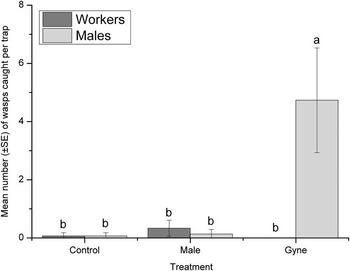
The majority of wasps caught in the field trapping experiment were male. More males were caught in the delta traps baited with live gynes than in the live male-baited or control traps (χ2 = 97.59, df = 42, P < 0.001) (Fig. 1). A total of 74 V. vulgaris males were caught over the three-day trial, 71 of which were caught in the traps baited with gynes, while the male-baited traps caught two males and the controls caught one male. The total number of V. vulgaris workers caught in the trial was six (one in the control, five in the male-baited traps). There was no significant difference between the numbers of workers caught among the treatments. No V. vulgaris gynes were caught in the study. All of the males and gynes used to bait the traps survived the duration of the field trial.
Mean number (±SE) of Vespula vulgaris males and workers caught at Arthur's Pass National Park, New Zealand from 30 April to 3 May 2010. No gynes were caught. The treatments were as follows: control: cage plus sugar water; male: caged V. vulgaris male plus sugar water; gyne: caged V. vulgaris gyne plus sugar water. Bars with different superscript letters are significantly different (χ2 = 97.59, df = 42, P < 0.001).

Wind tunnel experiments
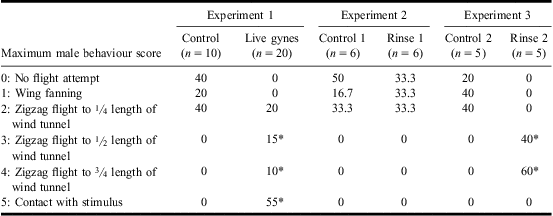
The results of the three wind tunnel experiments analysed using a three-way χ2 test (experiment ×treatment × behavioural score) show a significant difference for each of the three parameters analysed (χ2 = 3.5, df = 10, P < 0.001). In the first wind tunnel experiment, V. vulgaris males were attracted to the caged gynes and showed no attraction to the control (P < 0.001) (Table 1). All 20 males flew upwind to at least one quarter of the length of the wind tunnel towards gynes. A total of 16 males (80%) flew halfway way down the wind tunnel or further. Eleven of the 20 (55%) males flew upwind and made contact with the cages holding the gynes. Four of the 10 males tested to the control flew, and terminated flight at a maximum of one quarter of the length of the wind tunnel. These four appeared to be flying to escape, rather than exhibiting the zigzagging (cast-surge-cast) flight associated with plume tracking, also seen in moths (Willis and Baker Reference Willis and Baker1994).
Percentage of Vespula vulgaris males exhibiting maximum behaviours to treatments in the wind tunnel within the allotted two minutes.
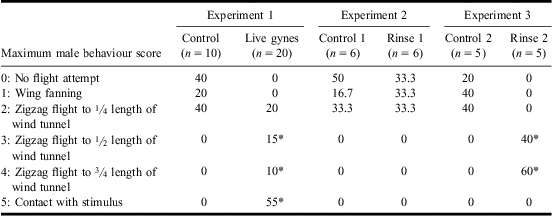
Notes: Experiment 1 compares male response to the control (empty cages), and to three live gynes in separate cages. Experiment 2 compares male response to a hexane blank and to a 0.3 gyne-equivalent hexane rinse. Experiment 3 compares attraction of males from a 2.3 gyne-equivalent hexane rinse with a hexane blank.
*Percentage of higher maximum score (P < 0.01).
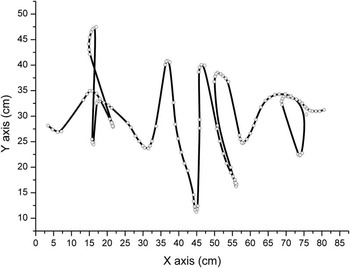
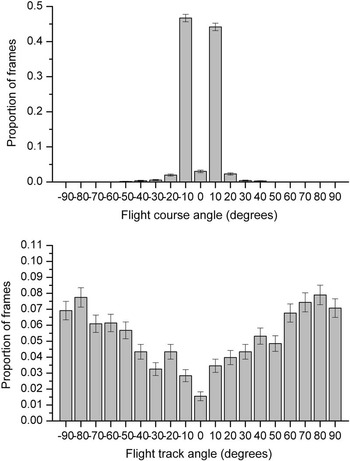
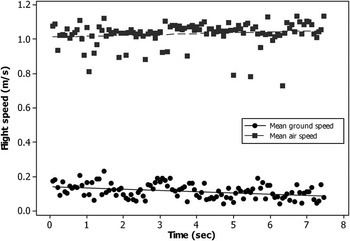
Strong lighting was essential to generate flight but this created problems with light reflections on the plexi-glass wind tunnel so that flight tracks were only properly recorded for eight full flights (Fig. 2) and 18 flight fragments. The flight course angles were predominantly between −10° and 10°, with a relatively sharp decline of angles to the right and left of this (Fig. 3). However, the proportion of video frames for flight track angles were highest at the full right (80–90°) and full left (−80 to −90°). Flight speed versus flight time was only successfully recorded for eight complete flights. The average up-wind flight speed over ground was 0.12 m/s after being corrected for the 0.9 m/s wind speed of the wind tunnel (Fig. 4). The average up-wind flight speed against the air was 1.03 m/s after being corrected for the 0.9 m/s wind speed of the wind tunnel (Fig. 4).
A typical flight track of Vespula vulgaris male flying upwind in a wind tunnel towards caged V. vulgaris gynes (from right to left).

Top: distribution of flight course angles (proportion of video frames ± SE) exhibited by male Vespula vulgaris flying upwind to caged V. vulgaris gynes in a wind tunnel. Bottom: distribution of flight track angles (proportion of video frames ± SE) of male V. vulgaris flying upwind to caged V. vulgaris gynes in a wind tunnel. Negative numbers represent flight to the left and positive numbers represent flight to the right.

Distribution of air (top) and ground (bottom) flight speeds over time exhibited by Vespula vulgaris males flying upwind to caged V. vulgaris gynes in a wind tunnel.

The second experiment compared 0.33 gyne-equivalent hexane wash against blank hexane. There was no difference between these two treatments as the males tested in both cases failed to fly any farther than the ¼ way up the wind tunnel (P = 0.765) (Table 1). For the third wind tunnel experiment, the hexane wash was increased to 2.3 gyne equivalents and again compared with hexane only. Males only flew to a maximum of ¼ way mark in the control test, while all of the males tested to the gyne wash flew significantly farther upwind (P < 0.001) (Table 1). While no males made contact with the dental roll impregnated with the gyne rinse, 60% of the males flew to at least the ¾ mark of the wind tunnel (Table 1).
Discussion
The results of this study demonstrate that male V. vulgaris are attracted to gynes and that the males find gynes by following a volatile chemical produced by the gynes. This result also demonstrates that the pheromone produced by a Vespula gyne can attract a mate from distances of at least 2 m. The very low trap count in the male-baited and control traps shows that the males were not merely attracted by the smell of the sugar water solution provided as food for the captive insects in each cage. This experiment also provides evidence that gynes are not attracted to males over long-range distances.
The wind tunnel experiments provide further evidence that the males follow a scent plume to find the gynes and do not rely on visual or auditory cues. The fact that 55% of the males tested used a plume tracking, or zigzagging flight, to alight on the cages of live gynes is strong evidence that they were not primarily using visual cues (Willis and Baker Reference Willis and Baker1994). Although we could not eliminate the possibility that sound was being used, it seems unlikely that a male following sound from a female would appear to be following a scent plume, as observed. A male following an auditory signal would likely fly in a direct line to the source, similar to cricket phonotaxis (Mhatre and Balakrishnan Reference Mhatre and Balakrishnan2007). Gyne extract was attractive to males at a dose of 2.3 gyne equivalents but not at the lower 0.3 gyne-equivalent dose, although replication of the gyne extract experiments was low (due to low numbers of gynes available). There was no contact made by the V. vulgaris males with the dental roll that contained the hexane rinse, suggesting that they may rely upon visual stimuli, short distance odour cues, or sound when they are within 5–10 cm of gynes. During the wind-tunnel assays to the live gynes, the males often partially exposed their aedeagus as they approached to make contact with the cage containing the gyne, which is further evidence of a sex pheromone.
The majority of literature on insect flight in wind tunnels pertains to moth flight manoeuvres in response to a sex pheromone (Baker and Haynes Reference Baker and Haynes1987; Willis and Baker Reference Willis and Baker1994; El-Sayed et al. Reference El-Sayed, Gödde, Witzgall and Arn1999). There have also been studies on the plume tracking flight behaviour of the mosquito, Aedes aegypti Linnaeus (Dekker and Cardé Reference Dekker and Cardé2011). To our knowledge, the present study is the first description of flight speed, tracking angle, and course angle for any kind of wasp. The flight tracks of V. vulgaris males are very similar to those of other insects plume tracking in a wind tunnel (El-Sayed et al. Reference El-Sayed, Gödde, Witzgall and Arn1999; Rutkowski et al. Reference Rutkowski, Quinn and Willis2009; Dekker and Cardé Reference Dekker and Cardé2011; Lacey and Cardé Reference Lacey and Cardé2011). The flight speed of V. vulgaris males during the wind tunnel experiments appeared to be much slower than the flight speeds we have observed them to be capable of in the field. The zigzagging flight tracks and relatively low flight speed in the wind tunnel assays are characteristic of flights of insects that use sex pheromones to locate mates (Baker and Haynes Reference Baker and Haynes1987; Willis and Baker Reference Willis and Baker1994; El-Sayed et al. Reference El-Sayed, Gödde, Witzgall and Arn1999; Rutkowski et al. Reference Rutkowski, Quinn and Willis2009). This provides the first clear evidence that V. vulgaris males are attracted to gynes by a sex pheromone(s). It is unlikely that gynes are using chemical cues to locate males over long distances. While it is widely acknowledged that social wasps use sex pheromones, to date no sex pheromones have been identified for any species of social wasp.
Knowledge of mate-seeking behaviour in Vespula species could be used as part of an integrated pest management approach to control populations where these insects are invasive. However, since it is the males that are attracted to gynes, and males are usually in plentiful supply, it is difficult to see how mass trapping of males could be intensive enough to exert substantial population level control. The sex pheromone must be identified before any real population control of these social wasps can occur.
Acknowledgements
This work was funded by the New Zealand Ministry for Science and Innovation (Co6X0811) and the University of Auckland. The authors thank the New Zealand Department of Conservation for permitting access to the conservation estate. They also thank Alasdair Noble for his assistance with the statistical analyses of the data, and two anonymous referees for comments on the manuscript.