INTRODUCTION
Language acquisition is facilitated by cognitive operations while awake, but also during sleep (Schreiner & Rasch, Reference Schreiner and Rasch2017). Sleep strengthens and integrates newly encoded memories with preexisting ones and enhances performance during retrieval (Rasch & Born, Reference Rasch and Born2013). This process is referred to as sleep-dependent memory consolidation. Evidence of memory consolidation during sleep has been found in various aspects of language learning, including vocabulary learning (Dumay & Gaskell, Reference Dumay and Gaskell2007; Gais et al., Reference Gais, Lucas and Born2006; Tamminen et al., Reference Tamminen, Payne, Stickgold, Wamsley and Gaskell2010), generalized speech learning (Fenn et al., Reference Fenn, Nusbaum and Margoliash2003), and generalized phonetic learning (Gaskell et al., Reference Gaskell, Warker, Lindsay, Frost, Guest, Snowdon and Stackhouse2014). Whether sleep impacts the learning of higher-level syntax remains relatively unexplored with some studies reporting positive effects of sleep (Batterink et al., Reference Batterink, Oudiette, Reber and Paller2014; Nieuwenhuis et al., Reference Nieuwenhuis, Folia, Forkstam, Jensen and Petersson2013) and others showing unclear results (López-Barroso et al., Reference López-Barroso, Cucurell, Rodríguez-Fornells and Diego-Balaguer2016). These mixed findings may suggest that sleep-related consolidation of pattern learning is constrained by particular conditions. In this study, we explored how awareness of rules mediates the benefits of sleep. In addition, we address whether different types of grammar knowledge—explicit (conscious, verbalizable knowledge) or implicit (tacit and unconscious knowledge)—are equally enhanced overnight.
LITERATURE REVIEW
SLEEP AND LINGUISTIC PATTERN ACQUISITION
Pattern extraction lies at the heart of language acquisition. Learners extract complex grammar from linguistic input (i.e., pattern extraction) and generalize the rules to novel sentences (i.e., rule generalization). While extraction of rules is known to occur while we are awake—for instance, through input processing, practice, and rehearsal of target languages—emerging evidence suggests that off-line (or unconscious) processing during sleep may also facilitate extraction processes (e.g., Batterink et al., Reference Batterink, Oudiette, Reber and Paller2014; Fenn et al., Reference Fenn, Nusbaum and Margoliash2003, Reference Fenn, Margoliash and Nusbaum2013; Gaskell et al., Reference Gaskell, Warker, Lindsay, Frost, Guest, Snowdon and Stackhouse2014; Nieuwenhuis et al., Reference Nieuwenhuis, Folia, Forkstam, Jensen and Petersson2013). According to the active system consolidation hypothesis, memory consolidation processes during sleep support integration of memory, as well as the formation of new knowledge (for details see Diekelmann & Born, Reference Diekelmann and Born2010 and Marshall & Born, Reference Marshall and Born2007). In the context of rule learning, a set of learned sentences undergoes off-line reactivation processes, which may allow for the extraction of common patterns (e.g., simple past tense) and the formation of rule knowledge (e.g., the rule of regular verb + -ed) (Stickgold & Walker, Reference Stickgold and Walker2013). As such, sleep may facilitate pattern generalization, and thus be fundamental to achieving higher-level proficiency in multiple language skills, including grammar learning.
While the preceding findings have begun to demonstrate the link between sleep-related memory consolidation and linguistic pattern learning, scholarship has increasingly recognized that off-line consolidation processes are selective (Diekelmann et al., Reference Diekelmann, Wilhelm and Born2009) and that one’s level of awareness may play a role. Previous studies in this area have investigated whether explicit rule knowledge modifies the sleep-associated benefits of pattern learning (e.g., Batterink et al., Reference Batterink, Oudiette, Reber and Paller2014; Robertson et al., Reference Robertson, Pascual-Leone and Press2004; Song & Cohen, Reference Song and Cohen2014) and whether explicit rule knowledge is sleep-dependent (e.g., Batterink et al., Reference Batterink, Oudiette, Reber and Paller2014; Drosopoulos et al., Reference Drosopoulos, Harrer and Born2011; Fischer et al., Reference Fischer, Drosopoulos, Tsen and Born2006; López-Barroso et al., Reference López-Barroso, Cucurell, Rodríguez-Fornells and Diego-Balaguer2016; Song & Cohen, Reference Song and Cohen2014). In both lines of inquiry, the impact of awareness on memory consolidation remains unclear. We take up discussion of each association in turn.
AWARENESS AND SLEEP-ASSOCIATED PATTERN LEARNING
Some studies have provided evidence that explicit knowledge of rules facilitates the benefits of sleep on pattern learning (e.g., Robertson et al., Reference Robertson, Pascual-Leone and Press2004; Song & Cohen, Reference Song and Cohen2014). Put differently, those who develop awareness of rules before sleep perform better on pattern learning tasks after a period of sleep. Song and Cohen (Reference Song and Cohen2014), for instance, examined whether sleep and awareness influence one’s ability to predict hidden pattern sequences (i.e., predicting “2” in the third position in a “4-3-2-1” sequence). In the serial reaction time task (SRTT), participants were trained on a 12-item sequence of key presses. The sequence was repeated throughout training and faster completion of the sequence reflects the amount of learning. Song and Cohen (Reference Song and Cohen2014) instructed some learners to search for the hidden patterns (i.e., intentional), whereas others were not informed of the hidden sequences (i.e., incidental). The authors found robust overnight improvement in SRTT performance only for participants in the intentional group. They concluded that off-line gains in finger-sequencing skills were facilitated by explicit knowledge of rules and that sleep translated declarative knowledge into procedural skills.
In another SRTT experiment, participants who developed rule awareness from intentional instructions showed distinct performance gains only after a period of sleep but not after wakefulness (Robertson et al., Reference Robertson, Pascual-Leone and Press2004). Recognition of hidden rules was probed by color cueing the start of a pattern sequence and was measured through a debriefing session administered after the retest. In the debriefing, participants reported awareness of 8 items, on average, out of the total 12 in the sequence. One question that has not been addressed by Robertson et al. (Reference Robertson, Pascual-Leone and Press2004), is precisely when—during the presleep training and test or during the postsleep retest—participants developed awareness of the patterns. Because this gap raises a possibility that the knowledge reported during the verbal reports could have emerged before sleep and/or after sleep, it is unclear whether awareness (i.e., developed before the sleep interval) impacts consolidation processes. There is a robust body of literature showing that sleep-dependent consolidation processes can lead to a sudden gain of rule recognition (see Batterink et al., Reference Batterink, Oudiette, Reber and Paller2014; Drosopoulos, et al., Reference Drosopoulos, Harrer and Born2011; Fischer et al., Reference Fischer, Drosopoulos, Tsen and Born2006; Wagner et al., Reference Wagner, Gais, Haider, Verleger and Born2004). As such, it is equally possible that explicit knowledge is gained from sleep. In the current study, we address this gap using a retrospective verbal report questionnaire that asked learners to report when awareness emerged during the experiment (i.e., session1 training, session1 test, or session2 test).
AWARENESS AND SLEEP-ASSOCIATED PATTERN KNOWLEDGE
Many can attest to situations in which sleep has clarified learned knowledge. A number of studies have empirically tested this anecdotal observation on whether sleep strengthens explicit rule knowledge (e.g., explicit knowledge gained prior to sleep is enhanced overnight; Drosopoulos, et al., Reference Drosopoulos, Harrer and Born2011; Fischer et al., Reference Fischer, Drosopoulos, Tsen and Born2006, López-Barroso et al., Reference López-Barroso, Cucurell, Rodríguez-Fornells and Diego-Balaguer2016; Song & Cohen, Reference Song and Cohen2014). With explicitly encoded information to be more susceptible to sleep-associated gains (Diekelmann & Born, Reference Diekelmann and Born2010; Gais & Born, Reference Gais and Born2004), a reasonable hypothesis may be that sleep will not only assist with the translation of explicit rule knowledge to pattern learning (e.g., Song & Cohen, Reference Song and Cohen2014), but may also reinforce explicit knowledge gains. A number of empirical studies reported counterevidence for this theoretical prediction. While Song and Cohen (Reference Song and Cohen2014) showed that the awareness of rules improved rule learning overnight, participants did not report more awareness of the sequence after sleep. Similarly, a language study on nonadjacent rule learning also found that there was no overnight improvement in explicit knowledge (López-Barroso et al., Reference López-Barroso, Cucurell, Rodríguez-Fornells and Diego-Balaguer2016). With several studies reporting a lack of explicit knowledge development before sleep (e.g., Drosopoulos et al., Reference Drosopoulos, Harrer and Born2011; Fischer et al., Reference Fischer, Drosopoulos, Tsen and Born2006), the question of whether explicit knowledge is enhanced overnight has not been fully addressed.
To summarize, despite strong theoretical foundations, empirical findings on the role of sleep in rule learning are mixed. Insights from the SRTT tasks suggest that explicit recognition of rules before sleep may facilitate sleep-dependent rule consolidation. Whether sleep consolidates explicit knowledge of patterns, however, remains unclear. To address these gaps, this study investigated two research questions. First, we examined the role of sleep in L2 rule generalization, specifically focusing on the extent to which awareness of grammar rules impacted sleep-dependent L2 rule generalization. Second, we explored whether a period of sleep differentially affected consolidation of explicit and implicit L2 grammar knowledge, focusing specifically on explicit L2 knowledge.
To address these questions, participants were exposed to a phrase-level grammar and were given meaning-focused instructions. We used grammaticality judgment tests (GJTs) to measure the ability for L2 rule generalization. To address research question 1, a retrospective verbal report was employed to assess presleep awareness. It prompted learners to verbalize rules they noticed during the experiment and, just as importantly, when they noticed the rules (e.g., session1 training, session1 test, or session2 test). We hypothesized that learners who recognized rules prior to sleep would improve their GJT scores after a period of sleep but not after wakefulness. To distinguish two type(s) of knowledge for research question 2, we collected source attributions (Dienes & Scott, Reference Dienes and Scott2005) after each GJT item. That is, we asked participants how they decided if an item was grammatical or not and gave them four options: guess, intuition, recollection, or rule. If explicit knowledge is susceptible to sleep-associated benefits, we expected to see an improvement of explicit knowledge after sleep but not after wakefulness.
METHOD
PARTICIPANTS
We recruited 124 native English speakers for a two-session study. They had no knowledge of German or other V2 languages (e.g., Dutch, Icelandic). Nineteen participants were excluded from all analyses because they did not complete the experiment. Five participants were excluded because they reported napping during the waking interval. Even a short period of sleep can consolidate language learning (see Heim et al., Reference Heim, Klann, Schattka, Bauhoff, Borcherding, Nosbüsch, Struth, Binkofski and Werner2017). The remaining 100 participants (64 women, 36 men) were randomly assigned to the Wake (n = 53, Mage = 22.04, SD = 5.36) or Sleep (n = 47, Mage = 23.83, SD = 8.90) conditions. Participants received course credit or 20 USD for participation.
MATERIALS
Stimulus Materials
We used a semi-artificial language (Rebuschat, Reference Rebuschat2008) for our experiment. This language consisted of English vocabulary arranged using German syntax rules. Unlike artificial languages, this system preserves the semantic information of English vocabulary and replicates the syntactic complexity of a natural language.
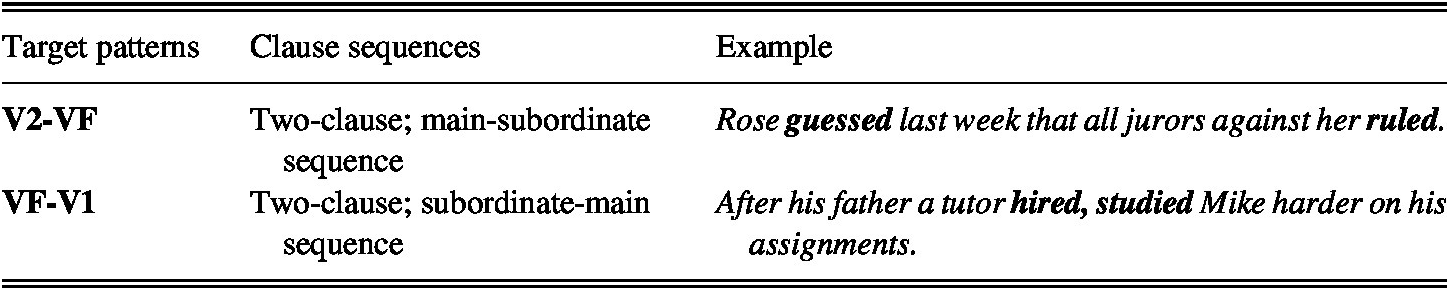
Aligned with German syntax, the target structures (V2-VF and VF-V1) in this experiment differed from each other in verb placement and sequence of the clauses.Footnote 1 The verbs were placed in the first (V1), second (V2), or final (VF) position of a clause sequenced in either a main-subordinate or a subordinate-main clause (see Table 1). Following these patterns, 220 sentences were used in the experiment: 100 in training, 60 in immediate testing, and 60 in the delayed testing set. All sentences were recorded by a female native American-English speaker and presented through Sennheiser HD555 headphones.
Target patterns, clause sequences, and examples of the verb-placement rules

Note: V1 = verb first position; V2 = verb second position; VF = verb final position.
Training Set
The training set consisted of 100 sentences, 50 for each target pattern (V2-VF and VF-V1). All sentences were grammatically correct, but half the sentences were semantically plausible (k = 50) and half were semantically implausible (k = 50). The plausible sentences described events that are likely to occur in a real-world context, while implausible sentences expressed situations that are unlikely to happen.
Testing Set
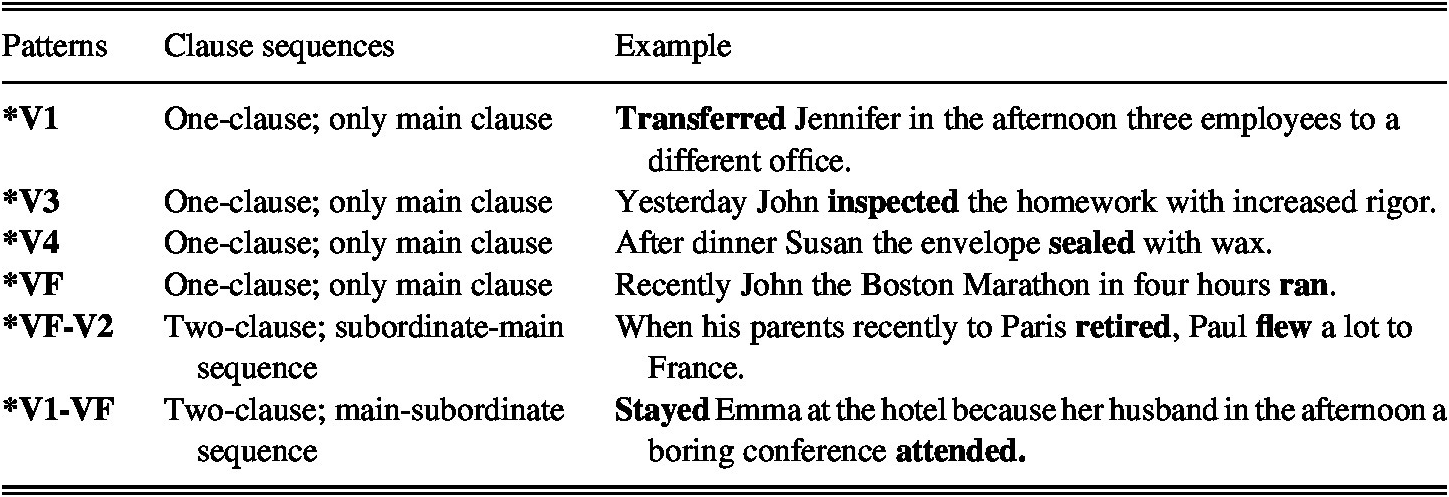
A total of 60 plausible sentences constituted the testing set, with 30 sentences conforming to the target syntax (hereafter, grammatical) and 30 sentences violating the syntax (hereafter, ungrammatical). The ungrammatical sets followed one of six verb placement patterns: *VF, *VF-V2, *V1-VF, *V1, *V3, or *V4 (see Table 2). Both testing sets were constructed with novel sentences that were different from the trained items. By doing so, we controlled for repetition effects when testing L2 rule generalization ability.
Ungrammatical patterns, clause sequences, and examples of the verb-placement rules

PROCEDURE
All participants completed two experimental sessions. The first session included training and an immediate posttest. The second session included a delayed posttest, a verbal report, cognitive tasks (that were unrelated to the present investigation), and a demographic questionnaire.
To assess changes in performance during sleep and while awake, both sessions were separated by a 12- to 14-hour retention interval. The Wake group was trained in the morning (between 08:00 and 10:00) and was tested in the evening (at 21:30). The Sleep group was trained in the evening (between 20:00 and 22:00) and tested the following morning (at 10:00).
Session1 Training
All participants were trained individually. Participants listened to a series of sentences and judged the plausibility of each sentence. This plausibility judgment task was intended to provide a cover story so that participants actively focused on the meaning of the words and not the hidden patterns. Thus, participants were placed in an incidental (or meaning-focused) condition where intentionality to learn the target structures was unlikely to surface.
A trial started with a fixation cross. After 200 ms, participants heard a sentence and were asked to repeat the sentence aloud. This task was designed to promote learning by activating verbal stimuli in phonological memory (Baddeley, Reference Baddeley2007). To prevent encoding of incorrect grammatical structures, participants listened and repeated the sentence until they placed the verbs correctly in the sentence. For instance, if participants repeated a sentence incorrectly, the experimenter replayed the sentence and asked them to repeat it again. We permitted up to three repetitions of a sentence. The plausibility judgment then appeared and remained on the screen until participants pressed a button to indicate whether the sentence was or was not plausible. No feedback was provided.
Session1 Test
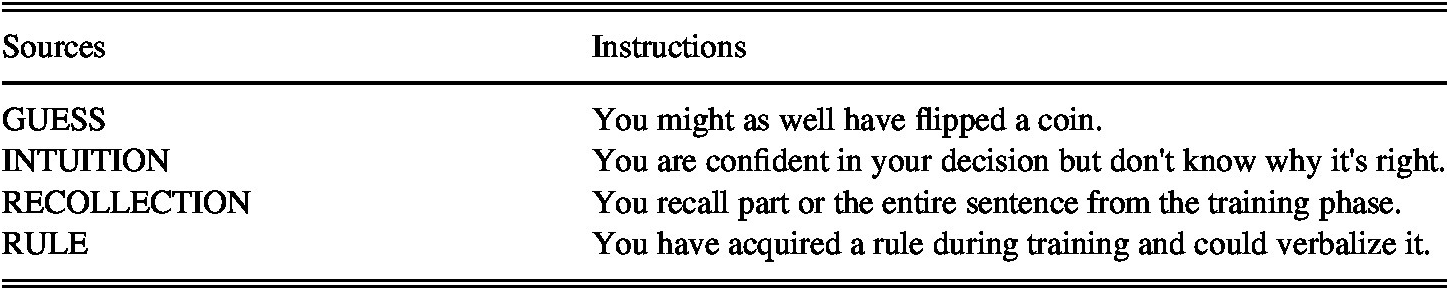
After training, participants were given a surprise test on the hidden patterns that included a GJT, followed by a source attribution assessment. Participants were informed that the word patterns in the training phase were not arbitrary but followed a complex system of rules. In the GJT, participants listened to 60 novel sentences and had to judge whether the sentences complied with the complex system. After each response, participants reported how they made their grammaticality judgment based on one of four sources (guess, intuition, recollection, rule; see Table 3 for the instructions). Knowledge is considered implicit when based on guess or intuition and explicit when attributed to recollection or rule (Dienes & Scott, Reference Dienes and Scott2005). Performance is compared against chance level (or above 50%). That is, if more than 50% of correct responses were attributed to either guess or intuition, this would reflect implicit knowledge, and if more than 50% of correct responses were based on recollection or rule, this would reflect explicit knowledge. At the end of the session, participants in the Wake condition were instructed not to nap during the retention interval. Session 1 lasted approximately one hour.
The instructions of the source attributions

Session2
As in Session 1, the posttest included the GJT and source attributions, but with 60 novel sentences. This test lasted approximately 15 minutes. After the test, participants filled out a report (see Appendix S1) that prompted them to provide descriptions of rules if they recognized any, and importantly when they recognized them (e.g., session1 training, session1 test, or session2 test). Participants were encouraged to elaborate their thoughts as extensively as possible.
CODING OF RETROSPECTIVE VERBAL REPORTS
A coding scheme was developed to determine whether participants had awareness of any target patterns. Based on the rubric (see Appendix S2 for coding scheme), two coders independently classified participants as Aware or Unaware. Interrater agreement was 92%, and all disagreements were resolved via discussion.
ANALYSIS
Accuracy (%) and d-prime (d′) scores on the GJT were calculated to measure learning.Footnote 2 D′ scores index discrimination ability of binary choices (MacMillan & Creelman, Reference MacMillan and Creelman2005) and are calculated by subtracting converted z-scores of false alarm rates (i.e., judging ungrammatical items as grammatical) from hit rates (i.e., judging grammatical items as grammatical), thereby taking into account overall response bias. A d′ score of 0 indicates chance performance and positive values reflect better discrimination skills.
We ran two assumption tests: the Shapiro–Wilk test for normality and Levene’s test for homogeneity of between-group variances. Unless otherwise noted, statistical assumptions were met. If violated, we ran nonparametric tests using SPSS or R. For all statistical tests, the alpha was set at .05.
RESULTS
GRAMMATICALITY JUDGMENT TASKS
Prior to addressing the research questions, we first examined participants’ performance in both immediate and delayed sessions. To do so, we ran Mann–Whitney tests on d-prime scores on the immediate and delayed GJTs in both the Sleep and Wake groups.
Immediate GJT Scores
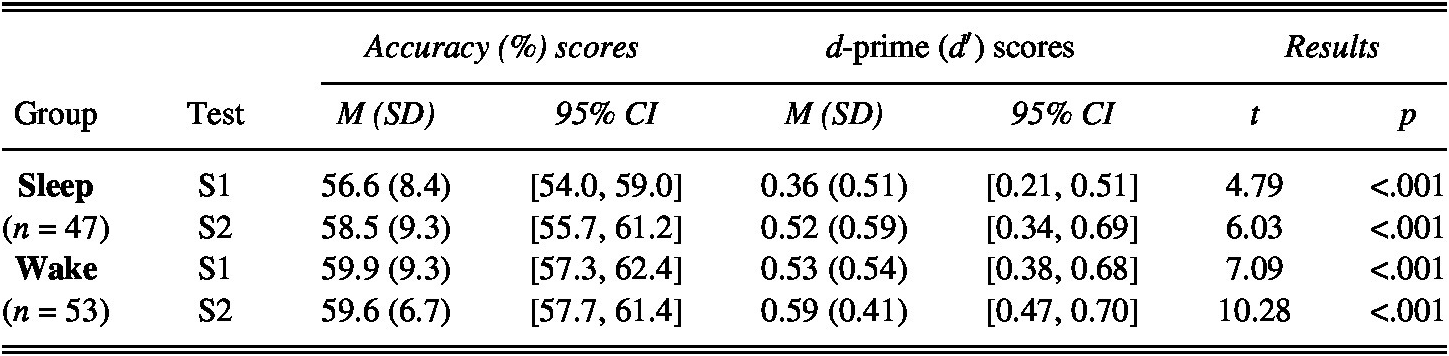
Table 4 shows accuracy and d-prime scores on the immediate test. The results of a Mann–Whitney test showed above chance performance in both the Wake, U = 1,206.00, p < .001, r = 0.699, and Sleep groups, U = 880.50, p < .001, r = 0.597. This suggests that learners discerned grammatical items from ungrammatical ones immediately after training. We compared the immediate GJT scores between the two groups and found that the Wake group was marginally, but not statistically, better than those in the Sleep group, U = 966.00, p = .054, r = 0.193, suggesting that performance affected by the time of day of testing (e.g., diurnal or circadian effects) was small to comparable.
Descriptive statistics of the GJT scores and results of mean differences from chance (50%) level

Note: S1 = immediate GJT scores, S2 = delayed GJT scores.
Delayed GJT Scores
Table 4 lists accuracy and d-prime scores of the delayed GJT scores. The results of a Mann–Whitney test showed that both groups performed above chance: Wake group, U = 1,303.00, p < .001, r = 0.823 and Sleep group, U = 918.00, p < .001, r = 0.719. Thus, learning effects were durable 12–14 hours post training.
To examine whether L2 grammar learning was strengthened after a period of wakefulness or sleep, we performed a robust version of a 2 × 2 mixed-design ANOVA with 20% trimmed means (using the bwtrim function in the WRS2 package with R software). Condition (Sleep vs. Wake) was entered as a between-subject variable and Time (Immediate vs. Delayed) as a within-subject variable. We found comparable effects in Condition, Q = 2.38, p = .129, ηp2 = .021 and Time, Q = 1.37, p = .247, ηp2 = .094. The interaction was also not significant, Q = 0.81, p = .373, ηp2 = .034, confirming that neither a period of sleep nor wakefulness contributed differentially to L2 generalization learning.
To examine whether presleep awareness status affected L2 rule generalization, we further tested whether test performance differed as a function of awareness of the target patterns. To this end, we divided the participants into the Aware and Unaware groups based on our assessment of participants’ reported rules. This resulted in 27 Aware (Sleep = 11, Wake = 16) and 73 Unaware (Sleep = 36, Wake = 37) participants. All participants in the Aware group reported noticing the rules during the first session; in other words, they reported becoming aware of the rules before the retention interval.
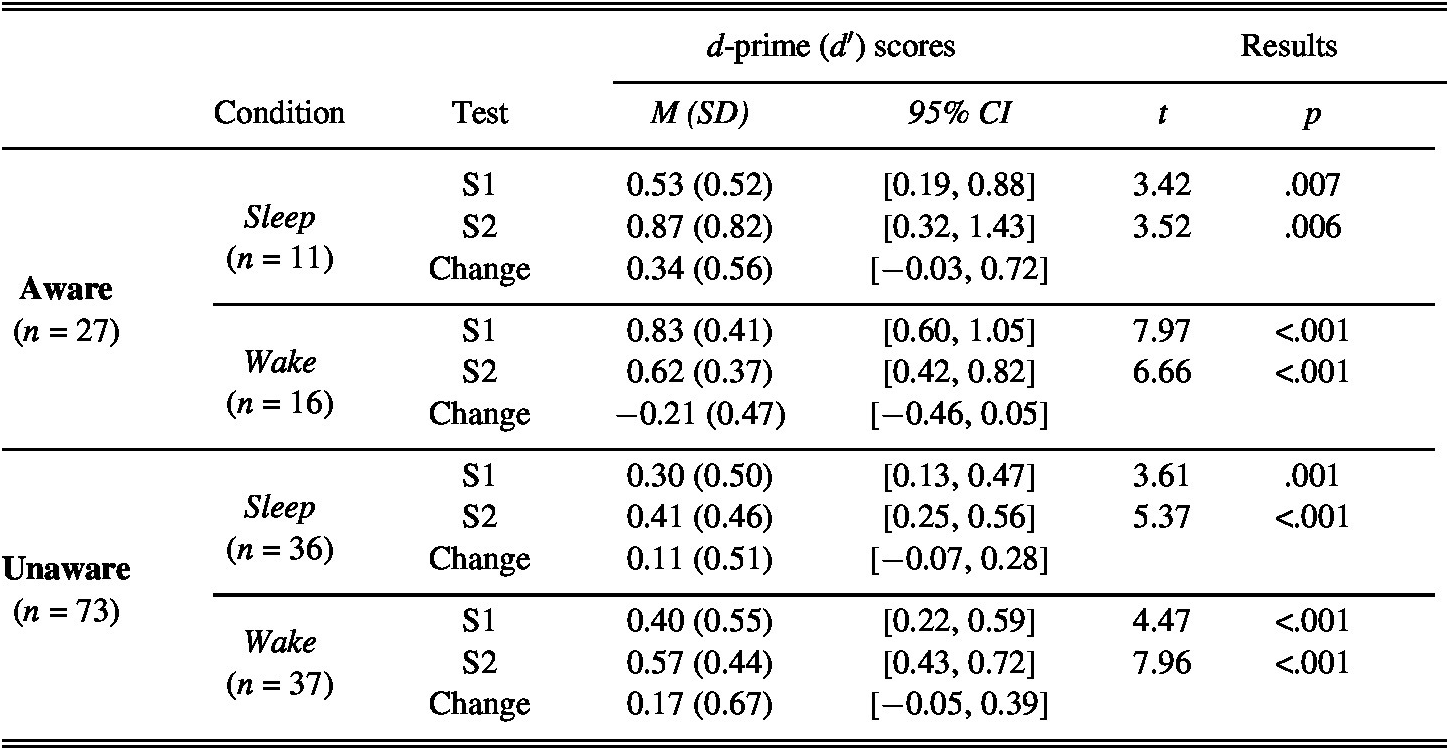
Table 5 displays d-prime scores on the immediate and delayed tests, and the change in d-prime between the two sessions. We computed a parametric version of a 2 × 2 mixed-design ANOVA for the Aware and a robust version of a 2 × 2 mixed-design ANOVA for the Unaware groups, separately, with d-prime scores as the dependent variable.Footnote 3 A robust version was used for the Unaware group to accommodate for violations of statistical assumptions. Time (2 levels: Immediate vs. Delayed) was entered as a within-subject variable and Condition (2 levels: Sleep vs. Wake) was entered as a between-subject variable.
Descriptive statistics of GJT scores and results of mean differences from discrimination (0) level

Note: S1 = immediate GJT scores, S2 = delayed GJT scores, Change = delayed–immediate GJT scores.
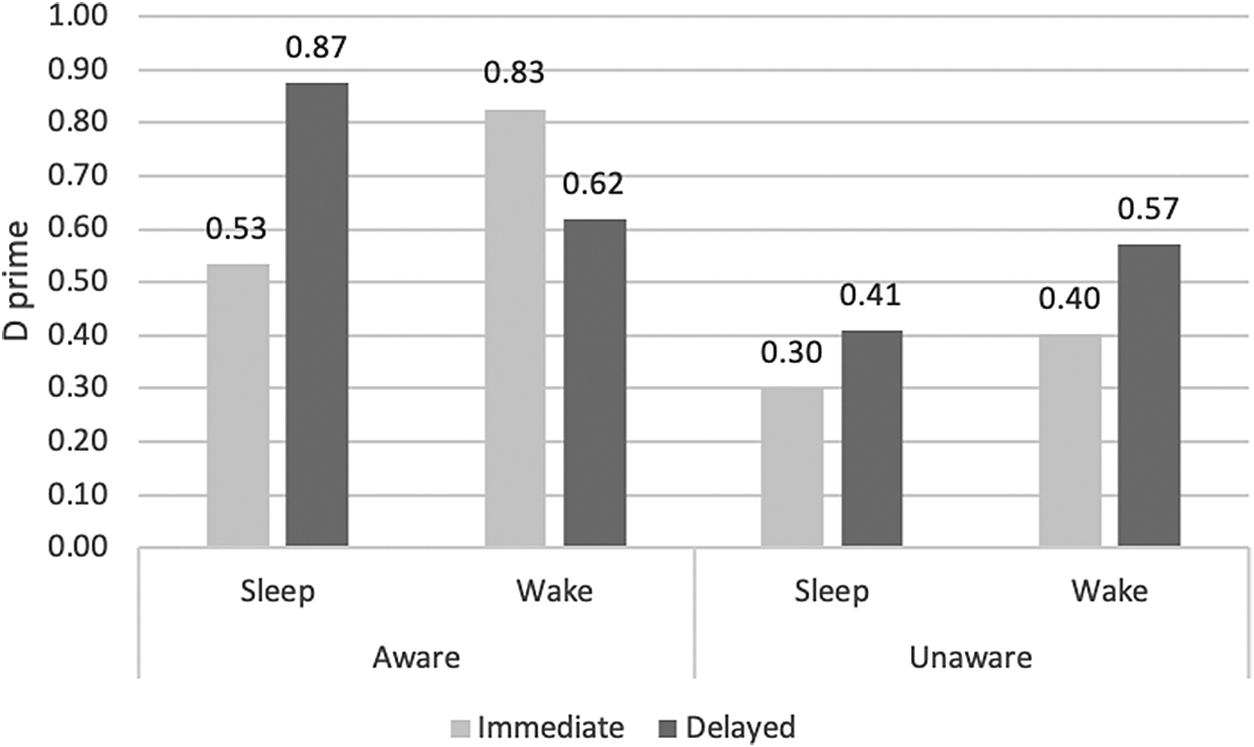
Results showed a significant interaction between Condition and Time only in the Aware group, F(1,25) = 7.548, p = 0.011, ηp2 = .232. As shown in Figure 1, the Aware group in the Sleep condition showed an increase of GJT performance overnight, while the opposite pattern was observed in the Wake condition. No further significant effects were found for Condition, F(1,25) = 0.010, p = 0.920, ηp2 = .000, and Time, F(1,25) = 0.453, p = 0.507, ηp2 = .018. All results were nonsignificant in the Unaware group: Condition, Q = 2.016, p = 0.163, ηp2 = .036; Time, Q = 2.147, p = 0.150, ηp2 = .127; and Condition × Time interaction, Q = 0.028, p = 0.867, ηp2 = .011. These results support the idea that sleep may facilitate rule generalization of L2 grammar, but only when learners have verbalizable knowledge of the structures prior to sleep.
Immediate and delayed GJT scores of Aware and Unaware participants in the Sleep and Wake conditions.

SOURCE ATTRIBUTIONS
To address research question 2, we analyzed source attribution data to examine the formation of different type(s) of L2 rule knowledge and whether they are consolidated from sleep.
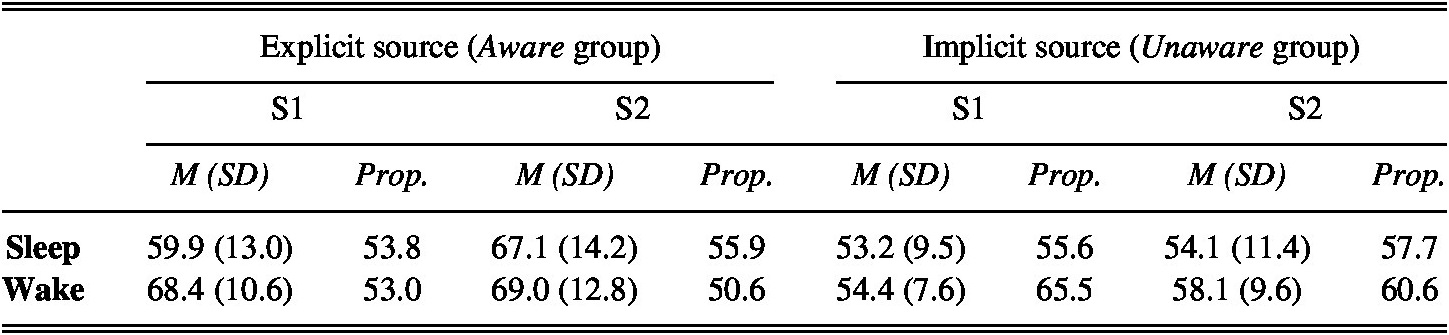
Table 6 lists the accuracy and proportion of implicit and explicit source attributions. The implicit category combined grammaticality judgments attributed to guess and intuition of the Unaware participants, and the explicit category combined judgments based on rule and recollection of the Aware participants. The accuracy for each source was computed by dividing the number of correct responses based on an implicit source, for instance, by the total number of responses attributed to implicit sources.
Accuracy (%) and proportion (%) of responses across implicit (Unaware participants) and explicit (Aware participants) sources

Note: S1 = immediate GJT scores, S2 = delayed GJT scores, Prop. = proportion.
Results from one-sample t-tests revealed that grammaticality judgments based on implicit and explicit sources were significantly above chance for all conditions and tests, with all p’s < .005. This indicates that both the Sleep and Wake groups displayed implicit and explicit knowledge immediately after training, and maintained both types of knowledge postretention intervals.
Next, we examined whether unconscious (implicit) and conscious (explicit) knowledge is differentially improved after a period of wake and sleep. We ran two sets of mixed-design ANOVAs, separately for explicit and implicit knowledge, with Condition (Sleep vs. Wake) as a between-subject variable and Time (Immediate vs. Delayed) as a within-subject variable. No results were significant, including the interaction between Condition and Time in explicit, F(1,25) = 2.046, p = .165, ηp2 = .076, and implicit knowledge, F(1,66) = .894, p = .348, ηp2 = .013. The results support the idea that the changes of linguistic knowledge based on guess and intuition (implicit) and recollection and rule (explicit) are comparable after a period of sleep and wake.Footnote 4
SUMMARY OF RESULTS
The findings from our study are twofold. First, performance in the delayed posttest of the Aware group, but not the Unaware group, was enhanced following a period of sleep, suggesting that only those with verbal knowledge of grammar may benefit from sleep-dependent memory consolidation. Second, explicit knowledge indexed by source attributions did not change following a period of sleep or wake, indicating comparability of the effects of sleep and wake in developing explicit knowledge.
DISCUSSION
In this study, we were interested in the extent to which L2 rule generalization and explicit knowledge of L2 grammatical rules are affected by sleep. The results suggest that sleep may benefit L2 rule generalization only for learners who are aware of the L2 rules prior to sleep. Previous work on this topic reported the importance of explicit aspects of procedural task representation in off-line pattern learning gains (e.g., Song & Cohen, Reference Song and Cohen2014). We were able to extrapolate findings from the memory consolidation literature using nonlinguistic pattern learning tasks to L2 research context with linguistic materials. In particular, our results may suggest that explicit awareness of linguistic rules generate overarching rule knowledge during sleep, and that this may facilitate L2 pattern generalization. Although speculative, enhanced performance of the Aware group, but not the Unaware group, after a period of sleep might represent such a case.
While sleep-dependent L2 rule generalization was mediated by verbalized rule knowledge, performance based on explicit sources did not change overnight. Simply put, explicit knowledge of L2 grammar did not improve from sleep (research question 2). Learners in both Sleep and Wake groups showed comparable accuracy rates for judgments attributed to explicit sources (rule and recollection) in the immediate and delayed GJTs. While this finding aligns with previous research (e.g., López-Barroso et al., Reference López-Barroso, Cucurell, Rodríguez-Fornells and Diego-Balaguer2016; Song & Cohen, Reference Song and Cohen2014), we expected overnight improvements of L2 explicit knowledge as explicitly encoded memory favors access to sleep-associated memory consolidation (Diekelmann & Born, Reference Diekelmann and Born2010; Gais & Born, Reference Gais and Born2004). In our study, the accuracy scores of rule- and recollection-based grammaticality judgments indexed L2 explicit knowledge. Arguably, rules and memory that learners attributed judgments on may not have been fully consolidated, and thus performance based on these sources was not improved postsleep. Given that this study was not designed to directly measure whether the sources of explicit judgments (e.g., rule knowledge and memory from training) are affected by sleep, the preceding explanations are speculative. Future studies would benefit from administering a concurrent verbal elicitation (e.g., think-aloud) during immediate and delayed posttests to observe whether the number of elicited rules changed over a period of sleep and wakefulness.
This study has important implications for the field of SLA. Adding to a small pool of research, this study substantiated that L2 grammar that is trained in an incidental context is both durable (e.g., Grey et al., Reference Grey, Williams and Rebuschat2014; Miller & Godfroid, Reference Miller and Godfroid2020) and susceptible to gains. Importantly, verbalizable awareness before sleep determined whether L2 grammar generalization was enhanced overnight. This finding adds credence to the critical role of awareness in acquiring L2 knowledge (e.g., Leow, Reference Leow2015) and further extends the importance of awareness in retaining and improving L2 knowledge off-line. Pedagogically, our findings may highlight the facilitative role of inductive awareness-raising activities for L2 grammar enhancement. Learners were engaged in a meaning-focused task and only those who developed awareness from the incidental linguistic exposure benefited from sleep.
While awareness was necessary for L2 rule generalization to profit from sleep, it is also important to recognize that L2 learning took place even in the absence of awareness. Specifically, the Unaware group showed evidence of implicit knowledge development posttraining. Consistent with a growing volume of literature (e.g., Grey et al., Reference Grey, Williams and Rebuschat2014; Kim & Godfroid, Reference Kim and Godfroid2019; Rebuschat et al., Reference Rebuschat, Hamrick, Riestenberg, Sachs and Ziegler2015; Rebuschat & Williams, Reference Rebuschat and Williams2012; Rogers et al., Reference Rogers, Révész and Rebuschat2016; Williams, Reference Williams2005), this finding may suggest that adults can acquire L2 grammar under a learning condition where attention is directed to meaning rather than form. However, research including an untrained group is needed to further verify this claim (for a review, see Hamrick & Sachs, Reference Hamrick and Sachs2018). In addition, although the use of source attribution and retrospective verbal report measures provided a rich profile of learners’ awareness, methodological refinements are needed. In future research, an inclusion of a concurrent verbal elicitation (i.e., think-aloud) could provide quality information on learners’ awareness levels during individual trials and enhance our understanding of the relationship between explicit rule knowledge and sleep-dependent memory consolidation. In addition, a logical next step for future research is to examine the association between L2 rule generalization and sleep processes. The design of the current study did not permit us to evaluate various sleep parameters or sleep stages (e.g., sleep spindles, slow wave sleep, and REM sleep) that are related to memory consolidation. Future research should empirically measure sleep after L2 grammatical learning using polysomnography.
CONCLUSION
There is a recent rise in L2 research informed by the findings from cognitive psychology. In this study, we applied the findings from memory consolidation literature to L2 grammar acquisition in an attempt to understand the role of sleep in acquiring and retaining L2 knowledge. Given the novelty of this study, we hope the findings will generate further discussion on sleep-related L2 memory consolidation, as well as the methodological approaches that can better address issues associated to sleep and awareness.
Supplementary Materials
To view supplementary material for this article, please visit http://dx.doi.org/10.1017/S0272263120000200.