




No CrossRef data available.
Attachment in infancy and preschool in low socioeconomic status rural Appalachian children: Stability and change and relations to preschool and kindergarten competence
Published online by Cambridge University Press: 01 June 2004
Abstract
Attachment classifications were obtained from the Strange Situation at 15 months and at 4 years for a sample of 82 low socioeconomic status rural Appalachian children. The rate of secure attachment in infancy was 50.5%, and the majority of insecure infants were disorganized. At 4 years of age 61.2% of children were secure; early secure relationships were likely to be maintained, and about half of the insecure infants changed to a secure classification by 4 years. Overall, there was low but significant stability in attachment at the level of secure/insecure. Comparisons of (a) children who changed from insecure to secure with those who were stable insecure and (b) stable secure children with those who changed from secure to insecure identified contextual, child, and maternal interaction factors associated with attaining secure attachment. Assessments of cognitive and socioemotional competence at 4 years and kindergarten age suggested a protective effect of secure infant attachment but little benefit from secure preschool attachment.This study was supported by Grants MCJ-540615 and R40 MC 00091 from the Maternal and Child Health Bureau (Title V, Social Security Act), Health Resources and Services Administration, Department of Health and Human Services and by Grant MH48395 from the National Institute of Mental Health, Department of Health and Human Services. Thanks to the families who participated and the Lincoln Primary Care Center Board of Directors and staff.
Information
- Type
- Research Article
- Information
- Copyright
- © 2004 Cambridge University Press
The attachment relationships that a child forms to his/her caregivers are theorized to enable the child to use caregivers as a secure base from which to explore the environment and to influence the internal working models of self and others that shape later relationships (Ainsworth, Blehar, Waters, & Wall, 1978; Bowlby, 1980). Observed attachment behaviors follow patterns that can be described and categorized by trained observers into the categories of secure (B), avoidant (A), resistant/ambivalent (C) (Ainsworth et al., 1978), and disorganized (D) (Main & Solomon, 1990).
The pattern of research findings supports measures of maternal sensitivity as the strongest and most consistent predictors of attachment security (Ainsworth et al., 1978; De Wolff & van IJzendoorn, 1997). Infant temperament (Goldsmith & Alansky, 1987; Malatesta, Culver, Tesman, & Shepard, 1989; van den Boom, 1989; Vondra, Hommerding, & Shaw, 1999) has also been linked to attachment classification but with less consistency and smaller effect sizes than mother sensitivity. Further, temperament theorists recognize that infant characteristics may develop or be modified in response to the caregiving environment, particularly maternal behaviors such as sensitivity (Crockenberg, 1986).
Bowlby said that a person's attachment behavior develops and becomes organized as a result of “the experiences he has with his attachment figures during his years of immaturity—infancy, childhood, and adolescence” (Bowlby, 1980, p. 41). In applying Waddington's (1957) model of epigenesis to personality development, Bowlby (1973) postulated that these psychological processes are more responsive to environmental influences, particularly the family environment, “during the early years of life” and that environmental influence diminishes through childhood and adolescence. Accordingly, changes in attachment behaviors, as they reflect the young child's working models of self and others, might be expected to occur in conjunction with changes in the caregiving environment, reflecting the notion of lawful discontinuity (Belsky, Fish, & Isabella, 1991; Weinfield, Sroufe, & Egeland, 2000).
Longitudinal research does suggest that family environment and contextual factors may affect the stability of attachment relationships over time and offer possible explanations for change. From infancy to early childhood high stability has been reported when stable low-risk families are considered (Main & Cassidy, 1988), whereas changes in attachment have been related to changes in family structure that may impact caregiving, such as divorce, remarriage (Fagot & Pears, 1996), or the birth of a sibling (Teti, Sakin, Kucera, & Corns, 1996).
In three examinations of attachment from infancy to adolescence or early adulthood (Hamilton, 2000; Waters, Merrick, Treboux, Crowell, & Albersheim, 2000; Weinfield et al., 2000), significant stability was found in two of these studies. Across all three samples, maintenance of insecure attachment or change from secure to insecure was related to the occurrence of or increase in negative environmental events or circumstances, such as loss of a parent by death or divorce, life-threatening illness, parental substance abuse, child maltreatment, and maternal depression.
Stability in Infant Attachment
In the first reported examinations of attachment stability over the period from 12 to 18 months of age, very high stability (80.9% and 96%) of the ABC classification was found in a middle-class sample (Ainsworth et al., 1978). However, in a high-risk, low socioeconomic status (SES) sample over the same 6-month period (Egeland & Farber, 1984), only 60% of the classifications were stable: 74% of secure infants but less than 50% of the avoidant and resistant infants. Changes in caregiving environment factors such as social support, life stress, and living arrangements were linked to changes in attachment. Because family poverty is associated with chronic stressors and negative life events that adversely impact parenting and child development (Duncan, Brooks–Gunn, & Klebanov, 1994; McLoyd & Wilson, 1991), a low-SES caregiving environment might be expected to be associated with both more insecure attachment and less stability in attachment.
Recent examinations of attachment stability in low-income samples support a link to ecological variables. For example, Vondra et al. (1999) reported 50% stability from 12 to 18 months (described as significant but very modest, with chance taken into account), with stability and change related to maternal personality and relationship satisfaction, infant difficultness, and disruptive life events. Waters and Valenzuela (1999) related both attachment classification and its stability from 18 to 28 months to the contextual factor of nutritional status in disadvantaged Chilean infants.
It is not necessarily true, however, that middle-class samples with (presumably) fewer risk conditions and major changes in caregiving contexts demonstrate high stability in infant attachment. In an early study, Thompson, Lamb, and Estes (1982) concluded that low stability (53% over 7 months) related to changing family and caregiving conditions. More recently, in two low-risk samples with infants assessed at 12 and 18 months, Belsky, Campbell, Cohn, and Moore (1996) reported stability levels for infant–mother attachment of 52 and 46%, respectively, for a three-category (ABC) classification and 55 and 50% for secure and insecure, all rates not greater than chance. In fact, Thompson (1998) concluded from reviewing a number of test–retest studies of Strange Situation classifications ranging over periods from 6 to 11 months that it was “difficult to establish a normative level of consistency in attachment classifications” (p. 55), but “secure attachments are far more stable over time than are insecure attachments” (p. 56).
Both Belsky et al. (1996) and Thompson (1998) raised the issue of whether the addition of the disorganized (D) category has affected the overall classification process in some manner and thereby reduced stability. However, as reported in the meta-analysis by van IJzendoorn, Schuengel, and Bakermans–Kranenburg (1999), the disorganized attachment classification does demonstrate strong long-term stability, with an average effect size of .34. Another, and perhaps more basic, issue complicating the evaluations of stability is the omission in many smaller and/or earlier studies of the chance rates of attachment distributions (Belsky et al., 1996).
Stability of Attachment from Infancy to Preschool
In addition to short-term studies within the infancy period, the stability of attachment has also been examined from infancy to preschool or early school age following development of coding systems to classify the attachment behavior of preschool (Cassidy & Marvin, 1992; Crittenden, 1995) and early school-aged children (Main & Cassidy, 1988). The developmental framework of these coding systems includes essential features of attachment behavior while considering changes related to the child's age and level of physical, cognitive, and social development (Cicchetti, Cummings, Greenberg, & Marvin, 1990).
Stability in attachment from infancy through early school age varies and may be influenced by differing methodologies, as well as risk status. The large (N = 1060) multisite NICHD Early Child Care Study (NICHD Early Child Care Research Network, 2001), which includes a range of family SES, assessed attachment with the standard Strange Situation at 15 months and a slightly modified version, coded with the MacArthur system, at 36 months. Four category (A, B, C, D) stability with chance rates taken into account was significant although “modest”: 64.1% among initially secure children but less than 30% each for the A, C, and D infants. At the level of secure or insecure, 40.4% of previously insecure children were also insecure at 36 months; thus, 59.6% of them changed to secure.
Two other smaller studies also reported lower stability (higher rates of change) for some insecure children. Howes and Hamilton (1992) found 70.8% stability in A, B, and C attachment classifications for 89 children (89.3% for secure, 72.7% for ambivalent, but only 22.7% for the avoidant classification) from a 12-month Strange Situation to a 4-year separation/reunion procedure coded by a reliable MacArthur coder. Bar-Haim, Sutton, Fox, and Marvin (2000) found the infant Strange Situation A, B, and C classifications for 42 children to be significantly stable from 14 to 24 months; but neither early assessment related to a modified Strange Situation at 58 months as coded with the MacArthur system. From 14 to 58 months 58.6% of secure infants retained the same classification, but only 7.1% of the insecure retained it. Respective results for 24 and 58 months were 51.6 and 7.1%.
Two studies using other coding systems for older children also reported relatively high stability in secure classifications. Fagot and Pears (1996) examined stability in the Strange Situation coded at 18 months with the Ainsworth system and 30 months with Crittenden's preschool system and found considerable change within the insecure group, specifically for avoidant infants (47.4% stability in contrast to 100% for resistant infants). At the level of secure/insecure more than 95% of A and C infants were classified as either defended or coercive in the Crittenden system, and 73.5% of secure infants were secure as preschoolers. With a small (N = 39) German sample, Wartner, Grossmann, Fremmer–Bombik, and Suess (1994) reported high stability for A, B, C, and D groups (89.5% for secure, 75% for insecure, significant with chance taken into account) from an infant Strange Situation to a 6-year separation and reunion procedure coded according to Main and Cassidy (1988).
Thus, among the few studies using laboratory assessments of attachment in infancy and again at preschool or early school age, the majority of published studies indicate at least moderate stability overall and, similar to infant studies, a general pattern of greater stability in secure attachment. Given the very small number of studies and the diverse ages of the children when assessed, as well as differences in the coding systems used, more research is needed on attachment stability from infancy to preschool and school age.
Associations Between Infant and Preschool Attachment and Subsequent Child Competence
Evidence from studies of both low- and high-risk samples suggests that a secure infant attachment relationship makes it more likely that the child will continue to meet challenges more successfully. For example, secure infants were later more enthusiastic and positive, less negative, and spent more time on task (Frankel & Bates, 1990; Matas, Arend, & Sroufe, 1978) in challenging problem-solving tasks than those who had been classified as insecure. Similarly, in their high-risk sample, Vondra, Shaw, Swearingen, Cohen, and Owens (2001) reported that stable security across 12, 18, and 24 months was associated with better behavioral and emotional regulation in challenging tasks. Increased effort when faced with potential failure in a challenging task at age 3 (Lutkenhaus, Grossmann, & Grossmann, 1985), competence in preschool at age 5 (Suess, Grossmann, & Sroufe, 1992), and kindergarten ego resiliency (Easterbrooks & Goldberg, 1990) were also related to secure infant attachment.
Secure infant attachment has also been associated with cognitive competence, to a lesser extent. For example, a meta-analysis (van IJzendoorn, Dijkstra, & Bus, 1995) has shown a substantial effect size of attachment on infant and preschool language competence. Analysis of the NICHD data set has also demonstrated infant insecurity, particularly avoidant attachment, to be associated with lower preschool language comprehension (Belsky & Fearon, 2002). Moss and St-Laurent (2001) have found that early school-age disorganized attachment predicts lower academic (language and mathematics) performance, a relation that was mediated by mother–child interaction. Meins (1997) has argued that the type of sensitive, contingent caregiver interaction that fosters secure attachment also promotes cognitive development, specifically, that more sensitive mothers of secure children may also be more attuned to the child's zone of proximal development (Vygotsky, 1978) in learning situations.
The present investigation explores antecedents and consequences of stability and change in attachment from 15 months to 4 years in a sample of low-SES rural Appalachian children. Typical of low-income rural White children, the majority of these children live in two-parent homes. In addition, rural Appalachian families also have high social support, especially from the extended family (Beaver, 1980; Fish, 1998). Thus, this group, although at risk because of low family income and parental education, does not share some other risks that are often associated with low SES.
The specific research questions addressed in the present study include the following:
- To what extent are attachment classifications stable in this population from infancy to the preschool period? Previous findings suggest lower stability in low-SES samples, but low-SES rural Appalachian families may differ from others in significant ways.
- What factors predict patterns of stability and change in attachment? More positive qualities in mothers (e.g., greater sensitivity), children (e.g., less negative temperament), and the caregiving context (e.g., higher maternal social support) are expected to distinguish families where children either maintain or attain secure attachment relations over time.
- What are the consequences of infant and preschool attachment security? Specifically, (a) how do infant and preschool attachment relate to preschool socioemotional competence in a challenging situation and to preschool cognitive ability and (b) how do infant and preschool attachment and preschool socioemotional and cognitive competence relate to kindergarten functioning? Attachment theory would predict that competent behavior would derive from attachment relationships and predict school adjustment; the reviewed literature suggests that attachment, competence in challenging situations, and cognitive ability all contribute to children's better functioning.
Method
Participants
The participants in this study were 82 low-SES, rural Appalachian mothers and their children with both infant and preschool attachment classifications.1
Ninety-eight children were assessed in the Strange Situation at 15 months and 85 children were assessed at 4 years, but two of the latter were missing the 15-month assessment and one child's 15-month assessment was nonstandard and unclassifiable.
Although the SES was low (only 57% of mothers and 53% of fathers completed high school, and 70% of families had an annual income below $10,000), few mothers were teenaged (12.2% 18 or under) or single (23.2% not married or living with a partner) and social support was high, although primarily centered on family. Over 90% of the mothers had multiple family members living in the area whom they visited at least once a week, and most reported high satisfaction with help from family.
Procedures and measures
The assessments for this study took place at the community health clinic in the third trimester of pregnancy and when the child was 2 weeks, 4 months, 9 months, 15 months, 4 years, and prior to kindergarten entry (mean age = 64.5 months). A final data collection was performed in schools in the spring of the child's kindergarten year. The measures used in this investigation are described below.
Attachment assessments
At 15 months, the standard Strange Situation (Ainsworth et al., 1978) was carried out. The videotaped Strange Situations were coded and attachment classified as secure (B) or insecure (A, C, D) by an independent expert coder (Donna Weston). Subsequent reliability classifications on 38% of the sample (36 tapes) were carried out by another expert rater from the University of Washington team. Agreement on secure versus insecure was 88.9% (κ = .78); agreement on A, B, C, and D categories was 77.8% (κ = .65).
At 4 years, the children were assessed in a slightly modified Strange Situation. Episodes 1 and 7 were 5 min in length rather than 3 min, and mothers were told to handle separations “however you feel will work best with your child,” allowing maternal choice in whether to say goodby or provide an explanation for leaving the room. A team of experienced coders at the University of Washington used the MacArthur coding system (Cassidy & Marvin, 1992) to code 4-year attachment. Children were classified into five categories (secure–B, insecure/avoidant–A, insecure/ambivalent–C, insecure/disorganized-controlling–D, and insecure–other) and scored on a 1–9 scale of security and on 1–5 scales of distress and confidence of classification. Each tape was coded independently by two coders who were unaware of the infant attachment classification. Prior to conferencing, agreement for secure/insecure was 77.4% (κ = .50) and agreement for A, B, C, and D categories was 76% (κ = .48). Mean confidence was 2.94. The range of confidence scores was 1–5, with 69.4% scored at 3, 4, or 5 (i.e., seen by coders as “fairly sure of the major category, but some behaviors may be contradictory” to “child is a classic example; coder is very confident on major and subcategory”). Coders resolved disagreements by reviewing tapes together and reaching consensus.
Contextual, child, and maternal variables hypothesized to relate to stability and change in attachment
Based on attachment theory and research and on Belsky's (1984) model of the determinants of parenting and child development, in which parent personality, contextual factors, and child characteristics all affect development, the following measures were selected from the longitudinal data set as potentially related to stability and change in attachment.
Contextual variables
Maternal negative personality
The scales that were administered prenatally included the neuroticism (hostility, anxiety, depression) and extraversion (warmth and positive emotions) scales from the NEO-AC Personality Inventory (Costa & McCrae, 1978) and the self-esteem problems scale of the Clinical Measurement Package (Hudson, 1982). Internal consistency (coefficient alpha) was .75 for extraversion, .88 for neuroticism, and .92 for self-esteem problems. These measures were combined in one personality factor with positive loadings for neuroticism and self-esteem problems and a negative loading for extraversion (68% of the variance accounted for, eigenvalue = 2.04). Thus, a high score reflects more negative personality traits.
Maternal social support
The Crnic, Greenberg, Ragozin, Robinson, and Basham (1983) measure, which assesses both contact with others (friends, family, and intimate relationships) and satisfaction, was given prenatally and at 4 years. Items pertaining to telephone contact and group membership were omitted, because many mothers did not have a telephone or belong to any organized groups, supporting the belief that rural Appalachian social support is based on kinship and proximity (Bryant, 1981). The remaining 23 items were summed (α = .78).
Maternal relationship stability
Based on mother interview data at each assessment, the caregiving relationships that children experienced were categorized as stable or not stable. A stable caregiving relationship was defined as maintaining the same partner relationship without disruption (separation or divorce) or maintaining a stable single mother household. Relationship stability was categorized from the prenatal period to 15 months and from 15 months to 4 years.
Disruptive events
Maternal interview data from each assessment were examined for the occurrence of these events: self or partner losing a job, self or partner being in jail, death of a family member, and serious accident or illness of self or family member. A summed score of the number of such events was created for the prenatal period through 4 years.
Family dependence on public assistance to meet basic needs
Prenatally and at 4 years, mothers reported whether the family received public assistance (yes or no), defined as either welfare payments or food stamps.
Child variables
Infant and child temperament
Social behavior (looking at mother and responding to social bids), positive affect (smiling, laughing), and negative affect (fussing, crying, negative vocalizations) were rated from videotaped interactions at 4 and 9 months. Behaviors from the later assessment were selected for greater likelihood of reliability and stability (McDevitt, 1986).
From 8 min of free play with mother, social behavior was rated every 15 s on a 5-point scale and summed across intervals. The scale ranged from not looking at or responding to mother to high engagement with extensive mutual gaze, shared positive affect, or infant animation (κ = .74). Positive affect and negative affect were rated on 3-point scales every 15 s and summed across intervals (κ = .74 and .85, respectively). We also rated negative affect and positive affect during a 2-min task in which the mother tried to get the baby to put “cookies” in a milk bottle toy (κ = 0.75 and 1.00), and we did a frequency count of negative affect between procedures and while mother completed questionnaires following the interactions (κ = .82). Social behavior and positive affect were correlated, as were the ratings of negative affect.
Composite positive/social behavior consisted of summed standardized scores for free play social behavior and positive affect plus positive affect during the milk bottle procedure. Standard scores for negative affect in free play, the milk bottle, and during the transitions and questionnaire period were summed to create a negative affect score.
Measures of 4-year socioemotional competence in a challenging situation
At 4 years, following the Strange Situation, children were given two puzzles to work, one age appropriate and one too difficult for 4-year-olds to complete without adult help. Mothers were present and children were told, “Mom can help you if you need help.”
From the videotapes, three behaviors identified in prior research (Frankel & Bates, 1990; Matas et al., 1978) were scored: initiative, persistence, and positive affect/comfortableness. Initiative and persistence were scored by first observing and rating lack of initiative and persistence.
Lack of initiative was the number of times (never, 1 to 2, more than 2 times) in each puzzle that a child asked the mother where a piece went or what to do before trying any strategy him-/herself. Scores were summed across the two puzzles, and then recoded so that high scores indicated high initiative. Persistence was scored in the second, difficult puzzle by adding the number of behaviors showing lack of persistence (e.g., stopping work on the puzzle, engaging in another activity, saying it was too hard or they did not want to do it, asking mother to finish it) and then assigning a persistence score of 1–4 based on the number of behaviors. Children who showed no such behavior received a score of 4, whereas children who showed 8 or more received a score of 1. Reliabilities (kappa) were .78 for lack of initiative and 1.00 for persistence.
Positive/comfort was a rating every 15 s of the degree to which the child appeared positive, enthusiastic, or comfortable in the situation. The end points of the scale were −2 (the child appeared very uncomfortable) and +2 (the child showed considerable positive affect, enthusiasm, or animation), with 0 scored when the child appeared neither uncomfortable nor obviously positive and seemed to be having an okay time. The reliability (kappa) was .79. Because children worked on the puzzles for varying amounts of time, the positive/comfort scores were transformed by taking the total for each puzzle, dividing by the time in seconds for that puzzle, multiplying by 100, and summing across puzzles to attain a score that could be compared across children.
The correlated scores for initiative, persistence, and positive/comfort were entered in a principal components analysis that yielded a single factor labeled puzzle competence, which accounted for 56% of the variance (eigenvalue = 1.69).
Maternal interaction variables.
The following behaviors were rated from the videotaped interaction by coders independent of those rating child behavior.
Maternal interaction during infancy
At 9 months, maternal sensitivity and overcontrolling/intrusive behavior were rated on 4-point scales for each 15-s interval of free play and summed across intervals (κ = .66 and .73). High sensitivity included following the infant's interests, responding contingently to the infant's affect and actions, encouraging the infant's efforts, and assisting the infant in achieving goals. Overcontrolling/intrusive was scored for overly stimulating, poorly timed, asynchronous behavior that seemed to address the mother's agenda rather than the infant's. The milk bottle task was also rated for mother facilitation, skillfully helping the infant to accomplish the task, and contingent feedback given if the infant approximated or succeeded at the task. Facilitation was rated on a 3-point scale (κ = .86) and contingent feedback as present or absent (κ = .88). These related behaviors were combined using standardized scores by summing sensitivity, facilitation, and contingent feedback and subtracting overcontrolling/intrusive behavior. The resulting aggregated behavior was labeled maternal sensitivity.
Maternal behavior during a 4-year cognitive task
At 4 years, maternal facilitation, contingent feedback, and overcontrolling/intrusive behavior were rated for the puzzle that required adult help. Facilitation was rated on a 3-point scale every 15 s (κ = .83). Facilitative mothers provided scaffolding/help that allowed the child to succeed, rather than the mother either doing the task or telling the child exactly how to do it. Thus, facilitation indicated that the mother was sensitive to the child's level of functioning (Vygotsky, 1978) and helped the child to achieve a higher level of performance. Contingent feedback was scored each time mothers recognized and acknowledged the child's efforts or success (κ = .84). Overcontrolling/intrusive behavior consisted of excessive commands, verbally intervening without invitation or waiting to see what the child could do without assistance, and physical intrusions, such as grabbing the child's arm or taking puzzle pieces out of his/her hand; it was rated on a 4-point scale every 15 s (κ = .84). Because puzzle times varied, scores were transformed by taking the frequency for each puzzle, dividing by the time in seconds for that puzzle, multiplying by 100, and summing across puzzles to get a proportional score that was comparable across mothers. The positively correlated scores for facilitation and contingent feedback were summed to create a variable labeled maternal positive assistance.
Outcome measures of kindergarten functioning
Children were assessed by project staff approximately 3 weeks before entering kindergarten on cognitive abilities related to school, including the Preschool Language Scale—3 (PLS-3; Zimmerman, Steiner, & Pond, 1992) and a color sorting and counting task. The PLS-3 measures both auditory comprehension and expressive communication with standardized scores and has concurrent validity with the Peabody Picture Vocabulary Test and the Verbal Ability Quotient of the Stanford–Binet Intelligence Scale (Zimmerman et al., 1992).
The mathematics task included three parts: sorting a group of colored bears (“Put all the red ones together.”) and answering the examiner's questions about how many bears there were of each of six different colors; answering six “more and less” questions (“Which color are there the most of?”); and answering four addition and subtraction questions (“How many blue bears would there be if I took one away?”). Each correct answer was given 1 point, except that children who had to manipulate the bears to answer the addition/subtraction questions (“take one away and count them”) were given 0.5 point for a correct answer, whereas children who could do the task mentally were given 1 point. Total scores ranged from 0 to a maximum of 16.
The correlated scores for math and language abilities were combined by principal components analysis in one factor, called cognitive ability, which accounted for 63% of the variance (eigenvalue = 1.90).
Each child's kindergarten teacher completed the Classroom Behavior Inventory (CBI; Schaefer & Edgerton, 1978), which has 42 items on a 5-point scale. Four factors emerged from the CBI. Factor 1, Focused Attention (15 items, α = .96), included working independently, staying on task, not asking for help with simple tasks, and trying his/her best. Factor 2, Verbal Intelligence (10 items, α = .96), contained items such as having a good vocabulary, being imaginative, asking questions, and being able to draw conclusions. Factor 3, Getting Along with Others (9 items, α = .92), included being agreeable, taking turns, respecting the rights of others, and not making fun of or trying to get even with others. Factor 4, Sociability (8 items, α = .87), comprised being sociable, seeking out others, being cheerful, and smiling and laughing.
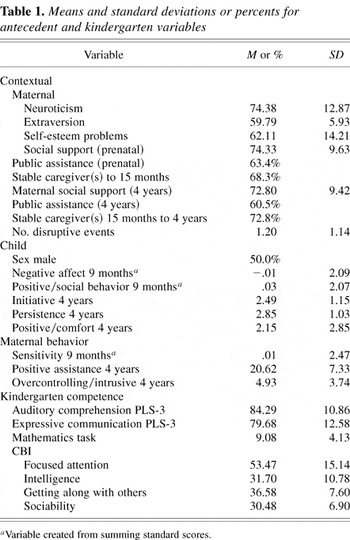
The means and standard deviations or percents for each of these variables described above are presented in Table 1. Data were missing for several reasons. Four mothers dropped out of the study at the prekindergarten (pre-K) assessment and another at the kindergarten data collection. Data are missing for one mother and child who missed only the 9-month assessment and for two others at 4 years because of a technical problem during filming of the puzzle task. The pre-K PLS-3 could not be scored (no baseline was obtained) for one child for auditory comprehension and three for expressive language, and one child refused to do the mathematics task.
Means and standard deviations or percents for antecedent and kindergarten variables

Results
To address the research questions of this study, the stability of attachment classification from infancy to preschool was examined. Then four groups of children who showed either stability or change in attachment security were identified and two sets of planned comparisons were used to identify mother, child, and caregiving environment antecedents that distinguished them. Follow-up analyses contrasted the types of insecure infants (organized and disorganized). Finally, attachment at each age was related to preschool competence in a challenging situation, pre-K cognitive ability, and teacher-reported functioning in kindergarten.
Stability and change in attachment
Distribution of attachment classifications at 15 months and 4 years
As previously reported (Fish, 2001), at 15 months, 50.5% of the rural Appalachian infants were classified as secure, 15.8% as avoidant, 4.2% as resistant, and 29.5% as disorganized. This distribution was similar to other low-SES (high-risk) samples, as published in the 1999 van IJzendoorn et al. meta-analysis, and significantly different from 15 low-risk US samples, χ[3]2 = 16.66, p < .001.
At 4 years, of the 82 children with attachment data at both ages, 61% of children were classified secure and 39% as insecure (8.5% A, avoidant; 9.8% C, ambivalent; 12.2% D–controlling; and 8.5% insecure–other). The number of children in each MacArthur category were (A) 7 avoidant–neutral; (B) 25 secure–reserved, 4 very secure, 6 secure–dependent, 5 secure–feisty, 9 secure–controlling, and 1 secure–other; (C) 1 ambivalent–resistant and 7 ambivalent–immature; and (D) 1 controlling–caregiving, 2 controlling–punitive, 7 controlling–general, and 7 insecure–other. There were no children classified as avoidant–ignoring or as behaviorally disorganized by the Main and Solomon criteria (1990).
Stability in attachment classification from 15 months to 4 years
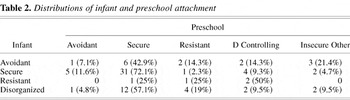
There was no significant stability in the A, B, C, and D classifications. As can be seen in Table 2, only the secure category had more than 50% stability. At the level of secure versus insecure, there was low, but significant stability, χ[1]2 = 4.70, p < .05; κ = .24; Goodman and Kruskal tau (with secure 4 dependent) = .057, p ≈ .03, because more than 70% of the children who were secure as infants remained so at 4 years. Children who were insecure as infants were about equally likely to be insecure or secure at 4 years.
Distributions of infant and preschool attachment

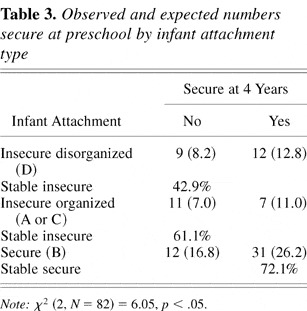
A further examination of stability versus change, with infant insecurity differentiated as disorganized (D) or organized (A or C) in Table 3, showed a distribution different than what would be expected by chance.2
The kappa value cannot be calculated on asymmetric distributions.
Observed and expected numbers secure at preschool by infant attachment type

Factors predicting patterns of stability and change
Next, analyses were carried out to identify factors associated with attaining or maintaining secure attachment over time. Two planned comparisons3
With planned comparisons, omnibus ANOVAs are not performed (Tabachnick & Fidell, 2001).
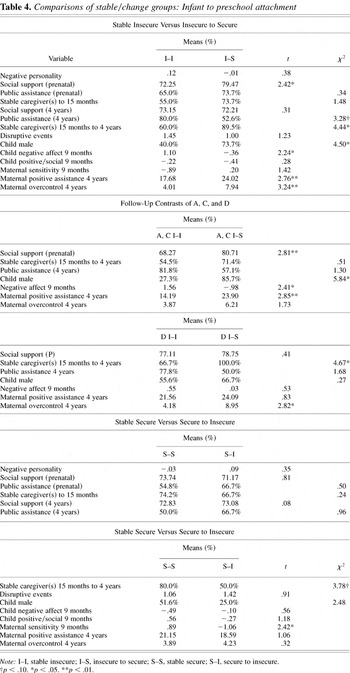
In addition, because this sample had a relatively high percentage of disorganized infants and because developmental courses of different styles of insecurity need additional study, in those instances where the first contrast (stable insecure with insecure to secure) revealed significant differences, two follow-up contrasts were carried out. These contrasts examined the insecure organized (A or C) and disorganized (D) infants separately. The results are shown in Table 4.
Comparisons of stable/change groups: Infant to preschool attachment

Clearly, the factors selected as potentially related to stability and change were more effective predictors for children who had been insecure as infants than for those who were secure infants. Compared to stable insecure children, those who changed to secure attachment at 4 years had mothers with more prenatal social support, mothers who were more likely to maintain a stable caregiving relationship from infancy to 4 years, and tended to be in families less likely to receive public assistance at 4 years. Boys were more likely to change from insecure to secure, as were infants who were less negative at 9 months. Unexpectedly, in the 4-year puzzle, mothers of insecure–secure children were more overcontrolling but also gave more positive assistance.
Follow-up separate contrasts of the two insecure–secure subgroups (see Table 4) revealed differences by group. Only the organized–secure group (A or C as infants but secure at 4 years) had significantly more male infants, greater prenatal maternal social support, lower 9-month infant negative affect, and higher 4-year maternal positive assistance than similar infants who stayed insecure. Only the disorganized–secure group had more stable caregiving from 15 months to 4 years and higher maternal overcontrol at 4 years than their counterparts who remained insecure. Public assistance at 4 years did not differ by type of infant insecurity. Thus, the disorganized insecure–secure group had fewer differentiating factors related to change to security at 4 years than did the organized insecure–secure group, and one of the D–secure differences, greater maternal overcontrol, appears counterintuitive.
Relatively few factors were associated with stability and change in secure infant attachment. Mothers of stable secure children were more sensitive at 9 months, consistent with research supporting the influence of early caregiving, and tended to be more likely to maintain stable caregiver relationship status from 15 months to 4 years than mothers of children who changed from secure to insecure.
Relation of infant and preschool attachment to preschool competence and to cognitive ability and kindergarten functioning
The final set of analyses were multivariate. The influence of both infant attachment security and 4-year attachment security on child competence and academic ability was examined first. A multivariate analysis of variance (MANOVA) with puzzle competence and pre-K academic ability as dependent variables and infant and 4-year security as grouping variables showed a significant multivariate effect for infant attachment, F (2, 66) = 7.29, p = .001, with significant univariate effects on both puzzle competence (F = 5.00, p < .05) and on cognitive ability (F = 11.93, p = .001). No effects were found either for 4-year attachment or for the interaction of infant and 4-year attachment. Post hoc t tests confirmed that children who were secure as infants showed greater competence in the 4-year puzzle task, t (78) = 1.97, p = .05, and had higher cognitive scores, t (71) = 3.19, p < .01, than did children who were insecure in infancy. Thus, only attachment security in infancy, not security in the preschool period, related to how children functioned in a challenging situation at 4 years and to their cognitive ability at entering kindergarten.
A possible mediational role for preschool socioemotional competence between infant attachment security and pre-K cognitive ability was also explored, according to the methods proposed by Barron and Kenny (1986). Separate regressions did show that (a) infant attachment security predicted 4-year socioemotional competence, F (1, 78) = 3.87, p = .05; (b) infant attachment security predicted pre-K cognitive ability, F (1, 72) = 10.15, p < .01; and (c) 4-year socioemotional competence predicted pre-K cognitive ability, F (1, 69) = 4.20, p < .05. However, in the final equation, when infant attachment and preschool competence were entered simultaneously as predictors, preschool competence was not significant. Therefore, preschool competence related to pre-K cognitive ability but did not mediate the effect of infant security.
Next, a series of analyses examined the relations of attachment, child gender, 4-year puzzle competence, and pre-K cognitive ability to the kindergarten CBI scores. A MANOVA with the four CBI factors as dependent variables and infant attachment security and 4-year attachment security as grouping variables indicated a multivariate effect of infant attachment, F (4, 70) = 2.68, p < .05, with a significant univariate effect on Focused Attention (F = 5.82, p < .05). A follow-up analysis showed that children secure in infancy had higher focused attention than those who had been insecure (Ms = 56.87 vs. 49.97), t (75) = 2.04, p < .05.
There was also a significant multivariate interaction, F (4, 70) = 3.85, p < .01, with significant interaction effects on Getting Along with Others (F = 4.54, p < .05) and Sociability (F = 9.29, p < .01). Follow-up tests of the stable and change attachment groups indicated that children who changed from insecure as infants to secure as preschoolers were lower (M = 31.79) on Getting Along with Others (being “nice”) than all others (Ms = 38.53 for stable insecure, 38.15 for stable secure, and 37.58 for secure to insecure), F (3, 73) = 3.75, p < .05. However, these insecure to secure children were also higher on Sociability (seeking others out) than the stable secure and stable insecure children (M = 34.47, 27.96, and 29.11, respectively), F (3, 73) = 4.24, p < .01.
ANOVAs with child gender as the grouping variable showed significant effects for Focused Attention, F (1, 75) = 5.77, p < .05, and for Getting Along with Others, F (1, 75) = 6.19, p < .05. Follow-up analyses revealed girls to be both more focused (Ms = 57.43 vs. 49.39), t (75) = 2.40, p < .05, and better at getting along with other children (Ms = 38.64 vs. 34.47), t (72.30) = 2.48, p < .05 than boys.
Correlational analyses showed that 4-year puzzle competence was correlated with Focused Attention, r (75) = .23, p < .05, while pre-K cognitive ability correlated with Focused Attention, r (72) = .50, p < .0001, with Verbal Intelligence, r (72) = .53, p < .0001, and with Getting Along with Others, r (72) = .31, p < .01.
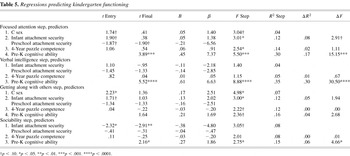
Finally, to address how attachment, preschool socioemotional competence, and pre-K cognitive ability considered together related to teacher-reported kindergarten functioning, a set of hierarchical regression equations, one for each CBI factor, was carried out. Variables were entered in the following order: infant attachment security and 4-year attachment security, preschool puzzle competence, and pre-K cognitive ability. For both Focused Attention and Getting Along with Others, child gender (coded 1 for boys and 2 for girls) was entered in the first step. The results are presented in Table 5, which includes change in variance accounted for (R2) and significance (F) of each step, as well as the contribution of each predictor at entry and in the final equation, as indicated by t values.
Regressions predicting kindergarten functioning

As Table 5 indicates, pre-K cognitive ability is by far the most powerful predictor of how children perform in kindergarten, adding significantly to the variance explained (6–30%) for all factors except Getting Along with Others. At the step in the regressions where attachment in infancy and preschool were entered, significant variance was explained for Focused Attention and for Getting Along with Others (both 12%), but that variance included 4 and 7%, respectively, attributable to child gender, that was entered first. In no case did 4-year socioemotional competence make a significant contribution with infant attachment already in the equation. Finally, considering all predictors together in the final equations, attachment security had limited and counterintuitive effects. With other predictors taken into account, children secure at 4 years tended to be lower in Focused Attention than those who were insecure and children secure in infancy were lower on Sociability than those who were insecure.
Discussion
The goal of this study was to examine stability and change in attachment from infancy to preschool and to relate attachment security at both times to preschool and kindergarten competence. The results increase the understanding of attachment relationships over time and their consequences in a large, but little studied, high-risk group (rural White children living in poverty), but the findings also raise a number of questions.
Consistent with prior research (Spieker & Booth, 1988; van IJzendoorn et al., 1999), the rate of insecure attachment in infancy was higher (49.5%) than for low-risk groups and the majority of insecure infants were disorganized. However, at 4 years, fewer children were classified as insecure (39%). The low but significant overall stability in attachment at the level of secure/insecure was clearly a function of stable secure relationships, as has been noted across studies, irrespective of family SES (NICHD Early Child Care Research Network, 2001; Thompson, 1998). In this sample, 49% of the children who were insecure as infants became secure by 4 years and more disorganized (D) infants became secure than did organized–insecure (A or C) infants. Thus, the elevated rate of insecurity, especially disorganized attachment, that characterized rural Appalachian infants was not found for the preschool period.
What factors were associated with this apparently positive change? Change was not related to more families with insecure infants leaving the study; there was not more attrition among families with insecure infants than there was with secure infants (χ[1]2 = .88). Neither were those who changed simply more difficult to classify; there was no difference in 4-year coders' confidence scores for stable and changing attachment groups (Ms = 2.97 and 2.96, respectively, t = .04, df = 80). However, as expected, there was some evidence that more positive traits of mothers, infants, and the caregiving environment contributed to attaining secure relationships.
Children who became secure, compared to those who remained insecure, were distinguished by some caregiving environment differences that were consistent with attachment theory and prior research on stability and change in attachment security. Specifically, attaining security was associated with more stable caregiving relationships, higher overall maternal social support, and mothers who had more optimal patterns of mother–child interaction, similar to prior work (Egeland & Farber, 1984). These mothers also tended to have less dependence on public assistance by 4 years. It may be that both improved family economic circumstances and the characteristics of parents who find work in a region of high unemployment are positive influences on child–caregiver relationships.
The children who changed from insecure to secure had also been less negative at 9 months than those who remained insecure. Child characteristics are presumed to directly affect development (Belsky, 1984), and less negative or difficult child temperament has been empirically linked to stability and change in attachment (Vondra et al., 1999).
Other group differences were unanticipated. In particular, why boys were more likely to change to secure (and girls to remain insecure) is not readily understood. One speculative interpretation of these findings is that some of the insecure infants, especially disorganized (63.2% of insecure to secure) and/or male (73.7% of insecure to secure) infants, might be characterized as “slow starters” in developing organized attachment strategies and other skills. Among these insecure infants, those with mothers who made more effort (both positive assistance and overcontrolling behavior4
Mothers of organized–insecure (A or C) infants who changed to secure at 4 years provided more positive assistance in the puzzle task, whereas the mothers of disorganized (D) infants who changed to secure at 4 years were more overcontrolling and intrusive compared to mothers of similar children who remained insecure. However, post hoc contrasts of A or C to secure mothers and D to secure mothers revealed that they did not differ from each other on either positive assistance (Ms 23.90 vs. 24.09, t = .06, df = 74) or on overcontrolling/intrusive behavior (Ms 6.21 vs. 8.95, t = 1.47, df = 16.8).
Kindergarten competence had multiple predictors. The strongest and most consistent predictor of teacher's CBI ratings was pre-K cognitive ability, which was higher in children who were secure as infants. In addition, children who were secure in infancy, girls, and those who were more competent in the 4-year puzzle task had greater Focused Attention. Girls were higher on Getting Along with Others, whereas children who changed from insecure to secure attachment (more likely to be boys) were lower. Finally, the same insecure–secure group that was low on teacher-rated social skills was high on seeking other children out and expressing positive affect (Sociability). When child gender, attachment security at both ages, competence in the puzzle task, and pre-K cognitive competence were considered together in hierarchical regressions, the only significant contribution of attachment was a counterintuitive one. Thus, the overall pattern of the kindergarten results shows mostly indirect effects of attachment, predominantly infant attachment.
In conclusion, for these rural Appalachian children, secure infant attachment had a positive influence on preschool socioemotional and cognitive competence and (primarily indirectly) on kindergarten functioning, whereas secure 4-year attachment offered no advantage, except in teacher-rated Sociability. At least two explanations for these results should be considered.
First, there may be a greater benefit to children of secure attachment attained in infancy, which is not inconsistent with attachment theory. In this high-risk sample, not attaining a secure relationship with the primary caregiver until 4 years may not be enough to confer protection and promote more competent development. It seems likely that, in the more stressful caregiving environment associated with economic disadvantage (Duncan et al., 1994; McLoyd & Wilson, 1991), children who have secure attachment relationships from earlier in life are somewhat protected against low-SES risks. Morisset, Barnard, Greenberg, Booth, and Spieker (1990) also reported that infant attachment security appeared to operate as a protective factor for cognitive development in higher risk children.
Second, the validity of the 4-year attachment assessment or its coding system may be an issue. Our Strange Situations were standard with minor changes; further, the same reliable coding group who coded preschool attachment for the NICHD study also coded our data. However, concern has been expressed that short separations are not sufficiently stressful to activate attachment behavior in preschool children (Solomon & George, 1999). Among the children in this study, 49.6% showed more than minimal distress in episode 5 (viewed as most stressful because it is the second separation and the child is left alone); in addition, 17.1% had at least one separation shortened and another 12.2% had at least one separation omitted because of distress. Thus, rural Appalachian 4-year-olds (who have a low rate of nonparental care, only 11% of our sample) appeared to respond to brief separations from their mothers in a manner consistent with the theory underlying the Strange Situation and consistent with Ainsworth's (1990) statement that “it is now realized that the Strange Situation offers enough stress even for the assessment of a 3- or 4-year-old” (p. 486).
Although the NICHD Early Child Care Research Network (2001) reports construct validity for MacArthur coding of preschool Strange Situations, based on relations to maternal and family antecedents and child outcomes consistent with attachment theory and research, Solomon and George (1999) expressed convergent validity concerns based on poor agreement between the MacArthur system and Crittenden's Preschool Attachment Assessment when applied to the same sample. They also cite one (unpublished) study “which could suggest that the Cassidy–Marvin system overestimates the numbers of secure relationships in the preschool years” (p. 299).
Additional concerns have been raised regarding low stability within insecure categories from infancy to the preschool age. Such results may arise from inherent instability over time in the manifestations of insecure attachment or they may be at least partially attributable to a lack of congruence between infant and preschool behavioral ratings of secure and insecure behavior (Barnett & Vondra, 1999) or to differences in how the two preschool attachment systems for preschoolers classify certain types of insecure children (Teti, 1999).
Thus, it appears that how to measure and code attachment in preschool years is less well defined than in infancy. The present data leave unresolved whether infant attachment offers a unique protective effect, especially for more vulnerable low-SES children, or whether some children classified as secure at 4 years (notably some of those who had been insecure in infancy) were not genuinely secure, resulting in no prediction from preschool attachment to puzzle competence or kindergarten teacher ratings. (Considering one aspect of that issue, 78% of the secure–controlling preschoolers, who may be considered less than optimally secure in the MacArthur system, had also been secure as infants.)
In addition, although child gender differences were a factor in kindergarten outcomes, sample size precluded simultaneous examination of the differences by infant attachment, preschool attachment, and gender. Gender differences, when found, more often show boys to be disadvantaged (Kraemer, 2000; Prior, Smart, Sanson, & Oberklaid, 1993). Gender differences may also be evident when “risk” conditions are additive. In the NICHD study (1997), male infants with extensive nonparental child care were more likely to be insecure. Among these low-SES rural Appalachian children, the combination of being male and not having the protective effect of secure infant attachment appeared to make lower academic and social functioning more likely in the school setting.
The findings from this investigation need to be tested with longitudinal data from larger samples that include both low-SES families and those who are not economically disadvantaged. The cultural characteristics of this population as well as their widespread economic disadvantage may limit generalizability to other groups. Sample size also limited the power available to discern significant group differences. Nonetheless, these results extend what is known about influences on attachment stability in low-SES families and about the consequences of secure attachment in infancy and preschool for competent function as children enter school.
Additional work is needed regarding the validity of different methods of assessing and describing attachment relationships in preschool children. Further investigation is also needed regarding conditions which might be associated with slower attainment of secure attachment in low-SES families as well as with the origins and consequences of disorganized, insecure–organized, and insecure–other attachment in families with different kinds of risks.
References
REFERENCES
Ainsworth, M. D. S.
(1990).
Epilogue: Some considerations regarding theory and assessment
relevant to attachments beyond infancy. In
M. T. Greenberg,
D. Cicchetti, &
E. M. Cummings (Eds.),
Attachment in the preschool years (pp.
463–488).
Chicago:
University of Chicago Press.
Ainsworth, M. D. S.,
Blehar, M. C.,
Waters, E., &
Wall, S.
(1978).
Patterns of attachment.
Hillsdale, NJ:
Erlbaum.
Bar-Haim, Y.,
Sutton, D. B.,
Fox, N. A., &
Marvin, R. S.
(2000).
Stability and change of attachment at 14, 24, and 58 months of age:
Behavior, representation, and life events.
Journal of Child Psychology and Psychiatry
41,
381–388.Google Scholar
Barnett, D., &
Vondra, J. I.
(1999).
Atypical patterns of early attachment: Theory, research, and
current directions. In
J. I. Vondra &
D. Barnett (Eds.),
Atypical attachment in infancy and early childhood among children at
developmental risk (pp.
1–24).
Monographs of the Society for Research in Child Development
64(3, Serial No. 258).
Barron, R. M., &
Kenny, D. A.
(1986).
The moderator–mediator variable distinction in social
psychological research: Conceptual, strategic and statistical
considerations.
Journal of Personality and Social Psychology
51,
1173–1182.Google Scholar
Beaver, P. D.
(1980).
The mountain family: Kinship and society. In
P. B. Cheek (Ed.),
The Appalachian woman: Images and essence (pp.
27–33).
Mars Hill, NC:
The Council on Appalachian Women Inc.
Belsky, J.
(1984).
The determinants of parenting: A process model.
Child Development
55,
83–96.Google Scholar
Belsky, J.,
Campbell, S. B.,
Cohn, J. F., &
Moore, G.
(1996).
Instability of infant–parent attachment security.
Developmental Psychology
32,
921–924.Google Scholar
Belsky, J., &
Fearon, R. M. P.
(2002).
Infant–mother attachment security, contextual risk, and early
development: A moderational analysis.
Development and Psychopathology
14,
293–310.Google Scholar
Belsky, J.,
Fish, M., &
Isabella, R.
(1991).
Continuity and discontinuity in infant negative and positive
emotionality: Family antecedents and attachment consequences.
Developmental Psychology
27,
421–431.Google Scholar
Bowlby, J.
(1973).
Attachment and loss: Vol. II. Separation.
New York:
Basic Books.
Bowlby, J.
(1980).
Attachment and loss: Vol. III. Loss: Sadness and depression.
New York:
Basic Books.
Bryant, F. C.
(1981).
We're all kin: A cultural study of a mountain neighborhood.
Knoxville, TN:
University of Tennessee Press.
Cassidy, J., &
Marvin, R. S.
(with
The Attachment Working Group of the John D. and Catherine T.
MacArthur Network on the Transition from Infancy to Early
Childhood).
(1992).
Attachment organization in preschool children: Procedures and
coding manual.
Cicchetti, D.,
Cummings, E. M.,
Greenberg, M. T., &
Marvin, R. S.
(1990).
An organizational perspective on attachment beyond infancy. In
M. T. Greenberg,
D. Cicchetti, &
E. M. Cummings (Eds.),
Attachment in the preschool years (pp.
3–49).
Chicago:
University of Chicago Press.
Costa, P., &
McCrae, R.
(1978).
The NEO Personality Inventory.
Odessa, FL:
Psychological Assessment Resources, Inc.
Crockenberg, S. B.
(1986).
Are temperamental differences in babies associated with
predictable differences in care giving? In
J. V. Lerner &
R. M. Lerner (Eds.),
New directions for child development: Temperament and social
interaction in infants and children (pp.
53–73).
San Francisco, CA:
Jossey–Bass.
Crittenden, P. M.
(1995).
Coding manual: Classification of quality of attachment for
preschool-aged children.
Miami, FL:
Family Relations Institute.
Crnic, K. A.,
Greenberg, M. T.,
Ragozin, A. S.,
Robinson, N. M., &
Basham, R.
(1983).
Effects of stress and social support on mothers and premature and
full term infants.
Child Development
54,
209–217.Google Scholar
De Wolff, M. S., &
van IJzendoorn, M. H.
(1997).
Sensitivity and attachment: A meta-analysis on parental antecedents
of infant attachment.
Child Development
68,
571–591.Google Scholar
Duncan, G. J.,
Brooks–Gunn, J., &
Klebanov, P. K.
(1994).
Economic deprivation and early childhood development.
Child Development
65,
296–318.Google Scholar
Easterbrooks, M. A., &
Goldberg, W. A.
(1990).
Security of toddler–parent attachment: Relation to
children's sociopersonality functioning during kindergarten. In
M. T. Greenberg,
D. Cicchetti, &
E. M. Cummings (Eds.),
Attachment in the preschool years (pp.
221–244).
Chicago:
University of Chicago Press.
Egeland, B., &
Farber, E. A.
(1984).
Infant–mother attachment: Factors related to its development
and changes over time.
Child Development
55,
753–771.Google Scholar
Fagot, B. I., &
Pears, K. C.
(1996).
Changes in attachment during the third year: Consequences and
predictions.
Development and Psychopathology
8,
325–344.Google Scholar
Fish, M.
(1998).
Negative emotionality and positive/social behavior in rural
Appalachian infants: Prediction from caregiver and infant
characteristics.
Infant Behavior and Development
21,
685–698.Google Scholar
Fish, M.
(2001).
Attachment in low-SES rural Appalachian infants: Contextual,
mother, and infant risk and protective factors.
The Infant Mental Health Journal
22,
641–664.Google Scholar
Frankel, K. A., &
Bates, J. E.
(1990).
Mother–toddler problem solving: Antecedents in attachment,
home behavior, and temperament.
Child Development
61,
810–819.Google Scholar
Goldsmith, H. H., &
Alansky, J. A.
(1987).
Maternal and infant temperamental predictors of attachment: A
meta-analytic review.
Journal of Consulting and Clinical Psychology
55,
805–816.Google Scholar
Hamilton, C. E.
(2000).
Continuity and discontinuity in attachment from infancy through
adolescence.
Child Development
71,
690–694.Google Scholar
Howes, C., &
Hamilton, C. E.
(1992).
Children's relationship with child care teachers: Stability
and concordance with parental attachments.
Child Development
63,
867–878.Google Scholar
Hudson, W. W.
(1982).
The clinical measurement package: A field manual.
Homewood, IL:
Dorsey.
Lutkenhaus, P.,
Grossmann, K. E., &
Grossmann, K.
(1985).
Infant–mother attachment at twelve months and style of
interaction with a stranger at the age of three years.
Child Development
56,
1538–1542.Google Scholar
Main, M., &
Cassidy, J.
(1988).
Categories of response to reunion with the parent at age 6:
Predictable from infant attachment classifications and stable over a
1-month period.
Developmental Psychology
24,
415–426.Google Scholar
Main, M., &
Solomon, J.
(1990).
Procedures for identifying infants as disorganized/disoriented
during the Ainsworth Strange Situation. In
M. T. Greenberg,
D. Cicchetti, &
E. M. Cummings (Eds.),
Attachment in the preschool years (pp.
121–160).
Chicago:
University of Chicago Press.
Malatesta, C. Z.,
Culver, C.,
Tesman, J. R., &
Shepard, B.
(1989).
The development of emotion expression during the first two years of
life.
Monographs of the Society for Research in Child Development
54(1–2,
Serial No. 219).Google Scholar
Matas, L.,
Arend, R. A., &
Sroufe, L. A.
(1978).
Continuity of adaption in the second year: The relationship between
quality of attachment and later competence.
Child Development
49,
547–556.Google Scholar
McDevitt, S. C.
(1986).
Continuity and discontinuity of temperament in infancy and early
childhood: A psychometric perspective. In
R. Plomin &
J. Dunn (Eds.),
The study of temperament: Changes, continuities, and challenges (pp.
27–38).
Hillsdale, NJ:
Erlbaum.
McLoyd, V. C., &
Wilson, L.
(1991).
The strain of living poor: Parenting, social support, and child
mental health. In
A. C. Huston (Ed.),
Children in poverty: Child development and public policy (pp.
105–135).
Cambridge:
Cambridge University Press.
Meins, E.
(1997).
Security of attachment and the social development of cognition.
Hove, UK:
Psychology Press.
Morisset, C. E.,
Barnard, K. E.,
Greenberg, M. T.,
Booth, C. L., &
Spieker, S. J.
(1990).
Environmental influences on early language development: The context
of social risk.
Development and Psychopathology
2,
127–149.Google Scholar
Moss, E., &
St-Laurent, D.
(2001).
Attachment at school age and academic performance.
Developmental Psychology
37,
863–874.Google Scholar
NICHD Early Child Care Research Network.
(1997).
The effects of infant child care on infant–mother attachment
security: Results of the NICHD study of early child care.
Child Development
68,
860–879.Google Scholar
NICHD Early Child Care Research Network.
(2001).
Child-care and family predictors of preschool attachment and
stability from infancy.
Developmental Psychology
37,
847–862.Google Scholar
Prior, M.,
Smart, D.,
Sanson, A., &
Oberklaid, F.
(1993).
Sex differences in psychological adjustment from infancy to 8
years.
Journal of the American Academy of Child and Adolescent Psychiatry
32,
291–304.Google Scholar
Schaefer, E. S., &
Edgerton, M. D.
(1978).
Classroom Behavior Inventory.
Chapel Hill, NC:
University of North Carolina at Chapel Hill.
Solomon, J., &
George, C.
(1999).
The measurement of attachment security in infancy and childhood.
In
J. Cassidy &
P. R. Shaver (Eds.),
Handbook of attachment: Theory, research, and clinical applications
(pp.
287–316).
New York:
Guilford Press.
Spieker, S. J., &
Booth, C. L.
(1988).
Maternal antecedents of attachment quality. In
J. Belsky &
T. Nezworski (Eds.),
Clinical implications of attachment (pp.
95–135).
Hillsdale, NJ:
Erlbaum.
Suess, G. J.,
Grossmann, K. E., &
Sroufe, L. A.
(1992).
Effects of infant attachment to mother and father on quality of
adaptation in preschool: From dyadic to individual organisation of
self.
International Journal of Behavioral Development
15,
43–65.Google Scholar
Tabachnick, B. G., &
Fidell, L. S.
(2001).
Using multivariate statistics.
Boston:
Allyn & Bacon.
Teti, D.
(1999).
Conceptualizations of disorganization in the preschool years. In
J. Solomon &
C. George (Eds.),
Attachment disorganization (pp.
213–242).
New York:
Guilford Press.
Teti, D. M.,
Sakin, J. W.,
Kucera, E., &
Corns, K. M.
(1996).
And baby makes four: Predictors of attachment security among
preschool-aged firstborns during the transition to siblinghood.
Child Development
67,
579–596.Google Scholar
Thompson, R. A.
(1998).
Early sociopersonality development. In
W. Damon
(Ser. Ed.) &
N. Eisenberg
(Vol. Ed.),
Handbook of child psychology: Vol. 3. Social, emotional, and
personality development
(5th ed., pp.
25–104).
New York:
Wiley.
Thompson, R. A.,
Lamb, M. E., &
Estes, D.
(1982).
Stability of infant–mother attachment and its relationship to
changing life circumstances in an unselected middle-class sample.
Child Development
53,
144–148.Google Scholar
van den Boom, D. C.
(1989).
Neonatal irritability and the development of attachment. In
G. A. Kohnstamm,
J. E. Bates, &
M. K. Rothbart (Eds.),
Temperament in childhood (pp.
299–318).
New York:
Wiley.
van IJzendoorn, M. H.,
Dijkstra, J., &
Bus, A. G.
(1995).
Attachment, intelligence, and language: A meta-analysis.
Social Development
4,
115–128.Google Scholar
van IJzendoorn, M. H.,
Schuengel, C., &
Bakermans–Kranenburg, M. J.
(1999).
Disorganized attachment in early childhood: Meta-analysis of
precursors, concomitants, and sequelae.
Development and Psychopathology
11,
225–249.Google Scholar
Vondra, J. I.,
Hommerding, K. D., &
Shaw, D. S.
(1999).
Stability and change in infant attachment a low-income sample.
Monographs of the Society for Research in Child Development
64(3,
Serial No. 258,
119–144).Google Scholar
Vondra, J. I.,
Shaw, D. S.,
Swearingen, L.,
Cohen, M., &
Owens, E. B.
(2001).
Attachment stability and emotional and behavioral regulation from
infancy to preschool age.
Development and Psychopathology
13,
13–33.Google Scholar
Vygotsky, L.
(1978).
Mind in society: the development of higher psychological processes.
Cambridge, MA:
Harvard University Press.
Waddington, C. H.
(1957).
The strategy of the genes.
London:
Allen & Unwin.
Wartner, U. G.,
Grossmann, K.,
Fremmer–Bombik, E., &
Suess, G.
(1994).
Attachment patterns at age six in south Germany: Predictability
from infancy and implications for preschool behavior.
Child Development
65,
1014–1027.Google Scholar
Waters, E.,
Merrick, S.,
Treboux, D.,
Crowell, J., &
Albersheim, L.
(2000).
Attachment security in infancy and early adulthood: A twenty-year
longitudinal study.
Child Development
71,
684–689.Google Scholar
Waters, E., &
Valenzuela, M.
(1999).
Explaining disorganized attachment: Clues from research on
mild-to-moderately undernourished children in Chile. In
J. Solomon &
C. George (Eds.),
Attachment disorganization (pp.
265–287).
New York:
Guilford Press.
Weinfield, N. S.,
Sroufe, L. A., &
Egeland, B.
(2000).
Attachment from infancy to early adulthood in a high-risk sample:
Continuity, discontinuity, and their correlates.
Child Development
71,
695–702.Google Scholar
Zimmerman, I. L.,
Steiner, V. G., &
Pond, R. E.
(1992).
Preschool Language Scale—3.
San Antonio, TX:
The Psychological Corporation.
Means and standard deviations or percents for antecedent and kindergarten variables
Distributions of infant and preschool attachment
Observed and expected numbers secure at preschool by infant attachment type
Comparisons of stable/change groups: Infant to preschool attachment
Regressions predicting kindergarten functioning
 You have
Access
- 19
- Cited by