Introduction
Late blight (LB) caused by Phytophthora infestans (Mont.) de Bary is among the most devastating potato diseases. The resistance genes R1–R11 from the wild species Solanum demissum Lindl. previously deployed for breeding LB-resistant potato cultivars are rapidly defeated by new pathogen races; nevertheless, many potato cultivars comprising these R-genes maintain higher LB resistance than the genotypes lacking R-genes (for review see Stewart et al., Reference Stewart, Bradshaw and Pande2003). The hopes to breed for durable LB resistance using broad-specificity genes, such as RB of S. bulbocastanum Dunal, seem to vanish with the discovery of P. infestans races overcoming LB resistance in RB-transformed potato (Champouret, Reference Champouret2010; Halterman et al., Reference Halterman, Chen, Sopee, Berduo-Sandoval and Sánchez-Pérez2010; for early evidence of S. bulbocastanum susceptibility to P. infestans see Budin, Reference Budin2002). Another option to obtain varieties with durable resistance is pyramiding and stacking several R-genes from wild Solanum species other than S. demissum (Haverkort et al., Reference Haverkort, Struik, Visser and Jacobsen2009; Verzaux, Reference Verzaux2010).
Several already characterized R-genes for LB resistance from diverse wild Solanum species encode coiled coil-nucleotide binding site-leucine rich repeat kinases. Once such R-genes are characterized, their orthologues found in other species using an allele-mining approach (Hein et al., Reference Hein, Birch, Danan, Lefebvre, Odeny, Gebhardt, Trognitz and Bryan2009) would help expand the range of candidate genes for breeding for LB resistance.
We developed and verified six sequence characterized amplified region (SCAR) markers recognizing R1 and R3 of S. demissum and RB of S. bulbocastanum and the germplasms of these species, and used them to screen 21 Solanum species sect. Petota Dumort. The structural homologues of all three genes were found far beyond the taxa where they had been initially discovered.
Materials and methods
Tubers of potato varieties came from the collections of the Institute of Plant Industry, St. Petersburg, Russia and the Institute of Potato Husbandry, Korenevo, Russia. Microtubers and seeds of wild Solanum species were obtained from the collections of the Institute of Plant Industry, Centre for Genetic Resources, the Netherlands and the United States Potato Genebank, NRSP-6, Sturgeon Bay, WI.
Standard protocols were employed for genomic DNA isolation from plant leaves, PCR analysis, and cloning and identifying genome fragments. Specific primers for SCAR markers (Supplementary Table S1, available online only at http://journals.cambridge.org) were designed following multiple alignment of the prototype gene sequences and anonymous genome fragments with their structural homologues from the NCBI Genbank using the programs BLAST (http://blast.ncbi.nlm.nih.gov/Blast.cgi) and Vector NTI Suite 8 package (Invitrogen). The data were processed with the Mann–Whitney U test (Reference Mann and Whitney1947) using SPSS Statistics 17.0 software (http://www.spss.com). For phylogenetic analysis, Maximum Likelihood trees were constructed using the software PHYLIP 3.2 (Felsenstein, Reference Felsenstein1989). The marker R1-1205 was modified from R1-1400 (Gebhardt et al., Reference Gebhardt, Ballvora, Walkemeier, Oberhagemann and Schüler2004) for more consistent scoring. Other markers were developed in this laboratory.
Results and discussion
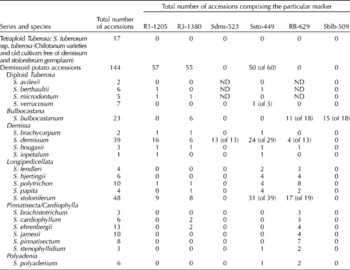
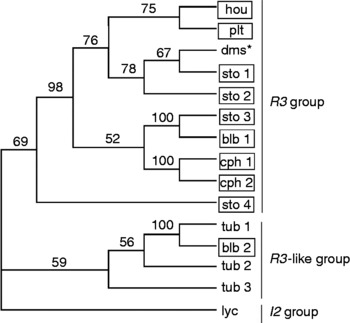
All markers reliably discriminated S. tuberosum L. ssp. tuberosum represented by potato varieties free of wild Solanum germplasm from wild Solanum species currently employed in potato introgression breeding (Table 1). The markers for demissum R1 and R3, bulbocastanum RB and stoloniferum Ssto-449 (the latter corresponds to a fragment flanking R1 in S. demissum) passed through as many as six to eight crosses into the modern potato cultivars. When verified by cloning and sequencing, the marker R1-1205 in S. polytrichon Rydb. and S. stoloniferum Schltdl. and Bouchet and the marker R3-1380 in S. bulbocastanum, S. cardiophyllum Lindl., S. hougasii Correll, S. polytrichon and S. stoloniferum shared 98–99% identity with the corresponding regions in the prototype genes. Full-length homologues of R3 from S. bulbocastanum and S. stoloniferum (GenBank accession nos. HQ731036 and HQ731037, respectively) shared 92 and 98% identity with the prototype R3a gene (AY849382) from S. demissum (Sokolova et al., in preparation). The phylogenetic analysis of the R3-1380 fragments from wild Solanum species sequenced in our laboratory as compared to those of the demissum R3 gene, tomato I2 gene and non-functional R3-like genes from the NCBI Genbank demonstrated that the R3-1380 sequences belonged to the same cluster as R3a (Fig. 1), presuming that this marker apparently represented the active gene. Sblb-509 was maintained for at least three generations, while Sdms-523 designed from the fragment of ribosomal internal transcribed spacer was lost already after two crosses.
Frequencies of SCAR markers for the R-genes and germplasms of Solanum

ND, not determined.
Maximum Likelihood tree comparing the R3-1380 sequences from wild Solanum species (in boxes) with the functional gene R3, gene I2 and R3 inactive homologues. Bootstrap values (in percent) are shown at the nodes. Sequences are listed with the numbers of Solanum accessions and NCBI Genbank nucleotide accessions (italicized). S. bulbocastanum: blb 1, PI275198, HM124855; blb 2, PI243508, HQ731036; S. cardiophyllum: cph 1, VIR24375, HM124857; cph 2, VIR21301; S. demissum: dms*, the functional gene R3a from AY849382; S. hougasii: hou, VIR 8818, HM124858; S. lycopersicum: lyc, I2, AF118127; S. polytrichon: plt, VIR24463, HM124859; S. stoloniferum: sto 1, VIR23652; sto 2, GLKS588, FJ175386; sto 3, PI365401, HQ731037; sto 4, CGN18348, FJ175388; S. tuberosum: tub 1, I2GA-SH23-3, AY849384; tub 2, I2GA-SH-23-1, AY849383; tub 3, I2GA-SH194-2, AY849385.

Only the markers Sblb-509 and Sdms-523 were species-specific. In addition to S. demissum and S. stoloniferum, the markers R1-1205, R3-1380 and Ssto-449 were found in other species of the series Demissa and Longipedicellata and even beyond these series. The presence of several R-genes in S. stoloniferum was first shown by phytopathological methods (for review see Grünwald and Flier, Reference Grünwald and Flier2005), and recently R3 sequences were isolated from S. stoloniferum by allele mining (Champouret, Reference Champouret2010). The presence of the R1-1400 marker in S. stoloniferum was confirmed by Gebhardt et al. (Reference Gebhardt, Ballvora, Walkemeier, Oberhagemann and Schüler2004), and now we have verified it by sequencing. Of special interest is the presence of R3-1380 in S. bulbocastanum, S. cardiophyllum, S. ehrenbergii (Bitter) Rydb. and S. microdontum Bitter (Table 1). However, we want to emphasise the possibility that R3-1380 also recognises the R5-R11 sequences allelic to R3 (Hein et al., Reference Hein, Birch, Danan, Lefebvre, Odeny, Gebhardt, Trognitz and Bryan2009). The marker RB-629 was found in over half of the accessions representing all wild Solanum series under study (Table 1; for more details, see Pankin et al., this issue).
The results of the marker analysis even when supported by sequencing do not immediately prove that newly screened Solanum species comprise the promising orthologues of the R1, R3 and RB genes. Nonetheless, such evidence helps focus on prospective targets for wider and deeper allele mining and functional analysis. However, in one case, we can relate the presence of the markers of demissum R1 and R3 to their function. Using the Mann—Whitney U test, we demonstrated that LB resistance of demissoid potato cultivars comprising the markers R1-1205 and R3-1380 significantly exceeded the resistance of the demissoid cultivars devoid of these markers. The difference was especially great when the cultivars comprising R1 and R3 were compared with varieties free of wild Solanum germplasm (Supplementary Table S2, available online only at http://journals.cambridge.org).
Conclusions
We developed and validated several markers of the R-genes and germplasm of S. bulbocastanum, S. demissum and S. stoloniferum which discriminated between cultivated S. tuberosum and many wild species. These markers can be employed for germplasm characterization in genetic collections and for monitoring the potato populations segregating after crosses. The presence of the R1 and R3 genes introgressed from S. demissum, as evidenced by the marker analysis, significantly improved LB resistance of potato cultivars.
Acknowledgements
The authors thank all colleagues who provided Solanum accessions and the pedigree information. This study was supported by the ISTC-USDA-ARS project 3714p.