Introduction
Many wars have clear victors and losers. The outcomes were often based on the size of the armies and their weaponry. This certainly oversimplified depiction of war has changed in recent decades to new types of hostility that have left countries in chaos and turmoil. The debate surrounding commercial sealing has in figurative speech taken on the characteristics of ‘war’, with discussions of ‘winners’ and ‘losers’ engaged in battle (Busch Reference Busch1985; Henke Reference Henke1985; Watson Reference Watson2004; Kretzer Reference Kretzer2013; COWI 2008: 101). The adoption of the European Union (EU) regulation 1007/2009 on trade in seal products (basic regulation; EP 2009a), which bans products stemming from commercially hunted seals from the European market, constitutes an important weapon in this ‘war’ to end the commercial seal hunt. But the implications of this align with the depiction of this new type of war with no victors or losers. Instead, the regulation has left a battlefield in which fighting has not ceased and in which victors and losers alike bear consequences that must be faced.
But is this the ultimate purpose of the regulation? What goal was the ban intended to attain? One direct result of the regulation is several court cases before the General Court of the European Union (EUGC) to overturn it. In its most recent judgement and based on the basic regulation, the court frames the primary and secondary goals of the regulation as internal market harmonisation as its prime objective, and external trade as its secondary objective (EUGC 2013a: paragraphs 35, 71). Yet, the arguments supporting the ban were mainly about animal welfare concerns in the commercial seal hunt and it was these concerns, not those of the market that shaped the process that led to the final regulation.
This article attempts to determine what the formulated and unformulated goals of the regulatory scheme for trade in seal products in the EU are. It comprehensively approaches the ban by not merely focusing on the basic regulation, but rather by taking the policy-making process and political environment into consideration when determining the ban's goals, objectives and consequences. For example, the deferring of the decision regarding the application of the EU as observer in the Arctic Council (AC 2013) is likely to be connected to the EU seal products ban and the resistance it triggered amongst the Inuit. The ban is then located within a context of the EU's aspirations in the Arctic while it is further embedded in the goals that are set forth in several documents that frame the EU's role and objectives in the north.
Seals, the EU and trade
The overhunting of seals in the 1950s and 60s led the European Community to adopt a ban on the importation of products stemming from harp and hooded seal pups (‘Seal Pups Directive’) in 1983, which is still in force today. In it, conservation concerns over the declining seal populations in the northwest Atlantic gave the incentive for imposing a ban. Bearing in mind these concerns, the preamble of the directive reads that ‘the exploitation of seals and of other species, depending upon their capacity to withstand such exploitation and with due respect for the balance of nature, is a natural and legitimate occupation and in certain areas of the world forms an important part of the traditional way of life and economy’ (ECoun 1983). Conservation concerns for earless seals (phocidae) within European waters were the reason for listing them in Annex IV of the Habitats Directive (ECoun 1992), which constitutes the European implementation measure required under the Convention on Biological Diversity, 1992. Under Annex IV of the Habitats Directive, member states of the European Communities are required strictly to implement protective measures for those species listed.
The Canadian commercial seal hunt aims at the harp seal (Pagophilus groenlandicus) of the northwest Atlantic population. This population is estimated to range between 8.6–9.6 million animals (United States 2012), showing a significant increase since 2005 when its population was estimated to be around 5.9 million animals (Kovacs Reference Kovacs2008). Each year, the Canadian Department of Fisheries and Oceans (DFO) issues a science-based total allowable catch (TAC) in order to avoid overhunting. In 2013 the TAC was 400,000 while merely 90,000 seals were actually hunted.
In both the Seal Pups Directive and the Habitats Directive, no references are made regarding animal welfare. Under the Annex, the exploitation of those species listed is merely linked to the maintenance or establishment of a favourable conservation status.
Animal welfare in relation to the seal hunt found its first political manifestation in the EU in the European Parliament (EP) declaration on banning the trade in seal products (EP 2006). This declaration, which links conservation issues and animal welfare to the seal hunt, triggered the policy-crafting process that led to the adoption of Regulation 1007/2009 on 5 May 2009, and its implementation regulation in 2010 (EC 2010a). Throughout the different documents produced in the process, conservation concerns were largely absent (see Sellheim Reference Sellheim, Alfredsson, Koivurova and Stepien2013a).
The goals of the EU seal products trade regulation
The linking of animal welfare and commercial seal hunting and the statements of policy makers regarding animal welfare deficits as the incentive to impose the ban may lead to a conclusion that the overall goal of the ban is the improvement of animal welfare in the seal hunt. This, however, appears premature as the goal setting within the ban is complex and yields several results. This is especially the case in the context of the EU as an Arctic actor. Breitmeier writes that ‘[g]lobal governance systems will be pointless or undesirable and will not deserve obedience if they will not contribute to problem-solving’ and it must be determined which problems, as identified by Sellheim (forthcoming), are to be solved with which means in the context of the EU seal products trade regulation. Although the EU seal products trade regime is not a global governance system as such, it is nevertheless a regional governance system with a strong exterior dimension (Sellheim Reference Sellheim2013b). In order to determine the primary, substantive goals and secondary goals that have shaped the outcome of the EU seal products ban, documents that have marked different segments of the drafting process are analysed: the EU parliamentary declaration that called for a trade ban, the study carried out by the European Food Safety Authority (EFSA) on animal welfare in the seal hunt (EFSA 2007), the impact assessment carried out by the Copenhagen-based consultancy firm COWI (COWI 2008), the commission regulation proposal (EC 2008a), the study on implementing measures for a ban on trade in seal products (COWI 2010), regulation 1007/2009 as such and commission regulation 737/2010 are examined to highlight the primary goals of the ban. Moreover, five EU documents, that set out secondary goals dealing with the Arctic and which are of relevance in the seal products trade ban context are taken into consideration:
2008 Commission communication ‘The European Union and the Arctic region’ (EC 2008b);
2009 Council of the EU ‘Council conclusions on Arctic issues’ (ECoun 2009a);
2011 EP resolution on a high north policy (EP 2011);
2012 Joint communication ‘Developing a European Union Policy towards the Arctic Region: progress since 2008 and next steps’ (EC 2012a);
its accompanying joint staff document ‘The inventory of activities in the framework of developing a European Union Arctic Policy’ (EC 2012b).
Thirdly, normative or meta-goals of the regulation are discussed.
Primary (substantive) goals of the seal ban regime
The goals set out in the EU seal products trade regime are manifold and the technical nature of Regulation 1007/2009 combined with the goals set out in the documents used during the drafting process make the determination of the regulation's intention difficult.
However, since concerns over animal welfare aspects in the commercial seal hunt have dominated the drafting process of the ban, a shut-down of the European Union's internal market for seal products stemming from these hunts constitutes a primary goal of the seal products trade regime. Already the EU parliamentary declaration calls in paragraph H.1 for a ‘ban on the import, export and sale of all harp and hooded seal products’ (EP 2006). While the Union does not hold legal competence to legislate solely based on ethical concerns, it is nevertheless able to use other spheres of legislative competences to embed ethical concerns into its policies (EC 2008a: 3).
After the EP had issued its declaration on banning trade in seal products (EP 2006), Belgium and the Netherlands imposed national legislation that banned trade in seal products while other countries such as Germany, Italy or Austria stated an intention to follow suit. Consequently, conditions for trade in seal products within the EU's internal market showed fragmentation and provided the commission with a trade environment that called for community action. To this end, since it was primarily ethical concerns that led to the national bans, the community responded by justifying the inclusion of ethical concerns into its trade policy regarding seal products. The expected further fragmentation of the internal market became a primary element in the process, leading to the adoption of a regulation that harmonises the rules on trade in seal products in the EU. Both the EFSA (2007) and COWI (2008) studies make reference to the fragmentation of the EU's internal market, and therefore COWI writes that it is necessary to ‘regulate [instead of banning; the author] the import, export and sale of all harp and hooded seal products’ (own emphasis; COWI 2008: 1). Accordingly, Regulation 1007/2009 reads in recital 15: ‘This Regulation establishes harmonised rules concerning the placing on the market of seal products. [. . .]’ (EP 2009: recital 15). It is important to note that all seal species are included here. The legislative focus has shifted from the desire to reduce potential animal suffering to harmonising the internal market as recitals 5, 6, 8–13 and 15, 21 as well as article 1 of Regulation 1007/2009 show. Therefore, although ethical concerns over animal welfare aspects in commercial seal hunts on the part of the European public may have given the incentive to start a legislative process, the final regulation abstains from making animal welfare improvement a prime objective. This stands in stark contrast to the commissioned EFSA study that analyses different animal welfare elements of the seal hunt and makes animal welfare the core element of its assessment.
In spite of the blanket nature of these harmonised rules regarding trade in seal products, several exemptions for the importation of seal products can be found. Within the basic regulation itself and throughout the entire process a primary goal was to not affect the Inuit and other indigenous communities and their conduct of the hunt, as it was perceived as an important element of Inuit culture and needs. This is due to the fact that the bans imposed in the 1980s on seal pups had detrimental effects on the Inuit who were dependent on seal hunting (Lynge Reference Lynge1991; Wenzel Reference Wenzel1991; Barry 2006: 59). This goal is already set out in the parliamentary declaration paragraph H.3 and therefore the 2008 COWI study assessed potential impacts of a trade ban also on the Inuit population. The goal is reiterated in the proposal's explanatory memorandum (EC 2008a: 5) as well as in recital 13 and article 3.2 of the proposal. It is turned into law in Regulation 1007/2009 recital 14 and article 3.1. In order to establish clear rules on this exemption, the 2010 COWI study focuses extensively on the Inuit and other indigenous communities and presents different schemes that are aimed at enabling Inuit to be exempted from the trade ban. Regulation 737/2010 stipulates the need to exempt Inuit hunts from the trade ban in recital 1 and frames the criteria to be exempted in article 3: ‘(a) seal hunts conducted by Inuit or other indigenous communities which have a tradition of seal hunting in the community and in the geographical region; (b) seal hunts the products of which are at least partly used, consumed or processed within the communities according to their traditions; (c) seal hunts which contribute to the subsistence of the community.’
Apart from this indigenous exemption a second derogation, as embedded in recital 17 and article 3.2 of the basic regulation, allows the occasional importation of seal products that are for the personal use of travellers and their families. Articles 4 and 5 of Regulation 737/2010 clarify these provisions and highlight the possible derogation when for example seal products can be found in the personal luggage of a traveller or when they are imported at a later stage, being accompanied by a certification of purchase in a third country. Technical and administrative guidance on how to achieve the goal of providing these exemptions are provided in the regulation.
Another means of derogation is importation of seal products stemming from national or regional marine resource management ‘which uses scientific population models of marine resources and applies the ecosystem-based approach,’ which do not ‘exceed the total allowable catch quota’ and which are placed on the market ‘in a non-systematic way on a non-profit basis’ (EC 2010a: article 5). This goal has found its way into the political process in the COWI study 2010 and is aimed to negate the commercial purpose behind placing such products on the EU market (COWI 2010: 34). Two elements fall in place here that embeds this goal in a difficult normative and practical environment. Firstly, as stipulated in the basic regulation recital 10, the opposition to the ‘killing of seals as such’ (EP 2009a: recital 10) has been used as an incentive to legislate in the field of trade in seal products. According to the public consultation that was carried out by the European Commission, 82.7% of the respondents disapproved the killing of seals irrespective of the hunt's purpose (COWI 2008: 130). To this end, marine management that reduces the number of seals sees itself confronted with ethical concerns over the killing of seals and it remains questionable if public morality, as reflected in the survey, which serves as an important indicative incentive for the adoption of the trade regulation, accepts such killing.
How this is the case can be seen when looking at, for instance, Scotland. On 31 January 2011, part 6 of the Marine (Scotland) Act 2010 came into force, which strictly regulates the killing of so-called nuisance seals in Scottish waters (Scotland 2010). Similar to arguments put forth by the Canadian government that the reduction of the seal population is necessary to protect fish stocks, animal welfare organisations protest against these claims and aim to abandon the killing of seals irrespective of the reason. While in Scotland animal welfare, that is humane killing methods, are included in the Marine (Scotland) Act, by and large animal welfare and painless killing are absent from the context of a marine management seal hunt. For example, the Swedish management plan for Baltic Sea grey seals as well as its Finnish counterpart hold no provisions on animal welfare requirements for the hunt on seals (Sweden 2007; Finland 2007). Both management plans are based on recommendation 27–28/2 on the conservation of seals in the Baltic Sea of the Baltic Marine Environment Protection Commission (HELCOM 2006). While creating general management principles (GMP) for seals in the Baltic Sea region relating to population size, distribution, and the overall health status, the recommendation also makes reference to animal welfare, identifying the national management plans as appropriate means for exemption from the GMP inter alia based on animal welfare reasons. What this implies and what species these animal welfare considerations apply to is not elaborated upon.
In all derogations provided for in the EU seal products regulation, animal welfare aspects are absent. Neither the Inuit exemption nor the personal use or the marine management clauses have animal welfare references. Resource management schemes, for example, may include the drastic reduction of animal populations through a cull for the sake of maintaining ecosystem-balance (see for example Yodsis Reference Yodsis2001; Sanz-Aguilar and others Reference Sanz–Aguilar, Martínez–Abraín, Tavecchia, Mínguez and Oro2009;). As a recent EU Parliamentary report shows, ecosystem management, culling and animal welfare are not linked when lawmakers at a community level are considering the negative effects of seals on both fish stocks and the fishing industry (EP 2012: paragraph 13).
Improving animal welfare conditions is also only marginally touched upon in the proposal and the regulations, which ultimately raises the question whether the improvement of animal welfare conditions in seal hunting is merely a meta-goal of the EU seal product trade regime. While the EFSA 2007 terms of reference inter alia clearly make animal welfare a prime objective by assessing ‘the most appropriate/suitable killing methods for seals which reduce as much as possible unnecessary pain, distress and suffering’ (EFSA 2007: 10) the COWI 2008 study states that a ‘possible EU ban of products derived from seal species would affect seal hunting activities and thus the extent of animal welfare aspects’ (COWI 2008: 7). The regulation proposal, however, does not touch upon animal welfare elements in its operative clauses, but in recital 10 makes animal welfare merely the incentive for the proposal, responding to concerns of members of the public. In recital 11 it calls for the provision of criteria to improve animal welfare in seal hunting, which are vaguely manifested in article 4, which allows for derogations from a ban for example when seals are killed and skinned without causing avoidable pain and suffering. The proposal makes the importing states liable for the enforcement of animal welfare standards in article 5 and calls for national authorities to monitor and enforce specific requirements necessary to ensure a high level of animal welfare as set out in annex II of the proposal (such as animal welfare principles, hunting tools, hunting conditions or reporting requirements).
Practical elements for the improvement of animal welfare standards are absent in the basic regulation and the harmonisation of the EU's internal market is its driving element. Yet, while the meta-goal that has led to the adoption of the ban is the improvement of animal welfare in the seal hunt, the feasibility of this goal is questionable in practice. Firstly, as stated by EFSA, there is no uniform information on the animal welfare aspects and hunting methods in seal hunting (EFSA 2007: 52–54), which is reiterated by COWI, highlighting further the incompletion of information upon which political decisions will have to be based (COWI 2008: 114). As to how far the regulation contributes to the improvement of animal welfare standards in countries in which the EU does not have jurisdiction is unclear since the cooperative element, that is possible incentives to re-open the market for seal products stemming from hunts complying with EU animal welfare criteria, are non-existent.
Given the incentive for the legislative process, concerns over animal welfare, and the imposition of a ban through internal market harmonisation measures, however without any provisions that contribute to animal welfare improvements and any monetary benefits the following question must be asked. Has the meta-goal for the legislative process been animal welfare improvement? There are indications that neither the improvement of the hunting conditions nor the fostering of best practices has been the driving goal, but instead it is the banning of the commercial seal hunt which inevitably results in the shut-down of the EU's market for products stemming from hunts conducted for profit. In combination with the absence of a clear definition of the notion of ‘welfare of seals’ in the basic regulation as well as actual implementation regulation it remains questionable how the acceptance of marine management schemes and aboriginal hunts contribute to the welfare of seals (both imply a non-commercial hunt). Yet, in general EU animal welfare contexts as well as in marine management seal hunts, the inherent human-animal relationship implies human domination over animals, either because animals are bred for human consumption or by justifying the killing for the ‘higher good’ of ecosystem sustainability (Waldau Reference Waldau2011: 96).
Recital 10 of the basic regulation breaks with this relationship and makes seals unique in and of themselves, making their killing immoral. This claim becomes clearer in relation to Regulation 1099/2009 on the protection of animals at the time of killing (ECoun 2009b), which permits the application of several of the same killing methods as those used in seal hunting, such as a ‘percussive blow to the head’ (ECoun 2009b: L 303/20) in annex I. Ultimately, farmed animals do not enjoy the same degree of moral protection as seals and appear to not be valued as highly. In reference to international treaties, Bowman states that those dealing with the protection of animals are primarily concerned with species that are threatened, rare or endangered, which does not include reference to individual animals, but rather refers only to the conservation status. On the contrary, animals for domestic consumption do not enjoy such a high degree of international protection, elevating the infliction of cruelty upon them as a necessity (quoted in Fitzmaurice Reference Fitzmaurice, Alfredsson, Koivurova and Loukacheva2010: 261). The very conditions of animals living in captivity in general do not change, even if improvements are made that impact the welfare of specific animals. The species is still held in captivity, born and bred for human consumption, ultimately to be killed with no changes in basic conditions (Waldau Reference Waldau2011: 96, 97).
The inherently exploitative relationship between humans and animals is reflected in the European Commission's Directorate General (DG) Health and Consumers, which ‘is to protect and raise the health status and condition of animals in the Community, in particular food-producing animals [. . .]’ (own emphasis; EU DG Health and Consumers). It is evident that animals falling under the category of ‘food-producing animals’ do not belong to species that legislators would single out in order to develop sui generis legislation for their protection. Seals, on the other hand, are singled out and the seal products ban can be considered to regulate trade in products stemming from charismatic animal species that due to conservation concerns or a strong lobby enjoy a higher degree of individual protection than animals traditionally perceived to serve humans. Also on the international parquet, with regard to international regimes protecting charismatic megafauna and associated hunting management, these protective mechanisms expose inherent cultural assumptions about human-animal relationships (see for example Hossain Reference Hossain2008).
Bearing the above in mind, contradictory meta-goals have arisen; the goal to end the overall killing of seals vis-à-vis the exemptions from the provisions aiming to achieve this. These goals are not justifiably reconcilable. It appears therefore that within the crafting process and the basic regulation itself, the wish to end the killing of seals has been replaced by the wish to end the killing of seals for commercial purposes irrespective of the consequences for the local population.
Secondary goals relevant in and for the trade in seal products
As of November 2008, the EU has constantly developed policy documents, which are to form the basis for an EU Arctic policy. The first of these documents was the communication ‘The European Union and the Arctic region’ (EC 2008b), which aims at promoting several policy objectives of relevance in the context of trade in seal products. Firstly, section 2 highlights the need to protect and preserve the Arctic environment in unison with its human population by inter alia developing an ecosystem-based management scheme and a holistic approach to all environmental considerations (EC 2008b: section 2.1). Under the subjection heading ‘Support to indigenous and local population’ it stipulates that the hunting of marine mammals has been an integral part of Arctic peoples’ cultures and that the right to maintain this hunt is recognised. However, due to the modernisation of the hunt which has put certain species at risk, as well as EU concerns over animal welfare of these hunts, it proposes dialogue with those communities that have been traditionally engaged in the seal hunt. It further emphasises that in light of the then continuing crafting of the basic regulation, future trade should be allowed when certain criteria for animal welfare in the seal hunt are met (EC 2008b: section 2.2).
The adoption of the basic regulation on 5 May 2009 was followed by several EU documents that directly or indirectly refer to the seal issue and set certain goals of relevance in this context. The first post-adoption document is the EU's ‘Council conclusions on Arctic issues’ (ECoun 2009b), which was concluded at the 2985th Foreign Affairs Council meeting on 8 December 2009. In paragraph 2, the conclusions recognise possible adverse effects of EU policies on resource management in the Arctic. Therefore, the conclusions state that it is important that these policies are formulated in close dialogue with the Arctic states and the local communities while highlighting the ‘importance of sustainable management of all natural resources in that region’ (own emphasis). Contrary to the commission communication, however, which locates the notion of ‘traditional livelihood’ not only within an indigenous context but in the context of local communities, without further ethno-cultural specification, the council conclusions in paragraph 3 make reference to the necessity of supporting the indigenous Arctic populations and their traditional livelihoods in order to ensure their sustainability.
On 20 January 2011, the European Parliament then adopted its resolution on a ‘Sustainable policy for the high north’ (EP 2011). This resolution sets several general goals that are relevant in the context of the seal hunt and which should be applied to the EU's activities in the Arctic. It can certainly be argued that the EU seal products trade regulation is an EU-internal policy since it merely regulates the EU's internal market. Yet, bearing in mind its immediate and tangible effects in Arctic and sub-Arctic communities, it seems fair to embed it in an Arctic context and treat it as part of an overall EU Arctic policy. It can even be argued that in 2008, the potential effects of the seal products trade regulation as regards Arctic governance were not considered. It could also be speculated that Canada's refusal of the EU to become an observer to the AC in 2009 moved the issue onto the EU Arctic agenda. Against this backdrop, paragraph 4 of the resolution emphasises the importance of the creation of best scientific knowledge with regard to processes that affect the Arctic. In the same vein paragraph 7 stresses that there is a need to gain more knowledge on Arctic communities and cultures by interaction and dialogue as well as providing support for capacity-building programmes. To this end the EU is called upon to ‘engage in policies that respect the interest in sustainable management and use of the land-based and marine, non-renewable and renewable natural resources of the Arctic region, which in turn provide important resources for Europe and are a major source of income to the inhabitants of the region’ (EP 2011: paragraph 5). Direct reference to the seal products trade issue can be found in paragraph 40 in which the then continuing court cases before the EUGC as well as the dispute settlement procedures before the World Trade Organization are mentioned. The aspiration is that the rulings both of the court and the WTO will contribute to the overcoming of controversies between the different stakeholders. On a more general level, paragraph 57 calls for the protection of the Arctic environment, the safeguarding of the interests of the Arctic population and the sustainable use of the Arctic's resources. These principles should be applied in all activities.
In their joint communication on the development of a EU Arctic policy the European Commission and the EU's Foreign Affairs and Security Policy high representative (EC 2012a) reiterate the main points from previous communications and resolutions. To this end the EU's Arctic policy is aimed to create: knowledge on climate and environmental change in the Arctic; responsible action to contribute to the economic development of the Arctic based on sustainable use of natural resources and expertise; and an intensification of dialogue with Arctic states, indigenous peoples and other involved bodies (EC 2012a: 4). Knowledge creation through research is a priority for the EU as an Arctic actor, with a special focus on the socio-economic impacts of climate and environmental change on the local population (EC 2012a: 7). Through its different funding mechanisms the EU has made significant contributions to indigenous and local populations, especially concerning competitiveness of Sámi areas, as stipulated in the joint communication's accompanying staff document (EC 2012b: 8, 9). The communication emphasises both the continuous funding for projects related to sustainable development and the promotion of sustainable management and resource use. In this regard it is especially noteworthy that it highlights the necessity of considering ‘the views of Arctic inhabitants [. . .] on issues of economic development’ (EC 2012: 11). Notwithstanding, as regards the then legal proceedings before the EUGC and the WTO dispute settlement, the EU would respect their outcomes and rulings. In this case before the WTO Canada and Norway attempted to show that the trade ban is discriminatory and therefore is inconsistent with international trade law. In its final report of 25 November 2013, the panel established under the dispute settlement body of the WTO concluded, however, that the EU ban is a technical regulation that addresses public morality in the EU as regards seal hunting and therefore does not violate WTO rules (WTO 2013: 186).
The effectiveness of the seal products trade regime
In order to assess the effectiveness of the seal products trade regime, a causal relationship between the identified problems, the goals and changes in the biophysical environment and cultures need to be established. Therefore, the regime's effectiveness with regard to formulated primary goals (animal welfare, exempting Inuit and other indigenous communities, internal market harmonisation) and unformulated secondary goals (end of the commercial seal hunt, dialogue, knowledge creation) will be considered here.
Animal welfare
The point of departure that has led to the basic regulation as well as the main incentive for adopting a ban were perceived shortcomings in animal welfare practises in the commercial seal hunts. Ultimately, a major goal, although not present in the regulation itself, was the improvement of animal welfare conditions in the commercial seal hunt. Has the ban contributed to the attainment of this goal? Three aspects must be considered in order to find an answer to this question: firstly, regulatory and managerial aspects must be considered; secondly, enforcement schemes must be evaluated; thirdly, the hunters’ application of possible changes must be evaluated in the field. However, a direct relationship between changes in Canadian seal hunting legislation, enforcement schemes and practices and the European seal products trade regulation cannot be established in a satisfactory manner. In order to do so, a close-up analysis of Canadian policy-making process needs to be undertaken, which would have to reflect the normative change in Canadian sealing discourses based on European actions. Obviously, the same would apply to other areas and countries where seal hunting is conducted. This, however, goes beyond the scope of this article.
Notwithstanding, there are indications that Canadian policy making processes have been influenced by the European initiatives to impose a ban on commercial seal products. In 2009 the Department for Fisheries and Oceans Canada (DFO) amended the Marine Mammal Regulations (MMR) under which sealing is regulated in order to increase the standards of animal welfare in seal hunting. Based on a report by the International Veterinarians working group (IVWG) and the recommendations it set forth (Smith and others Reference Smith, Caraguel, Crook, Daoust, Dunn, Lair, Longair, Philippa, Routh and Tuttle2005: 21, 22), the three-step-process, stunning, checking, bleeding, was included in the Canadian seal hunting legislation, while at the same time the hakapik, a wooden club with a hammer head and a spike, and a club were both prohibited as initial stunning tools for seals over one year of age. The DFO emphasises that these standards correspond to those standards set out by EFSA in its 2007 report (Canada 2009). While not the cause for the changes in MMR per se, this direct reference indicates the influence European initiatives have had on the policies embraced by Canada regarding seal hunting methods and standards. However, it is not regulation 1007/2009 that caused these changes. Rather, the language of the MMR shows that the discursive and legal environment surrounding seal hunting was influenced by this regulation. This, however, does not mean that animal welfare in practice has actually improved.
In order to determine this, it must be clarified what animal welfare entails. This is problematic as within the discourse of a trade ban and animal welfare improvement no clear-cut definition of ‘animal welfare’ has been enunciated. The concept is ambiguous. Generally, animal welfare is a broad concept, which refers to the ability of an individual animal to cope with its environment, and does not refer directly to the state of the overall species population. ‘Welfare’, however, is not equal to ‘suffering’. The latter implies a state of consciousness and may include pain, fear or distress. Welfare issues for wild animals may arise when the state of an individual animal is negatively affected by threats from its environment, stemming from for example, food scarcity, reproductive difficulties or general environmental conditions that make survival particularly difficult or even unlikely. These may occur without the animal consciously suffering (Broom Reference Broom1991: 4168–4170), however in a state of degrading quality of life. The reduction of suffering in human-animal interaction does not untie the knot of human domination over animals. If the discussion surrounding animal welfare were to consider animals’ right to life, the concept of ‘animal welfare’ would result in an abolishment of cruelty, suffering and ultimately death to animals, and would ensure that all animals can live in their natural environment without being exploited for human purposes. Consequently, a meta-goal of improving animal welfare as such in the commercial seal hunt creates significant conceptual difficulties.
Since the adoption of the EU ban and the coming into force of its implementation regulation, two studies have been carried out evaluating the animal welfare aspects of the Canadian commercial seal hunt (Butterworth and Richardson 2012; Daoust and Caraguel Reference Daoust and Caraguel2012). While seemingly indicating a recent evaluation of the hunt, both studies evaluate different seal hunts prior to 2009, and therefore cannot be taken as indicators of the improvement or degradation of animal welfare conditions in the hunt. Thus, it cannot yet be ascertained whether the EU's seal ban has had a direct impact on the hunting conditions. Interestingly, the two studies contradict each other. While Butterworth and Richardson identify the seal hunt as inherently inhumane, Daoust and Caraguel describe the applied killing methods as meeting high animal welfare standards. Given the absence of scientific proof of a change in the applied methods between the time before and after the EU seal products ban, at the time of writing it cannot be ascertained whether the EU ban has succeeded in improving animal welfare conditions in the seal hunt. Fieldwork on a commercial sealing vessel sailing from northern Newfoundland carried out by the author in April 2013 ascribes to the hunt very high animal welfare standards as instantaneous death or irretrievable unconsciousness of a seal occurred in some 98% of the approximately 2000 shot seals. However, according to non-structured interviews with first and second generation sealers from the area, hunting methods have not changed in spite of regulatory issues undergoing changes. As far as compliance is concerned, the mere potential presence of DFO and Coast Guard vessels in the area (the prevailing narrative of the sealers was ‘We don't see them, but they see us’) led to a continuous and stringent application of the three-step-process, ensuring the quick and painless killing and skinning of seals. It is therefore the Canadian regulations, not the EU regulation, that shape the application of animal welfare criteria, which in turn however have indeed experienced some influence by the policy shaping process of the basic regulation.
The regulation's impact on the overall welfare conditions of seals in their natural environment cannot be quantitatively measured. Although it can be argued that the ban has contributed to a reduction of the number of seals that are killed by creating an unfavourable trade environment for commercially hunted seal products and therefore elevated the hunting standards and regulations, there is no indication that the seal as part of the marine ecosystem has benefited from the ban. In fact, Newfoundland fishing communities are concerned with potential negative influences the ban may have had on the marine ecosystem, as a large-scale sustainable commercial hunt is perceived to contribute to avoiding an overabundance of seals.
Not affecting Inuit or other indigenous communities
The EU seal product trade ban is intended not to affect Inuit or other indigenous communities. But there is no universal definition of the term ‘indigenous’ as the 2007 United Nations Declaration on the Rights of Indigenous Peoples (UNDRIP) abstains from a definition. Also 1989 ILO Convention 169 concerning tribal and indigenous peoples in independent countries does not define ‘indigenous peoples’. Instead it highlights that the convention applies to disadvantaged culturally distinct peoples having lived in a certain area prior to colonisation (ILO 1989: article 1). In general, national laws define who indigenous peoples are. On a European level there is no definition of an indigenous people, but as protocol 3 to the accession treaty of Finland and Sweden to the EU shows, recognition of special rights to the Sámi people that are considered indigenous under Swedish and Finnish law occurs on a European level (EUPubl 1994).
EU Regulation 1007/2009 inserts a definition of the term ‘Inuit’ in article 2.4 but it does not define who else with regard to their ‘indigenous’ status it applies to. This creates problems in determining who is exempted from the regulation. In the 1983 directive on trade in products derived from harp and hooded seal pups, Inuit were already exempted. Wenzel has argued that the 1983 ban contributed heavily to a drop in seal pelt prices, ultimately adversely affecting the Inuit hunters who were dependent on access to the commercial markets for seal pelts in order to maintain their subsistence harvesting activities. Operational costs to conduct seal hunting for subsistence purposes were too high, ultimately leading to a decrease in subsistence economy in Inuit seal hunting communities, with negative changes for community viability and the ability to utilise resources for livelihood. While inserting the exemption for Inuit into the 1983 ban, Wenzel claims that European policy makers were reluctant to recognise the economic ties and practises that 100 years of contact and colonisation have created (Wenzel Reference Wenzel1991: 128–133). Also, Usher and others highlight the interdependency of subsistence economy and market mechanisms. They refer to subsistence economy as acting as ‘a sponge, absorbing labour when other opportunities decline, and releasing it when they arise.’ They continue noting that ‘[i]n subsistence-based systems, the ends of economic activity tend to be inseparable from the social system, and are more likely to be the maintenance of the system of social relations rather than accumulation at the level of enterprise’ (Usher and others Reference Usher, Duhaime and Searles2003: 178, 179). Disregarding the importance of the role of subsistence economy in Inuit communities, the cultural differences between Europeans and Inuit as well as Newfoundlanders in the underlying human-animal relationship were a main issue in the adoption of the 1983 directive (Lynge Reference Lynge1991: 28–35).
Inuit organisations and individuals claim the Inuit exemption to be ineffective and the ban to have adverse effects on the sustainability of their livelihoods. Therefore, spearheaded by the Inuit Tapiriit Kanatami (ITK), the Canadian Inuit representation, Inuit hunters from Canada and Greenland, hunters organisations, fur traders and seal product processors launched several court cases before the EUGC in order to overturn the ban and the implementing regulation. In its most recent judgement in case T-526/10, seeking the annulment of the implementing regulation, the court has underlined that the Inuit plaintiffs had not presented sufficient evidence of the adverse effects of the ban on their communities, but rather presented generalised statements without substantial proof (EUGC 2013: paragraph 97, 98). However, the 2008 COWI study remarked: ‘[P]olicy measures that have adverse impacts on the image of seal skins and other seal products will have a negative impact on the Inuit population anyway’ (COWI 2008: 117). This impact is highlighted in a small report commissioned by the Nunavut Department of Environment, which presents the decline of the prices for seal skins at the fur harvesters auction (FHA), showing that since the start of the legislative process within the EU to impose a seal products trade ban, prices have dropped from more than 70 CAD per seal skin in 2005 to less than 20 CAD in 2011. Also, the similarity between commercially hunted harp seal products and Inuit-hunted ringed seals make it difficult for the purchasing manufacturers to distinguish between the two species and origins. Ultimately, they prefer abstaining from buying any seal products in the first place (Nunavut 2012: 4–10). Hossain notes that the commercial sale of products stemming from subsistence hunts is an important factor in maintaining the subsistence activities, and stresses that the ‘EU regulation clearly failed to understand this complexity. The strict term ‘traditionally conducted’ provided within its regulation, ignores the broader meaning of the right to subsistence’ (Hossain Reference Hossain2012: 10). This is further elaborated upon in COWI 2010, reaffirming that both Inuit and commercial hunters use the same marketing chains, and that substantial financial efforts would be necessary to separate Inuit seal products from others (COWI 2010: 84).
A difficult situation arises when providing evidence that may not be quantifiable and which is cumulative in nature. The reputational loss of seal hunting, which has traditionally been an integral part of the Inuit culture (Boas Reference Boas1888; Wenzel Reference Wenzel1991; Lynge Reference Lynge1991; Dahl Reference Dahl2000; Pelly Reference Pelly2001), may influence ‘broader socio-cultural factors such as poverty, social disorganization, and loss of tradition’ (Nunavut and others Reference Nuttall2010: 7), contributing to an elevated suicide rate in Nunavut compared to the Canadian average. While the social and economic implications seem clear, it may be difficult to provide satisfactory legal evidence that proves that the seal products ban adversely affects Inuit culture.
In absence of legally valid evidence of the adverse impact of the ban on Inuit culture, the press release of the EUGC provides a public appraisal on the seal products ban vis-à-vis Inuit culture and notes that the fundamental economic and social interests of the Inuit are protected under EU law (EUGC 2013b). The ITK president Terry Audla responded to the press release by stating that ‘[t]he EU has no authority to speak on what is best for Inuit. We Inuit have been telling the EU all along that the ban is not good for us’ (ITK 2013). Nunavut's Minister for Environment, James Arreak, according to Nunatsiaq News, denominates the EU's stance in the seal hunting debate as hypocritical and neo-colonialist (Nunatsiaq News (Iqaluit) 11 June 2013).
The applicability of the Inuit and indigenous exemption
Although absent in the basic regulation and its implementation regulation, COWI 2010 frames the term ‘indigenous’ within the context of seal products: ‘distinct identity; historical continuity; basic rights (specifically the right to natural resources); respect for the integrity and non-discrimination; non-dominant part of society’ (COWI 2010: 8). Given this framing, the Kihnu community of Estonia, living on a small island in the Gulf of Riga in the Baltic Sea, is also considered ‘indigenous’ by making reference to its recognition by UNESCO (COWI 2010: 22). The validity of this claim is doubtful. Although the Kihnu enjoy special recognition under UNESCO's ‘Proclamation of masterpieces of the oral and intangible heritage of humanity’ of 18 May 2001 (UNESCO 2001), under which the Kihnu cultural space was added in 2003, this alone does not grant them indigenous status. Hence, although not internationally recognised as ‘indigenous’, in the context of seal hunting COWI would enable trade in seal products stemming from Kihnu hunts.
The exemptions within the basic and implementing regulation do not fully take into consideration and seem to over-simplify the socio-economic realities of indigenous and non-indigenous seal hunting communities. To clarify this let us take a look at the case of the communities of Woodstock and LaScie, Newfoundland, Canada. Newfoundland is the Canadian province with the largest commercial seal hunt. All criteria brought forth by COWI, as well as the banning regulations, apply, although the seal hunters living in these non-indigenous communities are of European origin.
In these Newfoundland outports there is a tradition of seal hunting (distinct identity, historical continuity, basic rights). The sea is omnipresent in these communities, which are built around small coves, with maritime references and activities as the dominant feature when crossing them. In combination with fisheries, of which seals are a part, as the prime employment opportunity, the notion of ‘having the sea in the blood’ (Three fishermen, personal communications, April 2013) emerges. This creates a distinct personal and cultural identity for the fishermen and their families. The seal hunt as such has been continuing for at least 3 generations with the possibility of future continuation if the markets allow. In Newfoundland in general, commercial seal hunting has been conducted since at least 1793 (Ryan Reference Ryan1994: 54) with deep rooted cultural manifestations in songs and poems (Ryan and Small Reference Ryan and Small1978). As outlined in previous research, ‘traditionality’ is not framed by temporal limits and the commercial seal hunt can be located within such historical discourse (Sellheim Reference Sellheim, Alfredsson, Koivurova and Stepien2013a). It can be argued that the ‘basic right’ of Newfoundlanders as Canadians to continue the utilisation of the abundant natural resources is a human right, manifested in common article I.2 of the two 1966 International Covenants which reads:
All peoples may, for their own ends, freely dispose of their natural wealth and resources without prejudice to any obligations arising out of international economic co-operation, based upon the principle of mutual benefit, and international law. In no case may a people be deprived of its own means of subsistence (UN 1966).
Products stemming from the hunt are indeed at least partially used according to tradition although both EU seal trade regulations avoid a definition of what ‘accordance to tradition’ entails. Inuit communities have voiced their concerns over the nature of this phrasing, as it may be interpreted as holding a backward, paternalistic worldview on Inuit culture and development. Inuit lawyer Aaju Peter writes that ‘Inuit are not frozen in time, but must pursue economic opportunities just like everyone else in Canada or Europe’ (Peter Reference Peter2010: 7). The harvesting and socially embedded use of marine species in Inuit communities is well documented (see for example Nuttall Reference Nuttall2005: 652). Parallels to this non-commercial meaning of seal products can be found in the outport of Woodstock where seal products are shared with family and friends. Seal flippers, hearts and carcasses are given, not sold, to members of the community for consumption. Upon arrival of the vessel in the local harbour, members of the community greet the arriving sealers and collect the goods that they ordered before the hunt. Thus, although the seal was hunted for commercial purposes, a partial distribution and use of seal products stemming from the commercial hunt within the community can be documented.
The seal hunt contributes to subsistence: subsistence or informal economy plays a vital role for human development and welfare in the Arctic (AHDR 2004: 74) and can be defined as ‘local production for local consumption’ (Nordic Council of Ministers 2010: 51) in which ‘sharing’ is an underlying feature (Glømsrød and Aslaksen Reference Glømsrød, Aaslaksen, Glømsrød and Aaslaksen2008: 9). It must be borne in mind that neither in the banning regulations nor in any of the above definitions of subsistence economy has a quantification of the utilisation of certain animals been undertaken. Therefore, the commercial seal hunt, while aimed to produce goods for commercial purposes, directly contributes to the subsistence of the communities through the sharing of carcasses and flippers as a non-monetary but direct support stemming from the hunt traditionally carried out in the region.
How indigenous peoples other than those represented in the court case before the EUGC, the Inuit, are impacted by the EU seal products trade ban cannot be assessed here. While there is no recent research data available for Alaskan or Russian Inuit, the exemption does not merely include Inuit, but also ‘other’ indigenous communities. Therefore, indigenous communities in Namibia, where a large scale seal hunt takes place, are also to be exempted. However, the lack of a clear definition of the term ‘indigenous’ in the EU regulation leads to a conceptual difficulty: who falls under the indigenous exemption? As shown above, the three criteria that provide the framework for the Inuit or indigenous exemption are also applicable to non-indigenous communities in Canada, whose hunters conduct the hunt that the EU aims to change. Therefore, the applicability of the exemption must be narrowed down to the ‘indigeneity’ of the concerned communities. Since the regulations do not clarify which people or communities are considered indigenous, it remains questionable which legal definition is applied. Two scenarios are possible. Firstly, in case of future court cases that will revolve around the indigenousness of a certain community or people, the court would have to decide on an ad hoc, case-to-case basis. Secondly, as a general rule, national legislation as regards indigenous peoples serves as the hallmark for being eligible to fall under the ban's indigenous exemption.
In the case of Namibia, this would prove to be particularly difficult. The seal hunt focuses on Cape Fur Seals (Arctocephalus pusillus) that live in colonies on land. There is no independent information on the animal welfare aspects of the Namibian seal hunt and the people who conduct it, ultimately making an indigenous exemption difficult to implement. The African Commission on Human and People's Rights (ACHPR) notes that in Africa, all people and peoples of the African continent that derive from colonised populations can be considered indigenous (ACHPR 2005: 88, 89). In the Namibian legislation regulating the seal hunt, no reference is made to the indigeneity of the hunters, but fishing (harvesting) rights are preferably given to Namibian individuals and companies under the principle of ‘Namibianisation’ depending on the percentage of Namibian versus foreign shareholders of the facility or vessel and the number of people employed (Namibia 2004: 13; Namibia 2009: 4–7). Since there is no independent information on how many people are engaged in the seal hunt, what socio-economic significance the hunt and trade has for the communities, and what population groups are engaged in the hunt, no conclusions can be drawn on the effectiveness of the EU regulation's indigenous exemption in a Namibian context unless extensive field studies were to be carried out. Looking at the exports of Namibian seal skins deriving from Cape Fur Seals, between 2006 and 2012 based on the CITES Trade Database, gross exports have varied greatly with no clear signal of a steady decline (CITES nd), indicating that at least up to 2011 the trade in Namibian seal skins has not been impacted by the EU regulation. It cannot be assessed whether the absence of numerical data for the year 2012 indicates an absence of exports or a lack of data.
Internal market harmonisation
As reaffirmed by the EUGC, the primary goal of regulation 1007/2009 is the harmonisation of the EU's internal market with regard to trade in seal products. This harmonisation has been achieved by imposing an EU-wide trade ban in the form of a regulation and not a directive, which would allow for national implementation procedures. The points of departure for the harmonisation clause are the national bans that were imposed by Belgium and the Netherlands in 2007. According to article 95 TEC (now article 114 TFEU) in recourse to article 30 TEC (now article 36 TFEU), national trade bans that fragment the free movement of goods in the internal market of the EU can only be justified on grounds of ‘public morality, public policy or public security; the protection of health and life of humans, animals or plants; [. . .]’ (EU 2001: article 30). This, however, raises several problems, which two EU legal opinions have dealt with extensively (Council of the European Union Legal Council 2009; European Parliament Committee on Legal Affairs 2009). It can be argued that the seal products trade ban is indeed a means to harmonise the internal market as it harmonises the member states’ national rules and does not affect the trade in other products whilst obliging public morality. On the other hand, it can be argued that a blanket ban makes the free movement of goods impossible. Arguing on the grounds of animal welfare considerations seems however arbitrary, as the protection of seals on these grounds would call for other animals to also be included, and would ultimately challenge the utilisation of animals for human consumption. At the same time, public morality cannot serve as a point of reference as the public consultation that was carried out, which was used to serve as the indicator for public morality cannot be considered representative (COWI 2008: 125).
The question of whether or not the seal product trade regulation harmonises the internal market focuses on the legality of instituting a ban that prohibits the commercial movement of seal products within the community. Article 3 (c) TEC constitutes the foundation for the smooth functioning of the internal market by making it a prime objective to establish and maintain ‘an internal market characterised by the abolition, as between Member States, of obstacles to the free movement of goods, persons, services and capital.’
The judgement of the EUGC of April 2013 picks up two crucial elements in the analysis of the question of the smooth functioning of the internal market with regard to seal products trade. Firstly, as stated in the explanatory memorandum to the commission proposal for a regulation concerning trade in seal products in 2008, several member states had already imposed national legislation shutting down their markets for seal products or were in the process of doing so (EC 2008a: 2). By stressing that these different national bans would create diverging conditions for the trade in seal products, the court concluded that there is a necessity to regulate based on internal market criteria. Consequently, the principle of subsidiarity, action taken on community level where national action proves less successful, allows for legislative steps on a community level. In its judgement the court highlights that internal market harmonisation, not animal welfare, is the primary goal of the regulation, and that both the legal basis and the principle of subsidiarity are justified (EUGC 2013a: paragraphs 26–86).
A second implication arises when looking at the claim that the regulation exceeds the means necessary to fulfil a certain goal, as brought forth by the applicants in case 526/10. The applicants argue that the regulation does not contribute to the improvement of the internal market and that it goes beyond its aspired objective: a breach of the principle of proportionality (EUGC 2013a: paragraphs 91–93). The court's responding argument is twofold. Firstly, it argues that the functioning of the internal market has improved due to harmonised rules that apply to all member states, enabling clear-cut rules for the trade in seal products. Since the regulation does not block the movement, warehousing, processing or manufacturing of seal products within the EU customs union, but merely the placing of these products on the EU market for commercial purposes, trade in seal products that uses the EU as a transit region is not negatively affected (EUGC 2013a: paragraphs 68–71). The second element is the ban's objective. While the plaintiffs refer to the animal welfare objective, the court argues that since the sole objective of the regulation is the harmonisation of the internal market, its objective is reached and it is within the proportionate measures that are to be taken.
However, it remains questionable if animal welfare can be completely taken out of the ban's context. After all, the ban was established because of the animal welfare concerns of European states and this ethical dimension ultimately led to the regulation that harmonised the internal market. The alignment of the rules pertaining to the trade in seal products on a community level can be considered an attempt of the EU to implement ethical concerns over seal hunts, since the community does not possess the legal competence to adopt measures directly linked to ethics. It is nevertheless permissible to use other means available to incorporate ethical considerations in its policies, which in the case of the trade in seal products has been done via internal market harmonisation (EC 2008a: 3).
The attainment of unformulated and secondary goals
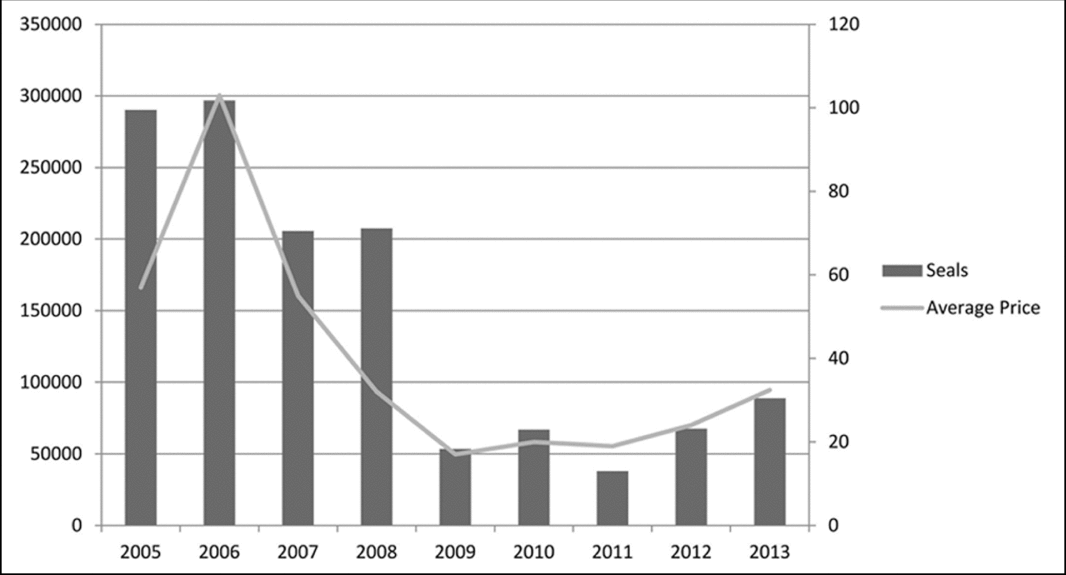
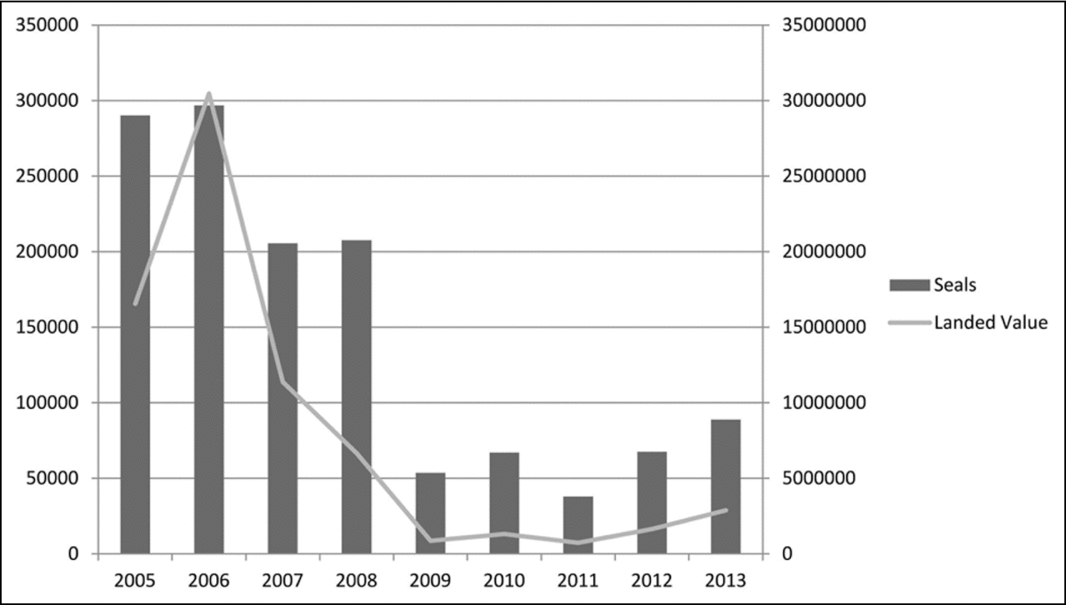
As discussed earlier, an unformulated meta-goal of the political process that has led to the conclusion of regulation 1007/2009 was neither the improvement of animal welfare, nor ending the killing of seals as such, but appears to be ending the killing of seals for commercial purposes. Both the dwindling European market and the increasing reputational loss of commercial sealing have devalued seal products and led to a reduced number of seals killed since the launch of the legislative process within the EU. In Newfoundland, both the number of seals and the associated landed value are strongly impacted by the reputational as well as the market loss for seal products. While in 2006 almost 300,000 seals were landed, generating around 30 million Canadian dollars with an average of about 102 dollars per seal, a massive drop occurred in 2007 when the legislative process for a ban was in full progress. The following year around the same number of seals of around 200.000 was caught while the average price dropped to 32 dollars, amounting to a landed value of 6.6 million dollars.
In the adoption year of the ban, 2009, the number of seals dropped to 53,531, generating merely 857,000 dollars with an average of 17 dollars per seal. Since then, the average price has slightly increased and amounted to 19 dollars in 2011, with a number of seals ranging at around 38,000 with a landed value of 735,000 dollars. In 2012, almost 70,000 seals at an average of 24 dollars were landed, producing 1.6 million dollars (Newfoundland and Labrador Department for Fisheries and Aquaculture 2005–2012). For 2013, nearly 90,000 seals were landed, generating around 2.9 million dollars with an average value of ca. 33 dollars (Canada 2013a, 2013b).
As visible in Fig. 1 and Fig. 2, during the crafting process of the EU regulation, the average price for one seal fell drastically, decreasing the landed value by more than 50% within one year in spite of a landing of seals that had decreased by around one third. Yet, although the markets and reputation dwindled and the number of seals that were killed was reduced, the commercial sealing industry did not cease to exist. This may also be due to loans of 3.6 million Canadian dollars from the Newfoundland government to Carino processing Ltd. in 2012 and 2013 to be able to buy and process raw materials from seals (Newfoundland and Labrador Department for Fisheries and Aquaculture 2012; Newfoundland and Labrador Department for Fisheries and Aquaculture 2013). Given the most recent data on the average price and number of seals killed, although not comparable to the conditions before the launch of the legislative process in the EU, since 2009 the average price and the landed value seem to have experienced a recovery. Whether this trend continues remains to be seen. Notwithstanding, it seems that the EU's regulation has weakened the commercial sealing industry, but has not managed to shut it down. In fact, growing demand in Asia, where the largest part of seal skins are sold to via international fur traders, may indicate that the industry as such will continue to exist. Also a growing demand on the Canadian market for seal flippers, seal oil and seal skin products show that the normative change in the perception of seal products has not occurred.
The number of seals vis–à–vis the average price for a seal, Newfoundland.

The number of seals vis–à–vis the landed value.
As shown earlier an important secondary goal that is reflected in the EU's Arctic documents to at the earliest stage in the 2008 commission communication (EC 2008b), is dialogue with Arctic populations. Indeed, stakeholder consultations were held during the drafting process of the regulations. Nevertheless, in the court cases before the EUGC, the usefulness of these consultative meetings is questioned by the applicants. Yet, the court highlights that it was one of these meetings that introduced the indigenous exemption into the ban in the first place (EUGC 2013a: paragraph 114). An attempt to establish a fruitful dialogue with Arctic indigenous peoples was made with a workshop on 9 March 2010 in which indigenous organisations, the EU Commission, and national foreign ministries were represented. Although no clearly defined platform for future dialogue exists, the workshop yielded several topics for future discussion, amongst others discussions over animal products (EC 2010b). As to how far this was discussed in the second workshop, which was held on 25 January 2011 in Tromsø, Norway, cannot be reproduced here as the information is not publicly available (EC 2011). There is also no information on any follow-up workshops available. Indeed, given the recent deferral of EU observership in the AC and the preceding campaign by Inuit organisations to lobby the Canadian government to deny the EU observer status, a continuous constructive dialogue that will assist in the overcoming of differences is obviously necessary.
It seems fair to say that the seal products trade regime is not a policy that supports indigenous and local populations in the Arctic, safeguards their interests or takes their views adequately into account. It therefore contradicts fundamental elements of the goals as formulated in the EU's Arctic-related documents that make reference to the Arctic's inhabitants. This claim is based on the fact that it remains unclear how a regulation that the Inuit are attempting to annul in court could support them or safeguard their interest. While their needs may seem to have been considered in stakeholder consultations, the Inuit's claim of negative cultural impacts of the regulation as well as the associated reputation loss of the EU in Inuit areas creates an adversarial environment between the EU and the Inuit. Ultimately, this leads to difficulties in accepting the EU in the AC and in considering the EU an Arctic actor.
The EU Arctic documents emphasise the importance of supporting Arctic indigenous peoples, and they also highlight the idea that local people's views are to be supported and taken into consideration. Problematic in the context of commercial sealing is the fact that virtually no knowledge exists within the EU of the commercial sealing industry, the people involved, and the communities impacted by this industry. Instead, in the political discussions, such as the EU Parliamentary discussion prior to the adoption of the basic regulation (EP 2009b), the commercial seal hunt is, in line with anti-sealing lobby groups, commonly portrayed as ‘barbaric’, ‘needless’ and ‘inherently inhumane.’
Therefore, neither the ban itself nor the political will in the EU are flexible enough to consider the commercial seal hunt and the commercial sealing industry as legitimate, and thus ultimately denying the sealer the right to his livelihood. This is a significant difference from the 1983 ‘Seal Pups Directive’. Instead, a labelling of the commercial hunt, the sealers and the industry has occurred which does not allow for a meaningful and sustainable dialogue between the EU and the commercial sealing industry. Moreover, since knowledge on the commercial sealing industry and the people involved is mostly missing, neither the socio-economic impacts nor the long-term discursive impacts of the seal products trade ban on Newfoundland society, especially with regard to the dwindling fishing industry, can be understood.
Conclusion
The goals that the EU seal products trade regime sets forth are not clear-cut. Animal welfare considerations were the incentive to start the policy-making process that led to the imposition of the ban, but these considerations are absent in the final regime. Therefore, the ban's causal effects in terms of any improvements in the welfare conditions of the commercial seal hunt are doubtful. However, the EFSA 2007 report, which was part of the process of the ban, had an influence on the Canadian seal hunting legislation and may have contributed to the improvement of animal welfare standards in the hunt.
In order not to adversely impact the Inuit population, the EU inserted a clause that was to exempt Inuit and other indigenous communities from the ban on placing seal products on the European market. The Inuit claim, however, that this exemption does not fulfil its purpose and that the overall reputational loss of the hunt has contributed to a decline in the trade in seal products. This, in turn, has negatively affected their culture. This claim, which is difficult to prove due to its cumulative nature, has inter alia led to several court cases trying to annul the regulations. These attempts have so far been unsuccessful. While Inuit leaders perceive the EUGC's judgements as paternalistic, it can be argued that at the same time the entire process and the Inuit exemption also has unfolded to be discriminatory towards non-indigenous sealers. The criteria that exempt a local community from the ban apply also to non-indigenous communities and therefore make ‘indigeneity’ as such the main element allowing for an exemption. In Namibia, however, due to a lack of knowledge both on the hunt and on the people conducting it, the applicability and effectiveness of the indigenous exemption cannot be proved. In general, the Inuit and indigenous exemption of the ban neither reflects knowledge of seal hunting communities in general, nor the impacts and processes that influence Arctic inhabitants. Although COWI (2008) showed that Inuit and others may be adversely affected by a ban this was not fully investigated. This ultimately has led to a negative reputation of the EU in the Arctic which may create problems for the EU's future Arctic aspirations.
The regulation's impact on the functioning of the internal market in the EU does not yield a clear-cut result, and depends on the vantage point and scope of perception. On the one hand it can be argued that the likelihood of further fragmentation of the market would have ultimately led to scattered provisions and an unfavourable environment for the trade in seal products, and therefore community intervention through the imposition of the community-wide ban was necessary. Since the regulation merely bans the placing on the market of commercial seal products while transit through the community and the placing on the market of non-commercially hunted products is still possible, trade as such is not impacted.
On the other hand it can be argued that the prevention of any trade in seal products in the EU promotes the exact opposite of a smooth functioning of the internal market, as the free movement of goods is no longer provided for.
With the shut-down of the EU internal market for commercially obtained seal products, the EU followed an unformulated underlying goal, which the regulation and the policy-making process implied, the cessation of the commercial seal hunt. Both the discursive and market environments for Canadian commercial seal products have strongly been impacted by the ban, yet, it has not succeeded in shutting down the trade completely. Instead, there are indications that the Canadian sealing industry is experiencing a recovery regarding the number of seals hunted and the average value of seal skins with a gradual growth of Asian and domestic markets. The Namibian trade, meanwhile, seems to have been unimpeded by the European ban.
In conclusion, neither the primary nor the secondary goals of the EU seal products trade ban and its drafting process are attained in a satisfactory manner due to unclear goal formulation and insufficient knowledge of its causal effects. Instead, it has yielded an unfavourable environment both for the EU in the Arctic and for the individuals and communities involved in the (sub-) Arctic seal hunt. This is irrespective of their ethnicity and the nature of the hunt they conduct. Moreover, the ban contradicts fundamental goals that are formulated in the EU's Arctic documents. The significance of this cannot be ascertained at the time of writing, but as far as the EU's observer status in the AC shows, this EU-internal legislation significantly impacts external processes related to the legitimacy of the EU in the Arctic.
Namibian exports of Cape fur seal skins. Reproduced from CITES nd.

Acknowledgements
The author is indebted to Victoria Sweet (Michigan State University, USA), Cécile Pelaudeix (Sciences Po Lyon, France) and Timo Koivurova (University of Lapland, Finland) for their comments on an earlier draft of this article. Gratitude also goes to the two anonymous referees for their invaluable comments.