Irregularities of fetal cardiac rhythm are detected in only 1 or 2 of each 100 pregnancies.Reference Southall, Richards, Hardwick, Shinebourne, Gibbens and Thelwall-Jones1 In most cases, these are atrial extrasystoles, which have little clinical relevance.Reference Southall, Richards, Hardwick, Shinebourne, Gibbens and Thelwall-Jones1–Reference Hornberger and Sahn4 Some types of abnormal cardiac rhythm, however, are of clinical significance because they can cause fetal compromise, which may lead to intrauterine death. Both sustained fetal tachycardias and atrioventricular heart block are associated with fetal and postnatal morbidity and mortality.Reference Krapp, Kohl, Simpson, Sharland, Katalinic and Gembruh5–Reference Lopes, Tavares, Damiano, Lopes, Aiello and Schultz8
Fetal tachycardia is most commonly defined as a ventricular rate exceeding 180 beats per minute.Reference Hornberger and Sahn4, Reference Jaeggi and Nii9, Reference Simpson10 Without a conventional electrocardiogram, the evaluation of tachycardia in a fetus is based on echocardiography. This involves assessment of chronological relationship between atrial and ventricular contractions, with assumptions then made regarding their electrophysiological relationship.Reference Allan, Anderson, Sullivan, Campbell, Holt and Tynan11, Reference Kleinman, Donnerstein, Jaffe, De Vore, Weinstein and Lynch12 In addition, echocardiography enables evaluation of haemodynamic consequences of tachycardia, and detection of associated structural cardiac abnormalities. Correct assessment of the nature of the tachycardia, and its haemodynamic consequences, are crucial for appropriate management.Reference Allan, Chita, Sharland, Maxwell and Priestly13–Reference Strasburger, Cuneo, Michon, Gotteiner, Deal and Oudijk18 There is currently no agreement, however, regarding the optimal protocol for such management. In addition, published data concerns mostly the prenatal course, with only a few series reporting follow-up beyond the neonatal period.Reference Boldt, Eronen and Andersson2, Reference Van Engelen, Weitens, Brenner, Kleinman, Copel and Stoutenbeek19, Reference D’Alto, Russo, Paladini, Di Salvo, Romeo and Ricci20 Our objectives, therefore, were to evaluate the diagnosis, clinical features, management, and outcome in consecutive fetuses diagnosed tachycardia. In addition, we evaluated their long-term postnatal follow-up.
Material and methods
We studied all consecutive fetuses presenting with tachycardia in a single tertiary institution during an 8-year period between January, 2001, and December, 2008. Fetal tachycardia was defined as a heart rate exceeding 180 beats per minute persisting throughout the ultrasonic examination, or being interspersed with periods of regular sinus rhythm. In all cases, tachycardias were detected during routine prenatal visits, and the patients were subsequently referred for further evaluation. Fetal tachycardias were classified as supraventricular if there was 1 to 1 atrioventricular conduction, atrial flutter if the atrial rate was in excess of the ventricular rate with the occurrence of fixed or variable atrioventricular block, atrial tachycardia if the atrial rate was in excess of the ventricular rate, but with the atrial rate being irregular and not conducted to the ventricles in a beat-to-beat pattern, and ventricular tachycardia if the ventricular rate was in excess of the atrial rate. Tachycardia was considered sustained if persisting for more than half of the scanning time, and intermittent if the periods of regular sinus rhythm were longer than periods of tachycardia. Fetal hydrops was defined as a collection of the fluid in at least two body cavities. The study was retrospective, relying on audit of data already collected for clinical reasons, so ethical approval was not sought.
Fetal echocardiograms were performed with the Aloka Prosound SSD-5500 (Aloka Co. Ltd., Tokyo, Japan) and Hewlett Packard 1000 (Philips INC, Andover, Massachusetts, USA) ultrasound systems. Long- and short-axis images of the intracardiac anatomy and the great vessels were obtained to evaluate cardiac structure and function. The fetal heart rhythm was assessed by M-mode echocardiography.Reference Allan, Anderson, Sullivan, Campbell, Holt and Tynan11, Reference Kleinman, Donnerstein, Jaffe, De Vore, Weinstein and Lynch12 The M-mode cursor line was aligned through the fetal heart in a direction to enable atrial and ventricular wall contractions to be recorded simultaneously. The atrial rate, the ventricular rate, and the chronological relationship between atrial and ventricular contractions were determined from such a recording. All scans were recorded on Video Home System videotapes.
Prenatal management
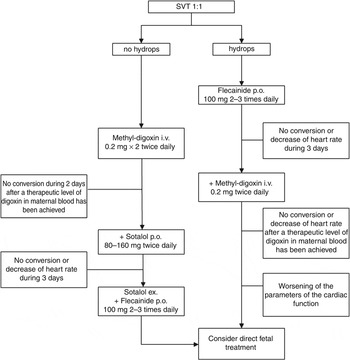
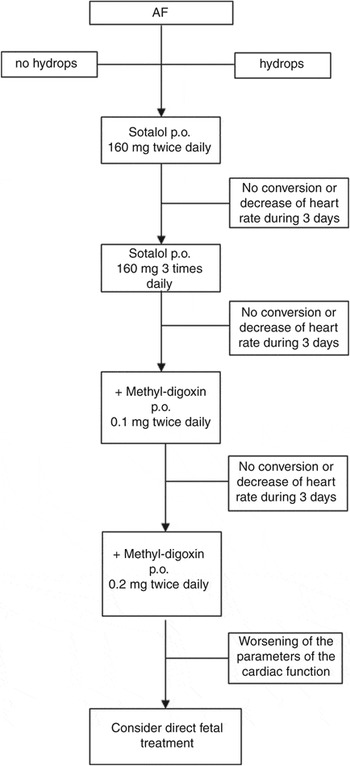
When tachycardia was diagnosed in the fetus we considered 3 options for management, first no treatment but close surveillance, second antiarrhythmic drug therapy, and third, delivery and treatment as a newborn. In any particular fetus, the decision was based on gestational age, the type of tachycardia, and the haemodynamic consequences of the tachycardia. Abstention of treatment with close surveillance was opted if tachycardia was intermittent and cardiac function completely preserved. In cases of sustained tachycardia, the options considered were transplacental administration of antiarrhythmic(s) or induction of labour and treatment of the newborn. Decision between two options based mainly on the gestational age of the fetus. When tachycardia presented before 36 weeks of gestation, a transplacental antiarrhythmic therapy was administrated. In contrast, after that time, the preferred option was delivery and treatment of the newborn. Protocols for fetal management of supraventricular tachycardias and atrial flutter are depicted in Figures 1 and 2.Reference Allan, Chita, Sharland, Maxwell and Priestly13–Reference Oudjik, Michon, Kleinman, Kapusta, Stoutenbeek and Visser15, Reference Oudijk, Ruskamp, Ambachtsheer, Ververs, Visser and Meijboom21
The protocol for treatment of fetuses with supraventricular tachycardia and 1 to 1 atrioventricular conduction.

The protocol of treatment for atrial flutter.

Follow-up data was gathered by review of pre- and postnatal documentation. Descriptive analysis was used, incorporating median values with ranges and percentages. For comparing survival and neurological outcome between hydropic and non-hydropic fetuses, Fischer’s exact test was performed. The level for significance was set at a value of p equal to 0.05.
Results
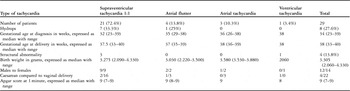
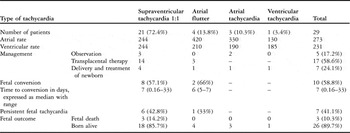
During the period, we diagnosed 29 cases of fetal tachycardia among a total of 1,840 women referred for fetal echocardiography. In all cases, tachycardias were detected during a routine prenatal visit, and the mothers subsequently referred for further evaluation. A concomitant congenital cardiac defect was identified in 4 fetuses (13.8%), including small muscular ventricular septal defects in 2, a non-restrictive perimembranous ventricular septal defect in 1, and Ebstein’s malformation in the other. In Table 1, we summarise the clinical characteristics of the cohort, while in Table 2 we summarise the characteristics of the tachycardias, their management, and the outcomes.
Clinical characteristics of the population.

Characteristics of the tachycardia, its management, and fetal outcome.

Among 14 non-hydropic fetuses with supraventricular tachycardia, we chose not to treat 6, 3 because the episodes of tachycardia were intermittent, and the remaining 3 because the diagnosis was not made until after 36 weeks gestation. Of 8 fetuses treated transplacentally, 5 converted during fetal life, 2 on digoxin alone, 2 on a combination of digoxin and sotalol, and 1 on a combination of digoxin and flecainide. The remaining 3 fetuses treated transplacentally were born spontaneously while still in tachycardia, and all 3 were successfully converted after birth.
Of 7 hydropic fetuses with supraventricular tachycardia, 6 were treated transplacentally with flecainide, and 1 was delivered and treated postnatally. Conversion to sinus rhythm occurred in 3 patients, within 24 hours in 2, and after 7 days of treatment in the other. Another 3 fetuses died, 2 within 24 hours of starting treatment, and the other after 6 days.
Of 4 fetuses with atrial flutter, 3 received sotalol, while the other was delivered and treated after birth. Conversion to a regular sinus rhythm occurred in 2 of the 3 treated transplacentally. The remaining fetus was delivered spontaneously while still in atrial flutter.
In all 3 fetuses with atrial tachycardia, the abnormal rhythm was intermittent, with the ventricular rate varying between 140 to 190 beats per minute. Cardiac function was preserved in all. Of these, 2 fetuses were closely followed, with spontaneous resolution noted in 1 at a follow-up visit 2 weeks later. The gestational age of the remaining fetus was more than 36 weeks and the fetus was delivered and treated postnatally.
Ventricular tachycardia was diagnosed in 1 only fetus, who had an associated large perimembranous ventricular septal defect, extending both to inlet and outlet portions of the septum. Due to gestational age exceeding 36 weeks, the fetus was delivered with an intention of post-natal management. After birth, the patient was found to have trisomy 18.
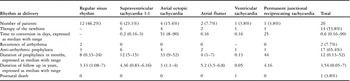
At delivery, 12 of the newborns (46.2%) were in regular sinus rhythm, with the tachycardia persisting in the remaining patients. After birth, all 14 were converted successfully to a regular sinus rhythm. In Table 3, we have summarised their postnatal management and follow-up.
Postnatal management and follow-up.

Adenosine was used as a first line drug in 11 newborns, 6 with supraventricular tachycardia, 4 with atrial ectopic tachycardia, and 1 with permanent junctional reciprocating tachycardia. The drug proved successful in terminating the tachycardia in all patients with supraventricular tachycardia, and in a single patient with permanent junctional reciprocating tachycardia, but failed to sustain a regular sinus rhythm in all of them for more than a few seconds. Adenosine failed to convert any of 4 patients with atrial ectopic tachycardia. Following adenosine, amiodarone was introduced in 9 patients and propafenone in 2 patients. In an additional 2 patients, one with atrial flutter and one with ventricular tachycardia respectively, amiodarone was introduced as a first line drug. Of 13 patients receiving amiodarone or propafenone, 8 converted on amiodarone or propafenone alone, and the remaining 5 after propranolol was added to amiodarone. In 1 patient with atrial flutter, conversion occurred during insertion of a catheter into the umbilical vein. The median time to conversion was much longer in patients with atrial ectopic tachycardia and permanent junctional reciprocating tachycardia than in those with supraventricular tachycardia, atrial flutter, or ventricular tachycardia.
Long-term antiarrhythmic prophylaxis was administered in 17 patients, 14 of those born in tachycardia, 2 patients in whom tachycardia recurred after birth, and 1 patient with Wolff-Parkinson-White syndrome. Amiodarone was prescribed for 7 patients in isolation, together with propranolol in 6, while 2 received propafenone and 2 methyl – digoxin. The median period of treatment was 12 months, with a range from 0.13 to 52 months, and the median period of follow-up was 3.5 years, with a range from 0.05 to 7 years. The baby born with ventricular tachycardia having trisomy 18 died at the age of 3 weeks.
Altogether, 25 of the cohort have survived over the long-term (86.2%). Excluding the patient with trisomy 18, only patients with fetal hydrops suffered mortality, with 37.5% of this group dying. The difference from the group of non-hydropic fetuses was significant, the value for p equal to 0.03. Among the 5 long-term survivors of those presenting with fetal hydrops, 1 patient has a severe neurological and cognitive handicap. There was no evidence of neurological impairment in any of the long-term survivors from the group presenting with preserved cardiac function.
Discussion
Sustained fetal tachycardia may cause intrauterine congestive heart failure leading to non-immune hydrops, polyhydramnios, and placental oedema, and can produce fetal death.Reference Gembruch, Redel, Bald and Hansmann22 Appropriate management, nonetheless, can decrease fetal mortality to below 10%.Reference Krapp, Kohl, Simpson, Sharland, Katalinic and Gembruh5 Fetuses can be treated successfully by maternal administration of antiarrhythmic medications. In contrast, fetuses diagnosed at an advanced gestational age can be delivered and treated postnatally. No intervention can be considered for fetuses with intermittent tachycardia and no signs of haemodynamic impairment, but close surveillance is necessary either to commence treatment or to deliver the fetus at appropriate time.Reference Api and Carvalho23 We favour delivery and postnatal treatment in fetuses presenting with tachycardia after 36 weeks of gestational age. In our series, therefore, we opted for transplacental medication in almost three-fifths of our cases, choosing to delivery a further quarter and treatment them as newborns. In only one-sixth did we opt for no intervention but close surveillance. The proportion of fetuses treated transplacentally in previous experiences varies from two-thirds to over nine-tenths, probably reflecting different approaches towards induction of labour in near term fetuses with tachycardia and their postnatal treatment among different institutions.Reference Boldt, Eronen and Andersson2, Reference Simpson and Sharland14, Reference Van Engelen, Weitens, Brenner, Kleinman, Copel and Stoutenbeek19, Reference D’Alto, Russo, Paladini, Di Salvo, Romeo and Ricci20 We believe that delivery after 36 weeks of gestation allows better evaluation and treatment of tachycardia, and eliminates maternal exposure to potentially harmful antiarrhythmic medications. All our fetuses presenting after 36 weeks of gestation, apart from 2, were delivered vaginally. In 1 case, we opted for caesarean section because of ventricular tachycardia, while the reason was obstetrical in the other.
When considering transplacental medication, it is important to identify precisely the mechanism of the underlying tachycardia, since the treatment can vary markedly. Despite the recent development of alternatives, echocardiography remains the dominant diagnostic tool for assessment of fetal tachycardia.Reference Taylor, Smith, Thomas, Green, Cheng and Oseku-Afful24, Reference Wakai, Strasburger, Li, Deal and Gotteiner25 M-mode imaging is a conventional echocardiographic modality that allows differentiation between supraventricular tachycardia with 1 to 1 conduction, atrial flutter, and ventricular tachycardia. Based on this technique alone, we correctly identified the type of tachycardia in 13 out of 16 patients in which postnatal electrocardiograms of tachycardia were available. We correctly identified 1 to 1 atrioventricular relationships also in the remaining 3 patients, but failed to establish the long ventriculoatrial conduction that would enable us further to differentiate the tachycardia as atrial ectopic tachycardia in 2 patients, and permanent junctional reciprocating tachycardia in 1, as proved after birth. Such fetal differentiation between tachycardias having short or long ventriculoatrial interval tachycardias is possible by simultaneous pulsed wave Doppler recordings of flow velocities in the superior caval vein and ascending aorta or pulmonary trunk and vein.Reference Fouron, Proulx, Miro and Gosselin26, Reference Carvalho, Prefumo, Ciardelli, Sairam, Bhide and Shinebourne27 An alternative method to measure the ventriculoatrial interval is by tissue velocity imaging, in which both the atrial and ventricular walls are simultaneously sampled, providing precise temporal data of atrial and ventricular events.Reference Rein, O’Donnell, Geva, Nir, Perles and Hashimoto28 A different protocol for treatment with sotalol rather than digoxin as a first line drug has been suggested to be superior in fetuses with long ventriculoatrial intervals.Reference Fouron, Fournier, Proulx, Lamarche, Bigras and Boutin17 We have started to make such measurement as part of our evaluation of fetuses with tachycardia over the last 2 years of the period of study. We found this measurement technically feasible, but more experience is needed to evaluate its impact on clinical decision-making.
Many different drugs have been used in the treatment of fetal tachycardia, including digoxin, flecainide, sotalol, propafenone, verapamil and amiodarone, all of them with potentially serious side effects.Reference Boldt, Eronen and Andersson2, Reference Kleinman and Nehgme3, Reference Krapp, Kohl, Simpson, Sharland, Katalinic and Gembruh5, Reference Jaeggi and Nii9, Reference Simpson10, Reference Allan, Chita, Sharland, Maxwell and Priestly13–Reference Krapp, Baschat, Gembruch, Geipel and Germer16, Reference Strasburger, Cuneo, Michon, Gotteiner, Deal and Oudijk18 The choice of medication depends on the type of tachycardia, the availability of the drug, and experience with its use. Before commencing transplacental therapy, a maternal electrocardiogram should be performed, and levels of electrolytes in the serum checked. In our series, digoxin, sotalol, and flecainide were used either in isolation or as a combination, according to a presumed mechanism of tachycardia and the selected protocol. Altogether, three-fifths of the fetuses we treated transplacentally converted to a normal sinus rhythm whilst still within the womb. The first drug alone was effective in 6 fetuses, and a combination of 2 drugs in 4 fetuses. In none of the fetuses, or their mothers, did we encounter morbidities related to the drug. Others have achieved conversion of fetal tachycardias in from three-quarters to nine-tenths of cases.Reference Boldt, Eronen and Andersson2, Reference Simpson and Sharland14, Reference Van Engelen, Weitens, Brenner, Kleinman, Copel and Stoutenbeek19, Reference D’Alto, Russo, Paladini, Di Salvo, Romeo and Ricci20 The differences with our series relate to the fact that one-quarter of our cohort was delivered while still receiving treatment, but prior to conversion. Of those 4 deliveries, 3 deliveries were spontaneous, and 1 induced because of premature closure of the oval foramen.
The outcome for our fetuses has been favourable. Of the cohort, nine-tenths were born alive, and all of these were successfully converted either whilst within the womb, or in the neonatal period. While there were no deaths among fetuses presenting with preserved cardiac function, 3 of our 8 hydropic fetuses died. This represented all our mortality, and all 3 hydropic fetuses had markedly reduced cardiac function at presentation, with significant regurgitation across both atrioventricular valves. Of these fetuses, 2 died within 24 hours, and the other after 6 days, despite showing a marked decrease in heart rate in the meantime. We believe that this decrease of heart rate represented an antiarrhythmic effect of flecainide, and that a continuation of the selected therapy, rather than its modification, was justified in this particular fetus. A significant difference in survival between non-hydropic and hydropic fetuses with tachycardia has also been reported by others.Reference Boldt, Eronen and Andersson2, Reference Simpson and Sharland14, Reference Van Engelen, Weitens, Brenner, Kleinman, Copel and Stoutenbeek19, Reference Hansmann, Gembruch, Bald, Manz and Redel29, Reference Frohn-Mulder, Stewart, Witsenburg, Den Hollander, Wladimiroff and Hess30
The natural history of paroxysmal supraventricular tachycardia and atrial flutter diagnosed in infancy is favourable, with spontaneous resolution during the first few years of life in the majority of cases.Reference Benson, Dunnigan and Benditt31–Reference Casey, McCrindle, Hamilton and Gow33 Such resolution has also been reported in fetuses presenting with tachycardia.Reference Van Engelen, Weitens, Brenner, Kleinman, Copel and Stoutenbeek19, Reference D’Alto, Russo, Paladini, Di Salvo, Romeo and Ricci20 While antiarrhythmic prophylaxis is relatively straightforward in patients born with tachycardia, or in neonates in whom paroxysm recurs, there is no consensus regarding the need for prophylaxis in neonates who do not have persistent or recurrent tachycardia. Of particular interest is a report of 20 neonates presenting with fetal tachycardia subsequent to successfully in-utero conversion.Reference D’Alto, Russo, Paladini, Di Salvo, Romeo and Ricci20 During the neonatal period, a tachycardia was inducible in four-fifths, but had resolved spontaneously by the end of the first year of life in two-thirds.Reference D’Alto, Russo, Paladini, Di Salvo, Romeo and Ricci20 This might indicate that maturation of the cardiac electrophysiological characteristics results in a resolution of the tachycardic substrate in some fetuses, and that the long-term prognosis of fetal tachycardia is even more favourable than in tachycardia presenting after birth. We administer an antiarrhythmic prophylaxis both to patients born with tachycardia, or to those in whom tachycardia recurs after birth. During follow-up, we do not increase the dose of selected antiarrhythmic drug parallel to growth unless the tachycardia recurs. In this way, patients gradually discontinue their antiarrhythmic drugs. At the completion of our current study, only 3 patients older than 1 year, representing one-tenth of our cohort, were receiving antiarrhythmic prophylaxis, 2 with atrial ectopic tachycardia and 1 with permanent junctional reciprocating tachycardia. Excluding our patient with trisomy 18, there was no late mortality in the group of liveborn patients.
Several studies have reported an increased risk for neurological damage in cases of fetal tachycardia complicated by hydrops.Reference Sonesson, Winberg, Lidegran and Westgren34–Reference Oudijk, Gooskens, Stoutenbeek, de Vries and Meijboom36 This is probably a result of haemodynamic compromise, which predisposes a fetus with a severe disturbance of rhythm to cerebral ischaemia during periods of moderate hypotension, and to intracranial haemorrhage during periods of moderate hypertension.Reference Schade, Stoutenbeek, de Vries and Meijboom35 The long-term neurological outcome in a group of children who were treated for fetal tachycardia complicated by hydrops, nonetheless, has been reported to be reasonably good, with no neurological abnormalities and cognitive dysfunction in three-quarters of cases.Reference Oudijk, Gooskens, Stoutenbeek, de Vries and Meijboom36 We observed such good neurological outcome in 4 of our 5 surviving hydropic cases. The other patient, however, suffered severe neurological damage, with generalised hypertonia, paraplegia, and delay in cognitive developmental. Antiarrhythmic therapy, therefore, should not be withheld or delayed in a hydropic fetus due to the possibility of poor neurological outcome.Reference Oudijk, Gooskens, Stoutenbeek, de Vries and Meijboom36
Fetal tachycardia, therefore, is a potentially life-threatening disorder that requires urgent evaluation. A correct assessment of the type of tachycardia and its haemodynamic consequences is crucial for appropriate management. Fetuses presenting before 36 weeks of gestation can successfully be treated by transplacental administration of antiarrhythmic medications. In contrast, mature fetuses can be delivered and treated after birth. Using this approach, we achieved excellent outcome in our non-hydropic fetuses, while the outcome was less favourable in fetuses presenting with impaired cardiac function and non-immune hydrops. Our experience shows that the long-term prognosis for children treated as fetuses for tachycardia is excellent, with spontaneous resolution of the tachycardia occurring during the first year of life in the majority of patients.
Acknowledgements
T.P. and S.V. were supported in part by the Slovenian Agency for Research grant P3-0343.