Introduction
Understanding the direct effects of temperature fluctuations and host availability is essential to comprehending the dynamics of invasive species. The life cycles of invasive insect pests are greatly impacted by global climate change, which also seriously upsets the equilibrium of ecosystems. These alterations may hasten the global spread of exotic crop pests, resulting in outbreaks that worsen losses to agriculture (Skendžić et al., Reference Skendžić, Zovko, Živković, Lešić and Lemić2021). Invasive species flourish in changed environments, frequently unopposed by native predators in new habitats, because of their extraordinary capacity for reproduction and adaptability (Ma and Ma, Reference Ma and Ma2022). Although a large variety of plant families are consumed by herbivores, these animals' fitness and performance differ greatly depending on the host plant (Scriber, Reference Scriber2002). Researchers can learn a great deal about the quality of resources and the adaptive mechanisms these versatile insects use to deal with different plant species by observing their eating habits on various hosts (Huang and Chi, Reference Huang and Chi2012; Chen et al., Reference Chen, Chi, Wang, Wang, Xu, Li, Yin and Zheng2018).
Conogethes punctiferalis, Yellow Peach Moth (YPM), is a major polyphagous pest in Southeast Asia, Australia, the United Kingdom, and Europe (Stanley et al., Reference Stanley, Chandrasekaran and Preetha2009; Haldhar and Maheshwari, Reference Haldhar and Maheshwari2021). Its impact is evident from its rapid spread across different regions. It is a major pest that attacks crops like maize and fruits such as Carica papaya, Dimocarpus longan, Averrhoa carambola, Durio zibethinus, and Helianthus annuus in various countries (Wang et al., Reference Wang, He, Shi and Ma2006; Kumar et al., Reference Kumar, Sagar, Chandel, Shashank and Chakravarthy2021; Rojas-Sandoval, Reference Rojas-Sandoval2022; Ramzan et al., Reference Ramzan, Pang, Shi, Naeem-Ullah, Saeed, Zhang, Panhwar and Zhang2024). In China, it severely infests maize, causing ear rot and large production losses (Yang et al., Reference Yang, Shi, Zhang, Guo, Li and Wang2015; Dong et al., Reference Dong, Li, Song, Li and Men2023; Gao et al., Reference Gao, Ji, Li, Wang, Zhao, Xu and Liu2024).
Due to altered agricultural methods, changing climate patterns, and inadequate pest management strategies, C. punctiferalis has become much more prevalent in China, especially in the Huang-Huai-Hai area, in recent years (Chen et al., Reference Chen, He, Wang and Wang2019, Reference Chen, Han, Yang, Qin, Guo and Du2023a; Jeong et al., Reference Jeong, Kim, Kim, Choi and Kim2021; Jing et al., Reference Jing, Zhang, Bai, He, Prabu and Wang2021; Shwe et al., Reference Shwe, Prabu, Chen, Li, Jing, Bai and Wang2021; Gao et al., Reference Gao, Peng, Jin, Zhang, Han, Wu and Xiao2023; Li et al., Reference Li, Shi, Huang, Guo, Hellmich, He and Wang2023). It is currently the most common pest in maize cultivation, even surpassing Ostrinia furnacalis (Lepidoptera: Crambidae), another important maize borer, in both abundance and damage (Wang et al., Reference Wang, He, Shi and Ma2006; An et al., Reference An, Yao, Gao and Shi2023). In Pakistan, it has recently been reported in mango orchards (Mehdi et al., Reference Mehdi, Ramzan, Abbas, Shahid, Hayat and Asghar2024). The life cycle and development of C. punctiferalis are critical factors for its impact as an agricultural pest (Du et al., Reference Du, Guo, Sun, Zhang, Zhang, Wang and Qin2012; Kumar and Kalkal, Reference Kumar and Kalkal2022; Ganesha et al., Reference Ganesha, Chakravarthy, Naik, Basavaraj and Naik2013; Doddabasappa et al., Reference Doddabasappa, Chakravarthy and Thyagaraj2014; Shashank et al., Reference Shashank, Doddabasappa, Kammar, Chakravarthy, Honda and Chakravarthy2015; Umbarkar and Patel, Reference Umbarkar and Patel2017).
The biology of C. punctiferalis on different hosts and artificial diets has been previously studied (Luo and Honda, Reference Luo and Honda2015a, Reference Luo and Honda2015b; Du et al., Reference Du, Zhang, Yan, Ma, Yang and Zhang2016). However, the life cycle of C. punctiferalis, which varies with different diets and temperatures, needs further study to understand the relationship between population growth and environmental factors. The purpose of this study is to examine the theory that temperature significantly impacts the fitness indices of C. punctiferalis when the nutritional conditions of individual host plants are constant. We aim to provide more insight into the development patterns and adaptability of C. punctiferalis by assessing these important parameters, which will have important implications for agricultural management and pest control strategies.
Methodology
Insects and hosts
Conogethes punctiferalis larvae were obtained from a stock colony maintained for seven generations on an artificial diet developed by Jing et al. (Reference Jing, Zhang, Bai, He, Prabu and Wang2021) at the State Key Laboratory for Biology of Plant Diseases and Insect Pests, Institute of Plant Protection, Chinese Academy of Agricultural Sciences, Beijing, China. The colony was maintained under controlled conditions of 27 ± 1°C, 60–80% relative humidity (RH), and a 14-light/10-dark photoperiod. Pupation was induced by placing paper inside the lid of a plastic box (31 × 26 × 28 cm), following the method described by Du et al. (Reference Du, Zhang, Yan, Ma, Yang and Zhang2016). Newly emerged moths were fed with a 10% honey solution, and an apple wrapped with gauze was provided inside the adult cage for oviposition. Newly laid eggs were collected and used for our experiments. The rearing methodology of Jing et al. (Reference Jing, Zhang, Bai, He, Prabu and Wang2021) was used to maintain the C. punctiferalis population. Three host substrates, namely maize, apple, and artificial diet, were utilised in this study.
Life table analysis
To evaluate the impact of host plants/diet and temperatures on the life history parameters of C. punctiferalis, C. punctiferalis eggs were collected from each host plant/diet at different temperatures. Individual eggs were then carefully removed with forceps without causing any damage and placed separately in Petri dishes. Each treatment consisted of 70 replicates, with each Petri dish containing a single egg. The Petri dishes were covered with lids lined with moistened filter paper until the larvae hatched. The experiments were carried out at two temperatures, 20 and 26 °C on maize, apple, and artificial diet substrates with an RH of 70 ± 5% and a photoperiod of 14:10 (LD) in a climate chamber were maintained. Eggs hatchability was observed daily at 8:30 am and 8:30 pm until hatching with that did not hatch or appeared shrivelled being considered nonviable. Larvae provided fresh food daily and larval instars were divided into two groups: first to second instars (L1–L2) and third to fifth instars (L3–L5) to minimise disturbance. The survival rate of the larvae was monitored daily until pupation. After emergence, adult moths were paired (4 M: 4 F) and placed in nylon mesh cages (35 × 35 × 35 cm) to determine their longevity and fecundity. An apple wrapped with gauze was placed in the adult cage for egg laying and a 10% honey solution was provided for adult feeding. The fecundity was recorded daily until the death of all individuals. All experiments were carried out at 20 ± 1°C and 26 ± 1°C, 70 ± 5% RH, and a photoperiod of 14:10 (LD) hours. The developmental time and mortality rates of each stage of C. punctiferalis were observed and recorded twice daily, at 8:30 a.m. and 8:30 p.m. The pre-oviposition, oviposition age, fecundity, and longevity of C. punctiferalis were also noted. Preliminary data for all individuals at different temperatures and on different host plants/diets were organised and analysed using an age-stage, two-sex life table approach (Chi and Liu, Reference Chi and Liu1985; Chi, Reference Chi1988). Population parameters such as means, and standard errors of development time, mortality, pre-oviposition period, total oviposition period, fecundity, and longevity of C. punctiferalis were calculated using TWOSEX-MSChart (Chi, Reference Chi2021), with estimates generated from 100,000 bootstrap replicates. The following formulas were used to get the estimates.
Age-stage specific survival rate (Sxj): where x is age and j is the stage

Age-specific survival rate (lx): where x is age.

where m denotes the number of stages.
Age-specific fecundity (mx): the number of eggs per female at age x:

Age-stage-specific life expectancy (exj): the time duration in which an individual of age x and stage y is expected to live:

, where S $^{\prime}$ iy is the probability that an individual of age x and stage y will survive to age i and stage j.
Age-specific maternity (lx × mx): the combination/product of lx and mx.
Age-stage-specific fecundity (fxj): the number of hatched eggs a female adult lay at age x.

Age-stage-specific reproductive value (Vxj): the contribution of individuals of age x and stage y to the future population:

Further, five population parameters were obtained by using such formulas:
Intrinsic rate of increase (r):

Finite rate of increase (λ):

Net reproductive rate (R 0):

Mean generation time (T):

The gross reproductive rate (GRR) was determined as

Results
Mortality rate
The mortality rates of C. punctiferalis reared on different diets at different temperatures are presented in table 1. Significant differences in the mortality of C. punctiferalis adults were observed among treatments, whereas no significant differences were recorded in the mortality of larvae, pre-pupa, and pupae.
Mortality rates (mean ± standard error) of different developmental stages of Conogethes punctiferalis reared on different host plants/diet at various temperatures

The different lowercase letters (a–c) denote significant differences in the developmental period of C. punctiferalis on various hosts at the same temperature. The different capital letters (A–B) indicate significant differences in the developmental period of C. punctiferalis on the same host at various temperatures. A paired bootstrap test was used to assess statistical differences in C. punctiferalis mortality across different stages across tested host plants or both different temperatures. Standard errors were estimated using 100,000 bootstrap resamples.
Developmental time, adult longevity, and reproduction
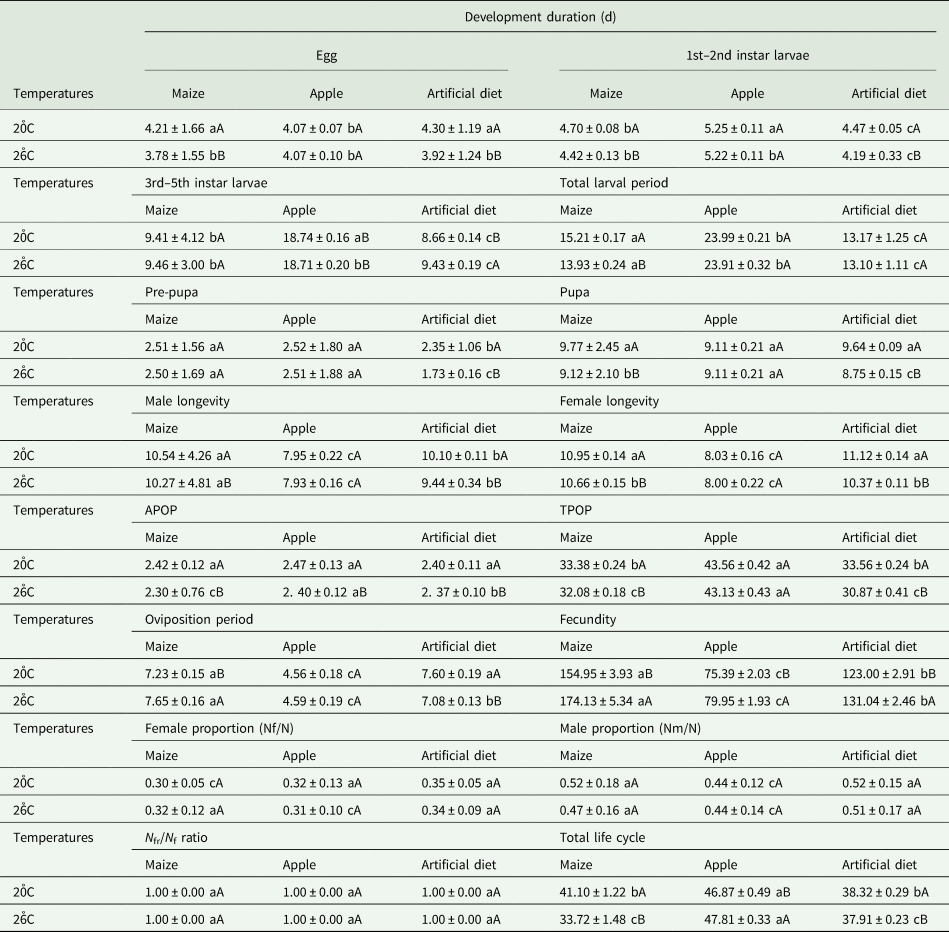
The embryonic period of C. punctiferalis across different treatments ranged from 4.07 to 4.30 days and 3.78 to 4.07 days at 20 and 26°C, respectively. The larval period (1st to 2nd and 3rd to 5th) was significantly longer on apples compared to maize and artificial diet at both temperatures (P < 0.05). The pupal duration of larvae fed apples was non-significantly impacted by temperatures, but significantly impacted when fed maize and artificial diet (P < 0.05). The larval duration of C. punctiferalis reared on an artificial diet was 23.99 and 23.91 days, 13.17 and 13.10 days on apples and 15.21 and 13.93 days on maize at 20 and 26°C, respectively (table 2). The significant differences in male and female longevity were recorded on maize and artificial diets (P < 0.05), while no differences were recorded on apples at both temperatures. However, adult longevity (male and female) was significantly shorter on apples than on maize and artificial diets (P < 0.05). Females longevity was significantly longer on an artificial diet than that on maize (females: 11.12 vs 10.95 days) (t = 1.140; P < 0.05). Overall, the development time was significantly longer at 20°C and shorter at 26°C (P < 0.05). Significant differences in the fecundity and total life cycle of C. punctiferalis reared on different diets or hosts were observed at both temperatures (20 and 26°C) (P < 0.05). The highest fecundity was recorded on maize (154.95 and 174.13 eggs), followed by artificial diet (123 and 131.04 eggs) and apple (75.39 and 79.95 eggs) at 20 and 26°C, respectively. The total life cycle of C. punctiferalis reared on maize, apple, and artificial diet at 20°C was 41.10, 46.87, and 38.32 days, respectively, and 33.72, 47.81, and 37.91 days at 26°C, respectively. The adult male proportion (Nm/N) was higher than females (Nf) at all treatments. Nf was recorded as the highest on an artificial diet at both temperatures. The curves representing the survival rates (Sxj) for the pupal and adult stages of C. punctiferalis fed on an artificial diet were consistently higher than those observed for the other two natural hosts across different temperatures (fig. 1). Temperature exerted a significant effect on the survival rates (vx) as well. Notably, females reared on maize at 26°C exhibited higher vxj values compared to moths fed on an artificial diet and apple (fig. 2). Furthermore, both temperature and diet significantly affected the adult longevity of C. punctiferalis. The shortest longevity of both males and females of C. punctiferalis was recorded at 26°C compared to 20°C when reared on maize. Under the same diet, the shortest lifespan (exj) of C. punctiferalis was recorded at 26°C compared to 20°C (fig. 3). Figure 4 illustrates the lx, mx, and lxmx curves of C. punctiferalis reared on different diets at various temperatures. At 26°C, the highest daily egg production (fx) values were 33.06, 23.21, and 19.01 on maize, artificial diets, and apple, respectively, while at 20°C, these values were 28.38, 21.12, and 15.03 on maize, artificial diets, and apple, respectively (fig. 4). The lxmx reached its maximum values at 26°C on maize and minimum at 20°C on apple (fig. 5).
Duration of the mean (±SE) each developmental stage of Conogethes punctiferalis reared on different foods under various temperatures

The lowercase letters (a–c) represent significant differences in C. punctiferalis's developmental period on various hosts at the same temperature. The capital letters (A–B) represent significant differences in C. punctiferalis's developmental period on the same host at both temperatures. To find statistical differences in C. punctiferalis mortality at different stages on tested host plants or both temperatures, a paired bootstrap test was employed. To estimate standard errors, 100,000 bootstrap resampling was used.
Age-stage specific survival rate (Sxj) of each developmental stage of Conogethes punctiferalis feeding different diets at different temperatures.

Age-stage reproductive value (Vxj) of each developmental stage of Conogethes punctiferalis feeding different diets at different temperatures.

Age-stage specific life expectancy (Exj) of each developmental stage of Conogethes punctiferalis feeding different diets at different temperatures.

Age-stage specific survival rate (lx), female age-specific fecundity (fx), age-specific fecundity (mx), and maternity (lxmx) of C. punctiferalis feeding different diets under different temperatures.

Pupal weight on different hosts/diet under different temperatures. Bars represent means ± SE. Significant differences among different hosts are indicated by different letters on each bar (Tukey-HSD test after ANOVA, P < 0.05).

Life table parameters
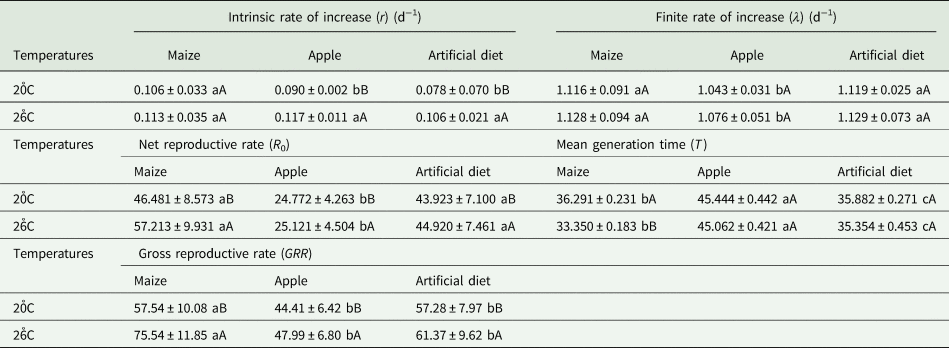
The diets and temperatures significantly influenced the life table parameters of C. punctiferalis (table 3). Among life table parameters of C. punctiferalis, only R 0 and GRR showed a significant increase with rising temperature (P < 0.05) showed a significant increase with rising temperature on each diet except λ. The highest values for r, λ, R 0, and GRR of C. punctiferalis were observed on maize at 26°C, while the highest value for T was observed on apples compared to the other two diets under both temperatures. T was significantly different on maize at both temperatures (P < 0.05).
Life table parameters of Conogethes punctiferalis reared on different foods under different temperatures

The lowercase letters (a–c) represent significant differences in C. punctiferalis's developmental period on various hosts at the same temperature. The capital letters (A–B) represent significant differences in C. punctiferalis's developmental period on the same host at both temperatures. A paired bootstrap test was employed to find statistical differences in C. punctiferalis mortality at different stages on tested host plants or both temperatures. To estimate standard errors, 100,000 bootstrap resampling was used.
Discussion
The temperature and quality of the host plant significantly affect the population dynamics of herbivorous insects. Traditionally, this relationship has been attributed to metabolic rate effects and changes in energy needs. However, recent data suggest a more intricate relationship between temperature, host plant quality, and life-history traits that affect insect fitness. (Sedighi et al., Reference Sedighi, Ranjbar Aghdam, Imani and Shojai2017; Chen et al., Reference Chen, Itza, Kafle and Chang2023b). The fitness parameters of herbivores, including C. punctiferalis, are closely tied to the nutritional value of the host plant. Host plant phenology and pest developmental physiology are intricately linked and influenced by abiotic factors, particularly temperature (Chen et al., Reference Chen, Chen, Yang and Liu2022; Karuppannasamy et al., Reference Karuppannasamy, Venkatasamy, Kennedy, Vellingiri and Natarajan2023). This study investigated how different diets affect the life cycle of C. punctiferalis at various temperatures. C. punctiferalis completed life cycle on castor oil plants, cardamom, and ginger in approximately 28, 31, and 32 days, respectively, under controlled conditions (Stanley et al., Reference Stanley, Chandrasekaran and Preetha2009). The results of this study differ from Stanley et al. (Reference Stanley, Chandrasekaran and Preetha2009) study because the current study did not test ginger, castor oil plants, and cardamom. The results revealed significant differences among treatments, indicating that C. punctiferalis successfully completed its life cycle on all diets (maize, apple, and artificial) at both temperatures. However, the developmental duration of each stage varied, with stages being shorter on maize and longer on apples at both temperatures. The duration of C. punctiferalis development is primarily determined by food availability and suitable habitats. Diets with higher nutrient concentrations can support higher metabolic rates in herbivores, leading to increased growth and reproductive potential. Conversely, low-nutrient diets may result in decreased fitness and lower metabolic rates. The shorter developmental time of pest fed maize indicates the suitability of maize for C. punctiferalis at 26°C. Insects have a longer time to complete their life cycle in perennial crops like apples because they contain compounds that slow down larval growth or because they lack certain nutrients. This is further corroborated by the fact that the larvae on apples spent a significantly longer time overall on apples than on maize or an artificial diet. The higher survival rate of larvae on maize and lower on apples is consistent with previous findings (Li et al., Reference Li, Ai, Du, Sun and Zhang2015). At 26°C, the pupal period was shorter than at 20°C, suggesting that higher temperatures could accelerate the pupae's transition into adult moths. This pattern held for all diets, emphasising how temperature affects pupal development. The substantial variations in male and female lifespans between diets and temperatures show how these two variables interact to influence adult survival. Many lepidopteran species have a common trait where females live longer than males. This trait may be related to the female reproductive roles, which require a longer lifespan for egg-laying. Shorter adult life expectancy at higher temperatures may be caused by higher metabolic rates that accelerate energy breakdown (Klepsatel et al., Reference Klepsatel, Wildridge and Gáliková2019). Life table parameters indicated that 26°C was the most conducive temperature for the growth and development of C. punctiferalis. Maize was identified as the most suitable host for C. punctiferalis, corroborating earlier research (Chen et al., Reference Chen, Chi, Wang, Wang, Xu, Li, Yin and Zheng2018; Xie et al., Reference Xie, Zhi, Ye, Zhou, Li, Liang, Yue, Li, Zeng and Hu2021). The intrinsic rate of increase (r), finite rate of increase (λ), net reproductive rate (R 0), and gross reproductive rate (GRR) were highest on maize at 26°C, while the generation time (T) was shorter on apples than on the other two diets under both temperatures. These findings align with previous studies (Pang et al., Reference Pang, Li, Wang, Chi, Liu, Wang and Zheng2022) and underscore the importance of temperature and diet in shaping the life cycle of C. punctiferalis. The observed variations in developmental durations on different hosts highlight the significance of host plant quality in influencing insect fitness. There is an optimal temperature range beyond which negative effects can occur, as evidenced by the higher fecundity and fertility on maize at 26°C compared to 20°C. In contrast to apple and artificial diets, it was suggested that the volatile chemicals released by maize might provide more alluring cues for oviposition. The current findings are closely consistent with the results reported by Li et al. (Reference Li, Ai, Du, Sun and Zhang2015), who also found that host plant choice significantly influences the development and reproduction of C. punctiferalis. Du et al. (Reference Du, Zhang, Yan, Ma, Yang and Zhang2016) also reported similar findings about the ovipositional behaviour of C. punctiferalis on different cultivars of chestnut. They reported that among tested cultivars, Huaijiu was most suitable for the oviposition of C. punctiferalis. It indicates that plant volatiles can affect the reproductive potential of C. punctiferalis. How temperature and diet affect survival and reproduction is shown by the lx, mx, and lxmx curves. The greatest recorded daily egg production (fx) on maize was at 26°C, indicating that this temperature maximises reproductive potential. When it comes to diet and temperature, the maximum lxmx values on maize at 26°C suggest that this combination provides the best conditions for the overall fitness of C. punctiferalis. The development rates of C. punctiferalis increased with increasing temperatures. In the previous study, it was observed that temperatures (24–27℃) significantly affected the sex ratio of C. punctiferalis population (Pang et al., 2022). The number of generations, survival rate, and developmental time that increase the probability of pest establishment could all be increased by an ideal temperature (Plessis et al., Reference Plessis, Schlemmer and Berg2020). Overall, this study contributes valuable insights into the complex interplay between temperature, host plant quality, and the life cycle of C. punctiferalis. Understanding these dynamics is crucial for developing effective pest management strategies in agricultural systems.
Conclusion
Our study reveals the effects of host plant quality and temperature on the developmental dynamics of C. punctiferalis. Maize is the most favourable nutritional source for C. punctiferalis, exhibiting improved developmental time, survival rates, and fecundity compared to apple and artificial diets across various temperature regimes. Through a comprehensive analysis of life-table indicators, we demonstrate that populations reared on maize display enhanced performance and fitness, with higher intrinsic growth rates and reproductive capacity. Particularly noteworthy is the keen reproductive potential observed in populations thriving at 26°C on maize, indicating increased susceptibility to outbreak conditions. Our findings underline the importance of further investigating the fundamental mechanisms driving the varying fitness and performance of C. punctiferalis across different host plants and temperature conditions. By exploring deeper into insect–plant interactions and adaptation processes, we can enhance our understanding of pest ecology and develop more targeted pest management strategies in agriculture. This comparative examination of temperature and diet effects on the life cycle of C. punctiferalis provides valuable insights for the development of sustainable pest control measures and crop protection strategies.
Supplementary material
The supplementary material for this article can be found at https://doi.org/10.1017/S000748532400083X
Acknowledgements
The authors are thankful to the Institute of Plant Protection, Chinese Academy of Agricultural Sciences, Beijing, China for facilitating this work. The authors extend their appreciation to the Researchers Supporting Project number (RSP2025R189), King Saud University, Riyadh, Saudi Arabia.
Author contributions
Muhammad Ramzan and Yongjun Zhang: conceptualisation; Muhammad Ramzan: methodology and software; Yongjun Zhang: investigation; Muhammad Ramzan, Longfei Shi, and Tianyuan Pang: writing – original draft; Xiangzhi Chen, Ruonan Li, and Yongjun Zhang: writing – review and editing. Khalid S. Almaary: editing and funding. All authors have read and agreed to the published version of the manuscript.
Competing interests
Authors disclose non-financial interests and declare no competing interests and funding.
Data and materials availability
The data supporting the results are available (Supplementary data 1).