




No CrossRef data available.
Article contents
Framing the concept of invasive species “impact” within a management context
Published online by Cambridge University Press: 04 May 2020
Abstract
Governments and conservation organizations worldwide are motivated to manage invasive species due to quantified and perceived negative ecological and economic impacts invasive species impose. Thus, determining which species cause significant negative impacts, as well as clear articulation of those impacts, is critical to meet conservation priorities. This process of determining which species warrant management can be straightforward when there are clear negative impacts, such as dramatic reductions in native diversity. However, the majority of changes to ecosystem pools and fluxes cannot be readily categorized as ecologically negative or positive (e.g., lower soil pH). Additionally, diverse stakeholders may not all agree on impacts as negative. This complexity challenges our ability to simply and uniformly determine which species cause negative impact, and thus which species merit management, especially as we expand invader impacts to encompass a more holistic ecosystem perspective beyond biodiversity and consider stakeholder perspectives and priorities. Thus, we suggest impact be evaluated in a context that is dictated by governing policies or conservation/land management missions with the support of scientists. In other words, within each jurisdiction, populations are identified as causing negative impact based on the hierarchical governing policies and mission of that parcel. Framing negative impact in a management context has the advantages of (1) easily scaling from individual landscapes to geopolitical states; (2) better representing how managers practice, (3) reflecting invasive species as spatially contextual, not universal, and (4) allowing for flexibility with dynamic ecosystems undergoing global change. We hope that framing negative impact in an applied context aids management prioritization and achieving conservation goals.
Information
- Type
- Commentary
- Information
- Copyright
- © Weed Science Society of America, 2020
Footnotes
Associate Editor: Stephen F. Enloe, University of Florida
References
Alexander, JM, Edwards, PJ (2010) Limits to the niche and range margins of alien species. Oikos 119:1377–1386CrossRefGoogle Scholar
Bagavathiannan, MV, Graham, S, Ma, Z, Barney, JN, Coutts, SR, Caicedo, AL, De Clerck-Floate, R, West, NM, Blank, L, Metcalf, AL, Lacoste, M, Moreno, CR, Evans, JA, Burke, I, Beckie, H (2019) Considering weed management as a social dilemma bridges individual and collective interests. Nature Plants 5:343–351CrossRefGoogle ScholarPubMed
Barney, JN (2014) Bioenergy and invasive plants: quantifying and mitigating future risks. Invasive Plant Sci Manag 7:199–20910.1614/IPSM-D-13-00060.1CrossRefGoogle Scholar
Barney, JN (2016) Invasive plant management must be driven by a holistic understanding of invader impacts. Appl Veg Sci 19:183–18410.1111/avsc.12239CrossRefGoogle Scholar
Barney, JN, Tekiela, DR, Barrios-Garcia, MN, Dimarco, RD, Hufbauer, RA, Leipzig-Scott, P, Nuñez, MA, Pauchard, A, Pyšek, P, Vítková, M, Maxwell, BD (2015) Global Invader Impact Network (GIIN): toward standardized evaluation of the ecological impacts of invasive plants. Ecol Evol 5:2878–2889CrossRefGoogle ScholarPubMed
Barney, JN, Tekiela, D, Dollete, E, Tomasek, B (2013) What is the “real” impact of invasive plant species? Front Ecol Environ 11:322–329CrossRefGoogle Scholar
Bartz, R, Kowarik, I (2019) Assessing the environmental impacts of invasive alien plants: a review of assessment approaches. NeoBiota 43:69–99CrossRefGoogle Scholar
Colautti, RI, Richardson, DM (2009) Subjectivity and flexibility in invasion terminology: too much of a good thing? Biol Invasions 11:1225–122910.1007/s10530-008-9333-zCrossRefGoogle Scholar
Cox-Foster, DL, Conlan, S, Holmes, EC, Palacios, G, Evans, JD, Moran, NA, Quan, P-L, Briese, T, Hornig, M, Geiser, DM, Martinson, V, vanEngelsdorp, D, Kalkstein, AL, Drysdale, A, Hui, J, et al. (2007) A metagenomic survey of microbes in honey bee colony collapse disorder. Science 318:283–287CrossRefGoogle ScholarPubMed
D’Antonio, C, Meyerson, LA (2002) Exotic plant species as problems and solutions in ecological restoration: a synthesis. Restor Ecol 10:703–713CrossRefGoogle Scholar
Fletcher, RA, Brooks, RK, Lakoba, VT, Sharma, G, Heminger, AR, Dickinson, CC, Barney, JN (2019) Invasive plants negatively impact native, but not exotic, animals. Global Change Biol 25:3694–3705CrossRefGoogle Scholar
Gallardo, B, Clavero, M, Sánchez, MI, Vilà, M (2015) Global ecological impacts of invasive species in aquatic ecosystems. Global Change Biol 22:151–163CrossRefGoogle ScholarPubMed
Hobbs, RJ (2000) Land-use changes and invasion. Pages 55–64in Mooney, HA, Hobbs, R J, eds. Invasive Species in a Changing World. Washington, DC: Island PressGoogle Scholar
Hulme, PE, Pysek, P, JaroaÌk, Vc, Pergl, J, Schaffner, U, Villa, M (2013) Bias and error in understanding plant invasion impacts. Trends Ecol Evol 28:212–218CrossRefGoogle ScholarPubMed
Jeschke, JM, Bacher, S, Blackburn, TM, Dick, JTA, Essl, F, Evans, T, Gaertner, M, Hulme, PE, Kühn, I, Mrugała, A, Pergl, J, Pyšek, P, Rabitsch, W, Ricciardi, A, Richardson, DM, et al. (2014) Defining the impact of non-native species. Conserv Biol 28:1188–1194CrossRefGoogle ScholarPubMed
Kumschick, S, Bacher, S, Dawson, W, Heikkilä, J, Sendek, A, Pluess, T, Robinson, T, Kühn, I (2012) A conceptual framework for prioritization of invasive alien species for management according to their impact. NeoBiota 15:69–100CrossRefGoogle Scholar
Kumschick, S, Gaertner, M, Vilà, M, Essl, F, Jeschke, JM, Pyšek, P, Bacher, S, Blackburn, TM, Dick, JTA, Evans, T, Hulme, PE, Kühn, I, Mrugała, A, Pergl, J, Rabitsch, W, et al. (2014) Ecological impacts of alien species: quantification, scope, caveats and recommendations. BioScience 65:55–63CrossRefGoogle Scholar
Maddox, DM, Mayfield, A, Poritz, NH (1985) Distribution of yellow starthistle (Centaurea solstitialis) and Russian knapweed (Centaurea repens). Weed Sci 33:315–327CrossRefGoogle Scholar
Matsuzaki, S-iS, Usio, N, Takamura, N, Washitani, I (2008) Contrasting impacts of invasive engineers on freshwater ecosystems: an experiment and meta-analysis. Oecologia 158:673–686CrossRefGoogle ScholarPubMed
Medina, FM, Bonnaud, E, Vidal, E, Tershy, BR, Zavaleta, ES, Josh Donlan, C, Keitt, BS, Le Corre, M, Horwath, SV, Nogales, M (2011) A global review of the impacts of invasive cats on island endangered vertebrates. Global Change Biol 17:3503–3510CrossRefGoogle Scholar
Millennium Ecosystem Assessment (2005) Ecosystems and Human Well-Being: Synthesis. Washington, DC: Island Press. 155 pGoogle Scholar
Morales, CL, Traveset, A (2009) A meta-analysis of impacts of alien vs. native plants on pollinator visitation and reproductive success of co-flowering native plants. Ecol Lett 12:716–728CrossRefGoogle ScholarPubMed
Pejchar, L, Mooney, HA (2009) Invasive species, ecosystem services and human well-being. Trends Ecol Evol 24:497–504CrossRefGoogle ScholarPubMed
Russell, JC, Blackburn, TM (2017) The rise of invasive species denialism. Trends Ecol Evol 32:3–6CrossRefGoogle ScholarPubMed
Simberloff, D (2003) Confronting introduced species: a form of xenophobia? Biol Invasions 5:179–192CrossRefGoogle Scholar
Simberloff, D, Martin, J-L, Genovesi, P, Maris, V, Wardle, DA, Aronson, J, Courchamp, F, Galil, B, GarcÌa-Berthou, E, Pascal, M, Pyaek, P, Sousa, R, Tabacchi, E, Vila, M (2013) Impacts of biological invasions: what’s what and the way forward. Trends Ecol Evol 28:58–6610.1023/A:1026164419010CrossRefGoogle ScholarPubMed
Tekiela, DR, Barney, JN (2015) System-level changes following invasion caused by disruption of functional relationships among plant and soil properties. Ecosphere 6:1–16CrossRefGoogle Scholar
Tekiela, DR, Barney, JN (2017) Not all roads lead to Rome: a meta-analysis of invasive plant impact methodology. Invasive Plant Sci Manag 10:304–312CrossRefGoogle Scholar
Thomson, D (2004) Competitive interactions between the invasive European honey bee and native bumble bees. Ecology 85:458–470CrossRefGoogle Scholar
Valéry, L, Fritz, H, Lefeuvre, JC, Simberloff, D (2008) In search of a real definition of the biological invasion phenomenon itself. Biol Invasions 10:1345–1351CrossRefGoogle Scholar
Vilà, M, Espinar, JL, Hejda, M, Hulme, PE, Jarošík, V, Maron, JL, Pergl, J, Schaffner, U, Sun, Y, Pyšek, P (2011) Ecological impacts of invasive alien plants: a meta-analysis of their effects on species, communities and ecosystems. Ecol Lett 14:702–708CrossRefGoogle ScholarPubMed
Ward, JM, Ricciardi, A (2007) Impacts of Dreissena invasions on benthic macroinvertebrate communities: a meta-analysis. Divers Distrib 13:155–165CrossRefGoogle Scholar
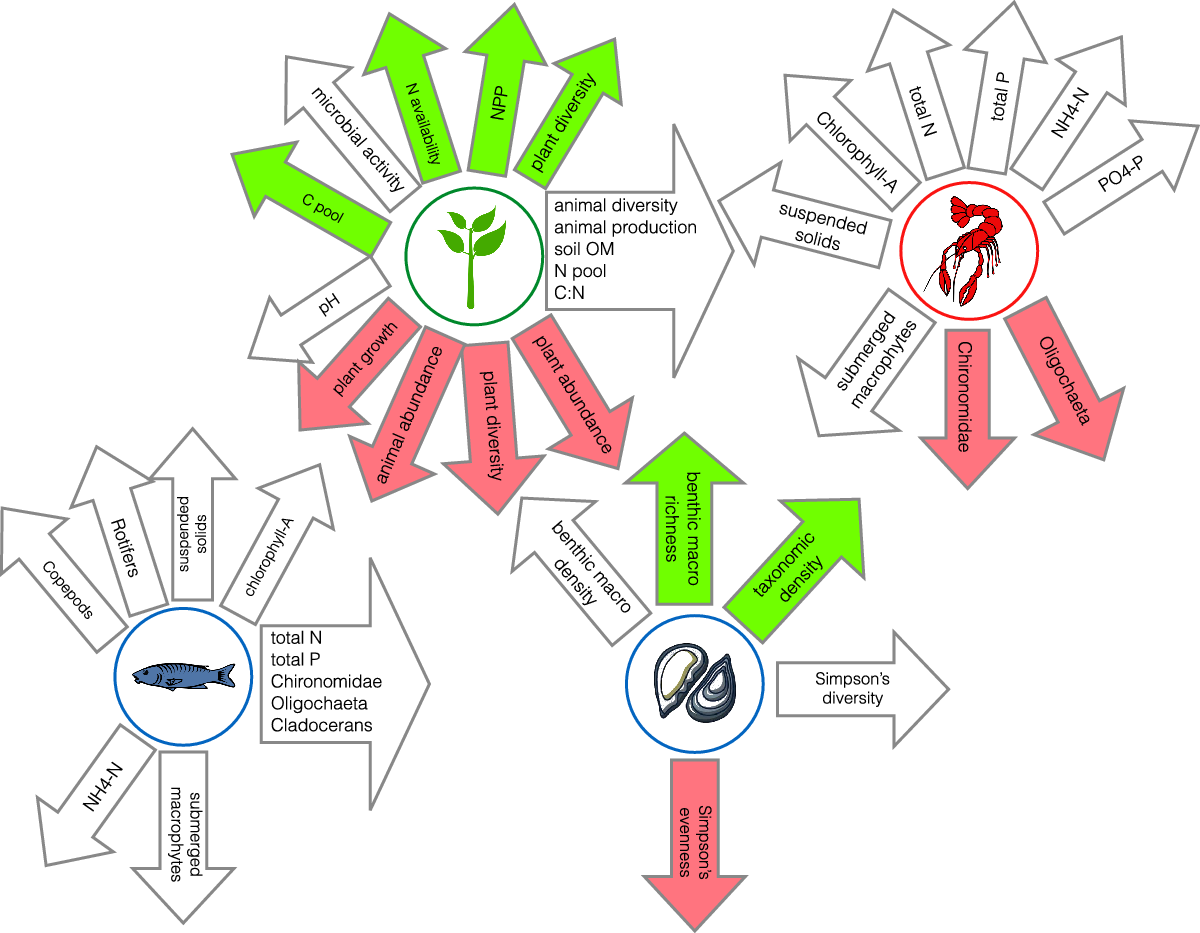
Figure 1. Examples of numerically positive, negative, and neutral directional changes associated with exotic plants, crayfish, carp, and Dreissena mussels. Red arrows are generally considered negative impacts, and green arrows are often considered positive, though not always. The white arrows represent ecological changes that are not clearly negative or positive and often depend on stakeholder perspective. The magnitude of changes is not represented. Data from Matsuzaki et al. (2008), Vilà et al. (2011), and Ward and Ricciardi (2007).
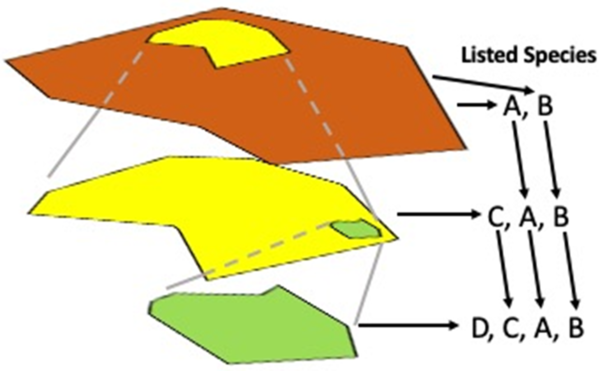
Figure 2. A hypothetical nested hierarchy of species with negative impact. The largest area (orange) considers species A and B to be causing negative impact, which could be federal noxious weeds or similar. The next nested parcel (yellow) considers species C to be causing negative impact, which would also include species A and B. Likewise, the smallest parcel (green) would consider species A, B, C, and D, according to the nested hierarchy, to be causing negative impact. This nested governing hierarchy allows consideration of negative impacts at various spatial scales.
 You have
Access
- 12
- Cited by
Governments and conservation institutions are concerned with invasive species because of the known and potential negative impacts they impose to biodiversity, ecosystem function, the economy, and human health. Thus, most scientific, policy, and conservation organizations consider invasive species to be those exotic organisms that cause negative impacts (Jeschke et al. Reference Jeschke, Bacher, Blackburn, Dick, Essl, Evans, Gaertner, Hulme, Kühn, Mrugała, Pergl, Pyšek, Rabitsch, Ricciardi and Richardson2014; Russell and Blackburn Reference Russell and Blackburn2017). This definition of negative impact is straightforward, sensible, and clearly parses the role of these exotic species in the ecosystem, and simplifies conservation and the protection of ecosystem services. Within this paradigm, invasive equates to an exotic species causing negative impact, and should thus be prevented or managed.
This has led to scores of individual studies seeking to understand the role and consequences of exotic species across Earth’s ecosystems (e.g., Vilà et al. Reference Vilà, Espinar, Hejda, Hulme, Jarošík, Maron, Pergl, Schaffner, Sun and Pyšek2011), as well as to identify which species are to be managed due to their negative impacts (Barney Reference Barney2016; Kumschick et al. Reference Kumschick, Bacher, Dawson, Heikkilä, Sendek, Pluess, Robinson and Kühn2012). Unfortunately, the species and ecological processes that have been studied to date do not represent the full diversity of exotic species and ecological impacts (Fletcher et al. Reference Fletcher, Brooks, Lakoba, Sharma, Heminger, Dickinson and Barney2019; Hulme et al. Reference Hulme, Pysek, JaroaÌk, Pergl, Schaffner and Villa2013). Thus, our fragmented understanding of the ecological impacts of most exotic species clearly limits our ability to determine which species are damaging, and thus invasive, and subsequently hamper impact-based management prioritization (Kumschick et al. Reference Kumschick, Bacher, Dawson, Heikkilä, Sendek, Pluess, Robinson and Kühn2012).
In some cases, ecological impacts are obvious and unambiguous, as when introduced predators consume native species (e.g., Medina et al. Reference Medina, Bonnaud, Vidal, Tershy, Zavaleta, Josh Donlan, Keitt, Le Corre, Horwath and Nogales2011). Though many schemes have been devised (Bartz and Kowarik Reference Bartz and Kowarik2019), in most cases attributing ecological changes to specific species is challenging (Barney et al. Reference Barney, Tekiela, Dollete and Tomasek2013, Reference Barney, Tekiela, Barrios-Garcia, Dimarco, Hufbauer, Leipzig-Scott, Nuñez, Pauchard, Pyšek, Vítková and Maxwell2015; Kumschick et al. Reference Kumschick, Gaertner, Vilà, Essl, Jeschke, Pyšek, Bacher, Blackburn, Dick, Evans, Hulme, Kühn, Mrugała, Pergl and Rabitsch2014). Thus, we are left with an incomplete accounting of the “real” ecological impacts of most exotic species (Barney et al. Reference Barney, Tekiela, Dollete and Tomasek2013). Continued elucidation of the role exotic species play in ecological processes remains an extremely valuable endeavor, especially in this era of rapid global change when the consequences of invasions are projected to intensify (Millennium Ecosystem Assessment 2005).
Despite these limitations, meta-analyses are being used to understand trends of ecological impacts from individual studies into broad categories (e.g., species richness, soil carbon pools) and testing for statistical differences between invaded and uninvaded plots. Importantly, there is a pattern among diverse taxa that many exotic species are reducing the number and abundance of native species across the globe (Fletcher et al. Reference Fletcher, Brooks, Lakoba, Sharma, Heminger, Dickinson and Barney2019; Gallardo et al. Reference Gallardo, Clavero, Sánchez and Vilà2015; Matsuzaki et al. Reference Matsuzaki, Usio, Takamura and Washitani2008; Morales and Traveset Reference Morales and Traveset2009; Tekiela and Barney Reference Tekiela and Barney2017; Vilà et al. Reference Vilà, Espinar, Hejda, Hulme, Jarošík, Maron, Pergl, Schaffner, Sun and Pyšek2011; Ward and Ricciardi Reference Ward and Ricciardi2007). Loss of native diversity is considered universally negative to conservation, but also to all other aspects of ecosystem function that are associated with that diversity. Thus, any exotic species responsible for the decline of native species is having an unambiguous negative ecological impact and should be managed.
However, the delineation of what constitutes “negative” impacts for the multitude of other ecological changes associated with exotic species is far less clear (Figure 1). Ecosystems are complex networks of matter, energy, genes, and their transformations that are valued as life-sustaining “services” on which all humans depend. Thus, any perturbation or threat to these services could be considered negative, and the species associated with that change prioritized for management. Measuring these changes has been made easier by our ability to more easily quantify underlying mechanisms of ecosystem change, such as changes in specific pools and fluxes (Kumschick et al. Reference Kumschick, Gaertner, Vilà, Essl, Jeschke, Pyšek, Bacher, Blackburn, Dick, Evans, Hulme, Kühn, Mrugała, Pergl and Rabitsch2014). For example, exotic plants have been associated with reductions in soil pH (Vilà et al. Reference Vilà, Espinar, Hejda, Hulme, Jarošík, Maron, Pergl, Schaffner, Sun and Pyšek2011), introduced carp with reductions in water nitrogen levels (Matsuzaki et al. Reference Matsuzaki, Usio, Takamura and Washitani2008), and exotic mussels with reduced water turbidity (Gallardo et al. Reference Gallardo, Clavero, Sánchez and Vilà2015) (Figure 1). However, Dreissena mussels (zebra and quagga mussels) also increase the richness, density, and biomass of benthic macroinvertebrates (Ward and Ricciardi Reference Ward and Ricciardi2007). While these changes range from numerically lower to higher than the reference (usually an uninvaded control), the interpretation of these changes as ecologically “negative” is far from clear. Further complicating interpretation is that a single species can cause a variety of numerically negative, positive, and neutral changes among a multitude of ecosystem parameters (Figure 1).
Examples of numerically positive, negative, and neutral directional changes associated with exotic plants, crayfish, carp, and Dreissena mussels. Red arrows are generally considered negative impacts, and green arrows are often considered positive, though not always. The white arrows represent ecological changes that are not clearly negative or positive and often depend on stakeholder perspective. The magnitude of changes is not represented. Data from Matsuzaki et al. (Reference Matsuzaki, Usio, Takamura and Washitani2008), Vilà et al. (Reference Vilà, Espinar, Hejda, Hulme, Jarošík, Maron, Pergl, Schaffner, Sun and Pyšek2011), and Ward and Ricciardi (Reference Ward and Ricciardi2007).
We have shown that the exotic grass Japanese stiltgrass [Microstegium vimineum (Trin.) A. Camus] causes a variety of numerically positive, negative, and neutral ecological changes: it reduces light availability and litter abundance; increases total plant cover, plant richness, and soil pH; but has no effect on native cover and soil organic matter (Tekiela and Barney Reference Tekiela and Barney2015). Thus, we are left with how to interpret exotic species–associated changes when the direction of change is not clearly associated with a negative ecological impact, and when other relevant parameters change in multiple directions (e.g., some numerically positive, some numerically negative).
Paradoxically, from the perspective of climate change mitigation, a species that increases carbon storage may be viewed as desirable, in spite of ancillary changes. This could be true for a variety of ecosystem services (Pejchar and Mooney Reference Pejchar and Mooney2009). Exotic species considered ecological pariahs in some contexts can have beneficial roles in disturbed landscapes (D’Antonio and Meyerson Reference D’Antonio and Meyerson2002). For example, yellow star-thistle (Centaurea solstitialis L.) is a damaging noxious weed in California but is also valued for honey production (Maddox et al. Reference Maddox, Mayfield and Poritz1985). As Colautti and Richardson (Reference Colautti and Richardson2009:1227) state, “Virtually any measure of impact can be used to call a species invasive, making generalizations difficult, or even spurious.” Including the socioecological contexts of exotic species is imperative, especially as novel ecosystems become the norm (Hobbs Reference Hobbs, Mooney and Hobbs2000).
An additional consideration that is seldom acknowledged, and rarely empirically studied, is the variation of impacts across the introduced range of an exotic species (Valéry et al. Reference Valéry, Fritz, Lefeuvre and Simberloff2008). Large variation in impacts could be expected, especially at the range margins of exotic species where they are experiencing novel biotic and climatic conditions (Alexander and Edwards Reference Alexander and Edwards2010). Broad application of negative impacts to entire species across large geographies based on limited empirical information is inappropriate (Simberloff et al. Reference Simberloff, Martin, Genovesi, Maris, Wardle, Aronson, Courchamp, Galil, GarcÌa-Berthou, Pascal, Pyaek, Sousa, Tabacchi and Vila2013). Thus, we are in need of a clear application of the ecological evidence in a spatially flexible management context.
Given these challenges, we propose that an exotic species’ impact be considered in the context of the relevant policy and mission of governments, conservation organizations, and managers, which are structured to protect and support specific commodities, processes, and species, and be applied in a governing hierarchy. Any exotic organism that threatens, or is likely to threaten, the integrity of those directives within relevant jurisdictional boundaries is considered to be having a negative impact. This could scale from large boundaries such as entire countries down to individual land parcels with multiple nested jurisdictions in between (Figure 2). For example, federal noxious weeds are regulated across the entire United States due to their known and perceived impact, as are state-listed noxious weeds. Thus, these regulations apply to all jurisdictions within the hierarchy.
A hypothetical nested hierarchy of species with negative impact. The largest area (orange) considers species A and B to be causing negative impact, which could be federal noxious weeds or similar. The next nested parcel (yellow) considers species C to be causing negative impact, which would also include species A and B. Likewise, the smallest parcel (green) would consider species A, B, C, and D, according to the nested hierarchy, to be causing negative impact. This nested governing hierarchy allows consideration of negative impacts at various spatial scales.
At a smaller spatial scale, if a land parcel is managed to protect migrating birds and their habitat, then any exotic species that directly or indirectly threatens that mission is considered to be causing negative impact, and its management would be warranted. This would include exotic predators of the birds and exotic plants that threaten bird habitat. Conversely, exotic species that offer beneficial habitat for migrating birds may not be considered to be causing negative impact for that parcel and may even be associated with positive impacts in the context of the overall mission. Suitable native alternatives should be considered, but this decision would be made individually and in consideration of all applicable laws, policies, and regulations at larger hierarchical levels. Similarly, the USDA and myriad other organizations are working to protect honeybees (Apis mellifera L.) across the United States from a variety of threats due to the heavy reliance on bee pollination for dozens of high-value crops. One primary threat is the exotic varroa mite (Varroa destructor Anderson and Trueman), which is associated with colony collapse disorder (Cox-Foster et al. Reference Cox-Foster, Conlan, Holmes, Palacios, Evans, Moran, Quan, Briese, Hornig, Geiser, Martinson, vanEngelsdorp, Kalkstein, Drysdale and Hui2007). Thus, despite A. mellifera being exotic to the United States, and in some contexts considered invasive itself (Thomson Reference Thomson2004), it is generally considered to be desirable and to have positive ecological impacts. Conversely, V. destructor is threatening A. mellifera populations and food security and is thus considered to be causing negative impact and is managed as such.
The flexibility of this framework can also accommodate local priorities of one group being at odds with the mission of the region. For example, many biofuel crops are known to be highly invasive in areas where they are proposed for introduction (Barney Reference Barney2014), but growers may recognize significant economic value in biofuel production. In these cases, local, state, and federal regulations limit the use of regulated species and protect the greater good of the region over the economic benefits of a select few at the expense of others (Bagavathiannan et al. Reference Bagavathiannan, Graham, Ma, Barney, Coutts, Caicedo, De Clerck-Floate, West, Blank, Metcalf, Lacoste, Moreno, Evans, Burke and Beckie2019). In circumstances where there are competing interests in nearby jurisdictions (e.g., biofuel producer vs. conservation easement), both parties should work together to ensure mutual noncompeting goals are met with regard to the use of exotic species.
This application of exotic species negative impact to populations that threaten something protected or of value allows clear interpretation of negative impacts that is context and management specific. This does not diminish the breadth of changes associated with exotic species (positive, negative, neutral), which should continue to be a focus of research, rather it is a recognition that the interpretation of those changes as ecologically negative is not unambiguous and should be made applicable to land managers. Thus, populations of a species may be considered as having negative impact in some contexts, but not in others. It is more important to manage based on the specific contexts, which is the scale at which the vast majority of management already occurs. In other words, this approach should better facilitate management prioritization. This is not to argue that an “innocent until proven guilty” approach is warranted, which suffers its own flaws and misconceptions (Simberloff Reference Simberloff2003). Rather, any exotic organism that threatens the mission of individual organizations, jurisdictions, and/or policy can be considered to be having negative impact.
Our knowledge of the ecological impacts of most exotic species is incomplete (Hulme et al. Reference Hulme, Pysek, JaroaÌk, Pergl, Schaffner and Villa2013), and when known may include a range of numerically positive, negative, and neutral changes. Therefore, it is more important than ever to understand the direct and indirect effects all species have on their environments (Barney et al. Reference Barney, Tekiela, Barrios-Garcia, Dimarco, Hufbauer, Leipzig-Scott, Nuñez, Pauchard, Pyšek, Vítková and Maxwell2015; Kumschick et al. Reference Kumschick, Gaertner, Vilà, Essl, Jeschke, Pyšek, Bacher, Blackburn, Dick, Evans, Hulme, Kühn, Mrugała, Pergl and Rabitsch2014), but categorizing species as impactful because of an associated ecological change somewhere within its invasive range is injudicious and leads to miscommunication and misinformation among managers. Identifying exotic organisms as those that threaten the policy, mission, and/or conservation directives (1) better represents the scale at which managers practice, (2) gives managers the information they need to prioritize populations, (3) reflects the scale of invasion as one of context and not universality, and (4) allows flexibility with dynamic ecosystems undergoing global change. We propose this as a suggested first step in developing a more applied approach to invasive species impact mitigation. Many challenges remain (e.g., neighbors with competing interests), but we hope this generates conversation on how to move toward improved invasive species management.
Author Contributions
JB and DT conceived the idea, JB wrote the article. Both authors contributed critically to drafts and gave final approval for publication.
Acknowledgments
We appreciate the comments of Dan Atwater, the associate editor, and two reviewers who improved the article. We declare no conflicts of interest.