

Background
The concept of frailty as a measure of functional loss, cognition, and urinary incontinence lets us move beyond traditional disease-based measures to focus on a more comprehensive measure of health (Ahmed, Mandel, & Fain, Reference Ahmed, Mandel and Fain2007; Bergman et al., Reference Bergman, Ferrucci, Guralnik, Hogan, Hummel and Karunananthan2007; Rockwood, Fox, Stolee, Robertson, & Beattie, Reference Rockwood, Fox, Stolee, Robertson and Beattie1994). This approach is based on the geriatric model of care, which focuses on broad multidimensional assessments in addition to measures of individual disease states and their severity (Jones, Song, & Rockwood, Reference Jones, Song and Rockwood2004; Jones, Song, Mitnitski, & Rockwood, Reference Jones, Song, Mitnitski and Rockwood2005). Frailty is a very strong predictor of mortality (Cawthon et al., Reference Cawthon, Marshall, Michael, Dam, Ensrud and Barrett-Connor2007; Klein, Klein, Knudtson, & Lee, Reference Klein, Klein, Knudtson and Lee2005; Mitnitski, Graham, Mogilner, & Rockwood, Reference Mitnitski, Graham, Mogilner and Rockwood2002), institutionalization (Rockwood, Mitnitski, Song, Steen, & Skoog, Reference Rockwood, Mitnitski, Song, Steen and Skoog2006), and falls and fractures (Ensrud et al., Reference Ensrud, Ewing, Taylor, Fink, Stone and Cauley2007).
The epidemiology of frailty has received increasing attention in the past decade. Definitions and theoretical models for frailty have been proposed and studied (Abellan van Kan et al., Reference Abellan van Kan, Rolland, Bergman, Morley, Kritchevsky and Vellas2008; Bergman et al., Reference Bergman, Ferrucci, Guralnik, Hogan, Hummel and Karunananthan2007; Fried et al., Reference Fried, Tangen, Walston, Newman, Hirsch and Gottdiener2001; Hogan, MacKnight, & Bergman, Reference Hogan, MacKnight and Bergman2003; Rockwood et al., Reference Rockwood, Fox, Stolee, Robertson and Beattie1994; Rockwood, Hogan, & MacKnight, Reference Rockwood, Hogan and MacKnight2000; Rockwood, Reference Rockwood2005). The risk factors and causal networks for a person’s developing frailty have been examined (Newman et al., Reference Newman, Gottdiener, McBurnie, Hirsch, Kop and Tracy2001; Newman et al., Reference Newman, Arnold, Naydeck, Fried, Burke and Enright2003; Ostir, Ottenbacher, & Markides, Reference Ostir, Ottenbacher and Markides2004), and there is increasing interest in the prevention and management of frailty (Faber, Bosscher, Chin, & van Wieringen, Reference Faber, Bosscher, Chin and van Wieringen2006; Feinberg, Reference Feinberg2003; Fried et al., Reference Fried, Hadley, Walston, Newman, Guralnik and Studenski2005; Melis et al., Reference Melis, van Eijken, Borm, Wensing, Adang and van de Lisdonk2005). However, most of this research has focused on the medical and physiologic factors which may lead to frailty, with less emphasis on the social determinants of frailty.
Social position has been defined, measured, and operationalized in various ways: education, income, overall wealth, and occupation have all been used as surrogates of social position (Berkman & Macintyre, Reference Berkman and Macintyre1997). Subjective social status has also been considered, and may be a stronger predictor of adverse outcomes than “objective measures” (Singh-Manoux, Marmot, & Adler, Reference Singh-Manoux, Marmot and Adler2005). All measures of social position have strengths and weaknesses (Galobardes, Shaw, Lawlor, Lynch, & Davey, Reference Galobardes, Shaw, Lawlor, Lynch and Davey2006a, Reference Galobardes, Shaw, Lawlor, Lynch and Davey2006b; Krieger, Williams, & Moss, Reference Krieger, Williams and Moss1997), and using a variety of measures is likely to be preferred. As well, there is some discussion concerning the nomenclature and definition of social position. Social class, socio-economic status, socio-economic position, and social position have all been used. All have different histories and use different theoretical models. We have considered social position since it is less dependent on prestige and is more general than some other terms (Galobardes et al., Reference Galobardes, Shaw, Lawlor, Lynch and Davey2006a, Reference Galobardes, Shaw, Lawlor, Lynch and Davey2006b; Krieger et al., Reference Krieger, Williams and Moss1997).
The effect of social position on health in older adults has received a great deal of attention. Social position has been found to predict mortality (McMunn, Nazroo, & Breeze, Reference McMunn, Nazroo and Breeze2009), functional decline (Ebrahim, Papacosta, Wannamethee, & Adamson, Reference Ebrahim, Papacosta, Wannamethee and Adamson2004; McMunn et al., Reference McMunn, Nazroo and Breeze2009; Ramsay, Whincup, Morris, Lennon, & Wannamethee, Reference Ramsay, Whincup, Morris, Lennon and Wannamethee2008; Rautio, Heikkinen, & Ebrahim, Reference Rautio, Heikkinen and Ebrahim2005; Rautio, Adamson, Heikkinen, & Ebrahim, Reference Rautio, Adamson, Heikkinen and Ebrahim2006; Taylor, Reference Taylor2010), resource use, and depression in older adults. While it appears that the effect of social position may diminish with age, it persists into old age (van Kippersluis, O’Donnell, van Doorslaer, & van Ourti, Reference van Kippersluis, O’Donnell, van Doorslaer and van Ourti2010). In most studies, there is evidence for a gradient effect across the social continuum, and not simply a threshold effect of severe deprivation.
There has been less research, however, into the effect of social position on frailty. Szanton, Seplaki, Thorpe, Allen, and Fried (Reference Szanton, Seplaki, Thorpe, Allen and Fried2010) found that socio-economic status, measured by both income and education, was strongly associated with frailty. These results, however, were based on data limited to women. As well, results based on their U.S, sample may not be generalizable to other societies with lower rates of inequality and poverty. Studies from other countries, however, have also shown an association between social position and frailty. The Three City Study in France (Avila-Funes et al., Reference Avila-Funes, Helmer, Amieva, Barberger-Gateau, Le and Ritchie2008) found that social position was associated with frailty in urban French centres. In Latin American cities, both childhood and adult social factors have been reported to be associated with frailty (Alvarado, Zunzunegui, Beland, & Bamvita, Reference Alvarado, Zunzunegui, Beland and Bamvita2008).
In Canada, Andrew, Mitnitski, and Rockwood (Reference Andrew, Mitnitski and Rockwood2008) have conducted extensive analyses on social vulnerability and frailty and found that social vulnerability and frailty are correlated. As well, social vulnerability predicts death, even in fit older adults (Andrew, Mitnitski, Kirkland, & Rockwood, Reference Andrew, Mitnitski, Kirkland and Rockwood2012). These analyses considered an aggregate scale of social vulnerability that included measures of social position. However, the main focus was not on social position, and other factors such as marital status and health beliefs were also included in the aggregate measure. In addition to individual social position, neighbourhood deprivation may be associated with frailty (Lang et al., Reference Lang, Hubbard, Andrew, Llewellyn, Melzer and Rockwood2009). Social position may be a risk factor for frailty, and reducing social inequalities may reduce the disparities in frailty rates. With cohort differences in education, economic security, and global social well-being, there may be changes in the rates of frailty in future cohorts.
Several outstanding questions remain to be studied. For example, is the association between social position and frailty evident among both men and women? Are different measures of social position associated with frailty? Is this association seen in representative, population-based samples? Is the effect a gradient or a threshold effect? Is the effect of social position independent of the effect of social supports and social networks? We addressed these questions using data from an existing population-based study. Specifically, our objectives were threefold: (1) to determine if frailty was associated with measures of social position (education, home ownership, income adequacy, and income satisfaction); (2) to determine if any observed association between social position and frailty was a threshold or gradient effect; and (3) to determine if any observed association was independent of main effects or interactions of age, gender, and social support.
Methods
Sample
Manitoba is a province in the prairie region of Canada. It has a stable population of just over 1 million residents (1,091,940 in 1991) with 13.4 per cent of those being older adults (Statistics Canada, 1992). Data used in this study were from the Manitoba Study of Health and Aging (MSHA), which began in 1991 and involved a subsequent follow-up study in 1996. The MSHA is a longitudinal study of aging and cognition conducted in conjunction with the Canadian Study of Health and Aging (CSHA Working Group, 1994). The primary objectives were to estimate the prevalence and incidence of dementia in Manitoba and to examine issues related to informal caregiving. For these analyses, we used the baseline cross-sectional data. The Manitoba Study of Health and Aging received ethics approval from the Research Ethics Committee of the University of Manitoba, and adhered to the Helsinki Declaration. Informed consent was obtained from the participants or from the appropriate proxy.
People over the age of 65 and living in the community were randomly selected according to health region and age group from a list provided by Manitoba Health, the provincial government department responsible for the planning and delivery of health services within the province. Since health care is universal in Manitoba, this is one of the most complete listings of residents available. The oldest old (> 85 years) were over-sampled in order to increase the likelihood of obtaining adequate numbers of individuals with cognitive impairment in the study sample. All health regions were represented, including rural areas. Initially, 2,890 persons were selected to participate. Of these, 443 individuals refused to participate, 480 were not eligible (i.e., had died, entered a nursing home, or were too ill), 162 could not be located, and 54 did not complete the screening questionnaire. This resulted in a sample of 1,751 participants. Of these, a further 46 were missing the data required to categorize their frailty group. Interviews were conducted in person by trained interviewers. Participants who scored below the threshold (78) on the cognitive screening tool (the Modified Mini-Mental State Examination [3MS]) (Teng & Chui, Reference Teng and Chui1987) were invited to participate in a clinical examination to confirm their cognitive impairment and to determine a diagnostic classification (e.g., Alzheimer’s disease; cognitive impairment, no dementia [CIND]).
Measures
Outcome Variable
Functional status was measured using the Older Americans Resource Survey (OARS) (Fillenbaum, Reference Fillenbaum1988), consisting of seven activities of daily living (ADLs) and seven instrumental ADLs (IADLs.) Cognition was measured using the modified 3MS (Teng & Chui, Reference Teng and Chui1987). Urinary incontinence was self-reported based on responses to the item “Do you ever lose control of your bladder? By that I mean do you ever pass water when you don’t intend to?” These functional status measures were used to create the frailty measures.
We considered two measures of frailty. For our primary analysis, we used a brief instrument of frailty derived from the Canadian Study of Health and Aging (Rockwood et al., Reference Rockwood, Stadnyk, MacKnight, McDowell, Hebert and Hogan1999). As a secondary analysis, we considered the Frailty Index, also derived from the CSHA data (Mitnitski, Song & Rockwood, Reference Mitnitski, Song and Rockwood2004).
The brief instrument of frailty is based on the classification scheme of the Geriatric Status Scale (GSS), which was used to target patients in hospitals eligible for a specialized geriatric intervention. Patients were classified into four levels:
▪ Not Frail: Those who walk without help, perform basic activities of daily living (eating, dressing, bathing, bed transfers), are continent of bowel and bladder, and are not cognitively impaired.
▪ Incontinent: Those with bladder incontinence only.
▪ Mild Frailty: one (two if incontinent of urine) or more of needing assistance with mobility or activities of daily living, has CIND, or has bowel or bladder incontinence.
▪ Moderate to Severe Frailty: two (three if incontinent) or more of totally dependent for transfers or one or more activities of daily life, incontinent of bowel and bladder, and a diagnosis of dementia.
The Frailty Index (Mitnitski, Song & Rockwood, 2004) is an index specifically based on the “accumulation of deficits” model of frailty. Here, we replicated the scale described by Mitnitski and Rockwood. This tallies 40 deficits and subjective complaints, and then divides the number of deficits an individual has by the total possible number. Thus, the index was scored from 0 to 1. For linear regressions, we considered the 40-point scale as a continuous variable.
Predictor Variables
Social position was measured in several ways. Education was self-reported as the number of years in school. Income security was measured with the item “How do you think your income and assets satisfy your needs?” and was scored as “Very well/Adequately/With some difficulty/Not very well/Totally inadequately”. For some analyses, these categories were grouped to ensure adequate numbers in each category. Household income was self-reported as the average monthly income for the household. Since there were many missing responses, with a very high refusal rate, we were unable to analyze this variable. Home ownership was assessed based on respondents’ self-reports concerning whether they owned their dwelling, rented their dwelling, lived with family, or had some other arrangement (this included collective living arrangements such as religious orders, Hutterite colonies, friends, etc). Satisfaction with income was assessed with an item from the Delighted-Terrible Scale (Michalos, Reference Michalos1980). This scale consists of a series of questions assessing satisfaction with various aspects of a person’s life. There are 12 questions, each rated on a 7-point scale, scored from 1 (terrible) to 7 (delighted). For finances, participants were asked to rate their satisfaction with their finances (income and assets, including investments, property, etc). For some analyses, these categories were also collapsed into combined categories.
Control variables
Socio-demographic, health status, and social support measures were included as control variables. Age and education were continuous measures, coded in years, while gender was dichotomous. Living alone was measured with the question “Do you live here alone (yes/no)?” Co-morbidities were measured by summing the number of self-reported health problems, from 0 to 35. Urinary incontinence was one of these problems, but excluding it from the scale did not alter any observed associations. Finally, social support was assessed with this question: “Most people have one or more individuals they can count on for help in time of need (i.e., helps and supports you). Can you think of someone like this in your life?” If the participant answered yes, the follow-up question was asked: “How many such persons?” Emotional support was measured with the question “Do you receive emotional support from anyone or not? That is, do you have someone to confide in, talk to about yourself, your concerns, etc.?” If the participant answered yes, the follow-up question was asked: “So, how many people in total would you say you receive emotional support from?” Providing support for others was measured with the question “Are you the main person providing help for someone else at the present time?” If the participant answered yes, then the follow-up question was asked: “So, how many people are you providing help for?”
Analyses
Categorical variables were compared using chi-square tests, and continuous variables were compared using t-tests (assuming unequal variance) or one-way analysis of variance (ANOVA). For the primary analyses, logistic regression models were constructed, with the outcome of mild/moderate to severe frailty versus no frailty/incontinence. Standard regression diagnostics (e.g., multicollinearity and influential outliers) were conducted prior to the analyses. Bivariate analyses and graphs were conducted in SPSS version 10 (SPSS, Chicago) software, and statistical models were constructed using Stata version 11 (Statcorp, College Station, TX) software. For the secondary analysis, we constructed linear regression models, with the outcome variable being the Frailty Index. We considered the Frailty Index as a score from 0 to 40.
Most of the measures of social position were correlated, and we therefore entered only one social position measure into each model. As well, the predictor variables living alone and gender were correlated, with women being much more likely to live alone. Omitting either living alone or gender did not substantially alter the effect of social position on frailty, and we chose to leave both factors in the logistic regression model.
We also assessed potential interactions, constructing logistic regression models with an interaction term between the social position measure of interest and other predictor variables. We found no significant interactions for the primary variables of interest. Results were stratified by gender and age categories to provide age- and gender-specific estimates of the association between social position and frailty.
Results
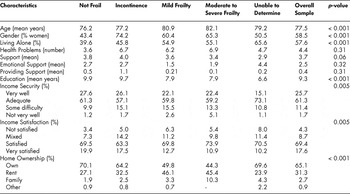
The baseline characteristics of the 1,751 participants are shown in Table 1. Those individuals who were older, women, and living alone were more likely to be frail. The association of social and emotional supports with frailty was less robust.
Baseline characteristics of participants by frailty status (Manitoba Study of Health and Aging)a

a Support is the number of people providing support, Emotional Support is the number of people providing social support. Providing Support is the number of persons for whom the participant is the major support. For continuous variables, ANOVA or Student’s t-tests were used, and for categorical variables, chi-square tests were used.
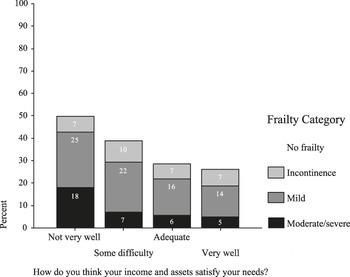
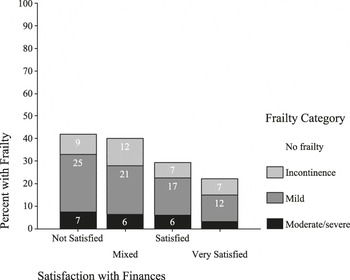
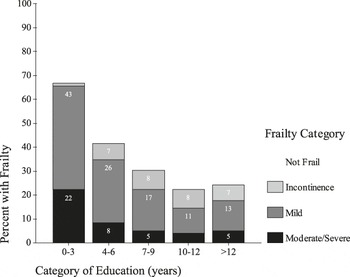
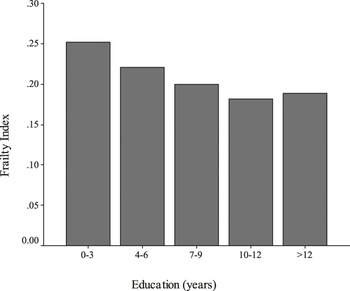
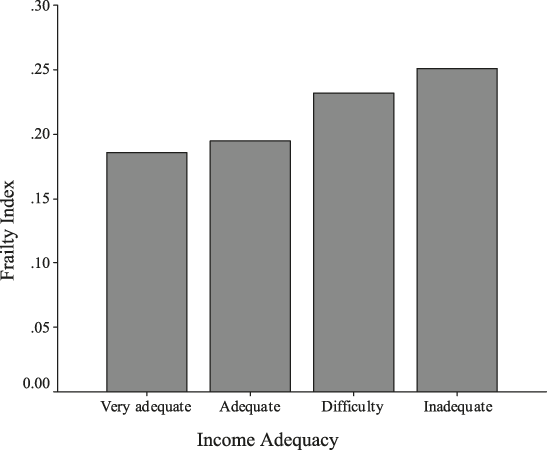
Regardless of the measure of social position used, there was a strong association evident between social position and frailty. Moreover, this association was a gradient across the measure, and not a threshold. For example, there was a strong gradient across both measures of income adequacy and satisfaction. Those who reported that their incomes met their needs were less likely to be frail (see Figure 1). Those who reported having higher satisfaction with their incomes were also less likely to be frail (see Figure 2). Lower education was also strongly associated with frailty. However, there may be a ceiling effect of education, with the highly educated participants (12+ years of education) having frailty rates similar to those with more moderate levels of education (10–12 years) (see Figure 3). Those who owned their own homes also were less likely to be frail than others (see Table 1).
Income adequacy and frailty

Satisfaction with income and frailty

Education and frailty

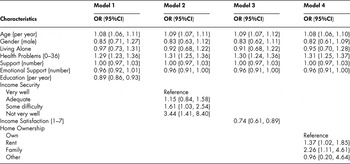
These associations were maintained in the logistic regression models, adjusting for potential confounding factors (see Table 2). There was a strong effect of education, with higher education being associated with a lower risk of frailty. Similarly, there was a strong association between income security and frailty. The odds ratio for being frail was more than three for those who reported that their incomes did not meet their needs very well. Higher levels of income satisfaction were associated with lower levels of frailty. Owning one’s home was also associated with a lower risk of frailty, although this effect appeared less strong. We found no evidence of interactions. In all subgroups, the effect of social position on frailty was maintained: notably, the association was observed among both men and women. Similarly, the effect of social position on frailty was seen in all age groups.
Results of logistic regression models for having frailtya
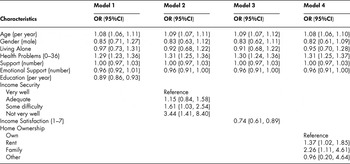
a Here, frailty is defined as the Brief Measure of Frailty. The outcome was frail versus not frail and incontinence only.
OR = odds ratio
95%CI = 95% confidence interval derived from the logistic regression model
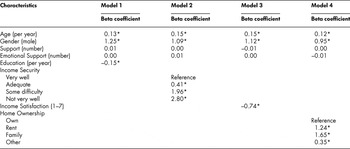
When we conducted analysis with the Frailty Index, the results were remarkably similar. There was a strong and graded association across all measures of social position (see Appendix). A similar ceiling effect of education was also noted: those with education above Grade 12 did not appear to have lower levels of frailty than those with Grades 10 to 12 educational levels. Linear regression results are shown in Table 3. Lower income security and lower income satisfaction were both associated with higher Frailty Index scores, while owning one’s own home was associated with a lower Frailty Index score. Higher levels of education were associated with a lower Frailty Index score. Indeed, the results of these sensitivity analyses were remarkably similar to the primary analyses.
Results of linear regression modelsa

a The unstandardized beta coefficients are shown. Here, we consider the Frailty Index (scored 0–40) as the outcome.
*denotes p < 0.05
Discussion
We observed a strong association between all measures of social position and frailty in cross-sectional analyses. Furthermore, this association was a gradient effect, not simply a threshold effect. We observed the effect across gender and age categories. The effect of social position was large, robust, and seen in all surrogate measures of social position we examined. Furthermore, this effect was apparent regardless of the theoretical model of frailty used.
Strengths and Limitations
There are some limitations to our study. First, the response rate for the household income question was low. Many participants simply refused to answer this question. As well, individual income was not asked, nor was total net wealth. Thus, associations between income, net wealth, and frailty could not be addressed. As well, there were people who declined to participate, and these potential participants may have been frailer and had lower social positions than those who participated. Second, the measures of social support were limited: simple one-item questions were asked rather than a scale of questions,
Third, we used the CSHA measure of frailty. The theoretical model and definition of frailty in this measure has been a subject of some discussion (Bandeen-Roche et al., Reference Bandeen-Roche, Xue, Ferrucci, Walston, Guralnik and Chaves2006; Bergman et al., Reference Bergman, Ferrucci, Guralnik, Hogan, Hummel and Karunananthan2007; Fried et al., Reference Fried, Tangen, Walston, Newman, Hirsch and Gottdiener2001; Rockwood et al., Reference Rockwood, Fox, Stolee, Robertson and Beattie1994; Rockwood et al., Reference Rockwood, Hogan and MacKnight2000; Rockwood & Mitnitski, Reference Rockwood and Mitnitski2007). The CSHA model is similar to the “accumulation of deficits” model (Rockwood & Mitnitski, Reference Rockwood and Mitnitski2007). A common competing model is the “frailty as a phenotype” model (Bandeen-Roche et al., Reference Bandeen-Roche, Xue, Ferrucci, Walston, Guralnik and Chaves2006; Fried et al., Reference Fried, Tangen, Walston, Newman, Hirsch and Gottdiener2001), which defines frailty as a distinct entity rather than simply the combined effect of multiple problems. This emphasizes physical measures, such as grip strength, weight loss, and fatigue rather than the more global measure used in the CSHA. Had we used a different model of frailty, we may have seen different results. A fourth limitation was that the measurement of social position was imperfect (Galobardes et al., Reference Galobardes, Shaw, Lawlor, Lynch and Davey2006a, Reference Galobardes, Shaw, Lawlor, Lynch and Davey2006b; Krieger et al., Reference Krieger, Williams and Moss1997). We therefore considered a variety of measures. We did not consider occupation, since occupation may not be an appropriate measure in populations who are not currently working (Galobardes et al., Reference Galobardes, Shaw, Lawlor, Lynch and Davey2006a, Reference Galobardes, Shaw, Lawlor, Lynch and Davey2006b) or in women of this age cohort. Fifth, the data were collected some years ago, and associations between social position and frailty may have changed with time.
A final limitation is causation which is difficult to establish with cross-sectional data. It is possible there is reverse causation, with frailty resulting in a lower social position. This is particularly true for home ownership: increasing frailty may make it difficult to maintain a household. This may indeed be the case, since living with family was a factor associated with frailty. However, many of the social factors we considered were measured in late life, but in fact measured social position earlier in life: education is usually obtained in one’s youth, and late-life income is often the result of one’s earlier occupation, savings, and income. To fully elucidate these effects, cohort studies throughout the entire life course would be needed.
There are also strengths to our study: it was population-based, with broad representation of an entire province, including rural regions. Trained interviewers gathered standardized, reliable measures. As well, many measures of social position were available.
The association between social position and frailty that we observed is perhaps not surprising. The CSHA definition of frailty incorporates cognition and disability, both of which have been shown to be correlated with social position, especially education. Furthermore, most diseases and syndromes follow a social gradient, even in older populations. However, previous investigations (Alvarado et al., Reference Alvarado, Zunzunegui, Beland and Bamvita2008; Avila-Funes et al., Reference Avila-Funes, Helmer, Amieva, Barberger-Gateau, Le and Ritchie2008; Lang et al., Reference Lang, Hubbard, Andrew, Llewellyn, Melzer and Rockwood2009; Szanton et al., Reference Szanton, Seplaki, Thorpe, Allen and Fried2010) of the effect of social position on frailty have all demonstrated that social position is associated with frailty. Our findings support those previous results. In addition, we observe that the effect is evident across the social gradient in men and women in all the older age groups. As well, these other studies have used the “frailty as a phenotype model,” whereas we have used the “frailty as an accumulation of deficits model”. Thus, our study reinforces the findings of these other studies in a different population with a different definition of frailty.
Our findings are also consistent with the findings of Andrew et al. (Reference Andrew, Mitnitski and Rockwood2008), who showed an association between frailty and social vulnerability. The notion of social vulnerability is broader than social position, and we have focused on the specific effect of social position. Both approaches have merit. The aggregate social vulnerability scale is useful for measuring risk, and for highlighting the importance of social factors on health. Our approach of disaggregating these factors is also useful. When policymakers plan social policy, understanding which specific social factors are associated with frailty may be important. For instance, ensuring adequate income for older adults may have important population health effects. Conversely, reducing income security in late life may have negative effects. These specific effects may be hard to disentangle when using an aggregate scale.
Our study did not address some important questions. For example, when in the life course does social position exert its effect? Life course studies are needed to follow a large population over time to determine if there are critical periods in life that are important in developing frailty or risk states for frailty. Also, how do changes in social and economic factors affect frailty in late life? Many societies are considering pension reform and social security reform, which may affect frailty rates. As these changes in financial security occur, it will be important to study their effect on late-life frailty. In addition, how do these social factors act to predict frailty? Although the number of studies on frailty and social position remains fairly small, there seems to be a consistent association between social position and frailty. Further research is needed to determine if this association is causal and, if so, the mechanism of causality. This will require large samples with detailed individual and contextual data collected over long periods of time. Further research should be pursued to address these questions.
Appendix: Results of Sensitivity Analysis
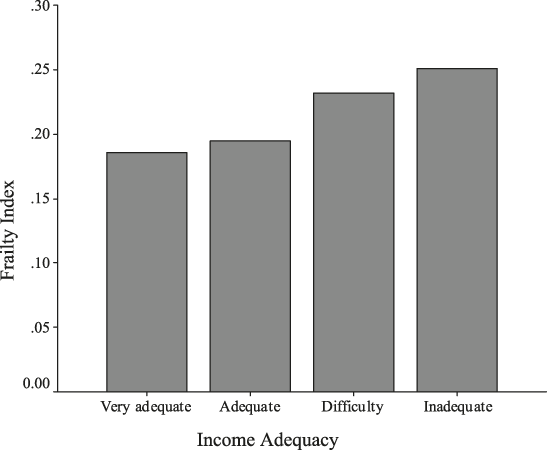
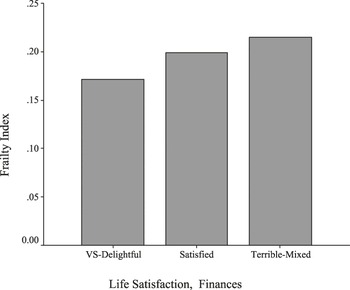
We present the analysis using the Frailty Index. This is a tally of 40 items and complaints, divided by the total number of possible deficits, and is scored from 0 to 1. There is a strong and graded association across each measure of social position.
Association between income security and the Frailty Index
Association between income satisfaction and the Frailty Index

Association between education and the Frailty Index