Sources
The principal sources of information on which this chronicle is based are British Broadcasting Corporation, Monitoring Global News line — Asia-Pacific Political and British Broadcasting Corporation, Monitoring Global News line — Asia-Pacific Economic. These sources, now only available electronically, do not have reference numbers and are only identifiable by date of publication of material. The inclusion of each of these dates would unnecessarily clutter the text and such dates have therefore been omitted, except, at many points, for the original sources from which the BBC reports themselves are taken.
Abbreviations
- XHNA
Xinhua (New China) News Agency
- CNA
Central News Agency (Taipei)
- RTHK
Radio-Television Hong Kong
- ZTS
Zhongguo tongxun she (China Reporting Agency), Hong Kong
- ZXS
Zhongguo xinwen she (China News Agency), Beijing
- RMRB
Renmin ribao (People's Daily)
- SCMP
South China Morning Post
- KCNA
Korean Central News Agency
1. Internal Developments
aNational People's Congress
bParty and Political Affairs
cSocial Affairs
dEconomic Affairs
eStatistical Communiqué on National Social and Economic Development in 2011
fXinjiang and Tibet
gHong Kong and Macau Special Administrative Regions
2. Foreign Relations
aDiplomatic Tours
bCountries, Territories and Region
cTrade Matters
1. Internal Developments
a The National People's Congress
The National People's Congress (NPC) Standing Committee met in Beijing from 27 to 29 February primarily to make preparations for the annual session of the NPC on 5 March. The session also considered draft amendments to the Law on the Promotion of Clean Production and a draft law on assets appraisal. It also considered a report on amending the two annexes to the Basic Law of the Macau Special Administrative Region concerning the election of the Chief Executive and of the Legislative Council (XHNA, 27 Feb.). It adopted decisions on amending the Law on the Promotion of Clean Production and one to permit appropriate modifications to the methods for selecting the Macau Chief Executive and the Macau Legislative Council (XHNA, 29 Feb.). The Fifth Session of the 11th National Committee of the Chinese People's Political Consultative Conference was held in Beijing from 3 to 13 March. The opening session heard a report from the Chairman of the Committee, Jia Qinglin, on the work of the committee of the previous year and its plans for the coming year. The opening session was attended by senior members of the Party and government leadership, and the session ran concurrently with the National People's Congress (XHNA, 3 Mar.).
The Fifth Session of the 11th National People's Congress (NPC) was held in Beijing between 5 and 14 March. It was presided over by Wu Bangguo, Chairman of the NPC Standing Committee. The final session approved the Premier's report on the work of the government, the report on the work of the NPC Standing Committee, the report on the execution of the 2010 National Economic and Social Development Plan and on the 2011 National Economic and Social Development Plan, the reports of the Supreme People's Court and the Supreme People's Procuratorate, and the report on the central and local budgets. It also approved further amendments to the Criminal Procedure Law to include the principle of protecting human rights. It adopted decisions on the election of deputies for the 12th NPC and draft methods for electing new NPC deputies from Hong Kong and Macau. Under the new election methods, nearly 3,000 deputies will be elected to the NPC by January 2013 (XHNA, 14 Mar.).
Premier Wen's Work Report
Premier Wen Jiabao delivered the Work Report on 5 March. Commentators noted that he had used the word “reform” an unprecedentedly large number of times. In his subsequent press conference, he repeated in even stronger terms his belief that reform was essential:
Reform has now come to a critical stage. Without successful political structural reform, fully implementing the economic structural reform would be impossible; the achievements we have made in this area could be lost; new problems emerging in society would not be fundamentally resolved; and such historical tragedies as the Cultural Revolution could happen again. Every Party member and leading cadre with a sense of responsibility should feel a sense of urgency. Certainly I am fully aware of how difficult it is to pursue reform. Any reform would require the awakening, support, enthusiasm and creativity of the people. In a big country like China, with a population of 1.3 billion people, we must pursue this based on China's national circumstances and develop socialist democratic politics in a gradual manner. This is no easy task. The reform can only progress and must not stagnate or regress, as stagnation or regression will simply offer us no way out.
Wen concluded with a promise that “as long as I draw breath, I will fight one more day for the cause of China's reform and opening up” (CCTC Channel one, 14 Mar.). The other headline from his speech was his setting of a growth target of 7.5 per cent, slightly below the mystical figure of 8 per cent which had come to be widely accepted as the minimum rate at which China had to grow to maintain social stability.
Wen opened by reviewing the work of 2011 against a background of a complex and volatile political environment abroad and arduous and challenging reform and development tasks at home. He noted that significant achievements had been made in reform, opening up and socialist modernization. He pointed to headline figures of GDP growth of 9.2 per cent, a record grain output of 570 million tonnes, the creation of 12.21 million new urban jobs and significant increases in urban and rural per capita incomes. He said that China had “followed a proactive fiscal policy and a prudent monetary policy, and maintained a balance between ensuring steady and robust economic development, adjusting the economic structure and managing inflation expectations.” He was particularly proud of having achieved general price stability amid worsening inflation expectations worldwide and significantly higher costs of production at home. Increases in the major indices began falling in August. New controls had been introduced in the housing market resulting in a significant reduction in speculative housing demand and a reduction in month-on-month house price increases. He noted that China had achieved a record harvest for the eighth year in a row, and had exceeded 500 million tonnes for five consecutive years, which showed it had reached a new level in grain production capacity. The industrial structure had been upgraded with emphasis on strategic emerging industries. Regional development policies had been introduced to promote the leapfrog development of Tibet and Xinjiang, and a ten-year rural poverty alleviation and reduction programme had been introduced. China had implemented a more active employment policy and the employment rate for college graduates had increased to 77.8 per cent. The number of rural workers had reached 253 million, of whom 159 million worked in towns and cities. Big efforts had been made to increase the incomes of low income people, and for the second year running per capita income of rural residents had risen at a faster rate than that of their urban counterparts. Wen said that the hard-won achievements of the past year had been a tribute to the vitality of the socialist system with Chinese characteristics and had enhanced the pride and cohesiveness of the Chinese nation. The achievements were owed to the sound decisions made by the Party Central Committee, with Comrade Hu Jintao as General Secretary, and its correct leadership as well as the concerted efforts and hard work of the Chinese people. He went on to say that: “we are keenly aware that China still faces many difficulties and challenges in economic and social development,” and listed a number of them. These included the continuing international repercussions of the global financial crisis and the sovereign debt crisis in some countries; high unemployment rates in the developed world; inflation in emerging economies; fluctuating exchange rates; and mounting protectionism in international trade and investment. Domestically the challenges included: China's continuing unbalanced, uncoordinated and unsustainable development; downward pressure on growth; high prices; problems in maintaining growth in agriculture; excess production capacity in some industries; energy consumption growing too rapidly; the hardships faced by small and micro businesses. The government still faced problems with its failure to meet targets on conserving energy, reducing emission and controlling prices. Problems of land expropriation, housing demolition, workplace safety, food and drug safety and income distribution were still very serious and causing widespread concern amongst the people.
In the coming year the major targets would be: a GDP increase of 7.5 per cent, keeping the registered urban unemployment rate at or below 4.6 per cent, holding increases in the Consumer Price Index to around 4 per cent, increasing foreign trade by around 10 per cent, and improving the international balance of payments. He said that the slightly lower growth rate was consistent with the targets set in the Five-Year Programme, and was intended to make people focus their work on accelerating the transformation of the pattern of economic development and making economic development more sustainable and efficient. Over the next year China would continue with its policy mix much as before. They would continue with a proactive fiscal policy, and a prudent monetary policy. Their aim was to promote steady and robust economic growth, keep prices stable and to guard against financial risks by keeping total money and credit supply at appropriate levels. China would continue to expand domestic demand and keep foreign demand stable, vigorously develop the real economy and work hard to counter the various factors for instability and uncertainty at home and abroad. Major tasks for the coming year included: promoting steady and robust economic development through expanding consumer demand, and improving the investment structure. Prices would be kept basically stable by increasing production and ensuring supply as well as improving distribution and reducing distribution costs, and improving market order. The steady growth of agriculture and rural reform would be promoted. He noted in particular that: “we will uphold the basic rural operation system. We will work diligently to determine, register and certify land ownership. Farmers’ rights to the land they contract to work on, to the land on which their houses sit, and proceeds from collective undertakings are property rights conferred by law, and these rights must not be violated by anyone… We will place farmland under strict protection and formulate and promulgate regulations concerning compensation for expropriation of rural collective land.” The industrial structure would be further improved and upgraded, and further efforts would be made to conserve energy, reduce emissions and protect the ecological environment. In this regard he noted that “we will start monitoring fine particulate matter in the Beijing-Tianjin-Hebei region, the Yangtse River Delta, the Pearl River Delta and other key areas.” He said that reform and opening up were the right choice for China's destiny and future. “We must respect the people's creativity, boldly explore new ways, and continue to promote all reforms, including the reform of China's economic and political systems, with greater resolve and courage.” He said that reform would be concentrated on the following key areas and crucial links:
We will further transform government functions, improve macro-controls, balance the relationship between government and the market, and make better use of the basic role of the market in allocating resources. We will advance reform of the fiscal and taxation systems, better balance the distribution of fiscal resources between the central and local governments and between all levels of local governments, and better arouse the initiative of both the central and local governments. We will deepen reforms of land, household registration and public services; balance the relationship between urban and rural areas; and promote co-ordinated development of industrialization, urbanization and agricultural modernization. We will carry forward reforms in social programmes and income distribution, strike a balance between economic and social development, and effectively safeguard social fairness and justice.
On government reform Wen said that:
We will expand socialist democracy; conduct democratic election, decision making, administration and oversight in accordance with the law; and protect people's rights to stay informed about, participate in, express views on, and oversee government affairs. We will implement the basic strategy of enforcing the law in both letter and spirit, respect and uphold the sanctity of the Constitution and laws, and govern in strict accordance with the law. We will resolutely rectify the problems of laws not being abided by or fully enforced, lawbreakers not being prosecuted, uncivilized law enforcement, dereliction and neglect of duty, and corrupt practices in law enforcement. We will work harder to build clean government. To do so, we will fight corruption, effectively carry out the long-term and basic work needed to improve the system of preventing and punishing corruption, and give high priority to solving serious problems that the people are resentful about.
Full text of the work report and of other reports can be found in (http://www.xinhuanet.com/english/special/2012lh/index.htm)
Budget
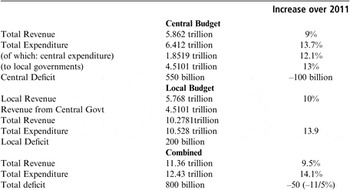
On 5 March the Finance Minister, Xie Xueren, reported on the budget outturn for 2011 and the draft budget for 2012 (Text in http://www.xinhuanet.com/english/special/2012lh/index.htm). He was in positive mode. He said that in 2011, “the economy developed in the direction anticipated through macro-control, living standards constantly improved, reform and opening up continued to deepen, and the Twelfth Five-Year Programme got off to a good start. On this foundation, further progress was made in fiscal development and reforms, and government budgets were satisfactorily implemented.” Revenues had reached 10.374 trillion yuan, an increase of 24.8 per cent over 2011, and national expenditure had totalled 10.524 trillion yuan, up 21.2 per cent. When various accounting adjustments had been made the deficit was 850 billion yuan (down by over 150 million yuan from the outturn in 2010). Table 1 gives the headline revenue and expenditure figures projected for 2012.
Central and Local Budgetary Estimates for 2012 (figures in yuan)
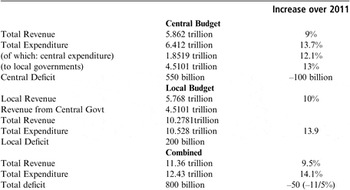
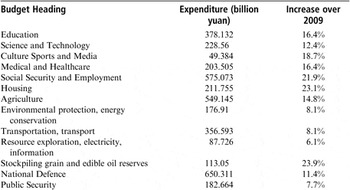
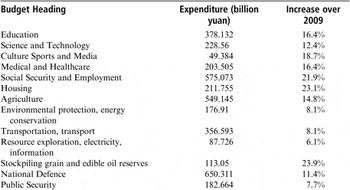
The Minister said that China would follow developments and changes in the economic situation, oversee and inspect implementation of a proactive fiscal policy, and strike a balance between maintaining steady and robust economic development, restructuring the economy, and managing inflation expectations. It was necessary to maintain continuity and stability in our fiscal policy, make macro-control using fiscal policy more targeted, flexible, and forward-looking, and stress fiscal sustainability. They would give full play to the role of fiscal policy in our efforts to promote economic restructuring; boost consumer spending; support scientific and technological innovation, energy conservation, and environmental protection; develop strategic emerging industries and the modern service industry; promote co-ordination among regions and balanced urban and rural development; and make economic development more sustainable and cost-effective. They would make good use of the role fiscal policy plays in stabilizing prices. Table 2 gives a breakdown of the major items of budgeted expenditure.
Major Budgeted Items of Expenditure, 2012
b Party and Political Affairs
Bo Xilai, a member of the Politburo and a contender for promotion to an even more senior post at the Party Congress in the autumn, was dismissed from his post as Party Secretary of Chongqing on 15 March, and replaced by another member of the Politburo, Zhang Dejiang. The official announcement gave no reason for his removal but the decision was the culmination of a political scandal that had come first to public attention when Wang Lijun, who had been until January Head of the Chongqing Public Security Bureau and Bo's right-hand man in his notorious campaign against organized crime in Chongqing, sought asylum at the US Consulate in Chengdu on 6 February. Wang's request was not entertained and he left the Consulate “of his own free will” after 24 hours to be immediately detained by the Chinese security authorities. Wang was flown to Beijing in the company of a Vice Minister of State Security and other State Security officials (Information Centre for Human Rights and Democracy, Hong Kong, 11 Feb.). At first it was officially reported that Wang was on recuperation leave, but the news spread rapidly through unofficial media and was later confirmed by US sources. It was later revealed that Wang had also sought an appointment with the British Consulate in Chongqing. There was intense speculation about the reasons for Wang's flight; his close association with Bo Xilai strongly suggested that there were adverse political implications for Bo. Nonetheless Bo remained in his post through to the meeting of the National People's Congress in March where he even gave a press conference on 9 March defending himself and his record (XHNA, 9 Mar.). Clear confirmation of the seriousness of Bo's problems came at the press conference following the NPC given by Premier Wen Jiabao on 14 March. In answer to a question on political reform, Premier Wen spoke of the absolute necessity for political structural reform, without which the achievements they had made could be lost, new problems emerging in society would not be fundamentally resolved and such historical tragedies as the Cultural Revolution could happen again. He had earlier noted that the mistakes of the Cultural Revolution and the impact of feudalism had yet to be fully eliminated in China. These remarks were taken as an indirect attack on Bo who had been notorious for his pushing of a Maoist nostalgia cult in Chongqing. Much more directly he also said that the Chongqing leadership needed to undertake self-reflection and earnestly draw a lesson from the Wang Lijun incident. He said that the incident had drawn a high degree of attention, and that the central government was conducting a special investigation which had already produced results. He said they would handle the matter strictly according to the laws and on the basis of facts (China Central TV 1, 14 Mar.). Premier Wen's words were carefully chosen reflecting the difficulties the leadership had with the case. The following day, Bo was dismissed, as was Wang Lijun (XHNA, 15 Mar.). The head of the Party's Organization Department, Li Yuanchao, travelled to Chongqing to address local party officials on the decisions (ZTS, 17 Mar.). Bo's dismissal led to even further speculation, which the authorities tried hard to control. There were rumours that Zhou Yongkang, the member of the Politburo Standing Committee in charge of security matters, was also involved, but he continued to appear regularly. A People's Daily commentary of 29 March said that people should not be confused by rumours and that China could only seek progress while ensuring stability by being undisturbed by external noise and unconfused by gossip (People's Daily, 31 Mar.). Meanwhile more details of the case against Bo began to leak out, in particular the alleged involvement of his wife, Gu Kailai, in the murder of a British businessman, Neil Heywood, who had been found dead in a hotel room in Chongqing in November 2011. At the time, the authorities had claimed that he had died of alcohol poisoning and his body had been quickly cremated. The UK government asked for the case to be reopened following Wang Lijun's stay in the US Consulate.
The Party's Central Commission for Discipline Inspection held a plenary session on 8 to 10 January, presided over by He Guoqiang and attended by all the other members of the Politburo Standing Committee. General Secretary Hu Jintao delivered a speech to the meeting. He noted that important elections were taking place in China in 2011 and 2012, including the elections of Party Committees at all levels from township to province and the election of a new Central Committee. He said that Party discipline should be strictly implemented throughout these processes, and that the Party would be tightening the supervision and transparency of the procedures for selecting and promoting officials. Newly elected committee members should keep on developing a correct attitude to their work and stick to the principles of putting people first and serving the people. He added that Party members faced difficult challenges in dealing with the arduous and time-consuming problem of corruption (XHNA, 9 Jan.).
The village of Wukan in Guangdong, which had seen large-scale protests last year over illegal land seizures and the rigging of local elections, has now become a celebrated model of how the Party responds to legitimate complaints. Official reports noted that the protestors' wrath had been defused in late December after Zhu Mingguo, Deputy Secretary of the Guangdong provincial committee of the CPC, had held a direct dialogue with villagers and promised a “fair and open” investigation into the grievances. Wukan set up a new Party branch and a work team to prepare for new elections to the village committee in January, following the dismissal of the previous village head (XHNA, 15 Jan.). Formal procedures for the elections began on 1 February with the election of members of an independent supervisory committee to oversee the process (XHNA, 1 Feb.). Among those elected to the 11-member committee were the fathers of two of the leaders of the original protests. One of them, Zhang Shuimei, was quoted as saying: "I am very happy to win trust among our villagers, and I will make every effort to make sure our village committee will be elected under a clean, fair and just process” (SCMP website, 3 Feb.). The voting was a protracted process. The first vote, on 11 February, elected 109 villagers’ representatives but none of the candidates for group leaders achieved the required number of votes, necessitating another round of elections (XHNA, 11 Feb.). In the third and final phase on 3 March, elections were held for the new 11-member village committee, including a chief, and two deputies. Twenty-two candidates stood. Lin Zulian, who had been appointed Party Secretary after the protests, won convincingly to become the new village head, and Yang Semao was elected as Deputy. According to Xinhua, villagers accepted the election results and regarded the two leaders as capable and strong with the interests of villagers at heart. Both had been prominent in the original protests (XHNA, 3 Mar.).
Premier Wen Jiabao, on a visit to Guangdong, said that furthering reform was the only key to solving all problems. He quoted the late Deng Xiaoping on his famous southern tour which revitalized the reform movement as saying that “opening-up and reform should be implemented unswervingly, or there will only be a dead end.” He said there should be boldness and determination in pushing reform forward, and highlighted the need to ensure farmers’ voting rights and the direct elections of village-level leaders as an important task for local authorities (XHNA, 5 Feb.).
Xia Baolong (aged 60) was formally appointed Governor of Zhejiang province on 16 January. He had been acting Governor since the resignation of Lu Zushan in August 2011. Xia had served as provincial official in Tianjin and in Zhejiang since 2003 (XHNA, 16 Jan.). Zhu Xiaodan (aged 58) was appointed Governor of Guangdong province on 18 January. He had been acting Governor since 2011 (SCMP, 18 Jan.). Lu Xinshe (aged 55) was elected Governor of Jiangxi province on 5 February. He had been acting Governor since June 2011 (XHNA, 5 Feb.). Li Bin (aged 58) was formally elected Governor of Anhui on 15 February. He had been acting Governor since December 2011 (XHNA, 15 Feb.). Li Jiheng (aged 55) was elected Governor of Yunnan province on 16 February. He had been acting Governor since December 2011 (XHNA, 16 Feb.).
Li Jiayang was appointed Vice Minister of Agriculture on 21 January, and Liao Xiaojun was removed from his post as Vice Minister of Finance (XHNA, 21 Jan.). Song Tao and Cheng Guoping were appointed Vice Ministers of Foreign Affairs on 6 February, replacing Lu Guozheng and Li Jinzhang. Li Xiaojie was appointed Director of the State Administration of Cultural Heritage (XHNA, 6 Feb.). Zhong Jianhua was appointed China's special representative for Africa, replacing Liu Guijin (XHNA, 14 Feb.).
c Social Affairs
The dissident lawyer, Gao Zhisheng, was reported to have been transferred from Beijing to a prison in Aksu County, Xinjiang province (Information Centre for Human Rights and Democracy, Hong Kong, 2 Jan.). The writer, Yu Jie, fled with his family to the United States on 11 January. He said that he feared for his safety after being warned against writing politically sensitive material by the authorities. He had been the author of a book highly critical of Premier Wen Jiabao called China's Best Actor: Wen Jiabao (SCMP, 13 Jan.). Hu Jia, a prominent rights activist, said that he had been questioned by police for several hours on 12 January and warned that he would be detained again if he continued campaigning on behalf of activists. He had been released in June 2011 after serving three and a half years in prison on subversion charges. But he remained subject to deprivation of political rights for a further year, which the authorities said barred him from giving press interviews or publicizing his views. He had, however, posted notices on Twitter and the internet concerning the fate of a number of dissidents and had urged his followers to show their support (SCMP, 13 Jan.).
The pro-democracy activist Li Tie was sentenced to ten years’ imprisonment for “subverting state power” and deprived of his political rights for three years in Wuhan. He is a freelance writer whose articles were highly critical of one-party rule and the lack of democracy in China. This was the third heavy sentence given recently to dissidents, with Sichuan student leader Chen Wei sentenced to nine years’ imprisonment, and Chen Xi in Guizhou receiving a ten-year prison term (Information Centre for Human Rights and Democracy, Hong Kong 19 Jan.). Zhu Yufu was put on trial in Hangzhou on 31 January on subversion charges because of a poem he had written supporting the Arab Spring. He had been a co-founder of the China Democracy Party and had been jailed in 1999 and 2009. He was sentenced to seven years (SCMP website, 1 Feb.).
China reacted strongly to the publication of a report by Human Rights Watch which described a worsening human rights situation in China. A People's Daily editorial of 29 January claimed that: “For them (Western governments and NGOs), it does not matter whether China achieves progress in human rights or if the Chinese government respects and protects human rights. What matters is that China has to be condemned politically” (XHNA, 29 Jan.).
The State Council announced on 1 March a new regulation on the administration of detention centres and the protection of the legitimate rights of detainees. It applied only to detention centres holding minor offenders who were detained for a maximum of 15 days. Warders were required to inform inmates and their families of their legal rights and to give families timely notice of detentions. Insulting, abusing, imposing physical punishment on offenders, and forced labour was banned (XHNA, 1 Mar.). Huang Jiefu, a Vice Minister of Health, said that China would be ending the practice of taking organs from condemned prisoners within three to five years. China was in the process of creating a national organ donation system and encouraging people to participate in it (XHNA, 22 Mar.).
d Economic Affairs
The five-yearly National Financial Work Conference was held on 6 and 7 January. The meeting decided on development plans for the financial sector in the coming five years. Premier Wen told the conference that China had maintained stable and relatively fast growth with steady consumer prices and improvements in people's lives. China had undertaken a series of financial reforms and large banks had improved the capacity in guarding against risk. China would ensure that the financial industry served the real economy and prevented virtual bubbles from inflating the economy. Financial oversight would be strengthened, and market forces would be given a greater say in fund allocation. Wen said China would continue to follow a prudent monetary policy for this year and make it more targeted, flexible and forward-looking by maintaining a “reasonable growth” in social financing. China's financial assets stood at 119 trillion yuan in November 2011, an increase of 149 per cent in five years. The non-performing loan ration was said to be 0.9 per cent, 6.2 points below the level of 2006 (XHNA, 7 Jan.).
The Head of the State Grain Administration acknowledged that China was facing mounting challenges in ensuring the supply of grain. The Administration had developed a five-year plan to meet these challenges, including significant enhancement of the logistics of the grain industry by 2015. Grain storage capacity would increase by 20 million tonnes in the period, and inter-provincial transportation would be upgraded. The Ministry of Agriculture stated that China was fully self-sufficient in rice, wheat and corn, but production of other commodities such as soy and mung beans fell short of demand (XHNA, 12 Jan.). Following a series of food safety scandals across the country, the Ministry of Public Security announced on 15 March a campaign to fight against food with banned additives, illegal cooking oil, stale pork and counterfeit drugs, in order to ensure “dinner table safety.” Since last year, police had apparently uncovered over 5,200 cases of unsafe food, and 6,500 of fake drugs (XHNA, 15 Mar.).
e Statistical Communiqué on National Social and Economic Development for 2011
The statistical communiqué was issued by National Bureau of Statistics (NBS) on 22 February (http://www.npfpc.gov.cn/data/201202/t20120223_382267.html). The brief introductory remarks noted that national economic performance had maintained steady and rapid development and made a good start to the 12th Five-Year Period, despite being faced with a complicated and volatile international economic environment.
The main features of China's economic performance in 2011 are summarized below, with comparable figures for the previous year in square brackets:
Overview
Preliminary estimates indicated that in 2011, GDP rose by 9.2 [10.3] per cent in terms of comparable prices to reach 42,154.4 billion yuan. Agricultural growth remained steady at 4.5 [4.3] per cent. Primary sector growth was lower than that of both industry (10.6 [12.2] per cent) and services (8.9 [9.5] per cent) which both decreased marginally over the previous year.
Agriculture
2010 saw a further modest expansion of the grain-sown area by 700 thousand hectares (ha) to 110.57 million ha; the sown areas to oil-bearing crops declined (by 0.1 million ha) while the area under cotton rose (by 0.1 million ha), and that under sugar rose marginally by 0.04 million ha.
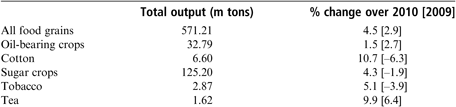
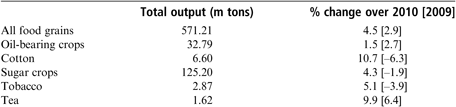
The output of major farm crops is shown in Table 3. Total meat output rose slightly by 0.4 [3.6] per cent to 79.57 million tons. Output of pork, beef and mutton all fell (by −0.4 [3.7], −0.9 [2.7] and −1.4 [2.2] per cent respectively). Total output of aquatic products was 56 million tons, or 4.2 per cent more than in 2010. Timber production fell again after a small rise in 2010 to 72.72 million cubic metres. Effective irrigation was extended to an additional 1.81 [1.634] million ha of arable land, in addition to which an extra 2.21 [1.975] million ha were brought under guaranteed water-saving irrigation facilities.
Output of Major Farm Products
Industry
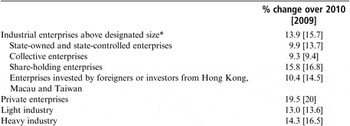
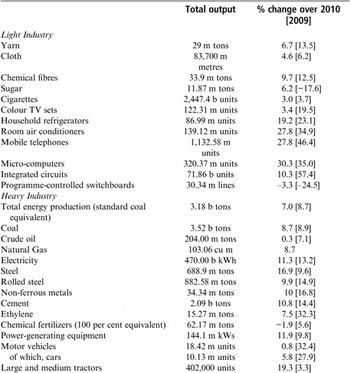
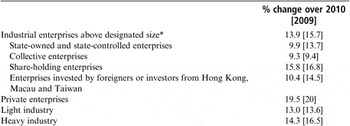
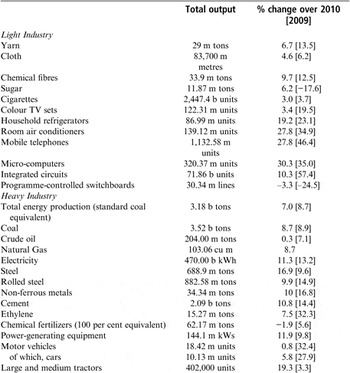
Industrial value-added grew by 10.7 [12.1] per cent in 2011. Further details are given in Table 4. The outputs of important industrial products are shown in Table 5.
Rate of Growth of Industrial Value-added, 2011
Note
* i.e. all state-owned enterprises and those non-state-owned enterprises with an annual sales income over 5 million yuan.
Output of Major Industrial Products, 2011
Industrial profitability improved substantially again. The overall rate of increase in profits in enterprises of above the designated size was 25.9 [49.4] per cent. Within this figure were the following increases in profitability by different enterprise ownership category during the same period:

Construction industry growth remained high at 10.6 per cent compared to 12.6 the previous year, and construction enterprises generated profits of 424.1 billion yuan (24.4 per cent above the 2010 level).
Fixed investment
In 2011 the rate of expansion of fixed-asset investment was flat at 23.6 per cent (23.8 per cent in 2010). Regional data are shown in Table 6. Urban investment in the primary sector increased slightly to 25 per cent (18.2 in 2010); the corresponding figures for urban secondary and tertiary fixed investment were 27.3 [23.2] per cent, and 21.1 [25.6] per cent.
Fixed Investment Growth by Region

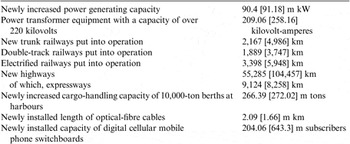
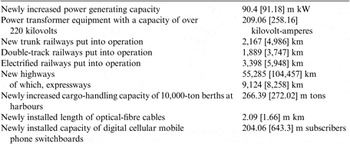
Table 7 summarizes the net impact of capital construction investment on production capacity in 2011.
New Increases in the Production Capacity of Selected Industries, 2011
Transport and telecommunications
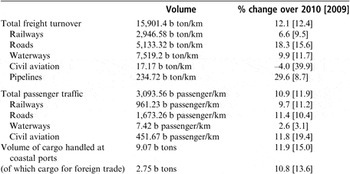
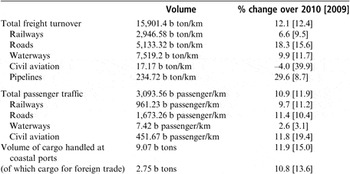
There was continued growth in both passenger and freight transport in 2011, as shown in Table 8.
Passenger and Freight Traffic in 2011
The turnover of post and telecommunication services increased by 16.5 [20.6] per cent. The total number of fixed-line subscribers fell again to 285.12 million [294.38]: 191.10 [196.62] million in cities, and 94.08 [97.76] million in rural areas. There were 127.35 [111.97] million new mobile phone subscribers, taking the total number of users to 986.25 [859.00] million at the end of 2011. Thus, the total number of telephone users reached 1271.37 [1,153] million; on average, telephone coverage reached 94.0 [86.5] for every 100 members of the Chinese population. The number of internet users rose from 457 to 513 million and broadband users reached 450 [350] million and the internet coverage rate was 38.3 per cent.
China received 135.42 million international visitors in 2011, up 1.2 per cent. Of these, 27.11 [26.13] million were “foreigners” (an increase of 3.8 [19.1] per cent) and 108.31 [107.64] million were “Chinese compatriots” from Hong Kong, Macau and Taiwan (up by 0.6 per cent). Foreign exchange earnings from international tourism totalled US$48.5 billion, up 5.8 per cent from 2010. Some 70.25 [57.89] million Chinese made overseas visits, of whom 64.12 [51.51] million undertook private visits. Revenue from domestic tourism was 1,930.6 billion yuan (a rise of 13.2 [23.5] per cent).
Domestic trade
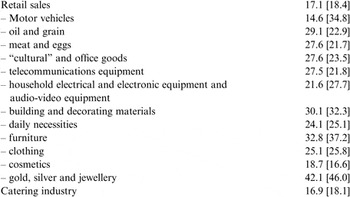
In 2011, real growth in the value of retail sales of consumer goods was 17.1 [18.3] per cent to reach 18,391.1 billion yuan (up by 17.2 [18.7] per cent in cities, and 16.7 [16.2] per cent in rural areas). More disaggregated estimates of sales growth are shown below (all figures in percentages):
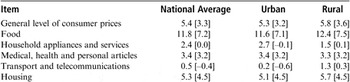
Consumer prices showed a continued upward trend over the year, although they began falling after reaching a peak in July. Overall prices increased by 5.4 per cent (compared to 3.3 per cent last year). Food prices went up by 11.2 per cent. Housing prices in 70 large- and medium-sized cities were described as “picking up first and then slowing down.” House prices showed a trend towards a decline in the month-on-month increases; by December 52 cities saw a decline in sales prices compared with only 3 in January. Overall housing prices rose by 5.3 per cent.
Consumer price changes for specific goods, or categories of goods, are shown in Table 9.
Change in the Consumer Prices of Selected Goods, 2011 [2010] (%)

Foreign trade and external relations
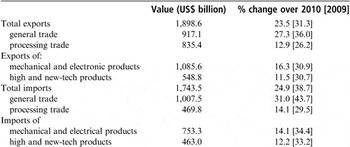
Foreign trade rose again (see Table 10) with exports up 20.3 per cent toUS$1,898.6 billion, and imports were up 24.9 per cent to US$1,743.5 billion. Overall, China enjoyed a merchandise trade surplus of US$155.1 billion, or US$26.4 billion less than in the previous year.
Levels of and Changes in Imports and Exports, 2011

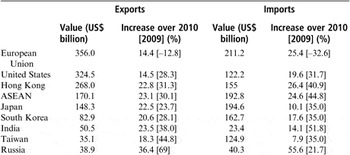
A geographical breakdown of China's exports is shown in Table 11.
Direction of China's Foreign Trade, 2011

Foreign investment picked up. Inflows of utilized foreign direct investment (FDI) rose by 9.7 [17.4] per cent to reach US$116.01 billion. Manufacturing absorbed $52.10 billion – an increase of 5.1 per cent, and the next largest category was real estate at US$26.38 billion, up 12.1 per cent. Chinese overseas direct investment (non-financial sectors) was US$60.1 billion, increasing only 1.8 per cent over 2010.
At the end of 2011, China's foreign exchange reserves totalled US$3,181 billion – US$338.1 billion more than a year earlier. At the end of the year the exchange rate was 6.3009 yuan to the dollar, a modest appreciation of 5.1 per cent.
Banking and insurance
The Communiqué noted that at the end of 2011 savings deposits lodged in all kinds of financial institutions totalled 82.7 [73.3] trillion yuan. There were significant increases in the money supply. The volume of cash in circulation (M0) rose by 13.8 [16.7] per cent to 5.1 trillion yuan; the corresponding rates of increase for narrow (M1) and broad (M2) money were 7.9 [21.2] per cent, and 13.6 [19.7] per cent.
Welfare, living standards and employment
Per capita cash disposable income of urban households reached 21,810 [19,109] yuan in 2011 [2010] (a real rise of 14.1 [7.8] per cent over that of the previous year). Rural residents’ average per capita net income was 6,977 [5,919] yuan: this represented a real increase of 16.4 [10.9] per cent. The definition of poverty was raised from an income of 1,274 yuan to 2,300. This resulted in a substantial increase in the number of rural residents considered to be living in poverty to 122.38 million. Under the old definition there had been just 26.88 million living in poverty in 2010.
There were improvements in both urban and rural social security provision. By the end of 2011, 283.92 [256.73] million people (composed of 215.74 [193.74] million current employees and 68.19 [62.99] million retirees) were enrolled in basic pension programmes. Some 143.17 [133.76] million urban residents had joined unemployment insurance schemes, while 472.91 [432.06] million were covered by urban basic health insurance (including 46.41 [45.83] million migrant workers). Co-operative health care in the rural areas extended its participation rate to 97.5 per cent. Work accident insurance was provided for 176.89 [161.73] million people, including 68.37 [63.29] million migrant workers. Some 138.8 [123.06] million people were enrolled in maternity insurance programmes. For the fifth year running, the number of people who received unemployment insurance payments fell – from 2.09 to 1.97 million. Finally, 28.778 [23.11] million urban residents were in receipt of minimum income relief from the government, while the corresponding figure for rural residents was 53,135 million, up from 52,284 million in 2011.
Total employment in 2011 was 764.20 million (a drop from 779.5 million the previous year). Urban employment rose slightly by 12.21 million. The official rate of registered urban unemployment was 4.1 per cent, the same as the previous year. The number of migrant workers working in other provinces reached 158.63 million, an increase of 3.4 per cent, and the number working within their home provinces reached 94.15 million, up 5.9 per cent.
Population
China's total population at the end of 2011 was estimated 1,347.35 [1,341.00] million.
Resources and environment
The amount of agricultural land newly allocated to construction use rose by 37.2 per cent to 588,000 hectares.
In 2011 the total stock of water resources fell from 2,847 to 2,402 billion cubic metres. At the end of the year, water storage in China's large reservoirs was 195.6 [209.1] billion cubic metres. Total water consumption increased by 1.0 [0.4] per cent to 606.0 billion cubic metres. Of this, consumption for living purposes increased by 2.5 [2.9] per cent, for industrial use it grew by 0.9 [1.4] per cent; water consumption for farms rose by 0.8 [−0.6] per cent. Per capita water consumption averaged 452 [445.7] cubic metres. Water consumption per 10,000 yuan of GDP and per 10,000 yuan of industrial value-added continued to decline by −7.3 [−9.1 and −7.9 [−9.6] per cent, respectively.
Based on monitoring of 398 sections of China's seven major water systems, 56.3 [59.6] per cent satisfied the national quality standard of Grades I–III for surface water, while 15.3 [16.4] per cent fell below Grade V level. At the higher end of the scale with 62.8 per cent of oceanic water stations met Grade I or II standards, the same as the previous year (down 10.1 per cent), and at the lower end there was an increase in the number at Grade IV or below now comprising 25.2 [23.2] per cent of all stations. 293 of 330 cities monitored reached Grade II for air quality monitoring or above (previously 612 cities were monitored), and only four fell below Grade III.
Natural disasters caused 309.6 billion yuan worth of direct losses, mainly through flooding and drought. There were 17 earthquakes of magnitude 5 and above.
The death tolls from both work accidents and traffic accidents were down, 5 and 12.5 per cent respectively. The death toll per million tons of coal fell 24.7 per cent to 0.564 persons.
f Xinjiang and Tibet
Nur Bekri, the head of the Xinjiang government, told a government meeting on 10 January that his government would work unswervingly to prevent mass incidents. The government would continue to crack down on illegal religious activities and crimes perpetrated under the guise of religion (XHNA, 10 Jan.). It was announced on 30 January that 8,000 more police officers would be recruited to be deployed in villages throughout the region to improve security. Their tasks would include security patrols, management of the migrant population and cracking down on illegal religious activities (XHNA, 30 Jan.). On 15 February, the authorities launched a series a public lectures in every village across the region to rally support for the government's religious policies and to discourage illegal religious activities (XHNA, 15 Feb.). Nonetheless there was further rioting on 28 February in Yecheng County, Kashgar, when a mob apparently attacked people on the street. At least ten people were killed, and the authorities claimed that two of the killers had been shot and the rest were being chased by police (XHNA, 28 Feb.). A month later, Abdukerem Mamut was convicted of organizing and leading the terrorist group that had carried out the attack, which had killed a total of sixteen people. He was the only survivor of a group of eight attackers, the rest were killed by police at the time of the incident. The court heard that he had spread religious extremism and violent terrorism and had formed a terrorist group between July 2011 and February 2012. He was sentenced to death on 26 March (XHNA, 26 Mar.).
Xinhua reported that Chinese officials had successfully tightened up on the management of monasteries in Tibet. Party Secretary, Chen Quanguo, told monks in Sera monastery that that stability was good for the nation and good for Tibetan Buddhism and its monasteries. He told the monks to cherish the stability they currently enjoyed and to fight unswervingly against the separatist activities of the Dalai Lama. According to official figures there were 1,700 religious sites in Tibet with 46,000 monks and nuns. Following the riots of 2008 thousands of local officials had been sent as “station cadres” to monasteries to strengthen management and prevent monks and nuns being duped by separatist forces (XHNA, 8 Jan.).
Two former monks from the Kirti Monastery in Sichuan set themselves on fire on 6 January in a further demonstration of protest. The authorities said that one of them (Dali Nima, aged 18) died and the other was seriously injured (Tseten, aged 22). Chinese experts claimed that the two men had been involved in a series of thefts, and had been enticed into their action by the Dalai Lama clique in an attempt to expiate their wrongdoing (XHNA, 7 Jan.). Xinhua reported that a monk from the Nyanmo Monastery in Golog Tibetan Prefecture, Qinghai, had burned himself to death on 8 January. There was no official confirmation of why he had done it. He was a Living Buddha and known to his followers as the Living Buddha Sopa (XHNA, 9 Jan.). Suggestions that another monk had killed himself apparently led to serious rioting in Luhuo County in the Ganzi Tibetan Region of Sichuan. According to the first reports one protestor was killed and dozens injured on 23 January in clashes with the police. The Foreign Ministry spokesman said that secessionist groups overseas were attempting to distort the truth and discredit the Chinese government, and claimed that a mob, including monks, had smashed stores and a police station in the town (XHNA, 23 and 24 Jan.). The following day there was further rioting in Seda, a township in the same region, resulting in another protestor being shot dead following attacks on the local police station. The police claimed they had no choice but to use force after coming under violent attack. The riots were again said to have been triggered by reports that three monks were going to set themselves on fire (XHNA, 25 Jan.). Sentences of ten to 13 years were passed on 21 March against some of those who been involved in the rioting (XHNA, 21 Mar.). It was reported that security had been tightened in Lhasa on 1 February. The new Secretary of Lhasa Party Committee, Qi Zhala, said this was due to the continued need to conduct an arduous fight against overseas separatists who saw Lhasa as a prime target for sabotage and infiltration. Household registration procedures were tightened, aimed especially at the migrant population, and all persons entering Tibet from 1 March were required to carry identification, a measure evidently aimed mainly at ethnic Tibetans (XHNA, 1 Feb.).
It was announced in Lhasa on 11 February that more than 200 monks and nuns at the Tsurpu Monastery, a major monastery for the Karma Kagyupa, or “White Hat Sect,” outside Lhasa had received subsistence allowances from the government (XHNA, 11 Feb.). More than 10,000 people were reported to have turned out for the funeral of a policeman who had been shot on 9 February while trying to arrest three “criminal gunmen” in Luhuo County, Sichuan, where there had been rioting by Tibetans in January. The Deputy Head of Sichuan's Public Security Bureau called on people to learn from him in fighting separatists, and to safeguard political unity and stability (XHNA, 13 Feb.).
A 19-year-old Tibetan nun, Tenzin Choedron, from the Siwa Monastery in Aba county, Sichuan, set herself on fire on 11 February and died two days later (XHNA, 13 Feb.). Two days later another monk from the Kirti Monastery in the same region, Losang Gyatso (aged 18), set himself on fire (XHNA, 14 Feb.). Yet another monk, Nangdrol (aged 18), set fire to himself in Aba county on 19 February (Kyodo News Service, 20 Feb.).
Premier Wen Jiabao met the official Panchen Lama in the Party offices at Zhongnanhai on 10 November to convey good wishes for the Tibetan New Year on 22 February. Premier Wen said that the policies of regional autonomy would continue and that greater efforts would be made to improve the lives of Tibetan compatriots. He urged the Panchen Lama to immerse himself in the study of Buddhism so as to “ascertain positive thoughts” and “lead the Buddhists lamas and followers in loving the country, abiding by laws and abiding by Buddhism commandments” (XHNA, 10 Feb.). At press conference during the National People's Congress, the Chinese spokesman said that measures to strengthen social management in Tibetan areas had been absolutely necessary since the Dalai Lama clique continued to incite separatism and violence, including the incitement of radical behaviour such as self-immolation. The Chinese government held a meeting on promoting development and stability in Tibet and the Tibetan areas of Sichuan, Yunnan, Gansu and Qinghai (XHNA, 1 Mar.).
More self-immolations and deaths were reported in early March. A teenage boy, Dorjee, set himself ablaze outside the local government offices in Aba on 5 March. On 3 March a 32-year-old woman burned herself to death, also in Aba, and on 4 March a 20-year-old student, set herself alight in Maqu, Gansu province (Kyodo News Service, 5 Mar.). A monk from the Rongwo Monastery in Tonren County in Qinghai set himself alight on 14 March, but survived (XHNA, 14 Mar.). Chinese official commentary claimed that the string of self-immolations were all part of a concerted attempt by the Dalai Lama clique to split China, and said that the struggle with him was not ethical or religious but political (XHNA, 7 Mar.). The Chairman of the Tibet government, Padma Choling, commented, “Let's face reality. The Dalai Lama and his followers do try to attract young Tibetans, but what we need to do is not to compete with them.” Instead he argued that “the key is to improve people's livelihood, especially in education. Also, in monasteries we respect religious practice. The popularity of the government will depend on its work.” He went on to list at some length all the good works being done by the Tibetan government (XHNA, 7 Mar.).
h Hong Kong and Macau Special Administrative Regions
The University of Hong completed a review into the handling of the protests against the visit of Vice Premier Li Keqiang to the University in August 2011. It concluded that the police had used unjustifiable and unreasonable force to clear away the demonstrators and that the University authorities had shown bad judgement and mismanagement in the affair. But it also concluded that there had been no interference from Beijing (SCMP website, 4 Feb.).
Elections for the fourth Chief Executive of Hong Kong Special Administration were held on 25 March. The winner was C.Y. Leung, the former convenor of the Unofficial Members of the Executive Council, who won 689 of the 1,132 valid votes cast by the Election Committee (of 1,200 persons). The other candidates, Henry Tang Ying-yen, former Chief Secretary, and Albert Ho Chun-yan, leader of the Democratic Party got 285 and 76 votes respectively (XHNA, 25 Mar.). The Hong Kong and Macau Affairs Office of the State Council issued a congratulatory statement on 26 March which noted that: “We believe Mr. Leung Chun-ying will lead the HKSAR government and unite people from all walks of Hong Kong society to work together for a better future for Hong Kong after he takes office … we are fully confident of the new HKSAR government and the future of Hong Kong.” The statement also noted that the election had been carried out in full conformity with the Basic Law and embodied principles of openness, fair play and justice. Henry Tang had originally been believed to be the candidate preferred by Beijing and had wide support in big business circles, but shortly after the election campaign began he became embroiled in a series of scandals, which severely damaged his public standing and the confidence of his supporters in him. As a result support, including that from Beijing presumably, switched to Leung who was elected comfortably. Leung's election and his appointment as the new Chief Executive were formally approved by the Chinese government on 28 March (XHNA, 28 Mar.).
On 29 March the Independent Commission Against Corruption (ICAC) arrested two very prominent businessmen, Robert and Thomas Kwok, the joint chairmen of Sun Hing Kai Properties, the largest real estate corporation in Hong Kong, following an investigation into violations of anti-bribery laws. Rafael Hui, a former Chief Secretary of the Hong Kong government, was also arrested in the same connection (http://www.nytimes.com/2012/03/30/business/global/hong-kongs-kwok-brothers-arrested.html).
2. Foreign Relations
a Diplomatic Tours
Vice President Xi Jinping's visit to the United States, Ireland and Turkey
Vice President Xi Jinping paid official visits to the US, Ireland and Turkey from 13 to 22 February. The visit to the US was the centre piece of the trip and the main purpose. It was part of the process of formally grooming him for the top leadership, and was seen by both sides as an important opportunity for their leaders to get to know each other. Xi's host in the US was Vice President Joe Biden, who accompanied him throughout the tour. Every effort was made on the US side to accord him full protocol respect, including a meeting with the President, and to make the programme interesting and varied, including a visit to the State of Iowa where he had last been in the 1980s. Xi was careful to stick to the prepared script during the visit, and no big breakthroughs were announced. But both sides seemed pleased with a successful visit that included wide-ranging discussions of the issues of the day, and allowed for a thorough review of the relationship. In a pre-visit interview, the Chinese Ambassador to Washington noted that “it's crucial for the two sides to show mutual respect, especially to each other's core interests and major concerns, while strengthening mutual dialogues and communications so as to deepen mutual trust and avoid miscalculation” (XHNA, 10 Feb.).
On his arrival in Washington on 13 February, Xi issued a statement in which he said that as the international situation experiences complex and profound changes, China and the US have more extensive common interests and shoulder more important common responsibilities:
Whether we can seize opportunities, tackle challenges and build a co-operative partnership at the new historical starting point matters to the future of our two countries and the world as a whole…..This is what I would like to explore with my American hosts in an active and practical manner during the visit, so that we can jointly promote the sustained, healthy and stable development of our relations in the new era (XHNA, 13 Feb.).
The first evening he met a number of former US dignitaries who had been involved in developing relations with China including former US Secretaries of State Henry Kissinger and Madeleine Albright, former US Treasury Secretary Henry Paulson, former US National Security Advisers Zbigniew Brzezinski, Brent Scowcroft and Sandy Berger, and former US Secretary of Labour Elaine Chao (XHNA, 13 Feb.). On 14 February he held formal talks with Vice President Biden, and met President Obama at the White House. He also had meetings with the Defence Secretary, Leon Panetta, and the Chairman of the Joint Chiefs of Staff, Martin Dempsey (XHNA, 14 Feb.). After the talks in Washington the two sides released what was called a joint fact sheet on improving economic exchanges between China and the US (text in XHNA, 14 Feb.). He met Congressional leaders on 15 and 16 February and attended a number of functions including a lunch with Vice President Biden and Mrs Clinton, the Secretary of State. On 16 February, he flew to Iowa to meet people with whom he had stayed in 1985 when he was a member of an agricultural delegation from Hebei province. He then travelled to Los Angeles for the opening session of the China–US Economic and Trade Co-operation Forum on 17 February, and had meetings with the Governor of California and the Mayor of Los Angeles.
He travelled to Ireland on 18 February where he met the Irish Prime Minister Enda Kenny, President Michael D. Higgins and other officials. In a pre-visit interview, the Chinese Ambassador to Ireland noted that trade had grown to US$5.87 billion in 2011, and there were now between 60,000 and 80,000 Chinese residents in Ireland (XHNA, 18 Feb.). On arrival, Xi said that “the main purpose of my visit is to deepen the traditional friendship between our two peoples and take bilateral relations and practical co-operation forward” (XHNA, 18 Feb.). In his talks with Prime Minister Kenny, Xi praised the development of relations between China and Ireland and expressed the hope that the two sides would continue to elevate traditional friendship and mutual trust and expand substantial communication and co-operation in a wide range of fields. Xi said that developing China-EU relations is a priority of China's foreign policy. China regarded the EU as a comprehensive strategic partner and supported Europe's integration process and encouraged the EU to play an even bigger role in the international arena. Prime Minister Kenny responded that Ireland was willing to build closer relations with China and hoped for more co-operation in trade, investment, education, agriculture and tourism. He said that Ireland would provide convenience and preferential treatment for Chinese investors in Ireland. A number of co-operation documents were signed after the meeting (XHNA, 19 Feb.).
Xi arrived in Turkey on 20 February and announced that “the main purpose of my visit is to deepen mutual understanding and the traditional friendship between our two peoples, and boost the friendly and mutually beneficial co-operation between China and Turkey in a variety of fields so as to better benefit the two countries and the two peoples.” During the visit, he had meetings with President Abdullah Gul, Prime Minister Recep Tayyip Erdogan, and the Parliamentary Speaker Cemil Cicek (XHNA, 20 Feb.). During the visit, a currency swap deal worth ten billion yuan was agreed between the People's Bank of China and the Central Bank of Turkey (XHNA, 21 Feb.). In his meeting with the Turkish Prime Minister, Xi said that “China hopes that Turkey will continue to take effective measures to oppose and prevent anti-China separatist activities by ‘East Turkistan’ forces on its territory so as to ensure the healthy and steady growth of China–Turkey ties,” adding that the issued concerned China's national security and social stability as well as its core interests (XHNA, 21 Feb.).
Foreign Minister Yang Jiechi's visit India and South Korea
Yang Jiechi, the Foreign Minister, paid official visits to India and South Korea from 29 February to 2 March. He met the Indian Foreign Minister and the Prime Minister Manmohan Singh for discussions on bilateral and international affairs and the upcoming BRICS Summit. Yang had talks with the Foreign Minister on 1 March and said that China was committed to enhancing their strategic and co-operative partnership. In their meeting, Prime Minister Manmohan Singh commented that the relationship had huge potential. There was enough space in the world for the two countries to work well together (XHNA, 1 Mar.). Yang Jiechi visited Seoul for the annual inter-ministerial consultations on 2 March and had talks with the South Korean Foreign Minister, Kim Sung-hwan (XHNA, 2 Mar.).
President Hu Jintao's visit to Seoul, New Delhi and Cambodia
President Hu Jintao visited Seoul from 25 to 27 March to attend the summit aimed at strengthening international co-operation on nuclear security. He then went on to India for a meeting of the BRICS and concluded with a state visit to Cambodia. He had a number of bilateral meetings in the margins of the Seoul Summit, including with the South Korean President Lee Myung-bak for a discussion on bilateral and other issues. They reviewed progress in their strategic co-operative partnership since 2008. Two-way trade in 2011 reached US$245.6 billion. The main topic of the conversation was North Korea. Hu said that there had been some new developments in the situation on the Korean Peninsula, which had caught the attention of the international community, and said that: “At present, the situation on the Korean Peninsula is very complicated and sensitive. We do not hope to see a reversal of the hard-won momentum of relaxation of tension on the Peninsula” (XHNA, 26 Mar.). Kyodo News Service reported that Hu told President Lee that China had asked the North Koreans several times not to proceed with their planned missile test (Kyodo News Service, 26 Mar.). Hu also had meetings with President Obama of the US and President Zuma of South Africa. With President Zuma he discussed their comprehensive strategic partnership and other issues of common interest. Trade with South Africa in 2011 was US$45.4 billion (XHNA, 26 Mar.). Hu told President Obama that the two countries should enhance dialogue, exchange and co-operation and respect each other's core interests and properly handle divergences and sensitive issues so as to steer the Sino-US relationship on the right course. He expressed the hope that trade frictions could be solved through co-operation. He suggested that the US should take concrete steps to lift its ban on high-tech exports to China, noted that the yuan had appreciated by something like 30 per cent since 2005 and said that further appreciation would not help solve the structural problems of the US economy. They also discussed the North Korean intention to launch a satellite, and exchanged views on Iran, Syria, Sudan and South Sudan (XHNA, 26 Mar.). President Hu Jintao addressed the nuclear security summit and made four suggestions for enhancing nuclear security: follow a scientific and sensible approach to nuclear security and boost confidence in the development of nuclear energy; strengthen nuclear security capacity building and live up to national responsibility for ensuring nuclear security; deepen international exchanges and co-operation and improve nuclear security around the world; take a comprehensive approach and address both the symptoms and root causes of nuclear proliferation and nuclear terrorism. Following the summit, China released a report on the progress it had made on improving nuclear security in the past two years since the Washington Summit (full text in XHNA 27 Mar.).
President Hu took part in the BRICS summit in India on 28 and 29 March. In a written press interview before the meeting Hu said that:
China hopes that the summit will continue to display the BRICS spirit of unity and win-win partnership, continue to enhance co-ordination and co-operation on global economy, finance, development and other major issues of common interest, push forward practical co-operation in various fields, send a joint message of confidence for world economic stability and recovery, provide impetus for improved global economic governance and make a contribution to common development in the whole world. We also hope that the summit will help strengthen institutional building of BRICS co-operation, map out plans for the future, and lay a solid foundation for the long-term growth of BRICS co-operation (XHNA, 28 Mar.).
Hu had bilateral talks with President Medvedev of Russia to discuss progress in their comprehensive strategic partnership. Trade totalled nearly US$80 billion in 2011 (XHNA, 28 Mar.). He also had a bilateral discussion with the Indian Prime Minister Manmohan Singh and put forward a five-point plan for improving relations (XHNA, 29 Mar.). Following the Summit, Hu summarized its achievements: first, development of the BRICS countries constitutes an important part of global common development, and co-operation among the BRICS countries is conducive to democratization of the international relations. Second, co-operation among the BRICS nations conforms to the time's trend of peace, development and co-operation, and the common interests the member countries and the international community share as a whole. The five countries should continue to join efforts to advance the process of global economic governance, co-operate closely on major regional and international issues and deepen practical co-operation in various fields. Third, the summit made a plan for future BRICS co-operation and passed the Delhi Declaration (XHNA, 29 Mar.). The spokesman for the Chinese delegation hailed the Summit's achievements: “The summit is a success as it has again showcased the co-operative partnership among BRICS countries, delivered a positive message to the world that BRICS is a united grouping aimed at win-win co-operation, and the meeting has successfully advanced co-operation among member countries.” (XHNA, 29 Mar.).
After the BRICS Summit, President Hu made a state visit to Cambodia. He had a formal meeting with King Norodom Sihamoni on 31 March, and also met the President of the Senate, Chea Sim, the President of the National Assembly, Heng Samrin, and the Prime Minister Hun Sen. The visit saw the signature of a number of co-operation documents covering infrastructure, human resources, economy and tourism, and the issue of a joint communiqué. Bilateral trade was worth US$2.49 billion in 2011. In his talks with Prime Minister Hun Sen, the two sides agreed to double trade to US$5 billion by 2017 as part of the process of developing the comprehensive relations of strategic co-operation and partnership. Hu said that China encourages its businesses to invest in Cambodia in areas such as infrastructure, civil aviation and tourism (XHNA, 31 Mar.).
b Countries and Regions
Africa (General, Cote d'lvoire, Niger, Namibia, Ethiopia, Congo, Mali, Senegal, South Sudan, Sudan)
The Chinese Foreign Minister, Yang Jiechi, made his customary tour of Africa in the New Year. He visited Cote d'Ivoire, Mali, Niger and Namibia. He met his counterpart from Cote d'Ivoire on 3 January, when he said that Cote d'Ivoire was an important co-operation partner for China, and called for increases in mutual political trust, multi-level friendly exchanges and trade and economic co-operation. He also had talks with President Ouattara (XHNA, 3 and 4 Jan.). The following day he was in Niger for talks with the Minister of State in charge of Foreign Affairs, Co-operation, African Integration and Overseas Nigeriens (XHNA, 4 Jan.). He then went on to Namibia where he had talks with the Prime Minister, Nahas Angula, on 5 January (XHNA, 5 Jan.).
Jia Qinglin, Chairman of the Chinese People's Political Consultative Conference, travelled to Ethiopia for the opening of the 18th African Union Summit at the new Conference Centre built with Chinese assistance on 29 January. He made five proposals to boost China–Africa ties including promoting the traditional friendship between China and Africa, intensifying co-ordination and co-operation on international and regional issues, endeavouring to raise the level of economic co-operation, expanding people-to people exchanges, and enhancing the building of FOCAC. He announced that China would provide 600 million yuan of free assistance to the African Union over the next three years (XHNA, 29 Jan.). An article published in advance of the visit noted the extent of China's collaboration with Africa:
First, trade between China and Africa has developed rapidly. The trade volume increased from US$12 million in 1950 to US$129.6 billion in 2010 and even topped US$160 billion in 2011. China has become Africa's first largest trade partner. Second, investment co-operation has developed vigorously. China's various types of investments have totalled more than US$40 billion, of which US$14.7 billion is direct investment. Now more than 2,000 Chinese enterprises have made investments in Africa. Africa has become an important overseas investment destination of China. Third, China's aid has yielded notable results. China has assisted Africa with the construction of large numbers of schools, hospitals, highways, bridges, water supply facilities, and infrastructural projects. Besides, China has also sent large numbers of agricultural experts, medical teams, and young volunteers, and trained some 30,000 personnel of all types. China has become Africa's important development and aid partner (XHNA, 27 Jan.).
During the visit, Jia met Ethiopian President Girma Wolde Giorgis and held talks with Prime Minister Meles Zenawi. He also met Obiang Nguema Mbasogo, President of Equatorial Guinea and current AU Chairman, as well as AU Commission Chairperson Jean Ping. During his meeting with the Prime Minister, Jia put forward a standard Chinese four-point proposal on improving bilateral relations and said China wanted to take the relationship to a new level. The two leaders witnessed the signature of an economic and trade co-operation agreement (XHNA, 28 Jan.).
A number of Chinese nationals were killed and injured when an arsenal exploded in Brazzaville on 5 March. The Congo chargé d'affaires was summoned to the Foreign Ministry where the Chinese demanded that the authorities take all necessary measures to rescue and treat the injured, and to protect the security of other Chinese organizations and personnel in the country (XHNA, 6 Mar.).
The Chinese Foreign Ministry spokesman said on 22 March that China hoped that the turmoil surrounding the overthrow of the President in Mali would be settled and that the situation would return to normal as soon as possible. China expressed concern over “military turmoil” and said that any issues should be solved through dialogue and consultation. China also called on the authorities to protect Chinese citizens and agencies in Mali (XHNA, 22, 23 Mar.).
The Chinese government warned its businessman and companies to delay dealings with Senegal as political violence spread from Dakar to other cities over the upcoming election. Five Chinese shops and warehouses were burnt during the protests (XHNA, 31 Jan.).
The Chinese Foreign Ministry spokesman called on 16 January for calmness and restraint in resolving the oil issue between Sudan and South Sudan, and added that China hoped the forthcoming round of negotiations under the aegis of the African Union would lead to compromise and breakthrough in reaching a consensus (XHNA, 16 Jan.). Li Yuanchao, a member of the Politburo, visited both South Sudan and Sudan on 13 January and had meetings with senior political figures in both countries (XHNA, 13 Jan.). China again urged restraint following South Sudan's decision to stop oil production and transportation through Sudan. The spokesman added that “the Chinese side hopes that the two governments will fulfil their commitment to protecting the legal rights of Chinese enterprises and those of other partners” (XHNA, 21 Jan.). Following the expulsion of the head of the Chinese Malaysian company, Petrodar, from South Sudan, the Chinese Foreign Ministry spokesman said that the co-operation between China and South Sudan has brought concrete benefits to the people of both countries. He added that “We hope the parties involved can step up communication and co-ordination to diminish misunderstandings in a bid to foster long-term co-operation” (XHNA, 23 Feb.). The Sudanese Foreign Minister Ali Ahmed Karti visited China from 26 to 28 February. He had discussions with Foreign Minister, Yang Jiechi, on bilateral relations, and international and regional issues of common concern. He also met Vice President Xi Zhongxun who expressed the hope that Sudan and South Sudan could properly solve their differences at an early date (XHNA, 28 Feb.). China sent a further mission to both Sudan and South Sudan in the shape of the new Special Representative on African Affairs, Zhong Jianhua, from 10 to 13 March. His express purpose was to encourage the two sides “to resolve differences through dialogue and negotiation, so as to maintain the overall situation of regional peace and stability” (XHNA, 13 Mar.). China again urged calm and restraint as tensions rose following limited clashes in the border areas on 27 March (XHNA, 27 Mar.).
A camp belonging to a Chinese company, the Power Construction Corporation of China, was attacked by rebels from the Sudan People's Liberation Movement (SPLM) in the South Kordofan region of Sudan on 28 January. Twenty-nine Chinese nationals were abducted, and 18 managed to escape of whom 17 were later brought to safety by the Sudanese Army while one remained missing. China undertook immediate emergency diplomatic action to try to get the abductees released, and later sent a special team led by the Ministry of Foreign Affairs to work with the Sudanese authorities on the case. The Sudanese government condemned the attack and blamed the government of South Sudan for inspiring it through its support of the SPLM. The Chinese Ministry of Commerce warned other Chinese companies operating in the area to monitor the security situation closely and to take stronger precautions to safeguard lives and property (XHNA, 29-31 Jan.). The missing worker was found dead several days later, and his body was repatriated to China. The others were released on 7 February into the custody of the International Red Cross and flown immediately to Kenya, from where they returned home.
Central Asia (Kazakhstan)
The Prime Minister of Kazakhstan, Karim Masimov, paid an official visit to China on 30 March for the first of a newly agreed series of meetings between Prime Ministers and to attend the Boao Forum. In addition to his talks with Premier Wen Jiabao, he had a meeting with Vice President Xi Zhongxun on 31 March (XHNA, 31 Mar.).
East Asia (Japan, North and South Korea)
The captain of the Chinese fishing boat that was detained by the Japanese coastguard on 20 December was repatriated to China on 3 February after being given a suspended sentence of three months and a fine of a million yen on 31 January for illegal operations in Japanese waters (XHNA, 3 Feb.).
The Foreign Ministry spokesman said that China was seriously concerned over reports that Japan was failing to destroy its abandoned chemical weapons in China on schedule. But he noted that Japan had indicated that it was still committed to continuing the process after the specified deadline of 29 April 2012 (XHNA, 16 Feb.).
China lodged a formal protest with the Japanese government over the denial by the Mayor of Nagoya that there had been any massacre in Nanjing in 1937. Nanjing Municipality announced that it would be suspending its official exchanges with Nagoya over the remarks (XHNA, 22 Feb.).
The South Korean President, Lee Myung-bak, paid a state visit to China from 9 to 11 January. He had talks with President Hu Jintao, Wu Bangguo, Chairman of the National People's Congress Standing Committee and Premier Wen Jiabao. Key issues for discussion included the situation on the Korean peninsula following the accession of Kim Jong Un, fishing problems in the East China Sea, and attempts to negotiate a Free-Trade Agreement. President Hu said that the visit would further develop their strategic co-operative partnership. He said that China would continue to support the improvement of relations between North and South Korea through dialogue and that China was willing to enhance communication and co-ordination with all relevant parties to safeguard peace and stability on the Korean Peninsula. President Hu welcomed the strength of the bilateral relationship and said that they two sides should expand co-operation in trade, energy conservation and environmental protection, technology, finance, logistics and electronic business, and make joint efforts for the realization of bilateral trade of US$300 billion in 2015 (XHNA, 9 Jan.). Chinese media noted that the trip had come near to cancellation following the incident in which a Chinese illegal fisherman had stabbed and killed a South Korean coastguard. During the meeting President Hu had undertaken that China would put greater emphasis on improving the education and regulation of Chinese fishermen. The two sides agreed to work towards starting negotiations on a Free Trade Agreement in the near future. They also agreed to sign an investment treaty as soon as possible and to boost co-operation in fighting international terrorism, drug trafficking, piracy, financial fraud and cyber crime (XHNA, 10 and 11 Jan.).
The US Under Secretary of State for East Asia, Kurt Campbell, visited Beijing for talks with senior Chinese officials on 4 January. He told reporters that the US and China shared a strong determination to ensure stability on the Korean Peninsula in the wake of the death of Kim Jong Il. Campbell had discussions with Vice Ministers Cui Tiankai and Zhang Zhijun. Their discussions included bilateral relations, Taiwan, Burma and Iran (XHNA, 4 Jan.). China welcomed the apparent progress made in talks between US and North Korean representatives in Beijing on 23 and 24 February. The Foreign Ministry spokesman said that China had kept in close contact with both parties and was “willing to work along with all parties to further promote the process of the six-party talks and play a constructive role in safeguarding the peace and stability of the Korean peninsula as well as Northeast Asia.” In relation to food supplies he said that “China has been providing assistance to the DPRK within its capacity and welcomes relevant parties and the international community to provide support to the DPRK with various means to help the country get through current difficulties” (XHNA, 27 Feb.). China welcomed the progress made in talks between the US and North Korea and the apparent agreement by the North Koreans to suspend nuclear tests, long-range missile launches and uranium enrichment activities in return for food aid. The Foreign Ministry spokesman said that “We encourage the DRPK and United States to improve their ties and make their respective contributions to maintaining peace and stability on the Korean Peninsula” (XHNA, 2 Mar.).
China continued to take a hard and unmoving line on North Korean refugees. The Ministry of Foreign Affairs spokesman said on 22 February that those who crossed illegally from North Korea into China were not refugees. They had done so for economic reasons, and China wished to avoid politicizing the issue. He said that China treated them “prudently and properly” and that there was no reason to discuss the issue in the Human Rights Council (XHNA, 22 Feb.). According to South Korean sources, some 220 defectors were known to be being held in detention centres in China, and the total could be 300 to 400. About 5,000 were repatriated every year. It was believed that there were between 50,000 and 100,000 North Koreans in China, many of whom were seeking to find a way to the South (Choson Ilbo website, 27 Feb.). Ambassador Kim Soo-kwon visited Beijing on 7 March for talks on the issue, but without much success (Yonhap News Agency, 7 Mar.). He then travelled on to Washington where Hillary Clinton stated publicly that the US was opposed to the forceful repatriation of North Korean refugees and revealed that the US had engagements with China on the issue (Yonhap News Agency, 9 Mar.).
Vice Foreign Minister Zhang Zhijun met the North Korean Ambassador to China on 16 March to express China's concerns over the North Korean decision to launch a satellite in April. Zhang said China had taken note of the DPRK's satellite plan as well as the reaction from the international community. China believed it was the common obligation of all parties concerned to maintain the peace and stability of the Korean Peninsula and northeast Asia. His statement added that “We sincerely hope parties concerned stay calm and exercise restraint and avoid escalation of tension that may lead to a more complicated situation” (XHNA, 17 Mar.). Further representations were made by China's special representative on Korea, Wu Dawei, on 20 March (XHNA, 20 Mar.).
International Organizations
Christine Lagarde, Managing Director of the International Monetary Fund, visited China and had talks with Vice Premier Wang Qishan on 17 March to discuss the world economic and financial situation, the Eurozone debt crisis and reform of the IMF. Xinhua reported her as saying that China should maintain a prominent role in global policy discussions amid lingering weaknesses in the global outlook. She said that China had shown leadership and policy skills in the crisis and the global economic situation might have been even more calamitous had it not been for the impetus that China provided to growth and stability. She suggested that China had three current priorities: supporting growth, shifting the drivers of economic growth away from investment and exports and toward domestic consumption, and improving household livelihoods (XHNA, 18 Mar.). She also met Vice Premier Li Keqiang who said that China would support the IMF in its role addressing the European sovereign debt crisis (XHNA, 18 Mar.).
Latin America (Colombia)
The Colombian Foreign Minister, Maria Angela Hoguin, visited China from 28 to 29 February. She had talks with Foreign Minister Yang Jiechi and met Vice Premier Li Keqiang (XHNA, 28 Feb.).
Middle East (Saudi Arabia, OIC, UAE, Qatar, Egypt, Iran, Libya, Israel, Jordan, Syria, Abu Dhabi)
Premier Wen Jiabao visited Saudi Arabia, the United Arab Emirates and Qatar from 14 to 19 January and attended the Fifth World Future Energy Summit in Abu Dhabi. In Saudi Arabia, he met Crown Prince Nayef bin Abdulaziz al Saud and noted that the two sides had always demonstrated mutual understanding support on issues involving their core interests and of major concern, saying that China wanted to lift bilateral ties to an even higher level. He said that apart from closer energy co-operation, China encouraged Chinese companies to invest in Saudi infrastructure (XHNA, 14 Jan.). He met King Abdallah on 15 January and they agreed to enhance their bilateral relations under a strategic framework. Premier Wen said that China wanted to strengthen co-ordination with Saudi Arabia on major issues, develop an all-around co-operative partnership in the energy sector, and expand co-operation in trade, investment, infrastructure, high-tech, finance, security and law enforcement. They agreed to set up a high-level committee to supervise the relationship (XHNA, 15 Jan.). During the visit an agreement on nuclear co-operation was signed on the use of atomic energy for peaceful purposes, and an agreement to develop the 400,000 barrels-per-day oil refinery in Yanbu (Arab News website, 16 Jan.). A joint statement was released on 15 January (text in XHNA, 15 Jan.). While in Riyadh, Wen met Ekmeleddin Ihsanoglu, Secretary General of the Organization of Islamic Co-operation (OIC). He said that China and the OIC shared common interests in safeguarding peace and stability in West Asia and North Africa and called for an end to violence against civilians in the region. He said that China supported popular appeals for reform in the countries concerned and believed that the governments and peoples in the region had the ability to solve their own problems (XHNA, 15 Jan.). He also met the Secretary General of the Gulf Co-operation Council, Abdullatif al-Zayani, on 15 January and they agreed to speed up negotiations on a free-trade agreement.
Premier Wen visited the United Arab Emirates from 16 to 18 January, the first visit by a Chinese Premier. Trade between the two sides exceeded US$35 billion in 2011, with a large deficit in China's favour. About 70 per cent of China's exports to the UAE were re-exported elsewhere in the Middle East and Europe and there are about 200,000 Chinese citizens living and working there (XHNA, 14 Jan.). Premier Wen met the UAE Vice President and Prime Minister, Sheikh Mohammed bin Rashid al-Maktoum and announced the establishment of a strategic partnership between the two sides. He said that China wanted to expand co-operation in oil and gas and establish a long-term, stable and comprehensive energy partnership. He also encouraged Chinese businesses to invest in local infrastructure projects. Wen also met the Crown Prince of Abu Dhabi Sheikh Mohammed bin Zayed Al Nahyan to discuss bilateral ties and issues of common concern.
On 19 January, he met the Emir of Qatar, Sheikh Hamad bin Khalifa al-Thani and agreed to lift their pragmatic co-operation to higher levels from a strategic perspective. He also had talks with the Prime Minister and Foreign Minister, Sheikh Hamad bin Jasim Jabir al-Thani. The two sides agreed to develop an oil refinery in Zhejiang province (XHNA, 19 Jan.). On 18 January, he addressed the fourth Chinese–Arab Business Conference and Investment Seminar in Sharjah. He put forward a three-point proposal on developing China–Arab relations: a) building mutual political trust and strategic co-operation. He said that China stood ready to work with Arab countries to play a constructive role in regional and international affairs and to build a more just and equitable international order; b) deepening mutually beneficial co-operation for common development, China wanted to import more from Arab countries, especially non energy products, and encouraged mutual investment and business development; c) expanding cultural and people to people exchanges, with the hope that more Arab countries would acquire Approved Destination Status for Chinese tourists (XHNA, 18 Jan.). In a press conference before he left the region, Premier Wen said that his visit had significantly enhanced mutual political trust. He said that his visit was not about oil but for friendship. China and Arab countries had no history of disputes, and should work together to overcome the difficulties of the international financial crisis. China would undertake its responsibility to support Arab countries in settling unrest in the region through political means (XHNA, 19 Jan.).
Twenty-five Chinese nationals, working for a cement factory in Egypt, were detained by local people in the town of Arish in the Sinai. They were apparently in dispute with the authorities over attacks in the region in 2004–06 which had killed dozens of people. The Chinese government activated its emergency response mechanism and urged the Egyptian government to take all necessary measures to ensure the safety of its citizens (XHNA, 1 Feb.). The workers were released unharmed the following day (XHNA, 2 Feb.). Two further Chinese workers were kidnapped in Cairo by unknown gunmen on 1 March who demanded large ransoms from the government (XHNA, 1 Mar.). The Egyptian Foreign Minister, Mohammed Amr, paid an official visit to China in late March. He had talks with Foreign Minister Yang Jiechi on 21 March, and Syria figured prominently in their discussions (XHNA, 21 Mar.). He also met vice President Xi Jinping, who said that China was satisfied with the growth of the relationship and attached great importance to developing ties with Egypt. China wanted to work together more closely and was encouraging Chinese companies to invest in Egypt (XHNA, 21 Mar.).
The Chinese Foreign Ministry spokesman said on 4 January that China's trade with Iran was “normal, open and transparent,” and that China's economic exchanges with Iran were not in violation of US security Council resolutions and should not be affected by the newly imposed US measures (XHNA, 4 Jan.). Chinese commentary criticized the US and EU sanctions as ineffective and unnecessary, and noted that the Iranians had made it clear that they would not give up enriched uranium activities. The Foreign Ministry spokesman reiterated China's position that the issue could not be resolved through sanctions and pressure and that the only right way was through dialogue and negotiation. He said that all sides should step up their diplomatic efforts and take new measures to enhance mutual trust and create favourable conditions for addressing the issue appropriately. He added that China hoped that the IAEA would resume contact with Iran at an early date and that the G5 + 1 would increase their contact and dialogue with Iran (XHNA, 5 and 9 Jan.). China expressed its strong dissatisfaction at the US decision to impose sanctions on the Chinese Zhuhai Zhenrong Corporation because of its links with Iran (XHNA, 14 Jan.). Premier Wen Jiabao reacted to Iranian threats to close the Strait of Hormuz by saying that the Strait should be kept open under all circumstances because it concerned the interests of all humanity. He added that China was opposed to “any extreme acts” in the Strait. He reiterated China's position that the Iran issue should be resolved through peaceful means. China opposed Iran producing or possessing nuclear weapons and would work with relevant parties to produce a nuclear free Middle East. But China would keep on its normal and justified trade with Iran (XHNA, 18 Jan.). The following day the Foreign Ministry spokesman voiced concern over rising tensions in the Persian Gulf and said that the imposition of tighter unilateral sanctions by some Western nations had escalated tensions with Iran. In China's view sanctions, pressure and military threats could not resolve the problem and only made it worse (XHNA, 19 Jan.). Meanwhile China hosted a visit from Ali Baqeri, Deputy Secretary of Iran's Supreme National Security Council. He had talks with Vice Foreign Minister Wu Hailong on 20 January on the issue (XHNA, 20 Jan.). China regretted the EU's decision on 23 January to impose further sanctions on the Iranian oil sector and said that “to blindly pressure and impose sanctions on Iran are not constructive approaches” (XHNA, 26 Jan.). China called on 10 February for an early resumption of talks between Iran and the G5 + 1, and announced that Assistant Foreign Minister, Ma Zhaoxu, would visit Iran for talks on the nuclear issue on 12 and 13 February (XHNA, 10 Feb.). Ma had talks with the Deputy Secretary of the National Security Council, Baqeri, on 12 February and also the Iranian Deputy Foreign Minister. He also met Saeed Jalili, Head of the Supreme national Security Council and the Iranian Deputy Foreign Minister, Akhundzadeh Basti. Ma said that his talks had been helpful, positive and constructive. He said that Iranian officials had been sending positive signals and that the parties concerned should snap up this opportunity, work concertedly and strengthen communication and co-ordination, in order to restore the nuclear talks as soon as possible. Ma added that China, like in the past, would make every effort to promote dialogue, and play a positive and constructive role in finding a peaceful solution to the Iranian nuclear issue (XHNA, 13 Feb.). China welcomed Iran's offer to resume talks on 7 March and promised that it would “work with the other five members of the six-nation mechanism to push for the early resumption of talks with Iran, maintain the dialogue process and find a comprehensive, long-term and appropriate way to resolve the issue” (XHNA, 7 Mar.).
The Ministry of Commerce sent a work team to Libya from 4 to 8 February to talk about China's role in post-war reconstruction. The team, including business representatives, planned to visit Tripoli and Benghazi to assess the damage done to Chinese assets on the ground and to talk with the authorities on the future operations of Chinese projects (mainly housing, railways and telecommunications). Before the war China had contracts worth US$20 billion in various projects in Libya (XHNA, 4 Feb.). The Chinese Embassy in Libya was attacked by protestors on 6 February, and China protested to the Libyan authorities (XHNA, 7 Feb.). China requested compensation from the Libyan government for those Chinese firms that had suffered losses in the civil war. The Minister of Commerce pointed out in a press conference that China had numerous construction projects in Libya including housing projects worth US$10 billion which had suffered heavy damage and losses. He added that the Ministry of Commerce team had decided that the situation was still too volatile for Chinese businesses to return to Libya (XHNA, 7 Mar.).
The Israeli Deputy Prime Minister and Foreign Minister, Avigdor Lieberman, paid an official visit to China from 15 to 22 March. On 16 March he met Foreign Minister Yang Jiechi, who said that the relationship over the last 20 years had brought substantial benefits to both countries and peoples. Lieberman also met Wang Jiarui, Head of the Party's International Liaison Department, in his capacity as Chairman of Israel's Israel is Our Home Party (XHNA, 17 Mar.).
China's special envoy to the Middle East, Wu Sike, visited the region in February. He told reporters in Israel that Israel should accept the reconciliation between Fatah and Hamas (agreed in Doha in early February) and make efforts to push forward the peace process. He suggested that the move was a step towards a final agreement between Israel and the Palestinians and urged Israel to let Hamas join the negotiations. In Israel, Wu met the Israeli Foreign Minister and the Israeli envoy to the exploratory talks held in Amman. Wu also met the Palestinian President, Mahmoud Abbas who welcomed the support given by China to the Palestinian cause. Wu said that the two sides should create an atmosphere suitable for reviving the peace talks so as to resolve their conflict (XHNA, 20 Feb.). Wu then travelled on to Amman where he said that the purpose of his visit to the region had been to voice China's concern about the region's peace process and find out what the two sides’ further arrangements and consideration were. He said he had urged the Israelis to take more positive steps on issues such as the Jewish settlements in occupied territories, and had noted a strong wish among the Palestinians to continue with engagement (XHNA, 22 Feb.). He then visited London and exchanged views with Tony Blair, the representative of the Middle East Quartet, and briefed him on China's efforts to help mediate peace talks between the Israelis and the Palestinians (XHNA, 24 Feb.). A delegation of Chinese businessmen and academics visited the West Bank in later February for discussion on investment opportunities in Palestinian territories (XHNA, 29 Feb.).
Special envoy Wu met the head of the Arab League in Cairo to discuss the Syrian crisis. He said that the proper framework for solving the crisis was through the Arab League, and that China was opposed to the internationalization of the crisis and called on all sides in Syria to stop the violence immediately and engage in an inclusive political dialogue. He also expressed regret over the recent attacks on Arab League observers in Syria (XHNA, 12 Jan.). China reiterated its opposition to forced regime change in Syria during the UNSC debate on Syria on 31 January. The Chinese Permanent Representative, speaking in support of draft Russian resolution on Syria (and by implication against the resolution favoured by the Arabs and the West), said that China was firmly opposed to the use of force to resolve the issue, and attempts to impose regime change. He added that China took a cautious approach to sanctions which often complicated the issue (XHNA, 31 Jan.). China and Russia both vetoed the Arab-European draft resolution on 4 February, China regretting that the “reasonable” revisions proposed by Russia had not been taken into account (XHNA, 4 Feb.). But China was clearly becoming concerned at the impact its decision was having. An article on 5 February claimed that the veto did not signify that China was taking a biased position of supporting one party against another in the crisis. China simply opposed the use of force and attempts at regime change. It went on to say that the killing of innocent civilians should be stopped immediately, but threats of the use of force would only push the regime into a corner and close the door on any potential political dialogue (XHNA, 5 Feb.). China also planned to send diplomatic missions to various neighbouring countries to explain its position further (XHNA, 7 Feb.). China revealed on 9 February that it had been in communication with opposition forces in Syria, and a delegation from the National Co-ordination Body for Democratic Change in Syria visited China from 6 to 9 February, and had talks with Vice Foreign Minister Zhai Jun and other officials. The Foreign Ministry spokesman said that China was a friend of all the Syrian people and had no private interests over Syria, nor did it deliberately shield or oppose any side in the conflict (XHNA, 9 Feb.). China denied that it was selling weapons to Syria, stating that the allegations were groundless. The Foreign Ministry spokesman said that China held a cautious and responsible attitude towards the export of military goods which was managed in accordance with international obligations and domestic laws and regulations (XHNA, 10 Feb.). Vice Foreign Minister Zhai Jun visited Syria as a special representative of the Chinese government on 17 and 18 February and had a meeting with President Bashar Al-Assad. Zhai told reporters at the airport that he would make contacts with Syrian leaders and various political factions during his stay in Damascus, and strive to play “a positive role” in Syria and “make some contribution” to seeking a proper solution to the Syrian issue (XHNA, 18 Feb.).
China also voted against the UN General Assembly resolution on Syria, which was passed on 16 February, on the grounds that it opposed armed intervention or forcing regime change (XHNA, 17 Feb.). The Chinese Foreign Ministry spokesman said that China was not prepared to attend the “Friends of Syria” held in Tunisia as China needed to study further the aims, effects and mechanisms of the conference. He reiterated that China saw itself as a friend of the Syrian and Arab peoples and supported all efforts that were conducive to peacefully and properly solving the Syrian issue. China believed that any action taken by the international community should help to cease tensions, boost political dialogues, resolve differences and maintain peace and stability in the Middle East (XHNA, 23 Feb.). In the event China appeared pleased with the results of the conference which “concluded with a consensus on avoiding a militarization of the conflict in Syria.” Xinhua noted that
In the face of frequent bomb attacks in Iraq and the bloody civil war in Libya, most of the Arab countries have begun to realize that the United States and Europe are hiding a dagger behind a smile – in other words, while they appear to be acting out of humanitarian concern, they are actually harbouring hegemonistic ambitions… Though the representatives of Saudi Arabia and the European Union showed their dissatisfaction by walking out of the meeting before it was over, most Arab countries stayed because they wanted to make sure a tragedy similar to Libya's would not unfold in Syria (XHNA, 25 Feb.).
China welcomed the appointment of Kofi Annan as special envoy of the United Nations and of the Arab League on Syria saying that “China hopes that this move will help push forward political dialogue and find a peaceful and proper resolution to the Syria issue” (XHNA, 24 Feb.). Meanwhile the Chinese continued to block condemnation of Syria in the UN or its related agencies. China, along with Russia and Cuba, vetoed a UN Human Rights Council resolution on Syria on 1 March (XHNA, 2 Mar.).
On 3 March, China unveiled its own six-point plan for the resolution of the Syrian issue. Describing itself as a responsible country and a friend of the Arab people, including the Syrian people, China proposed that:
1. The Syrian Government and all parties concerned should immediately, fully and unconditionally cease all acts of violence, particularly violence against innocent civilians. Various factions in Syria should express political aspirations through non-violent means.
2. The Syrian Government and various factions should bear in mind the long-term and fundamental interests of their country and people, immediately launch an inclusive political dialogue with no preconditions attached or outcome predetermined through impartial mediation of the Joint Special Envoy of the United Nations (UN) and the Arab League (AL), agree on a comprehensive and detailed road-map and timetable for reform through consultation and implement them as soon as possible with a view to restoring national stability and public order.
3. China supports the UN's leading role in co-ordinating humanitarian relief efforts. China maintains that under the precondition of respecting Syria's sovereignty, the UN or an impartial body acceptable to all parties should make an objective and comprehensive assessment of the humanitarian situation in Syria, ensure the delivery and distribution of humanitarian aid. China is ready to provide humanitarian assistance to the Syrian people. We oppose anyone interfering in Syria's internal affairs under the pretext of “humanitarian” issues.
4. Relevant parties of the international community should earnestly respect the independence, sovereignty, unity and territorial integrity of Syria and the right of the Syrian people to independently choose their political system and development path, create conditions and provide necessary and constructive assistance for the various political factions of Syria to launch dialogue, and respect the outcome of dialogue. China does not approve of armed interference or pushing for “regime change” in Syria, and believes that use or threat of sanctions does not help to resolve this issue appropriately.
5. China welcomes the appointment of the Joint Special Envoy on the Syrian crisis by the UN and the AL and supports him in playing a constructive role in bringing about the political resolution of the crisis. China supports the active efforts made by the Arab states and the AL to promote a political solution to the crisis.
6. Members of the Security Council should strictly abide by the purposes and principles of the UN Charter and the basic norms governing international relations. As a permanent member of the Security Council, China is ready to earnestly fulfil its responsibilities, engage in equal-footed, patient and full consultation with other parties on the political solution to the Syrian crisis in an effort to safeguard the unity of the Security Council. (XHNA, 3 Mar.).
China welcomed the UN Security Council Presidential statement on Syria on 21 March as a positive step towards a political solution (XHNA, 21 Mar.). It indicated that it was not thinking of attending the second Friends of Syria meeting in Istanbul in April. Xinhua said that the first meeting in Tunisia had failed to facilitate a settlement of the crisis (XHNA, 26 Mar.). Kofi Annan visited China from 27 to 28 March. He met Premier Wen Jiabao on 27 March who told him that China supported his mediation efforts, and believed that they would lead to a fair, peaceful and appropriate solution. He also had meetings in the Foreign Ministry with Vice Minister Zhang Zhijun (XHNA, 27 Mar.).
The Crown Prince of Abu Dhabi, Sheikh Mohammed bin Zayed Al Nahyan, paid an official visit to China from 27 to 29 March. He had meetings with Vice President Xi Jinping, with Premier Wen Jiabao and with Wu Bangguo, Chairman of the National People's Congress Standing Committee. Vice President Xi said that they should build a closer bilateral strategic partnership, which had been launched during Premier Wen's visit, and cement trade and energy co-operation. Premier Wen called on the two countries to improve investment co-operation in infrastructure, high-end manufacturing and green industries, and deepen educational and cultural exchanges. He said that they should work together to promote the negotiation of a free-trade zone between China and the Gulf Co-operation Council (GCC) (XHNA, 27 Mar.).
Russia
China publicly welcomed Vladimir Putin's election victory and indicated that it expected to further improve relations thereafter. President Hu Jintao sent a message of congratulations, which noted that the two countries were friendly neighbours and enjoyed a comprehensive strategic partnership. The message said,
Under the new situation, the Chinese side is willing, together with the Russian side, to walk side by side and join hands in a persevering manner, further implement development plans on Sino-Russian relations and co-operation consensuses and agreements in various areas in the next decade, and strive to push the Sino-Russian strategic co-operative partnership based on equality, trust, mutual support, common prosperity, and friendship generation after generation to an even higher level (XHNA, 5 Mar.).
South Asia (India, Nepal, Pakistan)
Two Indian businessmen found themselves detained in Yiwu city near Shanghai following a commercial dispute with Chinese partners. There were also reports that they had been tortured during their detention. An Indian diplomat from the Consulate in Shanghai fainted during their court appearance on 31 December and was allegedly mistreated by the crowd while trying to render them assistance during their trial. The Chinese Foreign Minister denied that the official had been mistreated and said that the Indian government should educate its businessmen to abide by Chinese laws and operate in a trustworthy and legal fashion (XHNA, 4 Jan.). According to Indian press sources, the two had been “kidnapped on 15 December” following a dispute involving the company for which they worked. They claimed that they had been ill treated, and the Indian press reported that the Chinese ambassador to India had given assurances that those responsible were being subject to criminal proceedings. Following negotiations with Indian officials, the two businessmen were allowed to go to Shanghai, but not to leave the country (Press Trust of India, 4 Jan.).
An Indian military delegation for defence talks with Ma Xiaotian, Deputy Chief of the PLA General Staff visited China from 9 to 12 January. The Indians reduced the size of the delegation by half because of the Chinese refusal to issue a visa to one officer who had been born in Arunachal Pradesh (Press Trust of India, 9 Jan.).
State Councillor Dai Bingguo visited India for the 15th meeting of special representatives on the border issue from 15 to 17 January. The meeting had originally been scheduled for November but had been cancelled following Chinese protests at the Dalai Lama's participation at the Global Buddhist Congregation in New Delhi at the same time as the talks were scheduled (Press Trust of India, 14 Jan.). To coincide with the visit, Dai published an article in The Hindu which spoke of a new golden period in the relationship and the success achieved by the China India Strategic and Co-operative Partnership for Peace and Prosperity over the last few years. Bilateral trade had risen from US$2.9 billion in 2000 to US$61.7 billion in 2010 (70 billion in 2011). He denied that there was any desire in China to “attack India” or “suppress India's development” (XHNA, 16 Jan.). On 17 January, he met Prime Minister Manmohan Singh who told him that India sought a solution to the border issue on the basis of fairness, reasonableness and mutual acceptance. Dai responded that he hoped that both sides would make great efforts to find a suitable solution to the border issue, while holding to the strategic and political height of views on developing the overall bilateral relations (XHNA, 17 Jan.). China and India signed an agreement on establishing a working mechanism for consultation and co-ordination on border issues to be led at director general level (XHNA, 17 Jan.). But problems continued to rumble on. The Chinese reacted formally to the visit of the Indian Defence Minister, A. K. Antony, to Arunachal Pradesh, a position rejected by the Indian government which said that China had no right to interfere in its internal affairs (Press Trust of India, 26 Feb.). The new working mechanism for consultation and co-operation over border affairs held its first meeting in Beijing on 6 March. They were conducted in a constructive and pragmatic atmosphere, and yielded positive progress. Vice Foreign Minister Fu Ying met the participants (XHNA, 6 Mar.).
Premier Wen Jiabao paid a brief stopover visit to Nepal on his way to the Middle East on 14 January. He had talks with the President, the Prime Minister and Party leaders. Eight agreements were signed on a concessional Chinese loan to Nepal worth US$150 million for the next three years, budgetary support worth US$20 million for 2012, infrastructure development, cultural programmes, upgrading of transit points, assistance for infrastructure development of Nepal police, assistance for the voluntary retirement of combatants and the upgrading of Pokhara airport (Nepalnews.com website 14 Jan.). In the joint communiqué issued after the visit, the Nepali government undertook not to allow any forces to use its territory or any anti-China or separatist activities (XHNA, 14 Jan.).
General Kayani, Chief of Staff of the Pakistani Army, visited China from 4 to 9 January. He had talks with Premier Wen Jiabao on 5 January who told him that China would consistently support Pakistan's efforts to safeguard its sovereignty and territorial integrity as well as back its economic growth. Liang Guanglie, the Minister of Defence, told him that China's all weather friendship with Pakistan was a strategic choice in accordance with the fundamental interests of both nations. General Kayani also had talks with Ma Xiaotian, Deputy Chief of the PLA General Staff on regional security and military co-operation (XHNA, 5 Jan.).
South and East China Seas
Chinese and ASEAN senior officials held the fourth round of discussions in Beijing from 13 to 15 January on the South China Sea to review the implementation of the Code of Conduct and exchange views on pragmatic co-operation under it. The Chinese Foreign Ministry spokesman noted that China had established a 3 billion yuan China ASEAN maritime co-operation fund to promote the implementation of the Code (XHNA, 12 Jan.). After the meeting a joint press release stated that the meeting had concluded that the general situation in the South China Sea was peaceful and stable, and had agreed to speed up specific co-operation projects, and to host seminars on maritime disaster-relief, environment, and rescue and biology research. They also agreed to set up experts committees on maritime scientific research, environmental protection, security and rescue, and on the crackdown on cross-border crimes (XHNA, 14 Jan.). On 29 February, the spokesman for the Ministry of Foreign Affairs said that China remained committed to a proper solution of the issue through peaceful talks with relevant and directly concerned countries in accordance with historical facts and international law. This, he said, was the consensus among the directly concerned countries. He stated that the core of the issue lay in difference of opinion over territorial sovereignty over the islands and their adjacent waters. He added that no country, including China, claimed sovereignty over the whole South China Sea (XHNA, 29 Feb.). The China Maritime Surveillance sent out its third patrol flotilla to the region in March, focussing on illegal offshore oil and gas platforms. Xinhua reported that they had found more than 30 foreign oil and gas exploration platforms operating illegally in the South China Sea. The patrol had hailed them by loudspeaker requiring them to report basic information about their rigs. No foreign warships or surveillance vessels had been encountered (XHNA, 20 Mar.).
China and the Philippines held discussions on the South China Sea and other issues on 14 and 15 January. The Chinese Foreign Ministry spokesman said that China was committed to neighbourly and friendly co-operation with the Philippines and that channels of communication were unblocked. China held that the South China Sea issue should be addressed through consultation and negotiation on the basis of fully respecting history and international law (XHNA, 12 Jan.). But problems remained. China felt obliged to reiterate its sovereignty over the Spratley Islands following a Philippine invitation to foreign companies to explore for oil and natural gas in a disputed area. The Chinese Foreign Ministry spokesman commented that “It is unlawful for any country or company to explore oil and gas in sea areas under Chinese jurisdiction without the permission of the Chinese government” (XHNA, 28 Feb.). China later protested publicly at Philippine plans to build a simple wharf on Zhongye Island in the South China Sea (XHNA, 22 Mar.).
There was also continued tension with Vietnam, mainly over fishing boats. China denied on 1 March that it had used force against 11 Vietnamese fishermen on 22 February, who claimed to have been assaulted and robbed by the Chinese, resulting in Vietnamese protests and Chinese refutations. The spokesman acknowledged that China had, lawfully, expelled some Vietnamese fishermen from fishing in certain South China Sea waters (XHNA, 1 Mar.). China and Vietnam agreed on 3 March to set up a hotline between their foreign ministries to deal with maritime issues (Vietnam News Agency, 3 Mar.). In another incident in the Paracel Islands China prosecuted a number of Vietnamese fishermen found in the area and detained on 3 March. The Chinese said they had been conducting illegal fishing operations and called on the Vietnamese government to take effective measures to educate and manage its fishermen and to stop illegal fishing operations (XHNA, 22 Mar.). China also commented on reports that the Phililppines and Vietnam were planning joint military exercises in the area, saying that relevant countries should avoid escalating and complicating the South China Sea dispute (XHNA, 29 Mar.).
Further claims and counter claims were bandied about over the Senkaku/Diaoyu Islands. Four Japanese provincial assemblymen landed on the islands on 3 January to demonstrate Japanese sovereignty. Meanwhile the Hong Kong authorities prevented a ship with unofficial Chinese, Hong Kong and Taiwanese activists on board from sailing to the region. The Chinese Ministry of Foreign Affairs stated that China had indisputable sovereignty over the Diaoyu Islands and its adjacent islands, and that the Chinese Government was unswerving in its determination to defend the territorial sovereignty of the Diaoyu Islands (Kyodo News Service and XHNA, 3 Jan.). China restated its position on sovereignty once more following reports that the Japanese were intending to give names to a number of islets in the region, including some near the Diaoyu/Senkaku islands to strengthen its claims (XHNA, 16 Jan.). Kyodo News Service suggested that the People's Daily had used new language in describing the Islands as part of China's “core interests” on 17 January (Kyodo News Service, 21 Jan.). On 3 March, the Chinese retaliated by releasing their own standard names for Diaoyu Island and its affiliates. This came one day in advance of Japan's formal adoption of its names for the islands, which of course the Chinese dismissed as illegal and invalid (XHNA, 3 Mar.). China shrugged off reports that a Chinese surveillance craft had warned off a Japanese survey boat in the East China Sea. The Foreign Ministry spokesman said that he was aware of the report and that “China hopes to make joint efforts with Japan to properly handle relevant issues and safeguard the stability of the East China Sea and the two countries' overall relations.” In all a squadron of four Chinese surveillance ships went on a patrol of the islands and of the Chunxiao and Pingu gas fields in the East China sea on 16 and 17 March, and one of them was reported to have successfully kept unauthorized Japanese survey ships out of the area (XHNA, 17 Mar.). The next round was a Japanese decision to register one of the islands as a national asset to which the Chinese predictably objected in standard terms (XHNA, 27 Mar.).
South East Asia (Indonesia, Singapore, Vietnam)
President Yudhoyono of Indonesia paid a state visit to China from 22 to 24 March, starting in Hong Kong and then travelling to Beijing. He had meetings with President Hu Jintao, Wu Bangguo, Chairman of the National People's Congress Standing Committee, Premier Wen Jiabao, and Li Changchun, a member of the Politburo Standing Committee. During the visit trade agreements covering 15 projects in the fields of iron and steel making, textile manufacturing, hydroelectric generation, mining and agriculture, and worth US$17 billion were signed (XHNA, 23 Mar.). Presidents Hu and Yudhoyono agreed to raise their bilateral strategic partnership to new levels, and President Hu said that China stood ready to expand co-operation in six areas: a) to strengthen strategic communication and enhance mutual trust as good neighbours; b) to expand trade and economic co-operation (particularly in oil, gas, mining, electricity, clean energy and renewable energy); c) defence (including collaboration on defence and security, staging joint drills, increasing visits, jointly combating terrorism and cross-border crimes); d) maritime and space co-operation; e) cultural and people to people exchanges; and f) co-operation on regional and international issues (XHNA, 23 Mar.).
The Singaporean Foreign Minister, Law K Shanmugam, paid an official visit to China from 9 to 11 February. He had talks with Foreign Minister Yang Jiechi, and with Vice Premier Li Keqiang. The two sides noted the strength of their bilateral relationship and discussed international and regional issues of common interest (XHNA, 10 Feb.).
The Vietnamese Foreign Minister, Pham Binh Minh, paid an official visit to China from 12 to 15 February and had talks with Foreign Minister Yang Jiechi on 12 February. Yang said that the relationship had seen new developments and that China was ready to work with Vietnam to implement the consensus reached by leaders of both sides. He met State Councillor, Dai Bingguo, who spoke positively of the consensus and said that they should maintain the stable development of ties, and Zhou Yongkang, a Member of the Politburo Standing Committee (XHNA, 14 Feb.).
Taiwan
China welcomed the victory of President Ma Yingjeou in the Presidential election on 14 January. Xinhua reported that the victory could open new chances for the peaceful development of cross-Strait relations, and that the result showed that the peaceful development of cross-Strait relations was the correct path and widely recognized by the people of Taiwan. It looked forward to even brighter prospects and further progress in cross-Strait talks, exchanges and co-operation. But it also warned that “two sides should be wary that the situation in the island is still complicated and the “Taiwan independence” stance will continue to haunt the cross-Strait relations development” (XHNA, 14 Jan.). The spokesman for the Taiwan Affairs Office commented that:
We have noted that the results of the election of the Taiwan region's leader and people's representatives have been announced. Facts over the past four years have again indicated that the peaceful development of cross-Strait relations is a correct road and has received support from the vast number of Taiwan compatriots. We sincerely hope that the Taiwan society will be stable and the people will live a happy life. We are willing to join hands with all walks of life in Taiwan on the basis of continuing to oppose “Taiwan independence” and uphold the “1992 Consensus,” inherit the past and usher in the future, further create a new situation for the peaceful development of cross-Strait relations, and make common efforts for the great rejuvenation of the Chinese nation (XHNA, 14 Jan.).
The spokeswoman for China's Taiwan Affairs Office said on 15 February that China was willing to face the future and create conditions for a final settlement of the disputes across the Strait. She said that putting aside differences and seeking common ground have proven effective in terms of difficult political issues but added that “we cannot shelve political and military disputes between the two sides of the Strait forever. We are going to have to face them one day” (XHNA, 15 Feb.). In response a spokesman for Taiwan's Mainland Affairs Council said the following day that mainland China should recognize the reality of the Republic of China being a sovereign country, and the time was not yet ripe for a peace agreement (CNA, 16 Feb.). China held a national conference on Taiwan affairs on 29 February and 1 March. A statement issued after the conference said that over the past four years, the common political basis of the opposition of “Taiwan independence” and the recognition of the “1992 Consensus” has been established and strengthened with the joint efforts of the people on both the mainland and Taiwan, and there were increasingly more people in the island who participated in, supported and benefited from the development of the cross-Strait relations (XHNA, 1 Mar.). The spokesman for the Taiwan Affairs Office said that the Taiwan authorities should adopt a positive and constructive attitude to Taiwanese people's political engagement on the mainland, following the news that the Taiwanese authorities intended to punish Taiwan people who served in public institutions on the mainland. Proper political engagement would help mutual understanding and help Taiwanese protect their rights and interests. She also urged Taiwan to approve a trip to the island by Justin Lin Yifu, the Chief Economist of the World Bank. He defected from Taiwan to the mainland in 1979 and had expressed a wish to pay homage to his ancestors on the island (XHNA, 28 Mar.). She also announced that China was willing to exchange views with Taiwan on military issues “in due time” and to discuss establishing a mechanism for promoting cross-Strait military trust.
Wu Poh-hsiung, an honorary Chairman of the Kuomintang (KMT), visited China with a delegation of senior KMT personnel. He was received by Hu Jintao in his capacity as General Secretary of the Communist Party of China (CPC) on 22 March. Hu noted the achievements made and said that cross-Strait development was the common will of both sides, and that the 1992 consensus was an agreement reached between the mainland and Taiwan upholding the one-China principle. Both sides should develop along the correct path to consolidate achievements, deepen co-operation, push forward cross-Strait development and make new breakthroughs for the revival of the Chinese nation. He suggested that the CPC and the KMT, as well as the mainland and Taiwan, should “ponder and carefully plan for future cross-Strait development” by “being responsible for the people, for history and for the fundamental interests of the Chinese nation.” Wu responded that adhering to the “1992 consensus” is an important form of political mutual trust between the CPC and the KMT. He said that: “It is not a country-to-country relation between the two sides of the Strait … both sides uphold one China, based on which we seek common ground while shelving disputes … The common ground is that both sides belong to one China, and as for the differences, we will squarely face reality and put aside disputes” (XHNA, 22 Mar.). The Mayor of Beijing, Guo Jinlong, visited Taiwan from 16 to 21 February to attend a culture week. He also had meetings with Hau Lung-bin, the Mayor of Taipei, and other senior figures (XHNA, 17 Feb.).
On 22 February the Chinese Foreign Affairs spokesman said that countries which had diplomatic relations with the PRC should not develop official ties or sign any official agreements with the “Taiwan region.” He added that “we don't oppose the countries who have established diplomatic relationship with us promoting non-governmental economic, trade and cultural activities with the Taiwan region.” This followed the visit of the Taiwanese Vice Minister of Economic Affairs to Germany, France and Belgium to discuss an economic co-operation agreement with the European Union. He also rejected the call by the Taiwan representative in the UK for Taiwan to participate in inter-governmental organizations and the specialized agencies of the UN (XHNA, 22 Feb.).
United States
Chinese commentary warned that the new military guidelines “Sustaining US Global Leadership: Priorities for 21st Century Defence,” which incorporated US pivot towards East Asia and were announced on 5 January, could cause a lot of ill will and meet with strong opposition if the US indiscriminately applied militarism in the region. But it noted that if the new US role were fulfilled with a positive attitude and were free from a Cold War mentality, it could be conducive to regional stability and prosperity, as well as benefitting China, which sought a peaceful environment to continue its economic development. On 9 January, China rejected accusations against it in the US Department of Defence strategic defence guidelines as “groundless and unworthy.” The Foreign Ministry spokesman said that China's strategic intent was clear, open and transparent. He added that “China's national defence modernization serves the objective requirements of its national security and development, and it is a positive factor in maintaining regional peace and stability” (XHNA, 9 Jan.).
The US Secretary of the Treasury, Timothy Geithner, visited China from 10 to 11 January at the invitation of Vice Premier Wang Qishan. The main reasons for his visit were to win Chinese support for sanctions on Iran and to voice concern over China's currency controls (Kyodo News Service, 10 Jan.). Following formal meetings with Wang Qishan, the two sides agreed to enhance their co-operation to advance global economic recovery. Geithner also met Premier Wen Jiabao, Vice President Xi Zhongxun and Vice Premier Li Keqiang.
It was announced on 13 February that the US had eased its visa application policy for Chinese. Future applications would only take three weeks, and Chinese applicants reapplying within four years of the expiry of an old visa would no longer be required for interview. The US Embassy in China had added 50 staff to handle new applications (XHNA, 13 Feb.).
Western Europe (EU, Germany, Iceland, Ireland, Italy)
The German Chancellor, Angela Merkel, visited China from 2 to 3 February. She Met President Hu Jintao, Wu Bangguo Chairman of the National People's Congress Standing Committee, and Premier Wen Jiabao. According to Der Spiegel, the main topics of her talks with Chinese leaders were human rights, the crises in Iran and Syria, and the euro (Der Spiegel, 2 Feb.). After her talks in Beijing, she visited Guangzhou accompanied by Premier Wen Jiabao. In a joint press conference after their meeting, Premier Wen said that China was considering involving itself more deeply in efforts to address the issue of European debt through the European Financial Stability Facility and the European Stability Mechanism, and that it was very urgent and important to solve the European debt crisis. He said that Europeans’ own efforts would play a vital and fundamental role in resolving the crisis and called on the EU to push ahead with financial reforms so that they could present a consistent and clear-cut solution to the international community. He added that Europe should create positive environments for China–Europe co-operation to address the European debt issue and offer suitable investment portfolios. He said that the long-term solution lay in strong and sustainable growth of economy, and urged Europeans to stand with China against all sorts of protectionism, expand mutual investment and enhance co-operation between China and Europe in high-tech and emerging sectors (XHNA, 2 Feb.). Chinese news commentary suggested that China had to make thorough investigations before announcing concrete moves to support the Euro. It went on to say that prudent actions foster accountable effects, otherwise the rescue money, which would come from the country's foreign reserves, would not find its rightful place. Worse, it would arouse domestic opposition. But measures to boost growth were also needed and the commentary pointed to recent major Chinese investments in British and Portuguese infrastructure, and in the German machinery manufacturer Putzmeister as important new moves. But it warned that there was growing displeasure in China over European tendencies towards protectionism, in the EU's complaints about China's export policies on rare earths and solar panels (XHNA, 3 Feb.). Trade between China and Germany was US$169.1 billion in 2011 and it was hoped that it would exceed US$200 billion in 2012 (XHNA, 3 Feb.).
Premier Wen Jiabao met the Icelandic President, Olafur Ragnar Grimsson, in Abu Dhabi on 16 January. He told President Grimsson that China supported the efforts of European countries, including Iceland, to preserve financial stability and maintain economic growth. He said that the two countries shared huge potential for co-operation in energy conservation, carbon emission reductions, geothermal power and glaciers. They agreed to deepen co-operation in new energy, environmental protection, ship building and polar regions research (XHNA, 16 Jan.).
The Irish Prime Minister, Enda Kenny, paid an official visit to China from 25 to 29 March. He went first to Shanghai to visit Irish enterprises in the region and then travelled on to Beijing. He had a meeting with Vice President Xi Jinping on 26 March, followed by formal talks with Premier Wen Jiabao on 27 March. Vice President Xi recalled his visit to Ireland with pleasure and said that he felt that the two countries were highly complementary in areas such as technology, market and human resources. Premier Wen welcomed Ireland's decision, as part of its Asian strategy, to consider China a primary partner and proposed that they should bolster investment, trade in service, mechanism of scientific co-operation, and co-operation on agriculture, culture, education, environmental protection, tourism and health. Trade with Ireland reached US$5.87 billion in 2011. Prime Minister Kenny reaffirmed Ireland's support for EU's recognition of China's complete market economy status and the EU lifting its arms embargo on China. Following the visit the two sides released a joint statement saying that they would establish a strategic partnership for mutually beneficial co-operation in the areas of politics, economy, trade, investment, food and agriculture, culture, science and technology, education, tourism and services. Ireland also undertook not to support Taiwan's bid to join any international organization of sovereign states (XHNA, 27, 28 Mar.).
The Prime Minister of Italy, Mario Monti, paid an official visit to China from 30 March to 2 April and attended the Boao Forum. He had talks with Premier Wen Jiabao on 31 March. Premier Wen noted that they were strategic partners and enjoyed a sound political relationship and mutually complementary economies. He announced his confidence in Italy's ability to achieve sustainable growth through reform. China encouraged investment in Italy and hoped that the Italian government would push the EU to create a more open and convenient investment environment for it (XHNA, 31 Mar.).
c Trade Matters
The Ministry of Commerce complained of the US decision to launch an anti-dumping probe into exports of wind towers and stated, “The act will not only hamper bilateral co-operation in the field of new energy and harm the interests of US industries, but also go against global efforts to tackle the challenges of climate change and energy security” (XHNA, 21 Jan.). On 30 January, the WTO upheld a ruling against the export duties and export quotas China had imposed on nine raw materials, including rare earths. Xinhua commentary argued that China had a legitimate case in limiting such exports and should work hard to protect its own interests in this and other cases before the WTO. It acknowledged that “further study is warranted to find the measures that are even more scientific and more consistent with the rules of international trade.” An official from the Department of Treaty and Law in the Ministry of Commerce said on 31 January that China will carefully review the World Trade Organization's ruling and, in the interest of sustainable development, apply scientific management to its resource type of products in accordance with WTO rules” (XHNA, 2 Feb.). The US, with the EU and Japan, filed a further complaint over Chinese restrictions on exports of rare earth, tungsten and molybdenum on 13 March. The Ministry of Commerce defended the decision on the grounds that “the policy aims to protect resources and environment, and realize sustainable development. China has no intention of restricting free trade or protecting domestic industries by distorting its foreign trade” (XHNA, 15 Mar.).