1. Introduction
Wolfgang Spohn’s Laws of Belief (Reference Spohn2012) is an extraordinarily rich book, ranging over a vast number of topics, including the representation of belief, rules for belief change, confirmation, laws of nature, probability and alternatives to it, and much else. All of this is discussed within the framework of “ranking theory”—the highly original and fertile framework for doxastic representation that Spohn has developed. Laws of Belief will more than repay careful study by anyone interested in formal epistemology and philosophy of science. In these comments, I focus on Spohn’s ideas about causation—a topic to which Spohn has made important contributions and that occupies (at least) 100 or so pages in Laws of Belief.
Before doing so, however, I want to draw attention to one portion of Spohn (Reference Spohn2012) (or really Spohn’s overall corpus): the “laws” of conditional independence described in chapter 7. These laws, the surrounding results, and connections to causation reflect earlier innovative work by Spohn from the 1970s and early 1980s that had an important impact on the development of the framework of Bayes nets by Judea Pearl and others. (Pearl’s notion of a graphoid encodes some of these ideas.) This is a striking example of a philosopher doing work that ended up contributing importantly to statistics, artificial intelligence, and causal inference—work that still has not received the attention it deserves in the wider philosophical community.
2. Spohn on Causation
In what follows, I make use (as Spohn does) of the framework of directed graphs for representing causal relationships in which an arrow drawn from the variable X to the variable Y ( ) indicates that X is a direct cause (or parent) of Y. Variables on a directed path originating with X are descendants of X. A standard assumption is that there is a probability distribution P over all of the variables of the graph’s variable set V. A graph G and a probability distribution P over V satisfies the Causal Markov condition (in one standard formulation) if and only if (iff) every variable in V is independent in P of all of its nondescendants conditional on its parents. A probability distribution P is faithful to a graph G iff the only independence relations exhibited by P are those that are implied by G alone. Taken together these two conditions, Markov and faithfulness, constrain the graphs that are consistent with the probability distribution P—a fact that can be used to guide inference from P to causal structure. In some cases, only a single graph will be consistent with P; more commonly there will be an equivalence class of graphs consistent with P—an observation to which I return below.
Turning now to Spohn’s account of causation, his approach is, as he explicitly says, Humean in spirit. According to Spohn, what we find in the world are nonmodal facts about properties possessed by objects or values taken by variables at particular times and locations. The modal element in causation comes in, as it does in Hume, as a result of our “projection” onto the world of our belief-regulating or “epistemic” activities, although on Spohn’s view to some extent this projection can admit of a kind of “objectification” (see below). Spohn’s account is thus an epistemic theory of causation in the sense that what we have reason to believe and how this changes under additional information is the primary notion from which, when combined with nonmodal worldly information, causal notions are constructed. In this foundational respect, I see Spohn’s account as contrasting in a fundamental way with the interventionist approach I favor, which instead sees causation as having to do with what happens in the world when we or nature do things, where “doing” has to do with the manipulation of worldly items and not just patterns of belief formation. Although this difference is important, it is also very interesting to ask about the extent to which each approach can replicate the results of the other and at which points the two diverge. I discuss both in what follows.
Spohn’s point of departure is what he calls “singular” or token-level causation involving particular causal processes—for example, how “my income affects my first son’s educational opportunities” (Reference Spohn2012, 341). Such singular causal claims relate what Spohn calls specific variables with specific temporal locations, such as a variable whose values are possible incomes for Spohn at specific times. These contrast with “generic” or type-level variables such as parental income and causal claims involving them, such as claims about how parental income causally affects children’s educational opportunities in general in some population.
In developing his account of singular causation, Spohn assumes a framework of “temporal points” that can be used to specify relations of temporal precedence among values of specific variables. Spohn also assumes that A can be a cause of B only if A is not later than B. (As an aside, I note that Spohn does allow for simultaneous causation, although much of his discussion abstracts away from this possibility, assuming instead that if A causes B, A is temporally prior to B. My discussion below also adopts this assumption.) Spohn relies heavily on this assumption in his account of causation—it yields an account of causal asymmetry and contributes to his account of what needs to be held fixed or controlled for in assessing whether A causes B.
The following characterization, which Spohn describes as “preliminary,” captures the core idea of his account:
(C) A is a cause of B iff A and B obtain, A precedes B, and A raises the metaphysical or epistemic status of B given the obtaining circumstances.
What does “raises the metaphysical or epistemic status” mean? As noted above, Spohn’s preferred account is in terms of ranking theory—the idea is that A provides something like a reason for belief in B or boosts the believability of B. As Spohn puts it, “causes are a specific kind of conditional reason” (350). This is the epistemic status version of the core idea, with reference to which the metaphysical status version is to be explained. As Spohn makes clear, ranks behave in many (although not all) respects like probabilities. Thus, in the present context we will not go far wrong if we understand “status raising” in terms of positive probabilistic relevance when the context is probabilistic and something like the obtaining of a necessary or sufficient condition when the context is deterministic.
The core idea is C, as I have said, but Spohn proceeds by first defining a notion (or notions) of direct cause via a more specific version of C and then extending this to other varieties of causation. I will not describe his definition in detail—it is complicated—but here are some of the central ideas. First, the “obtaining circumstances” in C are understood as including the entire past of the effect of the direct cause except of course for the direct cause itself. Second, the definition of direct cause is relativized in two distinct ways—it is relativized to a choice of ranking function and also relativized to what Spohn calls a “conceptual frame” U that includes a specification of the variables we employ.
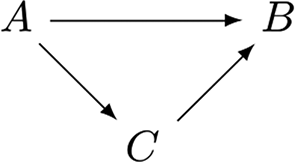
To illustrate how Spohn’s account is intended to work, suppose A is both a direct cause of B and an indirect cause of B through a third variable C (see the structure represented graph theoretically in fig. 1). (Since Spohn’s is an account of singular causation, we should think of fig. 1 as representing a token-cause structure relating values of specific variables in Spohn’s sense.) According to Spohn’s proposal, to capture the idea that A is a direct cause of B, we hold fixed the entire past before the effect B, except for A itself. This includes holding fixed C at its actual value since (we are assuming) C must be temporally prior to B if it causes B. If, under these conditions, A raises the epistemic status of B (e.g., is positively relevant to B), then A is a direct cause of B. It is worth noting, and Spohn explicitly observes, that an “interventionist” characterization of direct causation looks very similar. Woodward (Reference Woodward2003, 55), for example, characterizes a notion of “direct cause” roughly as follows.Footnote 1
(DC) X is a direct cause of Y with respect to some variable set V iff there is a possible intervention on X that will change Y (or the probability distribution of Y) when all other variables in V are held fixed at some value by interventions.
Applied to the example above, DC tells us to fix C at some value via an intervention—in the sort of case considered by Spohn its actual value will do—and then determine whether some distinct independent intervention on A will change the value of B. It will do so iff A is a direct cause of B. As it happens this is also sufficient for A’s taking its actual value to qualify as an “actual” or “singular cause” of B’s taking its actual value within an interventionist framework, at least on one characterization of “actual cause” (Woodward Reference Woodward2003).
Figure 1.

Despite this, there are, as intimated above and as Spohn is well aware, important differences between the interventionist framework and his own. One important difference is that the interventionist framework does not aspire to provide a reduction. This is a consequence both of the fact that the notion of intervention itself is a causal notion and for other reasons as well. By contrast, Spohn’s account is reductionist in aspiration. Roughly speaking, temporal information and assumptions about the relation between temporal and causal order play the role that explicitly causal assumptions play in the interventionist account—in particular, such assumptions tell us what we need to control for or hold fixed when we ask whether something is a direct (or any other kind of) cause. Spohn’s assumptions about the relationship between causal and temporal order also help to solve underdetermination problems that would otherwise imperil his reductionist project. Spohn argues that it is an advantage of his account that it provides such a reduction, thus avoiding the “circularity” that infects nonreductionist accounts.
3. Some Issues Raised by Spohn’s Account
Spohn’s appeal to temporal considerations raises several important issues that I can only discuss briefly. First, as Spohn is well aware, there is an obvious epistemological concern with this appeal—as he puts it, “it is impossible for us to know and take into account the whole past of the effect (unless we consider only very small frames).” One conclusion he draws is that “our causal judgment is always bound to be preliminary” (Spohn Reference Spohn2012, 360). He does not intend this merely as a claim about judgments of direct causation. That is, he does not mean merely that our judgment that A is a direct cause of B may change when we become aware of an additional variable C that lies on the only causal route from A to B, so that A is now judged to be an indirect cause of some kind for B but still a cause—perhaps a “contributing cause” in the framework of Woodward (Reference Woodward2003). Rather Spohn holds that, depending on the stock of variables we have available for characterizing the past of B, whether A causes B in any sense (directly or in some other way) can flip back and forth indefinitely as we consider more or less detailed descriptions of that past. It is only with reference to a properly behaved “universal” frame or a maximally detailed description of the past that such judgments will stabilize. And of course we usually and perhaps always do not have such a description. I will return to this issue below.
A second general issue is this: as Spohn is well aware, we often make (apparently reliable) causal judgments in the absence of the kind of temporal information to which he appeals, and we often make such inferences involving generic, nonspecific variables (rather than the “specific” variables and their values that Spohn prefers as causal relata). For example, causal modeling techniques often are applied to cross-sectional data in which we are given information about the distribution of various variables X, Y, Z in a population, perhaps observed at roughly the same time, but with no temporal information that would allow us to causally order these variables. Indeed, as a matter of the way in which they are defined and measured, many variables of interest to social and behavioral scientists may not have the kinds of temporal location that allows for the temporal ordering Spohn wishes to make use of—in other words, the appropriate temporal information may not be available for conceptual reasons, rather than merely as a consequence of our ignorance. As an illustration, consider data on individual health status and wealth at age 50. It is unclear in what sense, if any, one of these variables is temporally prior to the other, but we still might investigate their causal relation. Of course it might be claimed that it is always the case that “underlying” such variables are much more fine-grained causal relationships that are fully temporally ordered, but I would again emphasize that such information is often not epistemically accessible to investigators and that causal analysis is often carried out in the absence of such information. Indeed it is common in the causal modeling literature to employ nonrecursive causal models that contain causal cycles—the graphical representation is still in terms of directed arrows, but these arrows obviously cannot represent temporal priority.Footnote 2 In addition, sometimes the temporal scale on which it is possible to measure changes in variables of interest is much slower than the temporal scale that characterizes the causal dynamics among those variables, so that the former information is relatively uninformative about the latter. This is the case, for example, for fMRI measurements, which at present have a temporal resolution of 1–2 seconds, while the underlying brain dynamics often proceed on a much faster scale. Indeed, as Spohn is well aware, many of the standard frameworks for representing causal relationships and for causal inference—structural equations and directed graphs and the representations and inference procedures described by Pearl and in Spirtes, Glymour, and Scheines (Reference Spirtes, Glymour and Scheines2000)—make little or no use of temporal information. Relatedly, in actual applications, the target of such techniques is rarely particular singular causal relations (the causal relationship between Spohn’s income and his son’s educational attainment or between Jones’s smoking and his lung cancer) but rather causal claims that are much more generic—for example, the causal relation between parental income and son’s educational attainment or between smoking and lung cancer in some population.Footnote 3
Spohn is, as I have said, fully aware of these points—indeed precisely because standard causal modeling techniques abstract away from temporal information and do not in standard applications yield information about singular causal relationships he regards them as unsatisfactory as a foundation or starting point for a philosophical account of causation. I assume that for Spohn part of the attraction of focusing on singular causal claims is that it may seem prima facie plausible that for each individual causal episode described by a singular causal claim, there is some determinate temporal relationship between cause, effect, and whatever else is going on in the system of interest, even if we do not know this information. This is less obviously true when we move to more “type-level” causal claims.
It is also worth noting that in taking “singular causation” as his starting point, Spohn inclines to one side of a standard divide in the literature on causation. Philosophers with a more metaphysical orientation tend to regard singular or “actual” causation as primary and the target on which accounts of causation should focus, as one sees, for example, in Paul and Hall (Reference Paul and Hall2013). Those with a more philosophy of science or methodological orientation, like me, focus instead on more type-level causal notions, such as those that are the target in standard causal modeling techniques. Although the relation between these two notions has received some philosophical attention, it remains, in my view, underexplored, as do the implications of selecting one of these notions rather than the other as a starting point.
In support of maintaining at least some focus on the latter—the type-level notions—let me make the following observations. First, a great deal of scientific inquiry has one or another sort of type-level or generic causal claim as its target. In my opinion it is thus a reasonable project for the philosopher or methodologist to try to understand both these more generic claims and the procedures that are used to establish them (and, when appropriate, to make suggestions for their improvement). Although scientists and engineers are sometimes interested in singular causal claims about particular events (e.g., What caused the Challenger disaster?), more commonly, in both the social and natural sciences, their interest is in causal relationships that are more generic and repeatable (What causes the tides? What is the effect of economic conditions during a US president’s first term on his or her reelection prospects?). Standard causal modeling techniques are designed to answer such questions, not to assess the truth of particular singular causal claims, so it is not surprising that they cannot be straightforwardly used to address foundational issues about the latter.Footnote 4 That they cannot be so used may not reflect any fundamental inadequacy in these techniques but rather merely that they are directed at different targets than the assessment of singular causal claims. It also seems to me that such modeling techniques are at least sometimes successful in reliably establishing generic causal claims and that they sometimes succeed in the absence of the kind of temporal information to which Spohn’s account of causation appeals. It is also worth noting that Spohn does not try to argue that all such applications always yield unreliable conclusions.
A closely related point is this: reliably assessing singular causal claims is often very difficult and in many cases requires a lot of information that may be difficult to get and that may not be required to establish more type-level or generic claims. It is one thing to show that smoking causes lung cancer or is causing lung cancer in some population and another matter—much harder—to show of some particular person, Jones, who smoked and developed lung cancer, that his smoking caused his lung cancer. (Indeed even estimating the proportion of subjects in a population whose illness has been caused by exposure to a particular cause, such as smoking, typically requires a great deal of nonstatistical “biologic” information that may not be available—a problem well known to epidemiologists under the heading of estimating “etiological fractions.”) In general the problem of inferring “forward” to identify the effects of a cause (e.g., discovering that lung cancer is among the effects of smoking) is very different from the problem of inferring “backward” from an observed effect to its causes, particularly when the effect is a particular episode (e.g., observing that Jones has lung cancer and identifying what caused this), which is typically what is at issue when establishing a singular causal claim. These two problems (identifying the effects of causes and identifying the causes of some particular outcome) require different kinds of information for their solution, a point recognized by a number of methodologists. An additional reason why social scientists and others often focus on more generic or type-level claims rather than singular causal claims is thus that in many cases they may have information that enables them to establish the former but not the latter.
4. Causal Order from Nontemporal Information
In my remarks above, I raised the general issue of the relation between causal and temporal order. In this section I want to very briefly describe some procedures for inferring causal order in the absence of temporal information, both because I think they are of interest for their own sake and because they suggest the possibility of an account of at least some kinds of causal judgment that is less reliant on temporal information than Spohn’s. (Spohn [Reference Spohn2012, 341] says that he cannot imagine how one might proceed in constructing an account of causation without relying on information about temporal ordering—well, here are some possibilities.) I should also say at the outset that what I will describe does not yield anything like a definition of causal direction—for one thing the procedures are fallible and do not always work. In this respect they are arguably similar in status to other causal inference procedures that make use of assumptions such as the causal Markov and faithfulness conditions.
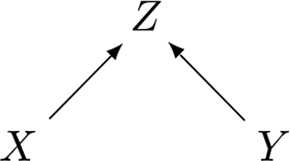
The first example is a very simple one suggested by the inference procedures described in Spirtes et al. (Reference Spirtes, Glymour and Scheines2000). It requires both the causal Markov condition and faithfulness as assumptions. Suppose that  ,
 ,
 ,
 , where
 means probabilistic independence,
 means probabilistic dependence, and
 means that X and Y are independent conditional on Z. It turns out that given Markov and faithfulness there is exactly one structure that is consistent with these conditions—a so-called unshielded collider structure (see fig. 2).
Figure 2.

Thus, given the above assumptions, in this particular case dependence and independence information is sufficient to fix causal ordering among the variables in the absence of temporal information. Of course it is not true that in all cases statistical information, even assuming Markov and faithfulness, will yield a single unique graph or a unique orientation for the edges. But examples like the one above do show that statistical information, in the presence of other assumptions (assumptions to which Spohn is sympathetic), can sometimes settle questions of causal direction/priority even in the absence of temporal information.
Next consider two examples from machine learning (e.g., Janzing et al. Reference Janzing, Mooij, Zhang, Lemeire, Zscheischler, Daniusis, Steudel and Schölkopf2012). Suppose (i) Y can be written as a function of X plus an additive error term that is independent of X:  with
 . Then if the distribution is non-Gaussian, one can show that there is no such additive error model from Y to X—that is, no model in which (ii) X can be written as
 with
 . A natural suggestion is that to determine the correct causal direction, one should proceed by determining which (if either) of i or ii holds, with the correct causal direction being one in which the cause is independent of the error. Remarkably, this yields results that are accurate in a majority of cases (70%–80%) when applied to real world data in which causal direction is independently known. This success is not magic—although I lack the space for detailed discussion, it has an explanation in interventionist terms. When
 this indicates that there is a source of variation (U) in Y that is independent of the variation in X, which is just what we would expect if X causes Y.
Another idea, which does not appeal to considerations about error term independence, is this: Suppose X and Y are statistically dependent. If the causal direction runs as X → Y, then we should expect that the function f describing this relationship ( ) will be “independent” of the (marginal) distribution of X—independent either in the sense that we can observe f apparently changing independently of p(X) or p(X) changing independently of f Footnote 5 or that f is “informationally” independent of p(X) in the sense of Kolmogorov information. If we find that this is the case and that the corresponding claim is not true of the inverse relationship
 , then we conclude that X causes Y. Again, as an empirical matter, this yields fairly reliable conclusions when applied to real world data in which causal direction is independently known. This idea also has a natural rationale within an interventionist framework: if there is a causal relationship running from X to Y, then we should expect that relationship to be stable or invariant under variations in the value of X or the probability distribution of X, but we have no such expectations for the relationship
 . Informational independence between f and p(X) is one source of evidence that f is invariant in this way.Footnote 6
Although, none of these procedures is 100% reliable, I believe they work because they pick up on deep features that causal relationships have—features gestured at above. They provide concrete illustrations of what I had in mind when I said above that there are features of causal relationships that are independent of temporal information that are relevant to causal direction.
5. Causal Relativity
Let me next return to an issue that I raised earlier concerning the “relativity” of causal claims. As noted above, on Spohn’s treatment, causal claims are ‘relative’ both to choice of a ranking function and to choice of a “frame” U, which for our purposes we can think of as roughly the variables used to characterize the claim and the surrounding system or circumstances. I will not comment on the former issue except to note that according to Spohn the subjectivity associated with choice of a ranking function can be mitigated by means of what he calls “objectification.” I do, however, want to comment on the second issue and in particular on Spohn’s discussion of the frame relativity of causal dependence. To save time I will not go into the details of Spohn’s definition of one variable causally depending on another (this is a bit different from his notion of direct causation described earlier), except to say that he proceeds by first characterizing direct causal dependence (which is a natural extension of his characterization of direct causation applied to variables) and then characterizes causal dependence as the transitive closure of direct causal dependence. Spohn explicitly acknowledges that both definitions offer only a frame-relative definition of causal dependence (and that this seems prima facie troubling), writing: “direct causal dependence is frame-relative not only due to possible omissions of mediating variables, but also because of incomplete representations of circumstances, and this point carries over to causal dependence as well. This seems to be an unacceptable consequence; there is no such frame-relativity in our ordinary notion of causal dependence, not even in a hidden way” (Reference Spohn2012, 394). He adds, “I agree that we have an absolute notion of causal dependence. What I want to argue, though, is that we can gain an understanding of that absolute notion only through the frame-relative one” (394).
His characterization of this absolute notion appeals to the notion of “the universal conceptual frame,” comprising “all variables whatsoever.” He makes this explicit with the following proposal:
Explanation 14.39: Y causally depends on X (simpliciter) if Y causally depends on X within the universal frame (and relative to a true ranking function on the universal frame).
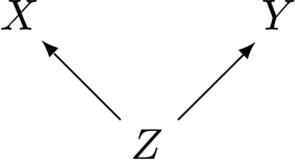
To get a handle on this, consider the structures in figures 3 and 4 (396). Spohn says in this case that figure 3 “reduces to” figure 4. He then makes the following assertion (397):
Assertion 14.42: Assuming universal faithfulness,Footnote 7  within any given frame means, in absolute terms that Y causally depends on X or that X precedes Y and is causally joined with Y.
“Causally joined” refers, roughly, to cases in which a dependency holds between two variables X and Y in virtue of a shared causal ancestor, but neither X nor Y causes the other.
Figure 3.

Figure 4.

I am inclined to say that the (nonuniversal) frame-relative notion (and the arrow that Spohn uses to represent this) is not a notion of causal dependence at all (at least as I would understand the notion) but (at least in a probabilistic setting) something more like a notion of probabilistic relevance that does not disappear when one conditions on certain other variables in one’s frame—in other words, it is a variety of conditional dependence. Thus, in figure 4 the arrow seems to mean simply that X and Y are statistically dependent or positively correlated (and that X precedes Y), where this may be because X causes Y or because X and Y are joint effects of a common cause, as in figure 3. The arrow from X to Y in figure 4 disappears in figure 3 because X and Y are not dependent conditional on Z.
Now it is uncontroversial that probabilistic dependence and independence relations, conditional and unconditional, are always “relative” to a variable set: X and Y can be unconditionally dependent, independent conditional on a third variable Z, dependent again conditional on both Z and a fourth variable W, and so on. But many think that causal relationships are different from relationships of conditional dependence and that we should not expect the former to be variable or frame relative in quite the same way as the latter.
As an alternative, consider how one might think about figures 3 and 4 within an interventionist framework. Here the basic idea is that X causes Y in background circumstances B iff there is some intervention on X that is associated with a change in the value of Y. An intervention I is an idealized unconfounded experimental manipulation—one way of realizing an intervention is by means of a randomized experiment (for details, see Woodward Reference Woodward2003). I emphasize that whether I counts as an intervention is not a variable-relative notion (see below).
Suppose one is faced with a situation in which what one knows is represented just by figure 4 in Spohn’s example—X and Y are dependent and one does not know about Z. An intervention on X will nonetheless involve a manipulation of X that is independent of Z—an intervention on X puts X entirely under the control of the intervention and manipulates X in a way that is uncorrelated with Z—this is part of the definition of an intervention and also what is achieved by a properly conducted randomized experiment. One of the virtues of such an experiment is that one does not have to know about the existence of Z or how it is related to X and Y to carry out a random assignment of values to X. Roughly all that one has to know is that the randomizing device is causally independent of any factors such as Z that might act as confounders for the X-Y relationship. Suppose that under all such interventions on X, Y does not change.Footnote 8 Then we may conclude, within an interventionist framework, that X is not, in one sense, a cause of Y (X is not what Woodward calls a total cause of Y), and, assuming faithfulness, one can also conclude that X is not a direct or contributing cause of Y. If an arrow from X to Y is interpreted to mean that X directly causes Y, figure 4 is, on an interventionist account of direct cause, simply a mistaken representation of the causal facts. Further, if it is also the case that Y does not change under any interventions on X, and that X changes under interventions on Z, with Y fixed and similarly for X and Y interchanged, then we may conclude that figure 3 is the correct structure. Note that, within the interventionist framework, these conclusions are not understood as variable-relative claims—we do not say that figure 4 is correct relative to the variables X, Y, and figure 3 is correct relative to the variables X, Y, Z.
In correspondence, Spohn has suggested that this characterization of the frame-relative features of his view (and the implied opposition between his view and interventionism) is misleading. On his view, it is true in one sense that in order to ascertain with full belief or confidence whether some causal claim is true, we would have to carry out the full extension to the universal frame. However, viewed from another perspective, this just amounts to an expression of fallibilism about the claim in question—an acknowledgment of the logical possibility that the belief might be mistaken. In other words, it is only in the sense that we have to acknowledge the possibility that any of our empirical a posteriori beliefs may turn out to be mistaken that we must also acknowledge the possibility that our causal beliefs about the relation between X and Y may flip back and forth between dependence and independence as we add more information, only stabilizing when (if ever) we reach the universal frame.
Let me conclude by suggesting a somewhat different perspective on all this. It seems clear, as a matter of empirical fact, that in many cases our beliefs about causal relationships do not exhibit the kind of radical instability (flipping back and forth from dependence to independence) countenanced by Spohn as an in-principle possibility. Putting matters in terms of Spohn’s notion of a universal frame, it looks as though we can sometimes reliably figure out from the information we currently have that further information about the (currently unknown) details of the universal frame is unlikely to change our present causal beliefs. This in turn suggests further questions: What features of the procedures by which we form our causal beliefs (and what features of the natural world) sometimes make it possible for us to reach conclusions that are stable in this way? My suggestion is that randomization (and arguably experimentation itself) can be thought of along these lines: thinking in terms of the universal frame, the results of the randomization tell us something that must be true in that frame (that if Y is associated with randomized X, there is no confounding Z in the universal frame) but not by telling us anything in detail about what is in it. There are other strategies with similar virtues.