

INTRODUCTION
Land uses that take the place of pristine tropical forests are particularly important in terms of global biodiversity since species numbers in tropical forests are so high (see Groombridge & Jenkins Reference Groombridge and Jenkins2000), and many areas where such land uses prevail (such as Indonesia, the Caribbean or Southern India) are within biodiversity hotspots (Myers et al. Reference Myers, Mittermeier, Mittermeier, Fonseca and Kent2000). Conservationists are naturally interested in the reactions of wildlife to major land-use changes in the tropics, and there have been recent reviews of the impacts on biodiversity of selective logging (Johns Reference Johns2004), the generally large-scale production of the world's major agricultural commodities (Donald Reference Donald2004) and production of shaded coffee and cacao (Komar Reference Komar2006; Schroth & Harvey Reference Schroth and Harvey2007).
Small-scale agricultural systems (hereafter ‘agroforests’) are hugely important land uses in the tropics. Indonesian jungle rubber gardens alone cover at least 2 million ha, and durian agroforests over 3% (1.5 Mha) of Sumatra (Thiollay Reference Thiollay1995). As well as occupying huge swathes of land and sustaining large numbers of people, most protected areas in the tropics are occupied by indigenous people (Nepal Reference Nepal2002; Harvey et al. Reference Harvey, Gonzalez and Somarriba2006), making it essential for conservationists to understand the impacts of the small-scale agriculture they practise.
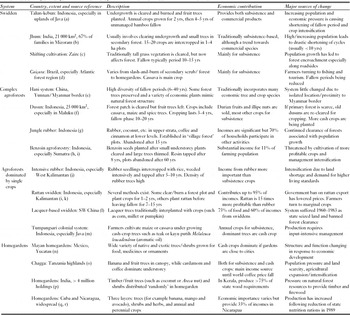
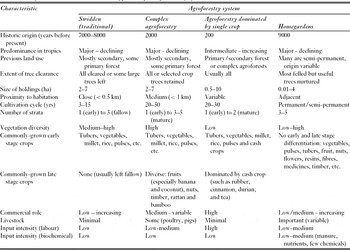
There is a substantial diversity of small-scale agroforests throughout the tropics (Table 1). Such is their diversity that they share few universal facets; they are practised over small spatial scales (0.01 to 5 ha), tended by low-income farmers, generally biodiverse and usually low-input (Michon & de Foresta Reference Michon, de Foresta, Kheong and Win1991). Several attempts have been made to classify and characterize small-scale agroforestry systems (see Fujisaka et al. Reference Fujisaka, Hurtado and Uribe1996; Kehlenbeck & Maass Reference Kehlenbeck and Maass2004; Kumar & Nair Reference Kumar and Nair2004), and while it is not our intention specifically to undertake such an analysis, we first describe the characteristics of the three major agroforestry types that we cover in this study (Tables 1 and 2), namely (1) shifting cultivation/swidden/slash-and-burn agrosystems, (2) complex agrosystems or forest gardens and (3) homegardens.
Descriptions of the major tropical agroforest types and their economic roles. The list is not comprehensive but includes some major systems and variants. Sources: (a) Christanty et al. (Reference Christanty, Abdoellah, Marten, Iskandar and Marten1986), (b) Shankar Raman et al. (Reference Shankar Raman, Rawat and Johnsingh1998), (c) Wilkie & Finn (Reference Wilkie and Finn1990), (d) Albuquerque et al. (Reference Albuquerque, Andrade and Caballero2005), (e) Wang & Young (Reference Wang and Young2003), (f) Kaya et al. (Reference Kaya, Kammesheidt and Weidelt2002), (g) Gouyon et al. (Reference Gouyon, de Foresta and Levang1993), (h) Garcia-Fernandez et al. (Reference Garcia-Fernandez, Casado and Ruiz Perez2003), (i) Garcia-Fernandez & Casado (Reference Garcia-Fernandez and Casado2005), (j) Lawrence (Reference Lawrence1996), (k) Safran & Godoy (Reference Safran and Godoy1993), (l) Long et al. (Reference Long, Cai, Marr, Guo and Ouyang2003), (m) Budiadi et al. (Reference Budiadi, Ishii, Sabarnurdin and Suryanto2005), (n) Rico-Gray et al. (Reference Rico-Gray, Garciafranco, Chemas, Puch and Sima1990), (o) Hemp (Reference Hemp2006), (p) Kumar et al. (Reference Kumar, George and Chinnamani1994), (q) Mendez et al. (Reference Mendez, Lok and Somarriba2001) and (r) Wezel & Bender (Reference Wezel and Bender2003).

Origins, characteristics and roles of ‘typical’ tropical agroforestry systems.

Shifting cultivation/swidden/slash-and-burn is practised by at least 240 million people in the humid tropics (Attiwill Reference Attiwill1994), swidden agriculture involves clearing and burning all or most vegetation except large trees from small plots of land, and growing a variety of annuals. With dropping fertility and the increased incidence of weeds and pests, the cultivator moves to a new plot to repeat the cycle, traditionally leaving the original fallow for a period (Uhl Reference Uhl1987). In some systems, banana, oil palm or bamboo are planted or otherwise promoted during this fallow period.
Complex agroforestry systems (Tables 1 and 2) are extensions of the basic swidden systems. Tree seedlings are co-planted (or transplanted after 1–2 years) with the annual crops, and either left in a classic fallow (for example rattan) or maintained in an annual-perennial association (for example damar-coffee). The trees become productive after 8–10 years (the tree phase, managed), and remain so for 25–50 years, after which the land is cleared and the cycle repeated. Complex agroforests are often similar in structure, function and ecological complexity to primary forests (Michon & de Foresta Reference Michon, de Foresta, Halladay and Gilmour1995), and some variants are extremely diverse in trees. For example, in Java, 607 crop species are cultivated within agroforests, a richness similar to that of the original forest (Dover & Talbot Reference Dover and Talbot1987). Some systems, although retaining their small size, have become dominated by a single crop or just a few crops, often grown commercially alongside minor subsistence crops (for example the jungle rubber and cinnamon-rice ladang systems of Indonesia; Table 1).
Homegardens, including kitchen, orchard, mixed or doorstep gardens, are pieces of agricultural land with distinct boundaries, usually near a house, ranging in size from 0.01 to 4.0 ha but typically around 0.5 ha (Fernandes & Nair Reference Fernandes and Nair1986). They are semi-permanent and more intensively managed than forest gardens (Wiersum Reference Wiersum2004), and yet have been considered the most biodiverse and complex of any agroecosystem (Swift & Anderson Reference Swift, Anderson, Schulze and Mooney1994). As with complex agroforests, homegardens contain three basic vegetative strata (Fernandes & Nair Reference Fernandes and Nair1986).
The conservation importance of agroforests is becoming increasingly recognized, with a growing number of studies comparing the biodiversity of primary forest to regenerating and/or agricultural land uses (Lawton et al. Reference Lawton, Bignell, Bolton, Bloemers, Eggleton, Hammond, Hodda, Holt, Larsen, Mawdsley, Stork, Shrivastava and Watt1998). While many concur that small-scale tropical agriculture is generally detrimental to biodiversity (Myers Reference Myers1991), and agricultural intensification is a major cause of global land-use change (Matson et al. Reference Matson, Parton, Power and Swift1997), forest clearance interspersed with long fallow periods might mimic natural small-scale high-intensity forest disturbances (Shankar Raman et al. Reference Shankar Raman, Rawat and Johnsingh1998). Further, agroforests may be a sustainable form of land use (Andrade & Rubio-Torgler Reference Andrade and Rubio-Torgler1994) that may actually enhance biodiversity at the landscape scale by creating new habitats (Kricher & Davis Reference Kricher, Davis, Hagan and Johnston1992). Agroforestry has been championed as a way to involve modified habitats in conservation strategies (Padoch & Peters Reference Padoch, Peters, Potter, Cohen and Janczewski1993), as a viable system for reducing pressure on remaining forests (Michon & de Foresta Reference Michon, de Foresta, Kheong and Win1991) by representing a ‘forest-analagous’ midway point between plantation monocultures and primary forests (Cullen et al. Reference Cullen, Schmink, Padua and Morato2001).
The aim of this review is to bring together the results of scientific studies on the effects of a range of agroforestry systems on tropical plants and animals to answer the following four questions. (1) Is there a consistent pattern of biodiversity change associated with conversion of forest to agroforestry systems? (2) Which factors most influence the degree of biodiversity change associated with different agroforestry systems? (3) Can we identify the characteristics of taxa most affected? (4) Can we identify the changes in small-scale agroforestry practices that will drive future changes in tropical biodiversity?
METHODS
We completed an extensive search for published studies that compared species richness, evenness or diversity indices, or species' abundances between primary forest and small-scale agricultural habitats, or across agroecosystems. We also searched for papers that compared bird species richness between primary forest and a series of agricultural land uses, namely recently (< 8 years) selectively logged forests, monocultural arboreal plantations, monocultural non-arboreal crops (such as rice and sugar cane), and shaded and unshaded cacao or coffee. We searched through papers listed on Web of Science and Scirus using the keywords (either singularly or in various combinations), agriculture, forest, biodiversity, richness, disturbance, tropical, homegardens, agroforestry, shifting agriculture and swidden, and then used the references cited within these papers to find other published studies. We also systematically searched the contents of the journal Agroforestry Systems, which focuses on agroecosystems. We used the information we obtained to address (1) differences in richness and abundance between primary forest and agroforests, (2) differences in richness and abundance between agroforestry types, (3) comparisons of β diversity across primary forest and agroforests and (4) life-history correlates of taxa/groups that decline or increase in agroforests.
We limited our search (Tables 1–3, see Supplementary material at http://www.ncl.ac.uk/icef/EC_Supplement.htm, Table S1) to agricultural systems practised on a small scale (usually ≤ 5 ha) which retain some trees during the cropping phase, have a regular fallow period following complete or partial tree clearance for cropping, have a tree crop phase after and/or during the non-fallow phase or have trees integrated into the permanent mixed agricultural plot. As such, we are dealing with swidden agriculture, homegardens and complex agroforests. We excluded studies of monocrop industrial-scale plantations, annual non-arboreal agriculture (Estrada et al. Reference Estrada, Coates Estrada and Meritt Jr1997) and grassland-based agroecosystems (Sinha et al. Reference Sinha, Hadauria, Ramarkrishnan, Saxena and Maikhuri2003). We also excluded studies that compared only crop diversity between agroforests (one exception was Kehlenbeck & Maass Reference Kehlenbeck and Maass2004, which also considered ornamentals and ‘weeds’), studies that considered only tree sprouts (Kammesheidt Reference Kammesheidt1998) and studies in which land-use description did not describe agricultural type adequately (Waltert et al. Reference Waltert, Bobo, Sainge, Fermon and Muhlenberg2005). Studies of coffee and cacao systems were excluded because there are extensive reviews of these systems already (Donald Reference Donald2004; Komar Reference Komar2006). Studies examining plant and animal diversity in mature secondary forests growing long after total abandonment of agriculture (i.e. that are not part of a regular fallow between successive swiddens) were not considered (see Brown & Lugo Reference Brown and Lugo1990; Corlett Reference Corlett1995).
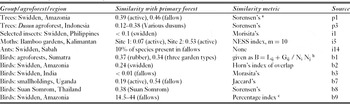
Species similarity measures between primary/intact forest and agroforests/fallows. Active indicates active agroforests, in all cases, fallow implies < 5 year since abandonment. Sources correspond to those in Table S1 (see Supplementary material at http://www.ncl.ac.uk/icef/EC_Supplement.htm). aCalculated from Fujisaka et al. (Reference Fujisaka, Escobar and Veneklaas1998), figure 2. bWhere Lij and Gij are the numbers of species lost and gained, and Ni and Nj are the numbers of species in communities i and j. cFollowing Wunderle et al. (Reference Wunderle, Diaz, Vlazquez and Scharron1987).

Our review focuses on land conversion to small scale agroforests and its influence on wildlife, other factors such as increased hunting (Naughton-Treves et al. Reference Naughton-Treves, Mena, Treves, Alvarez and Radeloff2003), pesticide use and predator control have not been the subject of so much research in the tropics and as such their impacts are acknowledged but are not dealt with in as much detail as changes in vegetation diversity and structure brought about by agriculture. If a paper recorded species richness/diversity measurements for vegetation as well as a target animal species, it was included in both the plant and animal sections (see Supplementary material at http://www.ncl.ac.uk/icef/EC_Supplement.htm, Table S1; Gillison et al. Reference Gillison, Jones, Susilo and Bignell2003).
HOW DOES THE BIODIVERSITY VALUE OF SMALL-SCALE AGROFORESTS COMPARE WITH PRIMARY FOREST?
We found 52 published studies comparing agroforests and/or fallow regrowth with primary or relatively mature forest (see Supplementary material at http://www.ncl.ac.uk/icef/EC_Supplement.htm, Table S1). Of these, 15 dealt with plants/trees, 12 with birds, eight with mammals, two with reptiles and 20 with invertebrates (some papers dealt with more than one group).
Species richness and composition
Of the 43 comparisons of species richness/diversity between currently-used agroforests or <10 yr fallows and intact forest, 34 reported lower species richness in agroforests (see Supplementary material at http://www.ncl.ac.uk/icef/EC_Supplement.htm, Table S1, plants: p1, p2, p3, p4, p6, p7, p8, x1; animals: i2, i3, i5, i6, i8, i10, i11, i13, i15, i16, i17, i18, r1, b1, b3, b5, b7, b8, m2, m4, m7, x1, x2). Proportions of studies of plants reporting reduced species richness (eight of 13) may be lower than that for invertebrates (14 of 17) and vertebrates (11 of 12) but any differences are difficult to test due to low number of studies and the prevalence of studies reporting richness declines in agroforests (meaning that some expected values are < 5). The only studies to report higher species richness in active agroforests were of plants in Sumatran jungle rubber (see Supplementary material at http://www.ncl.ac.uk/icef/EC_Supplement.htm, Table S1, p5), ferns (Sumatran jungle rubber; see Supplementary material at http://www.ncl.ac.uk/icef/EC_Supplement.htm, Table S1, p13) and frugivorous butterflies in Sulawesi swidden (see Supplementary material at http://www.ncl.ac.uk/icef/EC_Supplement.htm, Table S1, i4).
Of 24 studies which compared species richness along the gradient of disturbance/cultivation (active cultivation through new fallows to older fallows), 20 found that increases in species richness positively correlated with the regrowth gradient (see Supplementary material at http://www.ncl.ac.uk/icef/EC_Supplement.htm, Table S1, p1, p3, p4, p7, p8, x1, x2, i2, i7, i8, i15, i16, i17, i18, r1, b3, b5, b9, m2, m4). Exceptions (all found no correlation) were studies of plants in Indonesian agroforest fallows (p3), termites in Cameroon swidden fallows (i7), birds in Chinese fallows (b5) and understorey birds in Amazonian swidden fallows (b9).
Formal comparisons of β diversity across primary and agroforests are not as common as comparisons of α diversity, only 11 lent themselves to such comparisons (see Supplementary material at http://www.ncl.ac.uk/icef/EC_Supplement.htm, Table S1). While comparisons between studies using different similarity measures is difficult, most studies report very different species compositions between intact forest and active/recently abandoned agroforests, with often less than half of all species shared between habitat types (Table 3).
Life history correlates of species showing abundance shifts
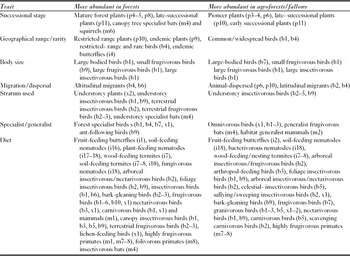
The sorts of species that decline or increase following agricultural land use change were far from easy to predict, but there are a few recurring trends in taxon responses (Table 4). For example, after forest clearance, obligate granivorous birds and open-habitat insectivores are particularly common, unsurprising given the growth of grasses found after disturbance. Also unsurprising is the generality that pioneer and early-successional plants win out over those of mature forest and late successional habitats. Amongst birds, terrestrial and some understorey species are among the most seriously affected, and this mirrors a general concern for such birds in the face of selective logging (see for example Thiollay Reference Thiollay1999; Cleary et al. Reference Cleary, Boyle, Setyawati, Anggraeni, Van Loon and Menken2007) and fragmentation (see Sekercioglu et al. Reference Sekercioglu, Ehrlich, Daily, Aygen, Goehring and Sandi2002). Declines were not, as with these forest changes, universal among agroforests, with five studies reporting increases among understorey insectivores (Table 4).
Life history traits reported to have higher or lower abundance in agroforests than in primary forest. Source codes (in brackets) correspond to those in Table S1 (see Supplementary material at http://www.ncl.ac.uk/icef/EC_Supplement.htm).

Traits associated with abundance shifts which are shared across widely differing taxa should be particularly important to identify. Perhaps most notable are declines among trees, butterflies and birds, of rare species, or species with limited geographical distribution, particularly endemics. To a lesser extent, a pattern also emerges with specialization across birds and mammals.
The greatest number of traits (Table 4) are associated with diet (especially among birds), although dietary width is rarely examined explicitly. Remarkably, 10 of the 20 dietary traits identified as being associated with species declining in agroforests were also reported to be associated within the same taxon with increases in agroforests. This indicates the great variety of species-specific responses to the changes produced by different agroforestry systems.
HOW AND WHY DOES BIODIVERSITY ‘VALUE’ VARY ACROSS AGROFORESTRY SYSTEMS?
We found 27 papers comparing the biodiversity value across different types of tropical agroforestry systems (see Supplementary material at http://www.ncl.ac.uk/icef/EC_Supplement.htm, Table S2). Thirteen of these papers were concerned with homegardens (permanent holdings), a much greater proportion than those comparing homegardens with primary forest (two from 52; χ21 = 22.7, p < 0.001). The majority (21 from 28, one paper dealt with both plants and animals) were concerned with plant taxa, a significantly higher proportion than those that compared primary forest and agroforests (χ21 = 18.2, p < 0.001). This may reflect a concentration on this issue by agro-ecologists rather than conservation biologists.
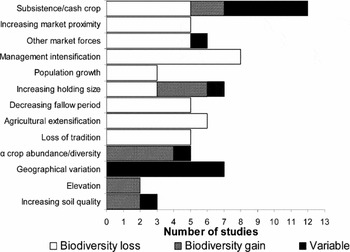
There was considerable ‘natural’ variation in biodiversity value across systems based on factors including geography, topography, altitude and microclimate (Fig. 1). Of the anthropogenic influences, increased prevalence of cash crops is the issue that has received most attention. It, along with increases in holding size and increasing soil quality, are the only factors that have been reported as associated with both a loss and gain in biodiversity (Fig. 1). Two from 12 papers identified higher biodiversity value in cash-crop orientated agroforests, although homegardens used for both functions were found to have higher diversity than those purely cultivated for subsistence (Mendez et al. Reference Mendez, Lok and Somarriba2001). The relationship between holding size and species richness is particularly complicated, due in part to differences in approach to measuring the latter. Studies have found variable results for different reasons. Kumar et al. (Reference Kumar, George and Chinnamani1994) found great variability between holdings but that small gardens had highest diversity, essentially because a range of activities were compacted in smaller holdings. In contrast, Rico-Gray et al. (Reference Rico-Gray, Garciafranco, Chemas, Puch and Sima1990) found only a weak relationship between garden size and diversity, this being swamped by uniqueness of holdings, which in turn reflects the cultural background and history of each owner. Padoch and de Jong (Reference Padoch and de Jong1991), Alburquerque et al. (Reference Attiwill2005) and Lamont et al. (Reference Lamont, Eshbaugh and Greenberg1999) drew similar conclusions, although in each case the complicating factors were reported to be different.
Factors influencing biodiversity values of agroecosystems as reported in reviewed papers.

Reactions to several other factors, including management intensification, agricultural extensification, market proximity, loss of tradition and shortening fallows have been reported to negatively impact biodiversity in at least six studies. While intensification generally, including weeding and removal of the understorey (see Garcia-Fernandez & Casado Reference Garcia-Fernandez and Casado2005), shortened fallow periods, agricultural homogenisation (see Thiollay Reference Thiollay1995), and restructuring of homegardens (see Michon & Mary Reference Michon, Mary, Landauer and Brazil1990) have strong and consistent negative impacts, it is difficult at present to assess which factor or factors might be key in reducing richness in agroforests. We did not find a study that compared across treatments to formally test whether, for example, understorey clearance was more detrimental than fallow shortening, or even whether there were multiplicative effects of one type of intensification on the detrimental effects of another.
Human population growth was cited as a direct cause of biodiversity loss in only two studies (Michon & Mary Reference Michon, Mary, Landauer and Brazil1990; Thiollay Reference Thiollay1995). Population growth may have indirect effects on agricultural landscapes (Rico-Gray et al. Reference Rico-Gray, Garciafranco, Chemas, Puch and Sima1990), spanning from the loss of traditional agroforestry as a land use (Parikesit et al. Reference Parikesit, Takeuchi, Tsunekawa and Abdoellah2004) to the isolation of agricultural plots from areas of intact forest (see for example Klein et al. Reference Klein, Steffan-Dewenter and Tscharntke2006). Agricultural extensification consistently depressed biodiversity values in agroforestry plots and influenced their floral/faunal communities (see Klein et al. Reference Klein, Steffan-Dewenter and Tscharntke2006).
DISCUSSION: AGROECOSYTEMS, AGRICULTURAL CHANGE AND BIODIVERSITY CONSERVATION
We could identify few generalities in response to agricultural disturbance across the plant and animal groups. One possible commonality may be the tendency for restricted-range and/or endemic species to be negatively affected by agroforestry. While this may not be a universal generality, it reflects patterns usually, but not always, found in studies of reactions of restricted-range taxa to other tropical land-use changes (Ghazoul Reference Ghazoul2002; Dumbrell & Hill Reference Dumbrell and Hill2005; Cleary & Mooers Reference Cleary and Mooers2006; Gray et al. Reference Gray, Baldauf, Mayhew and Hill2007; contra Cleary et al. Reference Cleary, Boyle, Setyawati, Anggraeni, Van Loon and Menken2007).
One reason for the lack of patterns may be that the changes in vegetation associated with the many types of small-scale agriculture are so diverse that they mask species' reactions. In fact, several characteristics (such as frugivory in butterflies, birds and primates, and wood-feeding in termites) have been identified as being associated with both declines and increases in different studies. Clearly there are gaps in knowledge, characteristics are difficult to compare across studies and regions, and are complicated by taxonomic influences. We see limited potential in the usefulness of indicator species/groups for assessing impacts of small-scale agriculture disturbances, except perhaps at a local scale with groups such as Pyraloid moths (Fiedler & Schulze Reference Fiedler and Schulze2004), nematode communities (Pate et al. Reference Pate, Ndiaye, Thioulouse, Villenave, Bongers, Cadet and Debouzie2000) and bats (Medellín et al. Reference Medellín, Equihua and Amin2000).
An array of biophysical and socioeconomic factors has been found to influence variability in biodiversity retention rates across agroforests. By far the most important detrimental influence has been agricultural commercialization in the form of intensification of management regime, market forces and distance of a holding to markets (Fig. 1; see also Perfecto et al. Reference Perfecto, Rice, Greenberg and Van Der Voort1996; Rice & Greenberg Reference Rice and Greenberg2000). Influences may be direct, for example through increased weeding or intensive planting regimes (Lawrence Reference Lawrence1996), or indirect, such as provision of more favourable circumstances for rich farmers to cultivate high value cash crops (for example the ‘teak boom’; Kumar et al. Reference Kumar, George and Chinnamani1994). Either way, such intensification is often associated with structural simplification (Michon & Mary Reference Michon, Mary, Landauer and Brazil1990; Garcia-Fernandez & Casado Reference Garcia-Fernandez and Casado2005), which may ultimately lead to a reduction in heterogeneity at various spatial scales. Such an association between ‘multivariate agricultural intensification’ and homogenization of landscape structure is echoed in temperate agroecosystems (Benton et al. Reference Benton, Vickery and Wilson2003). It is important to note that cash cropping does not necessarily reduce biodiversity. Dual-purpose homegardens can have higher plant diversity than subsistence-only homegardens (Mendez et al. Reference Mendez, Lok and Somarriba2001), while distinguishing between the impacts of growing cash crops from the complex dynamics associated with commercialization within an agricultural landscape is difficult. In addition, although market proximity has been linked with deforestation (Mertens et al. Reference Mertens, Sunderlin, Ndoye and Lambin2000), remote homegardens can have lower biodiversity than those close to urban centres (Wezel & Ohl Reference Wezel and Ohl2005).
Importantly, only two studies cited the direct detrimental effect of population pressure, supporting previous assertions that population growth is never the exclusive, or even primary cause, of forest-cover change (Angelsen & Kaimowitz Reference Angelsen and Kaimowitz1999; Geist & Lambin Reference Geist and Lambin2001). Increasing holding size though, which has been linked with decreases in species richness (Gajaseni & Gajaseni Reference Gajaseni and Gajaseni1999) as well as increases (Lamont et al. Reference Lamont, Eshbaugh and Greenberg1999), may be a function of human population density (Kumar et al. Reference Kumar, George and Chinnamani1994).
It may not always be actual habitat changes that drive the species richness and compositional changes in agroforests. Other factors such as changed hunting patterns (termed ‘garden hunting’ by Linares Reference Linares1976), pesticide use and predator control may have significant concurrent influences on the faunas of tropical agricultural lands just as they may do in temperate agricultural systems (Beecher et al. Reference Beecher, Johnson, Brandle, Case and Young2002; Donald et al. Reference Donald, Evans, Muirhead, Buckingham, Kirby and Schmitt2002). Ecosystem services most likely to be affected by agricultural intensification include decomposition processes, pollination, crop production and pest control (Altieri Reference Altieri1999; Schläpfer et al. Reference Schläpfer, Schmid and Seidl1999; Tilman et al. Reference Tilman, Cassman, Matson, Naylor and Polasky2002). In fact, hunting patterns are seen in some systems/taxa to be more important than habitat change in determining biomass or species richness in agroforests (Naughton-Treves et al. Reference Naughton-Treves, Mena, Treves, Alvarez and Radeloff2003). Additionally, some areas that have been cleared for agroforests may have high levels of biodiversity simply because they had high levels of biodiversity before clearance. Such natural geographical variation may swamp the changes brought about by land-use change (Jones et al. Reference Jones, Susilo, Bignell, Hardiwinoto, Gillison and Eggleton2003). It is also possible that the full effects of land-use change and agricultural intensification will not be apparent for many years after changes occur owing to long-term relaxation of species number due to increased local extinction rates (Brooks et al. Reference Brooks, Pimm and Oyugi1999).
Of course agroforests are not just important in conservation systems because of their retention of biodiversity. Homegardens provide an important model for the design of sustainable agricultural systems, being characterized by efficient nutrient cycling, minimal external inputs and potential for soil conservation (Torquebiau Reference Torquebiau1992; Jensen Reference Jensen1993; Gliessman Reference Gliessman1998), as well as high biodiversity values. Traditional agroforestry systems are known to provide stable buffer zone habitat around conservation forests (Michon et al. Reference Michon, Mary and Bompard1986), serve as corridors for wildlife (Daily & Erlich Reference Daily and Ehrlich1995), contribute to in situ conservation of biodiversity, genetic resources and evolutionary processes (Padoch & Peters Reference Padoch, Peters, Potter, Cohen and Janczewski1993), and, most fundamentally, support and improve rural livelihoods (Michon & de Foresta Reference Michon, de Foresta, Kheong and Win1991).
There is scope in principle for adjusting agroforestry regimes to increase their biological value generally or to create habitats for individual taxa, and recently there has been a surge of interest in the potential role of agricultural landscapes in biodiversity conservation (Halladay & Gilmour Reference Halladay and Gilmour1995; Vandermeer & Perfecto Reference Vandermeer and Perfecto1997). Agroforests such as the Indonesian dusun (see Table 1) retain remarkably high species diversity and it is conceivable that landscapes which contain an array of dusun holdings, rattan agroforests or traditional Javan homegardens set within a mosaic that includes much remnant forest should be amongst the most biodiverse landscapes in the tropics. However, most agroforests fall short of this highly diverse model for many reasons, not least the biological requirements of the dominant crop. For example, species richness was higher in rattan-dominated agriculture in Indonesia than in benzoin agriculture (Table 1) primarily because the former requires less intensive understorey management than the latter (Garcia-Fernandez & Casado Reference Garcia-Fernandez and Casado2005).
Especially welcome, in terms of ecological research, would be studies comparing the value of different agricultural regimes for taxa other than plants (21 from 28 studies dealt with plants alone). We found no studies of mammals and this seems an unusual bias. There was also a general lack of herpetefaunal research (only two papers) and invertebrate studies were rare given insect diversity. Few studies of the conservation value of agricultural habitats have assessed the reproductive output of such habitats compared to primary habitats (Naidoo Reference Naidoo2004). While the densities of parrots and hornbills in agroforests was high due to high local fruit availability, nest site densities were much lower than in adjacent primary forest (Marsden & Pilgrim Reference Marsden and Pilgrim2003b). Such work shows that natural and anthropogenic habitats can serve different functions for a given species/community, so it may be crucial to investigate further how differences in agricultural mosaics, their scale and geographic layout, influence species' ability to survive in numbers across human-dominated landscapes.