1. Introduction
How can institutions be copied into societies lacking them? While there is a huge literature on institutions and long-run economic development, we know little about what kind of institutional reform actually works in a particular setting. Many institutional reforms include an element of copying from more developed countries – in fact importing foreign institutions. Experience shows that institutional copying is likely to fail. Not least in Africa, the practice has often created the illusion of a reform – formal institutions being in place but with few of the expected benefits (Grindle, Reference Grindle2004; Rodrik, Reference Rodrik2008).
The literature on institutional copying and on diffusion has risen to the task of explaining these failures. This paper advances these concepts by distinguishing between the transfer of formal institutions and that of informal institutions. The distinction manifests itself along the requirements for time and for human resources. Copying formal institutions (such as a body of law) is a technical activity. It literally involves copying legal text and translating it into the language and the legal environment of the receiving country. Depending on size and complexity this can be done in a matter of months. Informal norms, on which the law rests in the originating society, need more time to be effectively transferred. Because local norms and customs and change very slowly, there is a latency in the transfer of informal norms (Williamson, Reference Williamson2000: 596–7). In terms of human resources, creating formal institutions on the model of another country requires of handful of skilled legal experts, who can be locals or expatriates. This paper argues that the successful copying of informal norms, i.e. the tradition on which most formal institutions rest in the originating society, warrants a large number of members from the country of origin. A specific legal or technical expertise is less of an issue here. Rather, the physical presence of expatriates from the originating country mediates how the formally established institution are ‘played’ under the conditions of the receiving country. In analogy to Robert Merton's seminal work this could be called a ‘reference group effect’ in institutional copying (Merton, Reference Merton1968).
The article provides anecdotal evidence for both the reference group effect and the latency of transferred informal institution. The period of investigation is the decolonization of British Africa. I argue that both effects explain some of the variation in the governance of former African coloniesFootnote 1 today.
Institutional copying and governance in British Africa
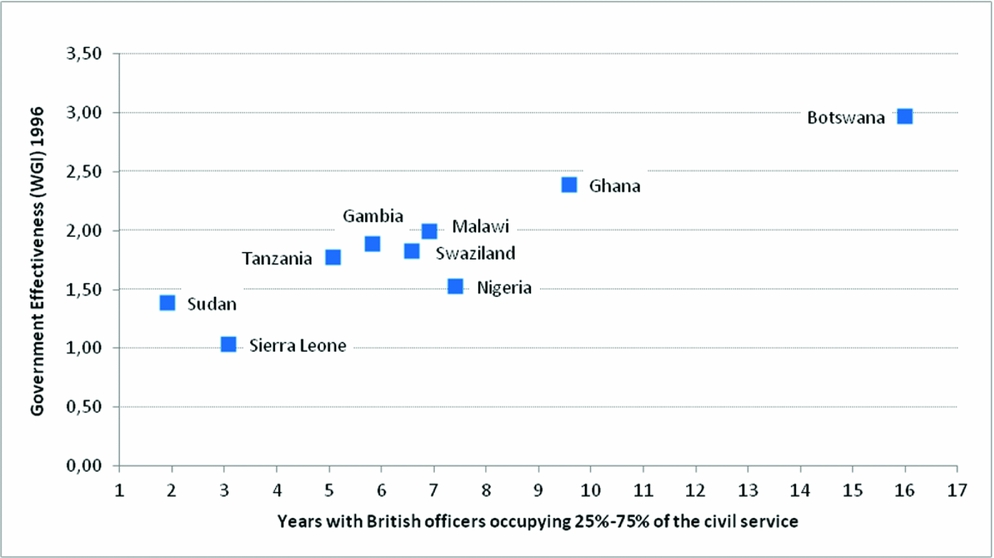
Until 1945, the British ruled their African territories with a ‘thin white line’ of expatriate officers who saw their priorities as maintaining peace and order and collecting taxes (Kirk-Greene, Reference Kirk-Greene1980). The size and the structure of colonial administrations changed substantially in the 1950s when the British intensified state building in the colonies. Preparations for independence usually accelerated in the last five years prior to independence (Lee, Reference Lee1967: 205). The paper's analysis is based on this late period and on a sample of nine out of the 15 British territories in Africa (see Appendix 1). All of them had peaceful transitions. All ‘overseas’ officers had been centrally recruited via the Colonial Office in London.Footnote 2 Localization, i.e. replacing British expatriate officers by African colleagues within the overseas service, started a few years before independence.Footnote 3 There was substantial variation in the speed of localization among African colonies. Sudan localized practically all of its British officers in the two years prior to independence. At the other extreme, Botswana had more than 25% expatriates employed in the civil service 14 years after independence. The length of time expatriates occupied senior posts is related to the quality of the civil services today. Figure 1 illustrates this connection.
Presence of British civil servants in former colonies and government effectiveness in 1996

The quality of governance of nine former British colonies three decades after independence is measured on the vertical axis.Footnote 4 The horizontal axis displays the number of years in which the share of British officers in the civil service remained above 25%. The connection is positive. Those former colonies that retained British officers for longer rank higher in terms of modern-day governance. Figure 1 illustrates this for the whole period of localization, i.e. the number of years in which British officers counted between 25% and 75% of the civil service. The association remains unchanged as long as the British retain a minimum share of 25%. It arises regardless of whether British staff were in the majority (between 50% and 75%) of the civil service or in the minority (between 25% and 50%).Footnote 5
The variation in the length of time that British officers remained in service can be explained by a natural experiment set around the compensation payments for the loss of careers. The problems related with the compensation payments, and British tenure in the ex-colonies was a fairly well-known issue in the 1960s that has been overlooked by the more recent literature on colonial history (Jeffries, Reference Jeffries1972: 100–3; ODI, 1964a: 62–3; The Times, 1963). Overseas officers were offered lifelong and pensionable positions guaranteed by the colonies in which they served.Footnote 6 Salaries and pensions were paid out of the territorial budgets, with weaker colonies receiving financial aid.Footnote 7 Employment contracts did not foresee the eventuality of independence. The majority of officers had been employed after WWII and were in their mid-thirties when independence was granted. Many had started a family in the colony. Who would guarantee employment and pension payments once the legal entity with which they had contracted ceased to exist? For most of the 1950s, the Treasury in London refused to assume financial responsibility for over 20,000 officers employed in the colonies. In October 1960, the UK government issued a White Paper announcing a compensation scheme for the loss of careers to all remaining British officers. Former colonies would be supported in their obligations towards existing and future pension payments (Colonial Office, 1960). In April 1961, a comprehensive scheme (The Overseas Service Aid Scheme) finally came into operation. It included a considerable compensation payment together with inducement payments, if officers chose to remain in service for longer (Ireton, Reference Ireton2013: 15).
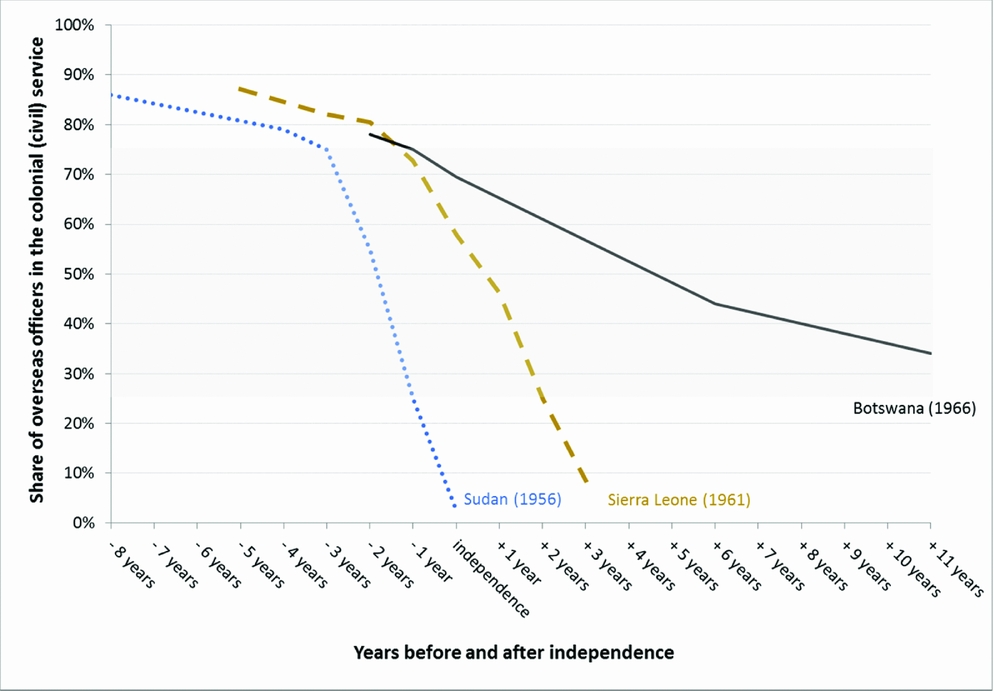
Only officers serving colonies that gained independence in 1961 or later enjoyed advance knowledge about the compensation for the loss of their career and about inducement payments for remaining in service after independence. Officers in colonies that gained independence before 1961 were offered ad-hoc solutions shortly before Independence Day.Footnote 8 As a result, the number of British officers available at independence and thereafter is to some extent a function of the year in which independence was declared.
Being able to plan one's future career ahead of independence made a difference. Figure 2 shows the effect for three colonies of our sample (independence dates in brackets). While Sudan and Botswana are the two extremes in the sample, there is a clear trend. Colonies that gained independence in 1961 or later experienced a prolonged presence of British officers.
The rates of localization of civil services at independence: Sudan, Sierra Leone, Botswana

The current paper investigates how the presence of British officers potentially mediated the process of institutional copying. The analysis selects a specific example of a colonial institutional copy of this late period of the empire. The Public Service Commission (or simply ‘the Commission’) was an institution whose function was limited to the public service. It served to safeguard the political neutrality of civil servants by insulating appointments, promotions and disciplinary measures from political influence. In Britain, this was achieved by a mix of informal conventions together with a Civil Service Commission that had evolved gradually together in the 19th century in a Weberian tradition (Allen, Reference Allen2012; Colonial Office, 1962: 2).Footnote 9 In African colonies, the corresponding legal provisions were introduced with the first constitutional changes towards self-government in the 1950s and 1960s (Adu, Reference Adu1965: 130).
The following section gives an overview on the literature related to institutional copying and diffusion. The analysis in section 3 investigates the extent to which the formal requirements were passed on to newly independent states and compares it to the degree to which they were practised effectively. It then discusses a possible connection between the extended presence of British officers and the variations in legal practice today. In section 4, interviews with retired colonial officers reveal a possible mechanism behind this connection and alternative explanations are discussed. Section 5 concludes.
The current paper stands out from the literature covering colonial history and institutions in at least three ways. First, it investigates the direct effect of colonial institutions on modern day governance rather than on economic growth. It also focuses on the legal tradition practised by a specific group (civil servants) rather than on the whole country. Second, it emphasizes the process of institutional copying as a source of variation in post-colonial governance instead of say, pre-colonial centralization, slavery, endowment or European settlement strategies. Finally, it advances the conceptual understanding of institutional copying, in particular that of informal institutions.
2. On institutional copying
New institutional economics regards institutions as durable systems of humanly devised constraints or social rules (Hodgson, Reference Hodgson2006: 13; North, Reference North1990: 3). There is a consensus today that institutions are fundamental determinants of economic growth (Acemoglu et al., Reference Acemoglu, Johnson and Robinson2001; Rodrik et al., Reference Rodrik, Subramanian and Trebbi2004; critically, Chang, Reference Chang2011). Reforms in developing countries often involve an element of emulating institutions from developed countries. However, such institutional copying often fails (Grindle, Reference Grindle2004; Rodrik, Reference Rodrik2008). In this section I review what we know about institutional transfers with the aim of extending our understanding of how informal norms are transferred.
Many institutional economists would agree that institutional transfers fail when transferred foreign formal institutions conflict with local informal norms (Boettke et al., Reference Boettke, Coyne and Leeson2008).Footnote 10 A growing field of legal transplants or (more generally) institutional transplantsFootnote 11 has emerged around this argument. Couyoumdjian (Reference Couyoumdjian2012) gives an overview on this literature. In an empirical study on transplanted law Berkowitz et al. (Reference Berkowitz, Pistor and Richard2003) argue that imported foreign law was largely ineffective, unless it was intentionally adapted to local law. Outside the rare cases in which countries share a close common and legal history (e.g. Scandinavian countries), the lack of adaptation renders the legal transfer as dead law – an outcome that authors call the ‘transplant effect’. The work of Berkowitz and colleagues is an important contribution to the field, even though their empirical model has been criticized for being based on a simple categorization (Daniels et al., Reference Daniels, Trebilcock and Carson2011). Furthermore, the authors offer little indication of why some countries were better in adapting than others or of who was in charge of institutional adaptation (Seidler, Reference Seidler2014). More recently, development economists have argued that the transplant effect may well be an accepted outcome in the developing world, when governments are content with mimicking the outside appearance of institutional reforms in exchange for continued financial aid (Krause, Reference Krause2013; Pritchett et al., Reference Pritchett, Woolcock and Andrews2013).Footnote 12 Can the problem of conflicting local institutions be overcome? Institutional literature offers two arguments. This paper will present a third alternative in this section.
First, the deliberate and top-down change of existing informal institutions is considered difficult but possible. The assumption is that newly introduced formal institutions can inculcate values into people living under them. When an imported institution creates regularities of behaviour among individuals, they begin to internalize the values embodied in the new regime (Chang and Evans, Reference Chang, Evans, De Paula and Dymski2005: 103; Hodgson, Reference Hodgson2006: 7). Ex-post enforcement is a central factor. For example, curbing Jim Crow practices in the USA in the 20th century needed strong federal enforcement by the new civil rights legislation (Helmke and Levitsky, Reference Helmke and Levitsky2004: 732). Post-reform enforcement costs are substantial unless marginalized groups exist who benefit from the new regime (Aldashev et al., Reference Aldashev, Chaara, Platteau and Wahhaj2012) or there is a change in the underlying conditions under which the informal institutions emerged. For example, the purchases of army commissions ended in Britain when new technology improved the monitoring of officers in battles (Allen, Reference Allen2012). In a similar manner, the end of Chinese foot binding took place when European influence had created new education and employment opportunities for women in the early 20th century, which in turn shifted the marriage market in China (Mackie, Reference Mackie1996). ‘Sharp breaks from established procedures’ such as crises or other critical junctures can be manifestations of a rapidly changing status quo facilitating the deliberate change of informal institutions (Williamson, Reference Williamson2000: 598).
A second option is to adapt the imported formal institution skilfully to local informal institutions in the receiving country. Rodrik (Reference Rodrik2008) and Grindle (Reference Grindle2004) favour such tailored ‘second-best’ institutions over what Evans (Reference Evans2004) calls ‘institutional monocropping’, i.e. the imposition of imported institutional blue-prints. The authors admit that adapting is not widely practised by international development agencies today. In theory, the resulting hybrid institutions should lower the enforcement costs of new regimes as local actors recognize the familiar elements therein and the new elements are not found too contradicting with how things have been done before. Unlike option one (a top-down change of informal institutions), most institutional adaptation takes place before the new institutional regime enters into force. Kurkchiyan (Reference Kurkchiyan2009) has investigated how a media self-regulatory body (an institutional copy of the BBC) was established in two different and geographically distant regions in Russia in 2002. While British media experts provided information on the model type, Russian experts were in the driving seats of establishing media self-regulatory agencies. Because of a distinct legal culture in Russia the resulting agencies had little resemblance with the British original but fulfilled a similar function. Japan is the more classical example of successful nationwide institutional adaptation. During the Meiji period, skilled Japanese bureaucrats imported European institutions and created well adapted copies (Westney, Reference Westney1987).
Is adaptation then the dominant strategy? Mukand and Rodrik (Reference Mukand and Rodrik2005) present a formal model in which states face a trade-off in the costs and benefits between adaptation and blueprint copying. The former strategy risks corruption when political interests take over, while pure imitation may result in a poor fit and end up as dead law. Grajzl and Dimitrova-Grajzl (Reference Grajzl and Dimitrova-Grajzl2009) describe a similar model in which developing countries make a choice between copying from abroad or developing indigenous institutions. In both formal models the human capital needed to adapt foreign institutions is available at no cost. However, in developing countries, skilled bureaucrats, who need to be knowledgeable in both the complex formal rules of foreign states and the prevailing informal norms in the receiving country, are often extremely scarce. I argue that blueprint imitation takes place in developing countries, precisely because there are so few well-trained intermediaries required for the adaptation process. From this perspective, developing countries have no choice and some degree of blueprint copying will be the default strategy. With little means of enforcing the new regimes, reforms in developing countries are likely to create dead law and corruption.
A look at the related and rich literature on diffusion supports this argument. Diffusion is understood as the transfer of innovations among organizations and corporations.Footnote 13 Here, the lack of fit owing to dissimilar organizational cultures poses an analogous problem. In international business however, efficiently set wages attract suitably trained workers. Hence, the adaptation or ‘re-invention’ of transferred innovations has become the standard response in this literature (Rogers, Reference Rogers2003: 17; Stone, Reference Stone2012: 483) and studies have focused on the speed or the extent of adaptation (Ansari et al., Reference Ansari, Fiss and Zajac2010). More recently, the diffusion literature has turned its attention to the transfer of policies into developing countries. Questions here are again very similar to those debated in the institutional copying literature. Among others, agency and structure (Marsh and Sharman, Reference Marsh and Sharman2009: 274–5) or the transaction costs of institutional adjustment of foreign policies (Benson and Jordan, Reference Benson and Jordan2011: 372–3) have become a major focus. Consequently, the success of policy transfer is to some degree seen as a function of available human capital and unlike in the institutional literature, there is a rich debate on actors involved in policy transfer (Benson and Jordan, Reference Benson and Jordan2011: 368–9). In China or inside the EU, where skilled bureaucrats are available, the adaptation practices (‘translation’ or ‘bricolage’) have taken a further step away from the original policy when scraps of imported policies are pieced together to create a new hybrid policy (de Jong, Reference De Jong2013; Stone, Reference Stone2017: 60; Thelen, Reference Thelen, Mahoney and Rueschemeyer2002: 227; Zweynert, Reference Zweynert2009: 353).
How much institutional bricolage took place in decolonizing Africa? The British had no central policy of deliberate adaptation of imported institutions to local conditions. Instead there was a general interest in maintaining high, i.e. British, standards in practically everything from localization to housing construction (Burr, Reference Burr1985:130; Tanganyika, Reference Tanganyika1954:17). Institutional adaptation took place infrequently at best.Footnote 14 Post independence, enforcement was low across Africa.
Under these conditions a third argument may explain variations in the success of institutional transfer. The conflict of imported formal institutions with local informal norms could have been mediated by the concurrent transfer of those informal institutions on which the foreign formal regime rested in its country of origin. In a similar manner, the diffusion literature has very recently started to distinguish between hard and soft transfer (Stone, Reference Stone2017: 8). Institutional theory informs us that formal and informal institutions rarely function alone, but complement each other to form the institutional framework of a society (North, Reference North1994: 366), and that piecemeal copying of selected institutions can be expected to fail (Roland, Reference Roland2004: 113). Also, the congruence of informal and formal institutions matters to economic performance, while formal institutions alone are less likely to promote economic growth (Williamson, Reference Williamson2009). To my knowledge searching for hard and soft transfers in the colonial past has not been done before. Berger (Reference Berger2009) shows in the example of colonial Nigeria how tax collection increased bureaucratic capacity with long-lasting effects on local governance. Here, the mechanism also runs through the human capital in local colonial governments and the author rightly argues that their effectiveness relied more on the competence of bureaucrats than on the law in place. Very unlike the more influential literature on long-term effects of colonization (for example Acemoglu et al., Reference Acemoglu, Johnson and Robinson2001; Dell, Reference Dell2010), this paper's focus on the administrative capacity at the end of colonial rule offers more proximate causal relations.
3. Institutional copying on the example of the Public Service Commission
This paper's analysis follows the third argument, which proposes that importing foreign institutions falls into two processes: copying the formal law and transferring its informal foundations with it. The two processes have different needs in two categories: actors and time. The introduction of the Public Service Commission (or simply ‘the Commission’) into British colonies serves as the object of investigation. Commissions had the task to ensure the political neutrality of civil servants by preventing nepotism and cronyism in particular in the areas of appointments, transfers and promotions. All African colonies created an initial version of the Commission in the years after 1945. The first Commissions merely advised the governor on questions of appointments and disciplinary measures. In negotiations on self-government the governors ceded powers and the British made it their policy to raise the status of the Commissions to independent bodies with executive authority in all matters related with appointments, transfers and discipline of civil servants. In African colonies, this took place about five years before independence was granted (Adu, Reference Adu1965: 129–45; Hatchard et al., Reference Hatchard, Ndulo and Slinn2004: 72; Lee, Reference Lee1967: 205).
It is not clear whether an equal understanding of the notion of political neutrality was shared by all individuals working inside the colonial administrations. Even within Colonial Office itself, a certain degree of patronage had been practised until the 1930s (Kirk-Greene, Reference Kirk-Greene2000: 129, 216–7). One can assume that the formal rules safeguarding the political neutrality of civil servants were foreign to colonial Africa and in many cases incompatible with local institutions shaping executive authority (Englebert, Reference Englebert2000). In consequence, the intention behind the processes and procedures related with the Commissions may not have been recognizable and may have been considered overly burdensome to British and local staff. While British colonial officers grudgingly accepted the burden of new, complex bureaucratic procedures and the paperwork that came with them (Lovering, Reference Lovering2010: 6), local officers from the colonies regarded them as ‘straight importations of structures which had proved workable or effective in the United Kingdom and which could work in Africa so long as there were British officers to man them’ (Adu, Reference Adu1965: 116).
The Colonial Office in London recognized that in the lack of ‘a body of convention and tradition to supplement its work’ the Commissions needed wider functions than their counterpart in the UK, the Civil Service Commission (Colonial Office, 1962: 2). London was also aware that the Commission was a foreign transplant and likely to be opposed by local staff and local politicians. A handbook advised overseas officers on how Commissions were best established in the colonies and what problems were to be expected.Footnote 15 It also contained specimen regulations; i.e. legal text to be used as a blueprint for equivalent colonial provisions (Colonial Office, 1962).
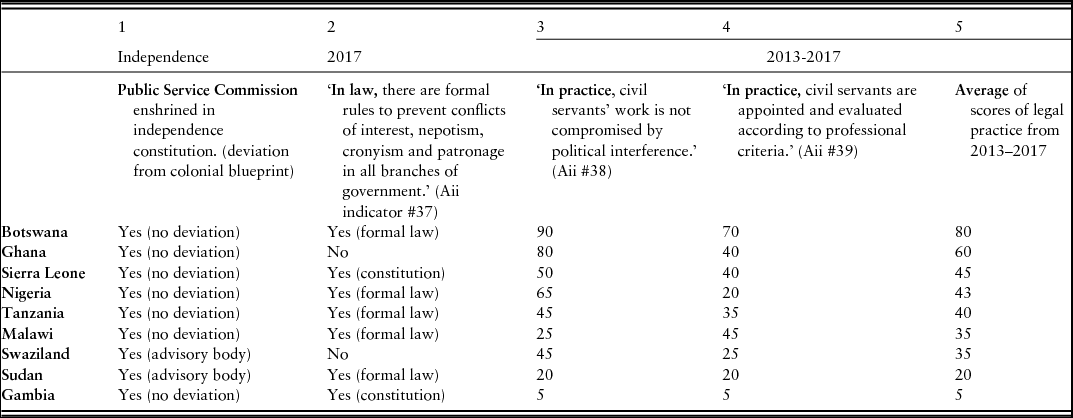
The first step of the analysis assesses variations in the copying of the formal institution. Before the British granted independence, the Commissions were established as fully independent bodies inside the public services and their powers were preserved in the constitutions of the newly independent states. Column 1 in Table 1 compares the legal provisions in these nine constitutions with the colonial blueprint along the following three legal requirements laid out in the ‘Specimen Public Service Commission Regulations’ (Colonial Office, 1962: Appendix A).Footnote 16
1. The Commission needed to be established as independent body apart from other bodies of the civil services.
2. The Commission had a minimum of three full-time members to be appointed by the successor of the British governor after independence – i.e. the parliament, the prime minister or the president.
3. Third, the Commission's powers included all appointments, promotions (transfers) and disciplinary measures of all civil servants below ministerial ranks. Judicial service officers, who had their own Service Commission, were excluded.
Formal law and legal practice today related with the political neutrality of civil servants

Sources: Column 1: Constitutions of African countries (see Appendix 2a); columns 2–5: for African Integrity Indicators (2013–17) see Aii.globalintegrity.org (2017).
Column 1 shows that at independence, only the constitutions of Sudan and Swaziland deviated from the standard text. The changes were intentional. They constituted a degree of institutional adaptation or bricolage that reflected the political and legal institutions in place at the time of the copying. In Swaziland, the Public Service Commission had already been established in 1963 with advisory powers only. On the request of the Swazi king this was simply enshrined in the 1968 constitution (Proctor, Reference Proctor1973). In Sudan, the geopolitical background tensions behind Sudan's independence weakened the British position as the country prepared for independence (Sconyers, Reference Sconyers1988). The constitutional provisions of the other colonies in the sample were almost verbatim copies of the corresponding paragraphs in the Colonial Office Handbook (1962: Appendix A).
Columns 2 to 5 in Table 1 fast-forward to the 21st century. They use the Africa integrity indicators (Aii), a set of indicators comparing formal legal text with the extent to which the law is effectively practised in a country. Since independence, legal reforms have changed and in many cases weakened the Commissions' powers across former African colonies. Column 2 tests whether there is formal legislation in the spirit of the British Public Service Commission today. A ‘Yes’ is assigned by the Aii when at least two of the following three conditions are met:
1. the law prohibits conflicts of interest, nepotism, cronyism, and patronage (at least two of these offences must be prohibited),
2. the law applies to all branches of government, including the civil service,
3. the law mandates mechanisms such as competitive recruitment and promotion procedures, safeguards against arbitrary disciplinary actions and dismissal, and recusal procedures.
Two out of nine former colonies do not pass the test. Ghana amended its constitution two years after independence introducing ‘special cases’ of appointments outside the Commission's strict mandate (Harvey, Reference Harvey1966: 57). Ghana's latest constitution (of 1992) and the Civil Service Act (of 1993) both address conflicts of interest but issues of cronyism, nepotism and patronage have been dropped. Swaziland today has no corresponding formal or constitutional law at all. At the other extreme, Gambia and Sierra Leone have kept almost verbatim copies of the British blueprint in their constitutions.
Finally, columns 3 and 4 assess the legal practice of the formal law in place. The figures are averages of the African integrity indicators (Aii) between 2013 and 2017.Footnote 17 This is in fact a measure of the transplant effect – the degree to which an imported foreign law has become dead law decades later (Berkowitz et al., Reference Berkowitz, Pistor and Richard2003). Whereas columns 1 and 2 report on formal legal evidence, columns 3 and 4 give perception-based indicators. Here, the Aii assign the maximum score of 100 points when the legal provisions laid out in column 2 are effectively practised. Two separate indicators assess this. In column 3 a score of 100 is earned when both of the following conditions are met:
1. Civil servants are disciplined/removed/transferred only through due process by a peer panel or oversight body.
2. Civil servants are not removed when a new administration takes power.
In column 4 a score of 100 is assigned when all the following conditions are met:
1. Appointments to the civil service are made on a merit-based system.
2. Individuals appointed are free of conflicts of interest due to personal loyalties, family connections, political party affiliations or other biases.
3. Performance evaluations are based on standard benchmarks.
Because columns 3 and 4 both assess the legal practice of the same body of formal law, it makes sense to build an aggregate value of the legal practice in place per country. Column 5 shows that there is considerable variation in this measure. The formal legal provisions do not appear to be an influential determinant. Ghana ranks second in terms of legal practice but has an insufficient formal law in place. Gambia has preserved the colonial law in its constitution but comes out weakest in terms of legal practice.
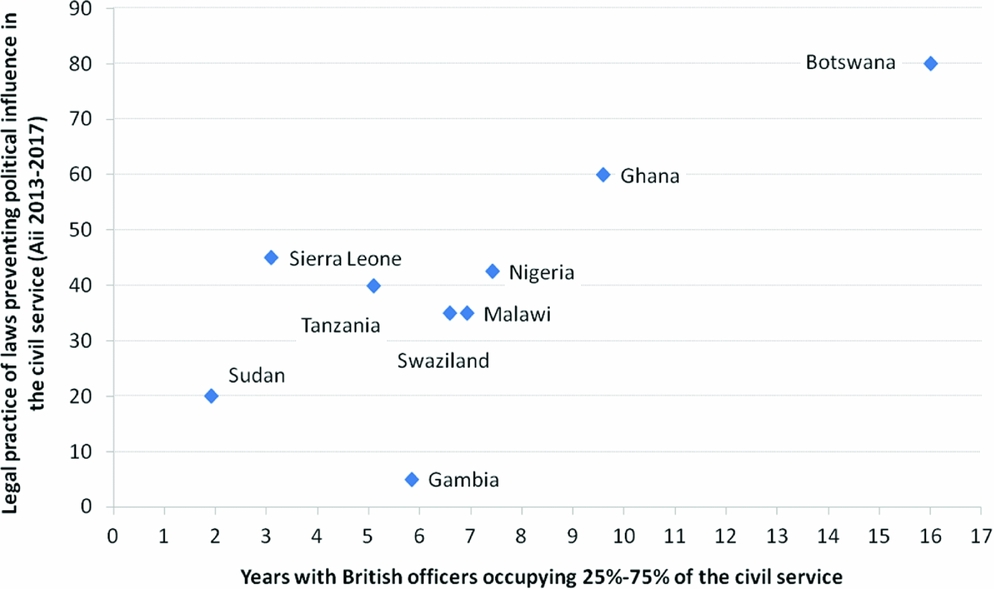
How much of the variation in the legal practice can be explained by the presence of British officers? Figure 3 reports on the connection between the legal practice of preventing political influence in the civil service with the paper's measure for the presence British civil servants from the introduction. The vertical axis shows the average Aii scores of the legal practice for each country (i.e. column 5 in Table 1). The horizontal axis displays the number of years in which the proportion of British officers in the civil service remained between 25 and 75% in the civil service.
Effectively practised prevention of political influence in civil services and the presence of British civil servants in former colonies

The scatterplot indicates a positive relationship between the share of British officers in the civil services after independence and the extent to which formal provisions protecting civil servants from political interference are practised effectively today. Again, the association holds as long as the share of the British officers remains above 25%. Very similar patterns emerge regardless of whether British officers were in the majority (between 50% and 75%) of the civil service or in the minority (between 25% and 50%).
4. The mechanism and identification
A series of telephone interviews with members of the Overseas Service Pensioners’ Association in the UK lends supports to the argument around the transfer of conventions into African civil services. The interviews followed a mixed methods questionnaire combining biographical questions and quantifiable ones. Question 53 from the interviews comes closest to asking about the mechanism behind the effect of their presence.Footnote 18 The results presented here are based on the responses of 45 officers who remained in service after independence. They were asked two questions:
1. ‘In your opinion, how relevant was the presence of British staff after independence for the local staff when they worked with imported British structures?’
2. ‘What were your own experiences?’
While 84% considered the presence of British staff relevant, the officers’ experiences are clustered around themes. The majority (25 out of 45 officers) thought that giving advice and being around mattered most. Personal accounts differ, but in particular the first years after independence were perceived as a continuation of colonial work routines by these officers. This is plausible. After independence, former British officers were no longer in control, but many enjoyed access to the ministers, politicians and heads of departments who had been working below them (Selassie, Reference Selassie1974: 193). Nine officers (20%) thought that their presence helped because it bought time needed for recruitment and training of local successors. Five officers saw themselves as actively maintaining British standards after independence. An education officer in Ghana for example felt that in departments where British officers were already in lower numbers one had to conform, and corrupt practices were more likely to occur.
Identification issues
Expatriate officers could not directly influence the colony they were assigned to because the selection process only permitted the acceptance or rejection of the career offer with no possibilities of negotiating details.Footnote 19 At independence however, they might have chosen to remain in colonies where institutions were more compatible with British ones or where expectations of the future looked bright. In the interviews retired British officers were asked why they chose to remain in service after independence. Responses to questions 76 to 79 reveal that the compensation scheme was the most important factor for those who were offered it (36 out of 45 interviewed officers). The interviewees were asked to assign a score of 1–10 for each of four potential factors influencing their decision to quit or remain in service at independence. The conditions connected to the compensation payments reached an average value of just about 8 – the highest score among the four options. A former colonial agronomist in Kenya underlined the importance of the compensation payments:
The compensation scheme assumed great importance to all the [overseas] staff members, from mid-1963 for the next years. It was a well-crafted scheme, as obviously, UK had given independence to many colonies in the decade before Kenya's turn, and had thus learned a great deal about how to do it better (. . .). The scheme alleviated the worries of the colonial officers that they would suddenly lose their jobs and maybe pensions, too and it gave them time to look around for other jobs if they wanted to leave fairly soon. Most of my colleagues were actively job-hunting all over the world, and I myself looked into other prospects when I was on leave. (. . .) Another aspect of the [compensation] scheme was that if a serving officer could get [a] promotion and continue for a while before he left, that could considerably increase the compensation and pension he would get. As some of the older men went fairly quickly, the middle-aged ones could move up into the empty posts more swiftly than ever before. (Allen, Reference Allen2017)
Alternative explanations
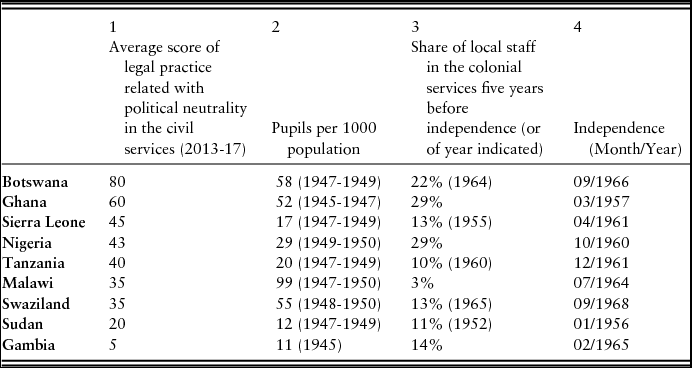
Explaining the post-independence governance of former colonies by the extended presence of expatriate civil servants after independence is a new line of argument. An influential part of the existing literature stresses a more traditional understanding of local human capital. Here, European education in the colonies enabled economic growth and with it better institutions (Bolt and Bezemer, Reference Bolt and Bezemer2009; Glaeser et al., Reference Glaeser, La Porta, Lopez-de-Silanes and Shleifer2004; critically Acemoglu et al., Reference Acemoglu, Gallego and Robinson2014). In the context of African colonies, it seems plausible that a large pool of the European-educated local population increased the likelihood of Africans being employed in the higher civil service at an early stage before independence.
Table 2 compares the Aii-based measure for the legal protection of civil service neutrality (column 1) with the figures linked to human capital. Column 2 lists enrolment in European schools in the late 1940s.Footnote 20 Column 3 displays the share of Africans in the colonial services five years ahead of independence.Footnote 21 Neither school enrolment nor localization rates five years before independence seem related with the legal practice in 2017. Ghana lives up to its reputation of being a colony with an early investment into education, which is reflected in a large share of local staff in senior positions five years before independence. However Nigeria, where colonial education was a lower priority, was similarly fast in localizing its senior officers.
Government effectiveness 1996, colonial education and the share of local colonial officers 5 years before independence.

Sources: For African Integrity Indicators (2013–17) see Aii.globalintegrity.org (2017); Bolt and Bezemer (Reference Bolt and Bezemer2009), territorial staff lists and secondary sources (see Appendix 2b and 2c).
The share of British staff may simply reflect the viability of African colonies in the sense that territories that found it harder to gain independence had more need of expatriate civil servants. In such cases, the share of local staff five years before independence should be low in colonies with later independence relative to those colonies with an early independence. However, colonies with later independence (Swaziland, Gambia) have shares similar to those of Sudan (1956) or of Sierra Leone (1961). This suggests that that the variation in the presence of British staff set in after independence, when inducement payments in the overseas compensation scheme took effect.
Finally, some colonies may had been considered more promising than others and British officers would have wished to remain in service there – resulting in the relatively high number of expatriates in successful former colonies. A majority of interviewed officers dismissed this idea. Likewise, experts and officers at that time potentially misjudged future development potential. At independence, no one had any hope for Botswana, while Nigeria was considered to have huge potential (Acemoglu et al., Reference Acemoglu, Johnson and Robinson2002; Stolper, Reference Stolper2003).
5. Conclusion
The principal innovation of this paper is an extended conceptual understanding of institutional copying. Subdividing the copying process into copying formal and informal institutions reveals distinct requirements in terms of actors and time. When the colonial powers copied formal law into their territories a transplant effect occurred to varying degrees. Variations in compensation payments to British colonial officers at independence allow this to be investigated using the example of decolonizing British Africa. The findings reveal an important gap in the literature. We know little about the roles and functions of actors involved in the copying (here local and expatriate bureaucrats) and how they influenced the chances of a successful transfer.
This paper explored the roles of expatriate bureaucrats in copying the formal law and in importing the complementing tradition behind it. The imported institution, the Public Service Commission, set incentives for the specific group of civil servants (as opposed to the whole population). In a sample of nine African colonies, local civil servants were exposed to working with the expatriates to varying degrees. The findings suggest a positive relationship between the extended exposure to expatriate officers and variations in effective legal practice in place today. Interviews with retired colonial officers suggest a mechanism behind this that is similar to a reference group effect of expatriate officers (Merton, Reference Merton1968). This suggests a more nuanced approach towards the role of human capital in institutional copying. Copying formal law arguably relies on legal expertise. Passing on acceptance of the law and the tacit knowledge behind it seems to have benefitted from British and local officers working alongside each other over a period of several years. Similar findings have been reported in the international business literature (Goffin and Koners, Reference Goffin and Koners2011). The finding should also be relevant for the literature around the transplant effect, where Berkowitz and co-authors (Reference Berkowitz, Pistor and Richard2003) do not specify groups of actors involved in the copying process.
Finally, the paper contributes to the literature on the institutional reforms in international development. On the recipients’ side, a high turnover of local bureaucrats has been found detrimental to aid implementation, in particular when the turnover rates are caused by political appointments (Cornell, Reference Cornell2014). In addition, existing practice of deploying expatriate advisors in developing countries may need to be revised, when these expatriates are involved in institutional reforms reflecting standards with a tradition in the industrialized world. For example, some of the targets proposed under the UN Sustainable Development Goals include copying Western standards into developing countries (UN SDG, 2017). The transfer of formal international institutions without such a tradition (e.g. international treaties on climate change) is a technical activity, and the literature's focus on human capital in its more traditional understanding seems justified (see for example Ovodenko and Keohane, Reference Ovodenko and Keohane2012: 533–4).
Acknowledgements
This research was supported by the Austrian Science Found (Project J 3848-G28). I thank the retired colonial officers who took part in the interviews and the Overseas Service Pensioners’ Association for their support.
Appendix 1. British territories administered by the Colonial Office in Africa, dates of independence, data series used in the study

Appendix 2. British African territories and data on overseas officers
Appendix 2a. Primary sources on the structure and policies of the colonial service
Colonial Office (1946), Organisation of the Civil Service, Cmnd. 197, London: HMSO.
Colonial Office (1950), Appointments in His Majesty's Colonial Service, London: HMSO.
Colonial Office (1953), Colonial Overseas Service: monthly cumulative progress reports on vacancies filled from starting date of 1 June 1945, Reference: CO 1017/268, internal document released in 1984, National Archives: London.
Colonial Office (1954), Reorganisation of the Colonial Service, Cmnd. 306, London: HMSO.
Colonial Office (1956), Her Majesty's Oversea Civil Service: Statement of Policy Regarding Organization, Cmnd. 9768, London: HMSO.
Colonial Office (1958), HMOCS: Statement of Policy Regarding Overseas Officers Serving in Nigeria, Cmnd. 497, London: HMSO.
Colonial Office (1960), Service with Overseas Governments, Cmnd. 1193, London: HMSO.
Colonial Office (1962), The Public Service Commission in Overseas Territories, London: HMSO.
Tanganyika (1954), Report of the Commission on the Civil Services of the East African Territories and the East Africa High Commission, 1953–1954, under the chairmanship of Sir David Lidbury, Nairobi: Government Printing Offices.
Appendix 2b. Primary sources on the number of British officers
Data on the share of British officers in the public services before and after independence have been constructed from territorial staff lists held at Bodleian Library in Oxford. Secondary sources (below) have been used where the territorial staff lists were incomplete.
Appendix 2c. Secondary sources on the number of British officers
Botswana
Mentz, J. (1985), ‘Evaluation of the role of the Presidential Commission on localization and training in implementing the policy of localization in Botswana’, Botswana Notes and Records, 17: 65–75, available at http://www.jstor.org/stable/40979737 [accessed 21 August 2017].
Ministry of Overseas Development (1977), Aspects of British Technical Cooperation (Botswana and Mauritius), London: Ministry of Overseas Development.
Parson, J. (1984), Botswana: Liberal Democracy and the Labor Reserve in Southern Africa, Boulder, CO: Westview Press.
Ghana, Nigeria, Sudan
Younger, K. (Reference Younger1960), The Public Service in the New States: A Study in Some Trained Manpower Problems, London: Oxford University Press.
Malawi
Baker, C. (1972) ‘The administrative service of Malawi – a case study in Africanisation’, Journal of Modern African Studies, 10(4): 543–60.
Nigeria
Nicolson, I. (1969), The Administration of Nigeria 1900–1960: Man, Methods, and Myths, Oxford: Clarendon Press.
Tanzania
Rweyemamu, A. (1966), ‘Managing planned development: Tanzania's experience’, Journal of Modern African Studies, 4(1): 1–16.
Skorov, G. (1966), Integration of Educational and Economic Planning in Tanzania, Paris: International Institute for Educational Planning, UNESCO.