Introduction
There are currently more than 90 published works on the feeding biology of the Myliobatiformes based on the literature review by Jacobsen & Bennett (Reference Jacobsen and Bennett2013) and 17 additional works reported between 2013 and 2018. This can be considered a dramatic increase considering that about 28% of these works were carried out between 1961 and 2000. However, there are currently only 14 published works on the feeding biology of the Myliobatiformes in regions close to Malaysia; 12 of these are from Australian waters and the other two from Japan. Stingray dietary studies in these areas are hampered by sampling costs, lack of fresh samples or an inability to adequately process frozen samples (Jacobsen & Bennett, Reference Jacobsen and Bennett2013). In the Indo-Pacific region, stingray markets tend to be from artisanal fisheries (Blaber et al., Reference Blaber, Dichmont, White, Buckworth, Sadiyah, Nurhakim, Pillans, Andamari, Dharmadi and Fahmi2009; White & Kyne, Reference White and Kyne2010), although large catches are thought to be unaccounted for due to the pervasive problem of illegal, unreported and unregulated fishing (White & Kyne, Reference White and Kyne2010).
Current studies on the feeding biology of myliobatoids are quite similar to those prior to 2000, focusing on general diet (Navarro-González et al., Reference Navarro-González, Bohórquez-Herrera, Navia and Cruz-Escalona2012; Bornatowski et al., Reference Bornatowski, Natascha, Carmo, Corrêa and Abilhoa2014), ontogenetic diet shift (Jacobsen & Bennett, Reference Jacobsen and Bennett2012; López-García et al., Reference López-García, Navia, Mejía-Falla and Rubio2012), spatial and temporal diet variation (some relate this to habitat utilization) (Navia et al., Reference Navia, Torres, Mejía-Falla and Giraldo2011; Woodland et al., Reference Woodland, Secor and Wedge2011; Shibuya & Zuanon, Reference Shibuya and Zuanon2013), resource or dietary partitioning (Jacobsen & Bennett, Reference Jacobsen and Bennett2012; O'Shea et al., Reference O'Shea, Thums, van Keulen, Kempster and Meekan2013; Varghese et al., Reference Varghese, Somvanshi and Dalvi2014) and feeding movement (Corcoran et al., Reference Corcoran, Wetherbee, Shivji, Potenski, Chapman and Harvey2013). However, published works up to 2018 covered only 35% of species (80 out of 229 species in Eschmeyer & Fong, Reference Eschmeyer and Fong2015) within the Myliobatiformes.
Stingrays in the Indo-Pacific region received even less attention. The few identification texts available such as White et al. (Reference White, Last, Stevens, Yearsley, Fahmi and Dharmadi2006) and Last et al. (Reference Last, White, Caira, Dharmadi, Fahmi, Jensen, Lim, Manjaji-Matsumoto, Naylor, Pogonoski, Stevens and Yearsley2010) have provided some general descriptions of their diet. Nevertheless, the word ‘presumably’ was commonly used to describe the diet of almost every species indicating the uncertainty or lack of knowledge of stingray food habits in the region. This is unfortunate since understanding their feeding ecology is crucial for conservation given the increasing human threats to critical coastal ecosystems such as mangroves, mudflats and coral reefs, which may serve as essential feeding or nursery areas for these fishes (Chong et al., Reference Chong, Sasekumar, Leh and Cruz1990; Beck et al., Reference Beck, Heck, Able, Childers, Eggleston, Gillanders, Halpern, Hays, Hoshino, Minello, Orth, Sheridan and Weinstein2001; Cerutti-Pereyra et al., Reference Cerutti-Pereyra, Thums, Austin, Bradshaw, Stevens, Babcock, Pillans and Meekan2014). For instance, previous (e.g. Sasekumar et al., Reference Sasekumar, Chong, Leh and Cruz1992) and preliminary work have indicated that juvenile stingrays enter shallow coastal mudflats in waves following tidal inundation.
Coastal mudflats can be very productive habitats as a result of high nutrient inputs from fluvial discharge (Trott & Alongi, Reference Trott and Alongi1999; Teoh et al., Reference Teoh, Lee, Chong and Yurimoto2016) and outwelling from adjacent mangrove forests (Tanaka & Choo, Reference Tanaka and Choo2000; Alongi, Reference Alongi2009). Such mudflats are known feeding grounds of fishes (Chong et al., Reference Chong, Teoh, Ooi, Jamizan and Tanaka2012; Lee et al., Reference Lee, Chong and Yurimoto2016), penaeid shrimps (Leh & Sasekumar, Reference Leh, Sasekumar, Soepadmo, Raol and Macintosh1984; Marsitah & Chong, Reference Marsitah and Chong2002), mysid shrimps (Ramarn et al., Reference Ramarn, Chong and Hanamura2015), hermit crabs (Teoh & Chong, Reference Teoh and Chong2015), molluscs (Broom, Reference Broom1982; Rodelli et al., Reference Rodelli, Gearing, Gearing, Marshall and Sasekumar1984) and shorebirds (Burger et al., Reference Burger, Niles and Clark1997; Backwell et al., Reference Backwell, O'Hara and Christy1998). Unfortunately, coastal mudflats particularly in the eastern Asian region are increasingly subject to land reclamations for development (Kao et al., Reference Kao, Wong and Chin1998), while coastal development often alters coastline morphology and hydrodynamics resulting in mud and sediment erosion (Łabuz, Reference Łabuz2015).
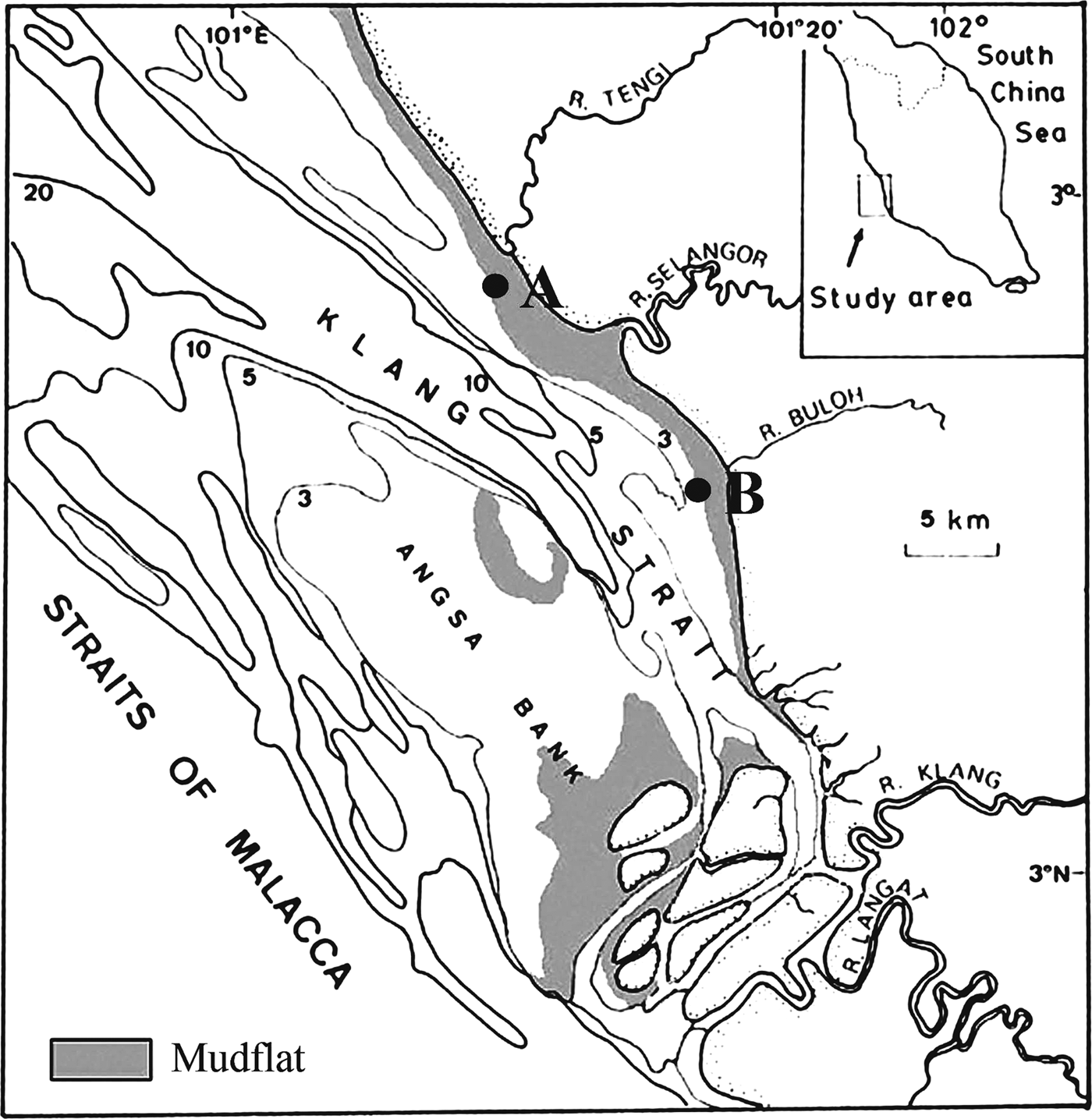
One of the larger and more important mudflats in Peninsular Malaysia is the Klang Strait mudflat (3°21.850′N 101°10.665′E) on the western coast (Figure 1) where the country's largest blood cockle culture beds (5000 ha) are also located. In the Klang Strait, soft-bottom stingrays are commonly encountered in commercial catches although their catches are low. However, scientific works on their ecology are lacking. Three species of stingray that are commonly found in the Klang mudflat include the dwarf whipray (Himantura walga), Bennett's stingray (Dasyatis bennetti) and sharpnose stingray (Dasyatis zugei) (Lim et al., Reference Lim, Chong, Lim and Yurimoto2014). A recent stingray revision renamed these species as Brevitrygon heterura, Hemitrygon bennetti and Telatrygon biasa respectively (Last et al., Reference Last, White, de Carvalho, Séret, Stehmann and Naylor2016). Lim (Reference Lim2016) suggested that the Klang mudflat acts as an important feeding and nursery ground of these coastal stingrays.
Selected study sites on Klang Strait mudflat, Peninsular Malaysia. A. Bagan Pasir (BP), B. Sungai Buloh (SB).

In this study, we hypothesize that since stingrays regularly enter the coastal mudflat during high tide, they forage on the coastal mudflat, making it an important feeding ground. Hence, the aim of this study is to elucidate the feeding ground function of the intertidal mudflat for the three major stingray species in Klang Strait; here, we examined feeding habits, food partitioning and ontogenetic shift (if any) in food usage to understand their feeding ecology.
Materials and methods
Stingrays were sampled from the Klang mudflat every month from July 2012 to November 2013. The fishing method used was an artisanal barrier net of 2.5 cm stretched mesh size deployed at two sampling sites located off the fishing villages at Bagan Pasir (BP) (03°22.072′N 101°10.529′E) and Sungai Buloh (SB) (03°17.605′N 101°15.276′E) (Figure 1). The L-shaped barrier net was deployed close to high slack water facing landward. The fish were retained when the tide receded. All batoids caught were collected. In the case of very large catches, a maximum of 60 fishes were randomly selected for analysis of stomach contents.
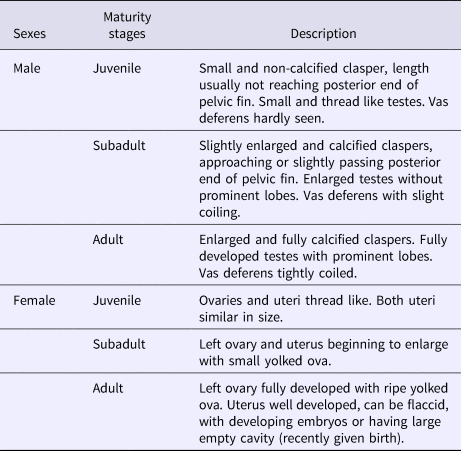
Stingrays obtained from each sampling were identified according to Last et al. (Reference Last, White, Caira, Dharmadi, Fahmi, Jensen, Lim, Manjaji-Matsumoto, Naylor, Pogonoski, Stevens and Yearsley2010, Reference Last, White, de Carvalho, Séret, Stehmann and Naylor2016). The disc width (DW) of each specimen was measured to the nearest mm. The sexual maturity of male and female fish was determined by examining the reproductive tracts after incision of the ventral abdominal wall. In addition, the size and calcification stage of the claspers were examined in males. Fish were then categorized as juvenile, subadult or adult following the descriptions given in Table 1.
Simplified classification of maturity stages for male and female stingrays in Klang Strait (adapted from White et al., Reference White, Platell and Potter2001; Yokota et al., Reference Yokota, Goitein, Gianeti and Lessa2012).

The fish's stomach was removed by cutting its anterior end (i.e. before the oesophagus) and posterior end just after the pyloric sphincter. Stomachs were individually placed in separate containers and preserved in 4% formaldehyde until examination of food items. The preserved stingray's stomach was first slit open and all food items were washed into a Petri dish. For large food items such as fish, crab and penaeid shrimp, the water displacement method (Hyslop, Reference Hyslop1980) was used to estimate their volume. The small remaining food items were pipetted out into a gridded 1 ml-Sedgewick rafter cell and examined under a compound microscope. The volume of each small food item was estimated from the cover area of each item using the eye estimation method (Chong, Reference Chong1977). All food items were identified to the lowest possible taxa. The number of prey items was also counted.
Cumulative prey curves were constructed by species, maturity stage, sex and site to evaluate whether the number of sampled stomachs was sufficient to elucidate the diet of stingrays on tropical mudflats. The number of stomachs examined can be considered sufficient if the slope is less than 0.1 (Soberón & Llorente, Reference Soberón and Llorente1993). This analysis involved randomizing the sample order 999 times and plotting the mean number of prey categories present against the number of stomachs analysed using PRIMER v6 software (Clarke & Gorley, Reference Clarke and Gorley2006).
The index of relative importance (IRI) (Pinkas et al., Reference Pinkas, Oliphant and Iverson1971) of prey item for each maturity stage and species of stingray was calculated using the modified formula of Cortés (Reference Cortés1997): IRI = (%V + %N) ×%F, where %V = V i n −1 × 100%, given Vi is the total volume of prey of a particular taxon i and n is the total volume of all prey in all stomachs; %N = N i n −1 × 100%, given N i is the total number of prey of a particular taxon i and n is the total number of all prey identified in all stomachs examined; %F = F i n −1 × 100%, given F i is the number of stomachs containing a particular prey taxon i and n is the total number of stomachs with any prey. The percentage of IRI (%IRI) was then calculated by dividing the IRI of each prey taxon by the total IRI, multiplied by 100%.
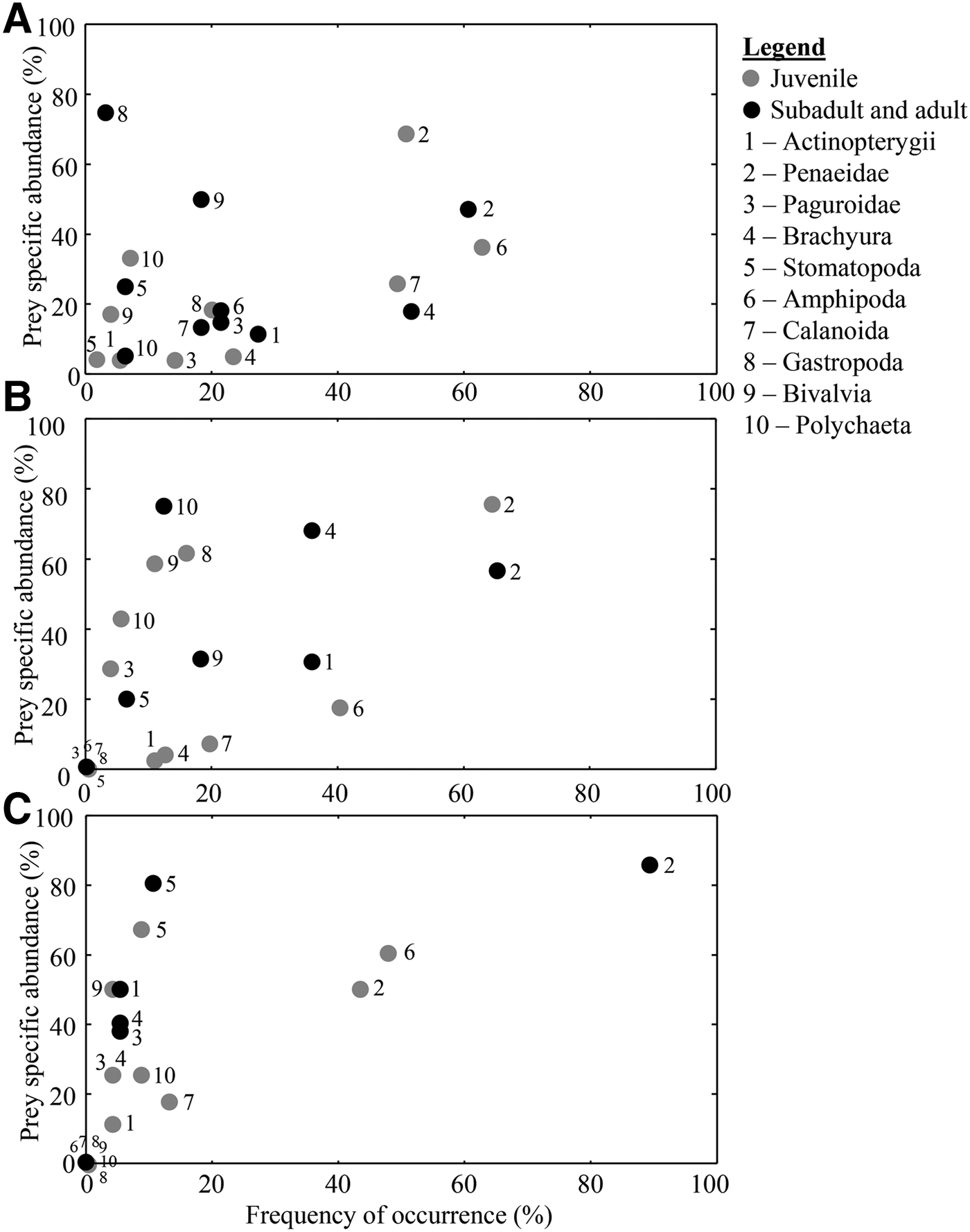
Schoener's index of diet overlap (Schoener, Reference Schoener1970) was calculated using the formula: C AB = 1.0–0.5 (∑|I A,i-I B,i|), where I is the index of relative importance of prey i in the diets of stingray species A and B. Stingray feeding strategies were analysed graphically following Amundsen et al.'s (Reference Amundsen, Gabler and Staldvik1996) two-dimensional scatterplot by using both prey specific abundance (P i) and frequency of occurrence (%F) data. Prey specific abundance was calculated using the formula: P i = (∑S i/∑S ti) × 100, where P i is the prey specific abundance of prey i, S i is the number of prey item i and S ti is the total number of prey items in the stomach that contain prey i.
Further comparison of the diet of stingrays was achieved using non-metric multi-dimensional scaling (nMDS) ordination and analysis of similarity (ANOSIM) in PRIMER v6 (Clarke & Gorley, Reference Clarke and Gorley2006). ANOSIM was first performed on the non-pooled dataset (V, N and F) to determine whether there were significant differences between site or sex for each species. If there were no significant differences, the datasets were combined to reduce the number of factors and increase the sample size. As suggested by Pardo et al. (Reference Pardo, Burgess, Teixeira and Bennett2015), partially pooled data provide a better representation and partitioning of the variation among species in multivariate analysis.
More refined analyses based on partially pooled data were carried out only if the sample size was sufficiently large (i.e. based on the cumulative prey curve slope criterion). Similarity matrices were constructed using the Bray–Curtis dissimilarity coefficient calculated from partially pooled data. These data (%V, %N, %F and %IRI) were square-root transformed after being individually pooled by randomly combining 3–10 stomachs to increase the number of prey categories per stomach following Pardo et al. (Reference Pardo, Burgess, Teixeira and Bennett2015). The obtained similarity matrices were used in nMDS ordination to visualize the variation among the stingrays. The similarity percentage analysis (SIMPER) of non-pooled data (V, N and F) was performed to identify the most important contributors to the variation in diet among the stingrays. For testing for spatial (site) differences in diet, the ANOSIM test was applied to only the juveniles of B. heterura which had sufficient sample sizes at both BP and SB sites.
In addition, the mean and range of number of prey taxa consumed by each stingray according to species and maturity were calculated. Kruskal–Wallis ANOVA was conducted on non-pooled data to compare the significant difference among the number of prey taxa consumed by the stingray species on the Klang mudflat. The volume of the largest prey item (PVmax) found in each stomach was also recorded so as to determine its relationship with predator (stingray) size (disc width) by using type I linear regression (Zar, Reference Zar1999). Both variables were subject to natural logarithmic (loge) transformation in the regression analysis to linearize the essential length-weight (volume) relationship.
Results
A total of 540 specimens of the three dominant stingrays were obtained from the two sites during the 17-month study. These included 349 B. heterura, 102 H. bennetti and 89 T. biasa. The initial ANOSIM test on non-pooled data, however, indicated no significant difference between sexes (P > 0.05); hence, data were then pooled without consideration of sex. Similarly, ANOSIM test showed no significant diet difference between subadult and adult fish (P > 0.05), and these maturity stages were then also pooled. Only the sample sizes of juvenile B. heterura were sufficiently large (i.e. cumulative prey curve achieving its asymptote) to allow diet comparison between sites (Figure S1). The cumulative prey curves for juvenile H. bennetti achieved its asymptote when site datasets were combined. However, despite data pooling, the diet results of juvenile T. biasa, subadult and adult H. bennetti, B. heterura and T. biasa may be considered as preliminary due to their small sample sizes (N = 17–38). The detailed information on number of stomachs examined and the number of empty stomachs according to species and maturity stage are given in Table S1.
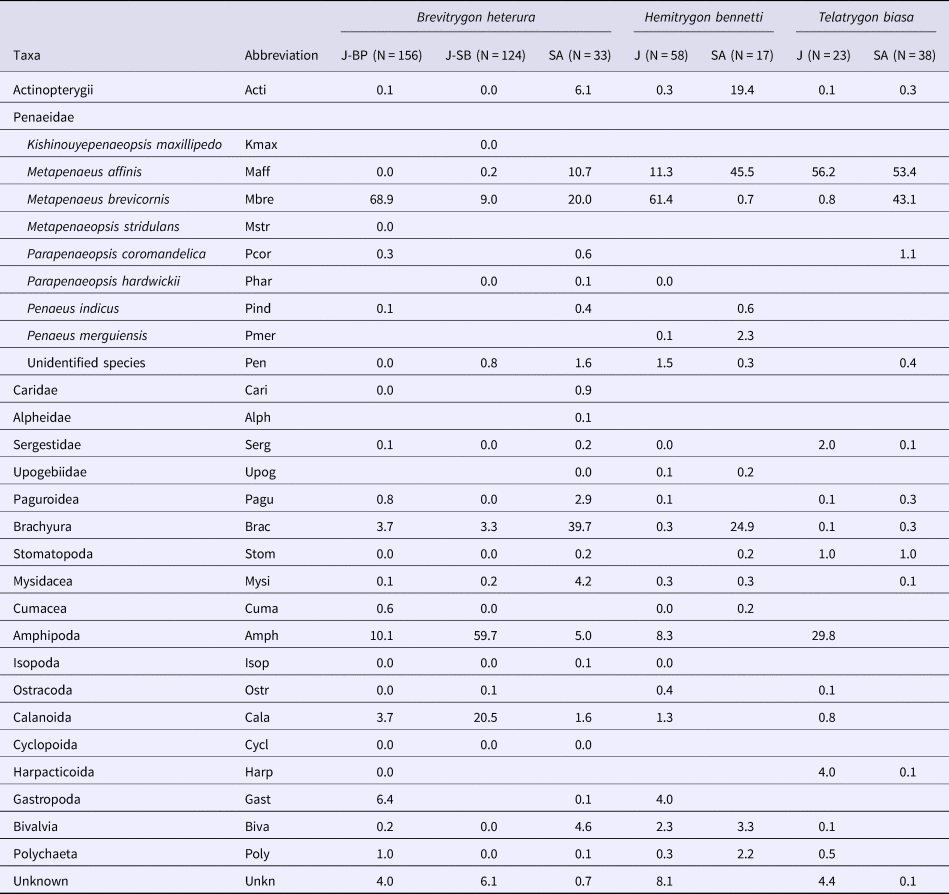
Twenty-nine prey taxa were identified by stomach content analysis (Table 2). The ‘Unknown’ category that formed part of the stomach content was partially digested prey items that could not be fully identified. Generally, the Penaeidae with eight identified species were dominated by Metapenaeus affinis (up to 56.2%IRI) and M. brevicornis (up to 68.9%IRI) as the most important prey items. Other important identifiable prey taxa with more than 10%IRI value included Amphipoda (59.7%IRI), Brachyura (39.7%IRI), Calanoida (20.5%IRI) and Actinopterygii (19.4%IRI).
Index of relative importance (%IRI) of the prey taxa recorded from stomach content analysis of three stingray species

Samples were pooled by sex, site and/or maturity except those indicated by their specified abbreviations. Site abbreviations (BP, Bagan Pasir, SB, Sungai Buloh), maturity abbreviations (J, juvenile, SA, subadult and adult).
Juvenile stingrays were found to exhibit different feeding habits (Table 2). They fed primarily on penaeids (M. affinis and M. brevicornis) with both B. heterura and H. bennetti more frequently eating M. brevicornis (41.1%IRI and 61.4%IRI respectively) while T. biasa consumed M. affinis (56.2%) more often. The presence of amphipods (33.2%IRI) and calanoid copepods (11.5%IRI) in the B. heterura diet indicated a different diet from H. bennetti. The diet of B. heterura showed site differences with individuals from BP feeding primarily on M. brevicornis (68.9%IRI) while individuals from SB mainly fed on amphipods (59.7%) and calanoid copepods (20.5%). Amphipods and calanoid copepods formed a minor part of the diet of B. heterura in BP (10.1% and 3.7%), and H. bennetti (8.3% and 1.3%). The high percentages of small-sized prey items were due to either the higher number (%N) or higher occurrence (%F) of such prey. For instance, at SB, amphipods and calanoids represented 37.5%N (78.2%F) and 28.8%N (57.3%F) of the diet of B. heterura respectively.
For the subadult and adult stingrays, the results showed a potential ontogenetic diet shift (Table 2). Telatrygon biasa (N = 38) which showed more specialized feeding behaviour, fed almost entirely on penaeid shrimps (>95%IRI). Another species of similar size, B. heterura, showed less specialization with increased predation on brachyurans and fish but reduced predation on penaeid shrimps, amphipods and calanoids. Diet shift in H. bennetti was similar to B. heterura; subadult and adult stingrays consumed more fish and brachyurans in place of the penaeids and amphipods consumed by juvenile stingrays.
The numbers of prey taxa found in each species of stingray by maturity stage were different, with B. heterura feeding on the widest range of prey followed by H. bennetti and T. biasa (Table S2). Moreover, the number of prey taxa found in individual stomachs varied between stingray species with maxima of 10, 8 and 4 prey taxa for B. heterura, H. bennetti and T. biasa respectively (Table S2). Results from Kruskal–Wallis ANOVA test showed that the number of prey taxa consumed was significantly different among the three stingray species, with T. biasa taking the least prey (P < 0.05). In addition, the number of prey taxa consumed by juvenile B. heterura in Bagan Pasir was significantly higher than juvenile B. heterura in Sungai Buloh (P < 0.05). Other maturity comparisons showed no significant differences (P > 0.05).
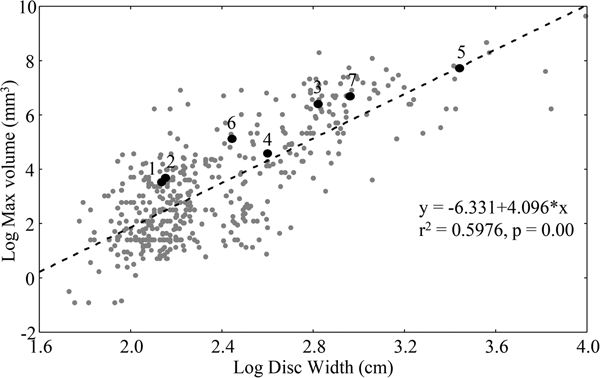
The volume of the largest prey item (PVmax) ingested was positively correlated (r = 0.77, P < 0.01) with stingray size (Figure 2). The mean PVmax of juveniles of the small sized stingray B. heterura from Bagan Pasir (average disc width 8.46 cm) was 35.13 mm3 (maximum 1000 mm3) while that of the subadults or adults of the large-sized stingray H. bennetti (average disc width 31.09 cm) was 2326.71 mm3 (maximum 15,000 mm3).
Linear regression of logarithmic-transformed volume of the largest prey item (PVmax) and stingray (predator) size (Disc Width). Grey dots represent individual stomachs; black dots labelled 1–7 represent the mean of regressed variables for the stingray species by maturity stage. Labels: 1 = J-BP, 2 = J-SB, 3 = SA (B. heterura); 4 = J, 5 = SA (H. bennetti); 6 = J, 7 = SA (T. biasa); see Table 2 for further explanation.

In general, juveniles of B. heterura showed a generalized feeding strategy involving a wide range of prey taxa that were consumed at low numbers and frequency (Figure 3A). However, the larger B. heterura shifted to larger prey, consuming more abundantly or more frequently softer bodied prey (crustaceans) as compared with hard shelled prey (molluscs). Similarly, the juveniles of both H. bennetti (Figure 3B) and T. biasa (Figure 3C) fed more abundantly although less frequently on a variety of small prey taxa. However, the larger T. biasa tended to feed frequently and abundantly on penaeids. Both juvenile and adult H. bennetti also appeared to feed more frequently and abundantly on penaeids. Although less frequently consumed, polychaetes and crabs could be ingested abundantly by adult H. bennetti, and similarly, stomatopods were ingested by adult T. biasa.
Scatterplots of prey specific abundance against frequency of occurrence in the diet of three species of stingray. (A) B. heterura, (B) H. bennetti and (C) T. biasa. Grey symbols = juvenile, black symbols = subadult and adult.

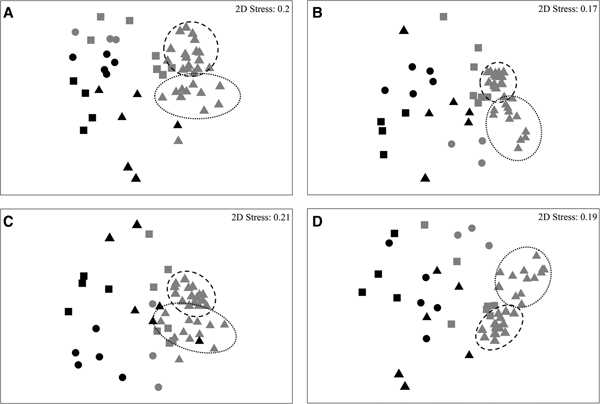
Figure 4 shows the nMDS ordinations derived from four measurements of prey items (%V, %N, %F and %IRI with square-root transformation). The results show that none of the measured variables separated all three stingray species, indicating diet overlap. For instance, juvenile B. heterura and H. bennetti were clustered together indicating shared prey taxa between them. The diet of juvenile T. biasa (grey circles) was more different to these two species; this was clearly observed for all variables except %F. Also, except for %F, subadult and adult stingrays were separated from the juveniles regardless of the species, indicating an ontogenetic diet shift. Subadult and adult diets of the three species overlapped to some degree, except T. biasa in a separate cluster if based on %V and %F. The diet of juvenile B. heterura, the only species of stingray that could be compared between sites, showed some degree of spatial difference.
Non-metric multidimensional scaling ordination of three sympatric species of stingray by maturity based on partially pooled data of food items measured using (A) %V, (B) %N, (C) %F and (D) %IRI. Species: triangle = Brevitrygon heterura, square = Hemitrygon bennetti, circle = Telatrygon biasa; Maturity: grey symbols = juvenile, black symbols = subadult and adult; Only juveniles of B. heterura are enclosed by drawn ellipses to show site differences (dashed line ellipse = Bagan Pasir, dotted line ellipse = Sungai Buloh).

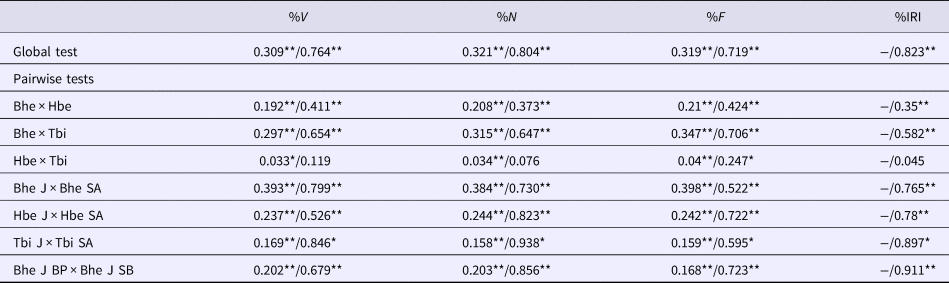
ANOSIM results showed that there were substantial differences among the stingray by species, maturity and sites (for juvenile B. heterura) with R-statistic value of about 0.3 for non-pooled data which increased to greater than 0.7 when the data were partially pooled. These differences were highly significant based on their P-value (<0.01) for all four diet variables except the comparison between H. bennetti and T. biasa for partially pooled data (Table 3).
R-statistic values in the ANOSIM test (non-pooled/ partially-pooled) for global and pairwise comparisons among stingray groups

Bhe, B. heterura; Hbe, H. bennetti; Tbi, T. biasa; J, juvenile; SA, subadult and adult; BP, Bagan Pasir; SB, Sungai Buloh.
*Significant at P < 0.05.
**Significant at P < 0.01.
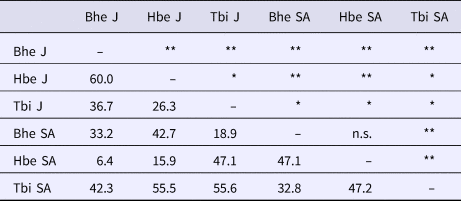
SIMPER analysis showed relatively similar results for the three diet measurements used (V, N, F) (Table S3) which is consistent with the nMDS results. Generally M. brevicornis and amphipoda were the most important prey taxa that ranked among the top three prey items in the comparisons. Larger sized M. affinis contributed more by volume while small-sized calanoid copepods contributed more by numbers and frequency of occurrence. The calculated Schoener's index of diet overlap (%SI) which ranged from 6.4 to 60.0 (Table 4) indicated low to moderately overlapped diets among the three species of stingray by maturity. The %SI for the juveniles of B. heterura from Bagan Pasir and Sungai Buloh was 30.4.
Schoener's index of diet overlap for the stingray groups

Bhe, B. heterura; Hbe, H. bennetti; Tbi, T. biasa; J, juvenile; SA, subadult and adult.
*Significant at P < 0.05, **significant at P < 0.01, n.s., not significant.
Discussion
This study reveals differences in feeding behaviour among the three species of stingrays in terms of their diet composition and number of prey taxa. Subadult and adult T. biasa ingest few prey taxa but feed very frequently and abundantly on penaeid shrimps (Figure 3C), which suggests that the species, on maturity, becomes specialized in its food habits. On the other hand, the large number of prey taxa consumed by B. heterura indicates that this species is more of a generalist, consuming a wide range of prey taxa, each in lower quantity and less frequently (Figure 3A). However, several studies have shown that stingray diets can be affected by prey availability from various habitats, where some stingray species consume acorn worms and/or polychaetes more frequently than crabs and stomatopods, as in D. chrysonata (Ebert & Cowley, Reference Ebert and Cowley2003) and Neotrygon species (Jacobsen & Bennett, Reference Jacobsen and Bennett2012). Our study seems to support this possibility of prey availability affecting diet as for instance, the difference in diet of juvenile B. heterura that lived on the different mudflat sites. We do caution that the lesser number of prey taxa observed in H. bennetti and T. biasa (compared with B. heterura) could result from their smaller sample sizes even though the stingrays were sampled over a 17-month period.
The type and contribution of consumed prey reiterates the benthic feeding behaviour of stingrays with the exception of larger stingrays which also feed on bony fish. The present finding agrees with Jacobsen & Bennett (Reference Jacobsen and Bennett2013) that most dasyatid stingrays feed primarily on decapods (Penaeidae in the present study). However, the present study also shows the importance of other prey taxa consumed by stingrays during ontogeny. Based on our preliminary findings, H. bennetti shows a trend of decreased ingestion of penaeid shrimps and increased ingestion of crabs and fish as they grow larger. Both B. heterura and T. biasa show reduced ingestion of amphipods and copepods that are replaced by penaeid shrimps, crabs and/or fish as they grow. Recent studies on the ontogenetic diet shift in the Dasyatidae show, however, that the contribution of penaeid and caridean shrimps becomes less important when brachyuran, polychaete and/or stomatopodean prey are also consumed as the fish develops (Ismen, Reference Ismen2003; Jacobsen & Bennett, Reference Jacobsen and Bennett2011, Reference Jacobsen and Bennett2012; López-García et al., Reference López-García, Navia, Mejía-Falla and Rubio2012). For stingrays of larger body size (e.g. Hypanus longus with a maximum disc width of 158 cm), bony fishes can constitute an important portion of their diet (López-García et al., Reference López-García, Navia, Mejía-Falla and Rubio2012). Similar studies on skates have also shown diet shift related to body size. For instance, the diet of Dipturus innominatus in New Zealand shifted from small crustaceans to larger crustaceans and fish when body size increased (Forman & Dunn, Reference Forman and Dunn2012). Six species of skates in south-eastern Australia all showed size-related changes in diet, in which four small-bodied species (Dentiraja cerva, D. confusa, D. lemprieri and Spiniraja whitleyi) living on the continental shelf preyed mostly on caridean shrimps, while a larger-bodied species (Dipturus canutus) living on the continental slope showed an ontogenetic diet shift from anomurans to brachyurans (Treloar et al., Reference Treloar, Laurenson and Stevens2007). The same authors also reported that another large-bodied species (Dipturus gudgeri) living on the slope preyed on teleosts irrespective of body size.
The contribution of copepods in the diet of stingrays has not been documented except for D. chrysonota (Ebert & Cowley, Reference Ebert and Cowley2003). No other studies on the food of juvenile or small stingrays have recorded copepods in their diet (Ismen, Reference Ismen2003; Raje, Reference Raje2003; Jacobsen & Bennett, Reference Jacobsen and Bennett2011, Reference Jacobsen and Bennett2012). Our study shows, however, that the contribution of copepods in juvenile B. heterura (3.7%IRI in Bagan Pasir and 20.5%IRI in Sungai Buloh) were substantially higher than in D. chrysonata (<1%IRI) as reported by Ebert & Cowley (Reference Ebert and Cowley2003). Moreover, full stomachs that were filled with only copepods (up to 149 copepods in a stomach) were observed in our B. heterura specimens. This is the first record of copepods being heavily consumed by a stingray. Consumed crabs belonging to the family Sesarmiidae is also an interesting observation of the present study. According to Tan & Ng (Reference Tan and Ng1988) and Ng (Reference Ng, Carpenter and Niem1998), these crabs are commonly found inhabiting mangroves and muddy areas, yet they had not been recorded on the mudflat area during sampling. Hence, it is likely that the stingrays forage deep into the adjacent mangrove forest during spring flood tide. Despite the large bed area of cultured blood cockles on the Sungai Buloh mudflat, this study shows negligible intake of this hard-shelled bivalve as food by the stingrays, similar to other Dasyatidae (Jacobsen and Bennett, Reference Jacobsen and Bennett2013; Pardo et al., Reference Pardo, Burgess, Teixeira and Bennett2015). The dasyatids have small weak teeth unlike durophagous myliobatids which have strong tooth plates for crushing hard shells (Ajemian & Powers, Reference Ajemian and Powers2012; Kolmann et al., Reference Kolmann, Crofts, Dean, Summers and Lovejoy2015).
Species competition for food in the same feeding ground can be reduced if stingrays have different diel feeding activity (Cortés, Reference Cortés1997), occupy the habitat at different times (Bangley & Rulifson, Reference Bangley and Rulifson2017), share only a small fraction of their feeding niche (Navia et al., Reference Navia, Mejia-Falla and Giraldo2007; Ruocco & Lucifora, Reference Ruocco and Lucifora2016), adapt with some degree of resource partitioning (Treloar et al., Reference Treloar, Laurenson and Stevens2007), partition their habitat space (O'Shea et al., Reference O'Shea, Thums, van Keulen, Kempster and Meekan2013), or if the shared food resource is abundant (Laptikhovsky et al., Reference Laptikhovsky, Arkhipkin and Henderson2001). On the Klang mudflat, stingrays certainly display considerable diet overlap between species compared at both juvenile and mature stages (Table 4). In most cases, diet overlaps (%SI) between species were significant, varying from 26.3 to 60 for juvenile stage, and from 32.8 to 47.2 for mature stage. Notwithstanding the observed ontogenetic diet shift, diet overlaps (15.9–55.6) were also evident between juvenile and mature stages of all species which compete for rather similar prey items (Figure 3). Interestingly, the penaeid shrimps are the prey item mostly and regularly exploited by both juvenile and mature stingrays of all three species (Figure 3). Thus, penaeid shrimps may represent a common shared resource known to be very abundant on the Klang mudflat which serves as their nursery area (Chong et al., Reference Chong, Sasekumar, Leh and Cruz1990; Sasekumar et al., Reference Sasekumar, Chong, Leh and Cruz1992; Marsitah & Chong, Reference Marsitah and Chong2002). Lim (Reference Lim2016) reported that different species of stingrays have different recruitment peaks on the Klang mudflat due to different peak breeding periods. Hence, temporal partitioning in the use of the mudflat as a feeding area could further reduce species competition for food and space.
This study shows a positive relationship between predator size (disc width) and the maximum prey volume (Figure 2). The prey eaten by small stingrays (juveniles of B. heterura and T. biasa that averaged 8.75 cm DW) included amphipods, copepods, fish larvae and postlarval to small juvenile shrimps with variable prey volumes of up to 1000 mm3. Medium-sized stingrays (juvenile of H. bennetti, subadult/adult of B. heterura and T. biasa that averaged 16.01 cm DW) are hypothesized to be capable of chasing their prey, at least more efficiently than small-sized stingrays (Carlson et al., Reference Carlson, Goldman, Lowe, Carrier, Musick and Heithaus2004). Their prey including larger-sized shrimps and crabs had variable volumes of up to 4000 mm3. Large-sized stingrays (subadult/adult H. bennetti that averaged 31.09 cm DW) in the present study are presumably the most efficient in capturing large prey such as fish (volume of up to 15,000 mm3) which are protein-rich food. However, the energy required for stingrays to prey on fish may be costly, which could explain the lesser contribution of fish as prey, as for instance, 19.4%IRI for subadult/adult H. bennetti in the present study. This hypothesis, however, needs verification from further work given the insufficient sample size in the present study, though the low contribution of prey fish (16.5%IRI) in the Myliobatiformes has also been reported in Jacobsen & Bennett (Reference Jacobsen and Bennett2013).
Given the large stock of penaeid shrimps shared as food by the three stingray species on Klang mudflat, it would be interesting to evaluate the stingray predation pressure and its ecological implication, if any. The mean density (±SE) of stingrays were 11 (±3) ind. ha−1 and 24 (±11) ind. ha−1 (Lim, Reference Lim2016) at Sungai Buloh and Bagan Pasir respectively, while the mean stock density (±SE) of penaeid shrimps estimated at Sungai Buloh and Bagan Pasir in the same period of study was 1203 (±866) ind. ha−1 and 1011 (±218) ind. ha−1, respectively (Lee, personal communication). On average, 43% and 39% of the stingrays were found to consume penaeid shrimp, at a rate of ~11 and 24 shrimps per fish in Sungai Buloh and Bagan Pasir respectively. Thus, the average predation pressure (±SE) on the shrimp stock by stingrays on the mudflat is estimated to be about 10% (±5) at Sungai Buloh and 15% (±8) at Bagan Pasir respectively. However, the predation pressure is considered much lower since the barrier net which also sampled the penaeid shrimps had a mesh size (2.5 cm) that excluded most of the smaller shrimps fed on largely by stingrays. Notwithstanding the low predation pressure due to the low stingray density and high shrimp density, the overall predation pressure on shrimps is considered high in coastal mudflats since shrimp predation by many teleosts is also well reported in several studies (Ong & Sasekumar, Reference Ong, Sasekumar, Soepadmo, Rao and Macintosh1984; Chong et al., Reference Chong, Teoh, Ooi, Jamizan and Tanaka2012; Leh et al., Reference Leh, Sasekumar and Chew2012).
In conclusion, three major species of dasyatid stingrays make regular high-tide invasions of the coastal mudflats of Klang which serve as their feeding and nursery area. The largely young stingrays exploit the vast benthic resources of penaeid shrimps (eight species) including 19 other prey taxa, displaying low diet overlap and some degree of diet specialization with ontogenetic growth. However, benthic copepods as a major diet for juvenile stingrays (B. heterura) is recorded for the first time. Given the importance of coastal mudflats as a productive area of living food resources, this study supports the protection of coastal mudflats which are relentlessly subjected to land-claims for development as well as heavy fishing activities.
Supplementary material
The supplementary material for this article can be found at https://doi.org/10.1017/S0025315418000759
Financial support
This work was supported by the Japan International Centre for Agricultural Sciences (JIRCAS) under Grant [57-02-03-1005] given to VCC; and UM IPPP Grant under Grant [PG103-2012B] given to KCL.