


Introduction
This narrative account uses the career of the Kenyan popular “live band” musician Awillo Mike in 2020 to explore how musicking—defined by Small (Reference Small1998, 9) as “tak[ing] part, in any capacity, in a musical performance, whether by performing, by listening, by rehearsing or practicing, by providing material for performance (what is called composition), or by dancing”—contributes to social resilience. Resilience here means:
[A] system’s ability to anticipate, absorb and recover, adapt, and transform when faced with a wide range of evolving risks and uncertainties leveraging both scientific and indigenous knowledge and building on social norms and communal systems to reduce harm and maintain an acceptable level of functioning without compromising long-term prospects for sustainability, prosperity, peace and well-being for all. (AUC, UNDP, and UNRISD 2024, 20)
This, then, is a “year in the work life” biography that enters the debate on the relationship between musicking and social resilience—specifically, the implicit tension between those who argue that “[m]usic sustains ways of life and identities” (Street Reference Street2003, 119), and those who “are unable to establish the ‘magical effect’ of songs on behavior and social change” (Fayoyin and Nieuwoudt Reference Fayoyin and Nieuwoudt2017, 1). Ethnographic and literary methods (interviews; viewing of a live-streamed musical performance and analysis of its recording; archival research; and close reading of song lyrics) were used to construct a narrative of Awillo Mike’s struggles to survive and sustain his music career during the COVID-19 pandemic. This is a narrative that shows how musicking is an everyday practice that persists by adapting, even in difficult circumstances. The story aligns with “evidence [that] supports the general notion that entertaining content may have long-term effects on viewers’ coping with adversity” (Reinecke and Kreling Reference Reinecke and Kreling2022, 4), suggesting that the tenacity of musicking can be explained by the fact that, as entertainment, musicking fulfils deep psychological needs and supports community resilience both directly and indirectly.
The story is in two parts. The first part describes Awillo Mike’s professional life in the months preceding the COVID-19 pandemic, highlighting the economy of Kenyan live band music. The second, longer part tracks Awillo Mike’s struggles during the pandemic. In this section, and especially through examining the musical work Awillo Mike produced during the COVID-19 crisis, the narrative underscores the contribution that musicking makes to social resilience.
Before Corona Stopped the Music
When news first reached Kenya of the eruption of an unknown virus that was deadly to human beings in far-off China, the post-Christmas slow-down in the country’s live band—and, indeed, entertainment—scene was setting in. It was early January. As is signaled by the corruption of its name in popular jokes that circulate among Kenyans especially over social media at the beginning of every year, “Njaanuary,” the month, usually sees more than the sobering up of Kenyans after the season of festivities. “Njaa,” used as the first syllable in the corrupted name of the month, means “hunger” in Kiswahili, the country’s national language. Broke after December’s heavy spending, Kenyans go back to everyday obligations and commitments—with their financial costs. Schools reopen. In the countryside, the last harvests of maize, the staple food in most of the country, are brought in and farmers begin to prepare their land. For most, the concern turns to immediate survival. The weather underscores the harshness of the month; it is hot, windy, dusty. Over the month the grass browns, then starts to grey.
There is little money for merry-making when the country is dragging itself back to business. This fact did not unduly worry Awillo Mike in January 2020.Footnote 1 He had been in the live band music industry for just over two decades. In Kenya, “live band” is a collective label for a set of guitar-based dance music genres. The “live” in Kenyan live band music is understood as “the kind of performance in which the performers and the audience are both physically and temporally co-present to one another” (Auslander Reference Auslander2012, 5). As a veteran, Awillo Mike knew what to expect. He still had a regular performance with the group Zaidi ya MzikiFootnote 2 every Sunday in Funcity, Utawala, Nairobi, and that would see him through the four weeks of January.
The payment due to a live band act is rarely substantial. In 2020 it usually fell between Ksh 25,000 and 35,000 (approximately €189–315) for an ordinary performance typically lasting 6–7 hours), and around Ksh 50,000 (approximately €379–450) for special performances such as weddings and corporate events—shared among an average of ten band members. The busiest live band acts have three ordinary performances a week (Wednesday, Friday, and Saturday). Yet even the musicians in such bands do not earn a living wage; in Kenya in 2020 this ranged between Ksh 38,100 and 52,100 (approximately €286–469) per month for a typical family (Voorend et al. Reference Voorend, Anker and Anker2019).
It would have been extremely rare to find a live band musician renting a house at more than Ksh 6,000 (approximately €45–54) a month—on average the lowest rent available in the lower-middle-class neighborhoods of Kenya’s towns in 2020. This explains why live band musicians generally lived either in working-class neighborhoods or in informal settlements. Awillo Mike’s take-home from a performance ranged between Ksh 2,000 (approximately €15–18) and Ksh 4,000 (approximately €30–36) since payment arrangements recognize both the hierarchies in band structure and the additional share due to musicians whose compositions attract performance contracts. Awillo Mike falls into both categories. He holds a leadership role in the groups with which he plays and his hits from the past—especially “I’m not Sober” and “Riziki”—remain staples of live band repertoires countrywide.
It is important to underscore a point implicit in the above: live band music is firmly located in the Jua Kali—that is, the largely unregulated “non-farming self-employment” (World Bank 2012, iv) informal sector of Kenya’s economy. This has been particularly true since the country experienced a significant economic downturn in the 1980s caused by:
[A] succession of changes, some evident towards the end of the previous decade (a deterioration of prices for coffee and tea in world markets), others emerging only in the 1980s (the second oil price rise and the subsequent recession in the world at large; the expansion of petroleum refining in the Arabian Gulf at the expense of Kenya’s refined exports; and the cueing off of trade with Tanzania and Uganda—all events beyond Kenya’s control). (Enos Reference Enos1995)
One of the numerous consequences of that economic downturn was the collapse of the music recording industry in Kenya (see Eisenberg Reference Eisenberg2015; Odidi Reference Odidi2017). With the collapse, the recording aspect of the guitar-based dance music genres diminished in importance and, subsequently, live performance became the definitive characteristic of the genres—they became live band music.
A description of the Jua Kali sector—which “accounted for 83 percent of total employment [in Kenya] in 2019 up from 82.6 percent in 2018” (Federation of Kenya Employers 2021, 8)—points to the vulnerability of those who work in it, relevant here for what it reveals about Awillo Mike’s working life in 2020:
Informal sector enterprises in Kenya are commonly referred to as jua kali and they comprises [sic] informal traders and artisans who produce goods and services for market. However, enterprises are not registered by register [sic] of companies [should be Registrar of Companies] and are not covered by the government Social Security Scheme and other employment related government regulations such as the minimum wage and non-payment of social contributions. Hence workers in the sector do not receive social security benefits like sick pay, disability pension, and old-age pension among others. (Ministry of Labour and Social Protection n.d.)
The point that Kenyan live band music is part of the Jua Kali economy also indirectly helps explain the music’s absence from the more lucrative sections of the country’s entertainment industry. Thus, there are audio and video recordings of the music but—no matter their cultural significance—these are secondary. There is hardly any local club—or lounge, as they have come to be called in Kenya—where they are regularly played. Financially, the recordings are subordinate: they confirm and broadcast the performance abilities of the musicians, thereby making it easier and more profitable for them to secure the performance gigs that are the real source of their livelihood. For this reason, the recordings are most useful when they get radio airplay—which, unfortunately, from around 2010, they have done regularly only in the marginal space offered by vernacular radio stations, each serving only speakers of its broadcast language. Recording sales are rarely significant.
Even so, somewhat paradoxically, some live band songs become part of or trigger conversations that draw in people beyond “the audience [that] are [together with the performers] both physically and temporally co-present to one another” (Auslander Reference Auslander2012, 5) in the performance spaces. Most such songs will have found their way into radio stations. Others will have reached wider audiences through community cultural events like disco matanga —night dances that accompany funeral vigils in parts of the country. Live band songs resonate with the masses for live band is music of the people, by the people, and for the people. As music and performance produced in the Jua Kali sector in which most Kenyans are engaged, live band is music of and by the masses; as music and performance that provides the masses with means to restate their humanity as they negotiate the mostly difficult issues that they confront in everyday experience (see, for example, Mboya Reference Mboya2020; Mboya and Wandolo Reference Mboya, Wandolo and Njogu2008), live band is music for the masses.
Sad as the situation of the Kenyan live band musician is, it is hardly unique. As Greivin observes, in most of Africa:
musicians operate within informal economies, relying on live performances, street gigs, and community events as primary sources of income. The lack of formal infrastructure such as unions, copyright enforcement, or streaming revenues compels artists to innovate within socio-economically constrained environments. (Greivin Reference Greivin2023, 3)
This is compounded by the fact that popular music does not attract the support of African governments. This is in stark contrast with, for example, “South Korea … [where] the government spends billions of dollars every year to support its arts and culture sector. As a result, South Korea’s K-Dramas and the K-Pop industry have now taken over the global stage and are allowing the rapid flow of tourists and investments into the country” (Soh Reference Soh2022).
Returning to Awillo Mike in January 2020—there was little reason for him to be anxious. In any case, he expected things to take a turn for the better soon after, as they usually did. There was even more reason to be optimistic this year. In his first address to the nation for the year, the president of Kenya, Uhuru Kenyatta, promised to “support … makers of entertainment” (Kenyatta Reference Kenyatta2020). He even outlined some practical steps his government planned to take to ensure that entertainers benefitted from their important work.
There was yet another reason why Awillo Mike was taking it easy. There was a sense in which the slow-down was welcome. December had been very busy, and it had been the culmination of the best six months he had had since the glory days of the mid-2000s, when his group Ja-Mnazi Afrika was arguably the most popular live band in Kenya. In addition to the regular gigs, the monthly performances in clubsFootnote 3 with both Zaidi ya Mziki Band in Nairobi and Orch. Ja-mnazi Afrika Band in Kisumu, Awillo Mike had also had occasional non-club performances—the launch of Sauti : Gifted Different, Unsilenced, a documentary he is featured in and for which he had written a song in July, and whose official release would come later, in 2020; and two Nairobi Godown “Boogies.” And then came the Christmas season, and he had several performances at weddings and corporate engagements. In December 2019, also, there was a twelve-day residency at the Homa Bay Tourist Hotel in Homa Bay Town on the shores of Lake Victoria. At the beginning of the year Awillo Mike had relocated from the low-income neighborhood of Dagoretti Satellite to the working-class neighborhood of Umoja 2, where he now lived with his partner.
As January wore on, business started picking up. It seemed like the deadly virus, now named, was not spreading outside China. Awillo Mike got into a new Friday–Saturday engagement at the Druids Lounge on Kangundo Road, Nairobi. Come the beginning of February new offers started coming in. Captain’s Terrace on Mombasa Road called. An Easter long-weekend performance in Bondo Town was broached. On TV the news reports were mostly on a locust invasion in Kenya, “the worst in 70 years” (World Bank 2020). By late February, however, there was a marked shift in the conversations around possible performance engagements. The offers were fewer and tentative. No club or bar proprietor was committing to a deal to have Awillo Mike perform in their venue. Then, on March 13 the first COVID-19 case was confirmed in Kenya. Two days later, on March 15, the Government of Kenya banned all social, including religious, gatherings as part of its efforts to protect the nation from the virus. The beer bars and nightclubs where live band music was regularly performed were shut down. “Corona stopped the music,” Awillo Mike remembers, “it rendered us technically jobless.”
“Lockdown”: Musicking (through) the Pandemic
Ten days after the banning of social gatherings, on March 25, the Government of Kenya announced a countrywide 7 p.m.–5 a.m. curfew. Containment measures continued to escalate (Ali and Mulama Reference Ali and Mulama2020). The police were deployed to enforce the COVID-19 lockdown. Their methods were frequently brutal (Namu and Riley Reference Namu and Riley2020).
With the present and immediate future for live music performance looking bleak, Awillo Mike decided he urgently had to find alternative sources of income. Live band musicians earned too little to save. Given the financial unimportance of recordings, complicated by rampant music piracy, live band musicians could not turn to the royalties on which musicians in other genres and in other economic contexts depended. Before 2020, Kenyan live band music had only peripheral presence in the digital music economy—YouTube views, online sales, and so forth. Adding to this, live band artists are generally not engaged in brand endorsements. Awillo Mike knew that surviving through April was going to be a challenge.
By the beginning of April 2020, Awillo Mike had settled on selling fish. The idea was first suggested to him by his partner’s sister. The plan was to reach out to potential customers—personal friends and fans made the obvious first line—online, primarily using Facebook and Instagram. Awillo Mike knew a thing or two about fish, having grown up in Bunyala, not far from the northeastern shores of the Kenyan part of Lake Victoria, where fishing is the main economic activity. He also knew one or two people from home who were in the business in Nairobi. He could use their supply networks. His idea was to specialize in selling the rarer species like mumi / odol (catfish) and kamongo (marbled lungfish) on the assumption that those who wanted alternatives to the readily available fresh ngege (tilapia), omena (silver cyprinid, often described as Lake Victoria sardine) and mbuta (Nile perch) would seek them out. Recognizing early that the perishability of fresh fish posed a challenge—since he did not have a refrigerator for the purpose—he decided to deal in processed fish like obambo (sun dried fish) and bude (smoked fish).
It was not easy getting the grants and soft loans Awillo Mike sought from family and friends. Everyone was preoccupied with their own survival. Jansens et al.’s observations about how low-income households in rural Kenya coped with the immediate consequences of the COVID-19 pandemic applied equally to their urban counterparts: “households deposited less savings, but also withdrew less, suggesting that they were protecting whatever savings they still had. Informal risk-sharing between households declined as indicated by declining credit and loans, loan repayments, gifts and Harambee contributions” (Jansens et al. Reference Jansens, Pradhan, de Groot, Sidze, Donfouet and Abajobir2021, 2).
Awillo Mike had entered a survivalist mode. In this he was not alone. The COVID-19 pandemic was a genuine crisis for African popular musicians. As Praise Zinhuku reports, the “indefinite pause, or disruption” (Zinhuku Reference Zinhuku2021, 2) the pandemic caused seriously affected the music sector across the continent. One would have expected Awillo Mike to set aside his thoughts of making music in the circumstances, but he did not. He still considered himself first and foremost a musician. He was just out of work. This was not unusual, as Breakwell and Jaspal, writing about the impact of the COVID-19 pandemic on musicians in the United Kingdom, explain:
The COVID-19 pandemic had substantial effects on musicians reliant on live performance to large audiences. These were financial, in both the short and longer terms—particularly if venues had to be permanently closed after debts had accumulated during lockdown—and related to psychological well-being. For a professional performer, the inability to perform can be a significant identity threat as their work is an important element in the configuration of their identity. Not only is musician their occupational descriptor but also the way they construe themselves. It is a way in which they achieve self-esteem and a sense of self-efficacy. The performance reinforces this when they are acclaimed, applauded, recognized, and rewarded for their skills and their creativity. The COVID-19 pandemic disrupted this system of identity reinforcement. (Breakwell and Jaspal Reference Breakwell and Jaspal2022: 792, emphasis in the original)
Awillo Mike experienced momentary relief from psychological distress on April 3, 2020, when Sauti : Gifted Different, Unsilenced premiered on YouTube (Ketebulmusic 2020). He was very happy about the documentary, sharing it widely online. It reaffirmed his identity as a musician. On April 6, 2020, President Uhuru Kenyatta “directed the Ministry of Sports, Culture and Heritage to set aside Ksh.100 million [roughly €834,000 at the day’s rate] to cushion local artistes from the effects of the coronavirus pandemic” (Muriuki Reference Muriuki2020). The president was still thinking of the “makers of entertainment” even in these new circumstances. This reminded Awillo Mike that he was not on his own—even though live band musicians were among those that were hardest hit economically by the pandemic containment measure, they were not forgotten.
It was not immediately clear how the presidential order was to be implemented. Awillo Mike waited. As he did, life under pandemic conditions—now popularly referred to as “the new normal”—went on. The smartphone became exponentially more central to daily life. Through it he kept up a mediated “social life” and participated in informal musician networks, now operating almost entirely virtually. Around this time, Awillo Mike became aware of something interesting unfolding in the Luo Music Bank Forum (LMBF). The LMBF was a WhatsApp group that brought together players in the Luo music industry—musicians, producers, radio presenters, music teachers, and a few very committed fans who were significant consumers of music. (The Luo music industry has at its center musicking in Dholuo, the language of the Luo people.) The forum was one of many informal groups, organized around patron–client relationships, that supported the country’s live band sector. Awillo Mike had joined the group in October 2019, simply to be part of the community of music makers and their prospective patrons and to keep abreast of developments in the industry. There was a lively sharing of experiences in LMBF. Sometimes the discussions became heated. Now, a businessman-politician in the group had decided to organize and sponsor a challenge for the musician members of the group: compose a song about the COVID-19 experience. The composer of the winning song would be awarded a prize of Ksh 60,000 (roughly €522 at the day’s rate), the first runner-up Ksh 40,000 (roughly €348 at the day’s rate) and the second runner-up Ksh 30,000 (roughly €261 at the day’s rate). The businessman-politician’s motivation was a desire to keep the musicians active and, through their music, to entertain the wider community.
Gripped by the drama, Awillo Mike closely followed the challenge to its conclusion. When, a couple of weeks after the first LMBF music challenge ended, the sponsor announced a second challenge—the requirement being to compose a song that promotes the government’s, by extension the WHO’s, recommendations on the management of the spread of the COVID-19 virus—Awillo Mike decided to participate. The decision was in itself an activation of his music-maker role and of his identity as a musician. He was back—even if that meant making music as part of the new normal.
To enter a song in the challenge, one first had to record it. Awillo Mike did not have the money to pay for studio time. Live band musicians in Kenya rarely do. They depend on patrons, and sometimes they raise funds through harambees. Footnote 4 Fortunately for Awillo Mike, the producer Dennis “Denno” Nguasi made him an offer. It was a gamble. Denno Nguasi would record his song for free; if the song won, they would share the prize money equally. Awillo Mike accepted. He also enlisted the services of singer Marvo Jangolo and guitarist Evans Wuonyaluero (“Jasakabaka”)—meeting a second condition the sponsors had set: that entries be collaborative efforts.
The process of making the song that would come to be known as “Lockdown”—from the conjuring of the first melodic phrase in the comfort of his house, through the camaraderie and negotiations that characterize studio work, to the approval of the final version—revitalized Awillo Mike. His practice had always been to give a new composition several test runs in live performance and, where necessary, to adjust in response to audience reaction. The times did not allow for that. He bounced the work in progress off a few friends whose judgment of live band music he respected. On May 14, 2020, Awillo Mike and his collaborators recorded “Lockdown.”
“Lockdown” is an argument. Awillo Mike reasons that since we find ourselves in this disastrous situation caused by COVID-19, we are obliged to act in ways that increase our chances of survival—we must wear masks, sanitize, observe social distancing and, once exposed to the virus, go into isolation. To reinforce his point, Awillo Mike compares the pandemic situation to a war, which demands sacrifice. The exhortation is for all to adopt a kind of military-style discipline and engage this menacing invisible enemy using guerilla tactics, “lest we die like locusts.” This use of hyperbole extends to the song title. This distinction is worth noting: as used in this song, “lockdown” is isolation, quarantine, the removal of individuals from the activities and interactions of normal life—not “a state or period in which movement within or access to an area is restricted in the interests of public safety or health” (Oxford Languages Dictionary), which usually refers to a forced stay-at-home confinement for entire communities.
The great innovation that Awillo Mike brings into this found argument—the challenge to make the argument through music—lies in the song’s claim that going into isolation in special circumstances is not new among the Luo and is therefore normal. (Given the motivation for making the song, it comes as no surprise that Awillo Mike has members of the Luo ethnic group as his targeted audience.) Awillo Mike lists several circumstances for which Luo traditions call for restriction of movement, modification of human contact or isolation: when a parent dies, the first-born son must stay at home until all the funeral rites are done; when a married man dies, the widow must refrain from various forms of social interaction until all the funeral rites for her late husband are done; when a woman gives birth she observes a period of recovery that involves refraining from sexual activity (curiously, in “Lockdown” it is the man who is urged to persevere in this case). Against the backdrop of a growing resistance to the measures implemented to manage the spread of COVID-19, this rooting of the measures themselves in cultural tradition seeks to persuade citizens to “own them,” see them as normal, and to submit willingly to them. Hence the assertion that “lockdown is not a prison.” This act of reminding the Luo of their traditions is therefore also a re–membering—a putting back together to wholeness of the community after the assault by the pandemic and by the steps taken to control it.
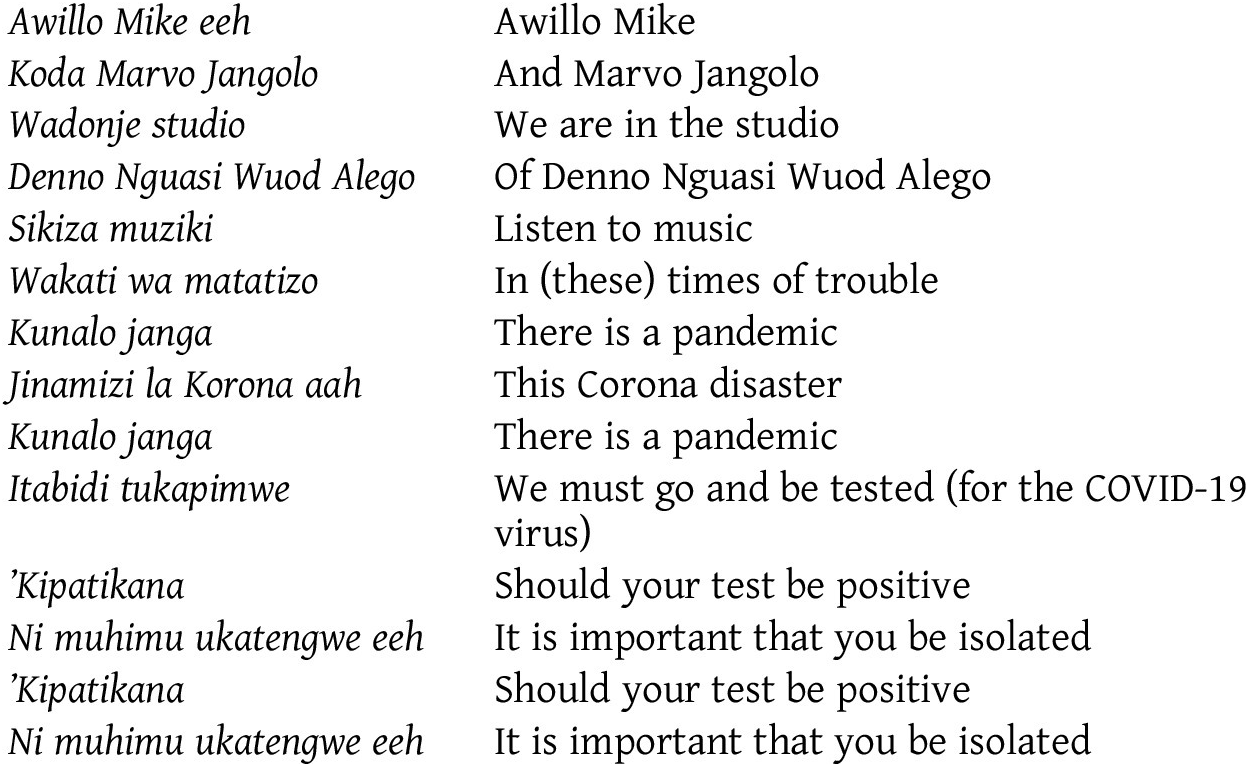
The phrase that is quoted in the title of this paper is from two lines in the introductory verse of “Lockdown,” “ Sikiza muziki/ Wakati wa matatizo ” (Listen to music/ In (these) times of trouble):

Table 1. Long description
The table consists of 14 rows and 2 columns.
Row 1: Awillo Mike eeh | Awillo Mike.
Row 2: Koda Marvo Jangolo | And Marvo Jangolo.
Row 3: Wadonje studio | We are in the studio.
Row 4: Denno Nguasi Wuod Alego | Of Denno Nguasi Wuod Alego.
Row 5: Sikiza muziki | Listen to music.
Row 6: Wakati wa matatizo | In (these) times of trouble.
Row 7: Kunalo janga | There is a pandemic.
Row 8: Jinamizi la Korona aah | This Corona disaster.
Row 9: Kunalo janga | There is a pandemic.
Row 10: Itabidi tukapimwe | We must go and be tested (for the C O V I D-19 virus).
Row 11: ‘Kipatikana | Should your test be positive.
Row 12: Ni muhimu ukatengwe eeh | It is important that you be isolated.
Row 13: ‘Kipatikana | Should your test be positive.
Row 14: Ni muhimu ukatengwe eeh | It is important that you be isolated.
In context, the lines are beautifully ambiguous. They can be understood as an urging of the listeners of “Lockdown” to listen carefully to the song’s message, whose basic ideas the subsequent lines capture. They can be understood to draw attention to the soothing effect of music. They can also be understood as urging the consumers of “Lockdown” to adopt listening, rather than dancing, as the primary mode of engaging with live band music during these difficult times, in which the “live” experience that is so important to the music had been disrupted.
Musically, “Lockdown” is an interesting, eminently danceable track in three parts. (And that complicates the urging to listen rather than to dance to the song.) It starts with a rhythm Awillo Mike calls “sakade,” essentially the Kenyan coastal “chakacha,” though today in Kenya more readily associated with the Congolese musician Koffi Olomide (Congolese musicians in Kenya call the rhythm “folklore” or “zebola”); the second, middle part is in the traditional Luo dodo or dudu rhythm; and the final part is a guitar chorus modeled on the Congolese sebene as done since the late 1990s—what is frequently referred to as the ndombolo sebene, complete with its animations. In parallel, the first part of the song is almost entirely in Kiswahili (only 4 of the 32 lines are in Dholuo, all coming at the opening of the 14-line first stanza) and is mainly choral singing; there is more Dholuo in the second part (11 lines out of 41, with 2 stanzas entirely in Dholuo and even the Kiswahili in the section being shot through by Dholuo), and the singing is in the call-and-response format of the dodo or dudu song. The animation in the final part is in Kiswahili. Fittingly, the claim that going into isolation is normal among the Luo, given its roots in Luo tradition, is made in the second part of the song. In short, musical form buttresses message.
At the time of the making of “Lockdown,” there was increased activity in the wider Kenyan music industry. Some DJs started streaming their shows live on Facebook, Instagram, and Twitter in March 2020 (Kamau Reference Kamau2020). Musicians working in genres known in Kenya as Kizazi Kipya, or New Generation—closely connected to American, Caribbean, and European forms (hip hop, R&B, ragga, reggaeton, house, and so forth—had continued releasing YouTube videos without interruption. Kizazi Kipya musicians had long secured ways of operating effectively and profitably in the digital space. They also started staging what Akombo and Akombo describe as “digital live concerts” (Akombo and Akombo Reference Akombo and Akombo2023, 24). The keyboard-based ohangla, which had recently become the dominant Luo music genre, had also begun to find its footing in the digital world.
Awillo Mike decided to do an online show in the manner of the DJs. He called up the other members of Zaidi ya Mziki band. But first there was something urgent to attend to. On May 19, 2020, the fish business for which Awillo Mike and his partner had been raising capital began operations. Just over a week later, on May 27, 2020, Awillo Mike registered Awillo Mike & Ornament Band with the Permanent Presidential Music Commission (PPMC). By then, the nature of the government support to the creative industry announced by the president on April 6 had become clear. It amounted to a stimulus package. To access the support, musicians had to register with the PPMC and make a formal application. For this, the special-purpose nine-person group comprised members of the Zaidi ya Mziki band and a couple of musicians who had participated in the recording of “Lockdown.” Awillo Mike applied for the support.
On May 30, 2020, Awillo Mike and Zaidi ya Mziki had their first virtual performance. The performance was hosted by the musician-producer Roy Captain in his house at Saika Estate in Nairobi, which became a studio for the musical event. It was streamed live via Facebook, Instagram, and YouTube. This was Awillo Mike’s first performance since “Corona stopped the music.” That the musicians had not rehearsed together sufficiently, if at all, was clear (see the recording of the show’s “10%”—the short performance before the performance proper that confirms that the show will happen as announced at Roy Captain 2020). There is a jam quality to the performance, and improvisation—usually circumscribed in live band shows—is permitted a lot of room. There is also the matter of the physical venue from which the broadcast was made. The performance area was different from—smaller than—the venues where live band music is regularly performed. It did not allow for the “stage show,” choreographed dance, that is usually part of Awillo Mike’s performances.
Most importantly, there was no live audience as part of the performance—as musicians, event production team, and so forth—was missing, and that affects Awillo Mike’s performances which, as Eric Masese (Reference Masese2021) has shown to some depth, are usually highly interactive. Even so, the performance sought to communicate defiance of the threat posed by the COVID-19 pandemic—and succeeded. The host and the musicians repeatedly declared that they would not be cowed by the novel coronavirus—and neither should Kenyans in general.
The band mostly performed Awillo Mike’s compositions. The performance confirms the observation that human “bodies and the movements they make (i.e. gestures) not only produce sound, but have influence on how the audience perceives music” (Gardner and Shea Reference Gardner and Shea2022, 1.3). Even the crowding of five maskless musicians and their guitars and a drum set on the squeezed stage—which in the context of the pandemic could be understood as reckless—communicates the defiance. Here is a group of men making music and having fun in spite of the pandemic and the conditions it had engendered. Musicking is an expression of faith in life, and these musicians were struggling for life.
It was a different kind of performance, Awillo Mike would later recall—and a learning experience. Even the manner of “payment”—through voluntary mobile money transfers from live stream viewers—was different from the norm. According to Awillo Mike, the performance almost paid for itself.
The following evening, on May 31, 2020, the results of the second LMBF Music Challenge were announced. “Lockdown” won first prize. The song exceeded the sponsor’s expectations. It is worth bearing in mind the limitations of time, in addition to the context of the challenge, to appreciate Awillo Mike’s achievement in “Lockdown.”
In the wake of its success in the challenge, “Lockdown” spilled out of the LMBF WhatsApp group onto connected WhatsApp networks and beyond, becoming part of the conversations among lovers of Luo music about the pandemic and its management. This illustrates how music functions as “a major tool of public discussion of health and development issues” (Fayoyin and Nieuwoudt Reference Fayoyin and Nieuwoudt2017, 4). This has prompted scholars to identify a role for “African musicians [as] … the continent’s investigative journalists, talk-show hosts, and editorial writers” (Allen Reference Allen2004, 2). These metaphors suggest that by effectively summoning conversations on topics deemed important to their publics, African musicians—to quote James Ogude in a different but related context—“force … the community to engage with issues relating to their destiny” (Ogude Reference Ogude2001, 44). The engagement empowers, and the empowerment “can contribute to … resilience” (Allen Reference Allen2004, 5), as Lara Allen further explains:
Identification with a certain kind of music creates a space in which individual experience can be articulated while simultaneously receiving affirmation from a group. Such acknowledgement and validation is profoundly empowering for individuals, and, if the sentiments expressed are shared with enough people, a powerful political force can be generated. Empowerment derived in this manner can contribute to the resilience of peoples living in a state of repression because it validates the self: it potentially improves individuals’ sense of self-respect and self worth [sic] when this is otherwise denied. (Allen Reference Allen2004, 5)
By becoming part of public discussion, “Lockdown” and the live-streamed performance of May 30, 2020—and other songs that engaged the pandemic—made the new normal and the reasons for its existence matters upon which to be reflected, talked about, and processed. This maneuver disarmed the pandemic. Music made it part of the everyday reality that need not be feared but must be confronted and negotiated. Sam Dennis Otieno captures these impacts in his observation that “artists through their performances helped demystify the [Corona] virus and also help their communities and regional audiences learn how to fight it” (Otieno Reference Otieno2021, 8). “Lockdown” counteracted the regular government briefings on the pandemic situation which, directing attention to the casualties of the virus and complemented by brutal police work, compounded the fear and despondency among the people. Beyond this, the song also contributed to the well-being of its makers and consumers, given that “[a] growing literature demonstrates beneficial associations between music engagement [—what in this essay is called musicking—] and quality of life, well-being, prosocial behavior, social connectedness, and emotional competence” (Gustavson et al. Reference Gustavson, Coleman, Iversen, Maes, Gordon and Lense2021, 1). This is reinforced by growing appreciation of “evidence about the social, economic, and, indeed, psychological benefits of music consumption, creating music and having a thriving music scene in one’s community” (Breakwell and Jaspal Reference Breakwell and Jaspal2022, 778).
With “Lockdown” and the live-streamed performance of May 30, 2020, Awillo Mike had adjusted his musicking practice in the role of music-maker to fit the new normal. Whether composing a song differently, without the input of a live audience, or delivering improvised musical performance while imagining his usual audience, he was adapting. He had also extended the “live” character of his music into the space of “digital liveness”: “technologically mediated temporal co-presence with others known and unknown” (Auslander Reference Auslander2012, 6).
For the remainder of the year Awillo Mike would continue in the direction he had laid down with the two events. Some of the key happenings in his career over the next seven months included his recording a live audiovisual performance at the state-owned PPMC studio—“to entertain the nation during the pandemic”—on June 2, 2020. The group had been successful in its application for a Government Stimulus Package. Later that month, on June 18, Awillo Mike uploaded “Lockdown” on YouTube (Awillo Mike featuring Marvo Jangolo 2020). On August 3, he was back in the studio recording “Kwaheri Papa Shirandula.” The song was sponsored by friends of the actor Papa Shirandula (born Charles Bukeko) who had succumbed to COVID-19 in July 2020. The video would later be uploaded to YouTube, on October 16. On September 5, 2020, Awillo Mike started registering his songs on the National Rights Registry under the Kenya Copyright Board (Kecobo) portal. He had recognized the value of being paid, however little, for the public broadcasting of his recorded work. Three days later, on September 8, he recorded “Owakifufumbusia Mukhisa Kituyi” with Kakai Wanyonyi. This was a campaign song for the politician Mukhisa Kituyi, who was considering a presidential run in the elections scheduled for 2022. In what came closest to a normal live band performance that year, Awillo Mike joined the Twisters Band featuring Akuku Danger, at the Alliance Française on December 7, 2020, at a John Nzenze Tribute Concert. John Nzenze was among the Kenyan musicians who rose to national prominence in the late 1960s.
Unsurprisingly, there was no Christmas season windfall for Kenyan live band musicians in 2020. For Awillo Mike, planned engagements in Eldoret over December did not materialize. Eldoret had always been supportive of Awillo Mike. It was where his career proper had begun. According to the Eldoret club owners who would have hosted him, the performances would have been difficult to make financially viable: the regular Eldoret clubgoer was not comfortable dancing to a live band from 2 p.m. to 9 p.m. They were used to the 9 p.m.–4 a.m. scheduling—which, of course, was not possible to have at the time, even with the slight relaxing of pandemic containment measures from September 28, 2020.
The Economic Paradox that is Live Band Music in Kenya
Musicking during the COVID-19 pandemic did not make Awillo Mike rich. The cut from the deal he made with “Denno” Nguasi was all the monetary reward Awillo Mike made directly from “Lockdown.” He also made “some money”—one-time payments—from several of the musicking events in which he participated. The events were few and far between. On balance, Awillo Mike remembers, once his fish trade was running, it was “more viable and profitable” than his music-making. At its best, the business was selling 390 pieces a week, each retailing at about Ksh 250 (€2.10–2.25 in 2020). The buying price roughly averaged Ksh 100 (€0.73–0.92 in 2020) a piece. Once other costs (transport, packaging, and so forth) and waste were factored in, he could make Ksh 40,000 (€320–360 in 2020) in a good month. That was roughly equivalent to the living wage in Kenya in 2020—and was adequate for the bare basics, but insufficient to save.
Together, fish trade and musicking enabled Awillo Mike to get by. Strange as it might seem, Awillo Mike fared better than many Kenyans. Fofana and Omolo capture the macro impact of the COVID-19 pandemic on the Kenyan economy:
The onset of COVID-19 pandemic coincided with a time when Kenya was making efforts to improve its economic growth prospects after the 2008 global recession. The average growth rate in real GDP was close to 6% between 2015 and 2019. In October 2019, the International Monetary Fund projected a growth of around 6% over the period of 2020-2024. However, in the April 2021 update, International Monetary Fund data showed that the Kenya economy grew at 1% in 2020. Thus, the economy lost five percentage points in GDP growth in 2020 because of the COVID-19 outbreak (International Monetary Fund, 2019, 2021). (Fofana and Omolo Reference Fofana and Oiro Omolo2023, 3)
In practice, as millions of people in Kenya experienced reduced earnings as they lost jobs, closed businesses, or took forced pay cuts in the economically restrictive lockdown conditions throughout 2020 (Kenya National Bureau of Statistics 2020a, 2020b)—Sitati and Ogolla report that “COVID-19 was associated with a 25-percentage point’s [sic] increase in the unemployment rate in the country” (Reference Sitati and Ogolla2023, 48)—those with low incomes found it extremely difficult to meet their basic needs. It was virtually impossible to prosper in the circumstances.
An important question arises: is merely surviving, as Awillo Mike did, truly enough?
While the narrative of Awillo Mike’s personal survival matters, the deeper significance of this account lies in the cultural meanings that his musical practice and broader struggles during the COVID-19 pandemic produced, mediated, and circulated. Awillo Mike entertained his publics while communicating the reassuring message that the COVID-19 pandemic could be overcome. He convened conversations about the pandemic and how the government was handling it. These conversations made COVID-19 part of an everyday reality that need not be feared but must be confronted and negotiated. In doing so, he and fellow musicians simultaneously disarmed the pandemic and empowered Kenyans to live in the new normal and to imagine life beyond it. I argue that Awillo Mike’s—and other musicians’—musicking became instrumental in Kenyan society’s navigation through and beyond the pandemic. Beyond entertainment, musicking was a tool for community survival and adaptation.
This is borne out by the observation of Bradbury et al., relevant beyond the immediate context of the United Kingdom: “Although the [COVID-19] pandemic has caused significant economic and psychological hardship, particularly for those working in the arts and cultural sector, many people turned to the arts as a vital means of coping with the challenges of the pandemic” (Reference Bradbury, Warran, Mak and Fancourt2021, 4). As the story of Awillo Mike shows, Kenyan live band musicians faced severe hardship throughout 2020. But once their music found ways of existing during the lockdowns, it became a means by which people could cope with and navigate the pandemic. Being of great social significance while bringing its practitioners little financial benefit makes Kenyan live band music an economic paradox.

 Open access

