

Since cooking is such an integral part of social life, whether in the context of a feast cooked by chefs in a palatial kitchen, or a simple meal prepared in the field during the workday, it is worth studying [Morrison Reference Morrison, Rodriguez-Alegría and Graff2012:1].
Consuming the Archaeological Archive with a Grain of Salt
In the practice of archaeology, food was and is always on the mind. Food affects cycles of labor, the lengths of archaeological field studies, and the seasonality of those studies. Despite its omnipresence in archaeological work, the question of how to feed teams of people for cycles of time in our discipline is not codified. Although strides have been made to revise codes of archaeological labor (González-Ruibal Reference González-Ruibal2018; Ichumbaki Reference Ichumbaki2023) and to alter archaeology as a practice of social justice (Hamilakis Reference Hamilakis2018; Laluk et al. Reference Laluk, Montgomery, Tsosie, McCleave, Miron, Carroll and Aguilar2022; Shackel Reference Shackel2013), there is no existing code of ethics through professional bodies that has a standard practice for food and meal requirements for archaeological staff. Part of the reason for this may be the fact that each excavation is unique and operates in heterogenous conditions. From remote settings with varying climates, to the number of employees and volunteers, to the way that payment, tuition, and expenses structures work on-site (Baxter Reference Baxter2009; Clarke and Phillips Reference Clarke and Phillips2011; Mytum Reference Mytum and Mytum2011), site conditions vary.
Throughout time, however, one can see that meals, diets, and eating habits are part of the excavation experience. Whether they are included as part of pay or as part of tuition expenses, which themselves are often steep and inequitable (Boytner Reference Boytner2014; Heath-Stout and Hannigan Reference Heath-Stout and Hannigan2020), excavations require the logistical arrangement of food provisioning. This is no small feat. One archaeologist estimated that if excavators were working hard all day, every day, dig supervisors should budget on providing between 2,000 and 3,500 calories per person (Scott Reference Scott2017). Many excavation manuals suggest eating snacks with enough sodium to replenish salt lost throughout the day through sweat and exertion (e.g., Emerson Reference Emerson2003; Speer Reference Speer2010). Despite archaeologists’ attention to ancient foodways, there is very rarely a reflection on the way that foodways affect the practice of archaeology. Hastorf (Reference Hastorf2017:8) states,
It is ironic that archaeologists, who spend time every day thinking about procuring their own food through breakfast, hot drinks in the morning, lunches on the run with friends, as well as having enough food in the house for dinner, often shift away from the rhythm and meaning of these core parts of the everyday to focus on distant words, concepts, and expansive forces when they turn to their material concerning the past.
It is necessary to address this gap, especially given that many ways of organizing archaeological sites are historically inherited. From the earliest stages of archaeology in which colonial authorities and antiquarians mobilized hundreds of people for excavation (e.g., Mickel Reference Mickel2019) to the current structures of small-class–size field schools (Davis et al. Reference Davis, Meehan, Klehm, Kurnick and Cameron2021), all involved have needed to eat. How we eat, what we eat, and why are not just mundane habits but are also political choices or “gastropolitics” (Appadurai Reference Appadurai1981) that have left an archival record. Decisions about archaeological food production are traceable—from beer crates used to ship archaeological collectionsFootnote 1 to archival records scorched from a cooking-stove fire,Footnote 2 food and its production have left signatures. Archivally, correspondence and photographs reveal dining dynamics that were often racially segregated and gendered, undoubtedly leading to different social and informational circles on-site.
This article attempts to scratch the surface on some of the food and provisioning practices that governed archaeological sites in the past. It is not meant to be a fully comprehensive, global site comparison. Instead, by analyzing the archival microhistories (Kaeser Reference Kaeser, Schlanger and Nordbladh2008) of two archaeological work sites in Mexico and Guatemala in the mid-twentieth century, this article seeks to piece together some of the dynamics around choice, taste, and provisioning that illuminate the long practice of stratification of archaeological workforces. Evidence of this stratification is important. Although archaeologists have traced differential pay and labor structures in archaeological labor teams (Díaz and Williams Reference Williams2024; Doyon Reference Doyon and Carruthers2014; Holley-Kline Reference Holley-Kline2025; Mickel Reference Mickel2019, Reference Mickel2021; Mickel and Byrd Reference Mickel and Byrd2022), I argue that tracing food, cooking, and consumption practices offers insight into the deliberate segregation of contracted archaeological laborers from twentieth-century principal investigators (Bell Reference Bell2020; Reilly Reference Reilly2022). I also demonstrate that consumption practices have feedback loops into the practice of archaeology itself. This research relies on archival correspondence, field diaries, and, when available, photographs from the Penn Museum Archives in Philadelphia and the National Anthropological Archives in Suitland, Maryland.
A notable limitation of this work is the nature of the archive itself, in which correspondence, the camera’s gaze, and diary entries are from the perspective of the North American excavators working in Guatemala and Mexico. To attend to the silences (Trouillot Reference Trouillot1995) and voids (Manjapra Reference Fladd2022) of workers’ voices not reflected in these archives, I attempt to “read against the grain” (Stoler Reference Stoler2009), acknowledging that the archive is a tool that can reproduce colonial conditions (Gordon Reference Gordon2018). I apply a critical skepticism or a “grain of salt” (Sartori Reference Sartori2021) in which I take seriously the references to working conditions, wage theft, and danger that were inherent in the critical task of feeding teams of people. The way that cooking, feeding, and dining appear in archival correspondence is varied and sparse, and this information is found in different media—lists of provisions, photographs of campsites, correspondence, diary entries, and, occasionally, the material culture of dining itself.
This article has two central arguments. First, I suggest that when studying the history of archaeological labor, we should attend to food, provisions, and dining as intimate and steady practices that both influenced labor on archaeological sites and informed practices for the future in need of reckoning. Studying the politics of food preparation sheds light on significant racialized and gendered practices in archaeology that invariably echo into our present (Fladd et al. Reference Fladd2026).
Second, I therefore argue that studying the past can directly inform current practices of food provisioning. By questioning certain inherited structures as political rather than practical, we can create more heterarchical working conditions that do not inadvertently replicate racist, classist, or sexist cooking and dining practices. Studying the past can show us that divided and hierarchical structures of cooking and eating can feed into the way that information was and is gleaned and shared in the production of archaeological knowledge.
In the first section, I analyze provisioning and cooking dynamics from the site of Piedras Negras, Guatemala (1930–1939), where a racialized cooking force was segregated from American workers. I then analyze how a cooking-camp fire affected archaeological data. In the second part, I explore how a cook’s wage theft at Coahuila, Mexico, in the 1940s almost jeopardized an archaeological project. This incident shows how cooking and feeding archaeological workers and the power imbalance of this process were important enough to rise to the level of local government. I close with an analysis of more contemporary cooking practices on archaeological sites, offering a chance to see the breakages and continuities of cooking and dining structures.Footnote 3 In analyzing field manuals, archaeologists’ food blogs, and other gray literature, I attempt to unravel which parts of food provisioning for archaeological sites have changed and which have remained as earlier archaeology’s legacy.
Throughout the archives, American archaeologists working in the 1930s and 1940s used racist language, derogatory descriptions, and slurs to refer to some members of their archaeological teams. I decided to replace these terms with more updated terminology that retains the identifier of the person in question without reproducing the offensive archival term, which I then italicize. Original terms are found in the original archival correspondence.
Up in Smoke: Nutritional Logics, Separation of Labor, and Cooking Hazards in Piedras Negras, Guatemala
From 1930 to 1939, the Penn Museum sponsored excavations at the Classic Maya site of Piedras Negras, Guatemala, with the primary goal being to transport Maya monuments to the Penn Museum (Díaz and Williams Reference Williams2024; Satterthwaite Reference Satterthwaite2018). The leader of the first two expeditions was John Alden Mason from 1930 to 1932; Linton Satterthwaite then took over for the next six seasons, from 1933 to 1939, excluding 1938.Footnote 4 Piedras Negras was fairly disconnected from any commercial centers that would have made it feasible for the excavators to stay in town and commute to the site (Satterthwaite Reference Satterthwaite2018).Footnote 5 Because of the site’s location, Mason contracted laborers to set up camp: this required not only building structures but also coordinating people to ensure that they would have sustenance in the long term.
Nutritional Logistics: Calculating the Cost of Feeding
Before the start of the first season in 1930, food was already a consideration. Edgar T. Wyer, an engineer who was contracted to work on assessing the road from which to bring out the monuments, wrote to Mason about the cost of surveying the landscape, which would require hiring laborers. Included in the projected expenses were items related to food preparation, envisioned as forming part of the workers’ compensation. Wyer tried to convince Mason that feeding about 12 laborers would be fairly inexpensive, using calculated government bare minimum rations as a baseline. The rations included rice, black beans, coffee, salt, corn, totopostes, lard, brown sugar, and lime. Taken together, the expedition could spend about $4.27 per day (or about $82.87 in 2026 dollars) for 12 men.Footnote 6 Mason also set up a commissary from which laborers could supplement their diets with other foodstuffs, mimicking other company structures in which wage laborers would spend earnings on company-sanctioned products (Martin Reference Martin2018).
In addition to bringing food into camp, archival correspondence shows that food was also planted and curated from local sources. Specifically, Mason discussed with Wyer the possibility of hiring a cook and gardener after consulting with colleagues of his who were agents for local lumber companies; he recommended hiring a Chinese cook who would also be in charge of planting seeds that Mason would send to Wyer.Footnote 7 His suggestion reveals that the cook’s duties would include planting and tending to a garden, showing that archaeologists introduced new flora into the Piedras Negras ecosystem. This included sourcing local fruits and vegetables and asking locals to plant them before the season even began.Footnote 8
From the language used in Wyer and Mason’s correspondence, it appears that racialized labor was codified for a cook’s position and that the practice of employing Asian cooks was well established for certain industries. In one letter, Wyer writes, “I believe that the Agua Azul [a Mahogany company] people pay their Chinese cook $100, which is ridiculous, he has to cook for two people or so.”Footnote 9 In another anecdote, Mason recalls that Harvard Peabody archaeologist Sylvanus Morley explicitly stated that he had a “Chinese servant” and attempted to solicit Chinese labor for Morley’s archaeological camp.Footnote 10 Why archaeologists specifically referenced hiring a Chinese laborer for cooking is not explained, but scholars have traced elsewhere anecdotal and archival evidence that Chinese-Mexican men were hired as cooks in wealthy American immigrant households in Mexico (Schiavone Camacho Reference Camacho and María2012). Chinese immigrants began arriving in Central America after 1850 as indentured workers, primarily engaging in large infrastructural railroad projects and agricultural work in Panama, Costa Rica, and Belize (Robinson Reference Robinson2009).
Chinese labor at this particular time may have been abundant, as reflected by newly passed Guatemalan laws that required companies to employ Guatemalans as 75% of their workforces, an initiative that some have traced as deliberately targeting Chinese companies that had a majority of employees from China or of Chinese descent (Anleu Reference Anleu2004:150).Footnote 11 With more laborers from China or of Chinese descent on the labor market, US archaeologists and corporate managers may have had more leverage in paying workers minimum or substandard wages, although this is never explicitly stated in archival correspondence. What makes tracking this racialized labor practice even more difficult are the lack of specificity and slippages with which American archaeologists referred to people of Asian descent employed on their sites.
For instance, Mason later secured a cook and gardener for the first season that he described as a “Japanese cook.”Footnote 12 Yet in the same season, Mason described the cook as a “Chinese cook.”Footnote 13 Although the cook largely goes unnamed, David Amram, a member of the expedition from the United States, wrote to his father and described a “Chinese cook, Luiz.”Footnote 14 The cook’s identities are mangled by American racialized mid-twentieth-century sensibilities, but their duties and practices take on greater granularity in some of the correspondence, with the work extending not to just preparing food but also to cultivating it.
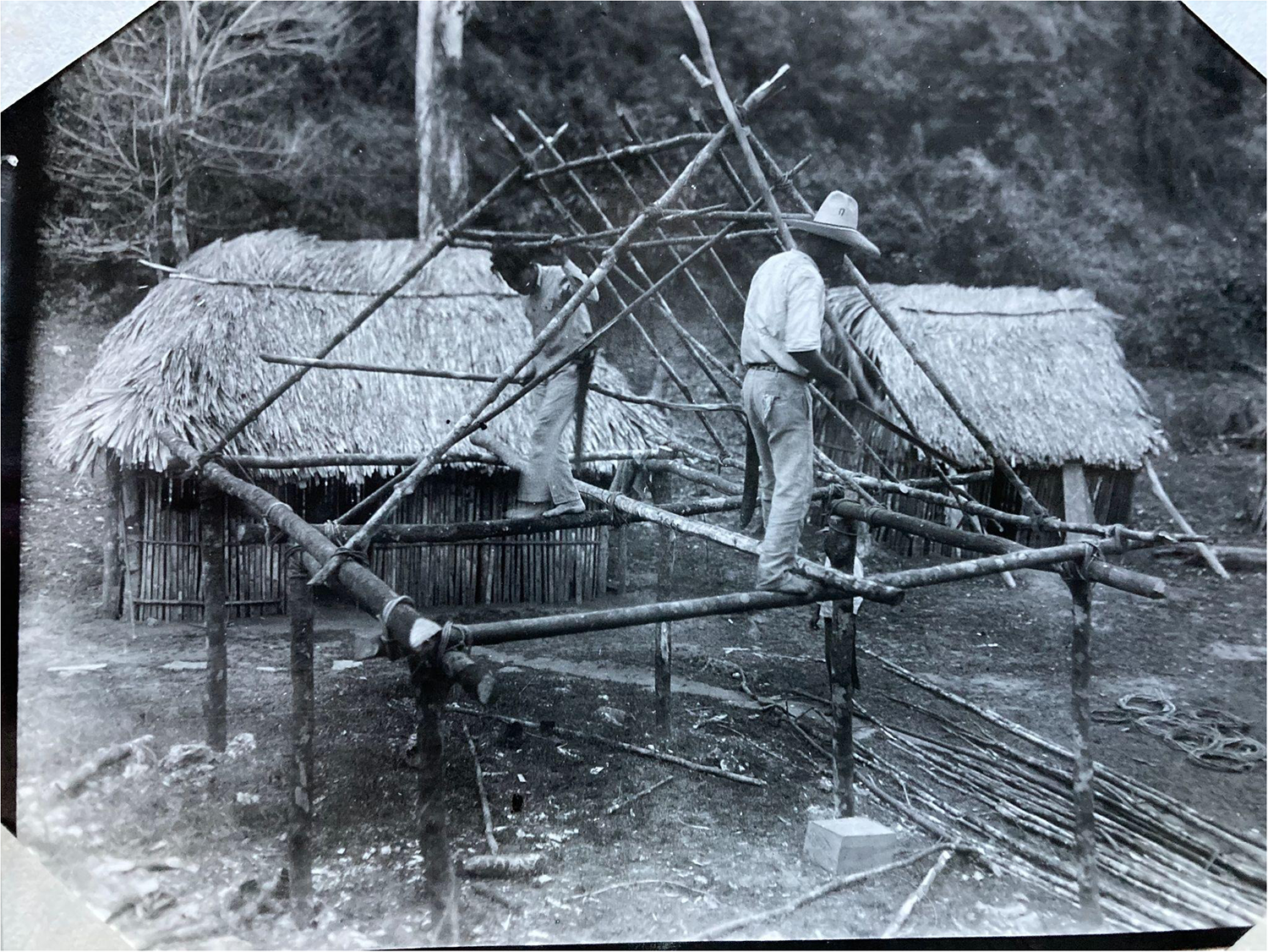
Before archaeologists arrived at the site, for instance, Mason wrote: “The Japanese cook and gardener is clearing his land and will plant vegetable and flower seeds which I sent in a few days.”Footnote 15 The fact that a garden was planted before archaeological work even began also demonstrates that members of the excavation team were engaging with the soil well before the “formal” expedition started. Although I was unable to locate more information about the location of the garden, its existence also asks us to consider how boundaries around the archaeological site were considered; that is, which places were safe or “sterile” enough to create camp infrastructure versus those that were deemed to be within the bounds of archaeological research. At Piedras Negras, the archaeological camp infrastructure was significant enough for Mason to describe the camp as a “small settlement” for 30 people, with a cow for milk and an ox for slaughter (Figure 1).Footnote 16
Setting up camp at Piedras Negras, Guatemala. Courtesy of the Penn Museum, 17558, 36-381.

The labor of producing food for this “settlement” was constant, captured in a letter that Amram wrote to his father about Jose Lopez, the cook: “The 30 men being fed at the men’s kitchen consume 325 tortillas a day. Any time of the day and far into the night, as well as at four in the morning, Jose Lopez is at his job. Kneading and baking. Their daily food bill calls for tortillas, frijoles, rice, coffee, lard, and meat (when it’s available). They eat about two and a half pounds a day and can work hard on it.”Footnote 17
The food prepared for the American archaeologists was made separately but seems to have been very similar, according to tidbits of information gleaned from diary entries. Mostly extracted from the diaries of Margaret Satterthwaite (which are largely complaints),Footnote 18 food often consisted of “oatmeal without salt,” smoked coffee, soda biscuits, and black beans.Footnote 19 Other times the food included “fried bananas, fried beans, and some kind of shortening-like a wafer, filled with lard, though for specific occasions [such as her birthday] the team had chicken with stewed tomatoes.”Footnote 20 Eggs seemed to have been sourced from passing mule trains or other farms by thrifty cooks.Footnote 21 Other goods to camp were brought in via mule train and included ketchup, milk, raisins, and candy.
Despite the similarity in prepared foods, dishes for the workers and principal investigators were made separately in separate kitchens and cooks’ quarters. Thus, food preparation came to affect the structure of the camp. For instance, during a period in which the laborers were on strike over working conditions, Mason reports closing “the men’s kitchen.”Footnote 22 The fact that similar meals were prepared separately for the field excavators and the American archaeologists led to a physical bifurcation on-site that I argue had very significant consequences. An incident of a fire in camp that I explore in the next section highlights the importance of seeing cooking for archaeology as constitutive of the preservation of archaeological data itself.
The Fire
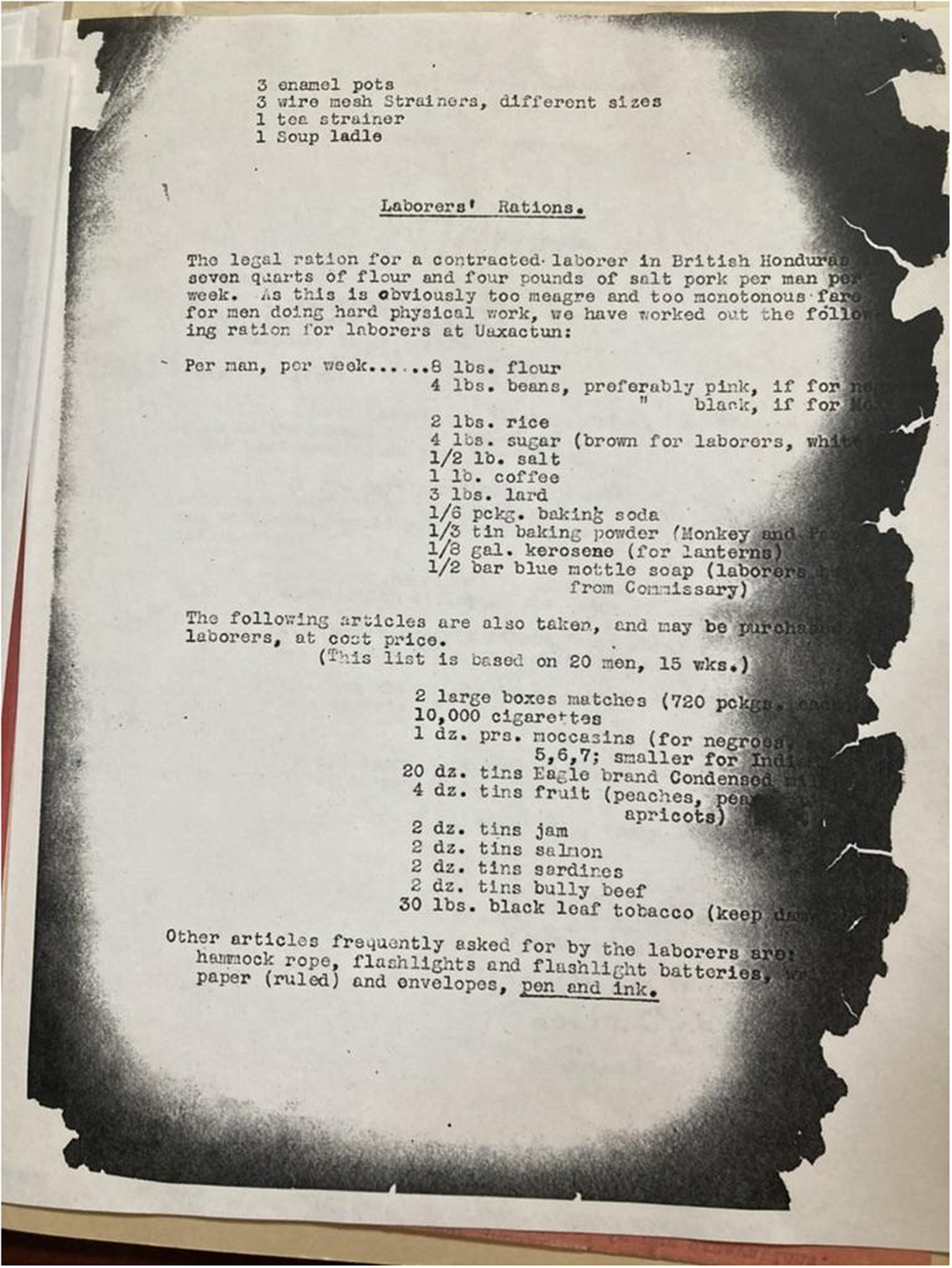
The archaeological campsite cannot be divorced from the archaeology it helped produce (Morgan and Eddisford Reference Morgan and Eddisford2015; Yarrow Reference Yarrow and Edgeworth2006). An incident that is illustrative of this is a kitchen fire at Piedras Negras that spread far enough to destroy vital records, burn artifacts, and leave an archival trace in the form of charred paper edges (Figure 2).
List of laborers’ rations. Courtesy of the Penn Museum, Box 1, Piedras Negras Guatemala Expedition Archive.

In setting up the initial camp, Mason outfitted a thatched cooking hut with a stovepipe. In May 1931, a fire broke out in the camp kitchen that ultimately spread to five camp buildings, destroying records and artifacts. According to correspondence and an official investigative report after the fact, a spark from the kitchen camp’s stovepipe was the culprit. In correspondence with Sylvanus Morley, Mason outlines the archaeological evidence that was lost at camp, which was extensive. Their losses amounted to at least 50 negatives that were deemed “irreplaceable,” tracings of maps and stelae, drawing equipment, photo darkroom equipment, ceramic stratigraphic data, and a series of cache pots, shell figurines, and caches of jade, flint, and obsidian.Footnote 23
Later, an official local governmental investigation was carried out on the fire, and a deposition was signed by Alfredo Pineda, Santiago Mendoza, Silverio L. Camposeco, and John Alden Mason. In the document, they name Luis Cantón as the official cook and describe him as a “chino.” As Cantón describes, the incident occurred most likely when he was baking bread, the heat of which caused an ember to ignite the fire.Footnote 24 The fire spread quickly but spared four employee houses, a cook’s house, a kitchen for “single men,” and the building housing grain and merchandise for the workers (i.e., the commissary).Footnote 25 Inventories from the camp point to materials that were lost in the fire: asterisks designate that they were burned.Footnote 26 Certain documents also bear the traces of the incident; their edges are carbonized and disintegrating, a materialization of archaeological cooking “documented” in the marginalia of the maps and correspondence plucked from the fire.
The fire at Piedras Negras was an incident in which the practices of preparing food on the archaeological site and the technological bricolage that it demanded (a stove and metal chimney with a thatched roof) influenced the material record of archaeology. Although lists exist of objects, negatives, and equipment that were incinerated, any photographic evidence of those objects was lost, a testament to how the everyday practices of archaeology can alter or, in this case, erase archaeological data.
Although an extreme example, the fire at Piedras Negras shows us that archaeological cooking labor should not be seen as separate labor from the information production of excavation and documentation. In some cases, cooking labor is not only influential but also consequential for data contribution. The segregation of food preparation and dining practices, in which American archaeologists had alternative chefs and eating quarters from contracted Mexican and Guatemalan laborers, also shows how cooking proximity affected archaeological data conservation. That the workmen’s kitchen and commissary were spared while the American archaeologists’ kitchen burned—and the fire spread to nearby buildings housing artifacts and important equipment—gives us clues as to which knowledge producers were allowed close proximity both to the tools and artifacts of archaeological production. In other words, although we lack a blueprint of the campsite, it appears that the American archaeological portion of camp had artifacts and equipment near their own eating and food prep quarters, rather than have the two kitchens close together or only having a single kitchen to share food prep and processing duties. Certainly, information sharing traveled between sides on the segregated camp,Footnote 27 but we can see how those in charge of the camp—the American archaeologists—envisioned that two parallel systems of living would dictate camp logistics, prioritizing American exclusivity above efficiency in food production.
A Firing: Justice and Wage Theft at Coahuila, Mexico
As the Piedras Negras expeditions were coming to an end, another American archaeologist, Walter Taylor, began to embark on excavations to Coahuila, Mexico, under the auspices of the Smithsonian Institution. Known for his inventive “conjunctive approach” outlined in his 1967 book A Study of Archaeology, Taylor’s contributions to archaeological methodology were seen as controversial at the time and yet prescient for the field (Hudson Reference Hudson2008). He is most famous for excavations conducted in Coahuila, during which Taylor became convinced of the need to study the aspects of everyday life at a time when archaeologists were primarily concerned with elites (Hudson Reference Hudson2008:193). It is thus particularly interesting that the everyday life of the archaeological site, especially around food production, would come to feature prominently in how the excavations unfolded.
In Coahuila, Taylor conducted excavations in a series of ancient cave complexes during a 10-month period from 1940 to 1941 and returning for a later field season in 1947. Part of the unsung archaeological team included his wife and trained anthropologist Lyda Taylor (see Maca Reference Maca, Maca, Reyman and Folan2010:15) and excavators Manuel Garcia, Pedro Gonzales, Juan Mata, Miguel Salas, and Guadalupe Romo (Williams Reference Williams2024). Previous research on this expedition, based on Smithsonian and National Anthropological Archives records, has revealed that the detritus of their archaeological work can be read through their consumption practices, as the team recycled cardboard packaging of food products and matchboxes to serve as data containers for their botanical and textile specimens (Williams Reference Williams2024). These were part of a collection that amounted to nearly 10,000 specimens that first entered the museum in 1942 (Accession No. 374960, Smithsonian, January 30, 1991). Smithsonian records further indicate that botanical specimens and textile fragments were packed in candy boxes, showing an iterative process whereby choices around taste and diet came to construct how data were divided and packaged (Williams Reference Williams2024).
Along with bringing packaged food to site, Taylor also relied on local food production. In an unusually detailed story that emerges from archival correspondence between Taylor and the funders of the expedition, one can see that food, its preparation, and its socialities led to tensions in camp, which escalated to a situation involving accusations of wage theft, Taylor’s arrest, and a case that had to be resolved through a local Mexican court. This incident sheds light on the precarity of archaeological cooks’ employment, revealing a story of how this specific chef sought a form of remediation and justice.
Although Taylor relied on a field house in the town of Cuatro Cienegas to store collections (Reyman Reference Reyman, Maca, Reyman and Folan2010:61), most of the other patterns of everyday life were conducted near the sites themselves, requiring Taylor to employ laborers to construct a camp, create a camp kitchen, and feed their team made up of only a handful of people, unlike Mason’s nearly 30 team members. Because of the more nimble nature of the small team, Taylor purchased and took with him some of the cooking equipment from the United States, which he then drove in a Jeep across the Mexican border.Footnote 28 According to the equipment list, the Jeep’s trunk contained a bread board, canister sets, a camp stove with gasoline, a four-person cook-and-serve set, spider (skillet) with glass top, a hot-cake plate “comal,” a frying pan, a folding frying pan, and a four-quart pressure cooker. This was supplemented by a small kitchen box with utensils for four, can openers, six container cans, butcher knives, and a spatula, among other miscellaneous items.Footnote 29
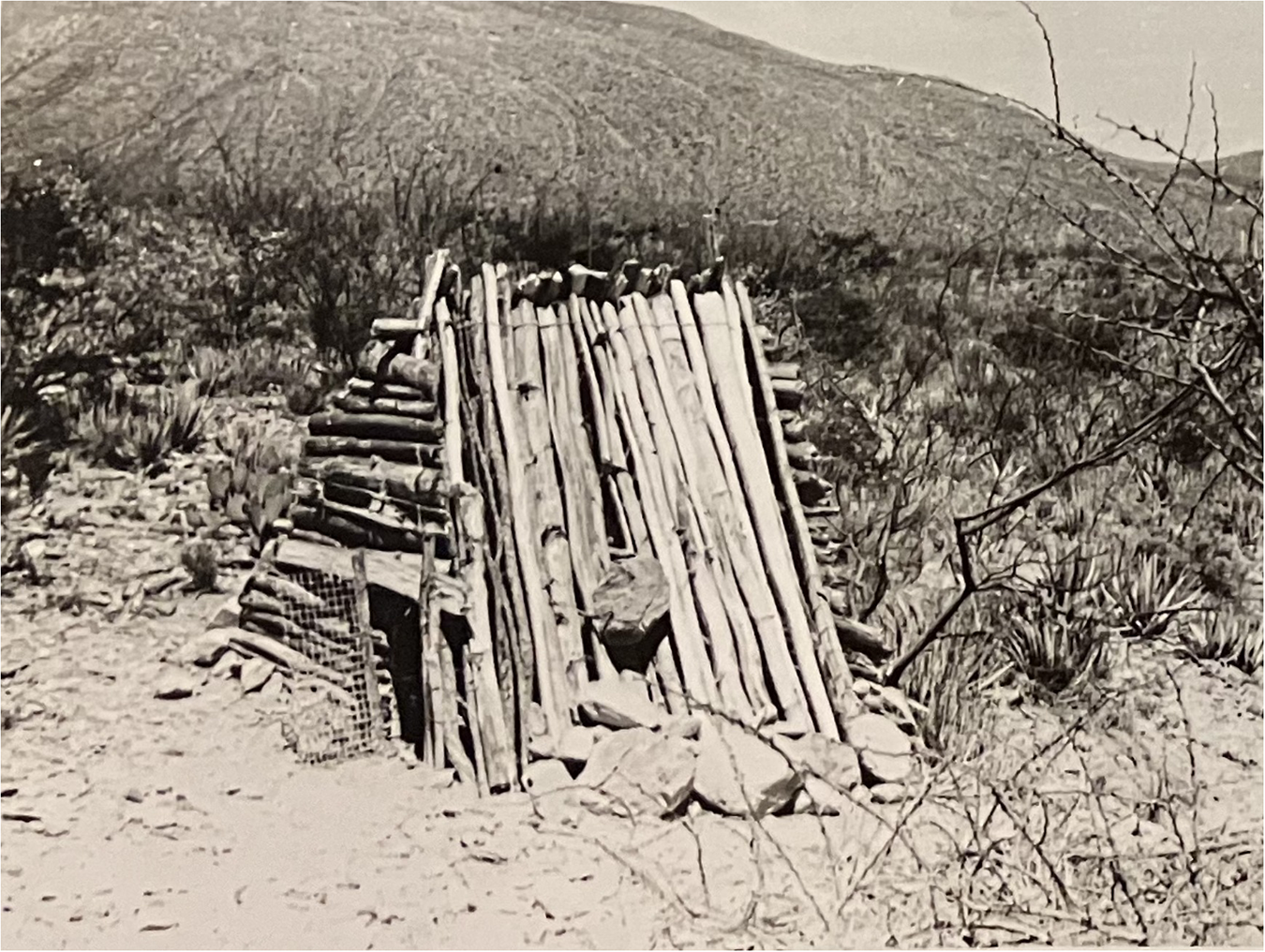
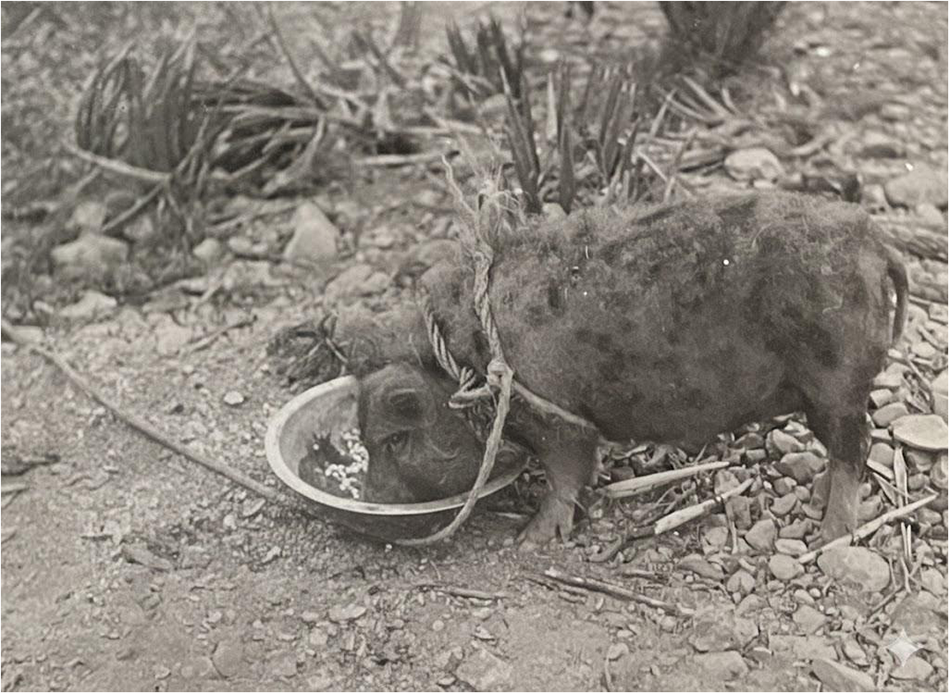
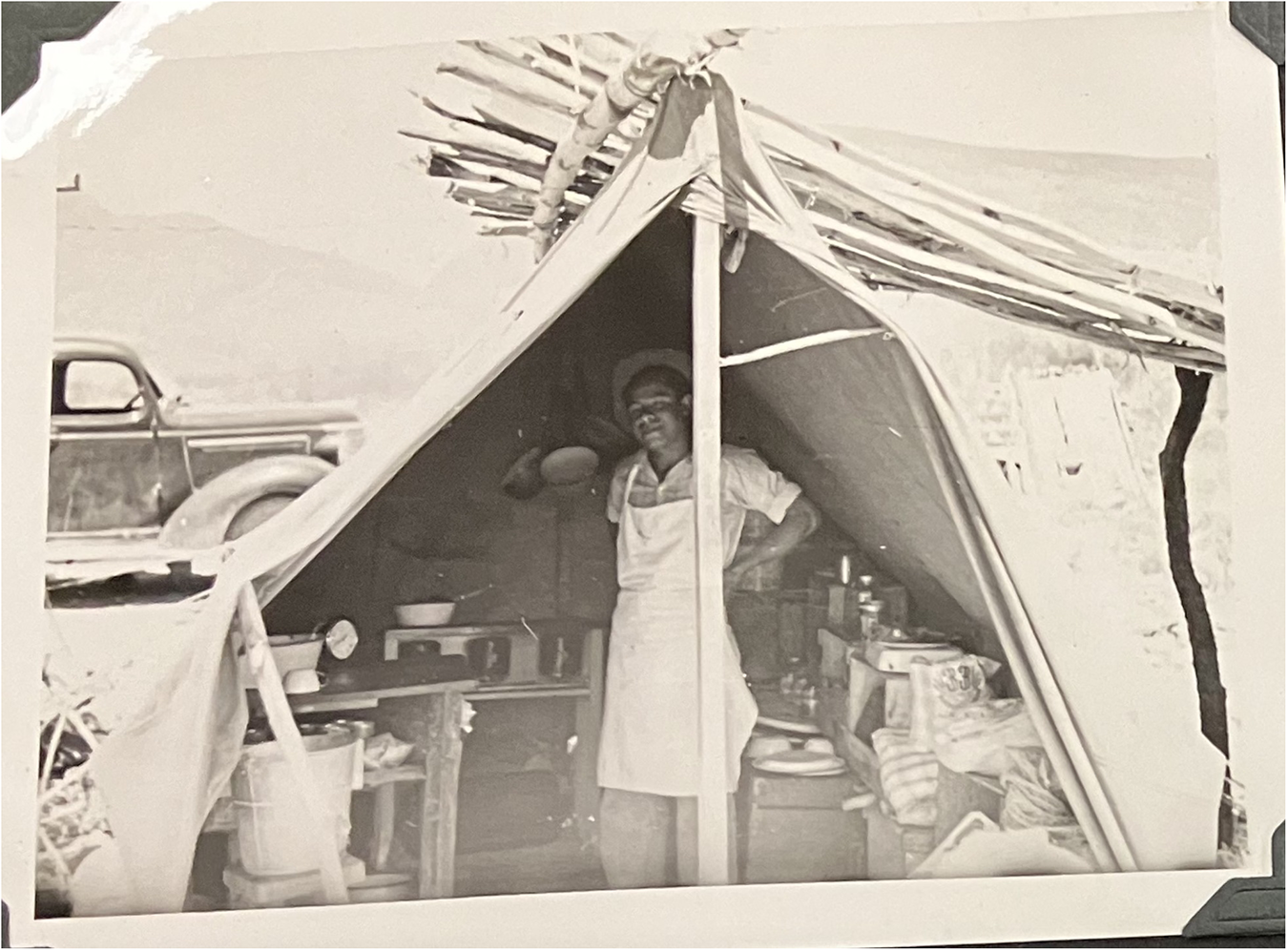
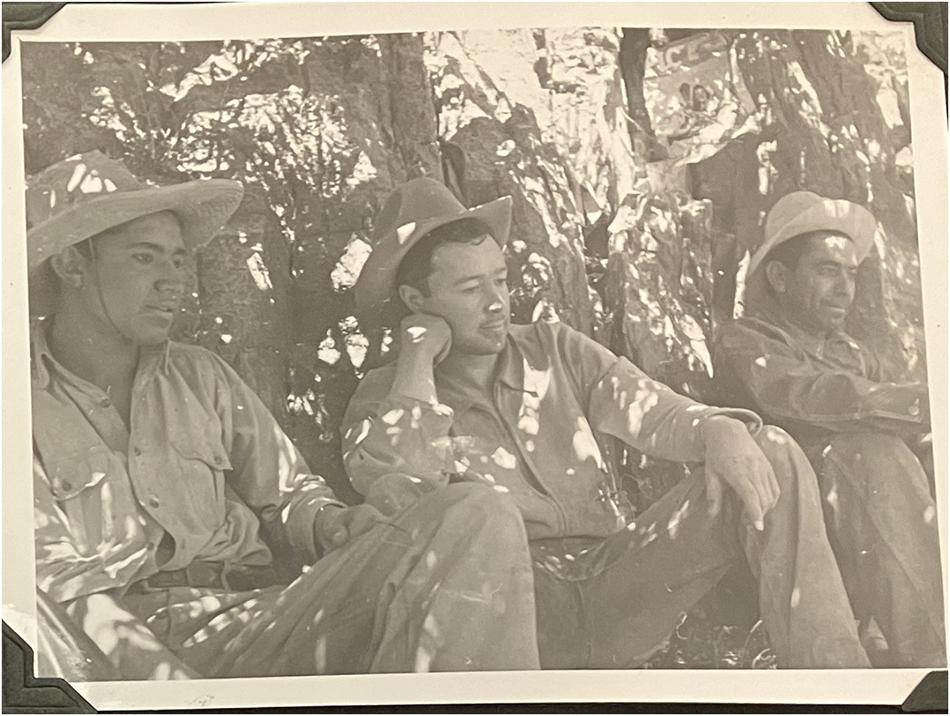
In addition to bringing food prep equipment from the United States, Taylor also sourced locally: both Taylor and the employed cook placed orders for canned food at nearby supply stores in Cuatro Cienegas.Footnote 30 As occurred in Piedras Negras, Taylor also sourced more local livestock and fodder, including chickens bought for food and eggs (a chicken coop was also built for this purpose) and a pig, titled in a photograph as an “8-peso pig” (Figures 3 and 4). Perhaps given the small scale of the excavations, Taylor and his local workforce shared the same infrastructure and appear to have eaten the same food: there are no separate food lists or different cooks. One camp photograph shows the camp architecture of a single cooking “remada” (structure), whereas another photograph shows both archaeologists and excavators eating in the remada together (Figures 5 and 6).Footnote 31
Chickens at Coahuila. Walter W. Taylor Field Photographs Box 105. Courtesy of National Anthropological Archives, Smithsonian Institution.

“8-peso pig.” Walter Taylor Field Photographs Box 105. Courtesy of National Anthropological Archives, Smithsonian Institution.

Cook tent and MS, camp at Espantosa. Walter W. Taylor Field Photographs Box 105. Courtesy of National Anthropological Archives, Smithsonian institution.

Figure 5 Long description
A man wearing an apron stands inside a tent, which is set up as a makeshift kitchen. The tent is open at the front, revealing various cooking equipment and supplies. Shelves and tables hold pots, pans and other kitchen items. The man is positioned centrally, with his hand on his hip and appears to be in a relaxed stance. Outside the tent, part of a vehicle is visible on the left side of the image.
Photo with caption “PG, WWT, JM, in lunch remada at CM 68” (neg. AHS). Walter W. Taylor Field Photographs Collection, Box 105. Courtesy of National Anthropological Archives, Smithsonian Institution.

Although on the surface there seemed to be a more egalitarian means of preparing and cooking food at Coahuila, the situation took a sharp turn midway through the season. According to Taylor’s account, tensions came to a head in a “final row” with the cook over more pay and an issue with the stove—most likely the one listed in the camp supplies that Taylor imported initially.Footnote 32 Taylor claims to have dismissed the cook; the next day, Taylor brought him to the nearest railroad station and just left him there. Although there is an archival silence regarding the cook’s next actions, it is clear that he exercised his right to report Taylor for improper dismissal, seeking justice and retribution by eventually getting his message to the municipal president (presidente municipal).
According to Taylor’s correspondence, an officer from the Commandate de Policia came to the dig house and detained him on charges related to the cook’s firing. Taylor then found himself before a judge at the Junta de Conciliacion y Arbitraje, a body “which presides over troubles between employer and employee.”Footnote 33 The issue seems to have been that Taylor dismissed the cook without providing any means of payment (train fare and expenses) for the cook to get home. In a letter, Taylor wrote that, eventually, “the Judge suggested that to end the whole matter, I pay the cook’s living expenses and train fare for the time it took him to get to his home. This would amount to about $10 Mex.”Footnote 34
Taylor eventually would have to pay more than this amount, including court-processing fees that came to 20 additional pesos, in exchange for a signed voucher that “everything had been regulated and the money paid.”Footnote 35 Taylor later secured another cook and a better stove, also suggesting that the original cook had been correct in his assessment of the first stove’s faulty nature.Footnote 36 However, this was only after having to pay an expense he had not accounted for, putting himself in a precarious position with the local government, and steeping himself in hot water with his funders at the Smithsonian.
Shortly after Taylor’s letter arrived recounting the court issue, a response from Alexander Wetmore, assistant secretary of the Smithsonian Institution, chastised him for endangering the status of the current and future project: “The fact that one of their labor regulations was ignored, as apparently admitted by you in the settlement, even though the latter was to some extent under duress, would really mean that you would have two strikes called on you at the beginning of any future negotiations.”Footnote 37
Dissuaded from sending a complaint to any higher authority, Taylor did not pursue the matter. The response to Taylor’s letter reveals how Smithsonian officials were convinced of Taylor’s wrongdoing. Wetmore clearly saw Taylor’s actions as potentially embarrassing for the institution and endangering possible future work.
Although the Coahuila cook’s actions are but one isolated incident of a laborer seeking redress, this archival anecdote does open a window onto some of the precarity of working conditions for members of the archaeological staff. Moreover, it shows that although cooks were responsible for preparing the dishes, much remained outside their control: the menu, ingredients, and even equipment were largely, if not exclusively, determined by Taylor.
The conditions around Piedras Negras, Guatemala, and Coahuila, Mexico, help us understand how American archaeologists and local excavators were negotiating their access and rights to food on camp. These situations allow us to contrast some central insights. For instance, whereas the workforce at Piedras Negras seemed to have been more segregated into different cooking architectures, the team at Coahuila was small and seemed to share more of their infrastructure unilaterally. However, the power imbalances remained the same: American archaeologists Mason and Taylor had the ability to employ, fire, and contest the conditions of their cooks. In both instances, parts of archaeological research were jeopardized due to cooking practices in unsafe and hazardous working conditions and through employee tensions that nearly rose to the status of a local diplomatic issue.
Finally, the broader social-political system in which archaeology was taking place in both Guatemala and Mexico should not be ignored. In Guatemala, many systems of food provisioning, from commissary structures to separate dining quarters, mimicked the labor structures from major agricultural companies such as the United Fruit Company (Bucheli Reference Bucheli2005). In the 1930s and 1940s, the country was itself deeply involved with the question of agrarian reform. Under the dictatorship of Jorge Ubico, vast plantations coerced rural laborers into extractive labor conditions, planting the seeds for unlanded farmers to fight for the expropriation and redistribution of US companies’ land concessions (Bucheli Reference Bucheli2005; Chapman Reference Chapman2007; Chomsky and Lauria-Santiago Reference Chomsky and Lauria-Santiago1998). The right to control one’s access to food was thus deeply entwined with the right to territorial sovereignty (Lubbock Reference Lubbock2024). At the site of Piedras Negras, forms of food consumption involving commissaries and labor rations were thus part of the fabric of blooming US agro-industries.
In Mexico during the same period, forms of these land redistributions were implemented under President Lázaro Cárdenas: communally held land parcels were granted to peasants and protected under an ejido system (Durón Reference Durón2025). However, World War II greatly affected the food chain: with rising export demands to the United States, issues arose around corn shortages and rising food prices, placing everyday consumers in vulnerable economic conditions. Two years after the excavations at Coahuila, the beginning of the US-Mexican scientific endeavor to improve crop yields through fertilizers would mark the start of the Green Revolution (Rojas Reference Rojas2024). At Coahuila, the early 1940s were characterized by increasing migrant labor to the United States and seasonal labor shortages (Cohen Reference Cohen2011). Thus, although Taylor’s excavations are just one example, we can see how a single worker was able to mobilize his rights with local government and rely on the fact that his labor was in demand to assert his rights to fair compensation. Embedded within both projects was the fact that food access and food sovereignty for workers were deeply political issues.
Indeed, the practice of archaeology has almost always had a relationship with the practice of agriculture—often, the same laborers are engaged in both industries, which vary by season (Bell Reference Bell2020) and in which both artifacts and consumables are the fruits of hierarchical labor. Although these incidents are just two microhistorical accounts of how archaeologists provisioned their workforces, they offer a fine-grained perspective on the tensions and decision-making surrounding archaeological food production. These questions are still pertinent today: whether as an archaeological worker, as a student volunteer, or as a PI, most excavations involve eating and information sharing on-site. And although some conditions have changed, continuities about food security and social stratification remain.
Provisioning Today and for the Future
Archaeologists have long considered food gathering, preparation, processing, and consuming all habits from which we can glean patterns of social life and communities of practice (Halstead et al. Reference Halstead, Hodder and Jones1978; Hastorf Reference Hastorf, Gero and Conkey1991, Reference Hastorf2017; Joyce Reference Joyce2021; LeCount Reference LeCount and Klarich2010; Morrison Reference Morrison, Rodriguez-Alegría and Graff2012; Sunseri Reference Sunseri2017; Twiss Reference Twiss2012). Moreover, some subfields in archaeology are specifically dedicated to understanding the ancient dynamics of food production, preparation, and dining for workforces and laborers (e.g., Campbell Reference Campbell, Atici and Arbuckle2023; Gerrard Reference Gerrard, Stallibrass and Thomas2008; Malleson Reference Malleson2022; Somerville et al. Reference Somerville, Sugiyama, Manzanilla and Schoeninger2017; Walker Reference Walker, Warner and Purser2017). Although some have used these methods to interrogate issues like poverty and social justice today for worker foodways (e.g., Chicone Reference Chicone2006; Logan Reference Logan2016) those studies have not been applied to the very conditions of archaeological workers today. For instance, investigating past dining practices can illuminate economic differentiation and hierarchy (Killen Reference Killen, Halstead and Barrett2004; LeCount Reference LeCount and Klarich2010; Pollock Reference Pollock and Bray2003). Feeding and provisioning large groups of people as acts of compensation are also well traced in the archaeological record, from state-sanctioned feasting to food compensation as wages (Bray Reference Bray2003; Giovannetti Reference Giovannetti2021; Pollock Reference Pollock and Bray2003; Samuel Reference Samuel1999). More specifically, archaeologists have traced, where possible, the practices of feeding laborers for discrete, temporally bound projects, such as state-funded infrastructure construction, as a means of understanding government practices, inequality, and labor-force dynamics (Campbell Reference Campbell, Atici and Arbuckle2023; Gerrard Reference Gerrard, Stallibrass and Thomas2008; Malleson Reference Malleson2022; Somerville et al. Reference Somerville, Sugiyama, Manzanilla and Schoeninger2017; Walker Reference Walker, Warner and Purser2017).
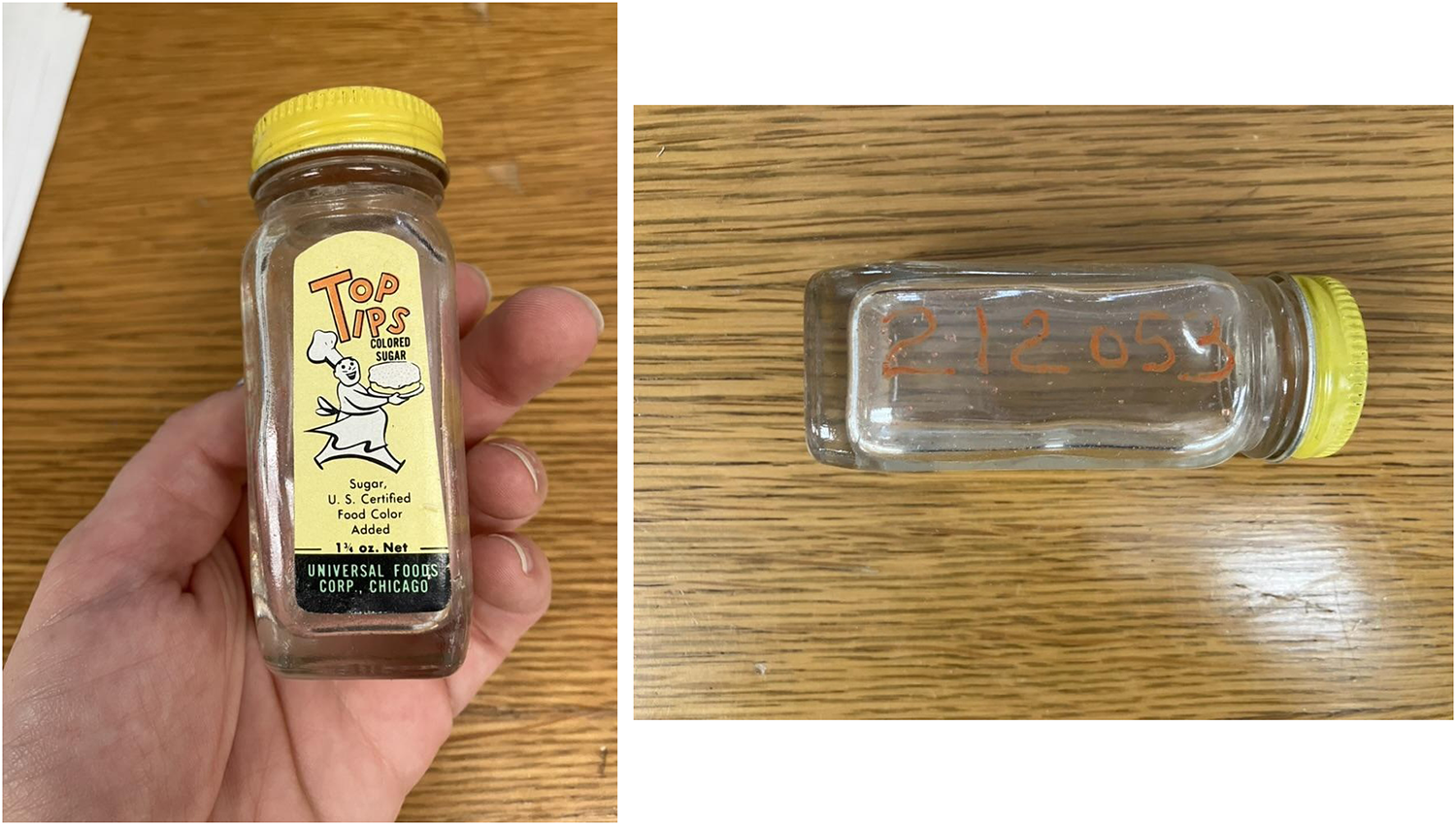
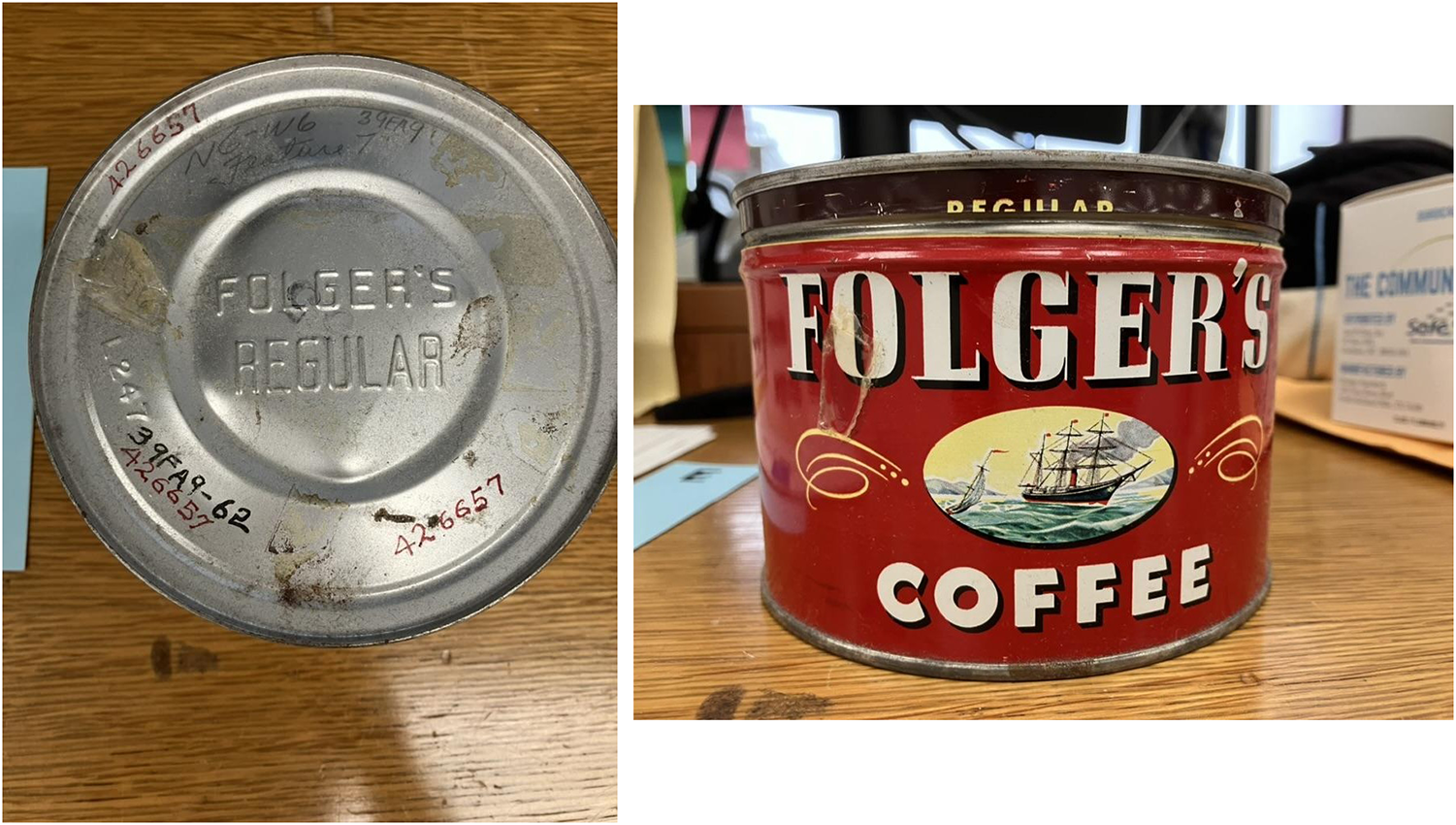
The practice of archaeology itself, often temporally bound for a season at a time and employing large numbers of peopleFootnote 38 from disparate geographic areas, is similar to these ancient events and yet often ignored as having a readable material record. Although data are scarce, this record exists; one of the most prominent ways is in the form of disposable containers, in which archaeologists used items like coffee cans and jars to store archaeological data (e.g., Williams Reference Williams2024). Field numbers, feature information, and museum accession numbers written or etched into their sides attest to the food containers’ archival social life and the fact that they likely passed through many team members’ hands (Figures 7 and 8).
Bottle of “Top Tips” Sugar, with catalog number 212053. Smithsonian NMNH Museum Support Center. The Smithsonian record shows that this is most likely associated with 50 beads collected in 1901. Photos by author.

Folger’s Coffee can with archaeological feature numbers “426657” and reference to “NG-W6 Feature 7” and 39FA9. Smithsonian catalog numbers show it was used to collect charcoal samples in 1957 in South Dakota. Photos by author.

Despite the archaeological emphasis on food and food production, we pay little attention to the material record of contemporary foodways on archaeological sites, unless archaeologists are using ethnographic practices to make inferences about historical ones. At an archaeological site in Xaltocan, for instance, archaeologists had conversations with women they employed as cooks on different techniques for maize grinding, which provided crucial details about the long history of corn processing on the site (Rodriguez-Alegría Reference Rodriguez-Alegría, Rodriguez-Alegría and Graff2012:107). However, it is possible to see how modern archaeological structures have inherited certain food structures. These too have left their own unofficial archival traces. Most of the written references I was able to find relating to archaeological food production were in gray literature, in the form of individual field manuals, field-school brochures, blogs from archaeologists, and occasionally a job posting for a site chef or cook, representing about 15 documents produced from 2012 to 2025. An exception was peer-reviewed work pertaining to field school practices at large (Boytner Reference Boytner2014; Emerson Reference Emerson2021).Footnote 39
Among the richest sources of information about archaeological food provisions are food blogs written by archaeologists and archaeological chefs. They include a series by a CRM archaeologist on how to make healthful meals on per diems (Succinct Research 2022) and a food series by Eleanor Scott on her personal blog, “Excavation Challenges—Food, Fieldwork, and Difference,” in which she outlines how to make social practices of archaeological dining more equitable and how to source ingredients and cook meals that are nutritious, filling, and adaptable to a variety of dietary needs. As Scott (Reference Scott2017) states, “Food is essential, food is emotional, and food is political, I think that the dig director who doesn’t get this is seriously missing a trick.”
Some of the challenges that she outlined from her experiences as both a field student and a camp cook included dig directors who wanted to scrimp on meal expenses, underestimated adequate food quantities per person per diem, and created elitist dining circles in which volunteers and staff members ate separately, not unlike practices at Piedras Negras that were previously described. One of the innovations she recommends for creating equitable eating habits on archaeological sites is the practice of having all members of the excavation do a rotation in the kitchen for a half or full day, because “it also allows diggers to see, think about, and understand the needs of others, up close” (Scott Reference Scott2017).
This practice seems to have been instated in at least several field schools, such as the University of Florida Historical Archaeological Field School (2014), which designated “1 to 2 students per day for kitchen prep.” This rotation structure is also helpful in that it can create legacy knowledge of how to cook for archaeological camps: because archaeological chef jobs are often for short seasons and almost always do not carry benefits or healthcare (Archaeology Southwest 2012), people can cycle through and leave no institutional knowledge for further seasons.
One element that has changed significantly is the structure of the “field school,” as contrasted to an archaeological team consisting only of wage laborers and salaried principal investigators. Although field schools have been around for at least a century (Boytner Reference Boytner2014; Clarke and Phillips Reference Clarke and Phillips2011; Gifford and Morris Reference Gifford and Morris1985) their geographic breadth and ubiquitousness in archaeological training have greatly increased.Footnote 40 Because field schools are often marketed as an experience of cultural immersion (Baxter Reference Baxter2009; Boytner Reference Boytner2014; Clarke and Phillips Reference Clarke and Phillips2011), food is often the first way that local labor and practices seep into the archaeological site: local chefs are often employed and manage cooking for teams of people. For instance, for the Stann Creek archaeological project in Belize, one participant remarked that while they got to “eat different kinds of Belizean dishes,” it was “also exciting when we got pancakes or spaghetti—something to remind us of home” (Peuramaki-Brown and Morton Reference Peuramakai-Brown and Morton2018:139). Although field schools have changed the topography of labor on archaeological sites, there is still the continuity of the division between local chefs and American team members, in which tastes and preferences show up, as it just did, in what is seen as exotic versus homey.
There is much literature on the archaeology of food, and yet not much has been written about the food of archaeological work. Even though archaeologists have paid increased attention to revisions of codes of ethics, “archaeologists must constantly examine our discipline’s history and practice of supporting all of the ‘isms’ recognized by social justice activists; the injustices and intersections of racism, sexism, heterosexism, ethnocentrism, ageism, classism, ableism, sectarianism, and more” (Little Reference Little2023:1; Wilkie Reference Wilkie2023). Food justice extends to archaeology—because eating is a daily habit, often the most powerful way that people can feel siloed is at mealtimes (Sbicca Reference Sbicca2018; Weik von Mossner Reference Weik von Mossner2025). From the contents of meals, to the timing of them for religious or medical practices, to the need for people to feel included or to eat on their own terms, dining on archaeological sites can be one of the first ways that people can get excluded and undernourished (Davis et al. Reference Davis, Meehan, Klehm, Kurnick and Cameron2021). One of the most important jobs of a field director is securing food for teams performing very physical and sometimes dangerous labor. Food can be a safety concern, can highlight cultural preferences, and can be a source of tension when different norms held by the directors and crew “collide” (Davis et al. Reference Davis, Meehan, Klehm, Kurnick and Cameron2021:74).
The practice of archaeology has left an archival trace of food and meals. This record is illustrative of broader social dynamics on archaeological sites, in which workers and certain kinds of labor are gendered and racialized. Recognizing these historical underpinnings can help critique and change these inequities. Simple practices, such as everyone dining together or rotating kitchen duty, reflect that the act of cooking and dining is part of the process of creating archaeological knowledge.
From nearly a century-long gaze into past archaeological feeding practices, some consistencies emerge. To start, the practice of employing a camp cook has been a long and fraught one. From Piedras Negras archaeologists who sought out specifically racialized labor to perform cooking duties, to Walter Taylor who was jailed for committing wage theft from the camp’s cook, to Scott’s experience managing field directors who wanted to save money by culling meals, food and its sourcing have reflected power imbalances. In addition to the actual meals being provided, dining practices have often ensured that information sharing is siloed on archaeological sites.
More often than not, cooking and preparing meals for archaeological camps today are treated as contemporary practices with little bearing on the actual practice of archaeology. Yet from the 1930s to the present day, cooking and sustaining archaeological workers have left indelible marks on landscapes, on extracted data, and in our contemporary practice. It is up to us to understand and change how these daily, seemingly innocuous practices like cooking are not just side products of archaeology but indeed are also constitutive of the labor that produces it.
Acknowledgments
Smithsonian Institution sources were accessed during the Summer Institute for Museum Anthropology (SIMA), a program run by Josh Bell and Candace Green, for whom I am extremely grateful. Penn Museum archives were accessed during my dissertation research, and I am deeply indebted to archivist Alex Pezzati for his wisdom in navigating the Piedras Negras archive. No permits were required for this work. Thank you to the anonymous reviewers of this article for providing crucial feedback.
Funding Statement
This research received no specific grant funding from any funding, commercial, or nonprofit agency.
Data Availability Statement
Archives are available for access at the Penn Museum Archives in Philadelphia and the National Anthropological Archives (NAA) at the Museum Support Center in Suitland, Maryland.
Competing Interests
The author declares none.

 Open access

