Citizen protests are common political phenomena, ranging in size, kind, and impact. This essay focuses on a unique kind of citizen protest that reaches a crisis threshold: massive uprisings accompanied by violence and system-level critiques, expressed in phrases such as “It is not 30 cents, it is 30 years,” used by protesters in Chile in 2019–20. Crises meeting this definition have occurred in countries as diverse as Iceland in 2009, Hong Kong in 2019, Chile, and Colombia in 2019–21. In contrast with economic crises (Strolovitch Reference Strolovitch2013), protesters—not necessarily elites—perform the discursive work of (re)interpreting material and political conditions. Protesters’ framing of their grievances may overwhelm elite attempts to reinterpret these crises for their benefit. We argue that protest-driven crises can alter gendered opportunity structures, but outcomes are likely multifaceted and potentially contradictory.
When Citizen Uprisings Precipitate National Crises
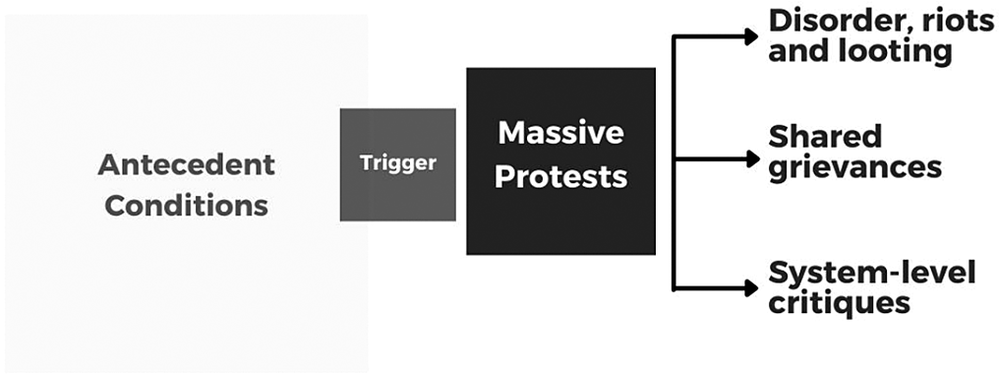
Figure 1 illustrates a stylized sequence and the resulting dimensions of protest-driven crises. The process begins with the antecedent conditions, including perceptions of social inequality, poor public services, and dissatisfaction with political institutions. Given these underlying conditions, an event can trigger protests accompanied by protester and police violence. Following a protest’s spark, the figure highlights three stylized reactions to the crisis: (1) desire to end the disorder, riots, and looting that accompany protests; (2) support and empathy for protesters and their shared grievances; and (3) appeals to address protesters’ system-level critiques.
Figure 1.
Sequence and dimensions of protest-driven crises.
We examine the 2019 Chilean protests to show how each dimension of protest-driven crisis can affect gendered opportunity structures, meaning the supply and demand for gendered leadership styles as well as the possibilities for women’s political representation. Protest-driven crises can culminate in constitutional moments (as in Iceland in 2009 and Chile in 2019), though not all do (e.g., Hong Kong in 2019 and Colombia in 2019–21). The Chilean case most notably resulted in the first gender-parity constitutional convention. Our analysis of Chile’s violence, shared grievances and system-level critiques reveals that gender plays a nuanced, potentially contradictory role, particularly in demand for gendered leadership styles.
Disorder, Riots, And Looting
Protest-driven crises, characterized by violence, vandalism, and/or looting, can solidify societal preferences for masculine, male leaders. Social psychologists describe masculine leadership as based on agentic qualities: vertical, hierarchical, and authoritarian decision-making styles (Eagly and Johannesen-Schmidt Reference Eagly and Johannesen-Schmidt2001). Leaders with agentic traits may be perceived as better equipped to handle issues related to violence and the need to restore order and security.
The most often-cited trigger of Chile’s protest-driven crisis was the decision by an expert panel on October 4, 2019, to raise the subway fare in Santiago, the nation’s capital. High school students protested the price increase by jumping over turnstiles, evading payment. Santiago then witnessed unprecedented citizen violence on October 18: subways stations were dramatically burned, and hundreds of supermarkets were looted and set on fire. Congress reversed the metro fare hike on October 21, but riots and looting—and peaceful demonstrations and cacerolazos (pot banging)—ensued and continued to be met by violence from the state.
Throughout the crisis, center-right President Sebastián Piñera sought to exercise decisive, vertical—and hence stereotypically masculine—authority. Piñera’s inner cabinet ministers with close ties to the dictatorship reportedly advised him to take stronger action against the disorder. The administration decided to apply the State Security Law against violent protesters on October 18 (Dammert and Sazo Reference Dammert and Sazo2020, 127). Piñera declared a national state of emergency the following day.
The Chilean case illustrates how fear and disgust over violence and disorder and worries over the economy can move citizens to seek masculine leaders to impose law and order. Economic activity contracted more than 3% during October and November 2019 (Central Bank of Chile 2020). Service and commercial activities were severely affected, especially small businesses (AméricaEconomía 2019). Influential columnists voiced demands consistent with a yearning for order and masculine leadership, and many citizens expressed a desire to return to a stable, idealized, and implicitly male-dominated past (Larraín Reference Larraín2020).
Finally, social scientists in Chile at the time argued that this protest-driven crisis created conditions that were ripe for extreme-right populist authoritarianism (Rovira Kaltwasser Reference Rovira Kaltwasser2020), implicitly assumed to be male because of the historical connections between masculinity and populism (Kampwirth Reference Kampwirth2010). Past cases of civilian uprisings in Latin America, such as the protest-driven party system collapse that brought Hugo Chávez to power in Venezuela, supported this expectation. Far-right former congressman and populist José Antonio Kast was among those who clamored for order, and he was viewed as a possible threat to Chilean democracy during the heat of the citizen uprising (Bellolio Reference Bellolio2020). Survey data from December 2019 showed ample support for authoritarian leadership: 49% of Chileans agreed with the statement that “the country needs a strong leader with the determination to guide us to the right path,” and 32% agreed that “the country needs a firm government instead of worrying too much over peoples’ rights” (CEP 2020). In fact, Kast’s late 2019 presidential bid—in which he ran as a law and order candidate invoking nostalgia for former dictator Augusto Pinochet—earned him a first-round victory, with 27.9% of the vote (though he was defeated in the second round by leftist Gabriel BoricFootnote
1). Therefore, this first dimension of protest-driven crises—disorder and violence—seems to sustain expectations for greater supply and demand for stereotypically masculine leadership, further reducing opportunities to enhance women’s representation.
Shared Grievances
A second dimension of protest-driven crises involves citizens’ empathy with protesters and their myriad shared grievances, many of which are attached to specific issues. The Chilean government’s response to the crisis was often criticized for lacking empathy. In an example of out-of-touch tone deafness toward average Chileans, the minister of economy commented that if Chileans did not like metro increases, they could wake up earlier to take the metro, thereby paying a slightly reduced price (Dammert and Sazo Reference Dammert and Sazo2020).
Chileans’ perceptions of cold, disconnected leadership may have fueled citizen demand during the crisis for empathetic, horizontal governance, and hence stereotypically feminine leadership. “Feminine” leadership, defined by communal traits, refers to horizontal, consensus-based, and more democratic decision-making methods (Eagly and Johannesen-Schmidt Reference Eagly and Johannesen-Schmidt2001). Stereotypically, feminine leaders are more in tune with everyday, common concerns, and CEP surveys conducted in 2020 showed a recurring demand for leaders to listen to citizens’ concerns. When asked about the best ways to solve the country’s current problem, “cabildos—citizen-led instances to hear peoples’ demands—received similar levels of support as structural reforms and a new constitution” (CEP 2020).
Additionally, shared grievances in Chile included diverse issue-based demands: fairer pensions, lower transportation and electricity costs, access to water, improved health care, and an end to corruption by the police (carabineros) and political and economic elites (including President Piñera). Some of these issues—namely, Chile’s pensions and utility costs—could be associated with a masculine technocratic leadership (Azocar Reference Azocar2020). Other demands, such as water and health care, qualify as compassion issues. In the Chilean case, the spontaneous aggregation of these demands under the umbrella concept of “dignity” may have tilted the balance in favor of feminine leadership (ChileVisión Noticias 2019). Although distinct from compassion issues, corruption may have a similar effect on societal demand for new female leaders and feminine leadership (Le Foulon and Reyes-Housholder Reference Le Foulon and Reyes-Housholder2021).
In addition to these shared grievances, protest-driven crises frequently involve clashes between protesters and police, accusations of police abuses, and, in turn, concern for physically injured protesters. Put differently, when shared grievances are met by police violence, compassion intensifies demand for stereotypically feminine leadership. Human Rights Watch documented widespread human rights violations in the protests’ repression (Bonnefoy Reference Bonnefoy2019), and INDH (2020) reported that more than 3,000 people suffered human rights abuses. Chileans disapproved of these human rights abuses: 65% believed that either the police or the military had abused them frequently (CEP 2020).
Finally, protest performance against human rights abuses staged by the Chilean feminist theater group LasTesis expressed a demand for alternative ways of understanding power. Their lyrics translated feminist theories into everyday language, drew attention to state violence, and questioned masculinist leadership. LasTesis accrued a massive following, and its performance was restaged throughout Chile and worldwide (Martin and Shaw Reference Martin and Shaw2021). Overall, support and empathy for the protesters—both their shared grievances and police abuses they suffered—may have augmented demand for stereotypically feminine and alternative leaderships.
System-Level Critiques
A third facet of protest-driven crises relates to critiques against the entire political system, which in Chile took the form of egregiously skewed wealth distribution, low-quality public services, and elitist political institutions. Legal experts and activists argued that many of Chileans’ shared grievances stemmed from the constitution written during the Pinochet dictatorship (Heiss Reference Heiss2020). Given the intimate interconnections between the military and masculinity, gender pervaded the writing of the 1980 Constitution. Chile’s Magna Carta requires supramajoritarian support for many of the material reforms demanded by the protesters, and thus for many, only a new constitution would allow for social progress. After weeks of protests, riots, and police repression, party leaders signed the Agreement for Peace and the New Constitution on November 15, 2019, which officially started the country’s drafting process.
Chileans’ long-standing dissatisfaction with political representation meant that only a new Magna Carta written by a diverse body of citizens would be legitimate. Links between Chile’s male-dominated elitist institutions and their discredited status (Reyes-Housholder and Roque Reference Reyes-Housholder and Roque2019) motivated key actors to believe that a constitutional assembly should not replicate the rules that elected Congress. A weak gender quota applied to the National Congress (Le Foulon and Suárez-Cao Reference Le Foulon, Suárez-Cao, Miranda and Suárez-Cao2018) and political parties’ control over candidacies made electing new and more diverse representatives very difficult. The recently revived feminist movement and women’s organizations (Reyes-Housholder and Roque Reference Reyes-Housholder and Roque2019) urged feminist congresswomen from a broad ideological spectrum to back a proposal for a novel electoral mechanism designed by electoral experts from the Red de Politólogas (Network of Women Political Scientists).
In March 2020, the Senate approved a reform that would guarantee gender parity (no more than 55% of constituent members from the same sex) in the results of the constituent elections (Arce, Garrido, and Suárez-Cao Reference Arce, Garrido and Suárez-Cao2020).Footnote
2 The speedy endorsement of gender parity contrasts with the much more limited gender quota for congressional elections adopted only a few years earlier (Le Foulon and Suárez-Cao Reference Le Foulon, Suárez-Cao, Miranda and Suárez-Cao2018). This shift suggests that the crisis dimension of system-level critiques altered the gendered opportunity structure, allowing activists to win the creation of new institutions that enhance women’s representation in the medium to long term.
Conclusions
This essay problematizes how protest-driven crises can affect gendered opportunity structures by examining their three stylized dimensions: disorder and violence, shared grievances, and system-level critiques. First, protest-driven crises by definition produce violence, which might immediately spur calls for top-down, rapid-fire decision-making, theoretically augmenting desire for masculine leadership. However, shared grievances—support and empathy for protesters—can simultaneously generate countereffects. Third, these crises’ system-level critiques can, but may not necessarily, spur calls for more inclusive institutions, opening opportunities for gains in women’s representation. Therefore, despite the notable outcome of Chile’s gender-parity constitutional convention, our argument implies that it remains difficult to predict to what degree protest-driven crises overall will favor the entry of female leaders and enhance demand for alternative, feminine leadership styles.
This essay, through dimensional disaggregation, provides an alternative, complementary avenue to studying gendered crises. Much of the existing literature in this vein suggests that national crises—implicitly defined by a single, most salient issue—exert unidirectional consequences on women’s political representation. For example, in this literature, interstate war and terrorism crises solidify preferences for masculine leadership, closing doors to female leaders. In contrast, corruption crises can enhance preferences for feminine leadership, opening these same doors. Our analysis suggests that gender scholars examining protest-driven crises should distinguish among these three dimensions, since exploring each may show different opportunities and barriers for women leaders.





 You have
Access
Citizen protests are common political phenomena, ranging in size, kind, and impact. This essay focuses on a unique kind of citizen protest that reaches a crisis threshold: massive uprisings accompanied by violence and system-level critiques, expressed in phrases such as “It is not 30 cents, it is 30 years,” used by protesters in Chile in 2019–20. Crises meeting this definition have occurred in countries as diverse as Iceland in 2009, Hong Kong in 2019, Chile, and Colombia in 2019–21. In contrast with economic crises (Strolovitch Reference Strolovitch2013), protesters—not necessarily elites—perform the discursive work of (re)interpreting material and political conditions. Protesters’ framing of their grievances may overwhelm elite attempts to reinterpret these crises for their benefit. We argue that protest-driven crises can alter gendered opportunity structures, but outcomes are likely multifaceted and potentially contradictory.
When Citizen Uprisings Precipitate National Crises
Figure 1 illustrates a stylized sequence and the resulting dimensions of protest-driven crises. The process begins with the antecedent conditions, including perceptions of social inequality, poor public services, and dissatisfaction with political institutions. Given these underlying conditions, an event can trigger protests accompanied by protester and police violence. Following a protest’s spark, the figure highlights three stylized reactions to the crisis: (1) desire to end the disorder, riots, and looting that accompany protests; (2) support and empathy for protesters and their shared grievances; and (3) appeals to address protesters’ system-level critiques.
Sequence and dimensions of protest-driven crises.
We examine the 2019 Chilean protests to show how each dimension of protest-driven crisis can affect gendered opportunity structures, meaning the supply and demand for gendered leadership styles as well as the possibilities for women’s political representation. Protest-driven crises can culminate in constitutional moments (as in Iceland in 2009 and Chile in 2019), though not all do (e.g., Hong Kong in 2019 and Colombia in 2019–21). The Chilean case most notably resulted in the first gender-parity constitutional convention. Our analysis of Chile’s violence, shared grievances and system-level critiques reveals that gender plays a nuanced, potentially contradictory role, particularly in demand for gendered leadership styles.
Disorder, Riots, And Looting
Protest-driven crises, characterized by violence, vandalism, and/or looting, can solidify societal preferences for masculine, male leaders. Social psychologists describe masculine leadership as based on agentic qualities: vertical, hierarchical, and authoritarian decision-making styles (Eagly and Johannesen-Schmidt Reference Eagly and Johannesen-Schmidt2001). Leaders with agentic traits may be perceived as better equipped to handle issues related to violence and the need to restore order and security.
The most often-cited trigger of Chile’s protest-driven crisis was the decision by an expert panel on October 4, 2019, to raise the subway fare in Santiago, the nation’s capital. High school students protested the price increase by jumping over turnstiles, evading payment. Santiago then witnessed unprecedented citizen violence on October 18: subways stations were dramatically burned, and hundreds of supermarkets were looted and set on fire. Congress reversed the metro fare hike on October 21, but riots and looting—and peaceful demonstrations and cacerolazos (pot banging)—ensued and continued to be met by violence from the state.
Throughout the crisis, center-right President Sebastián Piñera sought to exercise decisive, vertical—and hence stereotypically masculine—authority. Piñera’s inner cabinet ministers with close ties to the dictatorship reportedly advised him to take stronger action against the disorder. The administration decided to apply the State Security Law against violent protesters on October 18 (Dammert and Sazo Reference Dammert and Sazo2020, 127). Piñera declared a national state of emergency the following day.
The Chilean case illustrates how fear and disgust over violence and disorder and worries over the economy can move citizens to seek masculine leaders to impose law and order. Economic activity contracted more than 3% during October and November 2019 (Central Bank of Chile 2020). Service and commercial activities were severely affected, especially small businesses (AméricaEconomía 2019). Influential columnists voiced demands consistent with a yearning for order and masculine leadership, and many citizens expressed a desire to return to a stable, idealized, and implicitly male-dominated past (Larraín Reference Larraín2020).
Finally, social scientists in Chile at the time argued that this protest-driven crisis created conditions that were ripe for extreme-right populist authoritarianism (Rovira Kaltwasser Reference Rovira Kaltwasser2020), implicitly assumed to be male because of the historical connections between masculinity and populism (Kampwirth Reference Kampwirth2010). Past cases of civilian uprisings in Latin America, such as the protest-driven party system collapse that brought Hugo Chávez to power in Venezuela, supported this expectation. Far-right former congressman and populist José Antonio Kast was among those who clamored for order, and he was viewed as a possible threat to Chilean democracy during the heat of the citizen uprising (Bellolio Reference Bellolio2020). Survey data from December 2019 showed ample support for authoritarian leadership: 49% of Chileans agreed with the statement that “the country needs a strong leader with the determination to guide us to the right path,” and 32% agreed that “the country needs a firm government instead of worrying too much over peoples’ rights” (CEP 2020). In fact, Kast’s late 2019 presidential bid—in which he ran as a law and order candidate invoking nostalgia for former dictator Augusto Pinochet—earned him a first-round victory, with 27.9% of the vote (though he was defeated in the second round by leftist Gabriel BoricFootnote 1). Therefore, this first dimension of protest-driven crises—disorder and violence—seems to sustain expectations for greater supply and demand for stereotypically masculine leadership, further reducing opportunities to enhance women’s representation.
Shared Grievances
A second dimension of protest-driven crises involves citizens’ empathy with protesters and their myriad shared grievances, many of which are attached to specific issues. The Chilean government’s response to the crisis was often criticized for lacking empathy. In an example of out-of-touch tone deafness toward average Chileans, the minister of economy commented that if Chileans did not like metro increases, they could wake up earlier to take the metro, thereby paying a slightly reduced price (Dammert and Sazo Reference Dammert and Sazo2020).
Chileans’ perceptions of cold, disconnected leadership may have fueled citizen demand during the crisis for empathetic, horizontal governance, and hence stereotypically feminine leadership. “Feminine” leadership, defined by communal traits, refers to horizontal, consensus-based, and more democratic decision-making methods (Eagly and Johannesen-Schmidt Reference Eagly and Johannesen-Schmidt2001). Stereotypically, feminine leaders are more in tune with everyday, common concerns, and CEP surveys conducted in 2020 showed a recurring demand for leaders to listen to citizens’ concerns. When asked about the best ways to solve the country’s current problem, “cabildos—citizen-led instances to hear peoples’ demands—received similar levels of support as structural reforms and a new constitution” (CEP 2020).
Additionally, shared grievances in Chile included diverse issue-based demands: fairer pensions, lower transportation and electricity costs, access to water, improved health care, and an end to corruption by the police (carabineros) and political and economic elites (including President Piñera). Some of these issues—namely, Chile’s pensions and utility costs—could be associated with a masculine technocratic leadership (Azocar Reference Azocar2020). Other demands, such as water and health care, qualify as compassion issues. In the Chilean case, the spontaneous aggregation of these demands under the umbrella concept of “dignity” may have tilted the balance in favor of feminine leadership (ChileVisión Noticias 2019). Although distinct from compassion issues, corruption may have a similar effect on societal demand for new female leaders and feminine leadership (Le Foulon and Reyes-Housholder Reference Le Foulon and Reyes-Housholder2021).
In addition to these shared grievances, protest-driven crises frequently involve clashes between protesters and police, accusations of police abuses, and, in turn, concern for physically injured protesters. Put differently, when shared grievances are met by police violence, compassion intensifies demand for stereotypically feminine leadership. Human Rights Watch documented widespread human rights violations in the protests’ repression (Bonnefoy Reference Bonnefoy2019), and INDH (2020) reported that more than 3,000 people suffered human rights abuses. Chileans disapproved of these human rights abuses: 65% believed that either the police or the military had abused them frequently (CEP 2020).
Finally, protest performance against human rights abuses staged by the Chilean feminist theater group LasTesis expressed a demand for alternative ways of understanding power. Their lyrics translated feminist theories into everyday language, drew attention to state violence, and questioned masculinist leadership. LasTesis accrued a massive following, and its performance was restaged throughout Chile and worldwide (Martin and Shaw Reference Martin and Shaw2021). Overall, support and empathy for the protesters—both their shared grievances and police abuses they suffered—may have augmented demand for stereotypically feminine and alternative leaderships.
System-Level Critiques
A third facet of protest-driven crises relates to critiques against the entire political system, which in Chile took the form of egregiously skewed wealth distribution, low-quality public services, and elitist political institutions. Legal experts and activists argued that many of Chileans’ shared grievances stemmed from the constitution written during the Pinochet dictatorship (Heiss Reference Heiss2020). Given the intimate interconnections between the military and masculinity, gender pervaded the writing of the 1980 Constitution. Chile’s Magna Carta requires supramajoritarian support for many of the material reforms demanded by the protesters, and thus for many, only a new constitution would allow for social progress. After weeks of protests, riots, and police repression, party leaders signed the Agreement for Peace and the New Constitution on November 15, 2019, which officially started the country’s drafting process.
Chileans’ long-standing dissatisfaction with political representation meant that only a new Magna Carta written by a diverse body of citizens would be legitimate. Links between Chile’s male-dominated elitist institutions and their discredited status (Reyes-Housholder and Roque Reference Reyes-Housholder and Roque2019) motivated key actors to believe that a constitutional assembly should not replicate the rules that elected Congress. A weak gender quota applied to the National Congress (Le Foulon and Suárez-Cao Reference Le Foulon, Suárez-Cao, Miranda and Suárez-Cao2018) and political parties’ control over candidacies made electing new and more diverse representatives very difficult. The recently revived feminist movement and women’s organizations (Reyes-Housholder and Roque Reference Reyes-Housholder and Roque2019) urged feminist congresswomen from a broad ideological spectrum to back a proposal for a novel electoral mechanism designed by electoral experts from the Red de Politólogas (Network of Women Political Scientists).
In March 2020, the Senate approved a reform that would guarantee gender parity (no more than 55% of constituent members from the same sex) in the results of the constituent elections (Arce, Garrido, and Suárez-Cao Reference Arce, Garrido and Suárez-Cao2020).Footnote 2 The speedy endorsement of gender parity contrasts with the much more limited gender quota for congressional elections adopted only a few years earlier (Le Foulon and Suárez-Cao Reference Le Foulon, Suárez-Cao, Miranda and Suárez-Cao2018). This shift suggests that the crisis dimension of system-level critiques altered the gendered opportunity structure, allowing activists to win the creation of new institutions that enhance women’s representation in the medium to long term.
Conclusions
This essay problematizes how protest-driven crises can affect gendered opportunity structures by examining their three stylized dimensions: disorder and violence, shared grievances, and system-level critiques. First, protest-driven crises by definition produce violence, which might immediately spur calls for top-down, rapid-fire decision-making, theoretically augmenting desire for masculine leadership. However, shared grievances—support and empathy for protesters—can simultaneously generate countereffects. Third, these crises’ system-level critiques can, but may not necessarily, spur calls for more inclusive institutions, opening opportunities for gains in women’s representation. Therefore, despite the notable outcome of Chile’s gender-parity constitutional convention, our argument implies that it remains difficult to predict to what degree protest-driven crises overall will favor the entry of female leaders and enhance demand for alternative, feminine leadership styles.
This essay, through dimensional disaggregation, provides an alternative, complementary avenue to studying gendered crises. Much of the existing literature in this vein suggests that national crises—implicitly defined by a single, most salient issue—exert unidirectional consequences on women’s political representation. For example, in this literature, interstate war and terrorism crises solidify preferences for masculine leadership, closing doors to female leaders. In contrast, corruption crises can enhance preferences for feminine leadership, opening these same doors. Our analysis suggests that gender scholars examining protest-driven crises should distinguish among these three dimensions, since exploring each may show different opportunities and barriers for women leaders.
Acknowledgement
We thank the Center for Social Conflict and Cohesion Studies for financial support through grant ANID/FONDAP/15130009, as well as funding through the Fondecyt de Iniciación, grants 11220371 and 11201279.