Introduction
Asexual queen succession (AQS) is a reproductive strategy that enables colonies to preserve genetic diversity and ensure reproductive continuity by developing new queens from unfertilized eggs through thelytokous parthenogenesis in a few termite species (Hellemans and Roisin, Reference Hellemans and Roisin2020; Nozaki et al., Reference Nozaki, Yashiro and Matsuura2018; Vargo et al., Reference Vargo, Labadie and Matsuura2012). The conventional sexual mechanism of fertilized eggs is used by termites to develop heterozygous workers, nymphs, and alates, whereas new neotenic queens develop as ergatoids, nymphoids, and adultoids. They take over natal colonies as replacement reproductives when the primary reproductives weaken or die, particularly in the Termitidae, Kalotermitidae, and Rhinotermitidae (da Silva and Haifig, Reference da Silva and Haifig2020; Korb and Hartfelder, Reference Korb and Hartfelder2008; Myles, Reference Myles1999; Su et al., Reference Su, Xue, Liu, Chen, Zhang, Xing and Liu2015; Wu et al., Reference Wu, Huang, Zhang, Li, Liu, Zeng and Xia2024). This unusual reproductive system allows social insect queens to maintain appropriate genetic diversity in workers, while exploiting their genetic contribution to future queens (Pearcy et al., Reference Pearcy, Aron, Doums and Keller2004). AQS species produce queens, develop sterile colony members, and release the reproductives from fertilized eggs by the founding king through sexual processes (Fougeyrollas et al., Reference Fougeyrollas, Křivánek, Roy, Dolejšová, Frechault, Roisin, Hanus and Sillam‐Dussès2017; Nozaki et al., Reference Nozaki, Yashiro and Matsuura2018). However, in rare instances, sexual reproduction has completely disappeared, such as in populations of the termite, Glyptotermes nakajimai (Yashiro et al., Reference Yashiro, Lo, Kobayashi, Nozaki, Fuchikawa, Mizumoto, Namba and Matsuura2018). Therefore, the varieties of mixed strategies (sexuality and asexuality) have evolved to reduce the apparent costs of sexual reproduction in few species of Reticulitermes termites (Hellemans et al., Reference Hellemans, Dolejšová, Křivánek, Fournier, Hanus and Roisin2019; Matsuura, Reference Matsuura2011, Reference Matsuura2017; Matsuura et al., Reference Matsuura, Fujimoto and Goka2004, Reference Matsuura, Vargo, Kawatsu, Labadie, Nakano, Yashiro and Tsuji2009).
The mechanisms that drive AQS are complicated and encompass a variety of genetic modifications, environmental influences, and physiological changes. When a queen dies in a colony, it is usually replaced by neotenic nymphoids, as seen in the higher termite Embiratermes neotenicus (Fougeyrollas et al., Reference Fougeyrollas, Dolejšová, Sillam-Dussès, Roy, Poteaux, Hanus and Roisin2015, Reference Fougeyrollas, Křivánek, Roy, Dolejšová, Frechault, Roisin, Hanus and Sillam‐Dussès2017). Moreover, neotenics are reproduced through parthenogenesis, and primary queens increase their reproductive output while retaining their gene transmission rate to offspring (Matsuura, Reference Matsuura2017). A set of genes responsible for the development of primary queens is downregulated in the absence of an alate queen, but genes enhancing neotenic queens’ reproductive function (Ye et al., Reference Ye, Rasheed, Ran, Yang, Xing and Su2019). The mechanisms underlying AQS are also greatly influenced by environmental factors, such as colony size, resource availability, and social dynamics, as larger colonies have a higher number of desirable workers or nymphs, become neotenic queens, and increase the chances of a successful development, as in the termites Silvestritermes minutus and Reticulitermes virginicus (Fougeyrollas et al., Reference Fougeyrollas, Křivánek, Roy, Dolejšová, Frechault, Roisin, Hanus and Sillam‐Dussès2017; Matsuura, Reference Matsuura2011; Vargo et al., Reference Vargo, Labadie and Matsuura2012).
Moreover, Matsuura (Reference Matsuura2017) also reported an AQS system in the Japanese subterranean termite R. speratus, in which the founding primary queen was replaced by numerous neotenic females produced from unfertilized eggs through thelytokous parthenogenesis. AQS is genetically equal with improved reproductive capability and lifespan in the primary queen. Because of homozygous female neotenics, deleterious recessive alleles may be exposed to selection and eliminated at low cost (Matsuura, Reference Matsuura2011). However, the termite colony can promote its growth rate without losing its genetic diversity by AQS (Matsuura, Reference Matsuura2011, Reference Matsuura2017; Thorne et al., Reference Thorne, Traniello, Adams and Bulmer1999). Therefore, subterranean termites have a complex life history, and their colonies are usually formed by a single primary king and queen, who pair up, mate, and produce new colony members after dispersion flights (Chouvenc, Reference Chouvenc2022; Khan et al., Reference Khan, Khan, Suleman, Haroon, Su and Xing2022, Reference Khan, Li, Liu, Su and Xing2021, Reference Khan, Zhang, Meng, Zhao, Kong, Su and Xing2019). The number of neotenics inside a colony, ranging from a few to thousands, contributes to inbreeding and reproduces parthenogenetically, potentially for several generations (Hellemans et al., Reference Hellemans, Dolejšová, Křivánek, Fournier, Hanus and Roisin2019; Hellemans and Roisin, Reference Hellemans and Roisin2020; Ross, Reference Ross2001; Vargo et al., Reference Vargo, Labadie and Matsuura2012).
In some species, if the primary reproductives die, they can be replaced by some of their offspring, which may engage in sexual inbreeding for many generations. These secondary reproductives are often neotenic. Up to date, the systematic alternation of sexual and asexual reproduction has been recorded in three species of Reticulitermes (R. speratus, R. virginicus, and R. lucifugus), Zootermopsis nevadensis (Archotermopsidae), Neotermes koshunensis (Kalotermitidae), and two species of Termitidae, Embiratermes neotenicus and Cavitermes tuberosus (Aldrich and Kambhampati, Reference Aldrich and Kambhampati2007; Carrijo et al., Reference Carrijo, Engel, Chouvenc, Gile, Mikaelyan, Dedeine, Ware, Haifig, Arab, Constantini, Souza, Lee, Buček, Roisin, Cancello and Santos2023; Fougeyrollas et al., Reference Fougeyrollas, Dolejšová, Sillam-Dussès, Roy, Poteaux, Hanus and Roisin2015; Fournier et al., Reference Fournier, Hellemans, Hanus and Roisin2016; Kobayashi and Miyaguni, Reference Kobayashi and Miyaguni2016; Matsuura et al., Reference Matsuura, Fujimoto and Goka2004; Vargo et al., Reference Vargo, Labadie and Matsuura2012).
The Evolutionary Perspectives of Asexual Queen Succession highlights the fundamental adaptive responses to the social pressures and environmental challenges that termite colonies experience. The social characteristics of termite colonies and structures have undergone evolutionary advancements, driven by specific trends that enhance the female reproductive mechanism and strengthen the resistance of the colonial system to changing environments, resource scarcity, disease, and predation pressures (Aldrich and Kambhampati, Reference Aldrich and Kambhampati2007; Eyer et al., Reference Eyer, Moran, Richardson, Shults, Liu, Blumenfeld, Davis and Vargo2023; Ross, Reference Ross2001; Vargo, Reference Vargo2019; Vargo and Carlson, Reference Vargo and Carlson2006). Termites asexually reproduce to increase the number of colony members and adapt to environmental stress, while queens use parthenogenesis to produce the next generation of queens and engage in sexual reproduction for genetic variation through male reproduction (Matsuura, Reference Matsuura2017). Either way, eusociality in termites may be based on empirical evidence from genetic studies to better understand the diversity and evolutionary changes in their breeding system (Husseneder et al., Reference Husseneder, Simms, Delatte, Wang, Grace and Vargo2012; Ross, Reference Ross2001). Taxonomical and genetic population studies are necessary to promote a more comprehensive assessment of colony structural variation among termite lineages (Dronnet et al., Reference Dronnet, Chapuisat, Vargo, Lohou and Bagnères2005; Scicchitano et al., Reference Scicchitano, Dedeine, Bagnères, Luchetti and Mantovani2018). The genetic structure also provides new insights into the internal structure of social life, particularly in eusocial insects, empirical foundations for testing the predictions of kin selection theory and related theories (Bai et al., Reference Bai, Liu, Sillam-Dussès and Wang2022; Keller and Chapuisat, Reference Keller and Chapuisat1999; Pamilo and Seppä, Reference Pamilo and Seppä1994), even in parental conflict, the evolution of mating systems, and reproductive mechanisms within a single colony (Hoffmann, Reference Hoffmann2011; Wenseleers et al., Reference Wenseleers, Princen, Caliari Oliveira and Oi2021).
It is too hard to collect Reticulitermes reproductives from the wild colonies; therefore, microsatellite applications are used to guess the number of reproductives within colonies that are inbreeding (Vargo and Carlson, Reference Vargo and Carlson2006; Vargo et al., Reference Vargo, Husseneder, Woodson, Waldvogel and Grace2006). Although termites have a wide variety of mating systems, which include both sexual and asexual reproduction, there is still an absence of comprehension knowledge about various reproductive methods, particularly with regard to the mechanisms that regulate these reproductive strategies. Hence, R. aculabialis is one of the most economically important subterranean termite species found in more than 20 provinces and autonomous regions of central China (Hellemans et al., Reference Hellemans, Rocha, Wang, Romero Arias, Aanen, Bagnères, Buček, Carrijo, Chouvenc, Cuezzo, Constantini, Constantino, Dedeine, Deligne, Eggleton, Evans, Hanus, Harrison, Harry, Josens, Jouault, Kalleshwaraswamy, Kaymak, Korb, Lee, Legendre, Li, Lo, Lu, Matsuura, Maekawa, McMahon, Mizumoto, Oliveira, Poulsen, Sillam-Dussès, Su, Tokuda, Vargo, Ware, Šobotník, Scheffrahn, Cancello, Roisin, Engel and Bourguignon2024; Huang et al., Reference Huang, Zhu, Ping, He, Li and Gao2000; Matsuura, Reference Matsuura2011). The species have the capability to interbreed parthenogenetically in the absence of males (Xing et al., Reference Xing, Liu, Kong, Liu, Su, Yin and Tan2013), and our study aimed to investigate the breeding structure of R. aculabialis and determine whether it undergoes an AQS mechanism. We need to examine whether neotenics are homozygous.
Materials and methods
Sample collection
The wood nests of R. aculabialis were cut and dissected, and different castes were collected from the collected termite colonies. The maximum number of neotenics collected was 30 out of a total of 85 individuals from colony number 1, followed by colony number 4, which had 29 neotenics out of the total of 30 individuals. The collected samples were preserved in 95% ethanol and stored for the purpose of DNA extraction. The collected individuals were tagged according to their location and date (Table 1, Fig. 1) (Peng et al., Reference Peng, Khan, Liu, Deng, Fang, Zhang, Su, Xing and Yan2023).
Sampling locations of R. aculabialis colonies.

Information of 6 pairs of SSR loci

DNA extraction
We extracted DNA from preserved persons using a TIANamp Genomic DNA Kit (Tiangen Biotech Co., Ltd., Beijing, China). The termite body was homogenized and treated with 200 μL GA and 20 μL Proteinase K for 1 hour at 56 °C. The mixture was then mixed with 200 μL GB and 200 μL anhydrous ethanol at 70 °C for 10 minutes. The solution was passed through an adsorption column, and after numerous washing steps with GD and PW buffers, DNA was eluted with 75 μL TE buffer and kept at −20 °C (Han et al., Reference Han, Ding, Peng, Dai, Zhang, Yang, Gao and Kan2024; Matsuura, Reference Matsuura2017; Matsuura et al., Reference Matsuura, Fujimoto and Goka2004).
Genetic data analysis
The species were identified using a digital microscope (Keyence, Keyence Corporation, Osaka, Japan) and mitochondrial genes, especially the COI and COII (COI: Cytochrome c oxidase subunit I, COII: Cytochrome c oxidase subunit II) (Zeb et al., Reference Zeb, Aziz, Azizullah, Zan, Khan, Bacha and Cui2024, Reference Zeb, Wang, Dong, Wang, Zhang, Lin and Wang2019). Six microsatellite loci were used for genotype data as Ra 132, Ra 141, Ra 144, Rs 03, Rs 76, and Rs 78 (Dang et al., Reference Dang, Zhang, Meng, Zhang, Zhao, You, Su and Xing2017; Dronnet et al., Reference Dronnet, Chapuisat, Vargo, Lohou and Bagnères2005; Hayashi et al., Reference Hayashi, Kitade and Kojima2002; Vargo, Reference Vargo2000; Wu et al., Reference Wu, Xu, Hassan and Huang2019), as shown below in Table 2.
The information on R. aculabialis colonies and the collected number of different castes

* represents sexual reproduction; No. means total number of collected individuals; (Ne) means neotenic queens; (W) means workers; (S) means soldiers; (N) means nymphs; (A) means alates.
The data run with GeneMarker 2.2.0 software, the length of the amplified product band was measured and calibrated. To assess the genetic diversity of the microsatellite loci, we used GenAlEx software version 6.503 (Australian National University, Canberra, Australia) (Javanrouh and Khodamoradi, Reference Javanrouh and Khodamoradi2022; Peakall and Smouse, Reference Peakall and Smouse2006; Yüzer et al., Reference Yüzer, Doğaç, Tonguç and Günenç2023) to calculate the proportion of polymorphic loci (PPL), the number of alleles (Na), observed heterozygosity (Ho), and expected heterozygosity (He) in each colony. The data were also statistically analyzed with Excel software. The AQS system has a significant impact on the preference for parthenogenetic offspring introduced into neotenics. Therefore, to determine whether there is an AQS system in R. aculabialis, it is necessary to examine whether neotenics are homozygous (Matsuura et al., Reference Matsuura, Vargo, Kawatsu, Labadie, Nakano, Yashiro and Tsuji2009).
Results
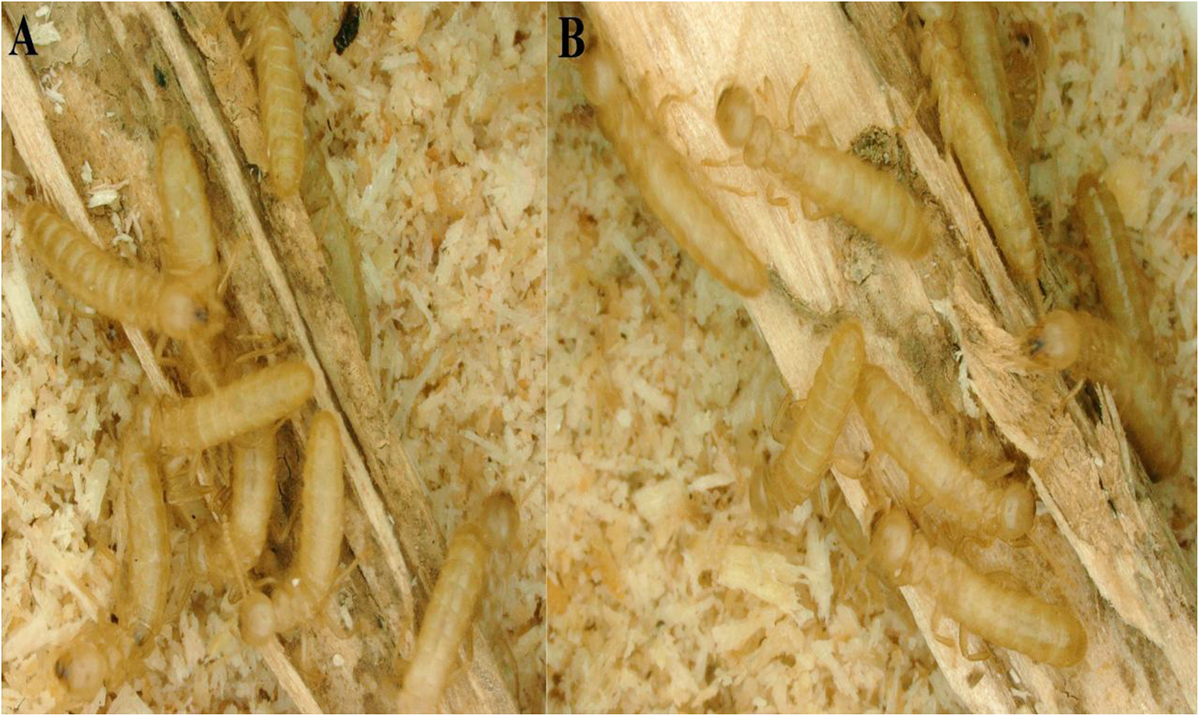
According to our results, neotenic queens of R. aculabialis developed from workers instead of nymphs and revealed genetic relatedness to the worker caste. Morphological discrimination revealed that the neotenic queens of R. aculabialis were workers without functional eyes or wing buds. Worker neotenic queens were also differentiated from the sexually developed ergatoids as they almost had wing buds and visual eyes like nymphs. Furthermore, they assumed parthenogenetic reproductive roles without fully transfiguring into primary queens, which allowed them to retain their juvenile characteristics and distinguished themselves from alate queens in the colony, leading to the loss of previous queens. These neotenics enhanced the asexual reproductive potential, maintenance, survival, and elasticity of the colony in challenging environments (Fig. 2).
(A & B) shows physogastry in neotenic queens of R. aculabialis.

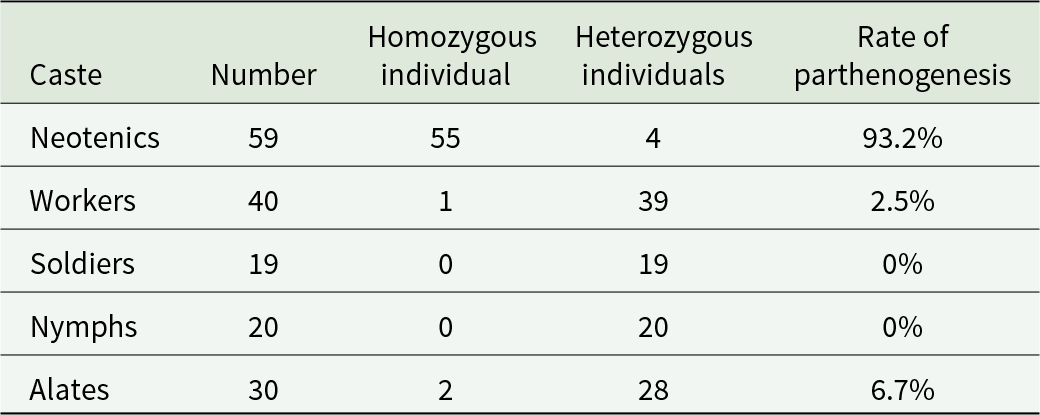
A total of 115 neotenics were collected from the study areas, and all the individuals recorded were females. Among individuals, 60 out of the total 115 (as obtained, 52.17%) were genotypically secondary queens, while 55 out of the total 115 (as obtained, 47.83%) were parthenogenetically secondary queens. The results of the current experiment revealed that homozygous neotenics were 86 out of the total 115 (as obtained, 74.78%), and heterozygous neotenics were 29 out of the total 115 (as obtained, 25.22%) (Fig. 3A). It is possible that the secondary queen was obtained parthenogenetically and was heterozygous due to crossing at this locus. In contrast to the neotenics, 2.5% were workers (Fig. 3B) and 6.7% were alates (Fig. 3D), which were produced parthenogenetically. All the nymphs and soldiers were recorded as gamogenesis (Fig. 3C, Table 3). As, we measured and calibrated the length of the amplified product band of the data using GeneMarker 2.2.0 software (S Figure A1, B1-4).
Based on their genotypes at six microsatellite loci, four colonies of R. aculabialis produced individuals of different castes and development stages, both sexually and parthenogenetically. (A) shows neotenics, (B) shows workers, (C) shows nymphs and soldiers, and (D) show alates.

The parthenogenetic frequency of each caste in four colonies of R. aculabialis

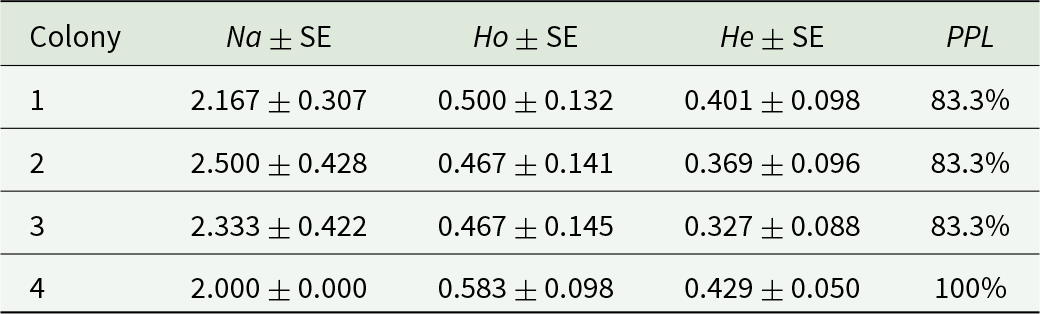
GenAlEx software version 6.503 was used to determine the genetic diversity of each colony (Table 4). The results of all colonies showed that the six microsatellite loci were polymorphic, and the ratio of polymorphic loci (PPL) was 83.33%. The number of alleles per group (Na) varied from 2.000 ± 0.000 to 2.500 ± 0.428, and the examined heterozygosity (Ho) ranged from 0.467 ± 0.141 to 0.583 ± 0.098. The mean heterozygosity observed in secondary queens was 0.023 ± 0.012, the mean expected heterozygosity was 0.353 ± 0.060, and the observed heterozygosity was much higher in workers and soldiers (Ho = 0.454 ± 0.056; He = 0.379 ± 0.041). The nymphs and alates (Ho = 0.465 ± 0.063, He = 0.386 ± 0.043) were closely related to workers and soldiers (Table 4).
The genetic information of six microsatellite loci

Number of Alleles (Na); Observed Heterozygosity (Ho); Proportion of Polymorphic Loci (PPL); and Expected Heterozygosity (He) in each colony.
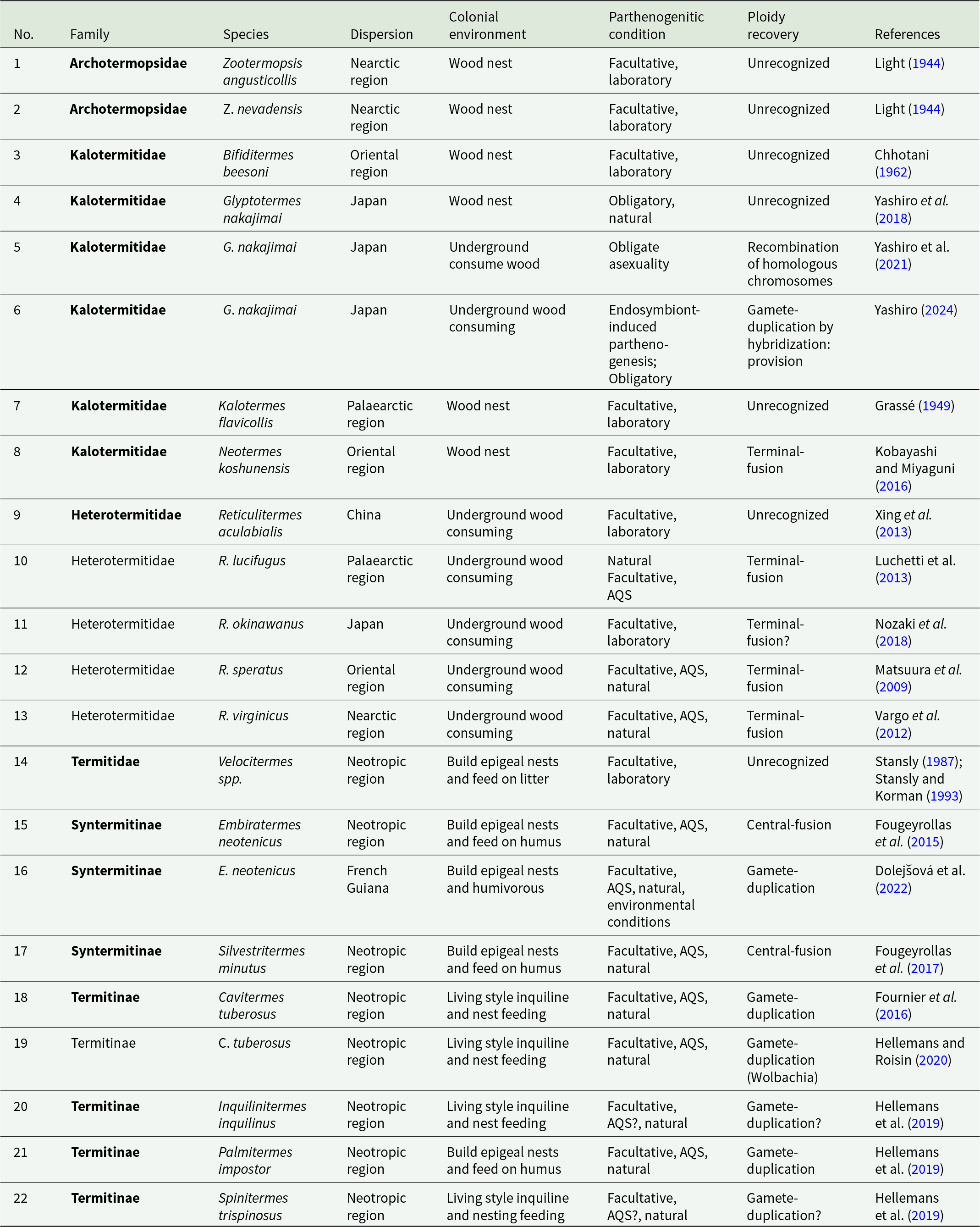
The examined individuals were found to be homozygous, and all loci were parthenogenetic, whereas individuals that were heterozygous at one or more loci were assumed to be of sexual origin. AQS termite species produce neotenic queens via parthenogenesis, replace their parental colonies, and document their social life history in Table 5.
Modified and updated list of previous studies on parthenogenesis in termites (1944–2024)

Discussion
Mixed reproductive strategies involving sexual processes and thelytokous parthenogenesis occur in all the major clades of social insects. In several species of termites, the queen maximizes their genetic input into the non-dispersing queens by parthenogenesis while maintaining genetically diverse sterile offspring and reproducing sexually for dispersal. This phenomenon is known as AQS, which has numerous independent ancestries and fictional benefits, ranging from multiplying colony reproductive capacity to extending life span beyond the foundresses. This AQS system has been previously documented in R. speratus, R. virginicus, R. lucifugus, C. tuberosus, and E. neotenicus termites (Fougeyrollas et al., Reference Fougeyrollas, Dolejšová, Sillam-Dussès, Roy, Poteaux, Hanus and Roisin2015; Matsuura, Reference Matsuura2017; Matsuura et al., Reference Matsuura, Vargo, Kawatsu, Labadie, Nakano, Yashiro and Tsuji2009; Nozaki et al., Reference Nozaki, Yashiro and Matsuura2018; Vargo et al., Reference Vargo, Labadie and Matsuura2012). However, according to our study, all neotenics were homozygous (74.7%), and a few were homozygous workers (2.5%). Therefore, we speculated that the primary queen produced these homozygous neotenics through parthenogenesis. Moreover, other castes, excluding neotenics, developed through sexual reproduction within the colony. In the case of R. aculabialis, all neotenics produced parthenogenetically were homozygous for alleles in the incidental queen and were dispersed randomly (S Table 6A–E). The earlier entomologist reported the AQS mechanism and its rigid monogamy in the termite R. speratus (Matsuura et al., Reference Matsuura, Fujimoto and Goka2004, Reference Matsuura, Vargo, Kawatsu, Labadie, Nakano, Yashiro and Tsuji2009). Similarly, the present study examined the successful AQS mechanism and the main reproductive monogamous pairs in R. aculabialis. Moreover, neotenic daughters are produced through parthenogenesis and replace the primary queen early in the colony’s life cycle (Fig. 4).
Asexual queen succession and reproductive pathways in R. aculabialis: from sexual lineages to neotenic queens at evolutionary stage of transmission; as female parthenogenetic nymphs to develop into neotenic-queens and an unknown reason prevents the sexually produced nymphs from developing into female neotenics.

These neotenics then mate with the primary or secondary king to produce soldiers, workers, and alates through sexual reproduction. This AQS system enables queens to optimize their genetic contribution through asexual reproduction in the next generation, while maintaining genetic diversity. Neotenics inherit only the queen genes, and the founding primary individual has no loss of genetic contribution to future generations (S Table 6A–E).
Therefore, the primary importance of asexual reproduction is the rapid accumulation of deleterious mutations (Felsenstein, Reference Felsenstein1974; Muller, Reference Muller1964). The homozygous progeny carrying recessive deleterious alleles through parthenogenesis would not be able to survive or grow into secondary queens, thereby serving as an effective means of purging these alleles and preventing their transmission to the next generation of sexual offspring (Fougeyrollas et al., Reference Fougeyrollas, Dolejšová, Sillam-Dussès, Roy, Poteaux, Hanus and Roisin2015).
However, the colonies of R. aculabialis collected from Xi’an and Nanjing suggested that such a system is conventional for this species. Previous studies have also documented the mode of parthenogenesis in R. speratus and R. virginicus (Matsuura et al., Reference Matsuura, Vargo, Kawatsu, Labadie, Nakano, Yashiro and Tsuji2009; Vargo et al., Reference Vargo, Labadie and Matsuura2012). The thelytoky mode in E. neotenicus was found to be the most centrally fused automixis in an enormous termite (Fougeyrollas et al., Reference Fougeyrollas, Dolejšová, Sillam-Dussès, Roy, Poteaux, Hanus and Roisin2015). The parthenogenetic phenomenon was also reported in R. aculabialis species, and all thelytoky termites were recognized. Therefore, the first meiotic division typically occurs in automixis with terminal fusion, and the polar body merges with the oocyte nucleus in the second meiotic division to restore diploidy, as in previous studies (Felsenstein, Reference Felsenstein1974; Templeton, Reference Templeton1982). The parthenogenetic offspring are mainly homozygous through automixis with terminal fusion (Fig. 5).
Diagrammatic representation of the cytological mechanisms involved in termite thelytoky: (A) ploidy restoration by automixis with terminal fusion, in which heterozygosity is rapidly reduced; this type of parthenogenesis occurs in the AQS of R. aculabialis; (B) ploidy restoration by automixis with central fusion, in which homozygosity transition is very low but dependent on recombination rate (r) in an AQS non-Termitidae species, E. neotenicus.

In the present study, 55 individuals (93.2%) were identified as parthenogens. However, in colonies number 1 and 4, there 29 neotenics were examined heterozygous at 1–3 loci. Therefore, secondary queens are sexually produced due to crossing over at these loci (Yamamoto and Matsuura, Reference Yamamoto and Matsuura2012). The transition rates of homozygosity in E. neotenicus (2%–8%) vary among loci and depend on the above chromosome position.
A comparison of the genotypes of R. speratus workers and neotenics revealed that the homozygous individuals may have evolved into neotenics at two microsatellite loci (Rf 21-1 and Rf 24-2) rather than heterozygous individuals at one or both loci (Yamamoto and Matsuura, Reference Yamamoto and Matsuura2012). This phenomenon leads to the development of heterozygous individuals into more homozygous workers and neotenics than the usually produced offspring. The parthenogenesis rate of workers and alates (2.5% and 6.7%, respectively) was exceptionally low compared to that of R. virginicus. Similarly, the rate of sexual reproduction in soldiers and nymphs was the highest (100%). Consequently, if the ploidy recovery mechanism is in the R. aculabialis terminal fusion (Fig. 5), the absence of heterozygous neotenics could be noted here because of a similar developmental favouritism to that recorded in R. speratus. The queen seemed to be systematically replaced in Reticulitermes by neotenics in the colony life, which rapidly became highly physogastric (Bagnères and Hanus, Reference Bagnères and Hanus2015; Haroon et al., Reference Haroon, Li, Zhang, Liu, Su and Xing2021). This mechanism was a hypothesis that the AQS system contributed to the development of the colony rate. The maximum fertility of the primary queen would be limited while perpetuating genes and avoiding the cost of inbreeding. Additionally, many neotenics have advantages in terms of protection and mobility (Fougeyrollas et al., Reference Fougeyrollas, Dolejšová, Sillam-Dussès, Roy, Poteaux, Hanus and Roisin2015). However, the presence of the primary queen leads to an unexpected future loss of the colony, while it may be easier to overcome the loss of a few neotenics.
In Reticulitermes, an interesting issue concerning the evolution of AQS mechanism is responsible for the evolutionary priority of female parthenogenetic nymphs to develop into neotenic-queens and what prevents the sexually produced nymphs from developing into female neotenics and producing them as alate-queens (Matsuura, Reference Matsuura2011; Shigenobu et al., Reference Shigenobu, Hayashi, Watanabe, Tokuda, Hojo, Toga, Saiki, Yaguchi, Masuoka and Suzuki2022). The multi-locus homozygous determination system in Reticulitermes has been found to prioritize development in parthenogenetic queens, which are homozygous at most loci, rather than the sexually developed alates intended for homozygous nymphs at different loci (Dedeine et al., Reference Dedeine, Dupont, Guyot, Matsuura, Wang, Habibpour, Bagnères, Mantovani and Luchetti2016; Hellemans et al., Reference Hellemans, Dolejšová, Křivánek, Fournier, Hanus and Roisin2019; Matsuura, Reference Matsuura2017; Thorne et al., Reference Thorne, Traniello, Adams and Bulmer1999). The preference for neotenic development of parthenogens related to natural R. speratus colonies contains only parthenogenetically produced neotenics (Matsuura et al., Reference Matsuura, Vargo, Kawatsu, Labadie, Nakano, Yashiro and Tsuji2009), indicating that genetic differences between parthenogenetically and sexually produced offspring separate their neotenic potential (Matsuura et al., Reference Matsuura, Himuro, Yokoi, Yamamoto, Vargo and Keller2010). The AQS mechanism has been identified in three species with a parthenogenetic ability in the subterranean termite genus Reticulitermes, but a parthenogenetic species without AQS has never been discovered (Dedeine et al., Reference Dedeine, Dupont, Guyot, Matsuura, Wang, Habibpour, Bagnères, Mantovani and Luchetti2016; Kobayashi and Miyaguni, Reference Kobayashi and Miyaguni2016). Therefore, parthenogenesis often results from the AQS method, specifically in the genus Reticulitermes. In the future, further studies could help identify more AQS species in subterranean termites.
Conclusion
The AQS mechanism in R. aculabialis highlights a fascinating reproductive strategy. The genetic analysis revealed that secondary queens were homozygous at all loci, indicating that they were produced through automictic thelytokous parthenogenesis. This process involves ploidy restoration, where the genetic material is duplicated to maintain the diploid state, ensuring genetic continuity without sexual reproduction. For future research, it would be valuable to compare termite breeding biology and reproductive strategies with those of the oldest eusocial insects, such as ants and bees. These comparisons could provide insights into the evolution of eusociality and the diverse reproductive adaptations that have emerged in different lineages of social insects.
Supplementary material
The supplementary material for this article can be found at https://doi.org/10.1017/S000748532500001X.
Acknowledgements
We are thankful to Zhang Hong Guo, who helped us in DNA extraction, and designing primers. In terms of English correction, we also want to thank Prof. Derek William Dunn for his language corrections, valuable comments, and advice that improved this article. We also thank to reviewers for their comments.
Author contributions
Zahid Khan and Xing Lian-Xi conceived and designed the study, and wrote the main manuscript text. Haroon performed the study and helped in photography. While Zhao Sha helped us in termite collection, DNA extraction, and also in statistical analysis. All authors reviewed the manuscript.
Funding
Financial support was provided by the National Natural Science Foundation of China (32471563).
Conflict of interest
The authors declare no conflict of interest.