1. Introduction
Eocene sea cows (Sirenia) have a pan-Tethyan distribution. Most of the occurrences of Eocene sirenians correspond to Old and New World records, with other localities in Africa, Indo-Pakistan and possibly Java (see Domning, Morgan & Ray, Reference Domning, Morgan and Ray1982; Sagne, Reference Sagne2001; C. Sagne, unpub. Ph.D. thesis, Muséum national d'Histoire naturelle, Paris, 2001). The oldest and most basal sirenians (Prorastomus, Pezosiren) come from the early Middle Eocene of Jamaica and have been referred to the Prorastomidae (Savage, Domning & Thewissen, Reference Savage, Domning and Thewissen1994; Domning, Reference Domning2001), which is regarded as a paraphyletic taxon (Gheerbrant, Domning & Tassy, Reference Gheerbrant, Domning, Tassy, Rose and Archibald2005). Sirenians probably diversified in the Early Eocene, paralleling the diversification of cetaceans in the Tethyan Realm, but so far there is no fossil known with certainty from Ypresian formations (see Zalmout, Ul-Haq & Gingerich, Reference Zalmout, Ul-Haq and Gingerich2003). Other occurrences of early Middle Eocene sirenians have been reported from North America (Domning, Morgan & Ray, Reference Domning, Morgan and Ray1982), northern Africa (Gingerich, Reference Gingerich1992), Indo-Pakistan (Zalmout, Ul-Haq & Gingerich, Reference Zalmout, Ul-Haq and Gingerich2003; Bajpai et al. Reference Bajpai, Thewissen, Kapur, Tiwari and Sahni2006, Reference Bajpai, Domning, Das and Mishra2009) and Europe. Lutetian sirenians from the southern margin of the Mediterranean Tethys (Egypt) and from the eastern Tethys (India, Pakistan) have been assigned to Protosiren, Eosiren, Eotheroides and Ashokia (Gingerich et al. Reference Gingerich, Arif, Bhatti, Raza and Raza1995; Zalmout, Ul-Haq & Gingerich, Reference Zalmout, Ul-Haq and Gingerich2003; Bajpai et al. Reference Bajpai, Thewissen, Kapur, Tiwari and Sahni2006, Reference Bajpai, Domning, Das and Mishra2009), those from the western Tethys are tentatively referred to Protosiren or a closely related form (Domning, Morgan & Ray, Reference Domning, Morgan and Ray1982), and finally those from the northern margin of the Mediterranean Tethys (Hungary) have been attributed to Sirenavus and Anisosiren (Kretzoi, Reference Kretzoi1941; Kordos, Reference Kordos1978, Reference Kordos1981, Reference Kordos2002). The above-mentioned taxa are assigned either to Protosirenidae (Protosiren, Ashokia) or to Dugongidae (the remainder), suggesting a rapid early Middle Eocene diversification of sirenians, with generically-distinct and endemic faunas on the north and south shores, respectively, of the former Tethys Seaway (C. Sagne, unpub. Ph.D. thesis, Muséum national d'Histoire naturelle, Paris, 2001; Bajpai et al. Reference Bajpai, Domning, Das and Mishra2009).
In Western Europe, Lutetian sirenian fossils (isolated teeth, ribs) are known from the Aquitanian Basin (Sickenberg, Reference Sickenberg1934; Richard, Reference Richard1946), but the occurrence of Protosiren and Eotheroides (as Eotherium) in these levels is very doutful (Domning, Reference Domning1996; C. Sagne, unpub. Ph.D. thesis, Mus. Natl. Hist. Nat., Paris, 2001). In the Eastern Pyrenees, Bataller (Reference Bataller1956) and Crusafont (Reference Crusafont Pairó and Westphal1973) referred some vertebrae and ribs from the Lutetian of the Ebro Basin to Halitherium sp. However, both the age of the beds and the status of the material are uncertain (Pilleri, Biosca & Vía, Reference Pilleri, Biosca and Via1989). Prototherium is represented by the species P. veronense and P. montserratense (also considered as the subspecies P. intermedium montserratense by Bizotto, Reference Bizzotto2005) in the Bartonian of Italy and Catalonia, respectively (Zigno, Reference Zigno1875; Pilleri, Biosca & Vía, Reference Pilleri, Biosca and Via1989).
In the Southwestern Pyrenees, sirenian vertebrae and ribs have been previously described from the Middle Eocene (Bartonian) of the Pamplona Basin (Navarre), and referred to as Dugongidae indet. (Astibia et al. Reference Astibia, Pereda Suberbiola, Bardet, Payros, Berreteaga and Badiola2006). Additional postcranial remains are known from the Middle to Upper Eocene formations of the Jaca Basin (Huesca) (see references in Astibia et al. Reference Astibia, Payros, Pereda Suberbiola, Elorza, Berreteaga, Etxebarria, Badiola and Tosquella2005). The aim of this paper is to describe new sirenian material from the Middle Eocene (upper Lutetian to lowermost Bartonian) limestones of the Urbasa and Andia plateaux in Navarre, and to discuss its affinities. These new records of sirenians are the oldest known in Western Europe.
Institutional abbreviations: MNHN – Muséum National d'Histoire Naturelle, Paris; UF – Florida Museum of Natural History, University of Florida, Gainesville; UPV/EHU – Universidad del País Vasco/Euskal Herriko Unibertsitatea, Bilbao; USNM – United States National Museum of Natural History, Smithsonian Institution, Washington, D.C.
2. Geological context
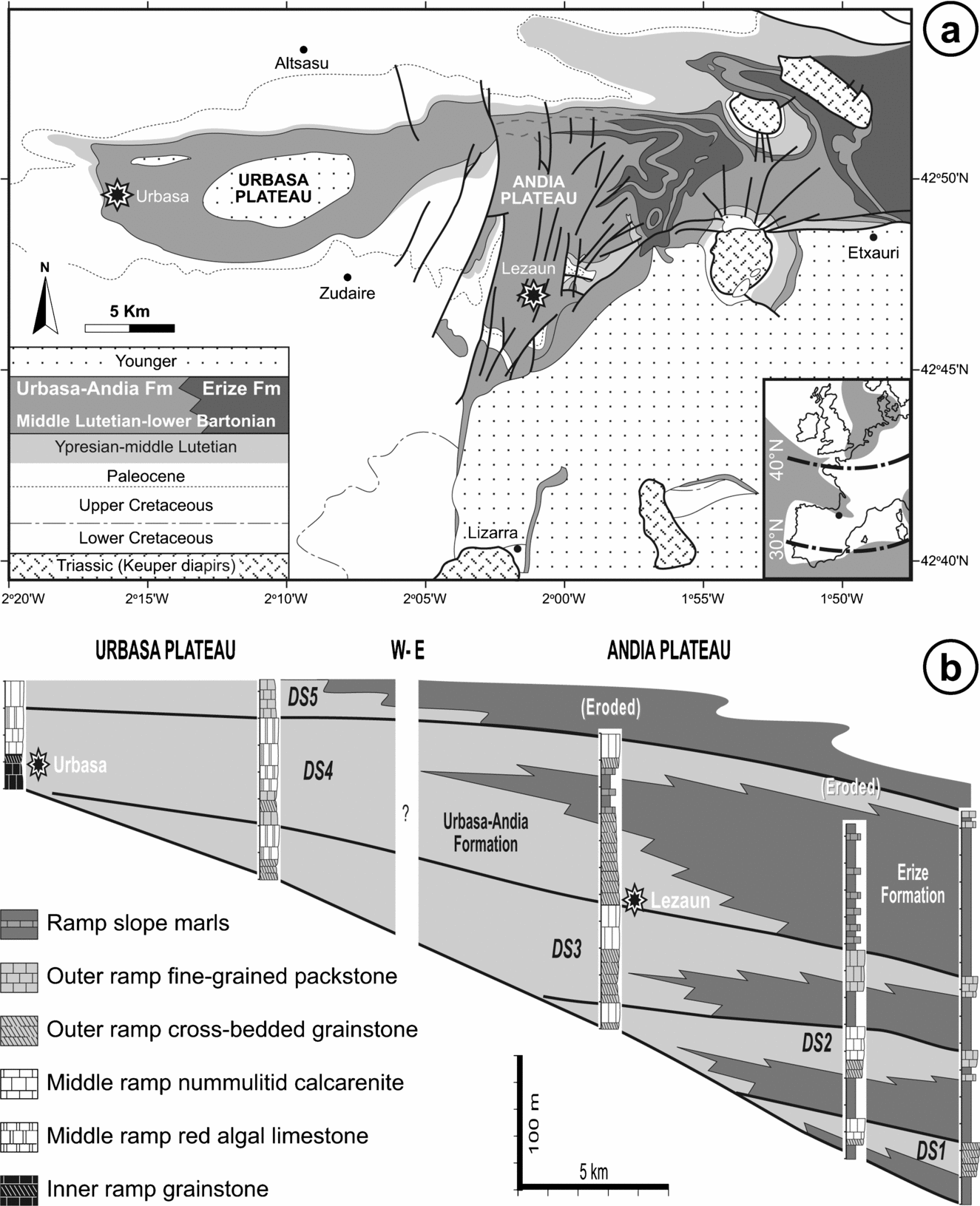
The sirenian fossils reported herein were collected in the Middle Eocene Urbasa-Andia limestone Formation (A. Payros, unpub. Ph.D. thesis, Univ. País Vasco, Bilbao, 1997), which crops out widely in the core of the E–W-trending syncline that makes up the so-called plateaux (Fig. 1a). A comprehensive study of its sedimentological and stratigraphic characteristics has recently been carried out by Payros et al. (in press), and the following description is based on that work. The Urbasa-Andia Formation is composed of varied shallow-marine limestones that, according to their sedimentary facies and benthic fossil assemblages, were accumulated in coastal, inner ramp, middle ramp and outer carbonate ramp environments. These limestones grade northeastwards into marls of the Erize Formation (A. Payros, unpub. Ph.D. thesis, Univ. País Vasco, Bilbao, 1997), whose planktonic foraminiferal content (middle Lutetian–early Bartonian E10 and E11 zones of Berggren & Pearson, Reference Berggren and Pearson2005) attests to hemipelagic deposition. These characteristics show that the Urbasa-Andia limestones accumulated in a 15–20 km wide distally-steepened carbonate ramp that deepened northeastwards (Fig. 1b). It was part of a wider shelfal system that flanked the southern margin of a deep-marine gulf, which was located between the Iberian peninsula and mainland Europe and opened northwestwards into the Atlantic Ocean at approximately 35° N palaeolatitude (Fig. 1a).
(a) Simplified geological map of the study area, highlighting Eocene stratigraphic units in grey. Locations of the sirenian findings in the Urbasa-Andia Formation are shown with stars (Lezaun and Urbasa). Inset shows the early Middle Eocene palaeogeographic reconstruction of the Pyrenean area, with location of the study area (black dot). (b) Stratigraphic architecture of the Urbasa-Andia Formation showing the distribution of depositional sequences (DS1 to DS5). The two sirenian sites are included within depositional sequence DS4, which extends from the late Lutetian SBZ16 to the earliest part of the Bartonian SBZ17 zones. Adapted from Payros et al. (in press).

Five depositional sequences occur in the Urbasa-Andia Formation, which onlap southwestwards onto a major angular unconformity (Payros et al. in press). Hence, the thickness and age of the Urbasa-Andia Formation are highly variable between localities.
The sirenian remains were collected from two localities. One is a limestone quarry (UTM X580856 Y4735347) near Lezaun in the Andia plateau. The fossils occur in cross-bedded orthophragminid grainstones that were accumulated in outer ramp dunes, at a depth of about 100 m, by return bottom currents (Payros et al. in press). Therefore, the sirenian remains were probably washed offshore during storm episodes. Underlying nummulitid beds yielded Nummulites blondeaui and N. cf. discorbinus, whose range corresponds to the late Lutetian SBZ16 zone of Serra-Kiel et al. (Reference Serra-Kiel, Hottinger, Caus, Drobne, Ferràndez, Jauhri, Less, Pavlovec, Pignatti, Samsó, Schaub, Sirel, Strougo, Tambareau, Tosquella and Zakrevskaya1998). Correlative beds in neighbouring outcrops contain N. deshayesi, N. carpenteri, N. praepuschi, N. beaumonti, N. discorbinus and N. meneghinii, which confirm the late Lutetian age.
The second locality with sirenian remains corresponds to the Arrasate (‘Limitaciones de las Ameskoas’) area of the Urbasa plateau (UTM X561160 Y4741051). The fossils were found in pebbly/sandy grainstones rich in porcelaneous larger foraminifera, peloids and fragments of encrusting foraminifera and red algae, many with a hooked shape. Some cross-laminations were observed. These characteristics suggest deposition in a subtidal shallow-marine setting, probably less than 20 m deep, relatively close to terrestrial source areas (Payros et al. in press). The occurrence of abundant epiphytic organisms, such as soritids and Fabiania sp., shows that the area was covered with perennial seagrasses and other macrophytes with flattened blades, although no direct remains have been preserved due to their soft bodies (A.P., pers. obs.). Despite the protection offered by this vegetation, the area was subjected to the action of continuous high-energy currents, showing that the coastal area was neither protected nor isolated from the open sea. Taking everything into account, these sirenian fossils are regarded as nearly autochthonous. It was not possible to determine the age of these deposits, but correlation with neighbouring areas suggests that they might have been formed during the late Lutetian SBZ16 or earliest Bartonian SBZ17 zones.
3. Material and methods
The sirenian material of Navarre described below consists of axial remains (two atlas vertebrae, one of them very fragmentary, dorsal ribs) and one appendicular bone (humerus). Most of the material was found in an area called Arrasate in the Urbasa plateau (abbreviation: UR). A few dorsal ribs come from a quarry near Lezaun (abbreviation: LE), in the Andia plateau. During the study of the material, it has been kept at the Palaeontology Laboratory of the Universidad del País Vasco/Euskal Herriko Unibertsitatea (UPV/EHU), Bilbao. Casts of the most significant fossil remains are housed in this institution.
Methods of thin-sectioning followed standard procedures. A rib was sectioned transversely. The thin-sections were ground to a thickness of 100 to 150 μm. They were studied at low and high magnifications using a petrographic microscope under normal and polarized light. The histological terminology and the typology of bone tissues used in this study refer to Francillon-Vieillot et al. (Reference Francillon-Vieillot, Buffrénil, Castanet, Geraudie, Meunier, Sire, Zylberberg, Ricqlès and Carter1990). See Buffrénil et al. (Reference Buffrénil, Astibia, Pereda Suberbiola, Berreteaga and Bardet2008) for a previous histological study of sirenian ribs from the Middle Eocene of Navarre.
4. Palaeontology
Mammalia Linnaeus, Reference Linnaeus1758
Sirenia Illiger, Reference Illiger1811
Dugongidae Gray, Reference Gray1821
?Dugongidae indet.
Figures 2–4
Material. UPV/EHU LE1.1–LE1.5, incomplete to fragmentary ribs; UPV/EHU UR1.4, atlas; UR1.12, fragment of atlas neural arch; UR1.5, proximal half of right humerus; UR1.1–UR1.3 and UR1.6–UR1.11, rib fragments.
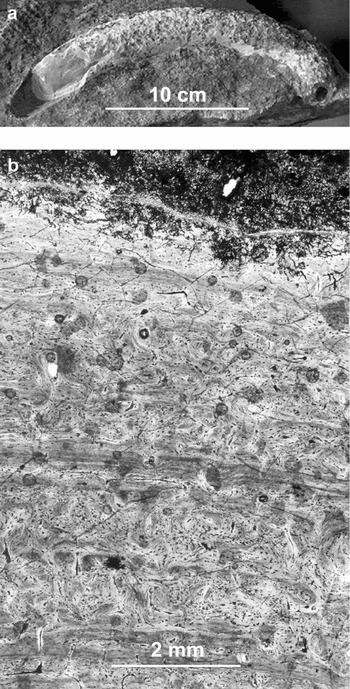
?Dugongidae indet. from the early Middle Eocene of Lezaun (Urbasa-Andia Formation, Navarre). (a) LE1.1, dorsal rib; (b) microscopic characteristics of the same rib. Densely packed Haversian systems and alternating cancellous growth bands. Peripheral region altered with tunnel network structures, probably made by microbial activity, filled by pyrite and iron oxides. Photograph with transmitted light. A colour version of this figure is available at http://journals.cambridge.org/geo.

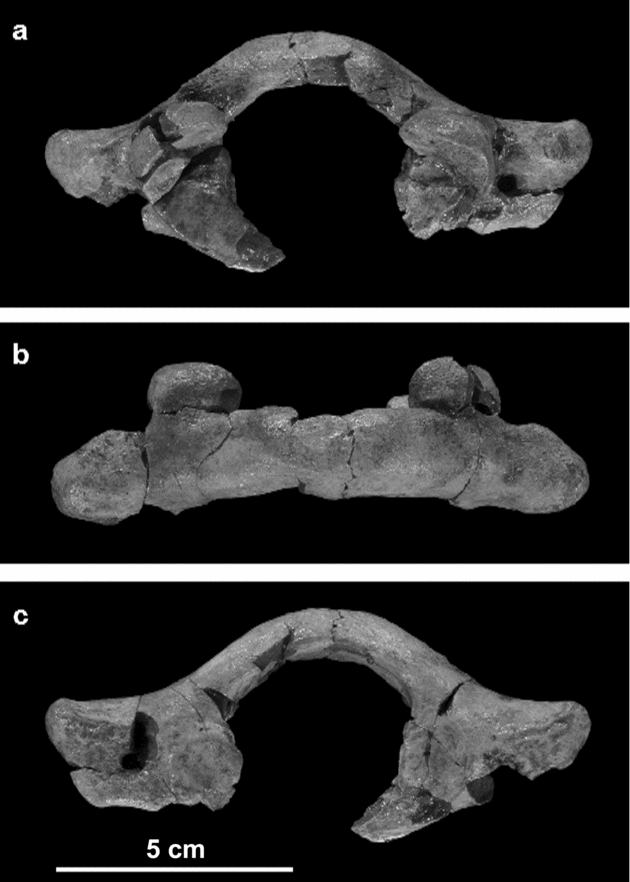
?Dugongidae indet. from the early Middle Eocene of Arrasate (Urbasa-Andia Formation, Navarre). Atlas UR1.4 in anterior (a), dorsal (b) and posterior (c) views.

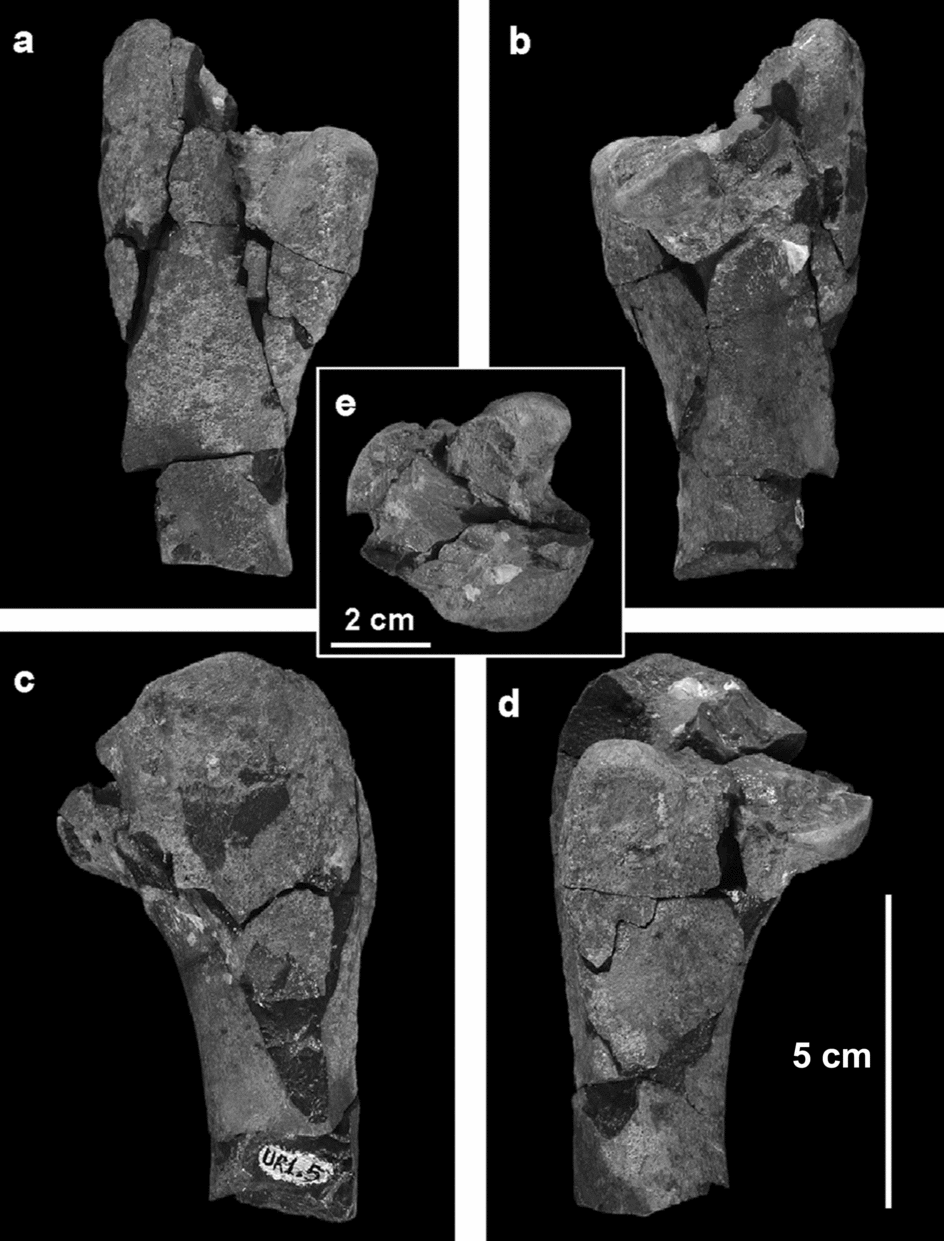
?Dugongidae indet. from the early Middle Eocene of Arrasate (Urbasa-Andia Formation, Navarre). Right humerus UR1.5 in anterior (a), posterior (b), lateral (c), medial (d) and proximal (e) views.

Provenance and age. UPV/EHU LE1.1–LE1.5: quarry near Lezaun (Navarre) (UTM X580856 Y4735347); Middle Eocene, late Lutetian SBZ16, middle part of the Urbasa-Andia Formation. UPV/EHU UR1.1–UR1.12: Arrasate (‘Limitaciones de las Ameskoas’) area of the Urbasa plateau, Navarre (UTM X561160 Y4741051); Middle Eocene, probably late Lutetian SBZ16 or early Bartonian SBZ17, middle part of the Urbasa-Andia Formation.
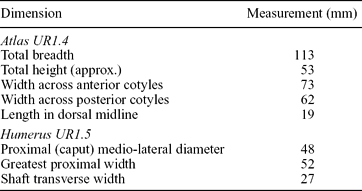
Measurements. See Table 1.
Measurements (in mm) of the atlas UR1.4 and humerus UR1.5 of ?Dugongidae indet. from the early Middle Eocene of Arrasate (Urbasa-Andia Formation, Navarre)

4.a. Description and comparisons
Atlas (UPV/EHU UR1.4, UR1.12). The atlas is low, compressed dorsoventrally (Fig. 3a, c). The dorsal arch is low, producing a broad neural canal. There is not a prominent neural tubercle but a scarcely rugose and incipient area in the two atlases (Fig. 3b). The ventral arch is broken. The anterior cotylar articular facets are long, deeply concave and have a bulbous dorsal rim. The arterial canal above the anterior cotyle is unbridged. The transverse processes are long, robust and knob-like. The wings are rugose dorsally, but smooth and more slender ventrally; each one is pierced near its roots by a large transverse (vertebrarterial) foramen. The posterior articular facets are subcircular in outline, less prominent and concave than the anterior articular facets. The tops of the posterior cotyles lie well below the dorsal surface of the transverse processes.
These atlases are rather plesiomorphic in shape and differ from those of derived dugongids and protosirenids. There are few atlases of early sirenians available in the literature. Savage, Domning & Thewissen (Reference Savage, Domning and Thewissen1994) described two fragmentary atlases of Prorastomus sirenoides from the early Middle Eocene of Jamaica and two atlases from the Late Eocene of Florida that they referred to Prorastomidae indet. UR1.4 is slightly smaller than these other atlases. It looks strikingly similar to the holotypic atlas of P. sirenoides (BMNH 44897), though it is slightly more robust and higher dorsoventrally, and has longer and blunter transverse processes. In dorsal view, UR1.4 is less concave than BMNH 44897. The Navarrese specimen is also more robust than the referred atlas of P. sirenoides (USNM 437769) and two ‘prorastomid’ atlases (UF 123678; cast UF 135798) (Savage, Domning & Thewissen, Reference Savage, Domning and Thewissen1994). These fossils display shorter and more laterally grooved transverse processes than in UR1.4. The dorsal or neural tubercle is more marked in these ‘prorastomids’ than in UR1.4, but this character appears to be variable among sirenians: for example, atlases of the dugongid Halitherium schinzii from the Early Oligocene of France and Germany have a more or less marked neural tubercle (MNHN collections).
With regard to the atlas of Protosiren sp. from the Middle Eocene of North Carolina, USA (Domning, Morgan & Ray, Reference Domning, Morgan and Ray1982), UR1.4 is similar in size or slightly smaller, lower dorsoventrally and wider laterally. The atlas of Protosiren shows a well-developed neural arch and stout transverse processes (Domning, Morgan & Ray, Reference Domning, Morgan and Ray1982). These differences (dorsoventral height, presence of a neural tubercle, wing robustness) are even more developed in representatives of Trichechidae, such as Potamosiren from the Miocene of Colombia (Domning, Reference Domning1982). Moreover, the posterior articular surfaces of Potamosiren are lower relative to the wings than those observed in UR1.4.
The atlas UR1.4 differs from those of Recent Sirenia (Dugong dugon (dugong), Hydrodamalis gigas (Steller's sea cow) and Trichechus spp. (manatees)), which bear in dorsal view a marked midline crest on the dorsal surface and less prominent anterior cotylar articular facets. The general aspect of UR1.4 looks more like that of dugongids, though less robust than that of trichechids that bear much more gracile transverse processes.
The presence or absence of a vertebrarterial canal through the transverse process is a common variation in sirenians (Domning, Morgan & Ray, Reference Domning, Morgan and Ray1982).
Ribs of Lezaun (UPV/EHU LE1.1–LE1.5). The ribs are banana-like, thick and massive in cross-section, without a medullar cavity (Fig. 2a). They differ from the ribs of Protosiren from Egypt and Balochistan, which are dense but lack pachyostosis (Gingerich et al. Reference Gingerich, Arif, Bhatti, Raza and Raza1995; Zalmout, Ul-Haq & Gingerich, Reference Zalmout, Ul-Haq and Gingerich2003). The cross-sections are similar to those of Prototherium solei from Catalonia (Pilleri, Biosca & Vía, Reference Pilleri, Biosca and Via1989, fig. 4a–c), Halitherium taulannense from Provence (undescribed material of Sagne, Reference Sagne2001), and an indeterminate dugongid from the Pamplona Basin of Navarre (Astibia et al. Reference Astibia, Pereda Suberbiola, Bardet, Payros, Berreteaga and Badiola2006).
The thin-sections of the ribs show well-preserved histological microstructures (Fig. 2b). In the Lezaun ribs, there is internally a nearly peripheral, approximately 1 mm thick, alteration layer exhibiting a branching three-dimensional network of tunnels filled by pyrite and/or iron oxides. The Lezaun samples show a larger number of fractures than those of Urbasa. Some of these fractures reach the external surface of the bone, where they show a replacement by secondary francolite, with different light-coloured layers on each side. The X-ray diffraction analyses indicate that the fossil bone is mostly composed of francolite (carbonate fluorapatite [Ca5(PO4, CO3)3(F)]).
Rib diaphyses have an extreme compactness (~ 98%) and histologically display a typical sirenian pattern. The medullar region is completely occluded; it includes thick perivascular layers of endosteal lamellar bone, between which small remnants of calcified cartilage matrix are interspersed. Deep cortical regions consist of a thick layer of fibro-lamellar tissue (see Francillon-Vieillot et al. Reference Francillon-Vieillot, Buffrénil, Castanet, Geraudie, Meunier, Sire, Zylberberg, Ricqlès and Carter1990 for bone typology) with a longitudinally oriented network of vascular canals. Towards the cortical periphery, vascular density decreases, and very conspicuous cyclical growth marks, in the form of annuli, occur (Fig. 2b). Unfortunately, the outermost cortical layers are not preserved; as a consequence, the individual ages of these specimens, as well as the modification of bone structure in late growth stages, cannot be observed. Haversian remodelling is relatively discrete, especially in peripheral cortical territories. As a whole, the basic histological features of the studied specimens are closely similar to those observed by Buffrénil et al. (Reference Buffrénil, Astibia, Pereda Suberbiola, Berreteaga and Bardet2008) in Prototherium montserratense from the Bartonian of Catalonia and in an undetermined dugongid from the Bartonian of the Pamplona Basin of Navarre, in the eastern and western Pyrenees, respectively.
Dorsal ribs of Urbasa (UPV/EHU UR1.1–UR1.3, UR1.6–UR1.11). Several fragmentary ribs are thick and massive, without a medullary cavity. The only preserved articular head displays a subcircular and rugose articular facet. The tuberculum is well developed.
One of the rib fragments is very thick in cross-section and closely resembles the rib sections of Eosiren libyca from the Priabonian of Egypt and Halitherium schinzii from the Early Oligocene (Rupelian) of Germany (see Astibia et al. Reference Astibia, Pereda Suberbiola, Bardet, Payros, Berreteaga and Badiola2006).
The histological features of the dorsal ribs are similar to those observed in the material of Lezaun (see above).
Humerus (UPV/EHU UR1.5). This includes the proximal half of a robust, lateromedially compressed right humerus (Fig. 4). It appears to have been damaged during extraction. The bone belonged to a mature individual as the diaphysis and proximal epiphysis are fused, but it was probably not an old adult as the surfaces for attachment of ligaments and insertion scars are neither rugose nor protuberant (Domning, Reference Domning1997). The articular surface of the head is not complete. The deltoid crest seems broad but scarcely prominent (Fig. 4a, c). The deltoid tuberosity is broken. The greater and lesser tubercles are well developed anteromedially, delimiting a deep bicipital groove (Fig. 4a, e). The greater tubercle extends proximally of the humeral head. In lateral view, the surface of the greater tubercle is rugose, and there are two well-defined scars for the supraspinatus and infraspinatus muscles (Fig. 4c). The humerus has a subtriangular cross-section at midshaft.
UR1.5 resembles the humerus of Halitherium more than that of Prototherium in its general form and robustness. The humeri of Prototherium veronense from the Bartonian of Italy (Sickenberg, Reference Sickenberg1934) and P. solei from the Priabonian of Catalonia (Pilleri, Biosca & Vía, Reference Pilleri, Biosca and Via1989) are comparatively more slender than UR1.5 and than those of H. taulannense from the Priabonian of Provence and Halitherium schinzii from the Early Oligocene of Germany (MNHN collections), among other taxa. Moreover, the greater tubercle of UR1.5 appears to extend more proximally relative to the humeral head than in P. solei, but the specimen from Catalonia is too fragmentary to be certain. The humerus of P. solei is considerably smaller than that from Navarre.
Both the extant dugong and the manatee Trichechus manatus possess a greater tubercle proximally divided into two well-separated ovoid to rounded parts, a large ventral one and a smaller lateral one. In the manatee, moreover, the large ventral part is located more medially than in the dugong, where both processes are located laterally. On the contrary, the Steller's sea cow humerus exhibits a laterally located greater tubercle, elongated in shape and undivided, as in most fossil sirenians, so that this character could be plesiomorphic for the clade. UR1.5 bears a greater tubercle comparable in shape to that of the Steller's sea cow and other extinct sirenians, which is an elongated and probably undivided (though this area is partially broken).
5. Discussion and conclusions
With the exception of two records of Miosireninae (Trichechidae) from the Late Oligocene of Westphalia and the Early Miocene of Belgium, only dugongids are known in the fossil record of Europe (see Domning, Reference Domning1996; Sagne, Reference Sagne2001; C. Sagne, unpub. Ph.D. thesis, Muséum national d'Histoire naturelle, Paris, 2001). Dugongidae representatives are known from the early Middle Eocene to present (Dugong). In the northern margin of the Mediterranean Tethys, dugongids are recorded from the Lutetian to the Pliocene (Gheerbrant, Domning & Tassy, Reference Gheerbrant, Domning, Tassy, Rose and Archibald2005).
The new sirenian material found in the Middle Eocene deposits of Lezaun (Andia plateau, Navarre) includes partial dorsal ribs of late Lutetian age. The pachyosteosclerotic ribs are indistinguishable from those of dugongids from the mid to late Eocene and Oligocene of Europe. Skeletal pachyosteosclerosis (increased volume plus increased density of bones), present at least in ribs, is characteristic of sirenians except for the near-basal form Protosiren (Buffrénil & Schoevaert, Reference Buffrénil and Schoevaert1989; Buffrénil et al. Reference Buffrénil, Astibia, Pereda Suberbiola, Berreteaga and Bardet2008). Here we refer this material to ?Dugongidae indet.
Additional material from Arrasate (Urbasa plateau, Navarre) consists of two atlases, dorsal ribs and a humerus. The morphology of the atlas (low dorsal arch, absence of a prominent neural tubercle) is reminiscent of prorastomids, whereas that of the humerus (robust bone, with a greater tubercle that extends proximally of the humeral head) resembles the condition observed in some specimens of Halitherium from the Late Eocene and Early Oligocene of Europe (Sagne, Reference Sagne2001; C. Sagne, unpub. Ph.D. thesis, Muséum national d'Histoire naturelle, Paris, 2001). Pending the discovery of more complete material, we here refer all this material to Dugongidae indeterminate. However, this referral would be worth considering in more detailed comparisons with protosirenid anatomy, to assert this Dugongidae identification with more certainty.
Though the presence of sirenian fossils in the Lutetian of Western Europe (Aquitaine and Pyrenees) has been widely accepted in the past (Sickenberg, Reference Sickenberg1934; Richard, Reference Richard1946; Bataller, Reference Bataller1956; Crusafont, Reference Crusafont Pairó and Westphal1973), the reliability of these finds in both the age of the beds and the status of the material is doubtful (Pilleri, Biosca & Vía, Reference Pilleri, Biosca and Via1989; Domning, Reference Domning1996; Sagne, Reference Sagne2001; C. Sagne, unpub. Ph.D. thesis, Muséum national d'Histoire naturelle, Paris, 2001).
The oldest sirenian remains reported to date in the Pyrenees were assigned to the Biarritzian (Pilleri, Biosca & Vía, Reference Pilleri, Biosca and Via1989), a regional stage defined by Hottinger & Schaub (Reference Hottinger and Schaub1960) on the basis of larger foraminifera. The Biarritzian stratotype is characterized by SBZ17 larger foraminifera, middle Bartonian NP17 calcareous nannofossils and E13 planktonic foraminifera (Mathelin & Sztràkos, Reference Mathelin and Sztràkos1993), although Serra-Kiel et al. (Reference Serra-Kiel, Hottinger, Caus, Drobne, Ferràndez, Jauhri, Less, Pavlovec, Pignatti, Samsó, Schaub, Sirel, Strougo, Tambareau, Tosquella and Zakrevskaya1998) later assumed that the Biarritzian stage embraces the whole SBZ17 zone, therefore also including the lower part of the Bartonian stage (equivalent to the upper part of calcareous nannofossil zone NP16). Given this off-putting stratigraphic framework it is not straightforward to determine the age of previously reported sirenian fossils in modern terms. However, it is clear that all the so-called Biarritzian sirenian remains should be ascribed either to the middle Bartonian (according to a strict stratotypic viewpoint) or to the lower–middle Bartonian (according to the ampler concept of Serra-Kiel et al. Reference Serra-Kiel, Hottinger, Caus, Drobne, Ferràndez, Jauhri, Less, Pavlovec, Pignatti, Samsó, Schaub, Sirel, Strougo, Tambareau, Tosquella and Zakrevskaya1998). Therefore, the Lezaun sirenian remains, reliably dated as late Lutetian (SBZ16 zone), definitively constitute the oldest sirenian record known in Western Europe. The age of the Urbasa sirenian remains could not be specified accurately by biostratigraphic means, but it can be indirectly inferred by correlation with neighbouring sections. This correlation suggests that the Urbasa material could also be included in the late Lutetian SBZ16 zone or perhaps in the lowermost part of the earliest Bartonian SBZ17 zone; therefore it may also be among the oldest sirenian fossils reported in Western Europe.
Finally, the late Lutetian (to basalmost Bartonian) sirenian remains from Navarre show that the pachyosteosclerosis of extant Sirenia was definitively present by the early Middle Eocene, as previously suggested with slightly younger (Bartonian) remains from the Pamplona Basin of Navarre (Astibia et al. Reference Astibia, Pereda Suberbiola, Bardet, Payros, Berreteaga and Badiola2006; Buffrénil et al. Reference Buffrénil, Astibia, Pereda Suberbiola, Berreteaga and Bardet2008).
Acknowledgements
We are grateful to Mr Patxi del Rosario (Iruñea/Pamplona) for collecting and lending for study the sirenian fossils, and Dr Claire Sagne (MNHN, Paris) for kindly providing access to the collections under her care and for useful discussions. We are also grateful to two anonymous reviewers for useful comments on the manuscript. Financial support was provided by the Ministerio de Ciencia e Innovación of Spain (projects CGL2004-02338, CGL2007-64061/BTE, CGL2008-01780/BTE and CGL2008-00809/BTE) and by the Gobierno Vasco/EJ (research groups GIC07/14-361 and GIC07/122-IT-215-07). This work is part of a palaeontological collaboration program between the Centre National de la Recherche Scientifique (CNRS, France), the Muséum National d'Histoire Naturelle (MNHN, Paris), and the Universidad del País Vasco/Euskal Herriko Unibertsitatea (UPV/EHU, Bilbao).