I. INTRODUCTION
The efficiency of thermoelectric materials is usually evaluated in terms of their dimensionless figure of merit ZT ( ), where α is the Seebeck coefficient, σ the electrical conductivity, κ the total thermal conductivity, which is the sum of lattice and electronic contributions, and T is the absolute temperature. It is clear that a thermoelectric material with high performance requires a high electrical conductivity, a high Seebeck coefficient, and meanwhile, a low thermal conductivity. CoSb3-based skutterudite compounds are very well known as promising candidates in power generation from waste heat within the electronic crystal phonon glass concept proposed by Slack.Reference Bell1–Reference Lamberton, Tedstrom, Tritt and Nolas3 Filling the interstitial voids in structure and nanoengineering are regarded as effective approaches to optimize the thermoelectric properties.Reference Zhai, Zhao, Li, Liu, Tang, Zhang and Niino4–Reference Majumdar7 Recently, the advance in thermoelectric materials indicates that introducing disordered structure into ordered structure may be an available way to obtain a higher ZT value. The reported highest ZT value of 2.2 for AgPbmSbTem + 2 alloys could be attributed to the significant suppression in thermal conductivity by introducing disordered Ag–Sb nanoregions into ordered PbTe matrix.Reference Snyde and Toberer8 Similarly, disordered nanoregions could also be found in BiSbTe crystalline.Reference Hsu, Loo, Guo, Chen, Dyck, Uher, Hogan, Polychroniadis and Kanatzidis9 The theoretical calculation has suggested that by introducing disordered hydrogen vacancies into nanoribbons, thermal conductivity could be reduced significantly and thus, a ZT value of 5.8 could be obtained possibly.Reference Poudel, Hao, Ma, Lan, Minnich, Yu, Yan, Wang, Muto and Vashaee10 By introducing glassy phase into GeTe alloys, Seebeck coefficient was enhanced by 12 times and thermal conductivity was reduced by 6 times, even though electrical conductivity was decreased about 100 times, and thus, ZT value could still be increased by about 2.5 times.Reference Ni, Liang, Wang and Li11 The similar effects of disordered structure on thermoelectric properties could also be found in other alloy materials.Reference Zhu, Yan, Zhao, Zhang, Chen and Yang12, Reference Hsiung and Wang13 Therefore, this work is focused on introducing disordered structure into ordered LaCeFe3CoSb12 hot-pressed bulk materials through a laser melting and quenching process, and the effects of the disordered structure on the thermoelectric properties of the materials with different melted and quenched powders are also investigated.
II. EXPERIMENTAL PROCEDURE
The LaCeFe3CoSb12 nanopowders were fabricated via a hydro-/solvothermal route.Reference Lu, Shen and Hu14 The resultant powders were melted through a laser processing system (HT-4; Shanghai Leiming Corporation, Shanghai, China) and then quickly quenched into liquid nitrogen. The melted and quenched powders (y mol) were mixed with the raw LaCeFe3CoSb12 powders (x mol) according to the compositional stoichiometric y/(x + y) = 0.0, 0.1, 0.3, and 0.5. Then, the obtained powders were hot pressed (833 K, 100 MPa, 20 min) into pellets with a diameter of 15 and 12.5 mm in a vacuum circumstance. Electrical conductivity and Seebeck coefficient were measured from 330 to 753 K by using a four-probe technique and a temperature differential method on a custom designed apparatus in a tube furnace under nitrogen gas flow. Thermal conductivity was measured by a thermal diffusivity system (Flashline™ 3000; Anter Corporation, Pittsburgh, PA) using Pyroceramic as a reference sample at several temperature points.
III. RESULTS AND DISCUSSION
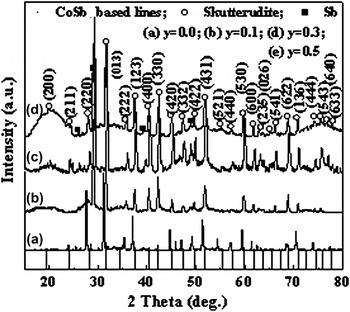
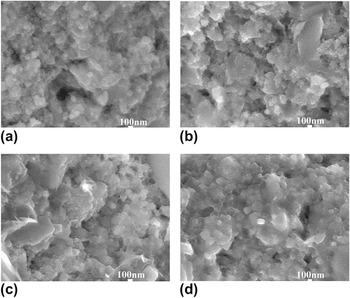
X-ray diffraction pattern of the LaCeFe3CoSb12 bulk materials is presented in Fig. 1. The major diffractions can be identified as standard skutterudite phase except for small Sb secondary phase and no La or Ce atoms can be detected. However, energy dispersion spectroscopy (EDS) data clearly indicate their existence in the materials (not shown here). We speculate that La and Ce atoms should have been filled into the interstitial voids in structure. More importantly, the diffraction peaks of LaCeFe3CoSb12 bulk material hot pressed from the raw powders are very sharp and exhibit a typical characteristic of ordered structure; however, the peaks of the materials with different melted and quenched powders are very dispersive and belong to a typical behavior of disordered structure. So the disordered structure can be partly preserved into the LaCeFe3CoSb12 bulk materials successfully through a laser melting and quenching process. Scanning electron microscopy (SEM) images of the LaCeFe3CoSb12 bulk materials are shown in Fig. 2. The raw LaCeFe3CoSb12 bulk material is composed of homogeneous nanospheres with a diameter of about 80 nm, but an obvious grain growth can be observed in the bulk materials with different melted and quenched powders.
X-ray diffraction pattern of the LaCeFe3CoSb12 bulk materials.

SEM images of the LaCeFe3CoSb12 bulk materials: (a) y = 0.0; (b) y = 0.1; (c) y = 0.3; and (d) y = 0.5.

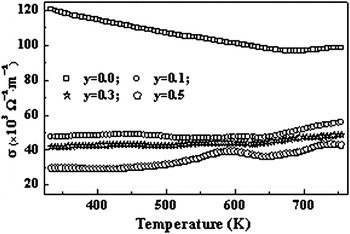
Figure 3 shows the electrical conductivity of the LaCeFe3CoSb12 bulk materials. It is clear that the temperature dependence of electrical conductivity for the LaCeFe3CoSb12 bulk material with raw LaCeFe3CoSb12 powders is a typical semimetal characteristic. Electrical conductivity of alloys is determined by the carrier concentration, the carrier effective mass, and the relaxation time, and the relaxation time is adversely proportional to the absolute temperature. With the increase of temperature, the decreased relaxation time will give rise to a negative temperature dependence of electrical conductivity. However, a typical semiconductor behavior can also be observed clearly for the bulk materials with different melted and quenched powders. The introduced disordered structure can result in a transition from semimetal to semiconductor accordingly. To explain the observed positive temperature coefficient of electrical conductivity, many mechanisms have been suggested, e.g., the scattering effect of structural disorders,Reference Ziman15 the Mott s–d scattering theory,Reference Mott16 and the inelastic scattering of phonons.Reference Dugdale17 The introduced structural disorders cannot exist in dopants or defects because they cannot change the temperature coefficient of electrical conductivity. We guess that the positive temperature coefficient may be resulted from the electron scattering of the structural disorders. The electrical conductivity at 753 K of the bulk materials can be decreased by about 60%, which is most likely due to the much enhanced electron scattering within the nanocomposite material.
Electrical conductivity of the LaCeFe3CoSb12 bulk materials.

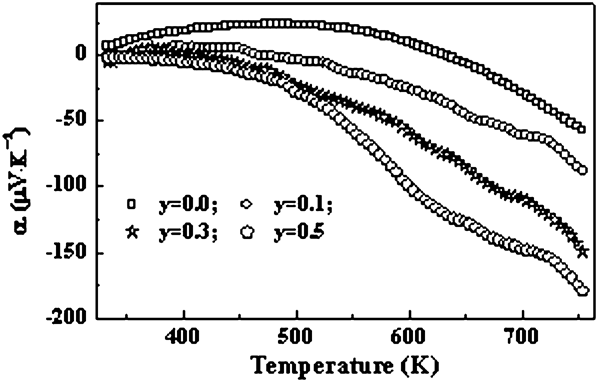
Seebeck coefficient of the LaCeFe3CoSb12 bulk materials is presented in Fig. 4. It can be seen that the Seebeck coefficient values at room temperature are very low and different from the reported CeFeCo3Sb12 and BaxYbyCo4Sb12 bulk materials, but they are well consistent with the CeFe1.5Co2.5Sb12 skutterudite.Reference Sales, Mandrus and Williams18, Reference Shi, Kong, Li, Uher, Yang, Salvador, Wang, Chen and Zhang19 Moreover, with increasing the melted and quenched powders, the Seebeck coefficient at 753 K can be increased by 2.6 times. The introduced disordered structure can decrease the concentration of carriers and increase the effective masses and introduce more scattering centers into materials, which may be a reason for the largely enhanced Seebeck coefficient.Reference Zhu, Yan, Zhao, Zhang, Chen and Yang12
Seebeck coefficient of the LaCeFe3CoSb12 bulk materials.
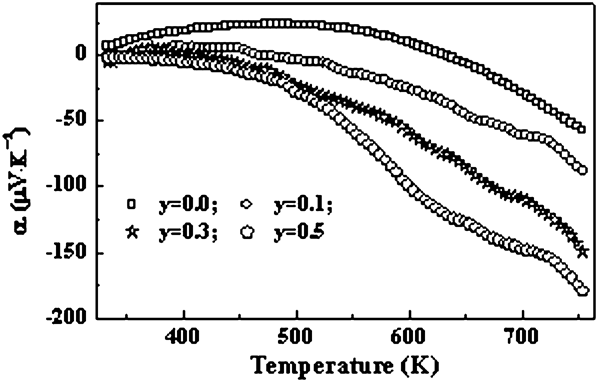
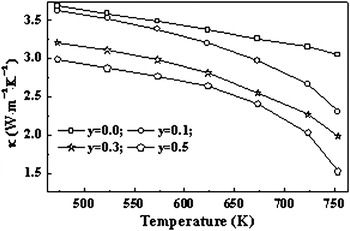
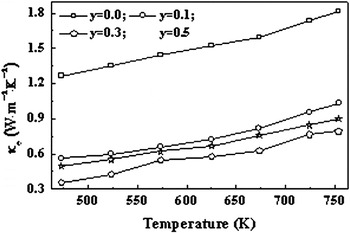
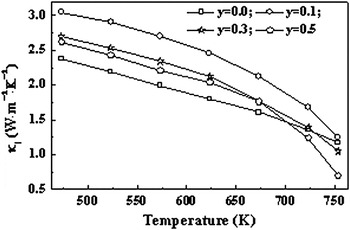
Figure 5 shows the thermal conductivity of the LaCeFe3CoSb12 bulk materials. With increasing temperature, the thermal conductivity decreases continuously and the thermal conductivity at 753 K can be reduced by about 50%. Generally, the thermal conductivity can be divided into two parts: the electron thermal conductivity κe and the lattice thermal conductivity κl. The κe can be calculated using the Wiedemann–Franz law with the Lorenz number equal to 2.45 × 10⁻⁸ V2/K2 (shown in Fig. 6). A positive temperature dependence of κe can be observed clearly, and the κe value at 753 K can be reduced from 1.8 to 0.8 W/(m·K) with increasing the melted and quenched powders. The introduced structural disorders can decrease the concentration of carriers and thus reduce the κe. The κl can be obtained by subtracting κe from κ and is shown in Fig. 7. The κl is determined by the lattice heat capacity, the mean free path, and the phonon velocity. As for a temperature far above Debye temperature, the lattice heat capacity can be simplified as a constant. With increasing temperature, the increased average phonons could increase the phonon collision chance, which would decrease the mean free path of phonons and consequently suppress the phonon thermal conductivity. So the observed negative dependence of the lattice thermal conductivity may be resulted from the increased phonon amount caused by a high temperature.
Thermal conductivity of the LaCeFe3CoSb12 bulk materials.

Electron thermal conductivity of the LaCeFe3CoSb12 bulk materials.

Lattice thermal conductivity of the LaCeFe3CoSb12 bulk materials.

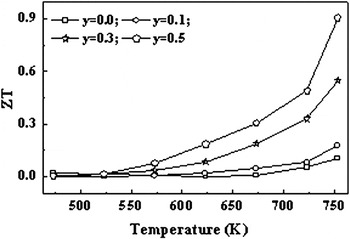
Figure of merit of the LaCeFe3CoSb12 bulk materials is presented in Fig. 8. The disordered structure can increase the ZT value significantly, and the maximum ZT value of 0.90 at 753 K can be achieved successfully. We ascribe the increase in ZT to the largely enhanced Seebeck coefficient and the obviously suppressed thermal conductivity resulted from the disordered structure.
Figure of merit of the LaCeFe3CoSb12 bulk materials.

IV. CONCLUSIONS
In conclusion, the disordered structure can be partly preserved in LaCeFe3CoSb12 nanopowders at room temperature successfully through a laser melting and quenching process. The introduced disordered structure can increase Seebeck coefficient largely while reduce thermal conductivity obviously, although electrical conductivity can also be decreased sharply. Consequently, the thermoelectric properties can be improved remarkably and the maximum ZT value of 0.90 at 753 K can be realized successfully.
ACKNOWLEDGMENT
The author (M.L.) would acknowledge financial supports by Henan University of Technology under Grant No. 2011BS056.