


I. Introduction
Over the past 2 decades, political scientists have increasingly turned their attention to the legalization and judicialization of world politics (Goldstein et al. Reference Goldstein, Kahler, Keohane and Slaughter2000; Alter, Hafner-Burton, and Helfer Reference Alter, Hafner-Burton and Helfer2019) and to the activities of international courts (ICs; Alter Reference Alter2014). Employing large data sets of cases, particularly from the Court of Justice of the European Union, the European Court of Human Rights (ECtHR), and the World Trade Organization’s Dispute Settlement Mechanism, scholars have investigated a number of questions important to the study of judicial politics. Important questions include, but are by no means limited to, the factors influencing IC decision making (Busch and Reinhardt Reference Busch and Reinhardt2003; Carrubba, Gabel, and Hankla Reference Carrubba, Gabel and Hankla2008; Voeten Reference Voeten2008; Larsson and Naurin Reference Larsson and Naurin2016), legal mobilization by civil-society actors (Cichowski Reference Cichowski2013, Reference Cichowski2016), the strategies ICs use to increase their independence (Lupu and Voeten Reference Lupu and Voeten2012; Larsson et al. Reference Larsson, Naurin, Derlén and Lindholm2017), the determinants of state compliance with adverse judgments (Hillebrecht Reference Hillebrecht2014a, Reference Hillebrecht2014b; Voeten Reference Voeten2014; Grewal and Voeten Reference Grewal and Voeten2015; Stiansen Reference Stiansen2019a, Reference Stiansen2019b), and IC effectiveness more broadly (Helfer and Voeten Reference Helfer and Voeten2014; Chaudoin, Kucik, and Pelc Reference Chaudoin, Kucik and Pelc2016). As is evident from these strands of scholarship, studying ICs not only is important in its own right but also provides opportunities for investigating more general puzzles in the study of judicial politics (Staton and Moore Reference Staton and Moore2011).
Despite this significant progress, several ICs have been less frequently studied by means of large-n data analysis. In particular, there are few publicly available sources of data on the regional courts located in the Global South, such as the Inter-American Court of Human Rights (IACtHR). Thus, although a number of recent studies have systematically examined the covariates of compliance with IACtHR remedial orders (Hawkins and Jacoby Reference Hawkins and Jacoby2010; Huneeus Reference Huneeus2011; Hillebrecht Reference Hillebrecht2014b; Staton and Romero Reference Staton and Romero2019), existing analyses are based only on relatively small subsets of IACtHR cases or focus only on questions relating to the court’s remedial orders and compliance by respondent states. To the best of our knowledge, the only publicly available quantitative data sets concerning the IACtHR are the data on compliance with 363 remedial orders in 65 judgments made available by Hillebrecht (Reference Hillebrecht2014b) and the data on compliance with 292 remedial orders from 45 judgments collected by Staton and Romero (Reference Staton and Romero2019). While this scholarship has produced many important findings, we believe that further progress can be made by gathering data on a broader set of judgments and variables and by collecting information about different aspects of the IACtHR in a single database allowing scholars to study a variety of research questions.
In this article we introduce a novel database on contentious cases in the IACtHR. Contentious cases are cases brought against states subject to the court’s jurisdiction alleging that a state has violated its human rights obligations. Although the IACtHR may also issue advisory opinions if requested to do so by Organization of American States (OAS) institutions or its member states, handling contentious cases is the main activity of the court. As of September 2019, the court had judgments and decisions in 267 distinct contentious cases. Of these, 248 cases have received a judgment on the merits. In addition, the court has rendered 26 advisory opinions.Footnote 1
Our database covers a larger number of cases and variables than previously available data sets on the IACtHR. It includes decisions on the merits of alleged human rights violations, on remedial orders, and in compliance assessments. In connection with the decisions reached by the IACtHR, we have also included data on dissents and written opinions by individual judges. We have gathered information on preliminary objections, acknowledgments of responsibility, and interpretation requests, as measures of the attitudes and positions taken by respondent states. Finally, we include information about alleged individual or collective victims in each case and amicus curiae briefs submitted by third parties. Our database thus allows researchers to track cases through different stages of the proceedings and investigate a range of research questions that have so far received limited scrutiny in systematic empirical research.
Our coding is primarily based on the detailed and systematic case summaries of the IACtHR’s judgments produced by the IACHR project at the Loyola Law School, Los Angeles, led by professor Cesare Romano. The coverage of the database is therefore limited to cases for which a case summary has been prepared. The current version of our database covers 201 contentious cases against the 22 states that have been subject to the jurisdiction of the IACtHR. While our database covers all cases that had received a merits judgment by the end of 2013, the coverage of later cases should be considered a convenience sample, and we do not yet include cases in which the merits judgment was rendered after 2016.Footnote 2 The database will be expanded to cover all contentious cases but is already made available to the scholarly community.Footnote 3
The remainder of the article proceeds as follows. Section II provides a brief introduction to the politics surrounding the IACtHR, the key questions addressed in the extant literature, and their relation to issues facing scholars of international adjudication more generally and points out some avenues for further research. Section III describes the sources and coding procedures we have used to generate the database. Section IV gives an overview of the database’s organization and its key variables. In Section V, we illustrate how the database may be used to gain new insights about the politics of the IACtHR. The final section concludes.
II. Decision Making and Compliance in the IACtHR
The IACtHR is based in San José, Costa Rica, and is one of two institutional bodies set up as part of the inter-American human rights system established by the OAS, the other being the Inter-American Commission for Human Rights (IACmHR; e.g., Cavallaro and Brewer Reference Cavallaro and Erin Brewer2008, 778–84). The IACtHR was established in 1979 to interpret and adjudicate alleged violations of the American Convention on Human Rights (ACHR), which entered into force in the preceding year (Posner and Yoo Reference Posner and Yoo2005, 41). The court has jurisdiction to decide contentious cases brought against states that have accepted the court’s jurisdiction. Contentious cases may be brought both by other member states and by the IACmHR, but to date all cases have been brought by the IACmHR (Staton and Romero Reference Staton and Romero2019, 481). Twenty-two states have accepted the jurisdiction of the IACtHR to hear contentious cases, although Trinidad and Tobago and Venezuela later denounced it (in 1998 and 2012, respectively).Footnote 4 In addition, the IACtHR may render advisory opinions if requested to do so by any OAS institution or any OAS member state. The types of cases that reach the IACtHR are influenced by the recent political history of the Americas and hence differ in important respects from the typical ECtHR cases. Specifically, a number of cases relate to atrocities during periods of authoritarian rule or by paramilitary groups, to amnesty laws enacted as part of transitions to democracy (Sandholtz and Padilla Reference Sandholtz and Rangel Padilla2016), and to crimes committed toward indigenous communities.
A number of institutional and contextual features of the IACtHR make this IC interesting for scholars of judicial politics and international relations. The court consists of seven judges who are elected for 6-year terms by the OAS General Assembly. The judges may be reelected once. In addition, respondent states are permitted to appoint ad hoc judges to sit on cases if they have no national judges or the national judge has recused himself or herself. While most decisions of the IACtHR are unanimous, the judges may dissent openly to any part of a ruling. Judges are also allowed to write separate opinions and commonly do so. There is ample room here for studying the effects of such institutional features on judicial behavior and the effectiveness of courts. For example, a question that would be interesting to explore is how the practice of allowing ad hoc judges to be appointed by respondent states influences IACtHR decision making and the reception of its judgments. Do these ad hoc judges systematically position themselves differently from the other judges in relation to the states that appointed them? How are their votes and opinions perceived by compliance constituencies? Under what conditions IC judges act independently from the states that appoint them, or rather act as “diplomats in robes,” is a long-standing question in the literature.
More generally, questions relating to the impact of career considerations on judicial decision making can fruitfully be addressed in the context of the IACtHR. While some scholarship has shown that judges are responsive to the interests of the states that control their appointment (Voeten Reference Voeten2008), it is unclear whether this is due to selection effects or to judges adjusting their decisions to achieve reappointment. Comparing IACtHR judges’ behavior during the first and second terms will help address such questions. In this way, the database may contribute to debates over the institutional design of ICs, including the ongoing negotiations over the establishment of a multilateral investment court. Furthermore, despite the growing literature on open dissents and individual opinions (Lewis Reference Lewis2006; Bricker Reference Bricker2017) and the value of such observable indicators for inferring the positions of individual judges (Voeten Reference Voeten2007, Reference Voeten2008; Hanretty Reference Hanretty2012; Stiansen and Voeten Reference Stiansen and Voeten2018), we are not aware of any studies that systematically examine patterns of judicial behavior in the IACtHR.
Individual applicants do not have direct access to the IACtHR. Instead, they must petition the IACmHR, which upon receiving the case determines its admissibility and conducts its own assessment of the case, including, if necessary, an on-the-ground investigation and oral hearings. The IACmHR then attempts to facilitate a friendly settlement between the applicant(s) and the respondent state. If the parties cannot agree on a friendly settlement, the IACmHR first issues its own recommendations on how the case should be resolved; only if the state fails to comply with the IACmHR’s recommendations may the IACmHR decide to submit the case to the IACtHR for a binding judgment (ACHR, Arts. 48–51). Thus, contentious cases reach the IACtHR only after an extensive process in which they have first been examined by the IACmHR. Similarly to the ECtHR before 1998, the IACmHR acts as an important gatekeeper for access to the IACtHR. It is, however, worth noting that a 2001 change in its Rules of Procedure has made submission to the IACtHR the default method for cases in which states fail to implement its recommendations (Cavallaro and Brewer Reference Cavallaro and Erin Brewer2008, 780). Still, the filtering that occurs at the IACmHR stage of the proceedings means that a relatively modest number of cases reaches the IACtHR, and the allegations that are raised in these cases tend not to be manifestly ill founded. This situation is markedly different from the situation in courts such as the ECtHR in which individual applicants enjoy direct access and thousands of applications of dubious legal merit reach the court. Moreover, as noted by Staton and Romero (Reference Staton and Romero2019, 481), the IACtHR’s docket is “biased towards particularly problematic cases, where there has already been considerable resistance from the defendant state.”
At least partially owing to the filtering that occurs at the IACmHR stage, the IACtHR ends up finding one or more human rights violations committed by the responding state in a clear majority of cases. However, it is worth noting that once a case reaches the IACtHR, the applicants or their legal representatives may allege additional human rights violations not previously alleged by the IACmHR or vetted by its lawyers. For instance, applicants may argue that the facts of the case constitute a violation of additional articles of the ACHR or that the violation should be recognized with respect to additional victims. Thus, even if the cases that reach the IACtHR are filtered by the IACmHR stage, the IACmHR does not necessarily control which legal questions the IACtHR considers in a given case. Again, we are not aware of any systematic investigations of factors that may influence whether the IACtHR decides to rule against the respondent state. The lack of attention to the decision making of the IACtHR is perhaps particularly surprising given the expansive stance it has taken when interpreting human rights provisions, which at times has led to hostile reactions by respondent states. In Section V, we show how our database can be employed to study IACtHR decision making and its relation to the court’s political environment.
Three other aspects of IACtHR politics that have so far escaped close empirical scrutiny are the characteristics of the applicants who have their claims heard by the IACtHR, the civil-society actors engaged, and the positions taken by the respondent state during the proceedings of the case. For example, we know little about whether certain types of victims are more likely to have their claims accepted by the IACtHR or more likely to have the remedial orders that affect them be complied with. Furthermore, it has been argued that civil-society mobilization is likely to influence compliance (Cavallaro and Brewer Reference Cavallaro and Erin Brewer2008), but there is a lack of studies analyzing the effect of such involvement on the decisions and broader implications of IACtHR judgments. As we discuss in more detail in what follows, our database can be employed to study such questions.
Several studies of the IACtHR focus on compliance with its rulings (Huneeus Reference Huneeus2011; Hillebrecht Reference Hillebrecht2014a; Staton and Romero Reference Staton and Romero2019). As described by Hawkins and Jacoby (Reference Hawkins and Jacoby2010), the IACtHR, upon finding one or more human rights violations, orders a set of remedies it expects the respondent state to implement. The ordered remedies range from monetary compensation for the victim or his or her family to legislative changes. Since 1996, the IACtHR has developed a practice of monitoring compliance with its judgments (Hawkins and Jacoby Reference Hawkins and Jacoby2010, 37). In special compliance hearings, the IACtHR asks the respondent state, the IACmHR, civil-society organizations, and representatives of the applicants to report on the implementation of each remedial order. On the basis of the information received, the IACtHR rules on whether the state has complied. For remedial orders without full compliance, the IACtHR continues its monitoring in future hearings (Staton and Romero Reference Staton and Romero2019, 481–82).
The information from the IACtHR compliance hearings is already being used in empirical research. Using descriptive statistics, Huneeus (Reference Huneeus2011) shows that the rate of compliance varies between different types of remedies depending on the domestic actor responsible for compliance. Staton and Romero (Reference Staton and Romero2019) show how the likelihood of compliance is correlated with the clarity of remedial orders. Combining data from both the IACtHR and the ECtHR, Hillebrecht (Reference Hillebrecht2014b) finds that executive constraints correlate positively with compliance in her data set of both IACtHR and ECtHR cases.
While extant compliance studies provide useful insights concerning the politics of compliance with IACtHR judgments, previous data sets have been constructed to answer specific research questions and therefore cannot easily be reused for other purposes. For instance, these data sets contain information about the content of remedial orders and compliance with these orders but not other aspects of the court proceedings, such as whether the state has asked for an official interpretation of what the order really entails, whether the state accepted international responsibility for the violation, or whether the remedial order concerns a victim who is a foreign national. This relationship appears to be representative also for most other quantitative data sets on ICs, which tend to be designed to facilitate answering specific research questions rather than to offer a general infrastructure for scrutinizing the judicial politics of an IC in question.
By contrast, our multiuser database aims to cover a broad variety of aspects of the cases, from the stage in which the jurisdiction of the IACtHR is triggered to the phase in which compliance with the final remedial order is more or less achieved. We believe that by offering such a general infrastructure, we are better able to contribute to research about the IACtHR, and ICs more generally, compared to data collections that are tailored toward answering specific research questions.
III. Coding Procedure
Our database provides researchers with variables covering a range of different aspects of IACtHR contentious cases. The database includes information on judicial behavior, compliance, the procedure before the court, violations alleged by the IACmHR or the representatives of the applicant and ruled on by the IACtHR, the (alleged) victims, preliminary objections filed by the respondent state, and amicus curiae briefs.
To accommodate different research questions, we have coded each variable at the lowest-possible level of analysis. For instance, we consider as separate decisions each decision involving either a separate article of the ACHR or a separate victim, even when closely connected. Users of the database are able to aggregate the data to the level of analysis most appropriate for their specific research questions.
The rich coverage of our database has been greatly facilitated by detailed and systematic case summaries of the IACtHR’s judgments compiled by the IACHR project at the Loyola Law School, Los Angeles.Footnote 5 The majority of variables and cases in our data set have been coded based on these summaries. The structured nature of these summaries has made it possible to identify and assess information for each case in a reliable manner.
For information not available in these summaries, we have relied on the full-text versions of the relevant judgments and decisions. These documents are available on the IACtHR’s website.Footnote 6 Particularly for information related to the IACtHR’s compliance hearings, it was generally necessary to consult the primary sources.
Most cases have been coded by a single coder (either the first or the third author). During the initial stages of the coding process, 20 cases were coded by both coders. This exercise revealed high levels of intercoder reliability. For variables in which we identified inconsistences, we implemented more specific coding rules, and the same two coders proceeded to code all cases in the database. After completing the first version of the database, we trained a research assistant previously unaffiliated with the project to recode a random sample of 40 cases. This exercise also revealed reasonable levels of intercoder reliability, further strengthening our confidence in the reliability of the database. More detailed information about the reliability tests is available in appendix Section B.
Because of our reliance on the case summaries provided by the IACHR project at the Loyola Law School, Los Angeles, our database is currently limited to the cases in which a case summary has been prepared. The 201 cases in our database make up 80% of the total of 248 contentious cases that the IACtHR had rendered a merits judgment on by September 2019 and all cases that had received a merits decision by the end of 2013. Currently the database does not include any of the cases that received a merits decision after 2016. We will continue to expand our database as more case summaries are provided.
IV. Overview of the Database
The database is organized into nine tables. Each table has a different unit of analysis and covers aspects of the IACtHR cases that are most accurately measured at this particular level. A set of unique identifiers link the different tables and allow scholars to construct a data set suited to their research question.
Table 1 provides an overview of the database. For details on the individual variables and their coding, we refer the reader to the codebook for the database (see app. Sec. A).
Overview of the Database

A main table contains information about each contentious case, including the respondent state, the judges involved at the various stages of the proceedings, the key dates of different judgments, and information on requests for interpretation. A case-level ID variable connects the main table to all other tables in the database. In the main table we also include the Correlates of War country code (Singer and Small Reference Singer and Small1994) for the respondent state, which enables users to merge our database with country- or country-date-level data sets frequently employed in political science scholarship.Footnote 7
A second table contains information about the (alleged) victims named in each case. In addition to the name of the victim, we include information on attributes such as gender, whether the victim is a legal or natural person, whether the victim is an individual or a group of unnamed individuals, and whether the victim was a national of the respondent state. We also include information on the victim’s legal representative in the IACtHR proceedings. Our database contains a total of 997 unique victims. An ID variable that identifies each unique alleged victim allows users to connect this information to the merits and remedial decisions taken by the court with respect to the alleged victim.
Three tables include information on the decisions reached by the IACtHR on merits decisions, remedial orders, and compliance. Of the 201 cases included in our data set, 200 include merits decisions.Footnote 8 To accommodate different research questions, we have disaggregated the different tables as much as possible. For instance, we include each decision involving either a separate article of the ACHR or a separate victim as a separate entry. Disaggregating the merits decisions in this manner yields a total of 7,192 decisions. Of these, 6,318 found a human rights violation on the part of the respondent state, 427 decisions found a nonviolation, and 447 were decisions not to rule on a particular allegation. Each decision can easily be connected to an alleged victim using the victim-level ID variable. A decision-level ID variable facilitates connecting each decision to associated remedial orders, separate opinions, and dissenting votes.
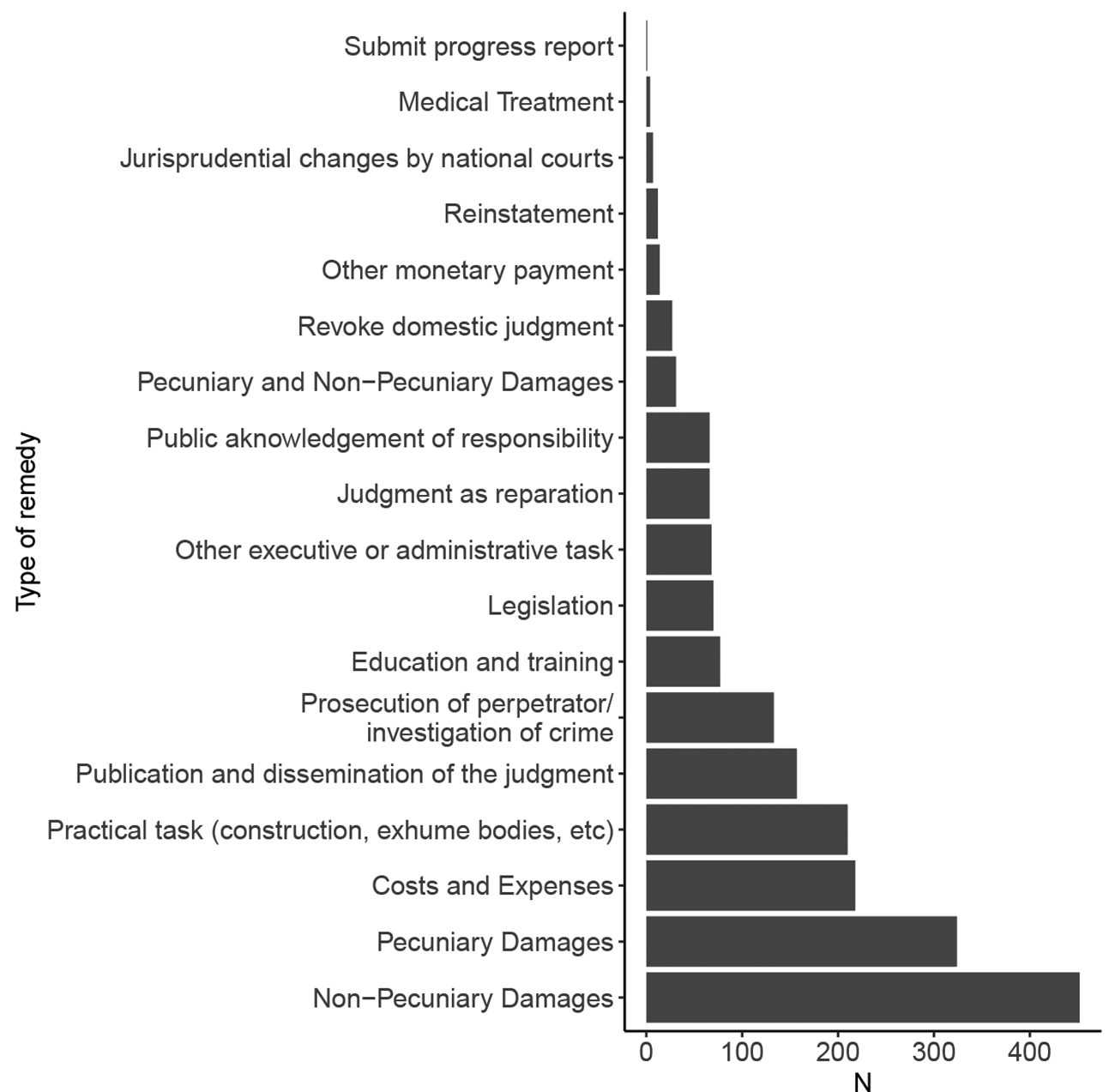
A total of 1,944 remedial orders were rendered in 194 cases in our data set. The remedial orders concern different types of actions required by the respondent state. We include both specific descriptions of each remedial order and a 16-category categorization of the remedy types. We include 16 different categories in order to preserve sufficient nuance to allow users of the data to easily create their own categorizations of remedial orders based on our categories. The 16 categories were defined after an initial pilot coding and were designed to follow the court’s own description of the different remedies as close as possible. In contrast to extant data sets (e.g., Hillebrecht Reference Hillebrecht2014b), we therefore employ different categories for different types of monetary compensations. Still, we found that some aggregation was necessary. For instance, the court may order a variety of different practical tasks, such as reforming prisons (see, e.g., Boyce et al. v. Barbado) and “implementing a housing program” (see e.g. Ituango Massacres v. Colombia). As the court’s description of such measures will necessarily depend on idiosyncratic features of the case, we found that some aggregation was necessary. The categories “practical task” and “other executive or administrative task” are therefore relatively broad and include a variety of different remedies. Because we also include the description of the ordered remedy, users of the database are able to recategorize these remedial orders according to their specific needs.
When aggregating different tasks, we have aimed to accommodate the existing categorizations employed in the literature. For instance, Huneeus (Reference Huneeus2011) categorizes remedies according to the branch of government involved in their implementation, and Hillebrecht (Reference Hillebrecht2014a) distinguishes between “financial reparations,” “symbolic measures,” “retrials and accountability,” “measures of non-repetition,” and “individual measures” and finds that compliance politics vary depending on the type of task. In developing our 16 categories, we sought to ensure that researchers will be able both to reconstruct such categorizations from extant scholarship and to construct new categorizations more suited to their specific research interests. In appendix Section C, we compare our data to the Compliance with Human Rights Tribunals (CHRT) data set published by Hillebrecht (Reference Hillebrecht2014a, Reference Hillebrecht2014b) and illustrate how we can use our 16-category categorization of orders to replicate her 5-category categorization. This exercise also demonstrates that while our coding is consistent with the already available data, our database offers considerably more nuance and detail.
The number of orders falling within each type is displayed graphically in figure 1. As the figure shows, the most common types of remedial orders concern pecuniary and nonpecuniary damages. Part of the reason for the relatively large number of monetary orders is that we code instances in which different applicants are awarded specific amounts as different remedial orders. While this approach may inflate the number of remedial orders, the disaggregated measurement allows for exploring questions such as how awards are influenced by the type of human rights violations identified or by attributes of the victim (as Altwicker-Hàmori, Altwicker, and Peters [Reference Altwicker-Hàmori, Altwicker and Peters2016] have recently explored in the ECtHR context). The figure also shows that the type of measures required by the IACtHR differs from what is typically required to comply with ECtHR judgments (as coded by Stiansen and Voeten [Reference Stiansen and Voeten2017]). In particular, orders for domestic courts to change jurisprudence or to revoke decisions are relatively infrequent, while a large number of remedial orders concern practical tasks (such as exhumation of victims) and investigation and prosecution of alleged perpetrators. Such differences may be expected to influence how compliance politics unfold (Huneeus Reference Huneeus2011). The remedies table includes the ID variables from the decisions and victims tables, and the remedial orders can thus be connected to specific merits decisions and victims. A remedy-level ID variable allows merging data concerning each remedial order with data concerning compliance, separate opinions, and dissenting votes.
Remedial orders
A final set of decisions in our database concerns the compliance hearings that the IACtHR holds to monitor the implementation of its remedial orders. We code the decisions reached at each compliance hearing according to a four-category categorization. The four categories are “full compliance,” “partial compliance,” “noncompliance,” and “unclear status/insufficient information provided by the respondent state.” The last conclusion is often reached by the IACtHR in cases in which the respondent state has not supplied evidence of compliance. In appendix Section C, we compare our coding to the compliance data made available by Hillebrecht (Reference Hillebrecht2014a, Reference Hillebrecht2014b). We show that while there is considerable agreement on the coding of orders that were fully complied with, our database offers more detail on the exact status of orders not yet complied with. Moreover, collecting data from all compliance hearings makes it possible to measure compliance at different points in time rather than only at the end of the process.
Two tables in our data set allow researchers to study the behavior of individual judges. One table includes information about instances in which judges voted against a decision. Such dissents may concern different types of decisions, including merits decisions, remedial orders, compliance decisions, interpretation requests, and preliminary objections. A second table includes information on opinions written by individual judges. As for the dissenting votes, the written opinions may concern various aspects of the case and may be concurring, dissenting, or separate. In addition to the decisions affected by each opinion, we have coded whether they can be considered to be aligned with or opposed to the interests of the respondent state. When an opinion or dissenting vote concerns more than one decision, we have coded separate entries.
Figure 2 displays the frequencies of different types of decisions that judges have written separately about (fig. 2a ) or that have been subject to dissenting votes (fig. 2b ). Most opinions and dissenting votes concern the merits decisions, but there is also a considerable number of both dissents and opinions that concern remedial orders. Figure 2a also shows that when judges write separately, they write concurring or separate opinions more often than dissenting opinions. What role the concurring and separate opinions play in IACtHR politics is therefore an important question for future research. Of the dissenting votes, almost all are in favor of the respondent state, reflecting the fact that most decisions of the IACtHR tend to find a violation or impose a remedial order.
Opinions and dissenting votes: a, separate, concurring, and dissenting opinions; b, dissenting votes.

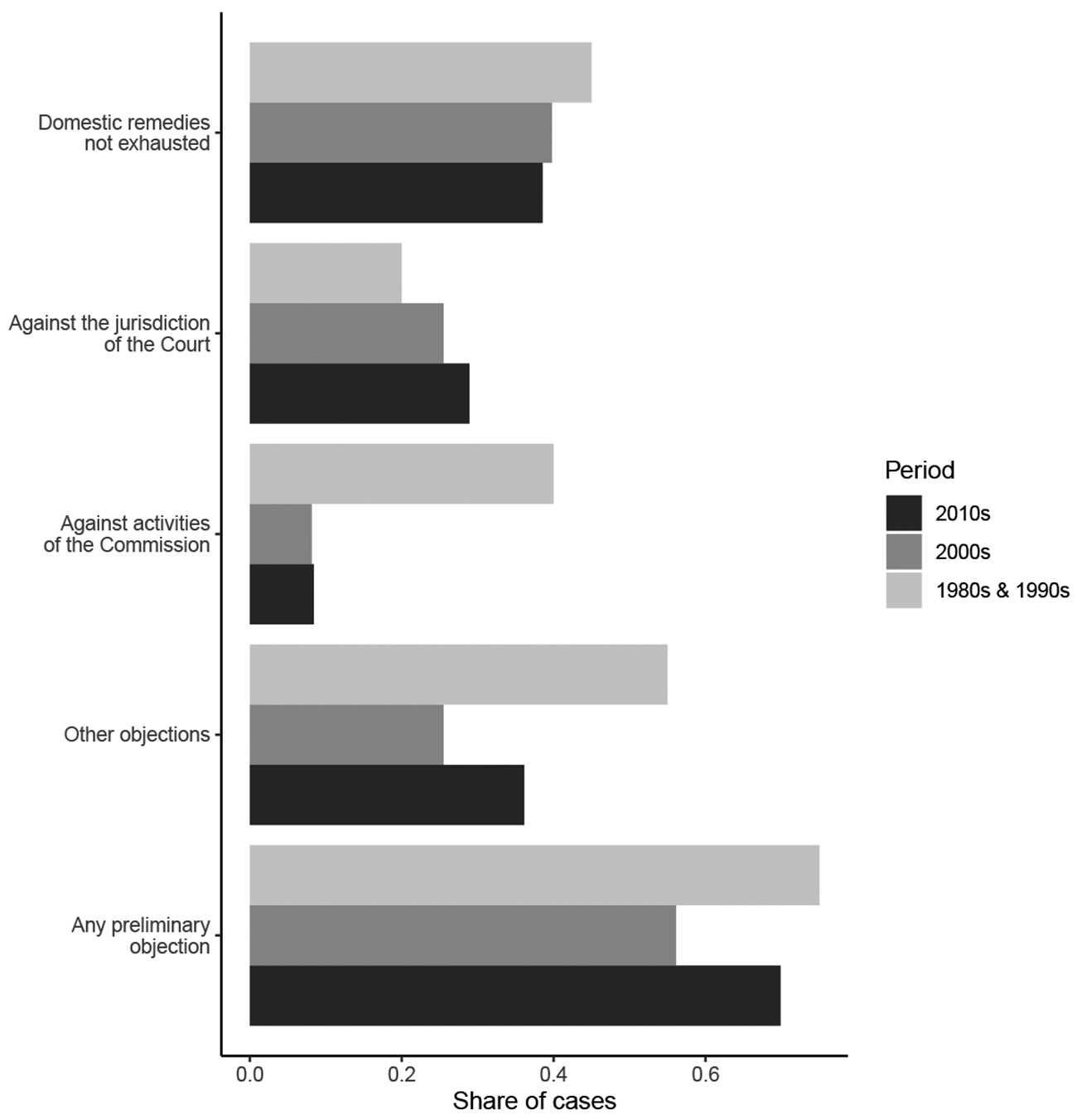
The final two tables in our database include information on preliminary objections raised by the respondent state and amicus curiae briefs submitted by third parties. For preliminary objections we code each separate issue raised by the respondent state as a separate objection. This approach yields a total of 287 distinct objections raised in 112 different cases. In the application that follows, we illustrate how this information may be employed to measure state resistance against a particular case. Our data also allow investigating what types of preliminary objections are most frequently raised by respondent states and whether the types of preliminary objections have changed over time. By inspecting our data, we found that more than 65% of the objections concerned alleged failures to exhaust remedies, challenges to the jurisdiction of the court, or challenges against the activities of the commission before the case is submitted to the court. The remaining objections are more diverse but include, for instance, claims that the court or specific judges are biased.
Figure 3 displays the share of judgments containing different types of preliminary objections by time period. As the figure shows, the share of judgments containing at least one preliminary objection was somewhat greater during the 1980s and 1990s than in later decades. In this first period of the court’s history, there is moreover a greater share of judgments containing claims that the commission had acted improperly before submitting the case to the court and relatively more idiosyncratic objections in the “other” category. By contrast, the share of cases in which the respondent state complains that the court lacks jurisdiction or that domestic remedies have not been exhausted has been more stable over time, although the latter type of objection was also somewhat more frequent in the 1980s and 1990s than later. We leave it to future research to investigate whether these changes reflect strategic adaptations by respondent states or other types of changes in the relationship between the court and the states subject to its jurisdiction.
Share of judgments containing preliminary objections
Similarly, we include each actor submitting a brief as a separate entry in the amici curiae table, yielding a total of 418 amici curiae in 77 different cases. Although the information we record about each brief is limited to the name of the amicus curiae and the case in which it is submitted, the information in this table may be used for a variety of purposes. First, this table enables studying which types of cases tend to attract the participation of civil-society organizations and other third-party actors, similar to the studies conducted by Cichowski (Reference Cichowski2013, Reference Cichowski2016) in the context of the ECtHR and by Squatrito (Reference Squatrito2018) in the context of the World Trade Organization’s Dispute Settlement Mechanism. Particularly in comparison to the ECtHR, our data show that third-party briefs are relatively common in the IACtHR, making this an important case to study for scholars of civil-society engagement with ICs. As we record the name of each amicus curiae, researchers will be able both to track repeat players and to add additional information about each actor. Second, researchers may use the amici curiae table together with other tables in the database to track the judicial and societal impact of third-party participation. For instance, Cavallaro and Brewer (Reference Cavallaro and Erin Brewer2008, 792–93) argue that the involvement of civil-society actors in IACtHR cases promotes subsequent compliance with remedial orders. This hypothesis is consistent with broader theories highlighting the importance of civil-society mobilization for generating compliance with international law (Simmons Reference Simmons2009). Yet, in a sample of 292 remedial orders from 45 cases, Staton and Romero (Reference Staton and Romero2019) find no evidence that participation by nongovernmental organizations is associated with compliance. Our data allow for a more comprehensive test of this hypothesis. In other contexts, the number of third-party briefs has similarly been used as a proxy for the political salience of a case (Vanberg Reference Vanberg2005). In what follows, we show how our amicus curiae data may be employed in models of judicial decision making.
V. Application: Political Signals and IACtHR Decisions
Our data set has already been used to study how judicial dissent influences compliance (Naurin and Stiansen Reference Naurin and Stiansen2020). In this section, we show how our database can be employed to address another central question in judicial politics: the extent to which judicial decision making correlates with the interests of respondent states. Whether judges are concerned only with the legal merits of claims or are also influenced by concerns of noncompliance, overrides, or other forms of court-curbing tactics from responding governments has been central to the study of other domestic and international courts (Vanberg Reference Vanberg2001, Reference Vanberg2005, Reference Vanberg2015; Carrubba et al. Reference Carrubba, Gabel and Hankla2008; Clark Reference Clark2011; Larsson and Naurin Reference Larsson and Naurin2016) but has not yet been studied systematically in the IACtHR context. Providing such an analysis is of particular interest owing to claims that the IACtHR has developed its case law without giving much attention to the interests of the states within its jurisdiction (Neuman Reference Neuman2008; Sandholtz Reference Sandholtz, Brysk and Stohl2017).
To investigate how the decisions of the IACtHR are influenced by its political environment, we combine data on merits decisions with two indicators of the respondent state’s response to the proceedings. As a measure of resistance from the state, we consider whether it raised preliminary objections. Preliminary objections offer a way for respondent states to resist cases brought against them and to avoid a hearing on the merits in inadmissible cases. For instance, in 1993 the IACtHR dismissed the case of Cayara v. Peru—concerning the unlawful execution or disappearance of 40 persons—after Peru objected that the IACmHR had failed to submit the case to the IACtHR within the time limit (Pasqualucci Reference Pasqualucci1999, 4–5). Although preliminary objections clearly can serve legitimate purposes, Pasqualucci (Reference Pasqualucci1999, 13) shows that in the inter-American system, they also “seem to be filed primarily as delay tactic. An example of such tactics occurred in the Neira Alegría Case, in which Peru … raised several groundless preliminary objections.” In this case, Peru had asked the IACmHR for an extension of the time before the case was submitted to the IACtHR, only to later use this extension as the basis for an objection that the case had been submitted to late. We posit that, in addition to potentially delaying cases before the court, the time and effort states invest in raising this type of objections may serve as a signal that the respondent state is strongly opposed to the case. The presence and number of preliminary objections may thus be used as a proxy for state resistance. This measurement strategy is similar to the use of government briefs as a signal of governments’ preferences and possibly their willingness to defy or overrule the rulings of the Court of Justice of the European Union (Carrubba et al. Reference Carrubba, Gabel and Hankla2008; Larsson and Naurin Reference Larsson and Naurin2016) and the German Constitutional Court (Krehbiel Reference Krehbiel2016).
While states can signal their discontent through submitting preliminary objections, they sometimes also acknowledge responsibility for certain violations. A notable aspect of the inter-American system is that once the jurisdiction of the IACtHR is triggered, the court continues to have jurisdiction over the case even if one or both parties wishes to withdraw the case (Pasqualucci Reference Pasqualucci2012, 175). Therefore, even if developments such as a shift in government lead to the respondent state no longer contesting the allegations, the IACtHR will render a judgment. Considerable time may have passed between the alleged violation and the case reaching the IACtHR, and the government currently in power in the respondent state may therefore not necessarily have strong vested interests in opposing all cases. For 34% of the merits decisions in our database, the respondent state had acknowledged responsibility for the alleged violation either fully or partially. For 26% of decisions, the respondent state had accepted full responsibility.
Whereas preliminary objections may persuade the IACtHR to not rule against the respondent state, acknowledgments of responsibility can be expected to have the opposite effect. If the court seeks to promote human rights reform but to avoid adverse political reactions from respondent states, violation findings may be particularly likely when the state has accepted responsibility. A state that has already accepted responsibility for an alleged human rights violation is unlikely to react to a violation ruling by criticizing or otherwise punishing the court. Moreover, the acceptance of responsibility may signal to the court that it is dealing with an amenable government that would welcome the political cover (Allee and Huth Reference Allee and Huth2006) that a violation judgment might provide for promoting human rights reforms. Our second indicator of the position taken by the respondent state is therefore whether the state acknowledged responsibility for the specific violation.
Table 2 reports results from four hierarchical logistic regression models estimated on all individual merits decisions in our database. The dependent variable in all models is whether the IACtHR found a violation. The four models include different operationalizations of the two indicators of the position of the respondent state. Model 1 includes the square root of the number of preliminary objections raised by the state.Footnote 9 Model 2 includes a binary indicator of whether the state raised any preliminary objections. Model 3 includes a dummy for whether the respondent state partially or fully acknowledged responsibility for the alleged violation. Finally, model 4 includes a dummy for whether the state acknowledged full responsibility.
Decision Making of the IACtHR: Multilevel Logistic Regressions

† p < .1.
* p < .05.
** p < .01.
*** p < .001.
We control for a set of possible confounders, measured in different tables of the database. First, we control for whether the violation was only alleged by the victim’s representatives or was also supported by the IACmHR. Allegations not supported by the IACmHR are less likely to be accepted by the IACtHR and are also expected to be more controversial. Second, we control for whether the violation was alleged in relation to the obligation to give domestic legal effect to the ACHR. Such allegations imply a more systematic violation than when the allegation relates only to the individual applicant(s). Third, we control for the salience of the case to nongovernmental actors by including a count of the number of amicus curiae briefs submitted in the case. Finally, we control for whether the victim was a collective actor, such as an indigenous group, or whether it was an individual person.Footnote 10 To account for the hierarchical data structure, all models include random intercepts for the case, the ACHR article concerned, and the respondent state.
Model 1 investigates the relationship between the number of preliminary objections and the IACtHR’s propensity to find a violation. Since the presence of any objections by the state might be more important than the number of distinct objections, model 2 considers instead whether at least one objection was raised. In line with our expectations, the relevant coefficients in both models are negative and statistically significant. There is thus evidence that the IACtHR is less likely to find a violation if the respondent state has submitted preliminary objections.
Models 3 and 4 consider whether the IACtHR is more likely to find violations when the respondent state has acknowledged responsibility for the alleged violation. Model 3 includes a dummy variable for whether the state acknowledged either partial or full responsibility. Model 4 includes a dummy for whether the state acknowledged full responsibility. Acknowledgments of responsibility are coded at the level of the allegations and may therefore be even more informative than preliminary objections about the respondent state’s position on specific allegations made in the case. Both model 3 and model 4 show a strong and highly significant relationship between such acknowledgments and the IACtHR finding a violation. There is thus strong evidence that the IACtHR becomes more likely to rule against the respondent state when it has acknowledged some responsibility for the alleged violation.
In conclusion, this brief analysis suggests that there is a relationship between the way state governments respond to allegations made before the IACtHR and the conclusions reached by the judges. These findings can be interpreted in different ways. One interpretation, at least concerning the link between states’ acceptance of responsibility and subsequent violation findings, is that the respondent state and the IACtHR judges tend to evaluate the legal merit of claims brought before the IACtHR in a similar fashion. With respect to the preliminary objections that primarily concern jurisdictional and procedural issues and that have been rejected by the IACtHR in cases that reach the merits stage, this interpretation may be less credible. Another interpretation is that IACtHR is sensitive to signals from the respondent state. Even if the state’s preliminary objections—alleging, for instance, that one or more of the court’s judges are biased or that the applicants have not gone to sufficient lengths in exhausting domestic remedies—are without legal merit, they may serve as powerful signals to the court that a violation ruling is likely to provoke adverse political reactions. By contrast, if a state has formally acknowledged its international responsibility for a human rights atrocity, the court may conclude that a violation ruling is not likely to provoke political reactions. In any case, our analysis indicates a robust correlation between the positions taken by the respondent states and the conclusions reached by the IACtHR.
VI. Conclusion
This article has introduced a new database on contentious cases decided by the IACtHR. Covering a wide range of variables, the database provides opportunities for investigating a range of previously unexplored research questions. We have illustrated how this database can be used to investigate decision making in the IACtHR. Our analysis shows that the outcomes of IACtHR merits decisions correlate with positions taken by the respondent state at early stages of the case proceedings. The data are now made available for use by the research community.



