

1. Introduction
Previous literature found that changes in the work environment that favored men, such as the plough in Alesina et al. (Reference Alesina, Giuliano and Nunn2013), or arable versus pastoral farming in Voigtlander and Voth (Reference Voigtlander and Voth2013), are associated with higher gender inequality. Even in the shorter run, changes in the work environment were found to affect women's relative outcomes. Specifically, Ross (Reference Ross2008) found that oil rents are associated with reductions in women's labor force participation as well as other measures of political influence.
This paper contributes to the literature by providing estimates of the impact of natural resources on the gender structure of population and consequent gender-specific outcomes: health and education, which ultimately define a person's future ability to participate in the society. Simple observation might suggest that natural resource windfalls affect demographic trends. Some of the countries with the highest levels of gender inequality are among the richest in oil. The World Bank puts forward that primarily men capture the benefits of extractive industries, employment, and income, while women tend to bear a larger share of social and economic risks.Footnote 1 At the same time, some oil-rich countries such as Norway provide numerous opportunities for women.
This paper is also a contribution to the literature on the natural resource curse. Earlier literature found that women's labor force participation and political representation in Parliament are lower in oil-producing countries [Ross (Reference Ross2008), Liou and Musgrave (Reference Liou and Musgrave2016), Simmons (Reference Simmons2019)]. However, lower labor force participation could be due to a simple income effect where the natural resource windfall is associated with an increase in fertility [Black et al. (Reference Black, Kolesnikova, Sanders and Taylor2013)], leading to a decrease in labor force participation while still improving women's overall welfare. We investigate the impact of oil wealth on more direct measures of changes in women welfare: sex ratios, health, and educational outcomes, which allow us to test competing theories regarding the mechanism linking natural resources to gender trends.
In addition, we use an arguably more exogenous source of variation in natural resource wealth. Previous literature relies on variation in oil production to investigate the impact of oil wealth on women, raising concerns of reverse causality. Oil production depends on economic development and institutions, which also correlate with gender-specific trends, introducing bias in the estimated effect of oil rents on gender-specific outcomes. We exploit variation in oil (and gas) wealth due to giant oil discoveries, i.e., fields containing ultimate recoverable reserves (URRs) of 500 million barrels equivalent or more. Lei and Michaels (Reference Lei and Michaels2014) provide evidence that after controlling for country and year fixed effects giant oilfield discoveries are both economically significant events and plausibly exogenous.
This paper also contributes to the literature by using an event study design that highlights the dynamic response of health outcomes to changes in natural wealth and manages to shed light on the cause of some of the contradictions in previous literature.
Using a panel of 136 countries over the 1951–2010 period, we find evidence of higher sex ratios (male/female) following giant oil discoveries especially in countries outside Africa during the periods when ultrasounds were not readily available. These changes are not driven by better health allowing more males to surviveFootnote 2 because, over the same period, giant oil discoveries are also associated with higher infant mortality and lower life expectancy among both males and females. Moreover, giant oil discoveries are not associated so much with higher sex ratios at birth but with higher sex ratios among children one year old and older, suggesting these changes are not driven by attrition before birth but by differential parental investment after birth. This theory is supported by other outcomes. We find evidence that giant oil discoveries are associated with wider educational gaps between men and women, and increased teen births reminiscent of societies where parents must dispose of their female offspring if they are to afford more sons [Leeson and Suarez (Reference Leeson and Suarez2017)]. The impacts of oil discoveries on measures of gender inequality are much smaller during periods of increasing oil prices. The negative health effects are also tapering off several years after discovery; timing consistent with industry-specific employment patterns as well as the possible onset of production and inflow of foreign direct investment (FDI) in other sectors.
2. Background
2.1 The natural resource curse
Using a cross-section of countries, Sachs and Warner (Reference Sachs and Warner1995) found that natural resource wealth is correlated with slower growth. Numerous papers followed exploring a variety of mechanisms that could explain this finding. Most often cited is the “Dutch disease”, which argues that resource booms increase exchange rates, reducing the competitiveness of the manufacturing sector, thus causing factors to move away from this sector. The literature points out that natural resource prices, apart from oil and gas, tend to decrease in the long run. Hence, countries that concentrate their economies and build their infrastructure around natural resource exploitation will generate less earnings from this sector over time and will be unable to divert their economies to other sectors due to the inflexible nature of their infrastructure.
Others proposed explanations relying on the impact of resource wealth on institutions [Ross (Reference Ross2001)] and found that resource wealth is associated with less democracy [Tsui (Reference Tsui2011)] and more corruption [Leite and Weidmann (Reference Leite and Weidmann2002)]. Alternatively, the effect could be mediated by the impact on institutions when differences in pre-existing institutions alter the effect of resource wealth [Torvik (Reference Torvik2002), Mehlum et al. (Reference Mehlum, Moene and Torvik2006), Robinson et al. (Reference Robinson, Torvik and Verdier2006)]. Or it could be due to the increased risk of war [Collier and Hoeffler (Reference Collier and Hoeffler1998, Reference Collier and Hoeffler2004), Ross (Reference Ross2006)]. Any of these mechanisms could also affect other measures of standard of living such as women's status in society.
Notably however, the correlation between resource wealth and growth remains controversial and many of these results were challenged. Some challenged the measure of abundance used. Using resource dependence, measured as the share of exports or output on GDP, as an independent variable is problematic when the dependent variable of interest is GDP because it introduces an endogeneity bias. Removing this source of endogeneity leads to a positive correlation between oil wealth and growth [Brunnschweiler and Bulte (Reference Brunnschweiler and Bulte2008)]. Others were concerned with the controls usually added to the regressions such as measures of the initial level of income [Alexeev and Conrad (Reference Alexeev and Conrad2009)]. A further critique refers to the use of cross-sectional data. This choice was questioned due to its inability to disentangle the impact of initial institutions from the impact of natural resource abundance. Just as concerning is that the results are sensitive to the choice of cross-section because oil prices fluctuate over time [Cotet and Tsui (Reference Cotet and Tsui2013)]. Measurement error in oil rents could also play a role in explaining differences across results. For instance, simply discovering giant oil fields was found to be associated with internal conflicts [Lei and Michaels (Reference Lei and Michaels2014)], while having oil fields located close to borders was found to increase the likelihood of interstate disputes [Caselli et al. (Reference Caselli, Morelli and Rohner2015)].
Such results also raise the question of whether the issue is one of possible heterogeneity of the effect across various aspects of development and local conditions. GDP per capita is only one measure of the quality of life. Oil revenues may have enabled Middle East governments to finance welfare systems that benefit the population through subsidized health care and education [Fargues (Reference Fargues2005)]. This is consistent with Acemoglu et al. (Reference Acemoglu, Finkelstein and Notowidigdo2013) findings that an increase in income induced by an oil price shock increases health expenditures, and with Cotet and Tsui (Reference Cotet and Tsui2013) showing that the value of oil production is associated with lower infant mortality and higher life expectancy. There might be significant heterogeneity in the effect given that democracies appear to have healthier citizens [Besley and Kudamatsu (Reference Besley and Kudamatsu2006)] and oil wealth, for instance, is associated with less democracy. Thus, resource wealth could still be a curse or a blessing on other margins than economic growth.
2.2 Natural resources and women
Besides growth and health, natural resource windfalls could also affect social and demographic trends and disproportionately affect women. There are several possible mechanisms for this effect.
Chambers and Gordon (Reference Chambers and Gordon1966) propose that the economic benefit from resource wealth will be at least partially absorbed by increased population growth. Some support for this hypothesis is provided by Black et al. (Reference Black, Kolesnikova, Sanders and Taylor2013) findings indicating that an increase in the value of coal is associated with an increase in fertility. This is important to note because when natural resource windfalls affect birth rates and population, using resource wealth per capita, a commonly used measure of resource abundance, introduces an endogeneity bias in regressions trying to explain GDP per capita or other per capita measures of welfare.
Increases in fertility are associated with significant reductions of female labor force participation: each birth reduces a woman's labor supply by almost 2 years [Bloom et al. (Reference Bloom, Canning, Fink and Finlay2009)], thus, a change in the value of natural resources could alter female labor force participation.
In addition, persistent norms regarding gender-appropriate employment could prevent women from gaining employment in some activities [Alesina et al. (Reference Alesina, Giuliano and Nunn2013)]. Such norms may be slow to change where the economic environment favors male employment over female employment. Extractive industries tend to be male-dominated industries. For instance, while women make up 48% of the global labor force, they account for only 22% of the labor force in the oil and gas sector [IRENA (2019)]. The percentage of female employees in the extraction of crude petroleum and natural gas in the European Union in 2011 was a low as 13.5% [Johnston and Silva (Reference Johnston and Silva2020)]. Thus, increased reliance on extractive industries could reduce women's labor opportunities.Footnote 3
This change in labor force participation could affect women's status. Ross (Reference Ross2008) tests the Dutch-disease argument as applied to women and finds that increased reliance on oil production reduces women's labor force participation, which decreases their political influence as measured by the number of seats held by women in the Parliaments. The loss of political power could impact other areas of women's life and their future outcomes. However, as the author readily acknowledges the revealed relationships may not be causal. The issue is that oil production depends on economic development and institutions, which also correlate with women's status introducing bias in the estimated effect of oil rent on women's status.
In fact, another possible path from natural resource wealth to gender inequality is through economic development. As countries develop, women's labor force participation first declines and then rises [Goldin (Reference Goldin and Schultz1995)], mortality rates decrease, and education levels increase both in absolute terms and relative to men [Mammen and Paxson (Reference Mammen and Paxson2000)]. Therefore, any change in economic growth due to changes in natural resource wealth will also affect gender inequality.
Alternatively, the environment at the time of discovery matters. Many oil countries were initially poor and likely less socially developed. These countries skipped the economic development that would have otherwise occurred because the exogenous wealth suppressed the pressure that might have otherwise led to the above-mentioned developments. These countries also skipped the social development phase normally brought about by economic development. In such cases, economic development was no longer accompanied by changes in gender inequality.
Increased reliance on oil production could affect demographic trends beyond fertility rates. Where female labor opportunities are low, girls have a lower economic value, which has been linked to lower female to male ratios [Carranza (Reference Carranza2014)]. Fewer female labor opportunities have been associated with fewer female births and lower survival probability among these births [Rosenzweig and Schultz (Reference Rosenzweig and Schultz1982), Qian (Reference Qian2008)].
Overall resource rents are predicted to act through the marriage market, the labor market, or the political market. All these theories predict that oil wealth has gender-specific effects, such as reduced women participation in the political process but have different implications on direct measures of welfare such as health and access to resources. Resource rents accruing to men employed in extractive industries produce an income effect that affects the marriage market and leads to higher fertility and lower education among women. This could affect labor force participation and participation in political processes negatively while still improving health and access to resources. However, lower employment opportunities leading to lower labor market value of women would affect health and access to resources negatively in addition to labor market participation. On the political market, resource rents could allow autocrats to promote policies favored by the ideologically motivated winning coalition, policies that would not be feasible for tax-reliant rulers [Liou and Musgrave (Reference Liou and Musgrave2016)]. Thus, where ideologies do not favor women, resource rents might lead to higher gender inequality but only under autocratic regimes.
This paper investigates the impact of giant oil discoveries on sex ratios, and school enrollment female to male ratios as measures of gender inequality.
3. Empirical strategy
3.1 Identification
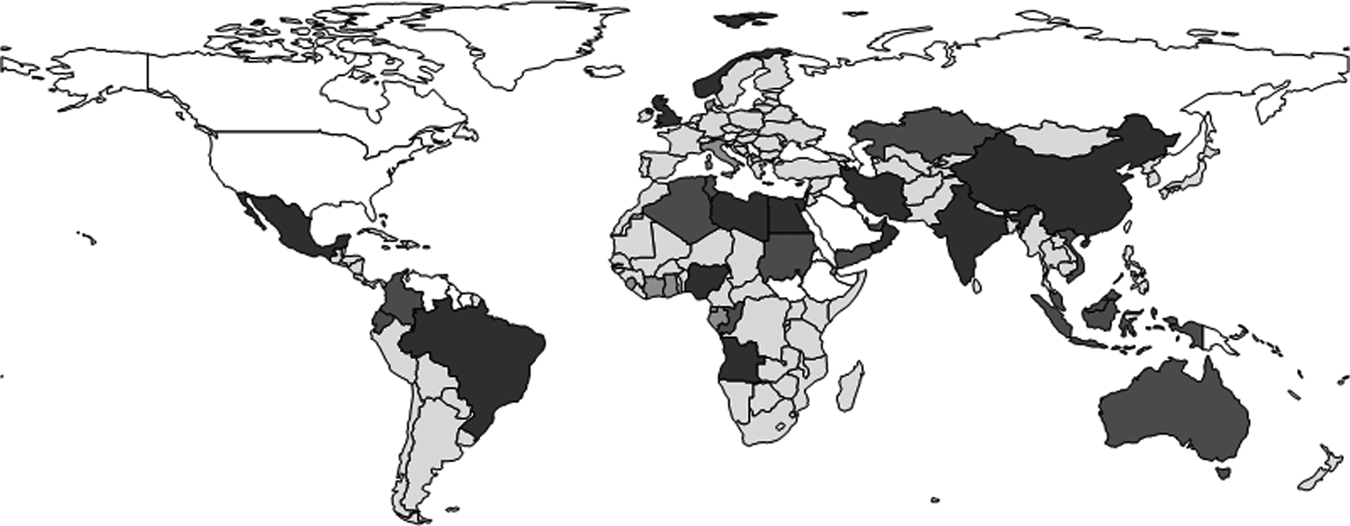
This study uses an empirical strategy similar to the one proposed by Lei and Michaels (Reference Lei and Michaels2014) where the variation in natural resource wealth comes from giant discoveries. Previous literature argues that discoveries may be more likely in democratic countries and in countries with better institutions [David and Wright (Reference David and Wright1997), Bohn and Deacon (Reference Bohn and Deacon2000)]. However, because the probability of finding a giant oilfield is low, and countries have little control over the timing of such findings, giant discoveries are plausibly exogenous [Lei and Michaels (Reference Lei and Michaels2014)]. The timing of giant oilfield discoveries is largely uncorrelated with countries' economic and political performance in the five preceding years, but recent past discoveries (in the previous 10 years) have some predictive power for subsequent discoveries [Lei and Michaels (Reference Lei and Michaels2014)]. This makes sense because successful exploratory well drilling in adjacent areas provides new geological knowledge. This new information could lead to changes in either the expected discovery size or in the probability of discovery, which could lead to higher exploratory effort and, thus, a new discovery. To remove concerns that the estimates are picking up the effect of trends in economic and political structures that are associated with prior explorations, we focus on a sample of countries that did not make any giant discoveries in the 15 years preceding the sample period investigated.Footnote 4 The countries in our sample are shown in Figure 1.
The number of giant discoveries 1946–2010. Notes: White areas are countries not in our sample of countries that made no giant discoveries between 1935 and 1950. The intensity of color increases from no giant oil discovery to 1 giant discovery, between 2 and 4 discoveries, and more than 4 such discoveries.

3.2 Measurement
In Lei and Michaels (Reference Lei and Michaels2014) the variable of interest is an indicator variable for the discovery in county i, year t. This type of design eludes the issue of the variable used to normalize the resource wealth. The choice of the variable used for normalization is a source of concern when, as discussed in section 2, variables used for this purpose, GDP or population, could be endogenous.
By retaining only giant discoveries, this strategy promotes some degree of comparability of shocks across countries because such discoveries are significant enough to produce a shock to any size economy. This framework, however, does not ensure the complete comparability of the shocks experienced by different countries. This may be a source of concern for our analysis because the size of the shock determines the size of the income windfall, which is postulated to affect fertility. It also determines the size of labor force employed in the field and, thus, the relative economic value of men versus women. This paper addresses this issue in several ways. First, it uses the number of giant discoveries in one year instead of an indicator for discovery in a country/year.Footnote 5 Second, it investigates the robustness of the results to using the number of discoveries normalized by the area of a country. Using the land area alleviates the concerns of endogeneity due to the normalization of the measure of resource wealth by an endogenous variable. Third, the paper considers the size of yearly discoveries as the regressor of interest also normalized by area. This is not necessarily a better measure because there may be measurement error in the size of the URRs due to different estimation methods across oilfields as well as subsequent updates [Lei and Michaels (Reference Lei and Michaels2014)].
3.3 Econometric specification
This paper uses an event study design to investigate the hypothesis that giant oil discoveries lead to higher gender inequality. This strategy allows us to consider changes under different time horizons and accounts for possible dynamic responses of the outcomes considered. This is important for two reasons. First, the impact of oil on the outcomes investigated here is partially mediated through its impact on development. The direction of the effect of development on women's labor force participation and, thus, possibly on gender inequality as well varies over time. Second, there is a lag between the timing of discovery and production ranging from about two years for onshore major fields to around ten years for offshore oilfields [Laherrere (Reference Laherrere1998)]. The short-run effect of discoveries may be different from the medium-term effect. In the beginning, only employment is affected but after production begins, there is an additional income effect.
The regression model is presented below:

where Yit, the outcome in country i and year t could be sex ratios, infant mortality, life expectancy, female/male enrollment in school, adolescent births, crude birth rate, or total fertility rate. Discit−j is the number of giant oil discoveries in country i in year t-j where j takes values from 0 to 10.
X is a vector of time-varying variables correlated with socio-demographic trends: lag population, lag GDP per capita, lag economic growth, lag democracy, and whether there is a war on a country's territory.Footnote 6 If giant discoveries are indeed exogenous, as assumed, these variables cannot improve identification but may improve the efficiency of our estimates.Footnote 7
All specifications include country fixed effects, λi, which control for any stable unmeasured heterogeneity across these areas such as secular differences resulting from unmeasured social and cultural norms. The models also include year fixed effects, γt, which capture unobserved trends in exploration and related factors common to all countries, such as changes in exploration technology.
It is likely that the error terms are correlated within countries over time. Misspecification of the autocorrelation process can lead to a downward bias in the standard error estimates [Bertrand et al. (Reference Bertrand, Duflo and Mullainathan2004)]. Consequently, robust standard errors clustered at the country level that allow for heteroskedasticity and autocorrelation of unspecified form are calculated and reported throughout the paper.Footnote 8
4. Data
The dataset spans the period between 1951 and 2010. The population data begins in 1950 but because of lagged control variables, our regressions use the dependent variables from the period starting 1951. The end of the period is constrained by the availability of giant discovery data.
The giant oil and gas discoveries data were compiled by Dr. M. K. Horn and made available through the Giant Oil and Gas Fields of the World GIS project. They include the discovery year as well as the estimated size. The fields included in the dataset contain estimated URRs of at least 500 million barrels of oil equivalent (MMOBE). Only 1% of the total number of fields is giants and their contribution is significant. They account for over 60% of the 2005 production and about 65% of the global URR [Robelius (Reference Robelius2007)]. Discoveries of giant fields are therefore economically significant regardless of the size of the discovering country.
The main specification retains only oil discoveries because oil was more consistently found to influence development in general. This also reduces measurement error in the size of the shock when there are non-linearities in the effect of natural wealth discoveries. Although the dataset also provides information on giant gas field discoveries, the market value of such discoveries is clearly different.Footnote 9
The adolescent birth rate (births per 1,000 women ages 15–19); life expectancy at birth by gender (in years); and females over males in primary, secondary, or tertiary education (children out of school) come from the World Development Indicators. Labor participation rate data (% of female population age 15+) come from World Bank. The population data by gender and age; crude birth rate (births per 1,000 population); total fertility (children per woman) and infant mortality (infant deaths per 1,000 live births) come from United Nations, Department of Economic and Social Affairs, Population Division, World Population Prospects: The 2012 Revision. The total population data were derived from the population by age. The sex ratios, which follow the convention of using males as numerator and females as denominator, were also computed from population data.
The GDP data come from Penn World Data, version 8.0. Democracy data come from the Polity IV dataset. We follow most of the literature to measure democracy using the polity index. The Polity 2 index was normalized to take values between 0 and 1 with 1 being the most democratic.
The location of inter- and intra-state conflict data comes from UCDP/PRIO Armed Conflict dataset, version 4-2005 [Gleditsch et al. (Reference Gleditsch, Wallensteen, Eriksson, Sollenberg and Strand2002)]. All country-year observations with at least 25 battle deaths are coded as ones, and other observations are coded as zeros.
Data on the Muslim population were obtained from the World Christian Database. The land area of each country comes from World Bank Social Indicators and Fixed Factors.
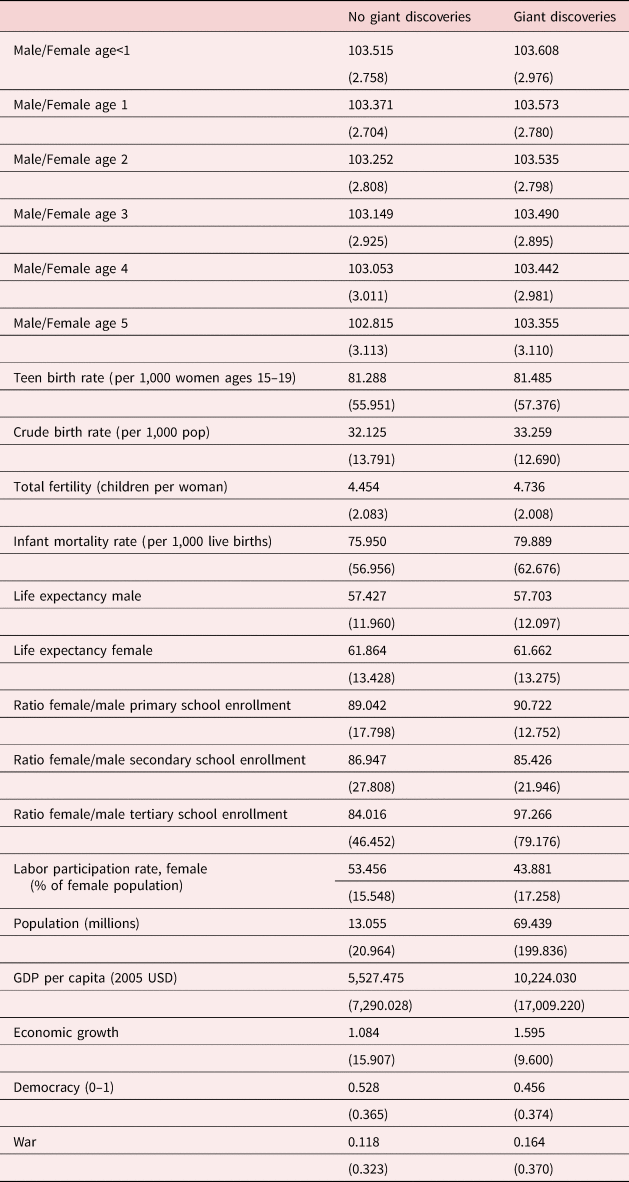
Summary statistics for these variables are reported in Table 1 separately for countries that discovered giant oil fields or did not discover during the period investigated. Most variables investigated look very similar across the two groups of countries. The exceptions are population, GDP per capita, and economic growth although even in those cases the standard deviations around the means are very large.Footnote 10 All regressions reported in this paper control for these covariates.
Summary statistics

Data are for the sample countries with no giant discoveries between 1935 and 1950.
In addition, we investigate the possibility that countries that made discoveries were on different trends prior to discovery than countries without discoveries, which could bias the estimates. For this purpose, we retain all countries that did not find any giant oilfield between 1935 and 1960 and split them into two groups: those that did not find oil between 1960 and 2010, countries without discoveries, and those that did, countries with discoveries. We limit this analysis to dependent variables available starting at least in 1950. The graphs presented in Figure 2 indicate parallel trends in variables such as sex ratios at age 2Footnote 11, birth rate, infant mortality, female life expectancy as well as population, GDP per capita, democracy and war during the pre-discovery period.Footnote 12 The results of this analysis provide support for the identification strategy because they suggest that the estimates are not picking up pre-existing trends.
Pre-trends in countries with and without giant discoveries. The figures use data for countries that did not find a giant oil field between 1935 and 1960. The data is split between countries that did not discover giant oil fields after 1950, the dashed fitted line, and those that did, the solid fitted line. These are all linear predictions with the exception of war, the result of a quadratic model. The shaded areas identify the 95% confidence intervals.

As a further robustness check we use micro-level data for Colombia and Indonesia from the Demographic Health Surveys (DHS) to investigate the impact of giant oil discoveries. These data allow us to take advantage of the available within-country variation by region to estimate the impact of oil discoveries. We assign treatment to women living in the regions closest to the location of giant oil discoveries.
The two countries were retained based on data availability: they made a known (i.e., before 2010) giant oil discovery during the years available in DHS datasets and there are data for more than one year pre-discovery and more than one year post-discovery. We use the DHS Colombia data for the years 1986, 1990, 1995, 2000, 2005. Colombia made two giant discoveries in 1992 (Cusiana) and 1993 (Cupiagua), both in the LLanos basin.Footnote 13 Of the 6 Colombian regions identified in DHS (Atlantic, Pacifica, Central, Oriental, Bogota, and Territorios Nacionales) only 5 regions are represented in the pre-discovery years,Footnote 14 thus our analysis assigns treatment to the available regions closest to the Llanos basin: Oriental and Bogota.
We perform a separate analysis using DHS data for Indonesia using years 1991, 1994, 1997, 2002–2003, 2007. During this period Indonesia made a giant oil discovery in 1996 (West Seno Complex in the Kutei basin) so we have a post-discovery period comparable to that used for the analysis of Colombia. We assign treatment to the regions of East Kalimatan and South Kalimatan.Footnote 15
5. Results
5.1 Main results
Figure 3Footnote 16 and Tables 2–4 report results from the estimation of equation (1). Although the results reported in Figure 3 Panel A show a preponderance of positive coefficients, indicating a positive association between oil discoveries and sex ratios (male/female), most of them are not significant at conventional levels.
Estimates of the effect of giant oil discoveries on sex ratio male/female) by Age. Panel A. All countries; Panel B. Excluding Africa. These are the estimates obtained from regressions of sex ratios on the number of giant discoveries controlling for lag population, lag GDP per capita, lag economic growth, lag democracy, war, country and year fixed effects. The sample includes only countries with no giant discoveries between 1935 and 1950. Robust standard errors clustered at the country level are used to obtain confidence intervals. Time zero is the year of discovery.

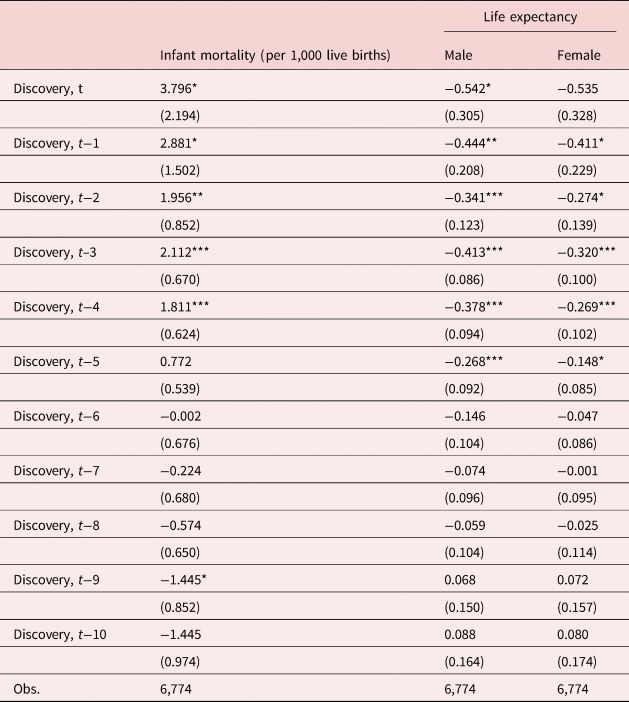
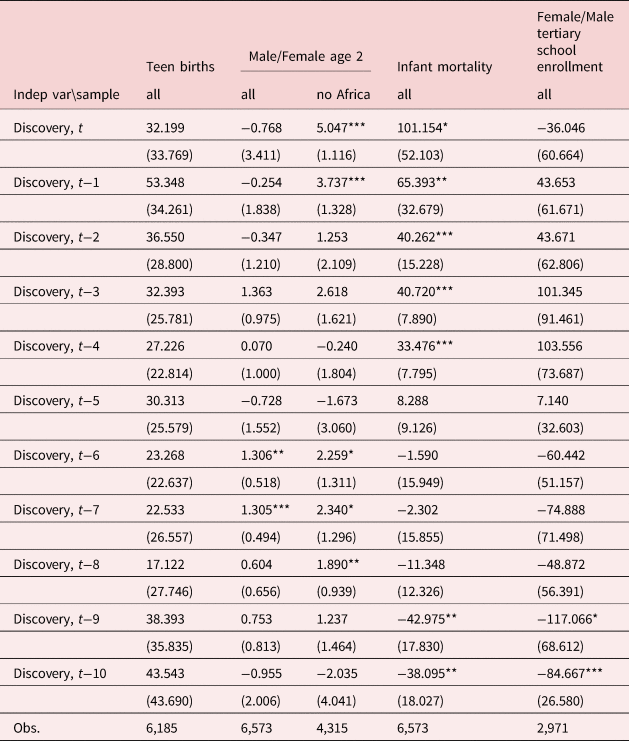
The impact of giant oil discoveries on health outcomes

The sample includes only countries that did not make any giant discoveries between 1935 and 1950. The independent variables measure the number of discoveries in a country year. All regressions control for lag population, lag GDP per capita, lag economic growth, lag democracy, war, country and year-fixed effects. Robust standard errors clustered at the country level are reported in parentheses.
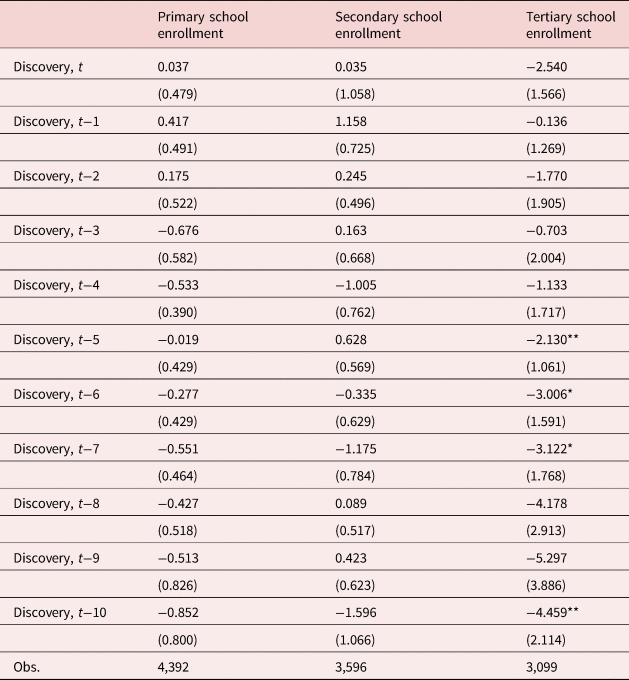
The impact of giant oil discoveries on female/male enrollment in school

The sample includes only countries that did not make any giant discoveries between 1935 and 1950. The independent variables measure the number of discoveries in a country year. All regressions control for lag population, lag GDP per capita, lag economic growth, lag democracy, war, country and year-fixed effects. Robust standard errors clustered at the country level are reported in parentheses.
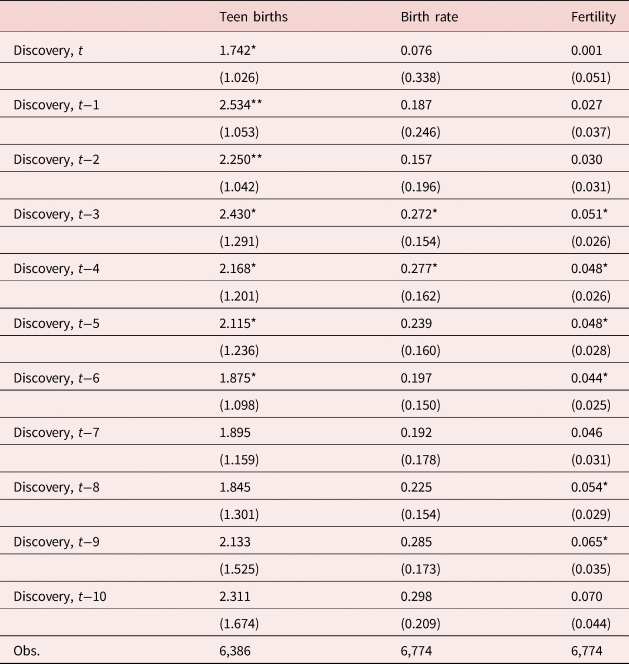
The impact of giant oil discoveries on birth rates

The sample includes only countries that did not make any giant discoveries between 1935 and 1950. The crude birth rate is the number of births per 1,000 population. The teen birth rate is births per 1,000 women ages 15–19. Total fertility rate is children per woman. The independent variables measure the number of discoveries in discoveries in a country year. All regressions control for lag population, lag GDP per capita, lag economic growth, lag democracy, war, and country and year fixed effects. Robust standard errors clustered at the country level are reported in parentheses.
In panel B, we explore the same question on a sample of countries excluding Africa. There are several reasons for doing so. First, the high preponderance of HIV and malaria-related deaths in Africa and the numerous interventions to address these health issues could confound our results. Because of the biological fragility of the male sex that leads to much higher mortality among males than among females exposed to the same shock [Kraemer (Reference Kraemer2000)] negative shocks tend to affect males more and health interventions have different effects on the two genders. Second, a significant body of literature, of which we cite just a few, indicates that cultural and social institutions are important determinants of gender inequality. There is evidence of intergenerational transmission of gender attitudes [Dhar et al. (Reference Dhar, Jain and Jayachandran2019)]. Using US data Fernandez and Fogli (Reference Fernandez and Fogli2009) found that cultural proxies have significant explanatory power of both labor force participation and fertility even after controlling for spousal characteristics and education. Using the World Value Surveys for 25 OECD countries Fortin (Reference Fortin2005) shows that gender roles and work attitudes help explain both work and fertility outcomes. In the specific case of African societies, the prominence of matrilineality [Amadiume (Reference Amadiume1997)] has the potential to produce differential relationships between genders relative to the more common patrilineal societies. Using the sample excluding Africa we find evidence of an economically and statistically significant effect on sex ratios.Footnote 17 Giant oil discoveries are associated with higher male/female ratios.Footnote 18 The effect appears to be immediate among the more fragile, the younger cohorts, and there is a lag between oil discoveries and changed sex ratios among older children.Footnote 19 One possible explanation is that with increased male employment in oil fields, women must take over some of the tasks that were otherwise fulfilled by men. The time investment in children must drop and this change is immediate. Under the hypothesis of male preference, the change would affect girls more.Footnote 20
However, by itself, this is not necessarily evidence of changes in the relative parental investment in female versus male offspring. Health literature suggests that males are more fragile and experience higher attrition in response to shocks early in life [Preston (Reference Preston1976)], thus, higher sex ratios (male/female) could be evidence of better health with males being the main beneficiary simply because of biological reasons.
There are two reasons to believe that the changed sex ratios reflect in fact changes in parental investment triggered by giant oil discoveries. First, there is no effect on sex ratios among infants (< 1 year old). Since in most country-years in this sample the sex of most fetuses is unknown to the parents until birth, changes in the attitudes toward the sex of the offspring cannot make any difference on sex ratios at birth. At the same time, improvements in health care technology would likely produce simultaneous changes in sex ratios at all ages. However, after birth if males are strongly favored, parental investment could change survival rates after birth.Footnote 21
Second, we investigate the impact of giant discoveries on health. The results reported in Table 2 indicate that giant oil discoveries are associated with higher infant mortality and lower life expectancy in the years following a discovery.
The effect on infant mortality tapers off and is reversed later possibly due to more resources being allocated toward governmental health spending [Fargues (Reference Fargues2005)] or through an income effect. The reversal of the effect is consistent with the estimates of Cotet and Tsui (Reference Cotet and Tsui2013) who concentrate on the medium (5-year) and long run (10 year or more) effect on health. Nevertheless, since any reduction in infant mortality occurs with a much longer lag than the changes in sex ratios identified in Figure 3 it is likely that changes in sex ratios are not due to better infant health.
We further investigate the impact of oil discoveries on education and fertility. Oil discoveries could decrease schooling across genders if returns to education decrease as the share of extractive industries in the total economy increases. Oil wealth could also lead to an increase in education levels [Stijns (Reference Stijns2005)] possibly through an income effect. Oil discoveries could affect female to male relative educational outcomes through more than one mechanism. There is a direct effect due to lower expected return to women's education owing to less fruitful job market opportunities. Better opportunities on the local marriage market could decrease age at marriage and first birth, thus, decreasing the likelihood to pursue higher levels of education. There could also be an indirect effect. Girls may be less successful in school due to poorer health, poorer nutrition, or taking over a larger share of domestic labor, which could induce them to drop out of school sooner. These mechanisms reinforce each other and suggest oil discoveries could be associated with poorer educational outcomes among girls relative to boys. The results reported in Table 3 are consistent with this prediction.Footnote 22 There is evidence of a negative association between giant oil discoveries and subsequent female/male educational achievement at the tertiary level implying an increasing educational gender gap. All coefficients are negative although not all are statistically significant. This is to be expected given that we are working with an unbalanced panel, which implies not all lags are identified from the same number of observations. However, the size of the effect is very consistent over time and economically significant: starting from our sample mean the estimate implies a drop from 87 to 85 women achieving tertiary education for every 100 men five years after the discovery and to 83 ten years after discovery.
Where women have poor labor market opportunities due to labor market conditions and lower education their standard of living hinges upon that of their spouses and their value is much determined by their value as mothers. This could affect the women's preferred fertility. Additionally, an income windfall from giant discoveries could affect the demand for children of both men and women [Lindo (Reference Lindo2010), Black et al. (Reference Black, Kolesnikova, Sanders and Taylor2013)]. Changes in male preference could provide incentives for parents to dispose of their daughters to afford more sons. That would decrease age at marriage and increase teen fertility [Leeson and Suarez (Reference Leeson and Suarez2017)]. Alternatively, women having now better marital prospects (either among higher-paid local men or through migration) choose to marry and have children earlier. The estimates presented in Table 4 provide support for these theories. Giant oil discoveries are associated with higher birth rates and fertility mostly driven by a significant increase in the adolescent birth rate.
The significance of the effect on teen births decreases with longer lags, but the size of the estimates is quite constant over time as is the effect on fertility. This is not that surprising considering that the more time passes between a shock and the time the effect is measured the more confounding events could occur and, thus, the noisier could be the estimates.
5.2 Robustness checks
5.2.1 Measurement error
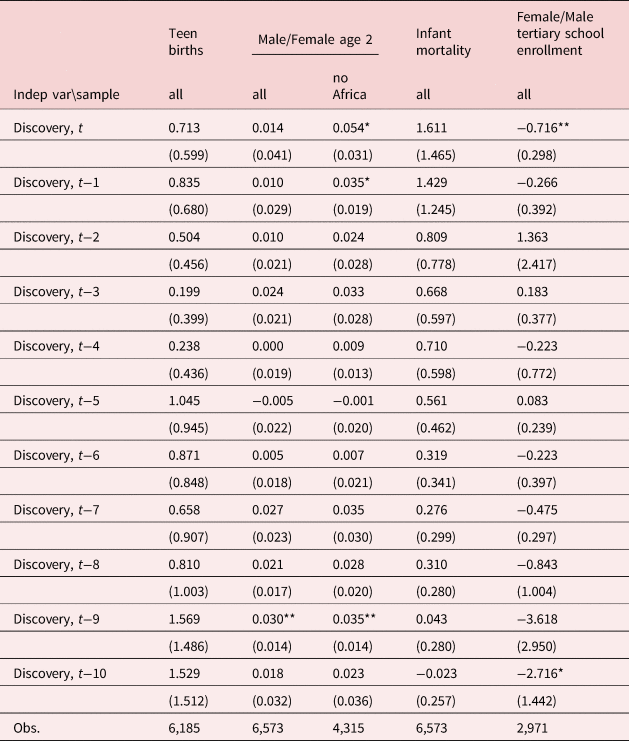
In the main analysis, we consider the number of giant discoveries as a measure of the natural resource wealth shock to a country. This provides a good measure of the size of the shock, but not a measure of the share of population affected. The share of the population affected could be a more relevant measure of the shock when investigating outcomes such as infant mortality rate or teenage birth rate. As discussed above, normalizing our independent variable of interest by population is not appropriate when discovery affects the population through birth rates, deaths rates, and migration. To elude this issue, we experiment with normalization by area (number of discoveries per 1,000 square kilometers). The results are robust to this change, Table 5.Footnote 23
Robustness check: measuring the magnitude of the oil shock by the number of discoveries normalized by land area

The sample includes only countries that did not make any giant discoveries between 1935 and 1950. The independent variables measure the number of discoveries per 1,000 square kilometers in a country year. All regressions control for lag population, lag GDP per capita, lag economic growth, lag democracy, war, country and year-fixed effects. Robust standard errors clustered at the country level are reported in parentheses.
Another issue is related to measurement error due to heterogeneity in the intensity of the shock. The intensity of the shock is driven by the value of discovery. In Table 6 we replace the number of discoveries with the amount of oil discovered normalized by area (million barrels of oil equivalent, per 100 square kilometers), which accounts for variation in the amount discovered. The estimates obtained using this specification are very similar to those from the main specification although not very precisely estimated. This is likely due to measurement error in the data. The way the amount of recoverable oil was estimated varies across oilfields. For some oilfields, this amount was updated from earlier versions of the dataset. Both processes suggest that the URRs data suffer from measurement error, which could be associated with attenuation bias.
Robustness check: measuring the magnitude of the oil shock by the amount of oil discovered normalized by land area

The sample includes only countries that did not make any giant discoveries between 1935 and 1950. The sample excludes Liechtenstein as an extreme influential outlier. The independent variables measure the amount of oil discovered, in million barrels of oil equivalent, per 100 square kilometers in a country year. All regressions control for lag population, lag GDP per capita, lag economic growth, lag democracy, war, country and year-fixed effects. Robust standard errors clustered at the country level are reported in parentheses.
The value of discovery is also driven by prices [Cotet and Tsui (Reference Cotet and Tsui2013), Liou and Musgrave (Reference Liou and Musgrave2016)] although in this case current prices are not the correct measure, expected future prices are. This is less of a problem when using discoveries as a measure of variation than when using production or reserves because discoveries always represent an increase in net wealth, while high production may signal dependency on the oil sector and, thus, low GDP when the price of crude oil drops. Nevertheless, the expected value of discoveries may be lower when the price of crude oil decreases, which could determine whether resources are diverted from other sectors toward the oil sector or not. Thus, due to variations in crude oil prices, the effect of discoveries could vary with the period investigated. Of course, investigating the sensitivity of the effect of discoveries to the period investigated may pick up other sources of heterogeneity than the expected value of discovery. For instance, technology advanced so that, during the most recent years of the sample, it was possible to know the sex of a fetus before birth in more developed countries. That knowledge could affect the impact of oil on sex ratios and women's education. Nevertheless, the exercise is useful as a falsification check. To the extent to which there is variation in the effect over time, this variation should be consistent across outcomes.
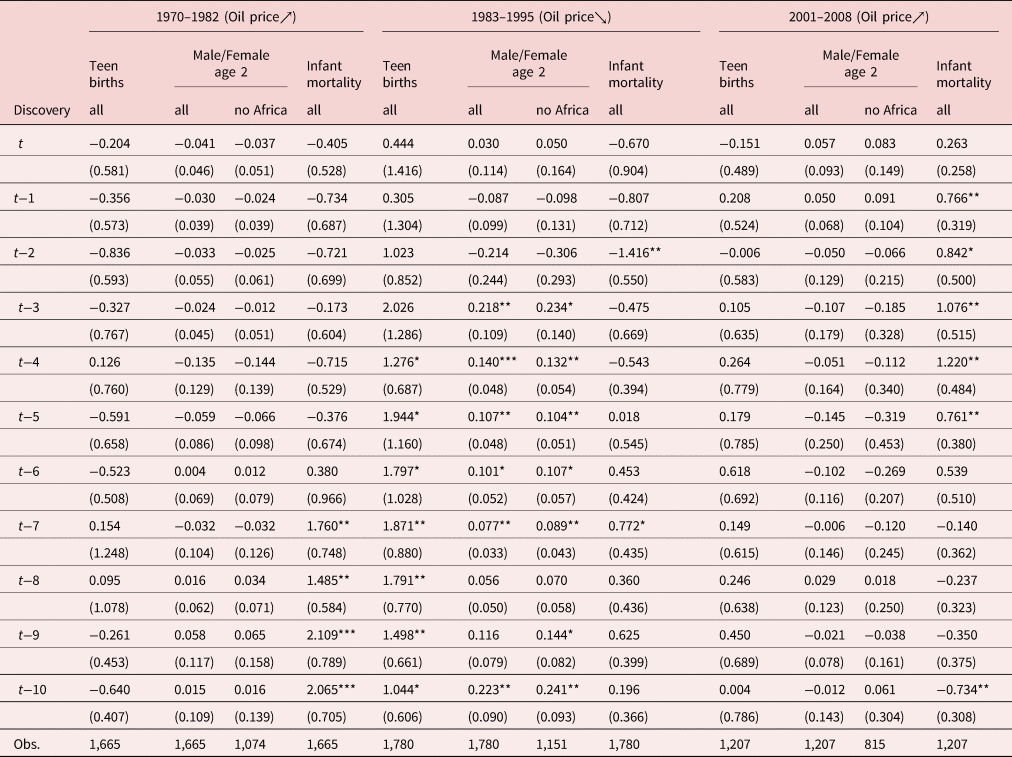
For the sake of brevity, in Table 7 we report estimates of the effect of oil discoveries on teen births, sex ratios, and infant mortality only.Footnote 24 We present results for three periods: 1970–1982 a period of increasing prices; 1982–1995 a period of falling prices, the 1980s oil glut;Footnote 25 2001–2008 a period characterized by increasing prices but also by significant changes in the availability of healthcare technologies. The results are consistent with predictions based on the evolution of crude oil prices and shed some light on the cause of some of the contradictions in previous literature.
The impact of oil discoveries: robustness to sample period

The sample includes all data available. The independent variables measure the number of discoveries in a country year. All regressions control for lag population, lag GDP per capita, lag economic growth, lag democracy, war, country and year-fixed effects. Robust standard errors clustered at the country level are reported in parentheses.
There is no significant evidence that during periods of increasing prices, 1970–1982 and 2001–2008, giant oil discoveries are associated with significant changes in sex ratios. However, when oil prices were on a downward trend, discoveries were associated with higher male/female ratios. This is consistent with the idea that oil discoveries lower the value of females, but a large enough income effect can offset some of the impact of this change on health outcomes.Footnote 26 The explanation is fully supported by the effect on teen births. Giant oil discoveries are associated with an increase in teen births during decreasing oil prices but not during periods of increasing oil prices. This pattern of coefficients rejects the idea that the effect of oil discoveries is fully explained by improved local marital prospects because the value of marriage should increase during high oil prices. On the other hand, a large enough windfall may reduce the likelihood that parents dispose of their teen daughters through marriage or could increase demand for products from sectors with less gender-skewed employment and thus the demand for women labor.
More puzzling could be the estimated effect on infant mortality. Oil discoveries appear to be associated with higher infant mortality mostly during periods of increasing prices when the income effect might lead someone to conclude that infant mortality should decrease.Footnote 27 In addition, this effect holds even during recent periods when health technologies might mediate the negative impact of poorer maternal health. An answer might be found by looking at determinants of infant mortality. High physical demands could increase the risk of miscarriage, preterm birth, or injury during pregnancy. As men are increasingly employed in oil fields, women might take over more physically demanding tasks that were otherwise fulfilled by men. Future research using micro-data should investigate the exact mechanisms given that the natural resource discoveries appear to be associated with short-term increases in infant mortality independent of the availability of health technologies.
5.2.2 Micro-level data and within-country regional variation
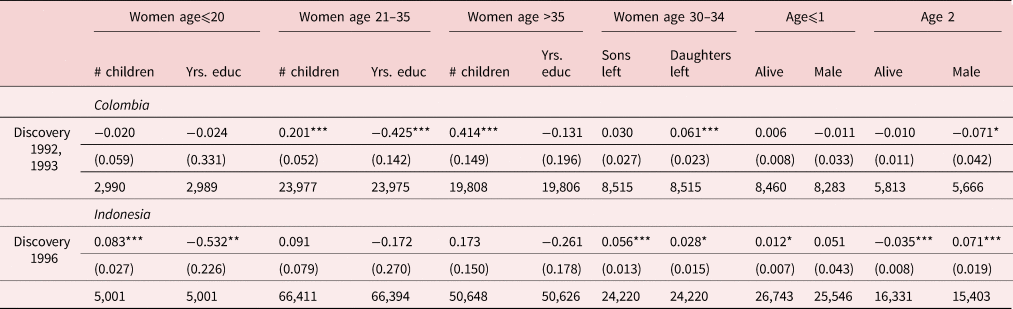
We report results from our analysis of Colombia and Indonesia in Table 8. Using within-country regional variation removes concerns of comparability of the treatment and the control group when external factors may affect the magnitude of the impact of discoveries. However, the micro-level evidence is not necessarily superior. The within-country analysis likely identifies mostly differences due to changes in employment but underestimates the income effect because within-country redistribution (public programs for instance) implies that the control regions also experience an income effect. As such these results should be considered complementary.
The impact of giant oil discoveries: case study

These regressions use data from Demographics and Health Surveys (DHS) for Colombia (years 1986, 1990, 1995, 2000, 2005) and Indonesia (years 1991, 1994, 1997, 2002–2003, 2007). During this period Colombia made giant oil discoveries in 1992 and 1993 and Indonesia made a giant oil discovery in 1996. The independent variable is a dummy equal to 1 in the regions closest to the discovery after the discovery, and zero otherwise. All regressions control for woman's age, urban residence, region FE, and year FE. All regressions are weighted using the sampling weights provided by DHS. All regressions report robust standard errors. In the case of Indonesia, there are more than 20 different regions, and thus the standard errors are clustered at the region level. Given the small number of regions (5) in Colombia, the standard errors are not clustered.
Due to data availability, we cannot perform an event analysis, so we report results from a difference-in-difference analysis. The results are consistent with the macro-level results; following giant oil discoveries, women living closer to the location of discovery in both Colombia and Indonesia have more children and fewer years of education. The age group most affected differs in a predictable manner based on prevalent levels of education in each country.
Both countries have low tertiary education attainment but there are significant differences in the proportion of women for which the decision to pursue tertiary education is relevant. According to the 2006–2007 World Bank data (the end of the period investigated) only ~22% of women 25+ completed upper secondary education in Indonesia, versus ~34% in Colombia.Footnote 28
Thus, the decision to pursue tertiary education is relevant for a larger number of women in Colombia than in Indonesia. DHS data indicate that during the period investigated in Colombia about 10% of women had more than a high-school education while in Indonesia only about 4%. In Indonesia, DHS data indicate that a larger proportion of women decides whether to pursue more than 6 years of education (~25% drop off school between the 6th and the 7th year) or more than 9 years of education (~15% of women continue education after the 9th year). The results are consistent with these differences. In Colombia, we find evidence of a significant increase in fertility among women 21–25 accompanied by a significant decrease in educational attainment. The same does not hold among women 20 or younger suggesting that the decision of attending secondary education has not been affected as much as the decision to pursue tertiary education. In Indonesia, we see an increase in fertility and a corresponding drop in education among very young women, 20 years old or younger.
We also find evidence consistent with an impact on the outcomes of children. The evidence from Indonesia is consistent with the macro-level evidence. We find no change in infant (1 year or less) mortality and sex ratios, but an increase in mortality rates and the proportion of males among surviving 2-year-olds suggesting atypical patterns of survival favoring males. However, we find no such evidence for Colombia.Footnote 29
Another way to investigate potential changes in parental investment is by looking at gender differences in the likelihood of leaving the parental home at early ages. In the DHS data, 40% of Colombian women and almost 50% of Indonesian women had the first birth between the ages 16 and 19. We find that in Colombia women aged 30–34, whose children are still young, are more likely to report having daughters than sons elsewhere. The same does not hold in Indonesia. Thus, although we consistently find evidence of deterioration of women outcomes the mechanism may vary with local factors.
These results may not generalize to other countries. Future research may need to focus on local data to identify the locally specific channels of the effect.
5.2.3 Other robustness checks
We perform a range of other sensitivity checks that are reported in full in the Appendix available on-line. Here, we only summarize our findings. First, the effects could be limited to autocratic regimes if they reflect increased ability of autocrats to promote policies unfavorable to women but favored by the ideologically motivated winning coalition [Liou and Musgrave (Reference Liou and Musgrave2016)]. We found that the effects are robust to excluding regimes with polity score less than −5.
Second, a concern could be that the results may be driven by other factors when many major oil discoveries took place in countries with significant Muslim communities. We re-estimate the model using a sample that retains only countries where the Muslim population represents less than 10% of the total population and find that the results are robust on this sub-sample.
Third, the effects identified in this paper could be explained by lower job market opportunities for women. We investigate the impact of giant oil discoveries on women labor force participation rate. Although not a perfect measure because discoveries could be affecting the type of jobs or the pay of women, without much impact on the number of women holding some sort of employment, we find evidence that oil discoveries are negatively correlated with women's labor participation rate, an effect robust to alternative measures of shock.Footnote 30 On their own these results may not say much about labor market opportunities of women because they could reflect only the impact of oil-fueled development on women's labor force participation, which tends to first decrease and then increase as countries develop. Nevertheless, when all results are considered together, they provide support for the idea that shocks to the natural resource sector disproportionately affect women negatively.
Fourth, we use all oil and gas discoveries that account for simultaneous shocks due to gas discoveries. The results are robust to this change in the specification as well.
6. Discussion and conclusions
Gender inequality is a persistent trait throughout history. Cultural differences and intergenerational transmission of gender attitudes can explain some of the differences in gender gaps across societies, but the question remains as to what explains the formation and survival of these cultural idiosyncrasies. Increasingly, researchers try to find answers among historical changes such as technological shocks that favored a certain gender given local features of the natural environment [Ross (Reference Ross2008), Alesina et al. (Reference Alesina, Giuliano and Nunn2013), Voigtlander and Voth (Reference Voigtlander and Voth2013)]. This paper adds to that body of literature evidence that a certain feature of the natural environment favoring male employment could affect women's relative outcomes. Using a plausibly exogenous source of identification, giant oil discoveries, and an event-type empirical strategy we estimate the effect up to 10 years after discovery and report evidence that oil discoveries are associated with relatively poorer health outcomes of females versus males. These effects are short lived and seem to be tapering off within 8 years from the discovery, consistent with the inverted U-shaped path of male employment following oil and gas discoveries. Most industry job creation takes place before the production begins [Jacquet (Reference Jacquet2011)]. Recent studies of the shale boom suggest that positive effects on employment decrease over time [Tsvetkova and Partridge (Reference Tsvetkova and Partridge2016)].Footnote 31 Moreover, there are reports of increased FDI in some discovery areas and, thus, growth in sectors that may not favor male employment. The effect of oil discoveries on health could decrease both because of the lower employment gender gap and because of the income effect associated with the onset of production.
We also find evidence of effects on fertility and gender education gap that seem to be longer lived, i.e., do not taper off within 10 years. Our empirical strategy does not identify long-run effects. Long-run effects could be possible when changes in educational outcomes of women affect the outcomes of their offspring, when sequential shocks reinforce each other, or when the specific local conditionsFootnote 32 lead to the perpetuation of gender employment and the wage gap. Of most concern is the impact on educational outcomes of women because that could be the path to the perpetuation of gender gaps in the long run, a hypothesis we believe should be of interest to future research.
The estimates reported here also allow us to reconcile some discrepancies from previous literature investigating the effect of oil on health. We find significant heterogeneity in the effect. For instance, all effects vary with the expected value of discovery as proxied by oil prices with sharp differences between periods of increasing oil prices (1970–1982 or 2001–2008) and those of decreasing prices (1983–1995). Although not reported we also found that oil discoveries are associated with a decrease in infant mortality during the 1950–1969 period. These results are useful in understanding the differences among various estimates of the effect of oil on health. Ross (Reference Ross2003) reports that oil dependence leads to worse health outcomes, an effect fully mediated through the impact of oil on political regime. These results received support from findings that oil is negatively associated with democracy [Tsui (Reference Tsui2011)], and democracy is positively associated with health [Besley and Kudamatsu (Reference Besley and Kudamatsu2006)]. On the other hand, Cotet and Tsui (Reference Cotet and Tsui2013) report a positive effect of oil on health especially in non-democracies. Neither paper includes data after 2000 and, thus, miss the improvement in health driven by the most recent discoveries. At the same time, Cotet and Tsui (Reference Cotet and Tsui2013) include more of the early data and conclude that oil wealth is associated with an improvement in health outcomes, while Ross (Reference Ross2003) using newer data misses the early improvement in health and finds that oil dependency is associated with poorer health. This paper finds that the results are even more nuanced and suggest that attempts to predict the effect of mineral resources on health should account for oil prices and for the differential impact on women.
The proposed explanation for the effects reported in this paper is the change in the labor market conditions triggered by a significant oil discovery. The changes in the labor market are likely reinforced by changes in the marriage market but appear to be offset by a large enough income effect and these effects do not vary significantly with the political regime.
Importantly, there is suggestive evidence that the income effect of the natural resource windfall offsets some of the impact of labor market changes. There is no change in fertility and relative female enrollment in tertiary educationFootnote 33 during periods of high oil prices, suggesting that a large enough income effect could allow women to delay fertility and pursue further education. This income effect along with the results indicating that the negative effects of giant oil discoveries are most detrimental in the early years following a discovery and before production ramps up but may perpetuate if not addressed suggest a potential solution. Countries could take advantage of the expected future oil rents to fund pre-emptive policies that enhance educational and employment opportunities for women.
Supplementary material
The supplementary material for this article can be found at https://doi.org/10.1017/dem.2022.16.
Conflict of interest
The authors declare none.
Ethical standards
The research did not involve any human participants or animals.