Introduction
Sensorineural hearing loss (SNHL) is highly prevalent amongst the elderly, and may lead to a number of oral communication difficulties in family and social interactions. Several epidemiological studies have been carried out in developed countries; the reported prevalence of SNHL in the elderly has ranged from 16 to 20 per cent.Reference Wilson, Walsh, Sanchez, Davis, Taylor and Tucker1–Reference Natalizia, Casale, Guglielmelli, Rinaldi, Bressi and Salvinelli6
Besides a reduced ability to enjoy music and other sounds, hearing loss in the elderly may produce social isolation, reduce self esteem and induce anxiety, all of which can affect mental health and quality of life. In the elderly, hearing loss has been associated with emotional, social and communication disability, with important adverse effects on quality of life.Reference Mulrow, Aguilar, Endicott, Velez, Tuley and Charlip7, Reference Dalton, Cruickshanks, Klein, Klein, Wiley and Nondahl8
The most common causes of SNHL in adults are presbycusis and noise exposure.
Presbycusis reflects the loss of hearing sensitivity associated with advanced age, and it is the third most common chronic condition reported by older people.Reference Wilson, Walsh, Sanchez, Davis, Taylor and Tucker1–Reference Quaranta, Assennato and Sallustio4 The typical audiometric profile clinically observed in presbycusis is a bilateral, symmetrical, high-frequency, sensorineural hearing loss which progresses with age.
Occupational noise-induced hearing loss is defined as a bilateral, sensorineural hearing loss that develops slowly over a period of several years as the result of exposure to continuous or intermittent loud noise in the workplace.Reference Wilson, Walsh, Sanchez, Davis, Taylor and Tucker1–Reference Quaranta, Assennato and Sallustio4 Typically, the first sign of hearing loss due to noise exposure is a ‘notching’ of the audiogram at 3000, 4000 or 6000 Hz, with recovery at 8000 Hz. Dobie suggested that a large number of US citizens (approximately 5 to 30 million) are exposed to hazardous noise levels in the workplace.Reference Dobie9 According to recent studies, based on exposure levels, approximately one in four workers may develop permanent hearing loss.Reference Dobie9
Deterioration of the cochlear structures, particularly hair cells, results from a complex interaction between presbycusis and noise-induced hearing loss. How the two interact in contributing to SNHL is still unclear.Reference Albera, Lacilla, Piumetto and Canale10, Reference Gratton and Vazquez11
This study aimed to investigate the effect of age and noise exposure on hearing loss in a group of older patients with presbycusis, and to determine whether SNHL has the same course in patients with and without a history of noise exposure.
Materials and methods
This study included a total of 460 patients; 367 with a history of presbycusis alone (204 women and 163 men) and 93 with a history of presbycusis and noise exposure (eight women and 85 men). Patients had been evaluated at the audiology department of the University Hospital of Ferrara between 1 January 2000 and 31 December 2008. At examination, patients' ages ranged from 70 to 93 years (median, 75 years).
All patients underwent history-taking (including professional anamnesis) and otolaryngological examination.
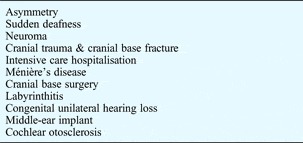
Exclusion criteria were based on patients' medical history and audiometric data. We excluded patients affected by conductive, mixed and sensorineural hearing loss due to a specific cause (e.g. sudden deafness, cranial base fracture, or congenital unilateral or bilateral hearing loss). We also excluded patients with asymmetrical hearing loss (i.e. a threshold difference of 20 dB or more at 500, 1000, 2000, and 4000 Hz). Unreliable subjects were likewise excluded (Table I).
Exclusion criteria

A medical history was taken for each patient, during a one-to-one interview, using a questionnaire focussing on the patient's otological background and ototoxic exposure.
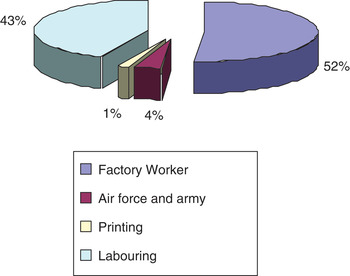
Occupational noise exposure was investigated by asking the patient about their former occupation, particularly regarding the age of first occupational noise exposure and the duration of exposure (following Blanchet et al.).Reference Blanchet, Pommie, Mondain, Berr, Hillaire and Puel12 The type of work place was noted. Occupational noise exposure was defined as exposure for three or more years.Reference Blanchet, Pommie, Mondain, Berr, Hillaire and Puel12 Patients defined as exposed to occupational noise reported no use, or only occasional use, of ear protectors. The occupations of patients defined as noise-exposed are shown in Figure 1.
Occupations of patients with presbycusis plus noise exposure. Labouring = pneumatic drill operator, welder, heavy machinery operator, tractor driver or miner

Any history of ototoxic medication was also recorded (i.e. streptomycin, quinine or chemotherapy).
A clinical database was then created, dividing patients into those with presbycusis alone and those with presbycusis plus noise exposure.
Hearing threshold evaluation
In order to assess hearing threshold, pure tone threshold audiometry was performed within a sound-proofed cabin (model E2X2, roll 01008 220V 10A; Mercury, Milan, Italy). An Amplaid audiometer (Amplaid, Milan, Italy) calibrated to ISO 9001 (International Standardization Organization) standards was used. The audiometric procedure was performed using headphones to assess air conduction and a bone vibrator for bone conduction. The better ear was evaluated first. An ascending method using 5 dB steps was utilised to calculate hearing threshold. Air conduction hearing thresholds were obtained at 125, 250, 500, 1000, 2000, 4000 and 8000 Hz. Bone conduction hearing thresholds were assessed with the use of a masking, white, contralateral noise, for 250, 500, 1000, 2000 and 4000 Hz.
Audiometric tests were performed by three experienced audiometric technicians.
Statistical analysis
Data were analysed using descriptive statistical studies available in the Statistical Package for the Social Sciences (Windows application) software program. The level of significance considered was p < 0.05. Non-parametric tests (Wilcoxon and Mann–Whitney) were used in order to evaluate threshold shifts between groups of patients. Analysis of variance was used to estimate the independent relationship between noise exposure and threshold levels, adjusting for age and gender.
Results
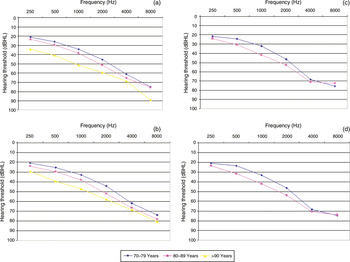
Mean pure tone average hearing thresholds were calculated for each tested ear, in both patient groups (i.e. presbycusis alone and presbycusis plus noise exposure) (Figure 2).
Mean hearing thresholds: (a) presbycusis, right ear; (b) presbycusis, left ear; (c) presbycusis plus noise exposure, right ear; (d) presbycusis plus noise exposure, left ear.

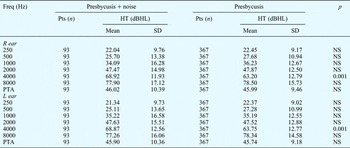
Statistical analysis revealed a statistically significant difference between the two groups at 4 kHz, with a slightly higher threshold level in patients exposed to noise. There was no statistically significant difference at any other frequency (Table II).
Hearing thresholds in the two groups

Freq = frequency; HT = hearing threshold; pts = patients; SD = standard deviation; R = right; NS = not significant; PTA = pure tone average (0.5–4 kHz); L = left
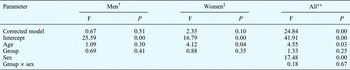
To assess whether the observed threshold difference at 4 kHz was attributable exclusively to noise exposure, analysis of variance was performed, adjusting for age and gender. This revealed that noise exposure alone did not explain the observed difference (Table III); rather, this difference was related only to differences in age distribution between the two groups.
Analysis of variance for effect of age, sex and noise exposure on threshold level, at 4000 Hz*

* Testing between-subject effects, with dependent variable = 4000 Hz. R2=†0.005, ‡0.022 and **0.179. F = F test; P = significance level
Analysis of variance also indicated that when patients were divided by sex, age was the only factor affecting hearing threshold levels (Table III).
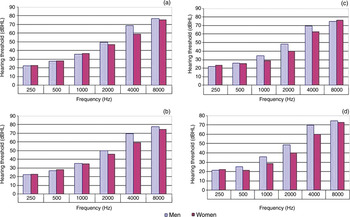
In addition, there was a statistically significant difference in hearing threshold levels at high frequencies, comparing men and women within both groups: men showed worse threshold deterioration, at 4 and 8 kHz, than women (Figure 3).
Mean hearing thresholds for men and women, within the two groups: (a) presbycusis, right ear; (b) presbycusis, left ear; (c) presbycusis plus noise exposure, right ear; (d) presbycusis plus noise exposure, left ear.

Discussion and conclusions
It is widely accepted that the most common causes of adult SNHL are ageing (causing presbycusis) and noise-induced hearing loss.13, Reference Nelson and Hinojosa14 According to the American Academy of Otolaryngology–Head and Neck Surgery, ageing and noise exposure are the commonest causes of SNHL, and one in 10 US citizens has a hearing loss which affects speech comprehension.Reference Albera, Lacilla, Piumetto and Canale10
Both noise-induced hearing loss and presbycusis can result from damage to the outer cochlear hair cells within the basal turn.Reference Albera, Lacilla, Piumetto and Canale10, Reference Gratton and Vazquez11
Presbycusis can be considered as the sum of damages resulting from various forms of physiological degeneration, including losses caused by ototoxic agents and by medical disorders and treatment. Presbycusis affects around 60 per cent of all people aged over 65 years, and involves a gradual decline in auditory sensitivity at all frequencies accompanied by a decrease in speech discrimination. Studies have demonstrated that presbycusis has a negative effect on elderly patients' functional status, quality of life, cognitive function, and emotional, behavioural and social well-being.Reference Blanchet, Pommie, Mondain, Berr, Hillaire and Puel12, 15–Reference Lee, Matthews, Dubno and Mills19
As regards noise-induced hearing loss, it has been reported that approximately 30 million US workers are at risk of noise-induced hearing loss, and that 10 million US citizens already have noise-induced hearing loss.Reference Nelson and Hinojosa14 However, recent studies indicate that presbycusis is still the most prevalent type of hearing loss in the adult population, and that noise-induced hearing loss accounts for less than 10 per cent of the burden of adult hearing loss in the US.Reference Blanchet, Pommie, Mondain, Berr, Hillaire and Puel12, Reference Rosenhall20–Reference Tambs, Hoffman, Borchgrevink, Holmen and Engdahl23
The current study aimed to describe the hearing threshold distribution within a patient cohort aged 70 years and older, and to analyse results by age, sex, and whether patients were affected by presbycusis alone or presbycusis plus noise exposure.
• This study assessed hearing thresholds in elderly patients affected by presbycusis with or without noise exposure, and also analysed the effect of age and gender
• Hearing was generally related to age rather than noise exposure
• This confirms recent findings, and supports the hypothesis that once noise-induced hearing loss occurs it tends to worsen slightly with continued exposure, but progressive hearing loss is primarily due to ageing
• The interaction between noise-induced hearing loss and presbycusis is difficult to determine
Data analysis clearly indicated that hearing loss in these elderly patients was mostly related to age itself rather than to noise exposure, even at 4 kHz. Therefore, our data confirm recently reported observations, and support the hypothesis that once noise-induced hearing loss has manifested it tends to worsen slightly with continued noise exposure, but progressive hearing loss is primarily due to ageing.Reference Albera, Lacilla, Piumetto and Canale10 A lifetime of noise exposure is likely to have a negative effect on hearing. However, the interaction between noise-induced hearing loss and presbycusis remains difficult to determine.
More research is needed to assess the relative effects of ageing and noise exposure on hearing thresholds within the general population.
Acknowledgements
We thank Monica Rosignoli for her valuable advice.