Introduction
The Argentine goatfish, Mullus argentinae Hubbs & Marini, 1933 is a small benthic fish distributed from Rio de Janeiro, Brazil to the coasts of Buenos Aires province, Argentina (Cousseau & Perrotta, Reference Cousseau and Perrotta2004). The feeding habits of M. argentinae are little known (Luque et al., Reference Luque, Porrozzi and Alves2002); however, species of Mullus are specialist feeders on benthic invertebrates (Aguirre & Sánchez, Reference Aguirre and Sánchez2005) with a predominance of polychaetes and crustaceans in their diets (Serrano et al., Reference Serrano, Velasco and Olaso2003).
The composition and structure of parasite communities of M. argentinae at the northern boundary of its distributional range have been reported by Luque et al. (Reference Luque, Porrozzi and Alves2002), but there are no previous studies on the parasite fauna of this species in Argentinean waters. However, parasitological studies of other fish species in the northern region of the Argentinean Sea, including demersal piscivorous species (Sardella & Timi, Reference Sardella and Timi1996, Reference Sardella and Timi2004; Timi et al., Reference Timi, Luque and Sardella2005; Braicovich & Timi, Reference Braicovich and Timi2008), benthic fishes preying on macroinvertebrates (Timi et al., Reference Timi, Lanfranchi, Etchegoin and Cremonte2008) and pelagic species (Cremonte & Sardella, Reference Cremonte and Sardella1997; Timi, Reference Timi2003; Timi & Poulin, Reference Timi and Poulin2003) have shown that the dominance in terms of prevalence and abundance of larval parasites (mainly nematodes, cestodes and acanthocephalans) is the common pattern. Of these, the numerically most important species belong to a group of trophically transmitted parasites, which are all larval stages and shared by different fish species. This group comprises species with extremely low specificity, such as juvenile acanthocephalans of the genus Corynosoma, plerocerci larvae of the genus Grillotia, and anisakid nematodes of the genus Hysterothylacium (Timi, Reference Timi2007).
According to Holmes (Reference Holmes, Esch, Bush and Aho1990), component communities and infracommunities may be either restricted subsets or random samples of the compound community. If the component community is determined by phylogenetic, ecological or physiological specificity of the parasites, then it will be essentially a restricted subset of the compound community, and infracommunities are likely to represent random samples of that subset. On the other hand, if infracommunities depend upon ecological or physiological traits acting at the level of individual hosts, then infracommunities will be random samples of the compound community. Both situations are the opposite ends of a continuum, rather than exclusive alternatives, and the location of parasite assemblages along this continuum depends on the numerical importance of species with low host-specificity in the compound community. Therefore, the ecological component of parasite diversity appears to prevail over the phylogenetic one in the determination of parasite community structure in fishes from the study area (Timi & Lanfranchi, Reference Timi and Lanfranchi2009).
Recently, Timi & Lanfranchi (Reference Timi and Lanfranchi2009) showed that larval parasite species with low host-specificity are the main determinants of the parasite infracommunity structure of another small benthic fish, the Atlantic searobin, Prionotus nudigula. In fact, Corynosoma australe and Grillotia sp. were the best represented species. They had a strong influence on the infracommunity structure by accounting for the highest proportion of individuals, dominating most infracommunities, greatly determining all infracommunity descriptors and producing marked changes in the similarity among infracommunities. Given the abundance and broad distribution of low host-specific larval parasites in the regional compound community (Timi, Reference Timi2007; Timi & Lanfranchi, Reference Timi and Lanfranchi2009), infracommunities were considered as subsets of the species available regionally. These parasites are obtained by passive sampling of infective stages as fishes feed, leading to predictable assemblages with a non-random composition and structure determined mainly by ecological filters, especially by host trophic habits.
Therefore, according to these predictions and due to the similarity between diets of P. nudigula and M. argentinae, it is expected that both fishes should display similar parasite faunas in the same zone. However, and precisely because of the diet of mullids (mainly polychaetes and crustaceans), it has been found that digeneans dominate the parasite communities of M. argentinae in Brazil (Luque et al., Reference Luque, Porrozzi and Alves2002), as well as those of M. surmuletus and M. barbatus in Mediterranean waters (Le Pommelet et al., Reference Le Pommelet, Bartoli and Silan1997; Ferrer-Castelló et al., Reference Ferrer-Castelló, Raga and Aznar2007).
The aim of this study was therefore twofold, first to describe the parasite community structure of M. argentinae at the southernmost boundary of its distribution, and second to evaluate the influence of the compound community composition on the infracommunities of this host by assessing the relative importance of larval parasites of low host-specificity and adult digeneans.
Materials and methods
A total of 75 specimens of M. argentinae (total length (TL) 19.5 ± 1.9 cm) were examined for parasites. Fish were caught by trawl off the coast of Buenos Aires Province (Bonaerense region) by the commercial fleet operating at Mar del Plata port (38°27′S, 57°90′W) between June and September 2007. Fish were either kept fresh or deep frozen in plastic bags at − 18°C until examination. After defrosting each fish was measured for total length (cm). Parasites were recovered from the body surface, musculature, gills, body cavity, viscera (stomach, intestine, liver, gall bladder, gonads and mesenteries) after examination under a stereoscopic microscope.
Prevalence and mean abundance were calculated for each parasite species following Bush et al. (Reference Bush, Lafferty, Lotz and Shostak1997). The relationship between host size and abundance was analysed by Spearman's rank correlation coefficients for each parasite species with prevalence>10%. For each individual fish, the species richness was calculated and the following community descriptors were calculated at infracommunity level (Bush et al., Reference Bush, Lafferty, Lotz and Shostak1997) for those fish harbouring two or more species: number of parasites in each infracommunity (N), species richness (S), Brillouin's index of diversity (HB), evenness associated to Brillouin's index of diversity (E) and the percentage of infracommunities in which each parasite species was either dominant or co-dominant (Magurran, Reference Magurran1988). The effect of host size as well as of the abundance of the dominant species on the infracommunity descriptors was evaluated by Spearman's rank correlation coefficients.
Results
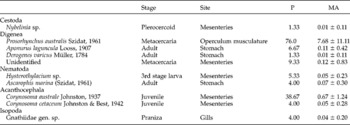
Sixty-six out of 75 fish were found to be parasitized by at least one of ten parasite species (table 1) (total prevalence 88%). A total of 664 individual metazoan parasites were found in the overall sample (total mean abundance 8.85 ± 11.26). Two microparasite species were also found: cysts containing spores of Microsporidium ovoideum (Thélohan, 1895) Sprague, 1977 (Microsporea) and mature oocysts of Goussia sp. (Coccidia), both in the mesenteries. These species were not included in further analyses.
Taxonomic composition, microhabitat, prevalence (P) and mean abundance±SD (MA) of parasites of Mullus argentinae from the coasts of Mar del Plata, Argentina.

The parasite fauna of M. argentinae was mainly composed of endoparasitic species (accounting for 99.55% of total abundance, and 90% of species richness), most of them displaying low prevalence and abundance. Only Prosorhynchus australis and Corynosoma australe showed prevalences higher than 10% (table 1), accounting for most (94.3%) of the individual parasites (86.8% and 7.5%, respectively). Larval stages also prevailed over adult ones (98.6% of the individual parasites and 80% of species richness). No effect of host sex was observed on prevalence or abundance for P. australis and C. australe (all P>0.05). These values were too low for all other species to allow for reliable comparisons. Host size was not related to abundance for either species (both P>0.05).
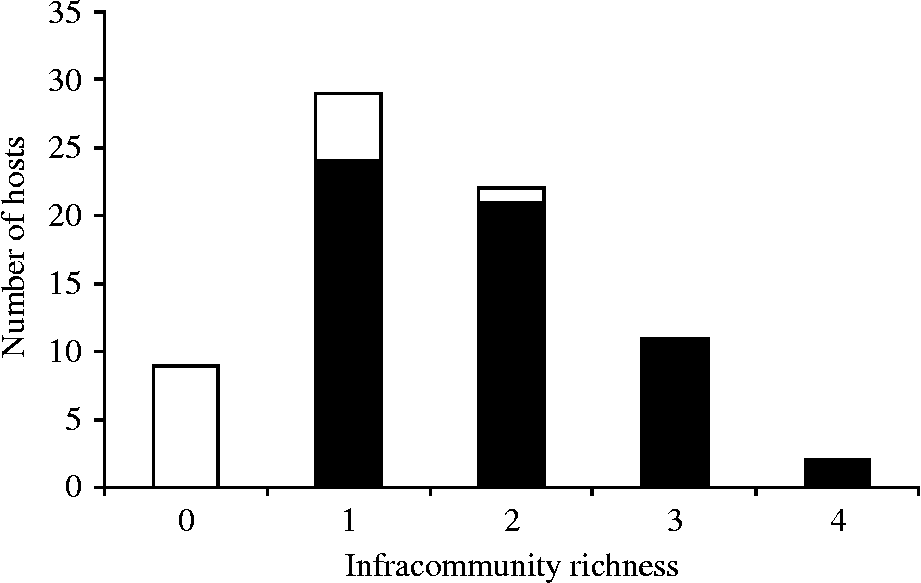
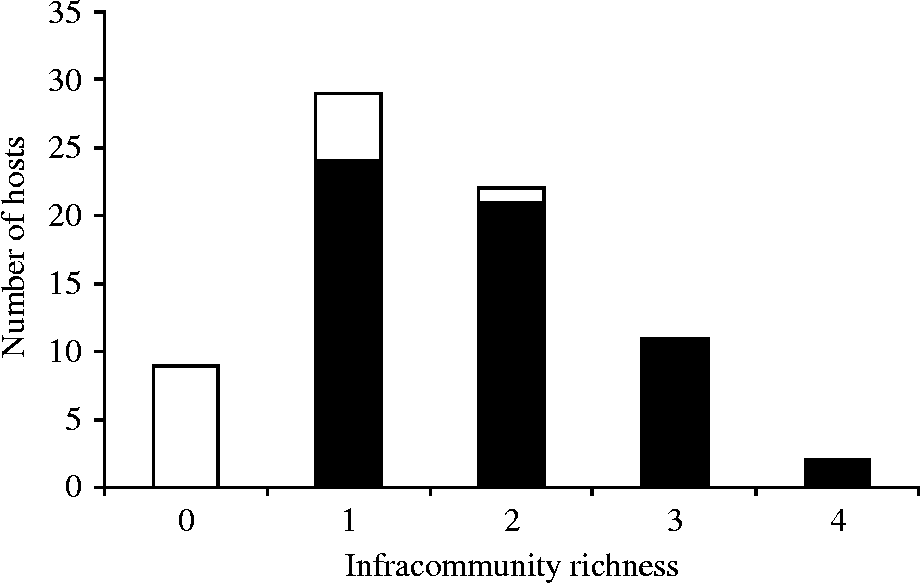
Thirty-one out of the 66 parasitized mullets (47%) harboured monospecific infections (77.4% of them represented by P. australis), with only 35 fish parasitized by two or more species. The highest infracommunity richness (four species) was observed only in two hosts (fig. 1). Species richness, when considering either all fish examined or only parasitized fish, was low (1.54 ± 0.98 and 1.76 ± 0.84, respectively). The mean number of parasites in the 35 infracommunities analysed was 10.86 ± 9.65; low values of species richness (2.43 ± 0.61) and diversity (0.41 ± 0.20) were also observed. The average values for evenness and dominance were 0.68 ± 0.27 and 0.72 ± 0.20, respectively, and 70% of infracommunities were dominated or co-dominated by P. australis, whereas 10% were dominated or co-dominated by C. australe.
Frequency distribution of infracommunity richness in Mullus argentinae. Proportion of infracommunities harbouring Prosorhynchus australis is shown in black.
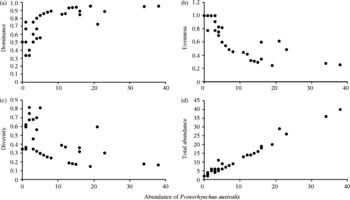
Increasing abundance of P. australis produced a concomitant increase of Berger–Parker dominance values in the infracommunities (Rs 33 = 0.83, P < 0.01), and therefore a decrease of evenness (Rs 33 = − 0.90, P < 0.01), which in turn affected the diversity (Rs 33 = − 0.53, P < 0.01) (fig. 2a–c). On the other hand, a strong relationship was observed between the abundance of this species and the total abundance of infracommunities (Rs 33 = 0.97, P < 0.01) (fig. 2d).
Effect of the abundance of Prosorhynchus australis on the infracommunity descriptors of Mullus argentinae. (a) Berger–Parker dominance index; (b) evenness; (c) Brillouin's diversity index; (d) total abundance.

Discussion
With the exception of Aponurus laguncula, Nybelinia sp. and C. australe, previously reported in Brazilian waters by Luque et al. (Reference Luque, Porrozzi and Alves2002), all other species constitute new records for M. argentinae. On the other hand, all parasites found in goatfishes have been recorded in other hosts inhabiting the Argentinean Sea, and P. australis has been reported at the adult stage as a parasite of the Brazilian codling Urophycis brasiliensis (Kaup) and the Argentine conger Conger orbignyanus Valenciennes (Szidat, Reference Szidat1961; Tanzola & Guagliardo, Reference Tanzola and Guagliardo2000; Etchegoin et al., Reference Etchegoin, Timi, Cremonte and Lanfranchi2005).
The present finding is, therefore, the first record of the metacercaria of P. australis. Luque et al. (Reference Luque, Porrozzi and Alves2002) reported the presence of ‘preadults’ (probably metacercariae) of P. ozakii Manter, 1934 in the intestine of M. argentinae from off Rio de Janeiro, and Ferrer-Castelló et al. (Reference Ferrer-Castelló, Raga and Aznar2007) and Figus et al. (Reference Figus, Culurgioni, Cortis, D'Amico and Canestri Trotti2004) found metacercariae of Prosorhynchus sp. and P. crucibulum (Rudolphi, 1819) encysted in the musculature of M. surmuletus from the Mediterranean. Apparently, there could be an evolutionary link between some members of the genus Prosorynchus and mullids, although other fish species, phylogenetically unrelated to mullids, have been cited as second intermediate hosts for Prosorhynchus spp. (Roubal, Reference Roubal1994; Laffargue et al., Reference Laffargue, Baudouin, Sasal, Arnaud, Begout Anras and Lagardère2004).
Prosorhynchus australis was the dominant species in the parasite assemblages of M. argentinae; it had a strong influence on the infracommunity structure, accounting for the highest percentage of all individuals and greatly affecting infracommunity descriptors, whose values were determined by this species. The importance of this parasite was reinforced by the low number of the trophically transmitted larval parasites, which constitutes a departure from the general pattern observed among fish species so far examined in this region. In fact, the infracommunity descriptors were the lowest reported in relation to other host species in the northern Argentinean Sea, especially in terms of species richness and diversity.
Although the degree of specificity of metacercariae of P. australis has not been established, it was absent from all other host species so far studied in the Argentine Sea, even from those sharing similar habitats to goatfish, but displayed high prevalence and relatively high abundance in M. argentinae. If this parasite is host-specific at the level of the second intermediate host, as has been observed in other bucephalids (Stunkard, Reference Stunkard1976), the phylogenetic component of the parasite fauna of M. argentinae prevails over ecological host traits in determining the structure of its parasite communities. Moreover, as bucephalid cercariae penetrate actively the tissues of the second intermediate fish hosts (Matthews, Reference Matthews1973), no food habits are involved in the acquisition of these parasites. Fish diet is, however, responsible for the presence all other endoparasite species found in M. argentinae, including the adults of A. laguncula, Derogenes varicus and Ascarophis marina, which show little host-specificity and are commonly reported in other fish species in the area.
Host ecological traits constrain the number of both species and individuals in the component communities to produce differences in parasite assemblages among fish species (Luque et al., Reference Luque, Mouillot and Poulin2004). Despite benthic fishes being expected to harbour rich parasite communities (Marcogliese, Reference Marcogliese2002), the low parasite burdens observed in the poor infracommunities harboured by goatfishes can be explained by their small size, specialized trophic habits and low level in the food chain (Guégan et al., Reference Guégan, Lambert, Lévêque, Combes and Euzet1992; Luque et al., Reference Luque, Mouillot and Poulin2004; Poulin & Morand, Reference Poulin and Morand2004). Furthermore, the total abundance of infracommunities relied completely on that of P. australis and the increasing dominance of this species in richer infracommunities reduced the evenness, producing the extremely low values of parasite diversity. The depauperate parasite infracommunities of M. argentinae are a clear example of the effect of ecological filters on parasite community structure. On the other hand, the markedly lower values of total abundance, richness and diversity in relation to Argentine goatfishes from Brazil (14, 3.8 ± 1.7 and 2.07 ± 0.97, respectively) (Luque et al., Reference Luque, Porrozzi and Alves2002) evidence the influence exerted by local environmental factors acting on compound communities in geographically distant localities (Poulin & Morand, Reference Poulin and Morand1999; Poulin, Reference Poulin2003).
In conclusion, both hypotheses concerning the composition of the parasite fauna of M. argentinae in the Argentinean Sea were refuted. There was not a dominance of low host-specific and trophically transmitted larval parasites, as expected based on the evidence from other fish parasite communities in the area. On the other hand, no dominance of trophically transmitted adult digeneans was observed, as was predicted based on evidence from mullids from other regions.
Prosorhynchus australis was the only species among all those found to display a certain degree of phylogenetic specificity. Therefore, the influence of phylogenetic factors seems to exceed that of ecological factors in determining the observed structure of the parasite communities. However, it is precisely host ecology that allows P. australis to become the determinant of infracommunity structure, by constraining the acquisition of other parasites, even when the numbers of P. australis are relatively low in individual goatfishes. This is evident after considering the high abundance and broad distribution of infective stages of parasites of low host-specificity in the regional compound community (Timi, Reference Timi2007; Timi & Lanfranchi, Reference Timi and Lanfranchi2009).
Therefore, any study aiming to determine the relative importance of evolutionary and ecological processes as structuring forces of parasite communities should take into account not only the identity and specificity of their component parasites, but their distribution and availability in the compound community.
Acknowledgements
The authors wish to thank Mr Roberto Mazella and Mr Hugo Mazella from the fish market Albatros, Mar del Plata, for kindly providing fish samples and to Dr Ken MacKenzie (University of Aberdeen, Scotland) for his critical reading of an earlier version of the manuscript. All experiments comply with Argentinean laws. Financial support was provided by grants from ANPCYT (PICT # 02199) and Universidad Nacional de Mar del Plata (EXA 442/08).