The hometown associations (HTAs) formed by international migrants sharing a place of origin are considered the quintessential “transnational” institution linking migrants to family and townspeople who stayed behind. Scholars of transnationalism present HTAs as the expression of a new kind of “transnational community” or “transnational social field” that is redefining what it means to belong to a community by including people who are physically absent but who make their presence felt through regular visits and remittances and by sponsoring charity and development projects in their hometown. New transportation and communication technologies stretching the limits of space and time are said to be the driving forces that allow migrants to belong to a single community anchored in multiple, distant geographic localities. Such migrants transcend the old boundaries of territorial belonging that depended on a sedentary population, and call into question basic social scientific concepts like “citizenship,” “community,” “nation-state,” and “migration.” Even the most recent transnationalism literature, which has retreated from some earlier claims of novelty to rediscover transborder practices of older migrations, continues to claim that new conceptions of membership are necessary to understand both new and older practices (Basch, Schiller, and Blanc Reference Basch, Schiller and Blanc1994; Levitt Reference Levitt2001; Portes and Landolt Reference Portes and Landolt2002; Smith Reference Smith2006).
Yet the “transnational” hometown associations are simply an international version of what anthropologists and historians have long known as “migrant village associations,” made up of domestic migrants from rural areas settling in the cities of countries as diverse as France, Peru, Egypt, China, Cameroon, and Papua New Guinea. From the 1920s through the 1960s, Iowan migrants to the Los Angeles area created Iowan associations that picnicked in the same public parks where Salvadoran and Guatemalan associations gather today (see, respectively, Moch Reference Moch2004; Jongkind 1974; Abu-Lughod Reference Abu-Lughod1961; Armentrout Ma Reference Armentrout Ma1984; Ottenberg Reference Ottenberg1955; Skeldon Reference Skeldon1980; Waldinger and Fitzgerald Reference Waldinger and Fitzgerald2004). With credible estimates of the number of Mexican HTAs in the United States running to over 3,000, most of the current academic, policy, and media attention to HTAs has focused on the Mexican case (Goldring Reference Goldring2002; M. P. Smith Reference Smith2003; Kearney and Besserer Reference Kearney, Besserer, Fox and Rivera-Salgado2004; R. C. Smith Reference Smith2006). What tends to be ignored in these discussions is that migrants from Mexican towns who have formed transborder HTAs in Los Angeles and Chicago have also formed domestic HTAs in Mexico City and Guadalajara. What, then, is particular about the transborder HTA, and what does that suggest about the need to reconceptualize basic social science concepts like “community” and “citizenship”?
Most studies of transnationalism exhibit a short memory, and to the extent that they are historically informed, they make only passing reference to radically different contexts to see what is “new” at the turn of the twenty-first century. For example, they draw an implicit comparison between Chinese HTAs a century ago and Mexican HTAs today (e.g., Glick Schiller Reference Glick Schiller, Hirschman, Kasinitz and DeWind1999). This paper takes a different approach by systematically comparing domestic and transborder HTAs from the same place—the county of Arandas in the Altos (highlands) region of the Mexican state of Jalisco.Footnote 1 Los Altos is the heart of the historic Mexican migrant-sending region. A comparative and historical approach allows me to distinguish what, if anything, is new or distinctive about transborder HTAs. I use the term “transborder” rather than “transnational” HTA to emphasize that such associations are formed across the geographic and administrative borders of states, even if they include people who claim to belong to one imagined nation transcending the state border. In the following pages, I describe the dawn of the domestic Arandense HTAs in the 1940s, their twilight by the 1980s, and the rise of the transborder HTAs in the 1990s. I will argue that there has been a remarkable similarity in the origins, activities, goals, and discourses of these two associational forms. Domestic HTAs were a vehicle for redefining the boundaries of local membership long before the transborder HTAs, which in fact were based on the domestic version. The discourse of extending Arandas to include its absent sons and daughters has applied equally to Arandenses in the United States and other Mexican cities. In both the domestic and transborder cases, defining community boundaries is not simply about migrants making claims to membership. It is a process subject to contestation with sedentary residents, particularly when real political power is at stake. Despite these conflicts, the domestic HTAs first institutionalized the split between residence and a popularized notion of community membership. Their historical importance has been ignored in the sociological literature on international migration, which removes them from the field of analysis by definition, and by disciplinary boundaries that have generally relegated questions of rural-urban migration to the anthropology and demography of urbanization.
Both forms of association grew out of a sense of dislocation caused by migration to what seemed like a foreign environment. Both have responded to migrants' interests in source and destination contexts. They sponsor projects in their hometowns and, at the same time, are sites for the exchange of information, resources, and companionship that ease assimilation into new host communities. The Catholic Church, followed by the state, has promoted HTAs as a vehicle for creating and maintaining voluntaristic ties between origin and destination. In both kinds of associations, migrants have been intermediaries between the county government and higher levels of Mexican government, which retain most resources needed for major hometown development. The domestic HTAs have been particularly important in this regard. Indeed, domestic HTAs and individual migrants have channeled government resources to Arandas on a scale that dwarfs even the most powerful transborder Mexican HTAs described in the literature.
Finally, although the transnationalism literature argues that improvements in communication and transportation are a primary cause of the contemporary transborder HTAs, because those systems allow migrants to participate simultaneously in life throughout a transnational social field (Portes, Guarnizo, and Landolt Reference Portes, Guarnizo and Landolt1999; Glick Schiller Reference Glick Schiller, Hirschman, Kasinitz and DeWind1999), in the Arandas case they were an effect of the work of domestic HTAs and individual migrants. Domestic migrants there had earlier mobilized their financial and political resources to link their isolated hometown to the rest of Mexico by introducing the telephone and building a highway. Contrary to the received wisdom that the “shrinking” of time and space through technology drives HTA activity inexorably forward, the comparative perspective here suggests that when transportation technologies shrink distance too much, they undermine the HTA's raison d'être.
Arandas: Cradle of Emigration
For most of its history, Arandas has been a poor, remote community dominated by small-scale, private agricultural production of corn, beans, and dairy products. Although Arandas is only sixty miles east of Guadalajara, the capital of Jalisco and Mexico's second largest city, Arandas and most of Los Altos have long been isolated from the rest of the republic. As late as the 1950s, the roads were impassable in the rainy season. In the dry season, a trip to Guadalajara was four hours by bus. It took almost two days to reach Mexico City by a combination of bus and railroad, a journey that now takes only six hours by car.
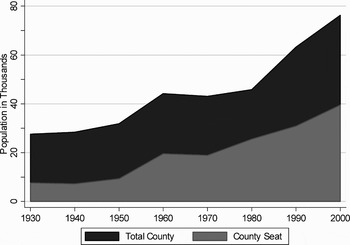
Over the last seventy years, an increasing share of the county (municipio) of Arandas' population has moved from villages and ranches into the eponymous county seat (cabecera). Emigration from the county has been even more dramatic. The first known Arandenses to migrate to the United States left around 1905 to work as seasonal track laborers from Kansas to California. The Cristero War (1926–1929) between the secular state and Catholic rebels prompted the largest exodus from Arandas in the twentieth century. Hundreds of residents fled to the United States and large Mexican cities like Mexico City, Guadalajara, and León (Taylor Reference Taylor1933). Unlike the general global pattern, in which longer-distance migrants are more positively selected given the greater costs of travel (Hatton and Williamson Reference Hatton and Williamson2005: 92), Arandenses in the United States began with a lower-class background than domestic-migrant Arandenses. Taylor Reference Taylor(1933) found the U.S. migrants were drawn from “almost all occupations and classes in the community” with the exception of the wealthier merchants, professionals, and owners of large ranches and haciendas. Railroad work was the most common job for Arandenses in the North. Others had experience in steel mills, mining, and the automobile industry. Internal migrants were even more heterogeneous. In addition to wage laborers, they included members of the local agricultural and commercial elite expelled by political push factors and attracted to Mexican cities by greater entrepreneurial and educational opportunities.
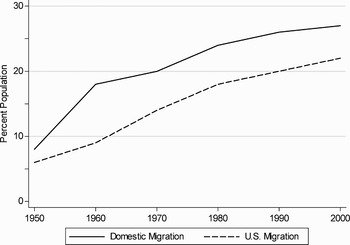
Large-scale migration continued to Mexican cities through the 1960s. From 1960 to 1970, Los Altos lost a third of its population, with a slight decline in Arandas (Winnie Reference Winnie1984). Internal migration from Arandas has outpaced U.S. migration at least since 1950, when 8 percent of the adult population had domestic migration experience and 6 percent had U.S. migration experience. In 2000, 27 percent had domestic migration experience and 22 percent had U.S. migration experience. Internal migration persists, particularly to Guadalajara, but migration to Mexico City has practically ended.
Domestic HTAs
Studies of migrant village associations in Latin America have described indigenous ethnicity as the motor of these associations (Doughty Reference Doughty and Mangin1970; Bataillon Reference Bataillon1972). For example, Orellana Reference Orellana(1973) argues that migrants' origins in indigenous communities with strong communal work traditions were a necessary condition for the formation of migrant village associations in Mexico City. The experience of Arandas and other towns in Los Altos suggests that such statements reflect anthropological interest in the indigenous rather than the broader configuration of migrant associations and their causes. Practically every town in Los Altos de Jalisco had an HTA in Mexico City during the 1940s, and Los Altos has long been considered by its residents and by social scientists as one of the “whitest,” least indigenous areas in Mexico (Taylor Reference Taylor1933). The distance (as measured by time to travel and communicate) between Los Altos and urban destinations, not indigenous ethnicity, was a necessary condition for the formation of its domestic HTAs in their several variations.
The Colonia Arandense
The local Catholic Church initiated the first HTAs from Los Altos. Alarmed by massive out-migration during the Cristero War, local clerics organized absentees in colonies to aid each other, maintain their conservative religiosity, and financially support churches that had been damaged during the war. In 1942, the parish priest in Arandas established a Pro-Emigrant Section of the Mexican Catholic Union that urged emigrants living in the United States, Mexico City, Guadalajara, and León to establish a “Colonia Arandense” in each destination to mutually aid each other and form religious study groups. The first domestic HTAs from Arandas were formed in the mid-1940s in León, Guadalajara, and Mexico City by seventeen “sons and daughters of Arandas, feeling the loneliness of their exile from their patria chica (little motherland).”Footnote 2 By the end of the decade, more Arandense colonias had formed in six other cities in Central Mexico. A representative coordinated the colonia federation's relationship with a corporatist County Cooperation Committee of thirty-nine that included subcommittees representing commerce, agriculture, workers, industry, professionals, and women. The Mexico City colonia dominated the activities of the federation. In 1946, it boasted a membership of 400, including influential bureaucrats and a radio network magnate. From 1946–1951, the Mexico City colonia published a six-page monthly newspaper, El Arandense, of which as many as 1,200 copies were distributed to Arandenses throughout Mexico and even the United States. The 1949 patron saint fiesta in Arandas drew 500 returnees from the colonias to a town with a resident population of 10,000.
What were the aims of the associations? Their first formal goal was a campaign of modernization. In the hopeful words of El Arandense, “by achieving the industrialization of our town, all of its problems can be resolved.” The lawyers, merchants, and bureaucrats who formed the backbone of the colonias dispensed money and advice to their paisanos (fellow townspeople) in Arandas. Projects over a five-year period beginning in the late 1940s included reforestation, hospital beds, telephone service, a water pump, a children's clinic, a chamber of commerce, library books, beautification of the park, art and literary competitions, cathedral construction, and a bank to make loans to farmers and ranchers. The colonia in Guadalajara developed a nine-member women's committee in 1946 for the “redemption of our Arandas woman, especially the peasant woman, to replace her antiquated working methods with modern ones, which will offer her greater comfort with less effort.” The colonia in Irapuato sent an agronomist to Arandas to teach peasants how to use improved strains of corn and other farming techniques.
A second goal of the colonias was to establish political links between Arandas and the levers of power in Mexico City and Guadalajara. Urban Arandenses acted as intermediaries to develop public infrastructure projects in Arandas by sending a delegation to meet Arandense bureaucrats in the corresponding ministries.Footnote 3 Members of the colonias sought and received public recognition for their projects in the county president's public speeches and even on national radio. In return, while claiming to be apolitical, El Arandense openly supported the candidacies of local congressional deputies and praised the work of the county president. The director of El Arandense, Francisco Medina Ascencio, was particularly adept at using the colonias to access government leaders and the resources they commanded. As a state official, and then governor of Jalisco from 1965 to 1971, he arranged for the construction of a secondary school in Arandas, highway improvements, a dam that allowed the first sustained irrigation in the county, paved streets, wells, and a drainage system. Medina Ascencio and other Arandense leaders in government obtained government jobs and admission to the public university for their paisanos in Guadalajara and Mexico City. Unofficially, Medina Ascencio had a strong hand in picking county presidents in his hometown. The circle between the migrant HTA, absentee interventions in Arandas politics, and channeling of government pesos home was complete.
Colonia leaders publicly and regularly complained of a lack of volunteerism on the part of locals in Arandas who did not share their modernizing spirit or questioned their motivations. After sending money to care for a sick child in Arandas, the colonia published the news with the question, “Now will the Arandenses who still doubt our effort believe us?” After reporting that a rich Arandense in Guadalajara donated 10,000 pesos to write a history of Arandas, El Arandense asked, “Why do many Arandenses still doubt the good faith of our labor?” These questions suggest that extending “the community” of Arandenses to include absentees deeply involved in local politics was contested by local political actors who resented the intrusion of emigrants.
A third goal of HTA organizing was mutual assistance and socializing within the destination node. Monthly meetings in Mexico City drew more than 200 Arandenses, who took their leave by saying “‘Til Arandas!”—a sort of “next year in Jerusalem” expression of belonging to a diaspora. The colonia in León offered an annual picnic that drew as many as 3,000 Arandenses and their friends. Like most groups of domestic or international migrants, the colonia drew on the social networks of its members for economic advantage. A directory of Jaliscienses living in Mexico City included several pages of Arandenses. Arandense-owned businesses in Guadalajara and Mexico City advertised discounts for paisanos. In 1948, the colonia in Mexico City organized a mutual aid society that included insurance in case of sickness or death. By 1950, the society had seventy members, and charged sub-market interest rates to members who used these loans to capitalize small grocery and retail businesses.
The organization of Arandense clubs ebbed and flowed, but all had faded away by the mid-1950s as the generation of elites that left during the Cristero Wars settled in destination cities and the federation organizers tired of devoting time and resources to publish their newspapers. Despite the decline in HTA organization of economic and political projects in Arandas, individual absentees remained critical actors in its development. A county president during the late 1950s recalled that the county budget was so meager that to fund practically any project he had to visit Arandenses living in Mexico City and Guadalajara. “The three years I was in the presidency, I was always off begging in other cities,” he said. Groups of Arandenses in those cities continued to hold parties, but they no longer raised money for development projects in Arandas. The county president usually spoke directly to four or five Arandense businessmen or politicians, who then either donated the money directly or arranged funding through their political contacts. Following a reform of state finances in the 1970s that channeled more funds to the counties outside Guadalajara, local leaders began relying on paisanos in state and federal government to arrange support for major projects that absent entrepreneurs or HTAs could not afford.
By the 1970s, local industries began to prosper, particularly factories distilling agave cactus into tequila and making dairy confections, which generated more local resources to pay for projects like paving streets. Nationally, after a long decline in the county share of total government expenditures from 12.9 percent in 1900 to 1.1 percent in 1980, the 1983 County Reform Act laid the groundwork for a greater county share of government expenses, which rose to 3.4 percent by 1991 (Díaz Cayeros Reference Díaz Cayeros1995: 82). A reapportionment of government revenues to give the counties larger budgets meant that county presidents no longer needed to ask paisanos for donations to provide basic services.
The Student Challenge
While the increase in county budgets reduced the Arandas administration’s incentive to reach out to absentees, pressure was building from Arandenses in Guadalajara seeking greater social status and their share of political power in Arandas. Several groups of Arandenses in Guadalajara formed, dissolved, and were reformed from 1945 to the present. The most influential of these was the “Arandas Social Group” (GSA), which formed in 1974 as an association of Arandense students at the public University of Guadalajara. What distinguished the GSA from previous HTAs was its base of students deeply influenced by a Marxist critique of religion and the economic elite's control of local government. The GSA sought a share of local power for its members and an allied family of capitalists in Arandas that had moved there from another part of the state. Both factions were frustrated by the existing oligarchy's monopoly of political and economic power.
When real political power was at stake, the extension of Arandas to include its “absent sons” was a matter of contention. The oligarchs of Arandas fought back against the GSA, informing the delegate of the Institutional Revolutionary Party (PRI) in Jalisco that “none of the ten or twelve persons who are said to form part of the Arandas Social Group are part of our community, because they live in Guadalajara” (Garibay Reference Garibay1993: 126). A rival publication based in Arandas attacked the “desterrados y despatriados” (the banished and exiled) who presumed to solve Arandas' problems from afar. Absentees were always vulnerable to the critique that they were not full members of the local community by virtue of their absence. The Catholic Church responded to the anticlericism of the GSA with denunciations in mass of the GSA newspaper, Antorcha, and visits to parishioners instructing them to boycott the newspaper.
In 1976, an influential candidate for governor of Jalisco broke the oligarchy's control of the Arandas county presidency for the first time since the Cristero War by imposing a schoolteacher as the official candidate in the Arandas municipal race. During this period, to be appointed as the PRI candidate in effect was to win the election. According to one explanation, the selection of the teacher was due to the GSA's ties to the University of Guadalajara's faction in Jalisco state politics, to which the state PRI owed a county presidency as its share of electoral spoils. Another version has the capitalist newcomer allied with the GSA buying the election from the Jalisco PRI. Regardless of which story is accurate, it is clear that Arandense students in Guadalajara played a critical role in the political transformation of Arandas. Once the new government was in power, GSA members took over several important municipal posts. The GSA's expectation that it would seize the reins of power in Arandas altogether was not met, but it did become one of several major interest groups as the new president was forced to compromise with local and state political interests.
The GSA disintegrated around 1982. Ultimately, its major accomplishment was to weaken the traditional oligarchy and create access for a wider array of actors to contend for the county presidency within the PRI. Student out-migrants were so successful because their project of opening up Arandas politically was consonant with a broader, long-term state project to eliminate regional powerbrokers and integrate the politically active population into the PRI (see Knight Reference Knight and Rodríguez O1990).
The Catholic Colonia
The only current organized group of Arandenses in Guadalajara is an informal religious club of seventy-five families that has its roots in similar clubs that have formed periodically since at least 1967, when an Arandense priest in Guadalajara created a group to revive the Day of the Absent Sons during the patron saint fiesta in Arandas. Every 12 November, the Arandenses in Guadalajara hold their signature annual event. Two hundred or more Arandenses gather at the Rosario church for a mass and a simple luncheon. The county president and parish priest of Arandas generally attend along with the county band. There is no discussion of projects for Arandas. The organizing committee once paid for a meal for all the absent sons who returned to Arandas for the patron saint fiesta, but the county government of Arandas now covers those costs. A smaller group of Arandenses gathers at a Guadalajara church every month for a salve, a procession through the church to honor the Virgin of Guadalupe through song. The salve group historically has been comprised of mostly middle-class, long-term residents of Guadalajara. It is one of the few remaining venues to reestablish hometown solidarity since Arandenses are no longer concentrated in one neighborhood as they were in the 1920s. The long-term future of the salve group looks grim in the face of weakening ties to Arandas among the organizers and apathy among the second generation. A sixty-two-year-old organizer who left Arandas in 1967 says he returns to Arandas less and less even though highway improvements have cut travel time: “Every year in Arandas, two or three relatives die . . . and sometimes I think, why should I go? Sometimes I take the bypass road around Arandas when I'm coming through. Sometimes I don't even stop off.” As with most other members, the organizers' adult children rarely attend the salve, although they do return to Arandas for the fiesta. The Colonia Arandense in León has declined in similar fashion. It has held a monthly salve since at least the 1950s, but around 2000 all other activities of the colonia like picnics and dances ended. The first generation leadership has mostly died or become too feeble to organize.
In broad strokes, then, domestic HTAs were critical for the economic development of Arandas in the 1940s and 1950s through direct donations, and more importantly, in their role as intermediaries between the county government and state and federal authorities. In the late 1970s, the university-affiliated HTA in Guadalajara played a critical role in opening up Arandas politics to a wider group of interests than the oligarchs that had historically controlled the county. The strength of the Arandas domestic HTA was temporary, however. Across the major destinations, HTAs have declined in the face of assimilation into the metropolitan milieu, decentralization of government, and economic growth that has generated more local resources and access to the levers of power. In the following section, I describe the modest rise of transborder HTAs, before turning to a systematic comparison of the domestic and transborder organizations.
Arandenses Abroad
The establishment of transborder HTAs from Arandas took more than a generation from the time they were first proposed. The federation of Arandas colonies in the 1940s encouraged branches to form in any city where Arandenses emigrated, including U.S. cities. The earliest known reference to U.S.-based emigrants participating in the “absent sons” procession through the streets of Arandas is to four Arandenses visiting from Los Angeles joining the parade of 500 in 1949. They reported to the colonia newspaper that they were trying to form an organization of Arandenses in Los Angeles. During the 1940s and 1950s, the only other accounts in El Arandense about paisanos in the United States was confined to social news of musicians on tour and elites living in Mexico who took their holiday in the North. As late as the 1970s, the county president of Arandas did not send invitations to the patron saint fiesta to migrants living in the United States, as he did to migrants in other parts of Mexico. At the time, Arandenses in the United States almost exclusively worked in low-wage jobs. For the same reason, county awards for distinguished Arandenses were offered only to paisanos living in other parts of Mexico, and the government did not seek funds from Arandenses resident in the United States.
Settlement patterns also inhibited the early development of U.S.-based HTAs. In the early 1930s, Taylor Reference Taylor(1933: 41) found “there was no tendency to form large and distinct Arandas colonies.” He reported that Arandenses had migrated to at least twenty-four U.S. states, which by 2003 had fallen to sixteen states, according to my study's survey. Arandenses living in the United States did not begin to organize groups until residential concentrations formed in greater Los Angeles and greater Chicago in the 1970s, though even there the lack of concentration within these metropolises has hindered HTA organization. By the 1980s, there were two soccer teams each in Orange County and Union City, California, and one each in Los Angeles and Chicago. Soccer clubs are often the basis for an HTA whose activities extend far beyond sports. One of the Arandas soccer teams in Orange County grew into the Social Club of Arandas. In 1978, Arandenses from northern and southern California began meeting every July 4th for a soccer game between representatives of the two destination nodes, followed by a party. They alternate every year between the San Francisco Bay area and Orange County. Club members have estimated that in its heyday in the 1990s it drew from 200 to 1,000 Arandenses.
Arandense HTAs have made charitable donations in Arandas. The Social Club donated four ambulances to the Arandas Red Cross in the late 1990s. An organization of about ninety families in Orange County formed in 1994 to compete with the Social Club as the legitimate voice of Arandenses in southern California. The new club leaders claimed that the older club was dominated by status-seekers who were not committed to altruistic hometown projects. Led by a cadre of half-a-dozen mostly middle-class men, the Arandense Community raised U.S.$2,000–3,000 a year in the mid-1990s for charity projects in Arandas. Like many HTAs, the Community took up collections to help pay for the repatriation of Arandenses who died in California. Cooperation with county authorities and the Social Club was hindered by struggles over who should receive public recognition for developing projects in Arandas and by rumors that county officials in Arandas kept the best donated clothes for themselves. Arandense Community leaders discussed building a clinic in Arandas, but before the project began the club disbanded over persistent rumors that club leaders were siphoning funds.
The timing of the development of Arandense HTAs in the United States is consistent with the broad pattern of Mexican HTA formation. As part of the federal government's renewed effort to embrace Mexicans in the United States, the Secretariat of Foreign Relations (SRE) in 1990 initiated the Program for Mexican Communities Abroad. The program encouraged migrants to form new HTAs, register them with the consulates, and cooperate with the Mexican government on hometown development projects. The Federation of Jalisciense Clubs in Los Angeles formed in 1991 and was followed by the Federation of Jalisciense Clubs in the Mid-West four years later. Following proposals by the SRE and the Los Angeles federation, the opposition governor from the center-right National Action Party (PAN) formed the Office of Attention to Jaliscienses Abroad (OFAJE) in 1996 and visited Jaliscienses in the United States a dozen times from 1995 to 2001. His PAN successor has been equally active. The OFAJE offers county presidents and migrants practical guidance on how to start an HTA. A 158-page book distributed in 2004 to HTAs in the state and interested migrants provides a template for HTA statutes and a directory of Jalisciense clubs in the United States.
According to Mexican consular registries, the number of Mexican HTAs grew from 263 to 815 between 1995 and 2005 (Lanly and Valenzuela Reference Lanly and Valenzuela2004; Migration News 2006). Lanly and Valenzuela Reference Lanly and Valenzuela(2004) estimate that only about a quarter of Mexican HTAs register with a consulate. HTAs often disintegrate and then re-form a few years later, sometimes under a different name. In some communities, ad hoc groups form and disband with each fiesta cycle. A loose definition of association to include the many ad hoc groups would suggest there are around 3,000 Mexican HTAs in the United States. Most are concentrated in California, Illinois, and Texas. In a 2004 survey of Mexicans in the United States that solicited a matrícula consular identification document, 14 percent reported belonging to an HTA (Suro Reference Suro2005). In 2005, registered HTAs donated U.S.$20 million to hometown projects, which when complemented with matching funds from municipal, state, and federal governments through the “3 × 1” program, generated U.S.$80 million in investment. In the first three years after it was expanded nationwide in 2002, the “3 × 1” program supported nearly 4,000 social investment projects (Migration News 2006; Inter-American Development Bank 2006).
The Arandas clubs have not participated in the 3 × 1 program, given the county government's alternative sources of funding, but the clubs remain active. The July 4th soccer game between Arandenses in Northern and Southern California is now organized by a wealthy Arandense restaurateur, Joaquín (a pseudonym), and a handful of paisanos that formed the Club Arandas. Joaquín is an unassuming man who migrated to Orange County without papers in 1974 to pick strawberries. By the 1980s, he was selling tacos from a lunch truck during Arandas club soccer games in Orange County. He is now a U.S. citizen who owns a chain of eight Mexican restaurants and lives on a private street that bears his name. Joaquín is also a spokesman for the Jalisciense federation in Los Angeles. When the governor of Jalisco visited California, Joaquín lobbied for a sewage treatment facility and a branch of the University of Guadalajara for Arandas. The outcome of that lobbying was uncertain as of this writing, but it has become increasingly common for Mexican migrants to intervene on behalf of their communities of origin with state and federal officials visiting the United States, sometimes with success (Lanly and Valenzuela Reference Lanly and Valenzuela2004). In general, the level of activity of the Arandas HTAs seems typical of Mexican transborder HTAs. They have sponsored hometown projects and made charitable donations, interceded with state and county officials on their visits to the North, and waxed and waned with charges of financial impropriety and leadership struggles (Fitzgerald Reference Fitzgerald2000; Goldring Reference Goldring2002; Smith Reference Smith2006).
Visiting Paisanos
Since Arandenses in California and Chicago first invited the county president of Arandas to visit in 1995, he has generally attended at least one of their annual signature events, usually the July 4th soccer game or a Señorita Jalisco competition to crown a young woman to represent Jaliscienses in the United States. Opinions are split among Arandenses in the United States and in Arandas over whether these are serious fund-raising trips, attempts to seek political support indirectly by showing concern for migrants, or simply junkets. In the 1990s, all three PAN county presidents raised funds from Arandenses in the United States for various vehicles and funds for a small hospital. A federal deputy noted in an interview that, during the 1990s, county presidents throughout the Los Altos region successfully visited HTAs and sister cities in the United States and brought back equipment for schools and hospitals and vehicles to collect trash and transport students.
The trips are not motivated only by social projects, however. A former county president of Arandas described the fund-raising limitations of the trips in an interview: “My wife went with me every time I went, and I invited several regidores (aldermen) too. I also invited two or three people who were not part of the administration. . . . It costs more money to take a trip to visit (the paisanos) than what they can donate at a given moment. I think that going to greet the paisanos there is the true motive of going.”
Politicking is also part of cross-border trips, although it is subtle. Few Arandense elites see emigrants as being politically involved. Transborder HTAs are unlikely to be vehicles for intensive political involvement or the transformation of Arandas like earlier domestic HTAs. Indeed, transborder Arandense HTAs have been avowedly apolitical. Joaquín has close relationships with both PAN and PRI leaders, and the quality of ties between the HTAs and county authorities does not seem to depend on the party in power.
The “soft” politicking of a trip to visit paisanos in the United States to show concern for migrants among voters back home meshes neatly with the junket function. The relative wealth of Arandas derived from the tequila industry, and its status as a small city, probably make Arandense officials more likely to approach their trips to the United States as excursions in comparison to officials from impoverished rural communities desperate for funds. Transborder HTAs are also more influential in communities with strong traditions of collective village labor and mandatory participation in local governance.Footnote 4 The importance of HTAs to a source community is inversely related to its degree of economic development.
Welcoming the Prodigal Sons
The patron saint fiesta is the primary public venue in which emigrants express a collective presence in their source communities. In Arandas, the local parish and county governments coordinate absent sons activities, with the former taking charge of the procession and mass, and the latter the luncheon and recognition of outstanding Arandenses in the United States. Arandenses living in the United States have been recognized as a corporate group in the Arandas fiesta since at least the late 1970s. In 2004, about 200 migrants paraded through the streets of Arandas behind a local marching band and banners of the Colonia Arandense in Guadalajara. Their number multiplied several times over when they reached the church. The parish priest and the visiting Arandas-born Bishop of Tlaxcala delivered homilies welcoming the absent sons and asking them to remember their families, origins, and traditions.
Nearly 1,000 migrants and their families attended the county luncheon for the absent sons that year. Officials estimated that 70 percent lived in the United States and 30 percent in Guadalajara, Mexico City, and other parts of Mexico. Several Arandenses in the United States were honored during the luncheon, representing the two kinds of ideal migrants in elite discourse at both the local and national levels. The first is one who becomes economically successful in the United States and returns to Arandas to build a house and start a business. The federal SRE has attempted to collect from the Jalisco OFAJE examples of “successful Mexicans who have returned from the United States and are now reintegrated into the economic and political lives of the communities of our country.” A publicity poster was printed asking successful returnees to call the SRE branch office in Guadalajara to identify themselves. The second type of ideal migrant achieves economic success and settles in the United States more or less permanently but returns to Arandas regularly for extended vacations. Joaquín, who has given money to Arandense charities outside the HTA framework as well, is a prime example. The SRE also has a program to identify this type of individual. The second type is most consistently targeted by the Arandas county government via the HTAs.
In private interviews, county officials presented their welcoming activities for the absent sons as an investment in paisano tourism. “We want them to come here instead of going to Acapulco or Orlando. . . . When they come here, they bring money and spend,” said one Arandense official involved in creating a directory of migrants to mail them fiesta invitations. Of the many fiestas in Arandas, the patron saint fiesta is the only one that generates net income for the government through sales of commercial licenses and exposition tickets. The absentee luncheon costs the county U.S.$5,000 out of total county fiesta expenditures of U.S.$130,000, which generated income of U.S.$250,000. The profit of U.S.$80,000 was donated to various social services in Arandas. At the state level, the OFAJE is developing a Paquete Paisano (Compatriot Package Tour) as a collaboration of state tourism officials and private operators offering tourism packages directed at Jaliscienses in the United States. The advantage of promoting paisano tourism over migrant-sponsored collective projects is that the former avoids problems of collective action. Encouraging migrants to return to the fiesta for their own enjoyment and the cultural edification of their children brings diffuse but much more important economic returns than a typical HTA-sponsored project. The median pocket transfer reported by household heads was U.S.$3,000 in Arandas and U.S.$1,000 in Agua Negra (Mexican Migration Project (MMP) 2003 Los Altos Survey). One family of returnees could easily spend as much as the amount raised at a typical HTA event. Second, politicians have less reason to worry about migrants transforming their collectively donated economic capital into political capital and the generation of demands on government services, or even worse, for political change.
The Rise, Fall, and Rise of the HTA
What explains why domestic HTAs grew beginning in the 1940s and then declined, while transborder HTAs have grown since the 1990s? The timing of the waxing and waning of these organizations lies in a constellation of factors. The first is exogenous stimuli from above. The Catholic Church promoted the domestic HTAs in the early 1940s to renew ties between local parishes and migrants who had fled a hinterland plagued by violence and poverty for the greater security and opportunities of major cities. Transborder HTAs with both secular and religious orientations began to form on a widespread basis in the 1990s. Their formation accelerated quickly when the Mexican government at the federal, state, and county levels launched a successful project to institutionalize its relationships with existing transborder HTAs and promote the creation of hundreds more. The external stimuli of the Church and state are a necessary but insufficient explanation, because they do not explain the timing of the growth of transborder HTAs in the 1990s, nor the reason that thousands of migrants responded voluntarily to state and Church initiatives.
Migration patterns are a second critical factor. Both the transnationalism and classic assimilation literatures are misleading, because the permanence of settlement, rather than increased circularity, has driven emigrants to make claims to membership in the community of origin as a corporate body despite their physical absence. Since the end of the Bracero program in 1964, and accelerating with the 1986 Immigration Reform and Control Act that granted amnesty to more than two million Mexicans, migrants have become more settled and concentrated in their destinations (Massey, Durand, and Malone Reference Massey, Durand and Malone2002). Enough time has passed to allow a handful of Arandenses to claw their way from menial jobs into the middle class and even entrepreneurial wealth. According to a University of Guadalajara study, migrants to the United States generate U.S.$2,500 for a typical family in the county's second-largest town of San Ignacio, ten times more than the average remittances received from internal migrants (Valenzuela Reference Valenzuela and Bernal2002). Migrants to the United States have much deeper pockets than their domestic counterparts. Nevertheless, significant internal migration continues from Arandas, even as the domestic HTAs totter or have collapsed.
A complete explanation of the decline of the domestic HTA and rise of their transborder counterparts must include changes in the centralization of Mexican government. On one hand, devolution, as measured by the increasing county share of total government spending, and the spatial de-concentration of government by spreading branch offices of federal agencies throughout the country, explains why local governments no longer see domestic HTAs as necessary. Local governments now have budgets based on the collection of property taxes, for example, that allow them to carry out projects in a way that was impossible in the 1940s and 1950s when the federal government controlled virtually all government spending (see Rodríguez Reference Rodríguez1997). Domestic HTAs are no longer necessary to serve as liaisons between the governments of peripheral towns and the state and federal capital.Footnote 5 On the other hand, the literature on transborder HTAs emphasizes that the decentralization of Mexican government is one of the driving forces behind the accelerated formation of HTAs in the early 1990s. One of the hallmarks of the administration of president Carlos Salinas de Gortari (1988–1994) was the National Solidarity Program for regional development and the alleviation of poverty, which included a sharing of planning and costs among the three levels of government and local citizens. Community participation extended to migrants in the United States, who were encouraged to contribute through the “International Solidarity” version of the matching fund program (Smith Reference Smith2006). Decentralization has encouraged transborder HTAs while discouraging domestic HTAs. Having lost their secular function, domestic HTAs have retreated to the strictly religious sphere, at the same time as transborder HTAs are expanding from the religious to the secular spheres. The question remains of why domestic HTAs did not form again to participate in Solidarity and similar secular programs when the opportunity structure was put back into place.
The final piece of the puzzle, explaining why domestic HTAs began and declined even as transborder HTAs continue, is nationalization, in Deutsch's (Reference Deutsch1966: 94) sense of the “complementarity” of communication habits and acquired social and economic preferences that unify a state's population. International migrants create HTAs as a means of coping with a sense of difference and alienation in the receiving country (Moya Reference Moya2005). I argue that given the limited nationalization of the Mexican populace during the domestic rural-urban migrations of the 1920s–1960s, the impetus for domestic migrants to become involved in their sending communities was strikingly similar to the conditions driving contemporary international emigrants to maintain connections to distant source areas. Over the last eighty years, as source communities like Arandas have become more nationally integrated through public education, all manner of government programs, and transportation and communication networks, a sense of displacement has dissipated among domestic migrants. Indeed, the domestic HTA has dug its own grave by contributing to the decline of local isolation that was the association's raison d'être. The HTA organizers of the 1940s and 1950s, along with individual absentees, improved the transportation, communication, and educational infrastructure of Arandas in a way that eroded the distinctions between the provincial town and the metropolis. “The highway brought in outsiders,” explained a seventy-year-old businessman who had organized the Mexico City HTA during the 1960s. Decades of massive, sustained contact between Arandas and other parts of Mexico diminished local distinctiveness. A sixty-two-year-old organizer of the religious club of Arandenses in Guadalajara explained that newcomers to Guadalajara don't join the HTA because Guadalajara is no longer such a radically different context from Arandas. “Arandas changed its life—why? Because of the means of communication, the means of transport, because when you're in Guadalajara, you can be in Arandas in an hour and forty-five minutes . . . There are no longer those red-tiled houses with a little room with wooden doors and a giant key. Now everything you live there, you live here. So I don't think there's much difference.”
An Arandense who first arrived in Mexico City in 1951 contrasted the prestige and sense of adventure in going to Mexico City then and in 2004: “When people saw someone who had been to Mexico City come back, they said, ‘Ooh, look, he’s been to Mexico City!' It was a source of admiration back then. Now, going to Mexico City is like going to the corner. Same for going to the U.S., too. In four or five hours you're there.” One local newspaper has called the modernization of Arandas its guadalajarización.
The participants in domestic HTAs are mostly older people who remember what a shock it was to move from Arandas to a metropolis. For their children in Arandas who patronize the six Internet cafes and speed to Guadalajara on a divided four-lane highway, the isolated highlands town is gone forever. On the other hand, the nation-making activities of the U.S. and Mexican states will continue to enforce the social cleavages between the United States and Mexico that drive transborder HTAs. Transborder HTAs, at least among the first generation, are likely to continue to operate while their domestic counterparts decline. The specific hometown basis of these Mexican organizations in the United States will likely continue even in the face of growing integration within Mexico, given that hometown networks structure flows of migrants between specific Mexican and U.S. localities by channeling information about crossing the border and obtaining lodging and jobs (see Massey et al. Reference Massey, Alarcón, Durand and González1987).
What Is Unique about the Transborder Hta?
There are remarkable similarities in the causes, activities, goals, and discourses of both domestic and transborder HTAs over the past sixty years. These similarities call into question the claim in the transnationalism literature that migrants' transborder ties require a radical new conception of community and membership. At a minimum, the historicity of the claim is questionable. The domestic HTAs that preceded the transborder HTAs first changed local conceptions of community in these areas. The inclusion of absentees in the political community was driven by similar subjective and structural differences between source and destination, concentrated settlement patterns, political centralization creating spaces for migrants as intermediaries between levels of government, and external stimuli from Church and state.
There has been a debate in the migrant village association literature about whether such clubs provide a temporary refuge for newcomers that slowly integrates them into city life or if, instead, HTAs are a vehicle for maintaining ties with the home village and sponsoring development projects there (Skeldon Reference Skeldon1977). The migrant village association debate mirrors the discussion in the international migration literature about whether the transborder HTA is a site of assimilation, like other ethnic institutions, or a vehicle for maintaining homeland ties (cf. Park Reference Park1950; and Smith and Guarnizo Reference Smith and Guarnizo1998). In the end, different migrant associations have emphases that change over time, but the two functions are not mutually exclusive. Both domestic and transborder hometown associations can be vehicles for pluralist assimilation to new contexts while still maintaining substantive ties to origin communities (Hirabayashi Reference Hirabayashi1986; Fitzgerald Reference Fitzgerald2004).
The Arandas domestic and transborder HTAs combined activities oriented towards both source and destination contexts. Examples of the latter include club activities that offer companionship and the practical resources channeled through hometown social networks that allow newcomers to make their way in the metropolis. Both forms of HTAs have provided mutual aid for members who are sick or whose bodies require repatriation, though the Colonia Arandense in Mexico City's mutual savings society in the 1940s supersedes the typical portfolio of Mexican HTAs in the United States. Finally, preferential pricing for paisanos has been formalized in both contexts. Examples include the Arandenses in Guadalajara who created a professional directory and gave discounts to Arandense shoppers at their stores, and the ongoing project of merchants in the Jalisco federation in San Antonio, Texas, to do the same for other Jaliscienses.
Migrant-sponsored modernization projects in their hometowns and fund-raising visits by political and religious leaders to satellites have been basic features of both domestic and transborder HTAs. Local leaders will obtain resources wherever they can get them, whether it requires traveling to Los Angeles or Mexico City. In both cases, government business may be intertwined with politicking and the desire to take one's holiday at public expense. In Arandas, the domestic HTAs of the 1940s and 1950s were far more important in the development of Arandas than the transborder HTAs have been. An impoverished community depended on paisanos in Mexico City and Guadalajara to obtain a highway, telephone service, a dam, paved streets, and other basic infrastructure. The current level of economic development in Arandas would have been impossible without that infrastructure in place to produce goods and ship them to regional, national, and, in the case of tequila, global markets.
The tendency in Arandas for solicitors of funds to approach individual patrons in the United States, like Joaquín, is a return to the fund-raising style of the county presidents who sought out individual Arandenses living in large Mexican cities in the 1950s, when negotiations were direct and problems of collective action avoided. From the perspective of hometown politicians there is an unstated advantage of private donations: they are not as easily leveraged into political capital for groups of absentees like the 1940s Colonia Arandense federation or 1970s university students in Guadalajara who helped overthrow the Arandas oligarchy. Of course, not all Mexican communities have produced migrants with the wherewithal to make large individual donations. Smaller rural communities may have no choice but to encourage the collective action of migrants.
Both domestic and transborder HTAs have directly made hometown donations, but more important for the HTAs has been their role as intermediaries with state and federal officials. Joaquín's lobbying with the governor of Jalisco on his visits to California represents an interesting twist on the notion of HTAs as political intermediaries between the Mexican center and its periphery because the lobbying takes place abroad. Transborder HTAs have been able to gain political leverage in Mexico not only through their collective remittances, but also because they are seen as one of the few legitimate voices to represent the 10 million Mexican-born in the United States in their relations with the Mexican government. The renewal of competitive party politics in Mexico in the 1980s and the expansion of the Mexican political field to include Mexicans in the United States have driven state and federal interest in establishing ties to the HTAs. A form of migrant lobbying that distinguishes transborder from domestic HTAs occurs when Mexicans living in the United States act as intermediaries to establish sister city programs between the governments of their Mexican places of origin and their U.S. destination. Like county governments throughout central west Mexico, the government of Arandas has attempted such a strategy, albeit unsuccessfully. A similar call for cross-border lobbying came during the 2004 absent sons luncheon, when an SRE official from the Albuquerque consulate, in attendance because his wife is from Arandas, called on Arandenses in the United States to contact their U.S. congressional representatives to promote President Bush's proposal for regularizing long-time undocumented Mexicans in the United States. Mexican HTAs have been slow to become involved in U.S. politics, but they represent a potential institutional sphere for intermediating between the governments of Mexico and the United States through ethnic lobbying. While there is good reason to be skeptical of the chances that an effective lobby will form, the point of theoretical significance is that international migrants' place in two different political systems provides them a space to act as intermediaries through a transborder HTA, as the place of domestic migrants in a nested federal system provides a space for the intermediation of a domestic HTA.
Certainly, domestic, and transborder associations are not the same. The international border separating HTAs in the United States from Mexican hometowns complicates the flow of material goods. Although Mexicans in the United States can act as intermediaries between their hometown governments and Mexican state and federal officials visiting the United States, and between hometown governments and sister city governments in the United States, they are nevertheless in two separate political systems. Migrants who rise to positions of political prominence in the United States can help fellow Mexicans obtain government resources in the United States, but they cannot channel massive development back home like the Arandenses in Mexico City did in the 1940s.
In the case of Arandas, the domestic HTAs have been far more important in creating hometown development and political change than have the transborder HTAs that began forming in the 1970s and took off in the 1990s. Even the most stellar examples of transborder HTAs in the contemporary Mexican migration literature, like the migrants from Ticuani living in New York who developed and then controlled the potable water supply in Ticuani en absentia (Smith Reference Smith2006), do not approach the level of hometown influence of the Colonia Arandense federation in the 1940s and the Arandas Social Group in Guadalajara in the 1970s. The experience of domestic HTAs from Arandas has been similar to that of Oaxacan HTAs in Mexico City that dominated their towns of origin economically and politically in the 1960s (Orellana Reference Orellana1973; Hirabayashi Reference Hirabayashi1986). Here, Arandas is not idiosyncratic either in Mexico or internationally—many studies have found similar degrees of HTA influence in developing countries, which in some cases continues to this day (e.g., Kane Reference Kane, Bryceson and Vuorela2002).
Time and Space
The transnationalism literature has argued that new technologies allow absent migrants to maintain intense ties with people in their source community in a way that is novel to the contemporary era (Portes, Guarnizo, and Landolt Reference Portes, Guarnizo and Landolt1999). Skeptical historians reply that nineteenth-century technologies enabled quite intense long-distance ties and were likely more important for achieving that possibility than the new technologies of the late twentieth century (Moya Reference Moya2004). All agree that technologies like the Internet and jet travel increase the mobility of people, goods, and information, but there are no clear measures for determining when a quantitative shift creates a qualitative shift in the kinds of long-distance ties that are possible. The Arandas case suggests caution in claiming a qualitative shift. For example, Mexican migrants in U.S. destination cities gather to share their videos of hometown festivals celebrating migrants' return, thus creating a sense of community even among those migrants who could not go back (see also Fitzgerald Reference Fitzgerald2000; Smith Reference Smith2006). Yet exactly the same purpose was achieved by 1940s Arandense migrants who distributed movies shot among their colonies in Mexico City and Guadalajara. Rather than the implicit “old versus new” dichotomous view of transportation and communication technology found in the transnationalism literature, it is more useful to think of periodic surges of innovation that make interaction between source and destination faster, and more frequent and intensive. Today it is certainly easier to participate in the life of a locality while being physically absent; the patron saint fiesta and salve in Arandas are now broadcast free over the Internet to anyone who cares to watch. Yet the introduction of telephone service to Arandas in 1953, with financial assistance from the colonia in León and the mobilization of the Mexico City colonia's political contacts, was surely much more important than the Internet for long-distance communication. As Giddens Reference Giddens(1987: 14) reminds, “electronic communication for the first time in history separates ‘immediate’ communication from presence.” These technologies date back to the nineteenth century and are equally useful for connecting long-distance domestic and international migrants to their hometowns.
One conclusion of the anthropological literature on migrant village associations in Latin America is that considerable geographic distance between source village and destination city is a necessary condition for the formation of associations. If the village is too close to the city, migrants simply return home for the companionship of fellow villagers or to attend to their affairs (Hirabayashi Reference Hirabayashi1986). The Mexican HTAs in Los Angeles, Chicago, and New York that the transnationalism literature studies are hundreds of miles from source communities in central Mexico. The importance of distance for transborder HTAs has been ignored because long geographic distance is simply assumed. There are practically no Mexican HTAs in U.S. border cities, and those that do exist in places like San Diego are formed by migrants from distant parts of Mexico like Oaxaca. One finds no HTA of migrants from Nuevo Laredo, Tamaulipas living in Laredo, Texas because migrants can simply walk across the bridge to go home. By taking geographic distance as a given, because of the cases selected, the transnational migration literature emphasizes the role of technologies that “shrink” distance. In the quintessential example, HTA leaders in New York City can fly to central Mexico for the weekend to inspect an HTA-financed infrastructure project (Smith Reference Smith2006). It would be more difficult for HTA members to sustain that level of involvement in their hometowns if such a journey were a matter of days rather than hours.
This study suggests that a more important condition of HTA formation and activity is significant distance measured by the time it takes to travel from source to destination, and, related to this, the subjective experience of difference between the two localities. The improved transportation networks between Arandas and major destination cities like Guadalajara and León means Arandenses can now commute several times a week. The HTAs that remain today are narrowly focused on religious performances, have few members, lack appeal for the second generation, imply no serious obligations for participants, and maintain limited contact with hometowns. The function of improving transportation networks in driving long-distance ties is not as linear as the literature claims. There is a turning point at which improved transportation technologies have a dampening effect on long-distance ties and their institutionalized expression through HTAs.
Finally, the transnationalism literature emphasizes that “community” can no longer be defined as a geographic entity alone, because absent migrants create a “deterritorialized community” (Appadurai Reference Appadurai and Fox1991; Smith Reference Smith1994; Basch, Schiller, and Blanc Reference Basch, Schiller and Blanc1994). The HTA crystallizes the territorial rupture of community membership. However, the discourse of the extension of Arandas and its territory to include its “absent sons” is the same for the Arandenses in Mexico City as for those in Chicago. As the Arandense colonia newspaper in Mexico City put it to readers in 1950, “In reality we are not outside Arandas; the presence of all of you establishes an extension of the red earth [of Arandas] and our beloved town” (El Arandense 5 Feb.). The equivalence of the domestic and transborder absent sons is commonly expressed in the patron saint fiestas that celebrate their returns throughout central west Mexico. To claim that community boundaries were strictly coincident with geographic boundaries prior to the contemporary era of “transmigration” is to fetishize the significance of crossing an international boundary and ignore the regularity of long-distance ties between associations of mobile paisanos and the places they call home.
Population of Arandas County and County Seat, 1930–2000 (Source: Fitzgerald Reference Fitzgerald2005).

Percentage of Adult Population in Arandas with Domestic and U.S. Migration Experience 1950–2000 (Source: 2003 author survey for the Mexican Migration Project).