INTRODUCTION
The physical illness of a loved one is typically associated with uncertainty, anxiety, and fear among family members, as well as a sense of a loss of control (Mok et al., Reference Mok, Chan and Chan2002; Strang et al., Reference Strang, Koop and Peden2002; Broback & Betero, 2003; Kristjanson et al., Reference Kristjanson, Cousins and White2004; Seamark et al., Reference Seamark, Blake and Seamark2004; Stajduhar et al., Reference Stajduhar, Martin and Barwich2008). Research on the psychological and emotional impacts of illness or disability suggests that these experiences involve secondary control strategies, an enhanced need for trust, and seeking the guidance and support of a professional authority figure rather than active “consumer” behavior such as idealized in empowerment philosophies of care (Rothbaum et al., Reference Rothbaum, Weisz and Snyder1982; Waterworth & Luker, Reference Waterworth and Luker1990; Donaldson et al., Reference Donaldson, Lloyd and Lupton1991; Anderson, Reference Anderson1996; Lupton, Reference Lupton1997). In addition, family members providing care for an ill or dying family member at home may face additional uncertainties regarding their ability to provide adequate end-of-life care (Broback & Betero, 2003).
In the context of this experience, many family caregivers look to health care providers for guidance and expertise; in addition, it is particularly important, in this context for family members to feel they can trust these health care providers. Although the concept of trust in health care providers has been explored in a variety of literature (Strang et al., Reference Strang, Koop and Peden2002; Heyland et al., Reference Heyland, Dodek and Rocker2006), there is some indication (as we discuss below) that a broader concept of “security,” encompassing trust but extending beyond it to include the emotional experience of feeling supported and secure in one's caregiving role, may be important. However, the concept of security has not been fully explicated to date in empirical research particularly focusing on the concept and instead remains embedded as themes or subthemes within a wide range of studies on palliative family caregiving.
The purpose of this article is to explore family caregiver accounts of their experiences within the health care system (and with individual providers). Considered together, the emerging findings can be viewed as manifestations of a need and desire for security in several differing dimensions. After reviewing the literature relevant to the concept of security in palliative family caregiving, we present findings from a qualitative, thematic analysis of data from 31 current and recently bereaved family caregivers.
Literature Review
There is little doubt that when faced with the daunting task of providing end-of-life care and making decisions about such care, family caregivers often place trust and confidence in both the healthcare system and professionals. In a recent study by Heyland et al. (Reference Heyland, Dodek and Rocker2006) trust and confidence in doctors was found to be the most important item related to family caregiver satisfaction with quality of end-of-life care. Relatedly, in a study examining the meaning of respite at the end of life, family caregivers noted the importance of having health care professionals whom they can trust to look after the patient (Strang et al., Reference Strang, Koop and Peden2002). Trust and confidence are closely related to perceived competence in the health care provider or health care system. The importance of competence for individuals' ability to cope with and manage providing end-of-life care to a dying family member at home has been established in research by Stajduhar et al. (Reference Stajduhar, Martin and Barwich2008) and Milberg and Strang (Reference Milberg and Strang2004).
A broader concept of “security,” encompassing trust, confidence, and perceived competence in health professionals, has been addressed in some palliative family caregiving research yet has not been fully explicated or defined. A notable exception is the theoretical work of Öhlén et al. (Reference Öhlén, Andershed and Berg2007), who discuss the term “safety.” Drawing on findings from a systematic review of family members' situation and needs for support in end-of-life care (Andershed, Reference Andershed2006), their own clinical experience, and theoretical reasoning, the authors highlight the significance of family members' need for safety, confidence, and trust (Öhlén et al., Reference Öhlén, Andershed and Berg2007) and note that “we have not found any theory or model of relatives' need for safety and security” (p. 383). Their conceptualization draws on a combination of safety (e.g., being safe from harm), security (e.g., freedom from danger, fear, and anxiety), and trust. They also draw on the concept of safety articulated in Maslow's (Reference Maslow1970) hierarchy of human needs, which “includes security, stability, dependency, protection, freedom from fear, anxiety and chaos, need for structure, order law and limits and strength in the protector” (Öhlén et al., Reference Öhlén, Andershed and Berg2007, p. 386). The authors propose strategies to promote feelings of safety for relatives at the level of nursing interactions. However, particular dimensions of safety are not fully explicated in the paper, which focuses on developing a goal-oriented, praxis theory (i.e., strategies for change) as opposed to articulating the dimensions or dynamics of the concept.
Security or related concepts have also been identified as important features of coping with providing palliative care at home (Kristjanson et al., Reference Kristjanson, Cousins and White2004; Stajduhar et al., Reference Stajduhar, Martin and Barwich2008), truly empowering interactions within the health care system (Mok et al., Reference Mok, Chan and Chan2002), perceived access (Albinsson & Strang, Reference Albinsson and Strang2003; Goldschmidt et al., Reference Goldschmidt, Schmidt and Krasnik2006; Stajduhar et al., Reference Stajduhar, Martin and Barwich2008), and satisfaction with quality of care (Ingleton, Reference Ingleton1999; Heyland et al., Reference Heyland, Dodek and Rocker2006). Recently, however, there has been some research that might indicate that the concept could be extended to include the emotional experience of feeling supported and secure in one's role and having clear and mutually accepted role expectations (Mok et al., Reference Mok, Chan and Chan2002; Albinsson & Strang, Reference Albinsson and Strang2003; King et al., Reference King, Bell and Thomas2004; Stajduhar et al., Reference Stajduhar, Martin and Barwich2008). For example, it has been described as a feeling of “not being abandoned or left alone in the caregiving process” (Mok et al., Reference Mok, Chan and Chan2002, p. 137) and of being “reassured that the healthcare system would be there to support them when they most needed it” (Stajduhar et al., Reference Stajduhar, Martin and Barwich2008, p. 82). For instance, “even when carers never experience a crisis out-of-hours, the reassurance provided by good information is very valuable” (King et al., Reference King, Bell and Thomas2004, p. 81). Likewise, caregivers can experience feelings of insecurity and lack of support. Guberman et al. (Reference Guberman, Gagnon and Cote2005) interviewed patients and their families after early discharge from the hospital, describing caregivers' anxieties and fears “linked to assuming the responsibility for administering the care and the potential problems that may arise” (p. 259) and feeling unprepared to do so. Ward-Griffin and McKeever (Reference Ward-Griffin and McKeever2000) revealed that family caregivers “experienced tension when nurses leaned toward a relationship that demanded more of them than they felt that they could give, when nurses left them on their own to provide the bulk of care” (p. 99).
Finally, although often not explicitly related to the idea of “security” in existing literature, several studies indicate that elements of dignity, respect, and being treated as an individual are also important for patients and/or family members (e.g., Coyle, Reference Coyle1999; Beach et al., Reference Beach, Sugarman and Johnson2005; Shiozaki et al., Reference Shiozaki, Morita and Hirai2005). For instance, Rogers et al. (Reference Rogers, Karlsen and Addington-Hall2000) analyzed open-ended responses to questions about dissatisfaction with care in the last year of life, concluding that dissatisfaction “may relate more to feelings of ‘dehumanization’, or situations in which the ‘rules’ governing the expected nurse-patient relationship were broken” (p. 773) or that otherwise threatened their sense of self or identity. These findings regarding threats to one's identity raise the possibility that identity security is another important element of perceived quality of care.
In summary, there is some research to suggest the importance of a concept of “security” that encompasses trust, confidence, perceived competence, as well as feeling supported in the caregiver role. However, few empirical studies focus exclusively on the concept of “security” or explicate the concept's various dimensions. The purpose of this study was to explore family members' accounts of their health care system experiences and identify what aspects of care are particularly important for their evaluations of these experiences. A key conclusion emerging from these findings is that a need and desire for security, in several differing dimensions, may be a core feature influencing family members' evaluations of the care they receive.
METHODS
Secondary Analysis
Data for this investigation were collected in the first phase of a 3-year mixed method, multisite study examining family caregiver coping in end-of-life cancer care. The purpose of Phase I was to identify factors influencing coping (see Stajduhar et al., Reference Stajduhar, Martin and Barwich2008) and to help in the selection of measures for Phase II of the study (a structured questionnaire with family caregivers actively providing care). Secondary analysis of preexisting qualitative data can assist with investigating new questions (Heaton, Reference Heaton2004); and maximizes the use of qualitative data (Glaser & Strauss, Reference Glaser and Strauss1967; Bernard et al., Reference Bernard, Pelto and Werner1986) by minimizing further intrusion (Hyman, Reference Hyman1972); it also reflects respect for the value of participants' research contributions, through their fuller use. Secondary analyses also have ethical benefits, through reducing oversurveying and research fatigue in potentially vulnerable populations. Lastly, secondary analysis minimizes recruitment challenges associated with end-of-life care research (Jordhoy et al., Reference Jordhoy, Kaasa and Fayers1999; Grande & Todd, Reference Grande and Todd2000; Ewing et al., Reference Ewing, Rogers and Barclay2004).
Qualitative secondary analysis is appropriate when a concept or question is evident within the data but was not specifically explored in the original study (Thorne, Reference Thorne and Morse1994; Hinds et al., Reference Hinds, Vogel and Clarke-Steffen1997; Heaton, Reference Heaton2004). Although primary data may lack the precise information required to address the new study's research question(s), the data for this study were scrutinized to confirm their fit for the purpose of analyzing accounts of health care experiences (Dale et al., Reference Dale, Arber and Procter1988; Stewart & Kamins, Reference Stewart and Kamins1993; Heaton, Reference Heaton2004).
Recruitment
Upon obtaining ethical approval from a university-based human research ethics committee, we recruited family members who were actively providing care to a person who was known to be dying from cancer. A full description of recruitment and sampling procedures is described elsewhere (Stajduhar et al., Reference Stajduhar, Martin and Barwich2008). Briefly, health care providers employed by hospice and home care agencies and two outpatient pain and symptom management clinics approached eligible family caregivers and informed them about the study. If family caregivers were interested in finding out more about the study or participating, they were asked for permission to release their name to a research assistant who later contacted them to determine their willingness to participate and to obtain informed consent.
Although this was not the original intent of the primary study, individual interviews were also conducted with family members who had become bereaved during the recruitment period but who still wanted to participate. This secondary analysis includes both caregivers who were actively providing care and those bereaved.
Data Collection
Data were collected by in-depth semistructured interviews. To be eligible for the interviews, family caregivers were those who were currently providing care at home or recently provided care at home to an adult diagnosed with advanced cancer for which the goal of cure was no longer reasonable and the primary goal of treatment was palliative, and who had a life expectancy of 6 months or less. Additionally, family caregivers had to be at least 18 years old, able to speak English, and reside in the study setting. To help judge prognosis of the terminally ill cancer patients, a Palliative Care Performance Scale (Anderson et al., Reference Anderson, Downing and Hill1996) score of 50% or less was used to screen potential participants, thereby ensuring that family caregivers were those providing a considerable amount of care.
An interview guide was developed to provide a framework for all interviews. Each participant completed one face-to-face interview that lasted approximately 2 hours. All interviews were conducted in the participants' homes and, with consent, were audiotaped and transcribed.
Data Analysis
Data collection and analysis occurred concurrently. As interview data were collected, they were transcribed and checked for accuracy against the tape recordings. NVivo, a qualitative data management software program, was used to manage the data. Initially, transcripts were read and recurring themes identified. These themes guided the subsequent coding of the data. Coding categories were revised and refined as more data were collected.
The analysis approximated “supplementary analysis” (Heaton, Reference Heaton2004) and “retrospective interpretation” (Thorne, Reference Thorne and Morse1994): Essentially, it entailed “a more in-depth investigation of an emergent issue or aspect of the data which was not considered or fully addressed in the primary study” (Heaton, Reference Heaton2004, p. 38). Specifically, during the analysis of qualitative data for the primary study, 31 of the 46 current and bereaved family caregivers spoke about experiences with the health care system in ways unrelated to family caregiver coping. The data were coded as “experiences with the health care system” and then further examined and coded in this secondary analysis. Thematic analysis was conducted to explore caregiver experiences with the health care system; first, data were first coded into descriptive subthemes (e.g., satisfaction, dissatisfaction, suggestions for improvement) that were then further analyzed and organized using the concept of “security” as an analytic lens to facilitate conceptual exploration. It is important to note that participants were not asked explicitly to comment on their experience of security; rather, the concept was used to develop our analysis of the data further. This method is not unusual in qualitative research; it supports concept development and extends our understanding of how concepts manifest in everyday experiences (Morse, Reference Morse1995; Morse et al., Reference Morse, Mitcham and Hupcey1996; Wuest, Reference Wuest2000).
RESULTS
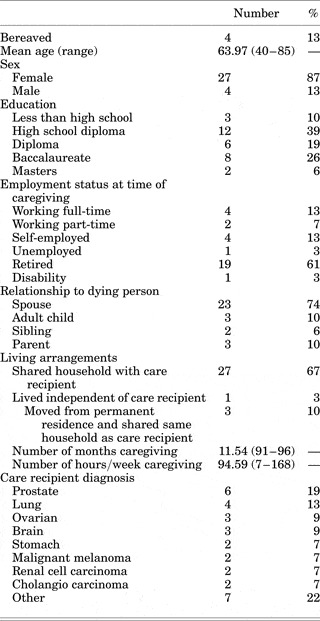
A descriptive summary of family caregiver and patient characteristics is provided in Table 1. The average age of family caregivers was 64 years and nearly all (87%) were female. Three quarters were providing care to a spouse. Family caregivers reported providing care for an average of 95 hours per week, and the average length of time caring was almost 1 year. The most frequently reported cancer diagnosis was prostate cancer.
Characteristics of family caregivers and care recipients (n = 31)

A thematic analysis of the data suggested that caregiver's negative and positive encounters within the health care system can be characterized by several themes that could be viewed within a framework of security in three dimensions: the competence of care, access to care, and respect for personal identity and dignity.
Security of Competent Care
This dimension, identified in family caregivers' descriptions of their experiences within the health care system, represents caregivers' evaluations of the quality of care their loved one received from health care professionals. It illustrates the important role of perceived competence for trust in health care professionals as well as an overall sense of personal security in providing care at home.
Caregivers frequently reported feelings of inadequacy in providing end-of-life care. They described a constant worry that what they are doing may have detrimental effects on the patient (e.g., not calling a doctor when maybe they should have or increasing pain medications when they should not have). To counteract this constant worry about these day-to-day decisions, caregivers looked to health care providers for guidance and expertise.
All caregivers at some point during their interview identified at least one incident where they described the care being provided to their family member using such words as “competent,” “experienced,” “expert,” and “in good hands.” For example, one gentleman caring for his wife with lung cancer said, “So the medical system certainly took over and looked after us. There's no question at all. And I felt that she was in the best situation she could be and was well looked after, she was comfortable. . . . That relieved things quite a lot.” Family caregivers were particularly grateful for care that was perceived to ease the burden of caregiving, such as being able to discuss issues with doctors on the phone, having physician make house calls, the availability of the physician at any given time, having their questions answered, and so forth. Likewise, family caregivers appreciated the knowledge and expertise of hospice workers when they assisted the family caregiver in the home setting. Most importantly, workers that were appreciated were seen as always knowing what to do and taking charge, thereby bringing some degree of control to a potentially distressing and daunting situation.
The provision of competent care seemed to be closely tied to trust in health care professionals. Naturally, family caregivers wanted their family member to receive the best possible care at the end of life. Caregivers discussed this quality of care as being able to trust that the health care professionals were doing everything possible for their loved one. For example, one 80-year-old wife caring for her husband with liver cancer stated:
I just think the world of him [doctor]. Always have. We moved here 20 years ago and we weren't running to the doctor, but he was there. He doesn't drive here, he walks over, just a couple of blocks. And both he and [reference], they both come in and they sit down and I enjoy both of them. He's very frank, very frank. And I'm frank with him and we have a very good relationship. I'd trust him anywhere. A lot of trust.
Other family caregivers discussed their need to be comfortable leaving the patient with trusted health care professionals while stepping away to run errands and take a break. In other words, they wanted to trust that the health care professional would attend to the patient in the same manner as they did. A woman caring for her husband with a brain tumor (who had just been moved to hospice 10 days prior to the interview) described how she would only take walks when the home care nurse was with her husband, as she knew he was being watched over while she was gone.
For most, caregiving for an individual at the end of life was a new experience. As such, caregivers viewed health care professionals as professional experts whom they could go to for information and guidance. There were many instances in which caregivers acknowledged the support they received from the health care professionals in terms of taking charge of the situation and making things happen. They described this support using phrases such as “put everything into place,” “steered us to,” “got us all signed up,” and “put me in touch with.” The ability of health care professionals to anticipate needs was also appreciated, as described in the following quote from a bereaved caregiver who has been providing care to her husband with stomach and bowel cancer:
They showed up pretty soon after we came home and the Hospice lady had got us all signed up. She said, “Whether you need it or not, it's better to have it [hospice care].” And that was very good indeed. I was very, felt very comforted with that. I didn't have to wonder where the help would come from. It seemed to just appear. So there's some very good system going on behind the scenes I think.
In contrast, several caregivers described situations in which they perceived the care being provided as incompetent. For example, one woman caring for her husband described a time when a health care worker watched her husband while she ran out to take care of some errands. Upon returning, she was shocked to find that her husband had soiled himself and was left to clean himself up. As noted in the quote below, she questioned why the worker never helped her husband, cleaned up the mess, or told her about what had happened:
I had a [health care worker] here and she never cleaned him up. He had to do it himself. And she never told me when she was here. And when I came home and I went to the bedroom, I could smell this sour stuff and I thought something happened. Then I noticed his clothing had trauma. And why she never told me, I had no idea. That's when I thought, “What's the sense of having her here if she can't, she hadn't looked in on him?”
Another wife caring for her husband with prostate cancer described a situation where a surgical incision on her husband's back was oozing thick liquid and smelled. Thinking that it may be infected, she questioned the home care nurse and was told that everything was fine and that the incision must heal from the inside out. To help absorb the odor, the caregiver explained that the nurse told her to get some kitty litter. When the next home care nurse arrived, the wife once again asked for an examination of the incision. At this point, the husband was immediately rushed to the hospital where they had to perform an operation to deal with the infection.
Another source of doubt about the quality of care provided stemmed from information that is inconsistent between health care professionals. This inconsistency is confusing for the caregiver and patient and can create doubt regarding care. A young wife caring for her spouse with melanoma stated, “I felt very overwhelmed, but they were all telling me what kind of medication to do. Everybody's got different opinions and the pain management, it's like, oh, that's not so much. So basically it ended up being me trying to figure it out.”
Even long-standing positive relationships between family caregivers or patients and their physicians (family physicians or specialists) can be a source of dissatisfaction, particularly once a cancer diagnosis is made. Another wife caring for her husband with melanoma described how delivering the diagnosis can shake the patient and family's trust in the provider:
My husband didn't like him [radiologist], or his way of demeanor and talking. And so luckily I ended up phoning up and his GP said, “Try a different radiologist.” So we got a second radiologist. I think that's very important for caregivers to realize, that they should find the right doctors. The doctor that [the patient] has now, the GP, he didn't like his original doctor that he's had for 10 years, for whatever reasons. But I think what happens with people with cancer, they can't figure out why the doctor didn't figure out sooner (that they had cancer). It happens, I think to a lot of people. They get angry and mad. Well you shouldn't deal with that doctor any more if that's how you're feeling.
Such relationships can be perceived as “incompatible,” strained, or difficult, and this can be a source of “questioning care” that can lead to the decision to seek alternate care providers. In other words, if the care provided by health care providers comes into question, caregivers can lose faith in the quality of care and the advice they receive. This can be a great source of stress and anger for the caregiver. In fact, these specific experiences of questionable care are what these caregivers recalled most vividly when asked about the end-of-life care provided to their family members, despite the fact that the rest of the care may have been exceptional.
In sum, these data suggest that perceived competence is important for a sense of trust in health care professionals, as well as an overall sense of personal security in providing care at home. Generally, caregivers described care as competent and were satisfied; these examples tend to focus on aspects of trust and being looked after by expert professionals. However, caregivers also described several examples that led them to question the quality and competence of particular health care professionals. To some extent, these individual experiences with particular professionals spill over into their overall confidence in the health care system.
Security of Access to Care
A second thematic dimension articulated within family caregivers' descriptions of their experiences with the health care system is a concern for access to care and services (including information). Caregivers' positive evaluations of access can be conceptualized as reflecting a sense of security (even where family members have not used that particular term); expressions of inadequate access can be viewed as manifesting a sense of insecurity about the health care system and/or individual health care providers.
For instance, access to services without waiting, a component of security, plays an important role in the overall experience of care provided at the end of life. Caregivers noted their appreciation for the availability of specialized equipment that could be used in the home. Without access to this equipment, many caregivers would have been unable to keep the patient in the home setting. This appreciation is highlighted by an elderly gentleman in the early stages of caring for his wife with lung cancer in their home:
It's just amazing. It's very impressive. We've got a wheelchair and a walker, both high quality, a raised toilet seat, a shower bench, a bed bar, and all of this is provided at no cost except you're expected to make a donation. And, that goes on for 3 months and I do believe they do start some sort of a rental thing after 3 months. So I was astonished at the support systems that are out there, just waiting to be called upon.
Given considerable media attention devoted to wait-list issues within the Canadian health care system, it is not surprising that caregivers also described their appreciation for timely access to specialists, family doctors, tests, and treatments. One caregiver suggested that “you couldn't get better service” in describing a time when the doctor “bumped someone” so her husband could receive immediate radiation treatments for a tumor on his spine. Others described how much they appreciated being able to contact their doctor 24 hours a day or not having to wait for access once their loved one was diagnosed with cancer.
Caregivers also recounted satisfaction with timely access to other health care professionals. For some, this provided the security of being able to speak with a nurse by calling the 24-h nurse hotline (particularly useful for medication advice), a service that was available in the province where the study took place. Others appreciated receiving a nonemergency phone number to the fire department (to address patient falls). Still others acknowledged being able to leave a message for their home care nurse knowing that he or she would always return the call promptly.
Overall, timely access to health care professionals provided a much-needed sense of security for these caregivers. Despite being alone with the patient in a home setting, they suggested that they were “not alone,” as there is always someone whom they could call on for support. This perception of security is best described by one caregiver who provided care to her husband with renal cell carcinoma:
It does make difference. Because you're not alone, it is not like “oh what do I do if I need something,” I can phone and I'll have a help. I think that's a lot of, like it's there. I'm not the person to phone just for anything, like you know if it's something really serious, then of course I'll either phone or I'll take him to the hospital. But if there's no any other help I will take him to Emergency. I'll get the help. But it's there. It's a security more than, it's a security. That's the word for it. It's a security.
For other caregivers, and in other situations, a lack of timely access, resulting in waiting, was identified as a problem. Having to wait leaves caregivers unsure about whether they would get access to the system and contributes to a feeling of insecurity. Any waiting during the end-of-life time period (e.g., for tests, treatment results, access to hospice, or even a phone call to be returned) can cause stress for both caregivers and the patient. One family member recalled that, “the scan was on a Friday, so we had to wait until Monday or Tuesday when we got it back, so that part was really annoying.” Caregivers noted that it is sometimes necessary to speak with a health care professional immediately, causing frustration when they wait for hours for a call to be returned by some providers. In addition, health care professionals do not always follow up as promised. One wife caring for her husband with melanoma described her wait resulting from a lack of follow-up:
The first person that we went to, she ended up taking a sabbatical and didn't tell us [patient and family]. She ordered a CT scan of his abdomen and didn't get back to us. She put his Dilantin down to one [pill] after a blood test and didn't get back to us. That's where a lot of the frustration, and he ended up having a seizure because he didn't have enough Dilantin, which is an anti-seizure medicine. She had put it down to one from three. No, didn't get back to us for whatever reasons. Ended up, that's when I decided just to deal with my GP, right?
A number of caregivers also commented on a lack of access to information. Some felt that health care professionals should be more forthcoming with information about possible side effects of medications and surgeries. As one example, a woman caring for her husband with prostate cancer described how she was unprepared when an incision on her husband's back opened up following back surgery and would have appreciated knowing that this was a possibility. This same woman also described a lack of information provided regarding home nursing care services, which she and her husband initially perceived as a situation in which the home care nurses were taking over their lives without any explanation as to what was being done or why it was being done:
And we didn't know what's happening, are they taking over our life or something? But I understand it now, but from the beginning we were kind of on the defensive and we just, I think they should have better, I don't know what, how to say it. They should maybe explain themselves or say “this is what we're doing for your good, and that's going to happen.”
In this situation, then, a lack of access to information contributed to a sense of lack of control, which can be conceptualized as “insecurity.” Some caregivers also suggested that when information is not provided by health professionals, the onus is on caregivers to take the initiative and ask; however, knowing what to ask is not always apparent.
Another important issue in regards to access is the lack of access due to financial barriers. Indeed, financial responsibilities imposed on families can also lead to caregivers questioning the heath care system and/or individual providers. Family members identified the stress of income testing as criteria for receipt of services, as well as the monetary cost of private residences, return phone calls by on-call physicians, and medications, as concerns that caregivers and patients should not have to deal with during such a difficult time. These caregivers had difficulty conceiving how there could be discussions about costs when their loved one was dying. For instance, a wife caring for her husband with esophageal cancer was informed that she may be responsible for paying for some of his care. She expressed her sense of disbelief:
“But all that just totally shocks me. When a person is in this state and the family is in such turmoil, we're talking dollars? If I was to fall and have a compound fracture in my leg or anything, I could get a hospital bed and stay there for 3 or 4 days if I needed to. And nobody comes like this looking for their money. It's just totally unbelievable.”
To some extent, this expression of shock can be interpreted as an emotional reflection of a sense of disturbance or insecurity.
In sum, family caregivers' descriptions of their experiences with the health care system suggest a concern for access to care and services (including information). Caregiver expressions of inadequate access can be viewed as manifesting a sense of insecurity about the health care system, which may extend to a sense of personal insecurity about their role and/or ability to keep their loved one at home. Caregivers' positive evaluations of access are reflected in a sense of security. Caregivers discussed the importance of access to specialized equipment, timely access to tests, treatment, and health care professionals and particularly negative experiences, including situations involving long waiting times, a lack of information, and financial barriers to access.
Although the security of access to formal services is important for family caregivers, having such services in the home environment in particular can, ironically, contribute to an insecurity of the personal and private space of the home and its normal routines. A number of participants refer to the phenomena of “strangers in the home,” whereby the home is temporarily transformed into a health care setting in which health care professionals come and go both day and night. While acknowledging and appreciating this help, many caregivers find the continual stream of health care professionals to be intrusive into their personal space and lives. Intrusiveness is exacerbated by the inconsistency in health care professionals. Indeed, they would no longer be “strangers” if the same individuals returned consistently. As noted by one caregiver, “Like there's lots of help you can get, but the change is horrendous and ongoing. And there are always strangers in the house.” The patient, not being used to strangers in the home, becomes agitated (which upsets the caregiver); the caregiver must also manage the coordination of care workers and “retrain” each new worker. These findings point to the need to be aware that having formal services, while contributing to a sense of security in the sense of feeling supported, may actually have adverse effects on the personal and spatial security of the home environment.
Security of Identity, Individuality, and Worth
A third dimension identified in family caregiver descriptions of their experiences with the health care system represents concerns about whether the family caregiver (and patient) are treated as a person of worth, that is, with respect, dignity, and esteem, and as an individual with particular needs. Positive perceptions in this regard are important for a securing a caregiver's sense of personal worth and identity, which we propose can be conceptualized as a type of psychological security.
For instance, caregivers noted their need for a particular kind of support from health professionals, described as being reassured that what the caregiver is doing is valuable and what she or he is feeling is normal. It is evident from a number of the comments that caregivers are pleased when health care providers acknowledge the caregivers' efforts. One daughter, caring for her mother 8 h every day described a conversation she had with the home care nurse about feelings of resentment toward her mom:
She's [home care nurse] a sounding board, she reassures me that all the feelings that I have are normal, because that feeling of resentment and anger towards my mom didn't feel very normal. And she reassured me that it is, that everybody does. She told me that the majority of people, this doesn't go on for years at a time and that it was an unusual case. She boosted me up and she complimented me and said nice things about me I guess. Made me feel good, which gave me strength. It gave me strength to continue, to get back to me so I could be there for my mom.
Being reassured is described as a positive experience, and as the above excerpt illustrates, can enhance a sense of “strength” for family caregivers. Another caregiver spoke about how health professionals reassured and complimented her: “[Nurses] make me feel that I'm doing something good and that I'm helping.”
Similarly, other family caregivers related stories of health care professionals who expressed personal concern for them and/or their well being. Indeed, the intense focus on the provision of support to the dying patient can often lead to the caregiver neglecting her or his own needs. Almost all caregivers reported a lack of sleep resulting from providing care throughout the night. The demands of caregiving can also negatively impact social life, eating habits, exercise, work, and family relationships. However, many caregivers do not see themselves as legitimate recipients of care, as they felt all care should be directed to the dying patient. For some of these caregivers, being encouraged and/or given permission by a health care professional to care for themselves and address their own needs is appreciated. This appreciation is indicated, for example, in the following quote made by an 85-year-old wife caring for her husband with prostate cancer:
But the RN said, “Well, no, [family caregiver] you've got to have, when they come, you're supposed to go out and have a bit of time to yourself.” And I said, “I don't really have to go out.” I said, “I'm here.” But I appreciated it. I really did. And those nurses, I just call them angels. They're just so wonderful, they're just wonderful what they do.
Such appreciation felt when a health care professional acknowledges the distinct needs of the family caregiver may in part arise from an enhanced sense of self-worth.
In the context of the lack of access described in the previous section, caregivers noted that they are constantly battling the system, as well as individuals within the system, for treatment, care or simply information. These battles with the health care system are particularly problematic for those who are not typically confrontational in nature. Not only is providing care at the end of life a role unlike any other they have been in before, but it necessitates that they adopt other possibly unfamiliar roles, such as “warrior.” Departures from one's normal behavior can create unnecessary stress in an already very stressful environment. As one wife caring for her husband with prostate cancer stated:
Well when you do that on a daily basis, this is like my job. And when you're in a stressful job, you take it home. So that fight is in me 24 hours a day. I'm waiting for the next battle to come that I have to be the warrior for. So you take that around with you everywhere and you get home and that's what you're talking about. It doesn't go away. It stays—I don't want to fight, I'm not a fighter, I don't want to fight. So the fighting is really hard, very stressful. You have to step out of your nature. Not that I would back down from a fight that was important, obviously. I won't back down. But I don't want to have to all the time. But somebody has to, and in the health care system I wouldn't want to at my age be sick and going in the hospital. I wouldn't want to be alone.
Having to step outside of one's normal role identity has important implications for one's sense of comfort and security.
Further, caregivers described interactions with health professionals in which they experienced negative communications that could be interpreted as devaluing or disrespectful. One daughter caring for her elderly mother with throat and ovarian cancer described a time when her mother was in a lot of pain, which she believed was caused by a feeding tube. She tried to bring this to the attention of the doctor “and he [doctor] just wouldn't listen. I was taking her there every 3 days and to Emergency, to his office and nothing, nothing, nothing.” Getting nowhere with this doctor, the daughter finally took her mother to her GP, who removed the tube; they discovered that the tube had ruptured the lining of her mother's stomach and as a result her stomach was filling with feces. In this scenario, the daughter felt that she was trying to communicate with the doctor but the doctor was not listening.
Another respondent described the insensitive manner in which she was treated by a physician. During a trip to the doctor's office to fill a prescription for her husband, this wife described being presented with a do not resuscitate form:
I went down to the office and the nurse catches him [doctor] on the way out between one little room and the other, and he takes me and fires me into the one little room and fires this form at me and says, “Read this.” And then he leaves. Now the form was a Do Not Resuscitate form. Now I'm reading this form, getting myself worked up and he comes back in and I looked at him and I said, “Why have you given me this form? It's got nothing to do with me. I'm here to get this prescription filled.” And he says to me, “Calm down and think.” Well at this point the tears were starting to roll down my face.
Inflexibility of services is another theme that arose from the discussions with caregivers, which reflects a sense that the individual needs of the family caregiver may not be acknowledged or respected within the health care system. For example, one caregiver caring for her husband with a brain tumor described a day of exhaustion in which she realized she would be unable to provide appropriate care throughout the night. When she inquired about having evening respite, she was told that this service was available, yet it required booking 48 hours in advance: “In other words, you had to know whether you're going to have a bad night or not 2 days ahead.”
The scheduling of meetings and tests is another point of system inflexibility. Caregivers (and patients) reported having no input regarding when tests, meetings, or treatments were scheduled. For caregivers who worked, the lack of input might mean having to take time off or canceling other planned activities. As one caregiver noted, “How the hell's my family supposed to get there in the middle of the day? Everybody works. But they're supposed to give up a day of work.” Further, scheduled care that is early or late can also be problematic. Caregivers using the time as respite and who make plans are inconvenienced when care arrives earlier or later than planned. The following is a quote from a caregiver for a spouse with multiple myeloma:
Like, Thursday I got 3 hours to go to acupuncture. I need acupuncture every 5 to 6 weeks and of course she was 20 minutes late, couldn't find us, and then 5 minutes before the time she's already calling me and I was right in the bank. I had to open a checking account for a business thing and that was my only chance. But really I didn't get even 2 and a half hours out of my 3 hours. So that was a frustrating thing.
More generally, a lack of responsiveness of policies and practices within the health care system to the particular needs of palliative family caregivers may be viewed as a source of bewilderment and shock and can contribute to a lack of faith in “the system.” Indeed, most caregivers had been informed about or were already aware of the many challenges associated with caregiving, but they reported not being prepared for the additional challenges faced within a health care system (and/or with individual providers that enact policies and practices) that they perceived as illogical and uncompassionate in responding to their needs. Rules and regulations can sometimes seem inappropriate under certain circumstances. For example, a stepmother caring for her stepdaughter with breast cancer discovered a system policy that stated that only family members can be present during family consultations with health care providers. Not being her birth mother, she was initially told she could not attend. It was only after a conflict that she was allowed to participate. Trying to comprehend and negotiate the rules and regulations of the system while providing end-of-life care is an added stress on the caregiver.
In sum, several themes can be conceptualized as related to a dimension of “security in identity,” encompassing whether the family caregiver (and patient) is treated as a person of worth, that is, respect, dignity, worthy of respect and esteem, and as an individual with particular needs. Caregivers described positive experiences when health care professionals validated and acknowledged their efforts and recognized the caregiver's distinct needs; they described negative experiences when dealing with a health care system services, policies, and practices that do not acknowledge or respect these individualized needs. They also expressed negative reactions when the health care system required them to step outside of their normal role identity or when they experienced devaluing interactions with health care professionals and the intrusiveness of “strangers” in their personal homes and lives.
DISCUSSION
In analyzing palliative family caregivers' accounts of their experiences with formal health care services (both positive and negative), we identified several aspects of care that were perceived as important by these caregivers. Further, we propose that these themes can be conceptualized as manifestations of security in three key domains. First, it is important for family caregivers to have a sense of security that the services are provided by competent professionals. This domain is primarily about trust in health care professionals as it is traditionally understood (Strang et al., Reference Strang, Koop and Peden2002; Milberg & Strang, Reference Milberg and Strang2004; Goldschmidt et al., Reference Goldschmidt, Schmidt and Krasnik2006; Heyland et al., Reference Heyland, Dodek and Rocker2006; Stajduhar et al., Reference Stajduhar, Martin and Barwich2008) and draws on the work of Öhlén et al. (Reference Öhlén, Andershed and Berg2007). Perceptions that health care professionals and providers are providing competent, indeed, quality care contributes to a sense of relief and therefore appreciation and eases the burden of caregiving; it enhances a sense of personal control and facilitates caregivers' ability to take a break. In contrast, insecurity in this domain encompasses doubt and mistrust and can lead to particularly negative memories, dissatisfaction, switching providers, as well as a sense of generalized distrust in the health care system.
Second, it is important for family caregivers to feel secure in their timely access to needed care, services, and information. This confirms findings from other research that note the importance of feeling supported for palliative family caregivers (Mok et al., Reference Mok, Chan and Chan2002; King et al., Reference King, Bell and Thomas2004; Stajduhar et al., Reference Stajduhar, Martin and Barwich2008). However, by linking the idea of feeling supported to perceived access to formal health care services, this article contributes importantly to the conceptual refinement of the concept of security in a way that highlights how feelings of security are embedded in wider structural contexts. This domain thus encompasses a sense of feeling supported as well as perceived access; security here enhances appreciation and a sense of one's ability as a caregiver to keep a loved one at home; insecurity in this domain contributes to feeling alone, stress, frustration, and lack of control and feelings of disbelief or shock when needed services are not available or accessible.
Third, these findings highlight the importance for family caregivers of feeling secure in their own identity and self-worth as a caregiver and as an individual, worthy of respect, being listened to, and as having normal reactions and doing a good job. The data presented above illustrate how interactions with health care professionals and perceptions of policies and practices within the health care system (such as the flexibility of services to individual needs) can either enhance or detract from a sense of security in this regard. Being supported and secure in this domain can contribute to a sense of identity and self-efficacy as well as appreciation for formal services. In contrast, insecurity in this domain can contribute to stress, role uncertainty, guilt, and bewilderment. This confirms other literature that identifies the importance of being acknowledged, validated, and recognized as an individual for family caregivers. For instance, Rogers et al. (Reference Rogers, Karlsen and Addington-Hall2000), analyzing open-ended responses in surveys with bereaved family members, concluded that “expressions of dissatisfaction arise from a sense of being ‘devalued,’ ‘dehumanized’ or ‘disempowered’” (p. 768) or where the symbolic “rules” of the expected relationships with health professionals are not met. They draw in this regard on the framework developed by Coyle (Reference Coyle1999), who suggested that dissatisfaction hinges on the interpretation of experiences as a threat to personal identity. Likewise, several studies of patient and family satisfaction highlighted the importance of being treated with “dignity” (Beach et al., Reference Beach, Sugarman and Johnson2005; Shiozaki et al., Reference Shiozaki, Morita and Hirai2005; Heyland et al., Reference Heyland, Dodek and Rocker2006), which encompasses a sense of being treated as worthy of esteem and respect (e.g., recognition, acknowledgement), which is closely tied to a sense of identity. However, although studies have identified this feature as important for family caregivers, our analysis suggests that this feature can be conceptualized as an aspect of the broader concept of security and represents a unique contribution of this article.
We propose that security is not just about trust in others or trusting relationships; it is also more than a generalized sense of institutional trust in the health care system. It includes but is broader than these elements and also encompasses a sense of one's personal ability to provide care at home because the latter is about a sense of being supported and looked after as well as about being valued and reassured. We have found that the concept of security provided a useful framework within which to understand participant accounts of their experiences with the health care system; it moves beyond a description of individual satisfaction or dissatisfaction with a number of apparently disparate experiences to identify a kind of common foundational need or desire that affects evaluations of these experiences. Indeed, there are close links between a need, desire, and appreciation for security and family caregiver satisfaction or dissatisfaction with services.
The idea that family caregivers need to feel supported in their role may not seem like anything new. But in the context of an emphasis on patient and family empowerment, it calls for caution that we do not forget the crucial importance of a sense of security, particularly for those, such as palliative family caregivers, that are already in situations that create a fundamental sense of insecurity (terminal illness in a loved one; being involved in a new role involving complex nursing tasks). Further, the concept of security needs to be recognized as crucially influenced by family caregivers' experiences within the health care system and with individual providers.
The research study that served as the basis for these findings was not initiated as an exploration of the concept of security. However, we have established that a sense of security is important for positive health care experiences, and we have presented a preliminary articulation of the content of the concept. However, there is a need for research explicitly focused on exploring caregivers experiences of security (and insecurity) in the above domains to further help in developing the conceptual framework we have presented here. For instance, future work could identify the causes and consequences of security as well as assisting us in reaching consensus on its conceptual content.
ACKNOWLEDGMENTS
This research is supported by the Canadian Cancer Society through a grant administered by the National Cancer Institute of Canada. Dr. Stajduhar is supported by a New Investigator Award from the Canadian Institutes for Health Research and a Scholar Award from the Michael Smith Foundation for Health Research.