The Mexican petroleum expropriation of 1938 looms large as the apogee of Mexican resource nationalism and America's “Good Neighbor” policy. In Mexico, the expropriation is viewed as a patriotic triumph, in which the federal government seized control of the country's most valuable natural resource. March 18th is Oil Expropriation Day, a national holiday. In 2008 President Felipe Calderón celebrated in a speech, “Today, we pay homage to the leadership, patriotism, and vision of General Lázaro Cárdenas. He knew how to defend the supreme interest of the nation by directing, with the support of women and men from all around the country, the rescue of this fundamental resource for Mexicans … Today, just as seven decades ago, oil is the patrimony of all Mexicans, a symbol of our sovereignty and an emblem of our nationalism.”Footnote 1
The popular view is supported by the historical literature. Lorenzo Meyer, for example, wrote: “Mexico did not pay the full value of the oil deposits… In fact, by compensating only a third of total property values … the original spirit of Paragraph 4 of Article 27 of the 1917 Constitution at last came into effect.”Footnote 2 Friedrich Schuler went further: “The March 1938 expropriation was the lifesaver of the Mexican state. The instant takeover of the already developed and producing oil sector promised immediate access to reliable revenue.”Footnote 3
In the United States, the temperate reaction of the Roosevelt Administration is seen as the decisive break with Washington's imperial relationship towards Latin America. In the words of historian Bryce Wood, Washington “curbed its finance capital” and downgraded the protection of American overseas private investments.Footnote 4 Michael Meyer and William Sherman combined both views in The Course of Mexican History when they wrote, “There would be no intervention on this occasion, as Franklin D. Roosevelt had come to the U.S. presidency enunciating a new policy of nonintervention … [President Cárdenas] struck a sharp blow for Mexican economic nationalism when he failed to be bludgeoned by the oil companies.”Footnote 5
The only problem with the narrative is that it does not fit the facts. President Cárdenas nationalized the oil industry in response to the companies' defiance of a Supreme Court decision in a labor dispute. The U.S. companies went to the mattresses over the dispute because their Mexican assets consisted of high-cost declining fields—they had little to lose. The U.S. companies, therefore, gambled in order to send a signal to other jurisdictions—like Venezuela—that they were not to be trifled with. After the nationalization, FDR, no friend of the oil men, responded to their lobbying by deploying sanctions to defend the companies' interests. Between 1941 and 1946 Washington imposed resolutions that fully compensated the companies for the market value of their assets. In short, the episode began with a miscalculation by the labor unions and ended with the American government's intervention on behalf of its private investors.
The Expropriation of Natural Resource Investments
Natural resource investments, particularly in oil, have long been subject to renegotiation between the host state and the investing company. The problem is one of the “obsolescing bargain.” Governments offer certain terms in order to attract private investment. Once the private investors have deployed their capital, however, the government has incentives to alter the terms of the bargain. In practice, the scope of renegotiation is limited by five factors: investor know-how (including the ability to market the product), reputational effects, the transaction costs of renegotiation, the ability of investors to influence key actors within the government (or interest groups upon whom the government depends to remain in power), and the ability of investors to call upon a foreign state to protect their property rights. Expropriation is only the most dramatic outcome of renegotiation. Governments can engage in “creeping expropriation” via the tax system or other methods of transferring rents from the titular owners of the investment to the state or third parties favored by the state. Governments can, for example, grant import monopolies over necessary inputs.
The oil industry has several features that make renegotiation particularly common. First, the industry often generates very high rents. Second, a great deal of the investment in production and transportation are sunk—companies have no easy way to redeploy those assets or recoup their investments should profits fall. Finally, oil exploration is an extremely risky business, with a high probability of failure. A tax regime designed to encourage exploration, therefore, is not one that will be well-suited to generating revenue from a mature industry.Footnote 6
It follows from the general model that governments will become more likely to expropriate under a limited set of conditions.Footnote 7 First, if the quasi-rents rise dramatically (most obviously via a rise in commodity prices) then expropriation should become more likely—the opportunity cost of not expropriating will rise. (Output price increases have the additional effect of making it relatively easy to compensate the expropriated investors at a level commensurate with the returns they expected before the rise in prices. In other words, high prices increase the government's return from expropriation while reducing the expropriated investors' incentive to resist.) Second, governments should become more likely to expropriate if the likelihood of punishment falls. This can happen due to changes in legal regimes (domestic or international), internal power balances, or the willingness of foreign states to intervene. Finally, governments should be more likely to expropriate if there is a fall in the transaction costs of expropriation, creeping or otherwise.
Historically, foreign expropriations (except during shooting conflicts or in the countries falling on the Communist side of the Iron Curtain during the Cold War) have been almost universally accompanied by compensation. Before the 1970s compensation tended to be ad hoc. Since then, the creation of international arbitration institutions and the end of sovereign immunity from judicial actions in third countries has introduced slightly more predictability into compensation decisions, at least as much as “net present value” calculated at sovereign borrowing rates has become the accepted standard.
This article is about an exception to the general model. The Mexican expropriation of 1938 met none of the above conditions. Oil prices were well off their peak; if anything, they were in the midst of a slow decline. The profitability of oil industry was low and declining, while tax rates were close to their revenue-maximizing level.Footnote 8 Lázaro Cárdenas's government was remarkably stable, as was the coalition that backed him up. No group or individual that had previously protected the oil industry lost power. Nor were there any changes in the willingness of foreign powers to intervene. The Coolidge administration had renounced intervention in 1928. The following Hoover administration began the withdrawal of American troops from Haiti and Nicaragua. Roosevelt's stated policy was simply a continuation of the previous two administrations. Finally, there is no evidence that the transaction costs of expropriation were particularly low: in fact, it took eight years for the Mexican industry to recover output levels, and government revenues did not regain their pre-expropriation levels for nine. Not only did the Mexican government fail to appropriate rents for itself or the unions; the U.S. government forced it to fully compensate the oil companies for the market value of their assets. The oil expropriation of 1938, in other words, was not an attempt by Mexico City to renegotiate the division of resource rents. Nor was it a reaction to changes in the political or economic environment. Rather, it was the result of miscalculations on the part of the labor unions, which overestimated the wealth of the companies and underestimated the companies' ability to maneuver a hostile U.S. administration into defending their interests.
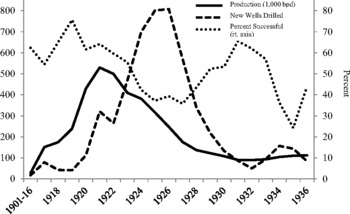
MEXICAN CRUDE OIL PRODUCTION AND NEW WELLS DRILLED, 1901–1936

The Decline of the Mexican Oil Industry
Mexican oil production declined monotonically between 1921 and 1933. The decline in output was not due to declines in investment or exploration. Under every available measure, investment peaked after output peaked. This is not consistent with the hypothesis that the companies cut back on investment from fear of expropriation.Footnote 9 It does, however, square with contemporary accounts of the invasion of Mexico's oil deposits by salt water.Footnote 10
The oil companies could not find enough new oil to maintain production. Production peaked five years before exploration. Exploration increased until 1926, but fewer new wells found oil (see Figure 1). The combination resulted in, as one observer put it, “a very pronounced increase in the cost of obtaining a barrel of crude.”Footnote 11
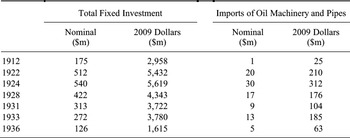
NOMINAL AND REAL VALUE OF INVESTMENT IN THE MEXICAN OIL INDUSTRY, 1912–1936

Sources:
For the year 1912, see Díaz Dufoo, La cuestión, p. 102. The year 1922 is an estimate produced by Foreign Minister Alberto Pani and cited in Standard Oil, Present Status, p. 4. The year 1924 is from México, Informes, p. 83. The year 1928 is from México, La industria, pp. 435–56. The year 1931 is from “Mexican Oil Output,” Wall Street Journal, 26 October 1932, 2. The year 1933 is from Gómez, Bucareli, p. 97. The 1936 estimates of capital investment ($96 million, nominal) are from U.S. Tariff Commission, Mining, p. 51, and land values (108 million pesos, nominal) are from “Mexican Oil Output,” Wall Street Journal, 26 October 1932, 2, and Marchand, L'effort, p. 72. All figures adjusted to 2009 levels using the U.S. GDP deflator. Imports are from Haber, Maurer, and Razo, “Law.”
The one exception to the lack of new discoveries was at Poza Rica. The Mexican Eagle Oil Company discovered oil in the region in 1930. Production started in 1932, but ran into a series of related problems. First, extraction costs were higher than in previous fields. Second, the company needed to construct new pipelines and export infrastructure. Third, 41 percent of the fields were located on federally owned lands.Footnote 12 A final arrangement wasn't reached with the government until May 1937 when Mexican Eagle gained the right to use federal lands in return for a 35 percent share of oil production.Footnote 13
The same patterns of a rise in investment until the mid-1920s and then a sharp fall afterward are seen in the Mexican government's estimates of the nominal and real value of investments in the oil industry and in the value of petroleum machinery exported to Mexico from the United States in Table 1. Financial information from Moody's Manual of Investment shows that by 1931, every company in the sample was disinvesting. Mexican Petroleum's investment peaked in 1924. Mexican Seaboard peaked in 1925, Mexico-Pánuco and Penn-Mex in 1930, and Mexican Eagle in 1931. In May 1932 Penn-Mex announced that it was shutting down its operations in Alvarez, Barra Sur de Tuxpan, and Veracruz, due to “diminishing production of the company's wells.”Footnote 14
The State of the Oil Companies
Three traded companies—Mexican Eagle, Mexican Petroleum, and Penn-Mex—produced all their oil in Mexico. A fourth, Mexican Seaboard, produced 62 percent of its oil in Mexico in 1930.Footnote 15 Royal Dutch-Shell purchased a controlling interest in Mexican Eagle in 1919.Footnote 16 Standard Oil of New Jersey (now ExxonMobil) acquired Mexican Petroleum in 1932.Footnote 17 The four companies represented 78 percent of Mexican production in 1937.
Declining production and rising costs caused increasing financial distress in the Mexican oil industry. Share prices went into a sustained decline during the 1920s and 1930s. Mexican Eagle share prices fell 89 percent between 1920 and 1930, briefly rallied when Poza Rica came on line, but then declined again. The value of Mexican Seaboard collapsed by half in 1922. It held steady until 1927 before entering a stunning decline that took its value down an additional 96 percent by 1931. Between 1931 and 1938 Mexican Seaboard's share value increased fourfold, but the recovery coincided with a decline in the Mexican share of the company's production from 57 percent to 20 percent.Footnote 18 Penn-Mex share prices collapsed in 1932 when South Penn Oil, which owned 55 percent of the company, liquidated most of the enterprise. South Penn Oil arranged to swap Penn-Mex's existing stock, with a par value of $25, for new shares with a par value of $1. It then authorized Penn-Mex's directors to “pay dividends out of any available funds … regardless of whether or not the excess was created through net earnings.”Footnote 19 The directors immediately paid a special dividend of $5.18. Four days later, South Penn sold its remaining stake to Sinclair for $1 per share plus an additional $18.75 to be paid out over time. By 1938 Penn-Mex had essentially ceased production.Footnote 20
Mexican Petroleum's share price fell by more than two-thirds between its peak in 1927 and 1932, when it was rescued from oblivion by negotiations between Jersey Standard and Standard Oil of Indiana. Standard of Indiana (later Amoco) owned 97.3 percent of the Pan-American Petroleum and Transport Company, which in turn owned 96 percent of Mexican Petroleum. Mexican Petroleum made up 21 percent of Pan-American's assets, by market value, the rest of which were located in Venezuela and Aruba. In April 1932, with the U.S. Congress debating oil import tariffs, Standard of Indiana agreed to sell Pan-American to Jersey Standard. Jersey Standard did not want Mexican Petroleum but sought other Pan-American assets to match up with its distribution network in South American and Europe. Standard of Indiana, however, insisted on selling all its overseas assets as a package. In 1935 three years after the purchase was finalized, Jersey Standard bought the remainder of Mexican Petroleum shares at par and delisted the stock.Footnote 21
Data from the companies' financial statements match the bearish verdict of the market. Mexican Eagle's return on fixed assets (ROA) declined from 9 percent in 1921 to nil by 1928, and remained low until Poza Rica boosted it back to 7 percent. Mexican Petroleum steadily lost money over the 1930s, paying no dividends and reporting an average ROA of 0 percent in 1931, followed by -9 percent in 1932, -7 percent in 1933, -2 percent in 1934, 0 in 1935, and -1 percent in 1936 and 1937. Penn-Mex managed to earn a small positive return on its rapidly shrinking asset base, averaging 2 percent between 1930 and 1936. Finally, Mexican Seaboard's returns fell from an average of 18 percent in 1921–1930 to 8 percent in 1931–1937— and the company was only able to maintain that level of profitability by shifting most of its production to the United States. Taken as a whole, the industry earned an aggregate ROA (weighted by assets) of 8 percent in 1921–1930 but only 1 percent in 1931–1937.Footnote 22
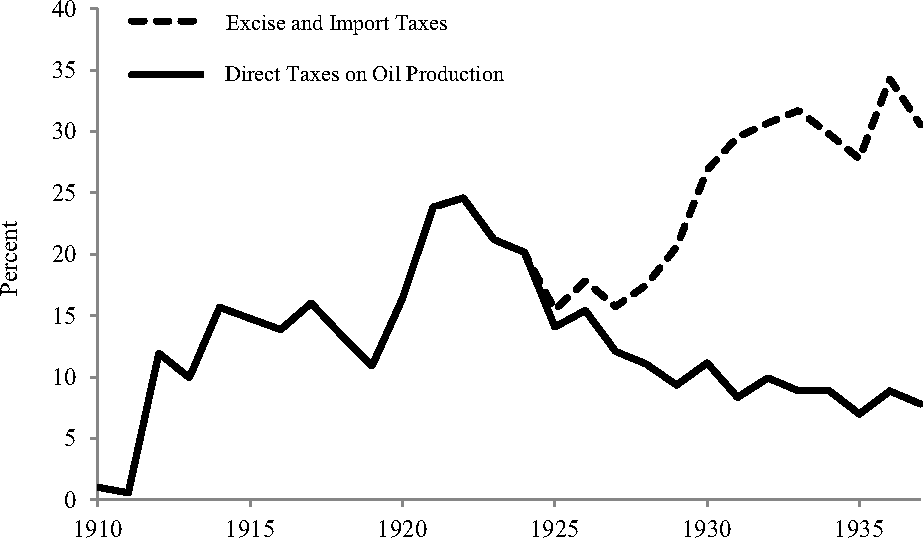
TAXES AS PERCENT OF THE GROSS VALUE OF CRUDE PRODUCTION, MEXICO, 1910–1937

Did the Mexican government contribute to the oil companies' parlous state? The answer appears to be no. First, as discussed above, the oil companies continued to prospect for oil during the 1920s and 1930s. When they found it, as in Poza Rica, they invested. Second, the share prices of all oil companies, not just those exclusively operating in Mexico, fell with the price of oil, which dropped from $26.10 per barrel in 1920 (in 2009 dollars) to $7.87 in 1931.Footnote 23 The price of the majors, however, recovered after 1931, while the Mexico-only firms did not. Third, there is little evidence that the Mexican government engaged in creeping expropriation via the tax system. Direct taxes on crude oil production, shown in Figure 2, declined from 1923 through the 1930s.Footnote 24 The Mexican government did impose excise taxes on retail gasoline sales, but the burden of those taxes did not fall on the foreign oil companies. Foreign-owned refineries could avoid Mexican excise taxes by the simple expedient of exporting their product to the United States or Europe. Most of Mexico's refined production was in fact exported. The maximum burden of refined product taxes was therefore equal to the cost of exporting refined products to the United States. In 1931 the cost of transporting gasoline to the United States was only 28¢ per barrel, well below the Mexican excise tax of $1.38 per barrel.Footnote 25
The Labor Disputes
The parlous state of oil company finances was on a collision course with the increasing militancy of the oil unions. Strikes hit the Mexican Eagle refineries in Tampico and Minatitlán in April 1915, followed by a second wave in 1916 and 1917. In May 1917 the labor unrest spread to Pierce's operations in Tampico and Mexican Petroleum's refinery in Mata Redonda.Footnote 26 The government of the state of Tamaulipas stepped in and settled the Pierce strike, mandating a 25 percent wage increase.Footnote 27 In June, Mexican Petroleum conceded the same benefits.Footnote 28 In 1924 a strike forced Mexican Eagle to concede an 8-hour workday, wage hikes, and the first collective bargaining agreement in the history of the Mexican industry. The other companies soon signed similar contracts.Footnote 29 Mexican Eagle ended a 1925 strike by paying $123,000 to the union leadership.Footnote 30 Nominal wage rates rose from 6¢ (U.S.) per hour in 1913 to 16¢ per hour in 1934. In that year, Mexican Eagle faced a second wave of disputes.Footnote 31 Strikes then hit Mexican Petroleum in January 1935, which preferred to shut down “rather than compromise with the workers.”Footnote 32 Peace lasted until November 3, 1936, when the Sindicato de Trabajadores Petroleros de la Repùblica Mexicana (STPRM) demanded a $2.3 million wage hike, guaranteed overtime, 18 paid holidays, 20 to 60 days paid vacation, health insurance, 25 days of severance pay for each year of service in the case of voluntary separation, 90 days of severance in the case of involuntary separation, housing benefits, and control over all hiring decisions, save for 110 positions across the entire industry.Footnote 33 The Federal Labor Board estimated the total cost of the package to be $7.3 million, of which wages and overtime came to $2.6 million. The companies, in turn, claimed that the annual cost would be $10.7 million, of which wage hikes made up $4.4 million.Footnote 34
The oil companies did not react well to the labor demands. Their lawyers wrote, “The union draft contains over 250 clauses, covers 165 pages of legal-size script of which almost 40 embrace the wage schedule and took several months to formulate, and yet the companies were to 'discuss' and 'approve' the document in the peremptory period of 10 days.” Moreover, the companies refused to give up control over hiring and firing. “Owing to the present restricted number of supervisory positions, the industry is already suffering the consequences of lack of control and discipline.”Footnote 35
President Cárdenas now intervened to contain the dispute by appointing a special commission. On August 14, 1937 the commission reported that the companies could afford the $7.3 million package. A wildcat strike immediately broke out at Poza Rica.Footnote 36 Cárdenas ordered it stopped.Footnote 37 A second wildcat hit Mexican Eagle in September. An exasperated Cárdenas accused the workers of helping “capitalist interests” by turning the country against the labor movement.Footnote 38 The strike ended when the company agreed to pay the workers 75 percent of lost wages and gave the union leadership $6,944.Footnote 39 On March 2, 1938 the Federal Labor Board announced that it would grant the unions a wage and benefits increase worth $7.3 million and greater control over personnel decisions. The Supreme Court upheld the decision the next day.
Mexican Petroleum reacted by closing 23 wells, moving oil stored in the fields to Tampico, presumably for quick export, shutting down the Mata Redonda plant, and sending a letter to every employee stating that it would be unable to comply with the board's order.Footnote 40 The STPRM called for a national strike. The March 7 deadline fixed by the Federal Labor Board came and went. On March 14 the Labor Board warned that they needed a response from the company by the following day. On March 15 the company reported that it could not comply. The board responded by suspending all contracts.Footnote 41 With their pay suspended, and a strike deadline looming, workers began to seize loading terminals and shut down pipelines across all oil firms.
President Cárdenas now faced the imminent collapse of Mexico's most important industry.Footnote 42 On March 18, 1938 he announced, “Under such conditions, it is urgent that the public authorities take adequate measures to prevent grave domestic disturbances due to the paralysis of transportation and industry, which would make it impossible to satisfy collective needs and supply the consumer goods needed by our population centers.”Footnote 43
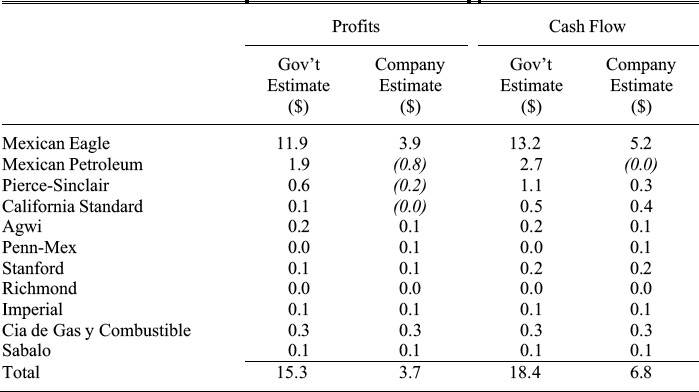
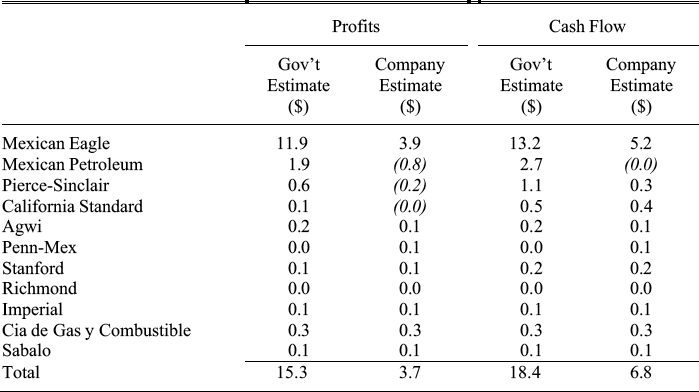
Why did the companies resist union demands to the point of shutting down the industry and provoking nationalization? Simply put: they could not afford them. According to company figures, the oil companies collectively earned $3.7 million in 1936. Eliminating depreciation and depletion expenses implies a net cash flow of $7 million, which is less than the official estimate of the $7.3 million cost of the labor settlement. The Mexican government, however, accused the companies of transfer pricing, and estimated their profits to be $15.3 million. Mexican Eagle, however, accounted for almost all of the difference between the companies' reported profits and the government's estimate seen in Table 2. For Mexican Eagle, if one believes the government's estimates of the company's cash flow, the cost of its share of the labor settlement amounted to 31 percent of its cash flow. If one accepts the company's own (audited) accounting, then the burden would have amounted to 102 percent of Mexican Eagle's cash flow.
The low figure would have been a substantial hit to the company's bottom line … and the high figure would have put it into the red. The calculation for the companies as a whole gives a low figure of 39 percent of cash flow (47 percent of reported profits) and a high estimate of 153 percent of cash flow (or a staggering 288 percent of profits).
The companies had two additional reasons to fight the union demands. First, they did not want to lose the ability to control their labor force. Second, and more importantly, many companies had profitable assets in other countries. They wanted to set a precedent that would discourage other countries from attempting to expropriate or alter oil concessions. The fear of expropriation was not abstract. In 1927 Spain nationalized Jersey Standard's properties.Footnote 44 In 1931 Uruguay established a state-owned oil refining and retailing company that drove down the private share of the market from 100 to 50.2 percent by 1937.Footnote 45 In 1932 the Chilean government threatened expropriation, which was headed off only by a well-timed military coup.Footnote 46 In March 1937 Bolivia nationalized Jersey Standard's unprofitable concessions.Footnote 47
OIL COMPANY PROFITS, MILLION DOLLARS, 1936
Source:
México, Mexico's Oil, pp. 293–95, 317–19, 331–33, 347–49, 365–67, 381–84, 390–92, and 433; and Moody's Manual of Investments, various years. Italicized numbers represent in the red.
The companies' real fear of contagion, however, concerned Venezuela. After 27 years of rule, President Juan Vicente Gómez died on December 17, 1935. After his death, riots wracked the Maracaibo oil zone. The violence became so bad that foreign oil executives and their families were forced to flee aboard oil tankers. Gómez's successor, Eléazar López Contreras, calmed the crisis via his “February Program,” which promised wage hikes and improvements in working conditions for the oil workers. He passed the Labor Act which allowed collective bargaining and mandated profit-sharing and introduced a new constitution which allowed for export taxes. Nevertheless, on December 11, 1936, a 43-day strike hit the oil zone, which cut production 39 percent before President López intervened to end it.Footnote 48 The López government soon began legal action against the companies, accusing them of owing unpaid royalties and back taxes. In a meeting with American officials in January 1938, a Venezuelan representative revealed that the lawsuit was only a feint: “[The] government had no desire to tangle with the companies and become involved in a protracted fight [but] if the companies did not appear more responsive, the government will have no other recourse.”Footnote 49 The Venezuelan government combined legal actions with a change in the buoy tax on ships transiting Lake Maracaibo from one calculated on tonnage to one based on the value of the crude they carried.Footnote 50 It also announced its attention to revoke the companies' exemptions from import tariffs.Footnote 51 When the companies protested, the government reopened the lawsuits, and in April 1938—scarcely two weeks after President Cárdenas ordered the expropriation of the Mexican industry—the Supreme Court of Venezuela ordered the Mene Grande Company to pay $4 million in back taxes.Footnote 52 In the words of historian Kelvin Singh, “The Mexican expropriation gave the Venezuelan government a psychological lever to be used against the companies… . The Mexican expropriation continued to hover like a specter in the background of company-state maneuvers until well into the Second World War.”Footnote 53
In short, the oil companies took a risk in Mexico in order to maintain a reputation in Venezuela and elsewhere. For them, it was a good bet. The assets they gambled had relatively low value. The union demand was unaffordable.Footnote 54 And finally, they figured (correctly) that the U.S. government would protect them.Footnote 55
Failed Private Sanctions
The companies may have expected U.S. protection, but the U.S. government would not act without strong pressure. The oil companies first tried to mobilize public opinion. The U.S. ambassador to Mexico, Josephus Daniels, complained that the companies “started to build propaganda fires under the government to compel a return of the properties.”Footnote 56 Editorial cartoons distributed by Jersey Standard portrayed the expropriation as a direct assault on American interests.Footnote 57 The companies also resorted to selective leaking, in order to tie the U.S. government's hands.Footnote 58 Moreover, the companies' propaganda highlighted terrorist incidents and called for American tourists to stay away from Mexico. In 1938 Mexico's tourism receipts dropped by a third.Footnote 59 Tourism was not yet a major part of the Mexican economy, however, and polling data indicated that Americans cared little about the expropriation.Footnote 60
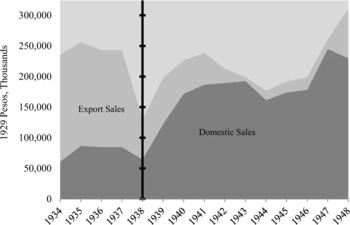
Second, the oil companies tried to interfere with Mexico's exports. They managed to lobby the U.K. government into boycotting Mexican oil.Footnote 61 The courts of other nations, however, blocked attempts to extend the boycott to other jurisdictions. A U.S. federal district court dismissed a case accusing the Eastern States Petroleum Company of importing $1.7 million worth of oil claimed by Mexican Eagle, based on sovereign immunity. Belgian and Dutch courts decided similarly. In France, Mexican Eagle won a lower court decision, but an appellate court overturned it and forced the company to pay damages to distributors who had been unable to take possession of their oil. A state court in Alabama went so far as to block attempts to stop the Mexican consul from taking possession of expropriated tankers.Footnote 62 Once it became clear that the courts would not enforce the sanctions, American middlemen began to arrange barter deals with Germany and Italy.Footnote 63 More importantly, with internal demand skyrocketing, Pemex succeeded in re-orienting itself around the domestic market.Footnote 64 By 1940 its sales had recovered to 1936 levels of around 250 million pesos primarily due to a rise in domestic sales from around 75 million to 150 million pesos (see Figure 3).Footnote 65
DOMESTIC AND EXPORT SALES OF MEXICAN PETROLEUM PRODUCTS, 1934–1949

Successful Public Sanctions
The private boycott having failed, the oil companies needed the support of the U.S. government in order to threaten Mexico. The rub was that FDR's Good Neighbor Policy eschewed intervention, and Washington had many reasons to avoid sanctions. Interior Secretary Harold Ickes wrote, “If bad feelings should result in Central and South America as a result of the oil situation that exists just now with Mexico, it would be more expensive for us than the cost of all the oil in Mexico.”Footnote 66 Moreover, Ickes feared that sanctions could cause the Mexican government to collapse.Footnote 67 Josephus Daniels, the U.S. ambassador to Mexico, shared Ickes's concerns.Footnote 68 Treasury Secretary Henry Morgenthau worried that economic instability might push the Mexican government to ally with the Axis or turn towards Communism.Footnote 69
The companies therefore designed a political strategy to maneuver Washington into sanctions, crafted in conjunction with Secretary of State Cordell Hull.Footnote 70 Hull was angry about a Mexican decision to increase tariffs, and he was easily persuaded of “the need to punish Mexico economically to gain its respect for American business before closer economic ties with the country could be achieved.”Footnote 71 On March 26, 1938 he sent a note to Mexico that denounced expropriation without compensation. He then asked Morgenthau to suspend treasury purchases of Mexican silver and reduce the silver support price from 45¢ to 43¢ an ounce. This was a blow to the Mexican government, which had earned 24 percent of its total revenues from silver in 1936, twice what it earned from oil taxes.Footnote 72 Hull convinced Morgenthau that the expropriation was a convenient excuse to suspend the Silver Purchase Act of 1934.Footnote 73 In addition, the Fair Labor Standards Act was bottled up in committee. Using Hull and Morgenthau's strategy, FDR could hold out a promise to reinstitute price supports for only domestic silver as a way to keep recalcitrant Nevadan legislators inside the New Deal coalition.Footnote 74 Morgenthau was hesitant to explicitly commit the president, so he sent a letter to FDR while the president was on vacation in Warm Springs, New York, stating simply that he would interpret a lack of communication as consent.Footnote 75
Hull used his congressional contacts to keep the pressure on both the Roosevelt administration to punish Mexico and the Mexican government to compensate the companies. Hull had served in Congress with Samuel McReynolds (D-TN), the chairman of the House Foreign Affairs Committee, and both had been judges back in Tennessee.Footnote 76 In January 1939 McReynolds introduced a bill calling for an end to silver purchases that subsidized Mexico's economy.Footnote 77 Other congressmen, notably Martin Kennedy (D-NY) and Hamilton Fish (R-NY) also introduced anti-Mexico resolutions. Hull insured that the bills would not pass, since they would interfere with the negotiations between the Mexican government and the companies, but the threat served as a useful cudgel.Footnote 78 In 1940 Sinclair Oil and the Mexican government agreed to $8 million in compensation and 20 million barrels sold at a 25¢ discount off of the market price.Footnote 79
Negotiations with the other U.S. companies continued until 1941, when Washington imposed a settlement. A two-person committee consisting of engineers Morris Cook and Manuel Zevada presented the final proposal on April 17, 1942. The Mexican government immediately credited $9 million to the United States. The two governments approved the payment schedule for the rest of the compensation in September 1943. Ultimately, the compensation payments made by the Mexican government exceeded the agreed upon amount by almost $6 million (see Table 3).Footnote 80
Mexico didn't settle with Mexican Eagle until 1946, when the Truman administration decided that it was in the interest of the United States to defend a British company. Unlike the United States, the United Kingdom had few levers to use against Mexico once the oil boycott failed. Worse yet, London came under pressure from key suppliers, Iran and Venezuela, to refrain from negotiating with Mexico City. The British ambassador to Caracas reported that Venezuela would be “most disturbed if they had any reason to believe that [the United Kingdom] might resume oil buying in Mexico to the detriment of Venezuela.”Footnote 81 London feared that an angry President López might be tempted to try “squeezing us over the condition on which we purchase their oil.”Footnote 82 In Iran, Britain was concerned enough to agree to make extra royalty payments of $6.6 million in 1939 and $17.7 million in 1940 and 1941.Footnote 83 Foreign Secretary Anthony Eden was not happy with the situation—“I do not like giving the Shah and Venezuela a veto on our relations with anybody”—but the war with Germany left London with little room to maneuver.Footnote 84 Charles Bateman, the new British minister to Mexico City, wrote that it would be impossible for the Mexican government to make a better offer to a British company than it had made to American ones.Footnote 85
VALUES OF MEXICO'S FINAL SETTLEMENT WITH FOREIGN OIL FIRMS

Note:
Compensation was valued by converting all payments into 1938 dollars using the U.S. GDP deflator and discounting them back to 1938 using the 3.2 percent rate at which the U.S. government lent to Mexico in 1943. (This rate was approximately equal to 3.1 percent rate on 10-year corporate bonds in the United States.) The second column assumes that the additional payments were divided up among the receiving corporations in proportion to their share of the original deal.
Source:
In addition to the sources mentioned in the text, see U.S. Department of State, “Compensation,” p. 351, table 5 and table 10.
Minister Bateman did not count on the changing relationship between Britain and the United States. Between 1938 and 1945 the United Kingdom was transformed from a potential U.S. rival into an important junior partner. Moreover, by 1945 it had become a junior partner in desperate need of foreign exchange. Mexico, in turn, needed U.S. capital to expand oil production. In 1943 Mexico negotiated a $10 million (₧48.5 million) loan from the U.S. Export-Import Bank for the construction of a new refinery at Azcapotzalco and production facilities at Poza Rica. In 1946 negotiations began for an additional credit of $150 million. The Truman administration, however, tacitly agreed to benefit the United Kingdom at Mexico's expense by refraining from the extension of new loans until Mexico City arrived at an acceptable arrangement with Mexican Eagle.Footnote 86 The United States signaled Antonio Bermùdez, Mexico's chief negotiator, that a rapid settlement of outstanding British claims was the only way to receive the loans.Footnote 87 The Mexican government rapidly complied with the American request, and the claim was settled by the end of 1946.
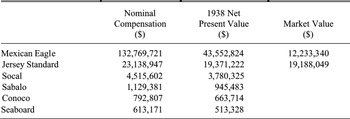
Did the oil companies receive fair compensation? In the cases of the two largest firms, Mexican Petroleum and Mexican Eagle, market values can be used as benchmarks for the compensation they received from the Mexican government. Jersey Standard purchased the Pan-American Foreign Corporation from Standard Oil of Indiana for $47.9 million in cash and 1,778,973 in Jersey Standard shares in 1932. Pan-American owned 97 percent of Mexican Petroleum, which was traded separately on the NYSE. At market value, Mexican Petroleum made up 21 percent of Pan-American.Footnote 88 Jersey Standard's shares were valued at $26.13 at the time of the deal: both the cash and shares were delivered in four annual payments. The discounted value of the 1932 deal using the interest rate on corporate debt of 3.1 percent came to 21% × 97.3% × 96% × ($44.3m in cash + $43.0 million in shares) = $17.5 million.Footnote 89 Adjusted for inflation, that figure becomes $17.9 million in 1938 dollars. Adding in the discounted value of the outstanding Mexican Petroleum shares bought at par in 1935 raises the total real price that Jersey Standard paid for its Mexican assets to $19.2 million, which roughly matches the compensation that the government of Mexico paid to Mexican Petroleum in Table 4.
It is unlikely that Jersey Standard's Mexican assets were worth more in 1938 than in 1932. First, Mexican Petroleum paid no dividends after 1932. Second, it consistently lost money in accounting terms, save a brief moment in the black in 1935. It is possible that Jersey Standard used transfer pricing to extract value, but that would require transferring income from Mexico with no corporate income taxes to the United States where it would pay a 19 percent rate on all corporate income above $25,000.Footnote 90 Third, Mexican Petroleum basically halted exploration after 1932, and production in its fields continued to decline after 1938. Overall production stagnated after 1938.Footnote 91
LABOR COMPENSATION IN THE MEXICAN OIL INDUSTRY, 1937–1946

Sources:
Powell, Petroleum, pp. 130, 153, 214–15, and appendix table 18.
Mexican Eagle received an even better deal from Mexico than Mexican Petroleum. The two sides settled for $81.5 million. Payments began in 1948, and totaled $132.8 million through 1962. Ironically, the waning of Britain's great power status insured that Mexican Eagle received a better deal than it would have had Britain remained a great power. The nominal Net Present Value in 1938 of the stream of payments discounted at 3.1 percent came to $82.6 million. After adjusting for the postwar inflation in the United States, the real value in 1938 dollars was $43.6 million, an amount that was more than three times Mexican Eagle's market capitalization of $12.2 million in 1936, right before the outbreak of labor unrest. The book value of the company's assets in that same year came to $16.5 million. It would be hard to argue that the company was undercompensated, considering that the settlement came to 3.6 times the firm's market value and 2.6 times its book value.
Winners and Losers in Mexico
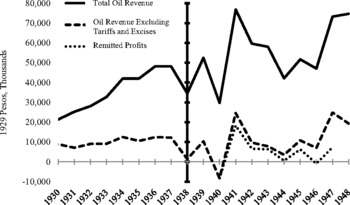
If the oil industry was in decline before the expropriation, then it should not have produced any windfall rents for the Mexican government. The data in Figure 4 is consistent with that conclusion. In the first eight years after nationalization, government revenues from the oil industry (excluding excise taxes) exceeded pre-nationalization levels in only one year, 1941. In 1940 Pemex's poor financial situation forced the government to grant a subsidy of ₧60 million.Footnote 92 The industry did not reliably produce more revenue until 1947, after loans from the U.S. Export-Income Bank allowed the expansion of the Poza Rica fields. The government did raise gasoline taxes from 8 centavos per liter to 9 centavos in 1940, and then again to 10 centavos in 1946, but it could have done that regardless of who owned the oil companies.Footnote 93
GOVERNMENT REVENUES FROM THE OIL INDUSTRY, 1930–1948

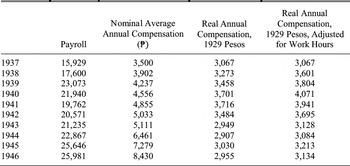
The oil workers who had gone on strike in 1937/38 gained little from the nationalization. The government rejected union demands to directly manage the industry, even though the government allowed the unions to manage the national railroads.Footnote 94 Wages rose and the work week fell from 44 to 40 hours, but management refused to grant the rest of the original labor award. In January 1940 the unions demanded its full implementation. Vicente Cortés, Pemex's general manager, replied by accusing the workers of lax discipline and “removing” company equipment. President Cárdenas called on workers to allow management to suspend the labor award “until such time as the industry could pay off the indemnification and modernize its equipment.”Footnote 95 An additional ruling on November 28, 1940, allowed management to fire workers hired after the expropriation and reduce the wages of workers earning over ₧700 per month.Footnote 96 Although the nominal annual average labor costs in Table 4 grew, increasing rates of inflation caused the real annual average labor costs in Table 4 to peak in 1940 and then decline to 1937 levels by 1944. The winners were the 10,000 additional workers hired after nationalization, whom might never have received jobs had the companies remained in private hands.
CONCLUSION
The Mexican oil expropriation of 1938 is generally viewed as the harbinger of two defining characteristics of the modern age: the end of empire and resource nationalism. The argument for the end of empire suggests that the United States chose not to employ all elements of its national power in defense of its economic interests. Rather, it respected the rights of a fellow sovereign nation to control its own economic policies. The conventional view of resource nationalism argues that Mexico established the first of the great national oil companies that would come to dominate the world's energy scene, seizing control of a large-scale source of rents that it could use to develop the country and, in turn, usher in an era of weakened property rights across what would become known as the Third World.
Like most stereotypes, there is a core of truth to these characterizations. The Roosevelt administration was hesitant to intervene against Mexico. The Mexican government did establish the first of the great national oil companies. After that the actual historical record diverges substantially from the accepted view. The U.S. government ultimately intervened to defend the property rights of American and British companies. The Mexican government, in turn, compensated the companies for their properties at more than their market value. The nationalization itself was the product of an out-of-control labor dispute, rather than a grand plan, and the companies were not particularly profitable. Neither the Mexican government nor the oil workers benefitted much from the nationalization.
The expropriation of 1938 took place in a context rather different from expropriations enacted in modern times, but not for the reasons that historians believe. The key difference between the environment of the 1930s and today is that in the 1930s domestic courts still refused to use their authority against foreign governments. That is no longer the case. Modern versions of 1938 play out differently not for reasons of ideology or relative power, but for an accumulation of small deliberate changes that have judicialized such disputes. The Mexican expropriation of 1938 was not the harbinger of a new age; rather, it was one of the last gasps of an old one.