‘I am convinced that fine art is the subtlest, the most seductive, the most effective instrument of moral propaganda in the world.’
George Bernard Shaw, preface to Mrs Warren's Profession, 1902Footnote 1Ethel Smyth characterised her opera The Wreckers (1902–04), to a libretto by H. B. Brewster, as a tale of ‘wrecking, religion, love and that sort of thing’.Footnote 2 Her casual apophthegm conceals the sensationalism of the plot, summarised more recently as ‘tangled love interests among the people of a small Cornwall village where the populace earns its keep by luring merchant ships to founder on the rocks and then pilfering everything in sight while “finishing off” the crew’.Footnote 3 Yet the opera is not just about Cornish history or the practice of wrecking. As well as featuring those elements, it raises several difficult moral and ethical questions. The most immediate of these concerns the legality of wrecking, and whether wrecking and violence can be justified on the grounds of the common good. Furthermore, if wrecking and the violence it spawns are considered immoral, how can such immorality be resisted, and should it be resisted even at the cost of order, of relationships and of life itself? Despite the opera's alleged basis in eighteenth-century English history, and its self-evident nationalism, it alludes in both words and music to issues at the heart of fin-de-siècle and early Edwardian debates about law, religion and sexual politics. It offers a critique of imperialism and state-sponsored violence, of the nexus between religion and the state, and of the laws governing relationships between men and women in marriage. Some of these issues had already been confronted by George Bernard Shaw in the ‘unpleasant’ didactic plays he had been turning out since 1892. An excavation of the cultural codes of Smyth's opera shows that she, like Shaw, challenged a variety of taboos while problematising the status of women, sexual double standards and the church's fixation on ‘social purity’. In this light, the opera can be interpreted as a parable of modern society, in which the forces of order and of the legal and religious establishments are pitted against proponents of ideas that were radical, even among an artistic and intellectual elite. That Brewster and Smyth chose to fashion their work in this way is arguably a reflection of the unconventionality of their own relationship, and their self-identification at the margins of social norms. The inherent conflict between Smyth's belief in artistic freedom of expression – encapsulated in the controversial subject and in comments the work makes about society's moral and religious values – and her efforts to present it to that very society, accounts to some degree for the difficulties she encountered in securing performances, and the misunderstandings of its reception.
1
Whereas Shaw was known to ‘use comedy as the sugar to make audiences swallow his didactic pill’, Brewster and Smyth chose to use history.Footnote 4 The opera's action takes place at an unspecified coastal location in Cornwall in the second half of the eighteenth century. Villagers inhabiting a small and isolated settlement depend for their livelihood on the sea and for their social life on the church. The principal characters are Pascoe (bass-baritone), a Wesleyan local preacher; Pascoe's wife Thirza (mezzo); a young fisherman named Mark (tenor); Lawrence (baritone), the lighthouse-keeper; Lawrence's teenage daughter Avis (soprano); Tallan (tenor), the local publican; and Tallan's son Jack (mezzo). Pascoe is the villagers' spiritual leader, an authoritarian and paternal figure whose injunctions seem to amount to the prohibition of pleasure itself. It is at Pascoe's direction that the villagers conspire in the lighthouse-keeper's practice of dimming or failing to light his lamp, hoping that a provident God will supply a shipwreck and its bounty for their starving community. Thirza is horrified by the villagers' actions. Her refusal to join in their prayers exacerbates problems in her marriage to Pascoe, already troubled by a difference of age (he is fifty-five and she is twenty-two). Moreover, Avis discovers that Thirza is in love with Mark, the childhood friend she believed was her betrothed. When Lawrence spies an illicit light warning passing ships of the rocks below, a band of wreckers sets out to unmask this traitor, or ‘vermin’ (Act I scene 3), in their midst.Footnote 5 Act II of the opera discloses that Thirza and Mark have been lighting a bonfire as a warning beacon during nocturnal trysts. On this night when they meet, Mark realises that he cannot remain in the village any longer. Thirza agrees after some persuasion to desert her marriage and home, and to elope with him. But their peroration on love and the lighting of the bonfire are interrupted by the sound of the wreckers' horns. As they flee, Pascoe appears on the cliff above and catches a glimpse of Thirza's face lit by the moon; he falls senseless at the scene and is found by the wreckers, who accuse him of the ‘crime’. In Act III, during an impromptu trial conducted by Lawrence in an underground cave, Mark and Thirza confess, knowing that the penalty for their aberrant actions is death. Although Pascoe offers Thirza redemption if she repents, she refuses. The lovers are branded traitors and adulterers and are left to drown when the cave fills with water at high tide. Defiantly, they profess their love for one another and their belief that death unites them.
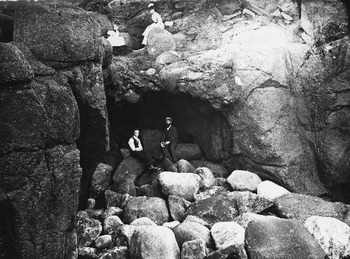
In notes to the published English libretto, Smyth portrayed aspects of her plot as historical truths. The work was conceived in 1886, when at the age of twenty-eight she embarked on a walking tour of the Scilly islands, off the coast of Cornwall. There she heard stories of local wrecks and then or later probably saw postcard prints from the Gibson family's remarkable collection of photographs of nineteenth-century wrecks (cover illustration). She also visited sites and landmarks associated with wrecking and smuggling. Some of those that particularly fascinated her were smugglers' ‘holes’ or caves, particularly the two named ‘Piper's Hole’, accessed from a secret passage (Fig. 1). Smyth described her admission to the cave on the island of Tresco, where
on entering it, just above high-water-mark, you go downwards rapidly and alarmingly by an ever-narrowing passage illumined by torches which are stuck at intervals in rings in the wall; the passage suddenly bends sharp to the left and you become aware, by the growling of boulders apparently only a few inches above your head, that you are under the sea; … presently, to your great relief, the passage takes another turn, the rumbling ceases, and squeezing between two rocks at what seems to be the end of the cave, you behold an unearthly-looking freshwater lake, on which floats Charon's boat, while the waving torch of the guide reveals to you that the lake is full of goldfish (put there by the owner of that island, Mr Smith-Dorrien) and that the goldfish are blind.Footnote 6
The entrance to Piper's Hole, Tresco, by Herbert Gibson, c. 1880s.

Fanciful tales were associated with the cave on the island of St Mary's, one eighteenth-century source repeating stories of ‘Men going so far in that never returned; of Dogs going quite through and coming out at Tresco, with most of their Hair off, and such like Incredibles’.Footnote 7 That same source divulged that the caves were sites where lovers met ‘to indulge their mutual Passion’, making them ‘almost as famous as the Cave wherein Dido and Aeneas met of old’. Smyth reported that the idea for The Wreckers came to her in the Tresco cave, and it was there that she envisaged the scene of the opera's ending. The denouement may be her own invention; no published account exists of deaths by drowning, let alone those of miscreants, in either cave. Smyth returned to Cornwall in 1902 ‘once or twice’ to absorb more local legends. Clearly susceptible to their romanticism, she depicted herself lying ‘on the cliffs, buried in soft pink thrift, listening to the boom of the great Atlantic waves against those cruel rocks, and the wild treble cries of the seagulls’.Footnote 8
Smyth completed her research in London at the British Museum, reading Robert Heath's A Natural and Historical Account of the Islands of Scilly (1750), Robert Southey's Life of Wesley (1820) and accounts of Cornish history published in the Journal of the Royal Institute of Cornwall.Footnote 9 Her concept was surely also inspired by the popular fin-de-siècle genre of novels about Cornish wreckers, such as Walter Besant's Armorel of Lyonesse (1890), G. A. Henty's The Wreckers of Pendarven (1893) and H. D. Lowry's Wreckers and Methodists (1893).Footnote 10 Revelling in lurid tales of smuggling and wrecking, Smyth found herself ‘haunted’ by
that strange world of more than a hundred years ago; the plundering of ships lured on to the rocks by the falsification or extinction of the coast lights; the relentless murder of their crews; and with it all, the ingrained religiosity of the Celtic population of that barren promontory, which, at the end of the eighteenth century, became the scene of Wesley's great religious revival!Footnote 11
Soon after, she communicated her idea to Brewster (living in Rome), who had persuaded her to allow him to write the libretto in French. By November 1902 he had prepared a synopsis. In 1903, Smyth reported, nothing existed for either her or Brewster but the composition of The Wreckers. When she posted to him a summary of each scene in English, she would receive in return ‘a beautiful version in French verse; – every motion of the soul-wave of the speaker so wonderfully rendered, that when I began to compose it, the music was seemingly already there’.Footnote 12
As much as Smyth might have been willing to believe in the ‘world’ she had discovered, her love of Cornish legend, coupled with her appetite for sensationalism, produced a novelistic confection of truth, myth and invention. Aspects of the location suggest the Scilly islands: the villagers' isolation, their anomalous form of government, their religious piety, the significant role of the lighthouse and lighthouse-keeper, and the frequency of wrecks. Since 1571 the Scillies had been leased to the Godolphin family. By 1750 the population of the islands was about a thousand, most of these living on the largest of seven inhabited islands.Footnote 13 Scilly islanders had no representation in parliament and those who farmed were not freeholders. Few ever left the islands, and the rare visitors who crossed the forty miles of Channel from Penzance did so ‘at the extreme Hazard of their Lives’.Footnote 14 Government was relegated to a Council of Twelve, comprising a representative of Godolphin, the chaplain to the islands (‘a Man of learning at one of the two Universities’) and several local (and at times very elderly) farmers. It had ‘full power and jurisdiction to hear, examine and finally determine all plaints, suits, matters, actions, controversies, contentions and demands’.Footnote 15 So arbitrary were its powers that one visitor in 1756 described the Council's operations as a form of ‘Liberty without Law!’Footnote 16 Indeed, in 1783 Godolphin dissolved the Council, accusing it of indolence and vice. Smyth's kangaroo court convened by the lighthouse-keeper is roughly equivalent to the Council, albeit an ad hoc version lacking representation from proper authorities. But, unlike Smyth's village elders, the Council knew the limitations of its jurisdiction. Whereas it was technically eligible to impose punishments of a fine, a whipping or a ducking for misdemeanours, all cases of heresy, treason and offences against life or limb were referred to the military garrisoned locally on St Mary's or to court on the mainland. In actuality, Heath knew of no such cases. He believed that the lack of crime on the islands ‘shews, that the people live upright enough not to require any, or that the Place is a Confeinement of itself’.Footnote 17
Even on islands as isolated as the Scillies, then, no secret court could be convened to try a case of treason. Nor was there a precedent for the situation in which Lawrence, the opera's lighthouse-keeper, poses as the village's chief judge while simultaneously acting to lure ships onto rocks. Lighthouses were administered by Trinity House in London, which paid its keepers handsomely for the responsibility and hardship. In the eighteenth century, the only lighthouse in the Scillies (and only the second to be built in Cornwall) was one erected in 1680 on St Agnes, the southernmost of the inhabited islands. Although in a strategic position within a few miles of the most dangerous waters in the British Isles, there are credible accounts of the lighthouse-keeper sometimes dimming or failing to light his beacon. Heath reported in 1750 that ‘before the coming of this present Light-Keeper, I've known [the light] scarcely perceivable in the Night, at the Island of St Mary, where it now looks like a Comet. And some are of Opinion, (not without Reason) that in the Time of the former Light-Keeper, it had been suffered to go out, or sometimes not lighted.’Footnote 18 The situation obviously improved: by the time of Smyth's visit in 1886 the Principal Lightkeeper on St Agnes had been at his post for at least the previous forty years, and by then supplementary lighthouses had been built on Bishop's Rock and Round Island.Footnote 19
Wrecks were not a rare occurrence in the Scillies in the eighteenth century. With myriad ‘hellwethers’, steeples and ledges, the islands represent one of the most formidable navigational hazards in the Western world. Defoe reported in 1724 the widespread assumption that ships were ‘almost continually dash'd in pieces there, in spite of the mariners' best skill’.Footnote 20 Modern estimates of the number of wrecks count as many as a thousand in the vicinity of the islands, the large proportion from the eighteenth century reflecting the fourfold increase in the shipping trade that century.Footnote 21 In a single winter storm, three or four ships might founder, sometimes with no trace but a few oranges on a beach. Heath reported that the islanders were ‘by their Situation, the sons and Daughters of God's Providence; and accordingly are otherwise cloathed and supplied out of Wrecks, sent in by the Sea, the Spoils of their rich Neighbours’.Footnote 22 Smyth would have seen relics of salvage from wrecks in Scillonian homes and churches, but histories of the Scillies relate that even during the famine that struck early in the nineteenth century, the menfolk were more likely to smuggle brandy from France than engage in deliberate wrecking.
Smyth's opera depicts the most heinous form of wrecking, for which the law prescribed severe penalties. According to both law and folklore, wrecking can range from the serendipitous pocketing of flotsam on a beach to the deliberate luring of ships onto rocks, and from plunder of a sinking ship to the outright slaughter of its crew. An Act instituted in 1753 pronounced it a capital offence to plunder a wrecked ship. Furthermore, ‘if any person or persons shall put out any false lights or lights with intent to bring any such ship or vessel into danger, then such person or persons so offending shall be deemed guilty of felony; and on being lawfully convicted thereof shall suffer death as in cases of felony, without benefit of clergy’.Footnote 23 In Cornwall (the most notorious county for wrecking), the term was usually understood as a species of salvage.Footnote 24 Stories abound of Scillonian clergymen praying for wrecks to relieve their parishioners' want.Footnote 25 Defoe, in his A Tour Thro' the Whole Island of Great Britain (1724), recounted that after a wreck on the Scillies ‘the sands were cover'd with country people running to and fro' to see if the sea had cast up any thing of value’.Footnote 26 He described ‘this part of Cornwall’ as ‘inhabited by a fierce and ravenous people; for they are so greedy, and eager for the prey, that they are charg'd with strange, bloody, and cruel dealings, even sometimes with one another; but especially with poor distressed seamen when they come on shore by force of tempest, and seek help for their lives’. Heath hotly rejected Defoe's slur; moreover, since Defoe's biographer concedes that he never visited the Scillies it is probable that he was describing a scene in another part of Cornwall.Footnote 27 Records indicate that tinners who worked mines on the Cornish coast were notorious for wrecking. It was because of their rioting and mob violence in protest against taxes and high corn prices that Cornwall was referred to as ‘West Barbary’.Footnote 28 The opera's murderous assembly of wreckers at the end of Act I matches eighteenth-century accounts of wreckers on the coastline near Penzance, where thousands of men, women and children would gather within sight of a wreck with pickaxes, hatchets, crow bars and ropes.Footnote 29 Yet even here a shipwreck was more akin to winning a lottery than an opportunity for the sort of ghoulish murder and pillage implied in the opera by the wreckers' anticipation that ‘Blood and sea-water mingle gladly / Snow-white and red the foam will glance’ (Act I scene 11).
The most questionable aspect of Smyth's characterisation of the wreckers is the conjunction of Wesleyan Methodism with this most barbaric form of wrecking. The wreckers' talk is couched in the deliberately archaic language of thees and thous, their hymns mimicking the familiar phraseology of renowned eighteenth-century hymnists such as John Newton and Charles Wesley (‘I was convicted of sin, broken and crushed … I trembled! I shuddered! I trembled!’). John Wesley expressly condemned wrecking, like smuggling, as a form of theft akin to ‘robbing on the Highway’.Footnote 30 It was true, as Smyth alleges, that ‘Wesley himself was powerless to combat successfully this terrible hereditary instinct peculiar to the Cornish peasantry, among whom he found his most devoted adherents’.Footnote 31 But whereas smuggling was tolerated, even within Wesley's congregations, as the poor peasant's chief weapon of revolt against high taxes and government interference, wrecking and its violence were widely decried.Footnote 32 Whether any Cornish Methodist community ever colluded in murder coincident with wrecking is doubtful. Still, Smyth argued in her memoirs that there had existed ‘Cornish savages’ who ‘had come to believe that like the Israelites in the Old Testament they were God's Chosen People, whose right, nay, whose duty it was to plunder and extirpate less favoured peoples’.Footnote 33 Pascoe is a type of Cornish Moses, chastising the men for profaning the Sabbath and Avis for wearing jewellery. His most severe application of the ‘law’ is in condoning the execution of the lovers, a fate which is best understood in light of the Old Testament punishment for adultery, which was death by stoning: ‘[S]o shalt thou put away evil from Israel’ it says in Deuteronomy.Footnote 34 Like Moses's people, in the face of poverty and affliction, Pascoe's flock calls ‘on God's mighty name’ to ‘whet Thy sword our foes to smite’ (Act I scene 9). As Pascoe exhorts the wreckers to plunder, he has a vision of a pillar of fire lighting their pathway in the dark (Act I scene 10), just as when the Israelites escaped from Egypt they were led by a ‘pillar of fire by night, to shew them light’ (Exodus 13:21).
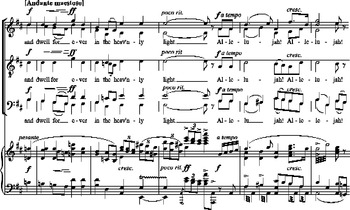
In identifying a body of the Christian ‘Chosen’, Smyth draws on the rhetoric of British imperialism. Since the creation of the United Kingdom of Great Britain in 1707, the union was underpinned by a shared Protestantism, ‘with its doctrine of missionary impulse, the idea of the British as an elect and the sanctity of hard work’.Footnote 35 In the nineteenth century the enthusiasm for Christian missions to the heathen became a strong motivational force for imperialism. Social Darwinism and its theory of the survival of the fittest provided a theoretical basis for racial elitism. Thus when the villagers describe themselves as ‘a hard race, and brave; Strong in the spotless fame / Of the women that bore us’ (an allusion to Exodus 1), and when the ships they intend to wreck are alien – ‘Foreign ships homeward bound are passing’ (Act I scene 10) – their words convey their conviction that Britain is a superior power with dominion over the sea.Footnote 36 The opera was written when imperialism was at its peak, following the jubilees of 1887 and 1897, the funeral of Queen Victoria in 1901 and the coronation of Edward VII in 1902, and when Britannia indisputably ruled the sea. Smyth was not one of the many composers associated with jubilees and coronations. But at the outset of Act I scene 1, to the words ‘God's Chosen people shall not pay the price of sin!’, she grasped an opportunity to parody coronation anthems. The hymn she devises has all the hallmarks of the triumphal accompaniment to the crowning of the monarch as ‘God's chosen instrument’. In her notes to the English libretto she describes her theme as a ‘broad, exultant tune’ representing ‘extreme religious fervour’ (Ex. 1).Footnote 37 To a jubilant maestoso melody in D major, accompanied by trumpets and drums and culminating in a hallelujah chorus, the wreckers first appear as defenders of the faith, upholders of justice and moral virtue, and as earthly representatives of ‘the King of might’.
Excerpt from ‘Revival Hymn’, Act I scene 1.

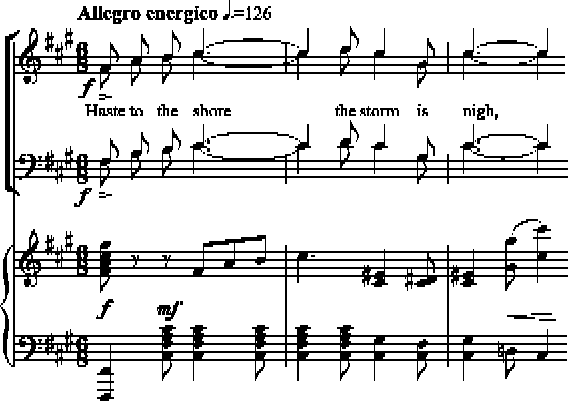
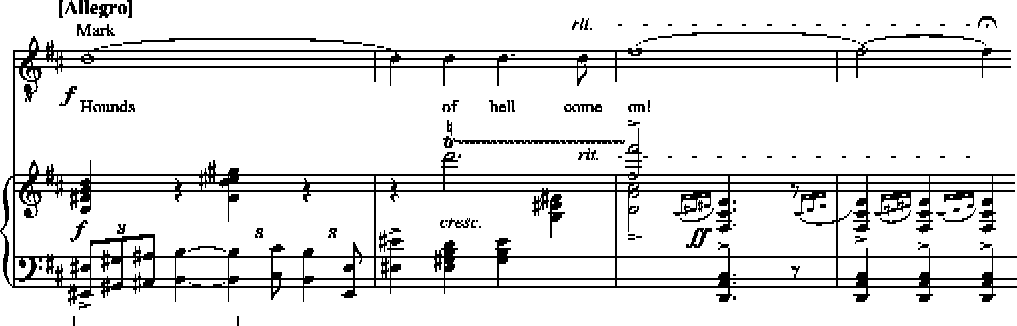
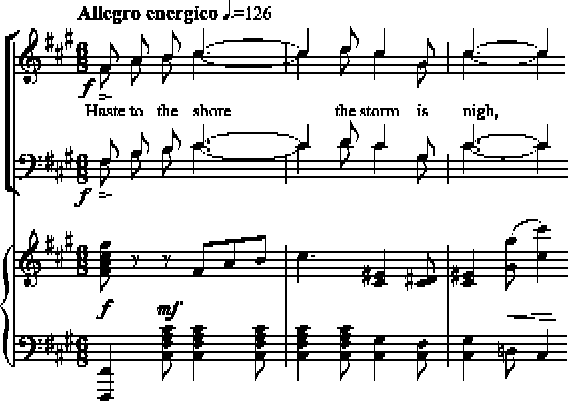
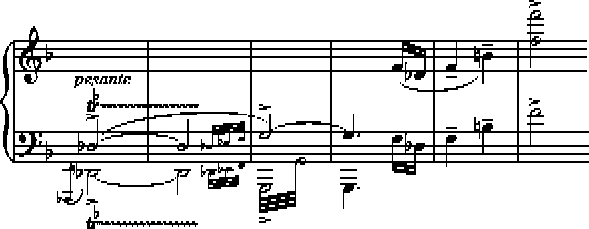
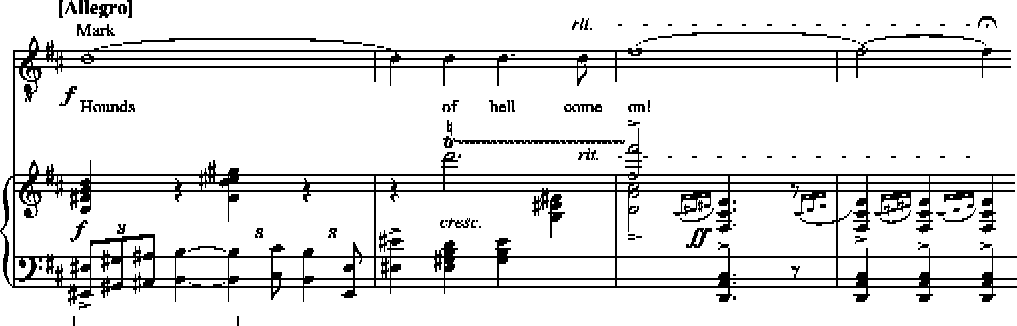
The irony of Smyth's music is soon apparent. Her manipulation of motifs associated with the wreckers, as well as their placement, offer a critical commentary on the perversions of the wreckers' Christianity. Of the fifteen ‘themes’ Smyth lists in the ‘musical analysis’ section of her English libretto, the motif used most liberally is the one heard in the opening bars of the overture and labelled ‘The Wreckers' Theme’. Its first four characteristic notes are based on a D minor triad, followed by sequences in dotted rhythm that convey a mood of rollicking revelry. In the first scene, this motif provides the melody of ‘Haste to the shore’, a vigorous chorus rejoicing in the spoils of wrecking (Ex. 2a). On the other hand, the motif's appearance in the major mode and in canon at the fifth when the wreckers return from the chapel (Act I scene 10) is a sign that Smyth awards them momentary purification. The second motif associated with the wreckers is a ‘Horn Signal’, described as ‘A weird call in use among Wreckers’.Footnote 38 At its appearance in the overture (Ex. 2b), the call's first interval is a prolonged fortissimo rising augmented fourth, abruptly stalling momentum as if to draw attention to itself. This call and its identifying interval – well known as the diabolus in musica, suggestive of disorder or malevolence – will saturate the wreckers' hunt for the perpetrators of the beacon fire. Moreover, in several key places Smyth ensures that the Wreckers' Theme refers to the diabolical Horn Signal. In Act I scene 9 when Pascoe preaches to Thirza that wrecking is ‘ours by right’, the Wreckers' Theme is altered so that the first four notes reach not the anticipated fifth degree of the scale but the augmented fourth. The distorted version of the Wreckers' Theme is subsequently deployed, and given prominence through dynamics and instrumentation, in Act II scene 3 when Thirza urges Mark not to light the torch, when Mark describes the wreckers as ‘Hounds of hell’ (Ex. 2c), and when, soon after, Thirza lights the beacon. It is a sign that the pursuit of the lovers and all that follows is the fateful result of Pascoe's self-interested interpretation of biblical promises. The full significance of the alteration to the Wreckers' Theme is revealed when its corrupted form sounds just as Pascoe condemns Thirza to death.
‘Wreckers' Theme’, Act I scene 1.
‘Horn Signal’, Overture.
Alteration of the ‘Wreckers' Theme’, Act II scene 3.
The vindictiveness of the wrecker's theology is highlighted by Smyth when she assigns, but reformulates, a sixteenth-century German chorale for the hymn they are heard singing from within the church. Smyth borrowed the melody of ‘Erschienen ist der herrlich Tag’, composed in 1560 by Nikolaus Herman and published in eighteenth-century German hymnals.Footnote 39 In its original wording the hymn is intended for Easter Sunday and for celebration of the triumph of the resurrection of Christ. An English translation of Herman's original, published in 1851, reads:
The wreckers' text retains the theme of God's triumph, but omits any recognition of the death and resurrection of a saviour, instead dwelling in Old Testament-style language on the merciless defeat of enemies:
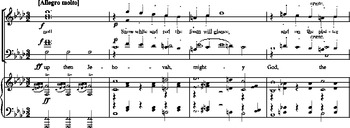
Nowhere is the sacred vengefulness of the wreckers more evident than in the ‘wild dance’ at the end of Act I, when they gather ropes, hooks, axes ‘and other wrecking tackle’. It begins in F minor, Allegro molto, followed by a section where Herman's chorale melody provides a cantus firmus, as though underlining the religious basis of their actions (Ex. 3). Following this, in an F major Presto complemented by thunder and lightning, chorus and soloists produce a bedlamesque sound by clapping as well as screaming at high pitch in short repetitive melodic units. In the commercial recording of this scene, individual words cannot be heard or understood.Footnote 41 If such rioting actually took place in eighteenth-century Cornish history, its putative motivation in a belief in a providential God is extremely tendentious. Even if what especially appealed to Smyth, as she recalled, ‘was the idea so strongly brought out in the ultimate text, that each of these people is, from his point of view, doing right’, under English law these so-called Christians were guilty of a crime punishable by death.Footnote 42 In the dominant irony of the opera's plot, the lovers, not the wreckers, suffer that penalty.
Excerpt from the ‘wild dance’: the ‘basso ostinato’ is the chorale melody from ‘Erschienen ist der herrlich Tag’ (bass voice and orchestra). Act I scene 11 (chorus only).

2
Smyth did not publish the prodigious correspondence she reported was exchanged with Brewster over the libretto. Although Brewster's French libretto was published in Paris in 1911, three years after his death, the extent of his contribution to the genesis of the work can only be inferred from scattered published excerpts of their correspondence and from Smyth's account of their collaboration, published almost forty years after the event.Footnote 43 In What Happened Next (1940), Smyth recalled that it was Brewster who determined the moral dilemmas in the plot: so unconventional was the libretto he first sent her, that when friends expressed dismay at its contraventions of Christian morality she asked him to enable Thirza to express remorse. Predictably, she reported, ‘Harry would not hear of it’.Footnote 44 The two renegade lovers whose rebelliousness would have been shocking in an eighteenth-century context (as well as for most of the nineteenth), are products of Brewster's own very unconventional attitudes and his adoption of radical fin-de-siècle ideals. Literary critics have explained how fin-de-siècle writers exploited the novel as a means to explore their own identity and subjectivity, and to address issues of contemporary morality. These writers' ‘complex fissured narratives’, Lyn Pykett observes, ‘in some way re-enact autobiographical dilemmas faced by the writers themselves … [creating] a genre at the interface between auto/biography, fiction and feminist propaganda’.Footnote 45The Wreckers, too, explores moral and ethical dilemmas faced by Brewster and Smyth as artists and intellectuals frustrated by a society dominated by the formidable institutions of the monarchy and the church. A reading of the opera that identifies ways in which it resonates with its authors' lives demonstrates the extent to which Mark and Thirza were proxies for Brewster and Smyth.
H. B. (Henry) Brewster was a New Englander descended from Puritans, claiming in his ancestry two Yankee clergymen and a Minute Man in the American Revolution. His father had emigrated, first to Russia and then to Paris, where he was dentist to the French court. Brewster's education was French, but he could speak and read several European languages, as well as Sanskrit. He wrote and published prose, poetic drama and poetry in English and French.Footnote 46 Among his friends in French literary circles were Maupassant and Mallarmé. In 1873 he married Julia Stockhausen, eleven years older than him and the daughter of a German diplomat. Independently wealthy, Brewster and his wife adopted Florence as their home and lived in seclusion while Brewster trained himself as a philosopher. Far from inheriting the pietistic Calvinism of his parents, he speculated that ‘generations of obscure ancestors of mine must have wept and gnashed their teeth and gnawed their hands in silent rage under the Blue Laws of New England; and all their compressed rebellion has burst forth in me’.Footnote 47 Brewster held what Smyth called ‘unusual views concerning the bond between man and wife’, epitomised by his declaration to her that, ‘If either of the couple should weary of married life, or care for someone else, it was understood that the bond was dissoluble’.Footnote 48 Smyth met Brewster and Julia in Florence in 1882, when she was ‘quite carried off my feet by the impersonal magnificence and daring of their outlook’.Footnote 49 Smyth fell in love with Julia (one of successive lesbian amours); Brewster fell in love with Smyth. He argued the possibility of a romantic trio and attempted to persuade Julia that Ethel belonged to them both. Brewster and Smyth met intermittently in the following years, but after one rendezvous in Leipzig Smyth wrote to him of her disquiet, ‘Harry, it is all wrong’.Footnote 50 Brewster negotiated with Julia a treaty (‘Traité de Florence, 22 Novembre 1885’) that stated ‘Each of the two shall be free and independent to act as he or she chooses’.Footnote 51 From then on he regarded himself as ‘free to follow without any restriction the course I judge best’. Ethel, however, told him she had ‘sinned too deeply’ and refused to see him for five years.Footnote 52 In the hope of a rapprochement, from 1887 Brewster spent winter and early spring in London, where his social circle included Henry James. James enjoyed Brewster's ‘accomplishment, his distinction, his extraordinary play of mind’ and found him ‘the clearest case of “cosmopolitan” culture I was to have known’.Footnote 53 In his later years in London, Brewster became a socialite among a literary crowd. Through his friends Maurice Baring (nephew of Smyth's friend Mary Ponsonby) and John Singer Sargent (intimate friend of Smyth's sister Mary Hunter) he was acquainted with writers including Edmund Gosse, Mrs Humphrey Ward, Walter Pater and Thomas Hardy.
Religion was a perpetually contentious issue in the correspondence between Smyth and Brewster. In the early 1890s, Smyth was going through a religious phase, spurred by her love for Mary Benson, wife of the Archbishop of Canterbury. In frequent, almost acrimonious, debates with Brewster on the subject of religion, Smyth characterised him as ‘the most deeply religious spirit’ and yet ‘the most inveterate enemy of creeds I ever met’.Footnote 54 When they discussed the existence of God, Brewster wrote ‘To the question: “does he exist” I answer probably not; I dont know and I dont care [sic]’.Footnote 55 Her attempts to convert him were doomed because, he informed her, ‘if there is one thing in the world I have dread of, it is the Church’. He challenged her assumptions, ‘Allow me to point out that this is a question of definition and that if what I care for so deeply – the eternal, the transcendent part of life, the part of it which passes reason – is not religion it is at least something of which I understand, in the measure of my strength’.Footnote 56 From 1887 Mary's husband Edward White Benson was president of the Church of England Purity Society, formed expressly to promote sexual continence in English society. Smyth later realised that Mrs Benson had recognised the dangers of Brewster's unilateral morality and had for this reason terminated their friendship. Privately, Smyth decided that her former friend ‘was constitutionally incapable of understanding the artistic temperament’.Footnote 57 By 1893, she recalled, ‘much to Harry's relief I myself was no longer the good Churchwoman I had been’.Footnote 58 At a time of incessant theological speculation and controversy, and almost certainly infected by Brewster's pluralist views, Smyth told Mary Benson that ‘love and what it entails is the gospel of my life’.Footnote 59
Her comment echoes a view enunciated by Brewster in The Theories of Anarchy and of Law: A Midnight Debate (1887), an elaborate and almost impenetrable metaphysical dialogue between a progressiste, a nihilist, a mystic and a sceptic. In it, he explored objections to the rules of law and morality, and propounded ideas of polytheism, individualism and what he referred to as ‘the philosophy of Anarchism traced to the subject of love’.Footnote 60 Anarchism was popular among French writers, so much so that French political anarchists accused writers of identifying themselves as such merely because they could quote a few lines of Nietzsche. Brewster, however, read and admired anarchist works by Kropotkin, such as his article ‘The Coming Anarchy’ published in The Nineteenth Century in 1887, and by Tolstoy, most likely ‘On Manual Labour’ (1887).Footnote 61 In Brewster's book, the character who espouses the ‘anarchical ideal’ rejects dogmatism as well as the rule of law. He ‘has a keen sense of the interdependency of ideas, and he refuses to accept any one of them as sovereign’. It is ‘Love alone’ that unites anarchists, ‘the ray of light which has passed through no prism’.Footnote 62 Little wonder that Smyth's friend, the expatriate writer Vernon Lee, described Brewster's book as ‘a perfect gospel of anarchy’.Footnote 63
Brewster's philosophical musings reflect his immersion in the maelstrom of radical cultural politics in London of the 1880s and 1890s, the heyday of anarchism in Britain. He appreciated London not only because of its proximity to Smyth's home in rural Surrey, but because (as he told her) ‘here, after all, religious and moral questions are far more alive and more boldly discussed than anywhere else’.Footnote 64 Individual anarchism, a philosophy propounded by Max Stirner that became influential in England, promoted a society of egoists, of separate and sovereign individuals, and a free and unregulated economy. The backbone of the societies of the Social Democratic Federation (founded 1881), the Fabian Society (1884), and the Socialist League (1885) was formed by idealistic artists such as George Bernard Shaw, William Morris and H. G. Wells. These societies suffered an undercurrent of tension between the literary and artistic crowd – who advocated socialism as a way of life – and those dedicated to the politics of the labour movement. One of the few declared anarchists was Charlotte Wilson who, according to Shaw, propagated ‘a sort of influenza of anarchism’ among Fabians.Footnote 65 Wilson championed a ‘higher morality’, insisting on ‘the absolute right of every adult to do exactly what he chooses’ so that the individual is enabled to develop ‘from within outwards until his soul is one with humanity’.Footnote 66 One product of the prevalence of anarchist ideals among a small and elite circle (the Fabian club in 1885 had only forty membersFootnote 67) is Wilde's famous essay ‘The Soul of Man under Socialism’ (1891) in which he professed himself an anarchist. There he declared that ‘Art is the most intense mode of individualism that the world has known’ and that ‘The form of government that is most suitable to the artist is no government at all’.Footnote 68 It is of course Wilde who has come to best exemplify the fin-de-siècle artist's bid for artistic and sexual freedom, as well as the state's ability to suppress it.
In the 1890s individual anarchy evolved into ethical, humanitarian and spiritual forms of anarchism that renounced violence in favour of individual example and moral idealism. Tolstoy throughout that decade produced a steady stream of polemics against governments, militarism, patriotism and violence, his theories so persuasive that from 1895 Tolstoyan communes were established in England by ethical anarchists, including his translator Aylmer Maude. Brewster's expressed interest in Tolstoy's theories in the late 1880s evidently drew him in shaping The Wreckers to influential arguments posed against violence and armed force.Footnote 69 Tolstoy wrote in The Kingdom of God Is within You (1894) that ‘The Christian is independent of every human authority by the fact that he regards the divine law of love, implanted in the soul of every man, and brought before his consciousness by Christ, as the sole guide of his life and other men's also’.Footnote 70 Tolstoy's ‘law’ outweighs any other, preventing its subjects from obeying laws they disagree with. It also prevents the use of force, which Tolstoy contends is unnecessary and antithetical to the law of love. In The Wreckers, everyone is Christian, but not everyone is prepared to obey Christianity's prohibition of murder. Pascoe's wreckers represent a government whose power is vested in its willingness to use force (including capital punishment) to sustain it. The lovers, however, act out of love and a spirit of humanitarianism. By building a humble bonfire of sticks and twigs, and by lighting the ‘fire of love’, Mark and Thirza rebel against a corrupt majority. This conflict of two idealistic individuals with an armed and powerful state mirrors contemporary controversy over the morality of war. At the fin de siècle, aggressive militarism was increasingly disparaged by the emerging peace movement. British pacifism, especially among Christians, was founded on Tolstoy's rationalisations, such as his declaration in ‘Patriotism, Or Peace?’ (1896) that ‘the greater the state, the more wrong and cruel is its patriotism, and the greater is the sum of suffering upon which its power is founded’.Footnote 71 By the time of the Boer War, opponents of imperialism among pacifists (the term was coined in 1901) were questioning the maintenance of the empire through force, arguing that patriotism should rest on loyalty to moral values, rather than in support of runaway nationalism.Footnote 72 Smyth herself ventured the opinion that ‘the so-called greatness of England does not lie in anything you can show on the map, but in the way the public quietly faces up to disaster’.Footnote 73 In The Wreckers, Mark and Thirza model an ethical but non-violent form of protest. Through them, Brewster and Smyth portray a principled rather than literal and fundamentalist Christianity, and promote a righteous non-violent form of anarchy consistent with the ‘law of love’ promulgated by Tolstoy. The lovers' final invocation is a prayer for divine clemency, ‘On all sinners who have sinned through love / Shed the mercy of love divine!’.
3
Brewster and Smyth themselves were, in terms of conventional morality, ‘sinners through love’. Brewster's relationship with Smyth was adulterous, for which Smyth suffered the disapproval of her English friends and family. Even if Smyth succeeded in forging a friendship that was ‘the quiet, never provocatively flaunted alliance we had always aimed at’, signs of her relationship with a married man were denounced by three of her sisters and her father.Footnote 74 Once, when she informed a friend she was going to invite Brewster to stay, the friend interpreted this to mean ‘past fructification’ and was scandalised.Footnote 75 Mary Ponsonby (who succeeded Mary Benson in Smyth's affections) was a craftswoman, an atheist, an intellectual interested in free thought and radical politics, and a tolerant and permissive friend. Yet even she was not amused when in April 1895 Smyth confessed she had finally made ‘what Rosetti called “supreme surrender”’ to Brewster in Paris.Footnote 76 Smyth remained coy about the continuation of a sexual relationship with Brewster, and it certainly did not preclude her pursuit of lesbian affairs. Nonetheless, she and Brewster came to term their relationship a ‘true marriage’, one that did not need to be sanctioned by the church and that allowed both parties the individual freedom they aspired to.Footnote 77 After the death of Brewster's wife (in September 1895), he would gladly have married Smyth, but she convinced him that ‘in the long run the play will be applauded just for lacking the conventional end and finding a beautiful one of its own’.Footnote 78 When their relationship did end, with Brewster's death in July 1908, Smyth prostrated herself with remorse worthy of a widow. Thirty years later she committed half of What Happened Next to a meditation on the question Mary Ponsonby put to herself after the death of her husband, ‘Have I done enough in return?’ By defining the relationship ex post facto as a ‘true marriage’, Smyth inscribed a code of fin-de-siècle feminism that held that a sexual relationship could be ‘true’ merely by dint of personal choice.
The prospect, in The Wreckers, that Thirza might abandon a loveless marriage for an illicit union based on companionate love and sexual attraction is an exceptionally radical envisioning of marriage in its time. Many protofeminists of the fin de siècle reviled marriage as a form of dependency and ‘sexual slavery’ or as an institution inimical to personal autonomy and creativity. When the novelist Mona Caird published an essay on marriage in the Westminster Review in 1888, the Daily Telegraph invited correspondence on the question ‘Is marriage a failure?’ and received 27,000 letters from mostly disillusioned correspondents. Caird argued that the problems of marriage were institutional and social, and that many women were forced to marry in order to ameliorate poverty and dependency. She advocated, instead of the model ordained by church and state, a ‘free contract’ framed by the couple themselves, acknowledging a woman's right ‘to possess herself body and soul, to give or withhold herself … exactly as she wills’.Footnote 79 Caird also argued for a mechanism of release from that contract, emphasising the freedom of the individual. Relationships, ‘despite all dangers and difficulties should be free. So long as love and trust and friendship remain, no bonds are necessary to bind two people together.’Footnote 80 The need to avoid the shackles of marriage was particularly acute among women writers. Olive Schreiner, author of The Story of an African Farm (1883) and a feminist, socialist and pacifist, rejected the idea of marriage, telling her friend Havelock Ellis ‘I must be free, you know, I must be free’.Footnote 81 Smyth's lesbian sexuality made her especially resistant to marriage, but she too cherished her independence and creative freedom. In 1894 she told Mary Ponsonby ‘No marriage, no ties, I must be free’.Footnote 82 Marriage itself was ‘an odious idea’. Free unions were not however an acceptable alternative to marriage, even among feminists. Millicent Garrett Fawcett, president of the National Union of Women's Suffrage Societies, proclaimed in 1891 that ‘People who … think marriages should be dissolvable at will … are in effect anarchists … none of the leaders of the Woman's Movement in England have ever countenanced for a moment anarchic methods or anarchic aims’.Footnote 83
The difference in men's and women's experiences of marriage, or ‘the double moral standard’, was something identifiable in the relationship between Brewster and Smyth.Footnote 84 For Brewster seemed to believe his adultery was of no consequence:
If we were Mohammedans, nobody and none of us, the concerned ones, would find it at all strange that I should take tender care of one wife and sit soothingly at her bedside all night as I have just done, and at the same time love another one. Yet because of our marriage laws and that artificial psychology in vogue, I must be supposed to wish evil to one woman and forget a past for which I am deeply grateful, because I wish well to another woman and the present is richer with her.Footnote 85
Male adultery was widely tolerated in France, the result of social and legal forces, including the abolition of divorce in 1816 (it was reinstated in 1884).Footnote 86 The classic European novels of adultery of the second half of the nineteenth century – Madame Bovary (1857), Anna Karenina (1878) and Effi Briest (1895) – all hinge on transgressive female adultery. Such a plot was unconscionable in Britain, and no classic of the genre was produced in English.Footnote 87 The silence of British authors (and artists) on the subject was vaunted as an emblem of national virtue. Fitzjames Stephens, a prominent anti-libertarian, reassured his readers during the obscenity trial of Madame Bovary (1857) that England was ‘safe’ from the ‘contamination’ of ‘French’ subjects.Footnote 88 Proscribing adultery, and enacting a form of self-censorship, enabled English novelists to escape the ire of the puritanical circulating libraries, which branded foreign novels in the vein of Anna Karenina as ‘literary filth’.Footnote 89 But by the last decade of the century adventurous novelists were addressing previously outlawed subjects and contesting accepted social mores. In 1895 – the year in which Smyth decided against marriage to Brewster – a ‘Philistine’ writing in the radical-liberal Westminster Gazette launched a tirade against the ‘Sex Mania of the New Fiction’.Footnote 90 One of the most scandalous novels of the year was Thomas Hardy's Jude the Obscure, whose heroine Sue Bridehead is a sexually predatory New Woman with liberated attitudes to adultery, marriage and divorce.Footnote 91 The novel's handling of taboo subjects was treated with derision by sections of the press, including the Pall Mall Gazette, which renamed it ‘Jude the Obscene’.Footnote 92 In fact, as Barbara Leckie shows in Culture and Adultery, adultery was highly visible in late nineteenth-century England. Transcripts of divorce trials took up the front page of the Pall Mall Gazette and several pages of the daily Times, irrespective of the Obscene Publications Act. Among those alarmed by salacious trial transcripts was Queen Victoria, who once wrote to the public censor to complain that ‘None of the worst French novels from which careful parents would try to protect their children can be as bad as what is daily brought and laid upon the breakfast-table of every educated family in England, and its effect must be most pernicious to the public morals of the country’.Footnote 93
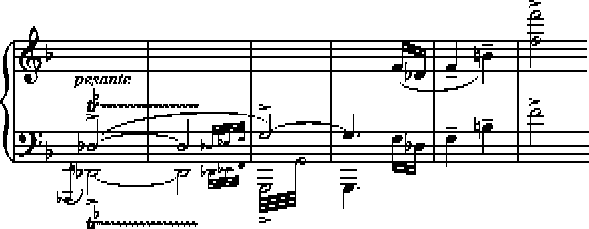
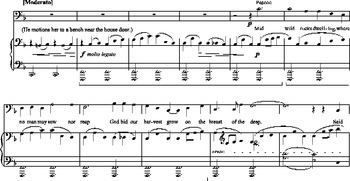
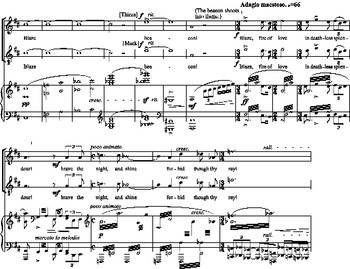
For Smyth to problematise adultery in a self-consciously historical English opera was to tackle a subject most considered distasteful, but nevertheless to situate herself alongside radical English novelists and playwrights fostering what George Gissing called ‘sexual anarchy’.Footnote 94 Smyth and Brewster conceived of lovers, like themselves, who reject social mores emblematic of England itself. The twin accusations against Mark and Thirza – that they are both ‘adulterers and traitors’ (Act II scene 2) – implies that they betray not just their village but the very moral bedrock of a nation. In Brewster's version of the libretto, Thirza is described as l'étrangère sans foi (the foreigner without faith).Footnote 95 She is accused of being ‘shameless’, a ‘whore’ who has bewitched Pascoe and ‘defiled the hearth where pure married love held its rites!’ His response to his own lust is shame and remorse, and the expectation of God's wrath. The ‘theme’ Smyth assigns to Pascoe comments on the unyielding nature of his beliefs and his legalistic theology. Heard as he preaches to Thirza of the benefits of wrecking, it is a four-bar ‘basso ostinato’ (literally, an ‘obstinate bass’) underpinned by a prolonged pedal on F (Ex. 4). According to Smyth, this music represents Pascoe's ‘iron tenacity of purpose’.Footnote 96 He is deterred neither by Thirza's fevered arguments against wrecking, nor by his own awareness of its effect on his marriage. In contrast to the puritanical plainness of Pascoe's song, the intensely lyrical music of Thirza's paeans to love demonstrates her sense of liberty and autonomy. Her climactic duet with Mark, ‘Blaze, fire of love’ (Act II scene 3), is remarkable for its rhythmic freedom, metrical irregularity, elastic tempo and what Elizabeth Wood terms ‘thorny chromaticism’, amounting to a gloriously unrestrained celebration of the ‘flame’ of their unbridled passion (Ex. 5).Footnote 97 Whereas the wreckers' music is so often redolent of the eighteenth century, the music of the lovers' coupling is the most modern in the score.Footnote 98
‘Pascoe's Theme’, ‘indicative of iron tenacity of purpose’, Act I scene 9.

Thirza's characterisation in the trial as wilful and unrepentant contests conventional ideals of femininity. A woman accused of adultery in a divorce trial could garner public sympathy if she had been compelled by male importunity, and if she appeared demure and contrite (as in the sensational Crawford vs Crawford and Dilke case in 1886, which ruined the lover not the adulteress). But if, as in the 1889 murder trial of Florence Maybrick, the adulterous woman was found to have been assertive enough to book the hotel and pay for the room, she (like Thirza) would be judged to have sullied what the queen termed the ‘public morals of the country’.Footnote 99 Often an adulteress's sanity was questioned, on the assumption that only a mental imbalance would render her capable of such a ‘crime’. Flaubert's Madame Bovary (considered by Leslie Stephen to be ‘one of the most revolting productions that ever issued from a novelist's brain’) presents in its heroine all the textbook characteristics of a nervous hysteric.Footnote 100 Emma Bovary was histrionic and capricious, she suffered palpitations, mood swings, sexual fantasies and impulsive extravagances.Footnote 101 But the sanity of Thirza is never in question. While she is defiant, and threatens and curses the villagers, it is Avis who is typecast as ‘coquettish’ and then ‘half-crazed’.Footnote 102 In her solos in Act I, Avis attacks her rival in love. She imagines Thirza is a rat and feigns murder (‘Smite her, kill her dead! / See her fun! Bravely done! Her blood flows red’).Footnote 103 She is hysterical, emotional and disruptive, suffering palpitations echoed in the music's accents (‘My heart is sore, so sore. / Pit-pat … hear it beating, madly beating / As stricken heart ne'er beat before’). Although still a teenager, she presents herself as sexually knowing and accuses Thirza of brewing ‘rank poisonous philtres’ to seduce her lover. Thirza, by contrast, is lucid and argumentative. At her trial she admits her complicity in lighting the beacon, testifies that Mark had ‘tended’ and ‘healed’ her sorrows and states that repentance was only possible if ‘up the hill the stream be flowing’. Smyth in her explanatory notesexplicitly denounces the court by calling it a ‘Cornish Vehm-gericht’, and associating it with medieval inquisitions.Footnote 104 (The Vehm were medieval Westphalian tribunals described by Walter Scott in one of his novels as ‘truly barbarous’, infamous for their ‘severe and secret vengeance’ and for their peremptory executions.Footnote 105) The theme Smyth devises to depict the court scene is a ‘heavy canto ostinato’, a hobbling bass illustrating a prisoner shackled in irons. To reinforce the allusion to a Dark Age, Lawrence chants a ‘psalm for the passing of souls’ and the choir intones a ‘trump of doom’ in a brief passage of faux medieval organum.Footnote 106 Lawrence pronounces a verdict of death by drowning, and the gates to the cave are locked.
The ‘Love Motif’, ‘Blaze, fire of love’, Act II scene 3.

Yet the mood at the end is not as sombre as this might suggest. In Mark's final song, he declares that ‘the cup must be drained, be it bitter or sweet’ (Act III scene 2). He alludes to the words of Christ before the crucifixion, identifying himself as a scapegoat resigned to his fate.Footnote 107 Death, in that context, is not a punishment but a sacrifice to a higher cause. Accordingly, through her music, Smyth portrays the lovers' deaths as a triumphant affirmation of love. As the gates of the cave clang shut, Thirza claims ‘Victory!’ Sunlight ‘streams through a fissure in the rocky roof of the cave’ during their final duet. Successive crescendos culminate in the interjection in the orchestra of a fortissimo recollection of the Love Motif just as they reach their final note. The plagal cadence (Ex. 6), from the subdominant minor (the D minor of the ‘Wreckers' Theme’ at the opening of the opera) to the transcendent tonic (A major), recalls the famous example of that cadence at the conclusion of Tristan and Isolde. Wagner described the dying Isolde's Verklärung as the moment when she ‘receives the blessed fulfilment of ardent longing, eternal union in measureless space, without barriers, without fetters, inseparable’.Footnote 108 In The Wreckers, the final moments have additional theological implications. The lovers have been solemnly entombed, but water cleanses them and washes away their sins. Dawn arrives, and its light shines on them, a sign of the granting of their request for ‘the mercy of love divine’.Footnote 109
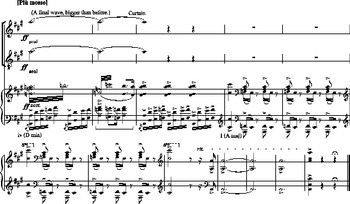
Closing cadence of The Wreckers, including the Love Motif (as marked).

4
The Wreckers was rejected by Covent Garden, as well as in Monte Carlo, Leipzig, Frankfurt, Brussels, Vienna and Munich. According to one account, Smyth spent five years ‘striding about Europe, cigar in mouth, trying to sell her opera The Wreckers to timorous or stubborn impresarios’.Footnote 110 First performances took place in German in Leipzig and Prague in 1906 under the title of Strandrecht.Footnote 111 As Elizabeth Kertesz shows in her examination of the reception of The Wreckers in Germany, the interest of German critics was sparked by the opera's exotic colour, its references to ‘the wild sea, the rough rocky coast and the folksong of this old musical Celtic tribe’ reminding them of Cornwall in the story of Tristan and Iseult.Footnote 112 Yet many German critics were horrified at their introduction to an English opera written by an English woman composer. Reviewing the first performance, the Berliner Tageblatt described the story as ‘rather distant from German taste’. Alfred Heuß, commenting in the Leipziger Kalender on the 1906/7 season, found the plot repellent: ‘It is a robbers' opera of exceptionally nasty character, in that the wreckers perform their work to prayers and hymns. Piety, murder, brutality, praying and cursing are so closely bound in this piece, that one is faced with the most peculiar mixture of religious hypocrisy.’ Failing to be attracted to the mix of history and myth, he reflected that ‘cannibals could be presented on the stage with the same justification’. Others accused Smyth of betraying national honour and ideals of femininity. ‘How does a lady come by such a text, and how can she also compromise England … like this?’ asked the Leipziger Volkszeitung.Footnote 113
Eighteen months later, on 30 May 1908 at Queen's Hall, Nikisch conducted a concert performance of The Wreckers in German to the end of ‘Blaze, fire of love’ in Act II.Footnote 114 Unfortunately, the opera reminded the Musical Times critic of ‘[t]he present hopeless condition of English operatic composers’.Footnote 115 There were several obstacles to an English production beyond the work's merit and its financial viability. Performance in French, even (as Smyth hoped) under André Messager at Covent Garden, would hardly qualify the work to be regarded as English.Footnote 116 Moreover that language, in particular, would raise suspicions of decadence.Footnote 117 Any depiction of adultery was considered repugnant. Tristan, at the time of its first English performance in 1882, was branded by some critics as ‘immoral’, one of them indicating that it was ‘worthy to compare in mischievous tendencies with the worst drama of Dumas fils or his imitators on the modern French stage’.Footnote 118 In London, the preservation of morality and of ‘true’ womanhood in the theatre was enforced by the Lord Chamberlain, who ruled that theatrical representation of prostitutes, mistresses and women who left their husbands offended the sensibilities of sisters and wives. In the heat of public debate on censorship, W. S. Gilbert, the most prominent librettist in the country, testified that ‘the stage is not a proper pulpit from which to disseminate doctrines possibly of Anarchism, Socialism and Agnosticism. It is not the proper platform upon which to discuss questions of adultery and free love before a mixed audience composed of persons of all ages, of both sexes.’Footnote 119 Eventually, due to the blandishments of Smyth and friends such as Violet Gordon Woodhouse, Beecham secured a license to produce The Wreckers at His Majesty's Theatre in 1909 and the work was repeated the following year in his opera season. Smyth asked her friend Alma Strettell to translate parts of Brewster's text into English, and it appears that she herself was responsible for the translation of the remainder.Footnote 120 With a printed libretto in hand, critics reported that they could hear (as well as read) every word.Footnote 121 There is little in the 1909 published version of the text to suggest that Smyth censored any part of her opera. Thirza's parody of phrases from the Lord's Prayer remains, as does Pascoe's description of his foes as ‘Satan's seed’ and the word ‘adulterer’ (which had once been eliminated from a London performance of a Verdi opera).Footnote 122 Possibly the only hint of Victorian prudery is Smyth's exclusion of a passage by Brewster in the final act, where Lawrence accuses Avis of acting like a prostitute.
After the première of the London production in 1909 most critics concentrated on Smyth's capacity as a composer, and the quality of the singers and production. Some praised the success of a work by a British-born composer, finding it ‘very decent stuff indeed’.Footnote 123 Surprisingly few took issue, as German critics had, with the ‘tastefulness’ of the drama. Filson Young, writing in the Saturday Review, criticised what was in his view a misrepresentation of the Cornish, who should have been depicted as melancholy with a ‘lonely sweetness’.Footnote 124 Arthur Kalisch, writing in The World, hinted at moral turpitude in a plot considered ‘too alien to our ideas to be a good subject for drama’.Footnote 125 He was more explicit in the Manchester Guardian. There, he argued that the opera failed ‘just in those qualities which one might expect to find in the work of a woman – restraint, subtlety, and charm’.Footnote 126 He identified a number of flaws. Understanding that the wreckers depicted Englishmen and Christians, he was bitterly disappointed to have been unable to sympathise with them:
It is impossible … for a twentieth-century audience to look upon loyalty to wreckers as anything of the kind. That this consideration seriously affects the value of the libretto as a subject for musical illustration need hardly be insisted upon. To take only one point: When we hear Pascoe's tirades in defence of wrecking set to music which might be appropriate to a martyr proclaiming his faith we cannot feel that it is dramatically right.
As much as Kalisch was incensed by the dramatisation of wrecking, he was even more incensed to think that the music and language of the Christian tradition might portray the wreckers as blameless innocents. Smyth had fallen into a trap identified by Shaw, that if the dramatist ‘takes a culpable prostitute for his heroine, he makes a heroine of a culpable prostitute’.Footnote 127 When in The Wreckers the stage is dominated by wreckers and their conspiracies (particularly in Act I), it signals that she has adopted wreckers as dramatic heroes, and has therefore made heroes of men more familiar in sensationalist novels as blackguards and pirates. And this is so especially if, as many critics noted, the wreckers' choruses offer the most enjoyable and accessible music of the opera.Footnote 128 Furthermore, Kalisch found himself uninterested in the plight of the lovers, who he thought took so long over the beacon-lighting they were bound to be caught, and whose central scene seemed ‘interminable’. His lack of sympathy suggests that he, like at least one of the German critics, saw a disconcerting contradiction between the humaneness of Thirza's actions in preventing shipwreck, and the impropriety of her adultery.Footnote 129 Plainly, the critics did not comprehend the depths of Thirza's misery in her marriage, or that that the lovers' breach of the community's pact was warranted – and the ironies of Smyth's music and her musical characterisations were insufficiently explicit to convince them. In 1909 the opera was perceived as a bleak tragedy, the inevitable result of numerous moral failures: the wreckers are betrayed, Avis is disowned for her lies and slander, Pascoe is deserted by his wife and the lovers are vanquished.Footnote 130 One hundred years later, in 2006, when a performance of The Wreckers was produced by a Cornish company in Truro, it was styled as ‘A tragic opera about a starving community which turns to wrecking ships’.Footnote 131 Its production sparked a public debate about whether the Cornish had ever participated in wrecking, the possibility being so discomfiting that the mezzo who played Thirza was obliged to tell journalists, ‘We're not actually saying this is what Cornish people did’. Most of the opera's ‘moral propaganda’ was lost, again, in the preoccupation with wrecking. The opera had become ‘just a story’.Footnote 132
5
It might seem that the unconventionality of The Wreckers stems mainly from the contribution of Brewster. His libretto undoubtedly reflects his own personal anarchism and sexual libertarianism, and offers a critique of a society defined by its Puritanism. Brewster's text advocates a host of civil liberties we now take for granted: the right to free thought, the right to rebel against corruption whether actively or passively, the right of a woman to leave her husband for another, the right to a fair trial, and the separation of church and state in the jurisdiction of the law. Brewster's grandson was disparaging of Smyth's ability to interpret Brewster's librettos, disclosing that when they were working on Fantasio (1892–4), ‘it was difficult for Ethel to have the slightest idea of what H. B. was writing or, for that matter, thinking, when he strayed outside the boundaries of clear-cut empirical response’.Footnote 133 But was she truly more conventional than Brewster, who preferred seclusion to public protest and whose publications for all their intellectual substance remain obscure? As much as Smyth had the capacity and opportunity to ameliorate the radicalism of The Wreckers, in 1909 when translating the original libretto into English she chose neither to soften its language nor to resile from revealing in her music where her sympathies lay. In Thirza and Mark she created modern heroes whose attitude to the church, to Christianity, to marriage and to femininity cast their opponents as relics of a bygone era of prudery and conservatism. Moreover, she succeeded in having that work performed in London, the citadel of operatic conservatism. Having scaled that pinnacle, she nonetheless attempted to deny any interest in crusades then being fomented by the women's movement. But by 1910 – when the Women's Social and Political Union superseded forms of passive resistance with a campaign of destruction of public property – she developed a growing sympathy for women's militancy. She wrote in Votes for Women:
Where such things are done, deep, fierce fires are burning somewhere – fires such as prevent this globe from becoming a dead thing turning in space like the moon. And when such actions of heroic self-sacrificing violence show up against a background of years and years of quiet constitutional effort … then, indeed, one marvels at those who dare, in the name of dignity or fastidiousness, criticise the militant's methods.Footnote 134
The seeds of the righteous anarchism that was to propel Smyth to commit a criminal act are to be found in The Wreckers. On 4 March 1912, in the company of hundreds of militant suffragettes, Smyth hurled a rock through the window of the colonial secretary's London home and was arrested and sentenced to two months in prison with hard labour.Footnote 135 If her opera was not, as Shaw would have it, ‘the most effective instrument of moral propaganda’, this violent strike far more dramatically contributed to the achievement of the rights that her opera envisaged.