Implications
The results of the current study suggest that the stallion’s thyroid hormones and functional responses may play an important role in providing complementary information for the assessment of transport stress and animal coping strategies. In addition, the existence of a significant correlation between T3 and rectal temperature, body weight and heart rate confirms that T3 is the most metabolically active iodothyronine. Moreover, the importance of the thyroid hormone, namely triiodothyronine (T3) generated locally by 5′-monodeiodinase (5′-MD) in the muscle tissue for metabolic needs during transport is still under investigation. In addition, when using circulating iodothyronine changes for the evaluation of transport stress the presence of peripheral 5′-MD should be further investigated. This may indicate that T3 generation in peripheral tissues possibly plays a paracrine role supporting transport stress and metabolic activity of skeletal muscle.
Introduction
Physiologic thyroid hormone concentrations reported for horses have a wide range of values because many intrinsic and extrinsic variables can influence their levels. These include: age (Irvine and Evans, Reference Irvine and Evans1975; Chen and Riley, Reference Chen and Riley1981), breed (Malinowski et al., Reference Malinowski, Christensen, Hafs and Scanes1996), gender (Fazio et al., Reference Fazio, Medica, Cravana, Messineo and Ferlazzo2007), seasonal period (Flisińska-Bojanowska et al., Reference Flisińska-Bojanowska, Komosa and Gill1991), altitude (Greene et al., Reference Greene, Cogger, Miltenberger, Koch, Bray and Wickler2002), changes in fertility (Gutierrez et al., Reference Gutierrez, Riddle and Bramlage2002; Meredith and Dobrinski, Reference Meredith and Dobrinski2004), daily rhythms (Morris and Garcia, Reference Morris and Garcia1983; Duckett et al., Reference Duckett, Manning and Weston1989), diet (Messer et al., Reference Messer, Johnson, Refsal, Nachreiner, Ganjam and Krause1995; Powell et al., Reference Powell, Lawrence, Fitzgerald, Danielsen, Parker, Siciliano and Crum2000), training and exercise (González et al., Reference González, González, Sánchez, Pinto, González, Enríquez, Martínez, Filgueira and White1998; Suwannachot et al., Reference Suwannachot, Verkleij, Kocsis, Enzerink and Everts2000) and disease, both severity and duration (Peeters et al., Reference Peeters, Debaveye, Fliers and Visser2006).
Thyroid hormones are important physiologic indices which are commonly used in metabolic rate and animal thermogenesis studies (McGuire et al., Reference McGuire, Beede, Collier, Buonomo, DeLorenzo, Wilcox, Huntington and Reynolds1991; Bird et al., Reference Bird, Clarke and Symonds1998) and their supplementation may increase metabolic rate and promote significant weight loss with dietary restriction. In addition, hormonally mediated events play an important role in central nervous system development and function, and a number of researchers have speculated that changes in cognitive function are also mediated by thyroid hormones in humans and animals (Schantz and Widholm, Reference Schantz and Widholm2001; Helmreich et al., Reference Helmreich, Crouch, Dorr and Parfitt2006).
Numerous studies to determine the amount of transport stress in horses have been carried out (Leadon, Reference Leadon1994; Fazio and Ferlazzo, Reference Fazio and Ferlazzo2003; Stull et al., Reference Stull, Spier, Aldridge, Blanchard and Stott2004) and thus it is well known that long-term stress (24 to 48 h) can influence a number of systems in the horse, including the immune, digestive and reproductive systems (Baucus et al., Reference Baucus, Ralston, Nockels, McKinnon and Squires1990a and Reference Baucus, Squires, Ralston, McKinnon and Nett1990b). The extent to which short transport stress influences the horse’s thyroid function has not been sufficiently studied and only limited scientific data are available that demonstrate its effect on body weight (BW), rectal temperature and heart rate (HR) changes (Stull, Reference Stull1999).
Given the above, the aim of the present research was to evaluate stallion thyroid function before and after road transport over short distances (under 300 km), taking into account the effects of different breed and age. Rectal temperature, BW and HR changes were also considered.
Material and methods
Animals
The study was carried out on a total of 126 healthy Thoroughbreds (n = 60) and crossbred (n = 66) stallions, aged 4 to 15 years and weighing 492 ± 15 kg. The horses were transported from the same stud farm (Instituto di Incremento Ippico of Sicily, Italy) to various other breeding stations in Sicily. All stallions had lived together and were a reproductive group of great value; they were therefore familiarized with the other animals in the group. All subjects were used exclusively for reproduction and all had previous transport experience and were familiar with the trailer as well as loading and unloading procedures. To ensure the homogeneity of the groups of horses per load and to exclude any chance of social competition stress, the same subjects were grouped together on all journeys over the three years of the study.
Each stallion was transported on one outbound journey (March to April) and one return journey (July to August) in every year, in accordance with the breeding season for three consecutive years (2004–06). The subjects were transported over exactly the same distance and route. However, this study examined only the subjects submitted to outbound journeys in order to minimize the effects of reproductive activity stress in stallions.
Samples
Two blood samples (10 ml) were collected by jugular venipuncture using evacuated tubes (Venoject; Terumo®, Terumo Europa N.V., Leuven, Belgium), one at 0800 h (basal I) and the other at 1100 h (basal II), in each horse box, one week prior to the loading and transport in basal conditions (control samples), then one week later, at 0800 h (before) in each horse box immediately before loading and about 3 to 4 h after transport and unloading (after), within 30 min of their arrival at the breeding stations (post-samples), in each new horse box. Serum samples were harvested after centrifugation at 1500 × g for 15 min at 4°C and stored at −20°C.
The recording of rectal temperature and HR was started before blood sampling to exclude a possible influence on HR changes. These measurements were recorded in an individual box for each horse to exclude the effect of loading procedure. Rectal temperature was measured using an electronic digital thermometer (Artsana, Grandate-Como, Italy) and HR using a Polar Sport Tester (Polar Electro Europe BV, Fleurier, Switzerland), which consisted of an electrode belt with built-in transmitter and a wristwatch receiver. The receiver had a memory function and stored data from the transmitter, averaging HR over 5 s intervals.
Individual live BWs were recorded in basal conditions, before and after transport using large animal scales.
Study design
The commercial trailer used was 9.515 m long and 2.5 m wide, with a ceiling height of 2.5 m. Six compartments with swinging gates were available to each group of stallions transported (i.e. six horses per load). Stocking density was about 2 m2/horse. Rubber padding lined the sides of the trailers from the floor to an approximate height of 1.2 m. The number of horses per load, the available floor area, distance travelled and time between loading and unloading were recorded. No feed or water was available during transportation, but they were made available before loading. The subjects were transported on main roads in a commercial trailer and were driven by the same professional driver. Driving speeds ranged from 0 to 80 km/h and the route took approximately 3 to 4 h to complete, and exactly the same route was followed on all journeys. Temperatures were recorded outside and inside the trailer before each journey commenced. Temperature and relative humidity inside the trailer at start and after transport ranged from 19.5°C to 22.4°C and from 62.4% to 65.1%, respectively. These were monitored continually using a Hygrothermograph ST-50 (Sekonic Corporation, Tokyo, Japan) placed near the centre of the trailer.
All methods and the procedures used in this study were reviewed and approved by the Messina University Institutional Board for the Care and Use of Animals.
Hormone assays
Serum total and free iodothyronine concentrations were determined in duplicate using a commercially available immunoenzymatic kits (Roche Diagnostics GmbH, Mannheim, Germany). The respective intra- and inter-assay coefficients of variation were as follows: 7.3% and 11.4% for T3, 2.3% and 5.7% for T4, 4.2% and 11.9% for fT3, 6.6% and 9.6% for fT4.
Statistical analysis
Data are presented as mean values ± standard deviation (s.d.) of duplicate measurements. One-way repeated measures analysis of variance (RM-ANOVA) was applied to: (i) determine whether transport stress had any effect, (ii) compare changes in BW, rectal temperature and HR values before loading and after unloading and transport and between basal I and basal II conditions, (iii) compare different stallion breeds and ages. The level of significance was set at <0.05. All calculations were performed using the PRISM package (GraphPad Software Inc., San Diego, CA).
The correlations between rectal temperature, BW, HR measurements and thyroid hormone concentrations were evaluated by correlation and linear regression.
Results
Effects of transport
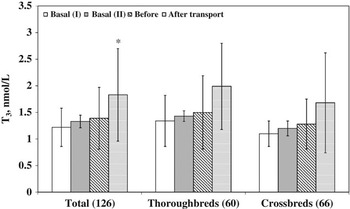
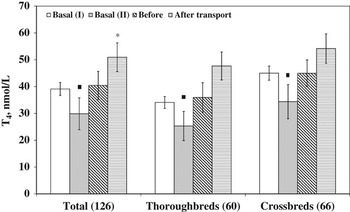
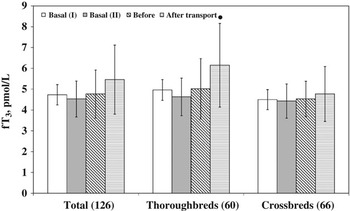
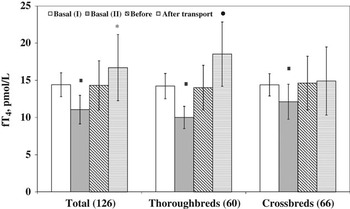
The results obtained showed significant (P < 0.01) increases in levels of circulating T3 (Figure 1), T4 (Figure 2) and fT4 (Figure 4) after transport under 300 km, compared to the before values. Transport effects were therefore observed for T3, T4 and fT4 hormones (P < 0.01), but not for fT3 levels (Figure 3). T4 and fT4 showed significantly lower levels (P < 0.01) in basal II than in basal I conditions. No significant differences were observed between the before and basal values for T3 and fT3.
Circulating triiodothyronine levels (mean ± s.d.) in basal conditions, before and after short road transport of stallions. Label on x-axis: groups and number of subjects. Asterisk indicates significant (*P < 0.01) differences in average hormone concentrations v. before.

Circulating thyroxine levels (mean ± s.d.) in basal conditions, before and after short road transport of stallions. Label on x-axis: groups and number of subjects. Asterisk indicates significant (*P < 0.01) differences in average hormone concentrations v. before. Symbol indicates significant (▪P < 0.01) differences in average hormone concentrations v. basal I.

Circulating free triiodothyronine levels (mean ± s.d.) in basal conditions, before and after short road transport of stallions. Label on x-axis: groups and number of subjects. Symbol indicates significant (●P < 0.01) differences in average hormone concentrations v. crossbreds.

Circulating free thyroxine levels (mean ± s.d.) in basal conditions, before and after short road transport of stallions. Label on x-axis: groups and number of subjects. Asterisk indicates significant (*P < 0.05) differences in average hormone concentrations v. before. Symbol indicates significant (●P < 0.01) differences in average hormone concentrations v. crossbreds. Symbol indicates significant (▪P < 0.05) differences in average hormone concentrations v. basal I.

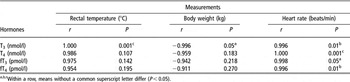
Rectal temperature (P < 0.01) and HR (P < 0.05) showed significant increases (Table 1) after transport, compared to before values. A positive correlation between T3 and rectal temperature (r = 1.000; P = 0.001) was recorded. In addition, HR was positively correlated with T3 (r = 0.996; P = 0.01), T4 (r = 1.000; P = 0.001), fT3 (r = 0.998; P = 0.05) and fT4 (r = 0.996; P = 0.01) (Table 2)
Rectal temperature, body weight and heart rate measurements in basal conditions, before and after short road transport of stallions

a,bWithin a row, means without a common superscript letter differ (P < 0.05).
Correlations and linear regression (r) between thyroid hormone concentrations, rectal temperature, body weight and heart rate measurements of stallions

a,b,cWithin a row, means without a common superscript letter differ (P < 0.05).
No significant decrease in BW after transport was observed (Table 1). No significant differences were observed for these parameters between basal and before values. However, a negative correlation between T3 and BW (r = −0.996; P = 0.05) was observed (Table 2).
Effects of age
There was no effect of age on total and free iodothyronines, and no significant differences were observed between stallions aged 4 to 9 years and stallions aged 10 to 15 years in basal conditions, and both before and after transport.
Effects of breed
Thoroughbreds showed higher fT3 (P < 0.05) and fT4 (P < 0.01) levels than crossbred stallions only after transport (Figures 3 and 4). No differences between Thoroughbreds and crossbreds were observed in basal and before conditions for total and free iodothyronine levels.
Thoroughbreds and crossbreds showed lower T4 and fT4 (P < 0.05) levels in basal II than in basal I conditions.
Discussion
The results observed document how the thyroid function (evaluated by means of the modifications in circulating total and free iodothyronine levels) actively modulates the response to short road transport stress in stallions with a greater release of T3, T4 and fT4. The significant response of T3 to short transport stress could be either the result of the preferential release of T3 from the thyroid gland or of an increased peripheral monodeiodination of T4, although a concomitant increase of T4 levels were observed. This data confirms that T3 is a metabolically active hormone (Larsen et al., Reference Larsen, Silva and Kaplan1981).
Increases in T3 and T4 levels after transport confirm that thyroid hormone modifications are an indicator of stress in domestic animals (Fazio and Ferlazzo, Reference Fazio and Ferlazzo2003; Fazio et al., Reference Fazio, Medica, Alberghina, Cavaleri and Ferlazzo2005 and Reference Fazio, Medica, Cravana, Messineo and Ferlazzo2007) and also show that horse breed, but not age, appears to influence thyroid responsiveness. In fact, the value of thyroid hormone concentrations cannot be used as an absolute value, as it is only useful in terms of its variation when relative basal values are known. The higher free iodothyronines observed in Thoroughbreds compared to crossbreds after transport confirm data previously obtained in horses (Malinowski et al., Reference Malinowski, Christensen, Hafs and Scanes1996) and suggests that partial thyroid responses to short transport stress are influenced by breed.
The influence of circadian rhythms on thyroid hormones was not investigated because single measurements of total and free iodothyronines are insufficient and thus inadequate to interpret this factor. In addition, the thyroid function can be affected by many endogenous and exogenous factors, such as loading, unloading, environmental changes and diurnal rhythms. How these factors could influence hormonal rhythms remains to be proven. Moreover, T4 and fT4 hormones showed lower levels in basal II conditions than basal I conditions. This suggests a significant effect of transport on these hormones, irrespective of the existence of periodicity demonstrated for thyroid hormones in adult geldings (Duckett et al., Reference Duckett, Manning and Weston1989).
However, the higher T4 and fT4 levels observed at 1100 h after transport showed that transport stress may mask the physiological pattern of those hormones, which one week earlier had been lower. The data obtained showed that the environmental conditions and the physiological state of an organism might modify the course and amplitude of rhythms.
Transport is inevitably associated with thermal stress, as confirmed by the positive correlation between rectal temperature measurements and T3 concentrations. However, the stallions had not been previously acclimatized in our study design. It has been shown that acclimatization can increase the horse’s ability to tolerate thermal load reflected by a decrease in respiration rate and rectal temperature (Rammerstorfer et al., Reference Rammerstorfer, Potter, Brumbaugh, Gibbs, Varner and Rammerstorfer2001). Extremely warm temperatures of 24°C to 32°C are dangerous, as horses cannot dissipate body heat quickly enough to maintain homeothermy.
In addition, the energy expended for standing during transport may be considerable and posture movements may vary depending on the quality and duration of transport. Short road transport may mask the changes in metabolic reactions as a response to stress. In this sense, the increase in total iodothyronine and fT4 levels could be a contribution to the energy requirements for muscles, including the reactions related to intermediary metabolism such as protein turnover, ion transport and substrate cycles.
These results indicate that short road transport can more severely affect thyroid patterns and related hormone secretion, but that effective compensatory mechanisms restore normal physiological adaptation to stress thus protecting the body against exaggerated catabolism. Thyroid hormone evaluation after short transport has been shown to be effective in evaluating short-term stress in horses and to provide an additional tool for distinguishing between total and free iodothyronine changes.
The physiologic responses of horses to short road transport show a decrease in BW (although not significant), as confirmed by a negative correlation only between BW and T3, as well as an increase in rectal temperature, in accordance with that reported after long, medium and short trips (Waran et al., Reference Waran, Robertson, Cuddeford, Kokoszko and Marlin1996; Stull, Reference Stull1999; Stull and Rodiek, Reference Stull and Rodiek2000). However, no differences were observed relating to different ages. The significant increase in HR observed after transport showed that HR remained higher, even up to 30 min after unloading. Though, previous results reported an increase in HR observed at loading and unloading (Waran and Cuddeford, Reference Waran and Cuddeford1995) and also during transport (Smith et al., Reference Smith, Jones, Carlson and Pascoe1994) in horses. These data are confirmed by the positive correlations observed between HR and total and free iodothyronines.
The data obtained could suggest that novel environments may reinforce the total cumulative effect on an individual horse’s heart rate, although no significant differences between Thoroughbreds and crossbreds were observed. Basal, pre- and post-transport values for rectal temperature and HR values of stallions fell within the physiological range reported for equine species (Rammerstorfer et al., Reference Rammerstorfer, Potter, Brumbaugh, Gibbs, Varner and Rammerstorfer2001).
These findings suggest that the stallion’s thyroid hormones and physiological responses may play an important role in providing complementary information for the assessment of transport stress and animal coping strategies. In addition, the existence of a significant correlation between T3 and rectal temperature, BW and HR confirms that T3 is the most metabolically active iodothyronine, also during transport in stallions.
Acknowledgements
The authors express their gratitude to the management and staff of Instituto di Incremento Ippico of Sicily, Italy, for their practical and technical assistance.