1. Introduction
The palaeo-oceanic lithosphere is emplaced along the convergent plate boundaries in the form of ophiolite complexes, which originated either at mid-ocean ridges (MOR) or supra-subduction zones (SSZ) including fore-arc/back-arc regions (Dilek & Newcomb, Reference Dilek and Newcomb2003; Dilek & Furnes, Reference Dilek and Furnes2009, Reference Dilek and Furnes2014; Pearce, Reference Pearce2014). Ophiolites are reported from different parts of the globe along the orogenic belts ranging in age from Archean to Cenozoic with MOR and SSZ geochemical characteristics (Dilek & Robinson, Reference Dilek and Robinson2003). The ophiolites of Proterozoic age (870–627 Ma) occur in the Arabian Shield and in the Atlas Mountains in NW Africa, while the Mesozoic–Cenozoic ophiolites are distributed along the Alpine–Himalayan Orogenic Belt and in the Philippines (Furnes et al. Reference Furnes, Dilek, Zhao, Safonova and Santosh2020). The geodynamic scenario of most of the global ophiolite sequences remains contentious with two competing tectonic settings: a MOR setting (Coleman, Reference Coleman1977) and an SSZ setting (Pearce, Reference Pearce2014; Hodel et al. Reference Hodel, Triantafyllou, Berger, Macouin, Baele, Mattielli, Monnier, Trindade, Ducea, Chatir and Ennih2020). However, both the MORB and SSZ geochemical affinities often co-exist within the same ophiolite, for example, Mirdita ophiolite, Albania (Dilek et al. Reference Dilek, Furnes and Shallo2008) and other Tethyan ophiolites (Dilek & Furnes, Reference Dilek and Furnes2019).
Well-studied Mesozoic Neo-Tethyan ophiolitic sequences are exposed along the northern Indian plate margin, that is, Indus Yarlung Tsangbo Suture (IYTS; Hebert et al. Reference Hebert, Bezard, Guilmette, Dostal, Wang and Liu2012; Liu et al. Reference Liu, Zhang, Xu, Wang, Chen, Guo, Wu and Sein2016; Bhat et al. Reference Bhat, Ahmad and Subba Rao2017a, Reference Bhat, Ahmad and Subba Rao2019a, b; Kingson et al. Reference Kingson, Bhutani, Dash, Sebastian and Balakrishnan2017; Xiong et al. Reference Xiong, Yang, Robinson, Gao, Chen and Lai2017; Buckman et al. Reference Buckman, Aitchison, Nutman, Bennett, Saktura, Walsh, Kachovich and Hidaka2018; Jadoon et al. Reference Jadoon, Ding, Baral and Qasim2020). However, due to extreme high altitude (average height 3000 m) and poor accessibility to the Ladakh terrain, especially Kargil region of western Ladakh, limited research work has been carried out on the western Ladakh ophiolites, particularly on Suru–Thasgam dismembered ophiolitic slice, thrust over the Dras arc complex. Here we report for the first time the petrological and geochemical characteristics of mafic–ultramafic rocks of the Suru–Thasgam ophiolitic slice. Our study is an attempt to understand the petrogenesis and to correlate and compare this with other Neo-Tethyan ophiolites, based on integrated mineralogical and geochemical datasets.
2. Regional geology
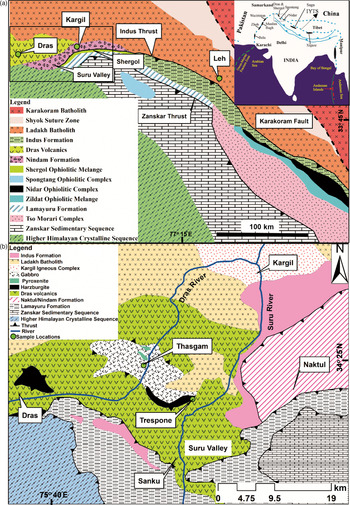
Ophiolites of Mesozoic age are exposed along the IYTS (Fig. 1a) and represent remnants of the eastern portion of the Neo-Tethyan Ocean (Maheo et al. Reference Maheo, Bertrand, Guillot, Villa, Keller and Capiez2004; Ahmad et al. Reference Ahmad, Tanaka, Sachan, Asahara, Islam and Khanna2008; Dilek & Furnes, Reference Dilek and Furnes2009, Reference Dilek and Furnes2011, Reference Dilek and Furnes2019; Aitchison et al. Reference Aitchison, Baxter, Zyabrev and Ali2011; Bhat et al. Reference Bhat, Ahmad and Subba Rao2017a, Reference Bhat, Ahmad and Subba Rao2019a, b; Buckman et al. Reference Buckman, Aitchison, Nutman, Bennett, Saktura, Walsh, Kachovich and Hidaka2018). In Ladakh Himalaya (Fig. 1a), the ophiolitic slices from NW to SE are: Dras ophiolitic slice (Radhakrishna et al. Reference Radhakrishna, Divakara Rao and Murali1984, Reference Radhakrishna, Divakara Rao and Murali1987); Suru Valley ophiolitic slice (Robertson, Reference Robertson, Khan, Treolar, Searle and Jan2000; Bhat et al. Reference Bhat, Ahmad and Subba Rao2019b); Shergol ophiolitic slice (Bhat et al. Reference Bhat, Ahmad and Subba Rao2017a, b, Reference Bhat, Ahmad and Subba Rao2019c); Spongtang ophiolite complex (Maheo et al. Reference Maheo, Bertrand, Guillot, Villa, Keller and Capiez2004); and Nidar ophiolitic complex (Ahmad et al. Reference Ahmad, Islam, Khanna and Thakur1996, Reference Ahmad, Tanaka, Sachan, Asahara, Islam and Khanna2008). These ophiolites are highly dismembered, similar to other Tethyan ophiolites (Moores et al. Reference Moores, Kellogg and Dilek2000), and are emplaced as imbricate blocks thrust over the Mesozoic Dras arc complex comprising Dras volcanics and Nindam/Naktul Formations (Honegger et al. Reference Honegger, Dietrich, Frank, Gansser, Thoni and Trommsdorf1982; Radhakrishna et al. Reference Radhakrishna, Divakara Rao and Murali1984; Reuber, Reference Reuber1989; Robertson, Reference Robertson, Khan, Treolar, Searle and Jan2000; Maheo et al. Reference Maheo, Fayoux, Guillot, Garzanti, Capiez and Mascle2006; Bhat et al. Reference Bhat, Ahmad and Subba Rao2017a, Reference Bhat, Ahmad and Subba Rao2019a, b). Earlier workers suggested that these rootless sub-horizontal bodies of ophiolites from Ladakh Himalaya represent substratum of the Dras arc complex (e.g. Reuber, Reference Reuber1989; Robertson, Reference Robertson, Khan, Treolar, Searle and Jan2000). Many others argued for their origin at palaeo-MOR in the context of the Neo-Tethys Ocean, emplaced during Late Cretaceous time along the Indus Suture Zone (ISZ) (e.g. Brookfield & Reynolds, Reference Brookfield and Reynolds1981; Radhakrishna et al. Reference Radhakrishna, Divakara Rao and Murali1984; Reuber et al. Reference Reuber, Montigny, Thuizat and Heitz1990). However, recent work based on the detailed whole-rock, mineral and isotope data proposed that these ophiolitic slices were evolved in a SSZ tectonic setting in the context of the Neo-Tethys Ocean (Maheo et al. Reference Maheo, Bertrand, Guillot, Villa, Keller and Capiez2004; Ahmad et al. Reference Ahmad, Tanaka, Sachan, Asahara, Islam and Khanna2008; Bhat et al. Reference Bhat, Ahmad and Subba Rao2017a, Reference Bhat, Ahmad and Subba Rao2019a, b, Reference Bhat, Ahmad, Subba Rao, Balakrishnan and Chalapathi Rao2021; Buckman et al. Reference Buckman, Aitchison, Nutman, Bennett, Saktura, Walsh, Kachovich and Hidaka2018; Jonnalagadda et al. Reference Jonnalagadda, Karmalkar, Benoit, Gregoire, Duraiswami, Harshe and Kamble2019).
(a) Geological map of the Ladakh Himalaya (modified after Maheo et al. Reference Maheo, Bertrand, Guillot, Villa, Keller and Capiez2004) showing the location of the study area (rectangle) and with an inset map of the Himalayan–Tibetan Orogen (modified after Dilek & Furnes, Reference Dilek and Furnes2009). (b) Detailed geological map of the Kargil District of Ladakh Himalaya (modified after Reuber, Reference Reuber1989) showing the Suru–Thasgam ophiolitic slice.

The Dras arc complex, a dominant tectonic unit in the study area (Fig. 1b), represents part of the intra-oceanic arc formed within the Neo-Tethyan Ocean during the Cretaceous Period above an inferred N-dipping subduction zone. It dominantly comprises mafic to intermediate volcanics with subordinate shallow- to deep-marine volcano-sedimentary assemblage of fore-arc apron known as the Nindam Formation (Robertson & Degnan, Reference Robertson and Degnan1994; Robertson, Reference Robertson, Khan, Treolar, Searle and Jan2000). This arc complex is overlain by dismembered Late Jurassic Neo-Tethyan oceanic lithosphere (Reuber, Reference Reuber1989; Robertson, Reference Robertson, Khan, Treolar, Searle and Jan2000). According to Reuber (Reference Reuber1989), part of this oceanic lithosphere, comprising serpentinized peridotites (Suru Valley Peridotites of Bhat et al. Reference Bhat, Ahmad and Subba Rao2019b) with minor gabbros, best exposed in the Suru Valley, represents tectonically disrupted oceanic substratum of the Cretaceous Dras arc complex. Based on mineral and whole-rock geochemistry, Bhat et al. (Reference Bhat, Ahmad and Subba Rao2019b) recently suggested that these peridotites evolved in an intra-oceanic subduction environment corresponding to Dras arc complex.
3. Field relationships
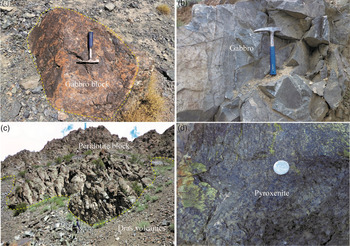
The Suru–Thasgam dismembered ophiolitic slice is composed of serpentinized peridotites, pyroxenites and gabbros thrust over the Dras arc complex as isolated blocks (Fig. 1b). Robertson & Degnan (Reference Robertson and Degnan1994) classified the Dras arc complex into three structural units from west to east: the Suru Formation (arc interior dominated by Dras volcanics), the Naktul Formation (a shallow-water fore-arc apron comprising thickly bedded turbidites and carbonates) and the Nindam Formation (a deep-water fore-arc apron comprising volcaniclastic turbidites and pelagic carbonates). This NW–SE-striking ophiolitic slice extends between Thasgam and Trespone villages towards SW of Kargil town, measuring c. 20 km in length and 10–12 km in width (Fig. 1b). Its southeastern exposure is marked by the Suru River where the gabbros and peridotites are exposed on the river bank. The Dras River flows through this ophiolitic slice at Trespone village, and the ophiolitic rocks such as gabbros and pyroxenites crop out along the Dras–Kargil National Highway on both banks of the river. The contact between the ophiolitic slice and underlying Dras volcanics is faulted as evident in the field and also described by earlier workers (e.g. Radhakrishna et al. Reference Radhakrishna, Divakara Rao and Murali1984, Reference Radhakrishna, Divakara Rao and Murali1987; Robertson, Reference Robertson, Khan, Treolar, Searle and Jan2000; Bhat et al. Reference Bhat, Ahmad and Subba Rao2019b). The sampled outcrops of the Suru–Thasgam ophiolitic slice are depicted in Figure 2 and their geographic coordinates are provided in Tables 1 and 2.
Field photographs of (a) isolated massive gabbro block at Trespone Village of Suru Valley; (b) outcrop of fresh gabbro near Thasgam Village; (c) peridotite block at Trespone Village; and (d) well-exposed pyroxenite at Thasgam Village of Dras.

Major (wt%) and trace (ppm) element peridotite and pyroxenite data from the Suru–Thasgam ophiolitic slice, western Ladakh

Major (wt%) and trace (ppm) element gabbro data from the Suru–Thasgam ophiolitic slice, western Ladakh. ND – not defined.

The medium- to coarse-grained dark-green-coloured massive gabbros are exposed as isolated blocks (1–4 m across) at the Trespone Village in Suru Valley (Fig. 2a), and also along the opposite banks of the Dras River near Thasgam Village (Fig. 2b). Gabbro samples SM2–6 were collected from Trespone Village and SM10–15 were collected from the Thasgam Village (respective coordinates provided in Table 2). These dark-green-coloured gabbros comprise the dominant component of the dismembered ophiolite suite of the study area. The isolated peridotite block, up to 100 m across, is exposed at Trespone Village towards the left bank of the downstream Suru River, overlying the Dras volcanics (Fig. 2c). Here black- to dark-green-coloured peridotite samples DP3–5 (coordinates provided in Table 1) were collected. In addition, undeformed cumulate textured pyroxenite blocks (Fig. 2d) are exposed at Thasgam Village along the left bank of downstream Dras River adjacent to gabbros. Olive-green-coloured pyroxenite samples TG10–15 (coordinates provided in Table 1) were collected from an isolated block on the road side.
4. Petrography
We conducted out petrographic study on 36 mafic–ultramafic rock samples from the Suru–Thasgam ophiolitic slice, described in detail in the following sections.
4.a. Peridotites
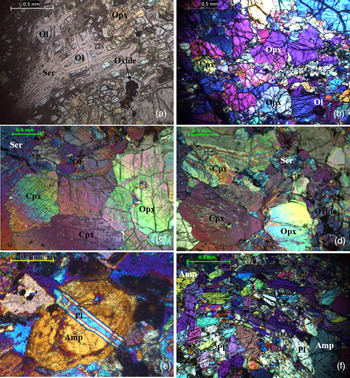
The peridotites are dominantly composed of variable sizes (0.2–0.5 mm across) of olivine (50–60 modal %), < 1 mm across orthopyroxene (20–30 modal %) with < 0.5 mm across clinopyroxene (5–10 modal %) and < 0.4 mm across spinel grains (< 5 modal %). Oxides and serpentine (< 10 modal %) are present as secondary mineral assemblages, whereby olivine has occasionally transformed into serpentine (Fig. 3a) reflecting the low degree of serpentinization (< 10%). Clinopyroxene was absent from sample DP3. The samples are therefore compositionally similar to clinopyroxene-absent and clinopyroxene-bearing spinel harzburgites. They also exhibit deformational features such as undulatory extinction and kink bands, reflecting their tectonite nature. These rock types have smoothly curved olivine crystals with proto-granular texture (Fig. 3b), and serpentine veins cut across the olivine and orthopyroxene crystals in places. Dark-brown vermicular spinel grains (< 0.4 mm across), commonly altered to iron oxides, also occur along margins and fractures between the silicate minerals.
Photomicrographs under crossed-polarized light: (a) peridotite with variable sizes of mineral grains; (b) peridotite showing proto-granular texture; (c) pyroxenite with cumulate texture; (d) pyroxenite with intercumulus space occupied by olivine grains; (e) gabbro with zoned plagioclase (Pl) in amphibole (Amp) after clinopyroxene; and (f) gabbro with ophitic to sub-ophitic textural relationship of mineral grains.

4.b. Pyroxenites
Petrographically, this rock type has a cumulate nature with composition ranging from olivine websterite to clinopyroxenite. The studied pyroxenites are distinguished from the peridotites based on their colour, textural features and mineralogical composition. The primary mineral assemblage constitutes clinopyroxene (Cpx; 60–70 modal %), orthopyroxene (Opx; 10–20 modal %), olivine (Ol; 5–10 modal %) and spinel (< 5 modal %); minor serpentine (Ser; < 3 modal %) and iron oxides constitute the secondary mineral assemblage. At places, the inter-cumulus spaces are occupied by small- to medium-grained olivine in the majority of the cases, and sometimes (rarely) by reddish-brown spinel grains. This rock type displays no evidence of deformation and therefore preserves the primary textures of a cumulate rock type (Fig. 3c). Both the pyroxene types occur in the form of subhedral grains (0.5–1.5 mm across) with a dominance of clinopyroxene in most samples. Small euhedral–subhedral olivine grains occur as inclusions in pyroxene grains and, at places, exhibit triple junctions along with orthopyroxene and clinopyroxene grains at inter-cumulus spaces (Fig. 3d). Secondary serpentine and iron oxide (< 0.5 mm across) are observed within the cracks and along grain boundaries of olivine and pyroxene. Small euhedral–subhedral grains of reddish-brown spinel (< 0.5 mm across) are present and are partially or totally included in the associated silicate minerals, indicating their early crystallization.
4.c. Gabbros
Gabbros are essentially composed of medium-grained plagioclase (65 modal %) and amphibole grains (20 modal %) with < 15 modal % of clinopyroxene, chlorite and iron oxide. At places, plagioclase feldspars show zoning and partial alteration to saussurite. Clinopyroxenes are replaced by amphiboles (Fig. 3e), while iron oxide occurs mostly along the margins of amphiboles. This rock type shows an ophitic to sub-ophitic textural relationship of mineral grains, with a few samples having a hypidiomorphic texture (Fig. 3f).
5. Geochemistry
5.a. Analytical techniques
After careful petrographic study, relatively fresh representative samples of peridotites (3 samples), pyroxenites (6 samples) and gabbros (11 samples) from the Suru–Thasgam ophiolitic slice were selected for geochemical analysis. The samples were crushed into small chips to remove the weathered parts. These rocks were then manually pulverized/milled using an agate mortar and pestle. Loss on ignition (LOI) was determined by heating a separate aliquot of sample powder (5 g) at 950°C. The whole-rock major-oxide analysis was carried out on powder pellets using an X-ray fluorescence spectrometer (Philips Magi X PRO, Model PW 2440 wavelength-dispersive X-ray fluorescence spectrometer or WDXRF), coupled with an automatic sample changer. Trace elements including rare earth elements (REE) were analysed by wet chemical method using a high-resolution inductively couple plasma mass spectrometer (HRICP-MS) in jump-wiggle mode at moderate resolution of 300. The analytical procedures for major- and trace-element determination were as described by Krishna et al. (Reference Krishna, Murthy and Govil2007) and Satyanarayanan et al. (Reference Satyanarayanan, Balaram, Sawant, Subramanyam and Krishna2014), respectively. All the analysis was performed at the National Geophysical Research Institute (NGRI), Hyderabad, India. Standard reference materials for mafic rock were BHVO-1 (USGS international basalt standard) and MRG-1 (Mount Royal Gabbro, Canada), and for peridotite PCC-1 (USGS international peridotite standard) and UBN were used along with a couple of procedural blanks. Analytical precision (relative standard deviation) for major elements is well below 1–2% for all the samples including reference standards and 3–5% for the majority of trace elements. The analytical results therefore demonstrate a high degree of machine accuracy and precision. Whole-rock major- (in wt%) and trace- (in ppm) element data of peridotites and pyroxenites are presented in Table 1, and that for gabbros in Table 2.
Mineral chemical analyses of olivine, orthopyroxene, clinopyroxene, plagioclase, amphibole and spinel from selected rock samples were performed at the BHU, Varanasi, using the electron probe microanalyser (EPMA) CAMECA SX-Five instrument. The instrument was operated at an acceleration voltage of 15 kV and probe current of 20 nA. Well-calibrated natural silicates were used as standards, and replicate analyses of individual points show an analytical error of < 2%. EPMA results of studied minerals are presented in online Supplementary Tables S1–S6 (available at http://journals.cambridge.org/geo).
5.b. Mineral chemistry
5.b.1. Olivine
Representative analyses of olivine from the peridotites and pyroxenites are presented in online Supplementary Table S1. The olivines in peridotite have relatively uniform composition. The forsterite content of olivine ranges from Fo88.5 to Fo89.3 in peridotites (typical range of mantle peridotites is Fo88-91, after Jonnalagadda et al. Reference Jonnalagadda, Karmalkar, Benoit, Gregoire, Duraiswami, Harshe and Kamble2019) and from Fo87.8 to Fo89.9 in pyroxenites. MgO in peridotites ranges over 47.4–48.8 wt% and is almost similar to that of pyroxenites (47.6–48.6 wt%), whereas Cr2O3 content increases from peridotites (i.e. 0.01–0.03 wt%) to pyroxenites (i.e. 0.03–0.15 wt%).
5.b.2. Orthopyroxene
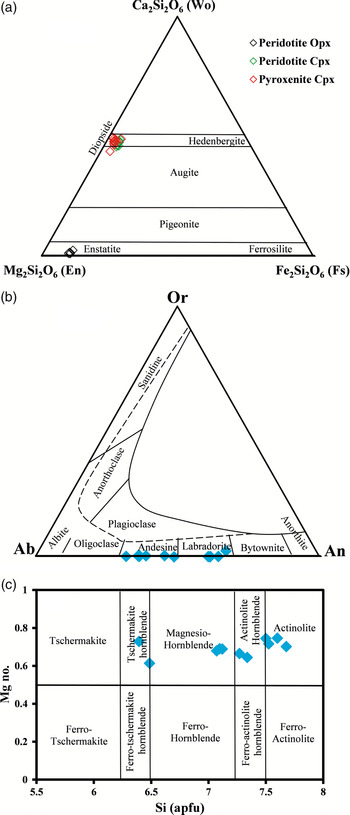
Orthopyroxenes are abundant in peridotites; however, they are less abundant in pyroxenites and almost absent in gabbros. Representative analyses of orthopyroxene from peridotites are listed in online Supplementary Table S2. The orthopyroxene in peridotites is of enstatite composition varying from En86.9 Fs9.4 Wo1.3 to En89.2 Fs10.3 Wo2.7 (Fig. 4a). They are unzoned and highly magnesian with Mg no. (100 × Mg2+/(Mg2+ + Fe2+)) ranging from 89 to 92. Further, they are characterized by higher Al2O3 (4.9–5.5 wt%) and Cr2O3 (0.52–0.57 wt%), and lower TiO2 concentration (< 0.13 wt%).
Plots of (a) chemical variability of pyroxenes from peridotites and pyroxenites shown in Wollastonite–Enstatite–Ferrosilite pyroxene ternary classification diagram after Morimoto et al. (Reference Morimoto, Fabries, Ferguson, Ginzburg, Ross, Seifeit and Zussman1989); (b) chemical variability of plagioclase from gabbros in Ab–An–Or feldspar ternary classification diagram after Deer et al. (Reference Deer, Howie and Zussman1992); and (c) chemical composition of amphibole from gabbros in the Leake (Reference Leake1978) classification diagram.

5.b.3. Clinopyroxene
Representative analyses of clinopyroxenes from peridotites are listed in online Supplementary Table S2 and of pyroxenites in online Supplementary Table S3. The studied clinopyroxenes do not show any zoning in the studied rock types. The clinopyroxene in the peridotites have relatively uniform composition of En47–50 Fe5–6 Wo46–49, and on the wollastonite–enstatite–ferrosilite ternary diagram of Morimoto et al. (Reference Morimoto, Fabries, Ferguson, Ginzburg, Ross, Seifeit and Zussman1989) they plot in the diopside field (Fig. 4a). The Mg no. (93–98) along with Al2O3, CaO, Cr2O3 and TiO2 contents of the analysed clinopyroxenes range over 1.65–6.75 wt%, 21.02–24.5 wt%, 0.34–1 wt% and 0.1–0.49 wt%, respectively. In addition, the clinopyroxenes in pyroxenites are of diopside composition, that is, Wo44–50 En46–53 Fs1–5 (Fig. 4a) with high Mg no. (93–97). Their Al2O3, Cr2O3, CaO and TiO2 contents range over 0.39–2.26 wt%, 0.03–0.54 wt%, 22.01–25.16 wt% and 0.03–0.15 wt%, respectively.
5.b.4. Spinel
Representative analyses of spinel from the pyroxenites is shown in online Supplementary Table S4. The studied spinels are Cr-rich (52.2–40.1 wt%) and Al depleted (7.4–14.2 wt%). They show a wide compositional range with high Cr no. (100 × Cr3+/(Cr3+ + Al3+ + Fe3+)) of 54–72 and low Mg no. of 27–40 (online Supplementary Table S4). However, in peridotites all the spinels are altered to magnetite with total iron (i.e. Fe2O3 + FeO) ranging over 69.5–86.7 wt%, low Al2O3 (0.1–3.5 wt%), Cr2O3 (9.7–21.2 wt%) and MgO (0.6–1.9 wt%).
5.b.5. Plagioclase
Representative analyses of plagioclase from gabbros are presented in online Supplementary Table S5. The plagioclases are mostly albitized, range in composition from An65.8 Ab67.9 Or2.5 to An31.8 Ab31.7 Or0.1 and plot in the andesine–labradorite field in a ternary diagram (Fig. 4b) of Deer et al. (Reference Deer, Howie and Zussman1992).
5.b.6. Amphibole
The amphibole is absent from peridotites and pyroxenites; however, it is present in gabbros as secondary minerals, formed as a result of the break-down of pyroxenes. These amphiboles, with high Si content (5.7–7.7) and high Mg no. (61–75) (online Supplementary Table S6), show compositional variation from magnesian–hornblende to actinolite, defining a paragasitic trend as per the classification diagram of Leake (Reference Leake1978) (Fig. 4c).
5.c. Whole-rock geochemical characteristics
The peridotites, pyroxenites and gabbros from the Suru–Thasgam ophiolitic slice are characterized by a variable range of major elements with Mg no. 89–90, 76–84 (Table 1) and 56–69, respectively (Table 2). The lower concentration of alkalis (Na2O + K2O) in the pyroxenites and gabbros is explained by the cumulative nature of these rocks or is a result of alteration effects (Kakar et al. Reference Kakar, Khalid, Khan, Kasi and Manan2013). However, the lower LOI values of peridotites (< 4.2 wt%), pyroxenites (< 0.20 wt%) and gabbros (< 2 wt%) reflect the restricted degree of alteration.
The peridotites are characterized by a higher concentration of mantle-compatible elements, for example, Cr (2564–4025 ppm) and Ni (2565–3230 ppm), and a lower concentration of mantle-incompatible elements, for example, Nb (0.06–0.12 ppm), Zr (9–11 ppm) and Hf (0.23–0.29 ppm) in comparison to primitive mantle (PM). In addition, their higher Mg no. is similar to that of modern oceanic residual mantle peridotites (Bodinier & Godard, Reference Bodinier, Godard and Carlson2003). Similarly, the concentration of Ni, Co and Cr decreases markedly from pyroxenites (220–543 ppm for Ni, 48–151 ppm for Co and 1512–7374 ppm for Cr) to gabbros (67–189 ppm for Ni, 31–49 ppm for Co and 69–582 ppm for Cr). In Nb/Y versus SiO2 classification diagram, the studied pyroxenites and gabbros show a sub-alkaline nature (online Supplementary Fig. S1a) with tholeiitic trend in the AFM ((Na2O + K2O)–Fe2O3t–MgO) plot of Irvine & Baragar (Reference Irvine and Baragar1971) (online Supplementary Fig. S1b).
The selected major- and trace-element concentrations of the studied rock types are plotted against Mg no. in online Supplementary Figure S2. These plots show distinct clusters with coherent trends from highly magnesian pyroxenites (Mg no. 76–84) to gabbroic rocks (Mg no. 56–69), perhaps reflecting magmatic differentiation. There is an observed negative correlation between CaO and Mg no. in pyroxenites and a positive correlation in gabbros reflecting plagioclase accumulation (online Supplementary Fig. S2). The high CaO/Al2O3 ratios in pyroxenites (2.9–9.3; Table 1) clearly indicate the accumulation of Ca-rich clinopyroxene, whereas gabbros have a lower CaO/Al2O3 ratio (0.5–1.1; Table 2), indicating accumulation of Ca-plagioclase. Cr, Ni and Co concentration decreases markedly from high values in the pyroxenites to much lower values in gabbros, consistent with fractionation of olivine, spinel and clinopyroxene. The Sr content is higher in gabbros as compared to pyroxenites, possibly because of the higher modal proportion of plagioclase in gabbros (Grove & Baker, Reference Grove and Baker1984; Beard, Reference Beard1986) as observed petrographically. In addition, the gabbros and pyroxenites have a lower concentration of high-field-strength elements (HFSE) such as Hf (1.5–7 and 2.4–41 ppm), Y (12–41 and 2.3–30 ppm) and Nb (0.8–5 and 0.5–56 ppm), respectively, reflecting the presence of a relatively high proportion of cumulus minerals relative to inter-cumulus liquid.
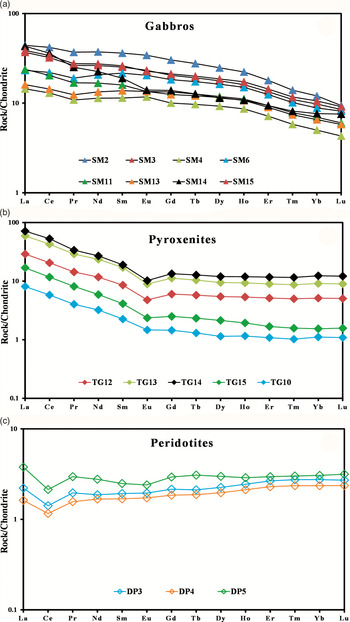
The chondrite-normalized rare earth element (REE) patterns (normalization after Sun & McDonough, Reference Sun, McDonough, Saunders and Norry1989) for gabbros, pyroxenites and peridotites are shown in Figure 7a, b and c, respectively. The studied gabbros and pyroxenites have a higher concentration of total REE (∑REE = 27.7–85.1 and 8.9–80.1, respectively) compared with peridotites (i.e. ∑REE = 4.35–7.1). In addition, they have variable chondrite-normalized REE patterns. The gabbros contain high REE concentration compared with chondrite and display fractionated patterns (Fig. 5a) with light REE (LREE) enrichment (i.e. LaN/YbN = 2.46–5.65 and LaN/SmN = 1.07–2.28), and heavy REE (HREE) depleted patterns (i.e. SmN/YbN =2.10–3.01) with negligible negative Eu anomaly. The pyroxenites contain overall enriched REE concentration compared with chondrites (Fig. 5b) and fractionated patterns with LREE enrichment (i.e. LaN/YbN = 5.65–10.98 and LaN/SmN = 3.39–4.11), slight negative Eu anomaly and flat HREE patterns (i.e. SmN/YbN =1.53–2.67). The REE patterns of peridotites (Fig. 5c) show a gradual increase in REE concentrations from LREE to HREE (i.e. LaN/YbN = 0.69–1.23, LaN/SmN = 0.96–1.52 and SmN/YbN = 0.70–0.81).
Chondrite-normalized REE patterns of (a) gabbros, (b) pyroxenites and (c) peridotites from Suru–Thasgam ophiolitic slice, western Ladakh. Normalizing values are from Sun & McDonough (Reference Sun, McDonough, Saunders and Norry1989).

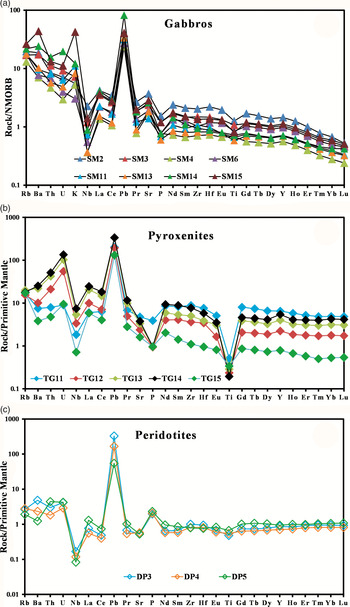
(a) N-MORB-normalized spidergram of gabbros and PM-normalized spidergram of (b) pyroxenites and (c) peridotites from Suru–Thasgam ophiolitic slice, western Ladakh. Normalizing values are from Sun & McDonough (Reference Sun, McDonough, Saunders and Norry1989).

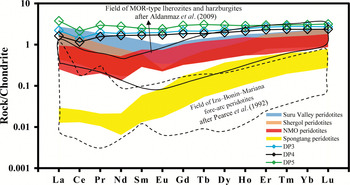
Chondrite-normalized REE patterns of studied peridotites in comparison to other Neo-Tethyan ophiolite peridotites. Normalizing values are from Sun & McDonough (Reference Sun, McDonough, Saunders and Norry1989).

The normal MOR basalt (N-MORB) normalized multi-element spidergram (normalization after Sun & McDonough, Reference Sun, McDonough, Saunders and Norry1989) of gabbros is shown in Figure 6a; the primordial mantle-normalized multi-element spidergram of pyroxenites and peridotites is shown in Figure 6b and c, respectively. The studied rock types display subparallel and coherent trends in all the samples, reflecting their pristine nature. The N-MORB normalized multi-element patterns of the studied gabbros show fractionated patterns with large-ion lithophile element (LILE) enrichment (e.g. Rb, Ba, Th, U, K, Pb and Sr) and HFSE depletion (e.g. Nb, P and Ti) as compared to N-MORB (Fig. 6a). Similarly, in the primordial mantle-normalized multi-element diagram, the pyroxenites display overall enriched patterns with LILE enrichment (e.g. Rb, Ba, Th, U and Pb) and HFSE depletion (e.g. Nb, P and Ti) compared with other trace elements (Fig. 6b). In addition, the depleted Sr concentration indicates there was no plagioclase accumulation in these rock types as observed petrographically. However, the peridotites display overall depleted patterns with positive spikes of LILE (e.g. Rb, Ba, Th, U and Pb) and a prominent negative spike of HFSE (Nb) compared with other trace elements (Fig. 6c).
6. Discussion
6.a. Post-magmatic alteration effects
The processes of metamorphism and hydrothermal alteration normally control the variable degree of elemental mobility in ophiolite rocks (Niu, Reference Niu2004). Although the studied mafic–ultramafic rock types are composed of a primary mineral assemblage of olivine, orthopyroxene, clinopyroxene, plagioclase and spinel, the petrographic observations such as the replacement of olivine with serpentine and magnetite, pyroxene with amphibole, and plagioclase with saussurite in some of the studied rock samples are consistent with metasomatic origin at lower temperatures (< 700°C; Abbott & Raymond, Reference Abbott and Raymond1984). Further, having low LOI values (3.4–4.2 wt%) compared with highly serpentinized global peridotites, the studied peridotites have smooth and coherent REE patterns (Fig. 5c), reflecting their least altered nature (Deschamps et al. Reference Deschamps, Godar, Guillot and Hattori2013). Similarly, the pyroxenites and gabbros have not undergone significant secondary alteration as inferred from their low LOI values (mostly < 2 wt%), absence of Ce anomaly and lack of secondary carbonate minerals (Van Acken et al. Reference Van Acken, Hoffmann, Schorscher, Schulz, Heuser and Luguet2016).
In order to evaluate the post-magmatic alteration effects in studied mafic–ultramafic rock types, we have plotted LOI values with other elements (online Supplementary Fig. S3). Elements such as Zr, Nb, La, U, Th, Pb, Rb, Ba and Sr do not show any correlation with LOI, indicating their least mobilization. According to Polat et al. (Reference Polat, Hofman and Rosing2002), in mafic rocks, a Ce/Ce* ratio (i.e. Ce anomaly) of 0.9–1.1 indicates least LREE mobility, whereas those with 0.9 > Ce/Ce* > 1.1 are characterized by LREE mobility. In present study, the Ce/Ce* ratio ranges from 1.02 to 1.1 in gabbros (except for SM10 with Ce/Ce* ratio of 0.7) and 0.99 to 1.08 in pyroxenites, indicating limited LREE mobility. Moreover, the REE patterns of gabbros (Fig. 5a) and pyroxenites (Fig. 5b) show subparallel and coherent patterns reflecting their pristine nature. We are therefore of the opinion that the studied rock types were least affected by the secondary processes of metamorphism and hydrothermal alteration. Major-and trace-element data describing these rock types can therefore be used to constrain their petrogenetic characteristics.
6.b. Nature of the protolith for peridotites
To constrain the protolith nature of the peridotites, we have focused on HFSE (e.g. Al, Ti, Nb, Hf and HREE), which are insensitive to or little affected by secondary processes (You et al. Reference You, Castillo, Gieskes, Chan and Spivack1996; Bedini & Bodinier, Reference Bedini and Bodinier1999; Canil, Reference Canil2004; Niu, Reference Niu2004; Iyer et al. Reference Iyer, Austrheim, John and Jamtveit2008; Deschamps et al. Reference Deschamps, Guillot, Godard, Chauvel, Andreani and Hattori2010, Reference Deschamps, Godar, Guillot and Hattori2013). The higher whole-rock MgO, Cr, Ni and Mg no. observed in the studied peridotites with lower concentration of highly incompatible elements as compared to PM probably reflect the residual nature of their protoliths (Niu, Reference Niu1997, Reference Niu2004), similar to the depleted harzburgites and dunites (Zhou et al. Reference Zhou, Robinson, Malpas, Edwards and Qi2005; Aldanmaz et al. Reference Aldanmaz, Yaliniz, Guctekin and Goncuoglu2008, Reference Aldanmaz, van Hinsbergen, Yildiz-Yuksekol, Schmidt, McPhee, Meisel, Guctekin and Mason2020). However, these rocks are also characterized by Al-rich pyroxenes (Al2O3 in orthopyroxene = 4.9–5.5 wt% and in clinopyroxene = 1.7–6.8 wt%) and Mg-rich olivines (Fo88.5–89.3), indicating that some portion of the protolith had fertile components, probably related to enrichment through slab derived fluid/melt addition (Marchesi et al. Reference Marchesi, Jolly, Lewis, Garrido, Proenza and Lidiak2011; Parlak et al. Reference Parlak, Bagci, Rizaoglu, Ionescu, Onal, Hock and Kozlu2020).
The Al2O3/SiO2 and MgO/SiO2 ratios of the studied peridotites range over 0.05–0.06 and 0.95–0.98, respectively (online Supplementary Fig. S4) and are similar to Shergol peridotites (0.05–0.06 and 1.09–1.2) and Suru Valley peridotites (0.04–0.06 and 0.7–0.9) (Bhat et al. Reference Bhat, Ahmad and Subba Rao2019b). However, these ratios in the studied peridotites are respectively higher and lower than the highly depleted mantle residual harzburgites (i.e. Al2O3/SiO2 c. 0.02 and MgO/SiO2 c. 1.1; after McDonough & Sun, Reference McDonough and Sun1995). In Figure 7, the peridotites have HREE concentrations comparable to Neo-Tethyan MOR-type ophiolitic lherzolites and harzburgites (after Aldanmaz et al. Reference Aldanmaz, Yaliniz, Guctekin and Goncuoglu2008), Shergol and Suru Valley ophiolitic peridotites (after Bhat et al. Reference Bhat, Ahmad and Subba Rao2017a, Reference Bhat, Ahmad and Subba Rao2019b) and Nagaland-Manipur ophiolitic (NMO) tectonite peridotites (after Singh et al. Reference Singh, Nayak, Khogenkumar, Subramanyam, Thakur, Bikramaditya Singh and Satyanarayanan2017). However, these are much higher than those found in Izu-Bonin-Mariana fore-arc peridotites (after Pearce et al. Reference Pearce, van der Laan, Arculus, Murton, Ishii, Peate, Parkinson, Fryer, Pearce and Stokking1992) and Spongtang ophiolitic peridotites of western Ladakh (after Maheo et al. Reference Maheo, Bertrand, Guillot, Villa, Keller and Capiez2004). Nevertheless, in a PM-normalized spidergram (Fig. 6c), the studied peridotites reflect enrichment in LILE (e.g. Rb, Ba, Th, U and Pb) and depletion in HFSE (e.g. Nb and Ti), suggesting subduction influence in their genesis (Hawkins, Reference Hawkins2003; Niu, Reference Niu2004; Bhat et al. Reference Bhat, Ahmad and Subba Rao2019b).
The high Mg no. and CaO but low TiO2 content of clinopyroxenes in studied peridotites reflect derivation from depleted-mantle sources (Pearce & Norry, Reference Pearce and Norry1979). According to Nozaka (Reference Nozaka2010), clinopyroxenes of different origin (i.e. magmatic versus metamorphic) can be distinguished using their Cr2O3 and Al2O3 concentrations, as the metamorphic clinopyroxenes are extremely depleted in these elements. Clinopyroxenes in the studied peridotites have higher Cr2O3 (mostly > 0.3 wt%) and Al2O3 (mostly > 1 wt%) compared with those of metamorphic peridotites, confirming their igneous origin. Further, the high-magnesian olivine from the studied peridotites differs from its oceanic counterparts formed in a MOR tectonic setting that are relatively depleted in MgO (Hebert, Reference Hebert1982). However, studied olivine compositions show similarity to ophiolites from the SSZ, such as Kizildag (Hatay) ophiolite (Bagci et al. Reference Bagci, Parlak and Hock2005), Nidar and Spongtang ophiolites (Maheo et al. Reference Maheo, Bertrand, Guillot, Villa, Keller and Capiez2004; Jonnalagadda et al. Reference Jonnalagadda, Karmalkar, Benoit, Gregoire, Duraiswami, Harshe and Kamble2019) and Suru Valley ophiolitic slice, western Ladakh (Bhat et al. Reference Bhat, Ahmad and Subba Rao2019b). Similarly, the Mg-rich orthopyroxenes in studied peridotites are reported from a number of SSZ ophiolites (DeBari & Coleman, Reference DeBari and Coleman1989; Parlak et al. Reference Parlak, Delaloye and Bingol1996, Reference Parlak, Hock, Delaloye, Bozkurt, Winchester and Piper2000, Reference Parlak, Hock and Delaloye2002; Bagci et al. Reference Bagci, Parlak and Hock2005; Singh et al. Reference Singh, Nayak, Khogenkumar, Subramanyam, Thakur, Bikramaditya Singh and Satyanarayanan2017; Abdel Karim et al. Reference Abdel-Karim, Ali and El-Shafei2018; Abdullah et al. Reference Abdullah, Misra and Ghosh2018; Bhat et al. Reference Bhat, Ahmad and Subba Rao2019b). From the above discussion, it therefore appears that the studied peridotites evolved in a subduction zone environment, similar to other Tethyan ophiolites such as Mirdita Ophiolite, Albania (Dilek et al. Reference Dilek, Furnes and Shallo2008), Albanide–Hellenide ophiolites (Saccani et al. Reference Saccani, Dilek and Photiades2018), Tethyan ophiolites (Dilek & Furnes Reference Dilek and Furnes2019) and western Philippines (Yu et al. Reference Yu, Dilek, Yumul, Yan, Dimalanta and Huang2020).
6.c. Petrogenesis of pyroxenites and gabbros
Mantle heterogeneity could be a possibility to explain the geochemical variation observed in ophiolite rock suites (Pearce & Norry, Reference Pearce and Norry1979; Saccani et al. Reference Saccani, Allahyari and Rahimzadeh2014; Saccani, Reference Saccani2015; Singh et al. Reference Singh, Nayak, Khogenkumar, Subramanyam, Thakur, Bikramaditya Singh and Satyanarayanan2017). The studied cumulate rock types (i.e. gabbros and pyroxenites) show subparallel and enriched chondrite-normalized REE patterns (Fig. 5), reflecting derivation from enriched mantle sources. In addition, the N-MORB-normalized spidergram of gabbros (Fig. 6a) and PM-normalized spidergram of pyroxenites (Fig. 6b) reflect selective enrichment in LILE and depletion in HFSE (e.g. Nb, P and Ti), commonly observed in subduction zone magmas (Wilson, Reference Wilson1989; Stern, Reference Stern2004; Shervais et al. Reference Shervais, Kimbrough, Renne, Hanan, Murchey, Snow, Zoglman Schuman and Beaman2004). Such trace-element characteristics indicate melting of metasomatized mantle wedge with active participation of subducted slab component (i.e. slab fluids and/or melts) in an island-arc/SSZ tectonic setting (Wilson, Reference Wilson1989; Shervais et al. Reference Shervais, Kimbrough, Renne, Hanan, Murchey, Snow, Zoglman Schuman and Beaman2004). In addition, coupled enrichment of U and Th reflect the influence of subduction melts into their source regions, rather than secondary processes. Similar petrogenetic processes have been earlier explained for other mafic–ultramafic rock types along the ISZ (e.g. Maheo et al. Reference Maheo, Bertrand, Guillot, Villa, Keller and Capiez2004; Ahmad et al. Reference Ahmad, Tanaka, Sachan, Asahara, Islam and Khanna2008; Buckman et al. Reference Buckman, Aitchison, Nutman, Bennett, Saktura, Walsh, Kachovich and Hidaka2018; Bhat et al. Reference Bhat, Ahmad and Subba Rao2019c) and other parts of the world (e.g. Wallin & Metcalf, Reference Wallin and Metcalf1998; Dey et al. Reference Dey, Hussain and Barman2018).
Fresh clinopyroxenes in the pyroxenites have low TiO2 concentration (< 1.0% wt%) typical of non-alkaline rocks (Le Bas, Reference Le Bas1962) and exhibit a strong affinity with intra-oceanic arc boninites similar to Egyptian ophiolites (Abd El-Rahman et al. Reference Abd El-Rahman, Polat, Dilek, Fryer, El-Sharkawy and Sakran2009; Abdel Karim et al. Reference Abdel-Karim, Ali, Helmy and El-Shafei2016). Generally, SSZ ophiolitic rocks have plagioclases with higher An-content (Parlak et al. Reference Parlak, Hock, Delaloye, Bozkurt, Winchester and Piper2000; Bagci et al. Reference Bagci, Parlak and Hock2005, Reference Bagci, Parlak and Hock2006) such as arc-related igneous rocks (Beard, Reference Beard1986; DeBari & Coleman, Reference DeBari and Coleman1989), Nidar ophiolites (Ahmad et al. Reference Ahmad, Tanaka, Sachan, Asahara, Islam and Khanna2008) and Naga Hill ophiolites, eastern India (Abdullah et al. Reference Abdullah, Misra and Ghosh2018). The high magmatic water content and high CaO/Na2O ratio in melts are commonly assumed factors responsible for the crystallization of such calcic-plagioclases (Arculus & Wills, Reference Arculus and Wills1980; Panjasawatwong et al. Reference Panjasawatwong, Danyushevsky, Crawford and Harris1995). However, because of hydrothermal alteration, the Ca content in plagioclases decreases and Na content increases in the studied plagioclases in gabbros, resulting in the formation of albitic plagioclases (Deer et al. Reference Deer, Howie and Zussman1992).
Further, several experimental studies have shown that the Al2O3 concentration of magmatic Cr-spinel in mafic–ultramafic rocks is directly linked to the composition of parental melt (Maurel & Maurel, Reference Maurel and Maurel1982; Kamenetsky et al. Reference Kamenetsky, Crawford and Meffre2001; Rollinson, Reference Rollinson2008) and can be calculated using the equation after Maurel & Maurel (Reference Maurel and Maurel1982), that is:
 $${\rm{A}}{{\rm{I}}_2}{{\rm{O}}_3}\,{\rm{wt}}\% ({\rm{spinel}}) = 0.035{({\rm{A}}{{\rm{I}}_2}{{\rm{O}}_3})^{2.42}}\,{\rm{wt}}\% ({\rm{parental}}\,{\rm{melt}}).$$
This equation is based on the observation that the Al2O3 concentration in spinel is a function of Al2O3 concentration in melt. According to Wilson (Reference Wilson1989), the spinel Al2O3 concentration in MORB parental melt ranges from 14 to 16 wt%, whereas in boninite/arc parental melt it ranges from 10.6 to 14.4 wt%. The calculated melt composition of the studied pyroxenites have Al2O3 concentration of 9–12 wt% (online Supplementary Table S4), comparable to the boninite/arc parental magma (Wilson, Reference Wilson1989).
The primary mineral compositions of the studied mafic–ultramafic cumulates have variable mineral compositions relative to low-pressure MORB-type parental magma (Fisk et al. Reference Fisk, Schilling and Sigurdsoon1980; Elthon et al. Reference Elthon, Casey and Komor1982; Parlak et al. Reference Parlak, Delaloye and Bingol1996). The main characteristics of low pressure (c. 1 atm) crystallization phase relationships of MORB are: earlier olivine crystallization followed by plagioclase prior to pyroxene crystallization; and lower Mg no. of coexisting clinopyroxene and olivine < 82 with orthopyroxene < 74 (Elthon et al. Reference Elthon, Casey and Komor1982, Reference Elthon, Casey, Komor, Gass, Lippard and Shelton1984; Pearce et al. Reference Pearce, Lippard, Roberts, Kokelaar and Howells1984). The studied mafic–ultramafic rock types contradict the low-pressure crystallization order by presence of clinopyroxene/orthopyroxene, the high Mg no. of olivine (91–88) and clinopyroxene (97–90), and the absence of plagioclase in pyroxenites (Elthon et al. Reference Elthon, Casey and Komor1982; Parlak et al. Reference Parlak, Delaloye and Bingol1996; Singh et al. Reference Singh, Nayak, Khogenkumar, Subramanyam, Thakur, Bikramaditya Singh and Satyanarayanan2017). In Figure 8, the coexisting olivine and clinopyroxene Mg no. of pyroxenites differ from the 1-atm experiment field of MORB and overlaps with the fields of high-pressure Bay of Island ophiolite and Mersin (Turkey) ophiolite cumulates, formed at the base of island arc (Elthon et al. Reference Elthon, Casey and Komor1982; Elthon, Reference Elthon1991; Parlak et al. Reference Parlak, Delaloye and Bingol1996, Reference Parlak, Bagci, Rizaoglu, Ionescu, Onal, Hock and Kozlu2020). The presence of unzoned and compositionally constant Al- and Mg-rich clinopyroxenes, and the absence of plagioclase in studied pyroxenites, is also indicative of high-pressure (c. 10 kbar) crystallization from basaltic melts (Flower et al. Reference Flower, Robinson, Schmincke and Ohnmacht1977; Elthon et al. Reference Elthon, Casey and Komor1982; Burns, Reference Burns1985; Parlak et al. Reference Parlak, Delaloye and Bingol1996). The high-pressure crystallization phase relationship therefore seems to be consistent with the observed Suru–Thasgam ophiolitic cumulates.
Mg no. of coexisting olivine and clinopyroxene in the pyroxenites from Suru–Thasgam ophiolitic slice. Field of oceanic mafic–ultramafic cumulates represents mineral compositions of high-pressure Bay of Island ophiolite ultramafics (data after Elthon et al. Reference Elthon, Casey and Komor1982) and Mersin ophiolite ultramafics (Parlak et al. Reference Parlak, Delaloye and Bingol1996). Grey shaded area shows experimentally determined 1-atm phase equilibria boundaries of MORB after Elthon et al. (Reference Elthon, Casey and Komor1982).

6.d. Tectonomagmatic implications
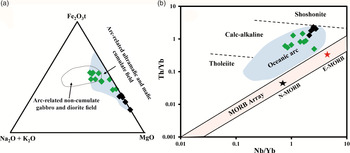
Various discrimination diagrams based on whole-rock trace elements or their ratios and mineral chemistry were used to put constraints on the palaeo-tectonic environment of studied rock types (Winchester & Floyd, Reference Winchester and Floyd1977; Beccaluva et al. Reference Beccaluva, Macciotta, Piccardo and Zeda1989; Woodhead et al. Reference Woodhead, Eggins and Gamble1993; Stern, Reference Stern2004; Condie, Reference Condie2005; Wang et al. Reference Wang, Zhang, Fan and Zhang2013; Nouri et al. Reference Nouri, Ashara, Azizi and Yamamoto2017). In the AFM diagram of Beard (Reference Beard1986), the studied gabbros and pyroxenites plot in an arc-related mafic–ultramafic cumulate field (Fig. 9a). Similarly, in Th/Yb versus Nb/Yb discrimination diagram (Fig. 9b) after Pearce (Reference Pearce2008), these rock types plot in an arc-array above the MORB-mantle array.
Tectonomagmatic discrimination diagrams for the gabbro and pyroxenite rock types of Suru–Thasgam ophiolitic slice: (a) (Na2O + K2O) – Fe2O3t – MgO (AFM) triangular plot where fields of cumulate and non-cumulate rocks are after Beard (Reference Beard1986) and (b) Th/Yb versus Nb/Yb plot (after Pearce, Reference Pearce2008) where N-MORB – normal mid-oceanic ridge basalt; EMORB – enriched mid-oceanic ridge basalt.

The orthopyroxenes in the studied peridotites are low in Al2O3 < 5.45 wt% and TiO2 < 0.13 wt%, but high in Mg no. (89.5–93; online Supplementary Table S2), comparable to SSZ peridotite pyroxenes (Choi et al. Reference Choi, Shervais and Mukasa2008; Bhat et al. Reference Bhat, Ahmad and Subba Rao2019b; Jonnalagadda et al. Reference Jonnalagadda, Karmalkar, Benoit, Gregoire, Duraiswami, Harshe and Kamble2019). Further, the presence of Mg-rich clinopyroxenes (i.e. Mg no. = 93–98 in peridotites and 90–97 in pyroxenites), Mg-rich olivines (Mg no. = 89–90 in peridotites and 89–91 in pyroxenites), and Cr-rich Al-poor spinels (Cr no. > 54 and Al no. < 29 in pyroxenites) also suggest SSZ tectonic affinity (Arai et al. Reference Arai, Kadoshima and Morishita2006; Singh et al. Reference Singh, Nayak, Khogenkumar, Subramanyam, Thakur, Bikramaditya Singh and Satyanarayanan2017; Bhat et al. Reference Bhat, Ahmad and Subba Rao2019b; Parlak et al. Reference Parlak, Bagci, Rizaoglu, Ionescu, Onal, Hock and Kozlu2020).
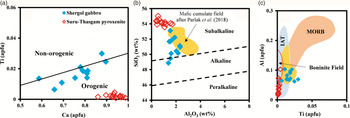
In addition, in the Ca versus Ti diagram (Fig. 10a), the pyroxenite clinopyroxene plots in an orogenic field, indicates its sub-alkaline nature in an Al2O3 versus SiO2 plot (Fig. 10b), and plots in the arc-tholeiitic field in an Al versus Ti plot (Fig. 10c), similar to western Ladakh ophiolitic gabbros (Ahmad et al. Reference Ahmad, Tanaka, Sachan, Asahara, Islam and Khanna2008; Bhat et al. Reference Bhat, Ahmad and Subba Rao2019c). Further, the studied gabbros have pargasitic composition amphiboles (Fig. 4c) correlative to island-arc affinity (Ahmad et al. Reference Ahmad, Tanaka, Sachan, Asahara, Islam and Khanna2008; Bhat et al. Reference Bhat, Ahmad and Subba Rao2019c). These mineral characteristics are generally expected from immature island arc-affinity rocks (Stern et al. Reference Stern, Johnson, Kroner, Yibas and Kusky2004).
Mineral discrimination diagrams of (a) Ca versus Ti after Leterrier et al. (Reference Leterrier, Maury, Thonon, Girard and Marechal1982); (b) Al2O3 versus SiO2 after Le Bas (Reference Le Bas1962); and (c) Ti versus Al after Beccaluva et al. (Reference Beccaluva, Macciotta, Piccardo and Zeda1989) for the clinopyroxene compositions of Suru–Thasgam pyroxenites in comparison to Shergol ophiolitic gabbros, western Ladakh and mafic cumulates from Goksun Kahramanmaras ophiolite southeast Turkey after Parlak et al. (Reference Parlak, Bagci, Rizaoglu, Ionescu, Onal, Hock and Kozlu2020).

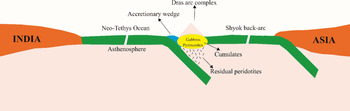
Previous studies on the Dras, Suru Valley, Shergol, Spongtang and Nidar ophiolitic slices from other parts of Ladakh have shown their genetic relationship with the intra-oceanic island-arc (IOIA) ophiolite complex within the Neo-Tethys Ocean (Bhat et al. 2020). In order to constrain the detailed geodynamic setting of the western Ladakh dismembered ophiolitic slices, we have used published age data and tectonic interpretations of these neighbouring consanguineous ophiolitic rocks. The earlier studies have reported Upper Jurassic – Middle Cretaceous ages such as zircon U–Pb ages of 160 ± 3 and 156 ± 1 Ma from Dras volcanics (Walsh et al. Reference Walsh, Buckman, Nutman and Zhou2021), a U–Pb age of 88 ± 1 Ma from Spong volcanics of the crustal part of Spongtang ophiolite (Pedersen et al. Reference Pedersen, Searle and Corfield2001), a 40Ar–39Ar amphibole age of 130–110 Ma (Maheo et al. Reference Maheo, Bertrand, Guillot, Villa, Keller and Capiez2004) and Sm–Nd mineral–whole-rock age of 140 ± 32 Ma (Ahmad et al. Reference Ahmad, Tanaka, Sachan, Asahara, Islam and Khanna2008) from the Nidar ophiolitic gabbros, and 136 Ma U–Pb zircon age of Spongtang ophiolite gabbros intruding the mantle peridotites (Buckman et al. Reference Buckman, Aitchison, Nutman, Bennett, Saktura, Walsh, Kachovich and Hidaka2018). On the basis of mineral and whole-rock geochemistry, this study suggests that the studied peridotites represent metasomatized mantle wedge peridotites in the context of the Neo-Tethys Ocean, whereas the pyroxenites and gabbros reflect high-pressure and -temperature fractionation sequences comparable to modern-day island-arc tholeiitic sequences (Fig. 11). We therefore propose that the Suru–Thasgam ophiolite rock types represent the relict of the deeper part of the intra-oceanic Dras arc complex.
Cartoon depicting proposed geodynamic model for the formation of the Suru–Thasgam ophiolitic peridotites, pyroxenites and gabbros in the context of Neo-Tethys Ocean.

6.e. Genetic relationship and modern-day analogues
The western Ladakh ophiolites of Mesozoic age have SSZ tectonic affinity preserving earlier MOR tectonic signatures (Bhat et al. Reference Bhat, Ahmad and Subba Rao2019c), similar to Goksun Kahramanmaras ophiolite from SE Turkey (Parlak et al. Reference Parlak, Hock, Kozlu and Delaloye2004, Reference Parlak, Bagci, Rizaoglu, Ionescu, Onal, Hock and Kozlu2020), Mamu Dagi ophiolite from northern Turkey (Celik et al. Reference Celik, Topuz, Billor and Ozkan2019) and Chaldoran ophiolite from NW Iran (Bargoshadi et al. Reference Bargoshadi, Moazzen and Yang2020). In order to correlate the western Ladakh ophiolite rock types, we plotted an incompatible versus incompatible element diagram (online Supplementary Fig. S5). In Sm versus Gd (online Supplementary Fig. S5a) and Nd versus Sm (online Supplementary Fig. S5b) diagrams, the studied gabbros and pyroxenite rock types are correlative to Dras basalts and Kargil gabbros (after Bhat et al. Reference Bhat, Ahmad and Subba Rao2019a), Shergol gabbros (after Bhat et al. Reference Bhat, Ahmad and Subba Rao2019c), Nidar gabbros (after Ahmad et al. Reference Ahmad, Tanaka, Sachan, Asahara, Islam and Khanna2008) and Spongtang gabbros (after Buckman et al. Reference Buckman, Aitchison, Nutman, Bennett, Saktura, Walsh, Kachovich and Hidaka2018), and plot on the same differentiation line. The studied gabbro and pyroxenite rock types therefore belong to the same SSZ tectonic setting as proposed for other ophiolitic rock types from western Ladakh (Bhat et al. Reference Bhat, Ahmad and Subba Rao2019c, 2020).
Modern-day analogues of the SSZ-type ophiolites of western Ladakh are found in the Eocene Izu–Bonin–Mariana (IBM) island-arc system of the SW Pacific Ocean (Stern & Bloomer, Reference Stern and Bloomer1992; Taylor, Reference Taylor, Taylor and Fujioka1992; Ichiyama et al. Reference Ichiyama, Koshiba, Ito and Tamura2020) and the Tonga arc of Papua New Guinea (Hawkins, Reference Hawkins, Taylor and Natland1995). The geochemical similarity between the IBM island-arc magmatic stratigraphy and that found in the Jurassic–Cretaceous Tethyan ophiolites suggests that the studied ophiolites were associated with the subduction initiation followed by the development of widespread island-arc complex that led to the closure of the Neo-Tethys Ocean (Reagan et al. Reference Reagan, Ishizuka, Stern, Kelley, Ohara, Blichert-Toft, Bloomer, Cash, Fryer, Hanan, Hickey-Vargas, Ishii, Kimura, Peate, Rowe and Woods2010, Reference Reagan, McClelland, Girard, Goff, Peate, Ohara and Stern2013, Reference Reagan, Pearce, Petronotis, Almeev, Avery, Carvallo, Chapman, Christeson, Ferre, Godard, Heaton, Kirchenbaur, Kurz, Kutterolf, Li, Li, Michibayashi, Morgan, Nelson, Prytulak, Python, Robertson, Ryan, Sager, Sakuyama, Shervais, Shimizu and Whattam2017; Bhat et al. 2020).
7. Conclusions
This whole-rock and mineral geochemical study on peridotites, pyroxenites and gabbros from the Suru–Thasgam ophiolitic slice, western Ladakh, has led to the following conclusions.
-
(1) Geochemically, the studied rock types show sub-alkaline tholeiitic characteristics and the peridotites and pyroxenites are characterized by higher Mg no. (i.e. 89–90 and 76–84, respectively) as compared to gabbros (56–69).
-
(2) The peridotites show nearly flat chondrite-normalized REE-patterns ((La/Yb)N = 0.6–1.5) while their multi-element patterns show overall depleted REE signatures with prominent Nb, a Ti negative anomaly and a Pb positive anomaly compared with PM. However, multi-element patterns of pyroxenites and gabbros show a depleted HFSE signature (e.g. Nb, P and Ti negative anomaly) and enriched LILE signature (e.g. Rb, Ba, Th, U, K, Pb and Sr positive anomaly).
-
(3) The presence of Ti-poor clinopyroxenes in pyroxenites reflect their derivation from a previously depleted mantle source caused by earlier melt extraction.
-
(4) The presence of highly magnesian olivine (Fo88.5–89.3 and Fo87.8–89.9) and clinopyroxene (Mg no. of 93–98 and 90–97, respectively) in tectonite peridotites and pyroxenites exhibits close similarity to other SSZ-related Neo-Tethyan ophiolites.
-
(5) Our study suggests that the peridotites represent residual protolith nature and later evolved in a SSZ tectonic environment. However, pyroxenites and gabbros were formed by fractionation from tholeiitic melts at high pressure and temperature in an intra-oceanic island-arc tectonic setting; they are therefore compositionally similar to those observed in modern island-arc tholeiitic sequences.
-
(6) This field, mineralogical and geochemical study suggests that the Suru–Thasgam ophiolitic slice formed as part of a much larger sheet of oceanic lithosphere which accreted to the base of the intra-oceanic subduction system including Dras, Spongtang, Shergol, Suru Valley and Nidar ophiolitic slices of western Ladakh and Muslim Bagh and Bela ophiolites of Kohistan region of Pakistan. The latter were coexistent and genetically related within the same SSZ setting during the Late Cretaceous closure of the western part of the Neo-Tethys Ocean.
Supplementary material
To view supplementary material for this article, please visit https://doi.org/10.1017/S0016756821000042
Acknowledgements
IMB thanks the Council of Scientific and Industrial Research (CSIR), New Delhi for providing the fellowship to carry out this work. The authors are grateful to Dr AK Krishna, Dr M Satyanarayanan and Dr KSV Subramanyam from CSIR-NGRI, Hyderabad for assisting during the Laboratory work. NV Chalapathi Rao thanks DST-SERB, New Delhi, for funding the EPMA National facility at BHU, Varanasi. The authors thank the Geological Magazine Editor Dr Kathryn Goodenough and reviewers, particularly Professor Yildirim Dilek for insightful suggestions which have greatly improved the quality of the manuscript.
Declaration of interests
None.