Introduction
Classification
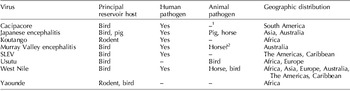
West Nile virus (WNV) is a member of family Flaviviridae (ICTV, Reference Fauquet, Mayo, Maniloff, Desselberger and Ball2005). This family is comprised of three genera: Flavivirus (which includes WNV), Pestivirus and Hepacivirus. More than 70 viruses have been classified in the genus Flavivirus and the majority of these are arthropod-borne viruses (arboviruses). This genus is further divided into 12 serocomplexes, including the Japanese encephalitis virus (JEV) serocomplex which consists of WNV, Cacipacore, JEV, Koutango, Murray Valley encephalitis, St. Louis encephalitis (SLEV), Usutu and Yaounde viruses (Table 1). Kunjin virus, which is endemic in Australia, is now considered to be a subtype of WNV (Scherret et al., Reference Scherret, Poidinger, Mackenzie, Broom, Deubel, Lipkin, Briese, Gould and Hall2001; ICTV, Reference Fauquet, Mayo, Maniloff, Desselberger and Ball2005).
The JEV serocomplex

1 No.
2 Anecdotal evidence indicates that Murray Valley encephalitis virus occasionally causes disease in horses.
Sequencing and phylogenetic studies have shown that WNV can be divided into two major genetic lineages (Berthet et al., Reference Berthet, Zeller, Drouet, Rauzier, Digoutte and Deubel1997; Lanciotti et al., Reference Lanciotti, Roehrig, Deubel, Smith, Parker, Steele, Crise, Volpe, Crabtree, Scherret, Hall, MacKenzie, Cropp, Panigrahy, Ostlund, Schmitt, Malkinson, Banet, Weissman, Komar, Savage, Stone, McNamara and Gubler1999, Reference Lanciotti, Ebel, Deubel, Kerst, Murri, Meyer, Bowen, McKinney, Morrill, Crabtree, Kramer and Roehrig2002; Beasley et al., Reference Beasley, Davis, Whiteman, Granwehr, Kinney and Barrett2004a) (Fig. 1). WNV isolates in lineage 1 have a worldwide distribution, and include both virulent and attenuated viruses. Lineage 1 isolates have been further divided into three clades (Lanciotti et al., Reference Lanciotti, Ebel, Deubel, Kerst, Murri, Meyer, Bowen, McKinney, Morrill, Crabtree, Kramer and Roehrig2002). Clade 1a contains isolates from Africa, Europe, Asia and the Americas, clade 1b consists of Kunjin viruses and clade 1c consists of isolates from India. WNV isolates in lineage 2 were once found exclusively in Africa and were usually associated with asymptomatic infections, but several virulent lineage 2 isolates were recently identified in Europe (Bakonyi et al., Reference Bakonyi, Ivanics, Erdelyi, Ursu, Ferenczi, Weissenbock and Nowotny2006; Erdelyi et al., Reference Erdelyi, Ursu, Ferenczi, Szeredi, Ratz, Skare and Bakonyi2007). It was recently proposed that two virus isolates from the Czech Republic represent a new (third) lineage of WNV or a novel flavivirus in the JEV serocomplex (Bakonyi et al., Reference Bakonyi, Hubalek, Rudolf and Nowotny2005). In another recent study, it was suggested that WNV can be classified into as many as five distinct lineages (Bondre et al., Reference Bondre, Jadi, Mishra, Yergolkar and Arankalle2007).
Phylogenetic tree generated by parsimony analysis (PAUP) of aligned nucleotide sequences of 33 WNV strains from diverse geographic locations. The phylogenetic analysis is based on a 255-bp region of the envelope gene (positions 1402–1656). The tree is rooted using JEV (strain SA-14) as an outgroup. The two lineages (1 and 2) and three clades (1a, 1b and 1c) of WNV, as described by Lanciotti and colleagues, are denoted (Lanciotti et al., Reference Lanciotti, Ebel, Deubel, Kerst, Murri, Meyer, Bowen, McKinney, Morrill, Crabtree, Kramer and Roehrig2002). Values above some branches represent the percentage support by parsimony bootstrap analysis. Bootstrap values are based on 1000 replicates.

Virion morphology
The WNV virion is a small (~50 nm in diameter), spherical, enveloped particle with icosahedral symmetry (Brinton, Reference Brinton2002; Mukhopadhyay et al., Reference Mukhopadhyay, Kim, Chipman, Rossmann and Kuhn2003; Lindenbach et al., Reference Lindenbach, Thiel, Rice, Knipe and Howley2007). The envelope consists of a host-derived lipid bilayer and 180 copies of both the envelope (E) and membrane (M) proteins. The E and M proteins are embedded into the lipid bilayer via their carboxy-terminal transmembrane domains. The M protein is generated by furin-mediated cleavage of the precursor membrane (prM) protein late in virus maturation (Stadler et al., Reference Stadler, Allison, Schalich and Heinz1997). The prM and E proteins interact to form heterodimers that are present on the virion surface as 60 trimeric spikes. Cleavage of the prM protein enables the E protein to form head-to-tail homodimers that lie parallel to the lipid bilayer. The envelope surrounds a nucleocapsid core which is composed of multiple copies of the capsid (C) protein and a single copy of the genomic RNA.
Genomic organization
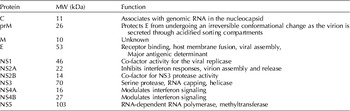
The genomic RNA of WNV, like that of other flaviviruses, is approximately 11 kb in length and consists of a 5′ untranslated region (5′ UTR), a single open reading frame (ORF) and a 3′ UTR (Brinton, Reference Brinton2002; Beasley, Reference Beasley2005; Lindenbach et al., Reference Lindenbach, Thiel, Rice, Knipe and Howley2007). The 5′ and 3′ UTRs of the flavivirus genome are approximately 100 and 400–700 nucleotides (nt) in length, respectively, and can form highly conserved secondary and tertiary structures. The 5′ end of the genome is capped, and the 3′ end usually lacks a polyadenine tail. The ORF encodes a single large polyprotein that is co- and post-translationally processed by viral and cellular proteases to generate three structural and seven nonstructural (NS) proteins in the gene order: 5′-C-prM(M)-E-NS1-NS2A-NS2B-NS3-NS4A-NS4B-NS5-3′. The flavivirus structural proteins are primarily involved in virion formation, whereas diverse functions have been assigned to the NS proteins (Table 2). RNA replication occurs in the cytoplasm in close association with the rough endoplasmic reticulum (ER). Virions are assembled in the lumen of the ER then transported within vesicles to the cell surface where they are released by exocytosis.
Functions of the flavivirus proteins

MW, molecular weight; C, capsid; prM, pre-membrane; M, membrane; E, envelope; NS, nonstructural.
Clinical manifestations and pathogenesis
Humans
The majority of WNV infections in humans are asymptomatic but, during recent outbreaks in Europe, Israel and the USA, approximately 20% of infections have resulted in a mild flu-like illness known as West Nile fever (WNF) (Hayes and Gubler, Reference Hayes and Gubler2005; Hayes et al., Reference Hayes, Sejvar, Zaki, Lanciotti, Bode and Campbell2005b; Davis et al., Reference Davis, DeBiasi, Goade, Haaland, Harrington, Harnar, Pergam, King, DeMasters and Tyler2006). The illness is characterized by a variety of non-specific symptoms that cannot be distinguished from other infectious illnesses on clinical examination. Symptoms include an abrupt onset of fever, headache, myalgia, nausea, fatigue, weakness, vomiting and diarrhea. Symptoms usually develop 2–14 days after virus infection. The illness typically lasts for 2–5 days but, in more severe cases, fatigue can persist for over a month. Approximately 1 in 150 WNV infections lead to severe neuroinvasive disease (WNND) which is characterized by encephalitis, meningitis and/or poliomyelitis-like flaccid paralysis (Davis et al., Reference Davis, DeBiasi, Goade, Haaland, Harrington, Harnar, Pergam, King, DeMasters and Tyler2006; Sejvar and Marfin, Reference Sejvar and Marfin2006; Sejvar, Reference Sejvar2007). The fatality rate in patients with WNND is approximately 10%, and long-term neurological sequelae occurs is >50% of patients. Patients presenting with encephalitis have a poorer outcome than those with meningitis. WNND is more common in elderly and immunocompromised patients and is rarely reported in patients <30 years.
The pathogenesis of WNV is similar to that of other flaviviruses. Following peripheral inoculation, initial WNV replication is believed to occur in skin Langerhans dendritic cells (Samuel and Diamond, Reference Samuel and Diamond2006). The virus then spreads to the lymph nodes and blood stream, followed by peripheral tissues such as the spleen and kidney. The virus may then penetrate the central nervous system (CNS) resulting in inflammation of the medulla, brain stem and spinal cord (Guarner et al., Reference Guarner, Shieh, Hunter, Paddock, Morken, Campbell, Marfin and Zaki2004; Kleinschmidt-DeMasters et al., Reference Kleinschmidt-DeMasters, Marder, Levi, Laird, McNutt, Escott, Everson and Tyler2004; Samuel and Diamond, Reference Samuel and Diamond2006).
Horses
WNV has been responsible for extensive morbidity and mortality in horses in Europe, Israel and the USA (Castillo-Olivares and Wood, Reference Castillo-Olivares and Wood2004; van der Meulen et al., Reference van der Meulen, Pensaert and Nauwynck2005). Experimental infection studies performed by the Centers for Disease Control and Prevention using a USA strain of WNV demonstrated that the majority of WNV infections in horses are asymptomatic; clinical signs were observed in 1 of 12 (8%) animals (Bunning et al., Reference Bunning, Bowen, Cropp, Sullivan, Davis, Komar, Godsey, Baker, Hettler, Holmes, Biggerstaff and Mitchell2002). WNV illness in horses is characterized by fever and a variety of neurologic signs (e.g. ataxia, muscular weakness and amaurosis). The illness typically lasts 3 weeks (Salazar et al., Reference Salazar, Traub-Dargatz, Morley, Wilmot, Steffen, Cunningham and Salman2004). In recent outbreaks, the mortality rate in clinically affected horses has ranged from 23 to 43% (Murgue et al., Reference Murgue, Murri, Zientara, Durand, Durand and Zeller2001; Autorino et al., Reference Autorino, Battisti, Deubel, Ferrari, Forletta, Giovannini, Lelli, Murri and Scicluna2002; Durand et al., Reference Durand, Chevalier, Pouillot, Labie, Marendat, Murgue, Zeller and Zientara2002; Salazar et al., Reference Salazar, Traub-Dargatz, Morley, Wilmot, Steffen, Cunningham and Salman2004; Ward et al., Reference Ward, Levy, Thacker, Ash, Norman, Moore and Webb2004, Reference Ward, Schuermann, Highfield and Murray2006). Approximately 80% of clinically affected horses that survive make a full recovery (Salazar et al., Reference Salazar, Traub-Dargatz, Morley, Wilmot, Steffen, Cunningham and Salman2004). Vaccination can reduce the risk of death by 44% (Ward et al., Reference Ward, Schuermann, Highfield and Murray2006). Although horses have been used as sentinels for human risk of infection with some mosquito-borne viruses, for example Western equine encephalitis virus (Potter et al., Reference Potter, Currier, Pearson, Harris and Parker1977), clinical cases of WNV in horses do not usually precede human cases in the same area (Corrigan et al., Reference Corrigan, Waldner, Epp, Wright, Whitehead, Bangura, Young and Townsend2006). WNV exhibits a pronounced CNS tropism in horses; lesions are rarely detected in extraneural tissues (Cantile et al., Reference Cantile, Del Piero, Di Guardo and Arispici2001; Castillo-Olivares and Wood, Reference Castillo-Olivares and Wood2004).
Birds
In birds, WNV disease is characterized by various neurologic signs including ataxia, paralysis and incoordination, in addition to various non-neurologic signs such as depression, lethargy, ruffled feathers, weight loss and myocarditis (Komar et al., Reference Komar, Langevin, Hinten, Nemeth, Edwards, Hettler, Davis, Bowen and Bunning2003a; van der Meulen et al., Reference van der Meulen, Pensaert and Nauwynck2005). Birds that succumb to WNV infection often die in the first 24 h from the onset of clinical signs. Dead bird surveillance has provided an efficient early warning system for WNV disease in humans in the USA (Eidson et al., Reference Eidson, Komar, Sorhage, Nelson, Talbot, Mostashari and McLean2001a, Reference Eidson, Kramer, Stone, Hagiwara and Schmitb). In contrast to horses, WNV infection in birds causes lesions in multiple tissues, with the most consistently infected tissues being the kidney, brain, liver, heart and spleen (Steele et al., Reference Steele, Linn, Schoepp, Komar, Geisbert, Manduca, Calle, Raphael, Clippinger, Larsen, Smith, Lanciotti, Panella and McNamara2000; Kramer and Bernard, Reference Kramer and Bernard2001; Panella et al., Reference Panella, Kerst, Lanciotti, Bryant, Wolf and Komar2001; Fitzgerald et al., Reference Fitzgerald, Patterson, Kiupel, Simmons, Grimes, Sarver, Fulton, Steficek, Cooley, Massey and Sikarskie2003; Gibbs et al., Reference Gibbs, Ellis, Mead, Allison, Moulton, Howerth and Stallknecht2005).
Other vertebrates
With the notable exceptions of horses and birds, WNV disease is not a common occurrence in vertebrate animals. However, neurologic disease has been observed in WNV-infected squirrels (Heinz-Taheny et al., Reference Heinz-Taheny, Andrews, Kinsel, Pessier, Pinkerton, Lemberger, Novak, Dizikes, Edwards and Komar2004; Padgett et al., Reference Padgett, Reisen, Kahl-Purcell, Fang, Cahoon-Young, Carney, Anderson, Zucca, Woods, Husted and Kramer2007), and hamsters and mice have been used as laboratory models for WNV-induced encephalitis (Xiao et al., Reference Xiao, Guzman, Zhang, Travassos da Rosa and Tesh2001; Beasley et al., Reference Beasley, Davis, Whiteman, Granwehr, Kinney and Barrett2004a). There have been occasional reports of encephalitis in dogs following naturally-acquired WNV infection (Lichtensteiger et al., Reference Lichtensteiger, Heinz-Taheny, Osborne, Novak, Lewis and Firth2003; Read et al., Reference Read, Rodriguez and Summers2005; Cannon et al., Reference Cannon, Luff, Brault, MacLachlan, Case, Green and Sykes2006). WNV infection can also cause neurologic illness in alligators (Miller et al., Reference Miller, Mauel, Baldwin, Burtle, Ingram, Hines and Frazier2003; Klenk et al., Reference Klenk, Snow, Morgan, Bowen, Stephens, Foster, Gordy, Beckett, Komar, Gubler and Bunning2004; Jacobson et al., Reference Jacobson, Ginn, Troutman, Farina, Stark, Klenk, Burkhalter and Komar2005). Mild, non-neurologic disease has been reported in several vertebrate species, including cats, following WNV infection (Austgen et al., Reference Austgen, Bowen, Bunning, Davis, Mitchell and Chang2004).
Geographic distribution, major outbreaks and molecular epidemiology
WNV in the Eastern Hemisphere
WNV was first isolated in 1937 from the blood of a febrile woman in the West Nile District of Uganda in East Africa (Smithburn et al., Reference Smithburn, Hughes, Burke and Paul1940). The virus was later shown to be widely dispersed across Africa, Europe, Asia and Australia (Hall, Reference Hall2000; Hayes, Reference Hayes2001; Petersen and Roehrig, Reference Petersen and Roehrig2001; Zeller and Schuffenecker, Reference Zeller and Schuffenecker2004; Kramer et al., Reference Kramer, Styer and Ebel2007). Between its original isolation and the mid-1990s, WNV was not considered to be a major pathogen of humans or animals; outbreaks were infrequent, associated with a low incidence of neuroinvasive disease and often took place in rural areas. The first recorded human outbreaks of WNV occurred in Israel in the 1950s (Bernkopf et al., Reference Bernkopf, Levine and Nerson1953; Goldblum et al., Reference Goldblum, Jasinska-Klingberg, Klingberg, Marberg and Sterk1956). Subsequent human outbreaks occurred in France in 1962–1964 and South Africa in 1974, followed by a 20-year period of relatively little WNV activity (Hannoun et al., Reference Hannoun, Panthier, Mouchet and Eouzan1964; Panthier et al., Reference Panthier, Hannoun, Beytout and Mouchet1968; Jupp, Reference Jupp2001). However, since 1994, there has been an alarming increase in the frequency and severity of WNV outbreaks in humans and equines. In the Eastern Hemisphere, WNV outbreaks are now a regular occurrence in Europe and the Mediterranean Basin. In 1994, 50 human cases with two deaths occurred in Algeria (Le Guenno et al., Reference Le Guenno, Bougermouh, Azzam and Bouakaz1996). The next outbreak, which resulted in 393 cases with 17 deaths, took place in Romania in 1996 and represents the first recorded outbreak of WNV in an urban area (Tsai et al., Reference Tsai, Popovici, Cernescu, Campbell and Nedelcu1998). Additional human outbreaks occurred in Tunisia in 1997 (173 cases), Russia in 1999 (318 cases), Israel in 2000 (417 cases) and Russia in 2000–2001 (120 cases) (Zeller and Schuffenecker, Reference Zeller and Schuffenecker2004). Equine outbreaks of WNV have occurred in Morocco in 1996 (94 cases), Italy in 1998 (14 cases), France in 2000 (76 cases), Israel in 2000 (76 cases) and France in 2004 (32 cases). In the last decade, sporadic cases of WNV disease in birds have also occurred in the Eastern Hemisphere; most notably, WNV was isolated from several birds exhibiting signs of encephalitis in Israel in 1998, and Hungary in 2003–2005 (Malkinson et al., Reference Malkinson, Banet, Weisman, Pokamunski, King, Drouet and Deubel2002; Bakonyi et al., Reference Bakonyi, Ivanics, Erdelyi, Ursu, Ferenczi, Weissenbock and Nowotny2006; Erdelyi et al., Reference Erdelyi, Ursu, Ferenczi, Szeredi, Ratz, Skare and Bakonyi2007).
WNV in the United States: the first 3 years
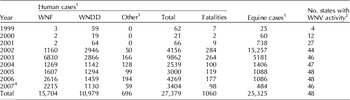
WNV was first detected in the Western Hemisphere in 1999 during an outbreak of human encephalitis in New York City (Gubler et al., Reference Gubler, Campbell, Nasci, Komar, Petersen and Roehrig2000; Nash et al., Reference Nash, Mostashari, Fine, Miller, O'Leary, Murray, Huang, Rosenberg, Greenberg, Sherman, Wong and Layton2001). There were 62 human cases with seven deaths (Table 3). Twenty-five equine cases with nine deaths occurred in the same area (Ostlund et al., Reference Ostlund, Crom, Pedersen, Johnson, Williams and Schmitt2001). One striking feature of this outbreak was the extraordinarily large number of dead and dying birds which were reported. Thousands of birds, particularly American crows and other corvids, died as a result of WNV infection in New York, New Jersey and Connecticut (Anderson et al., Reference Anderson, Andreadis, Vossbrinck, Tirrell, Wakem, French, Garmendia and Van Kruiningen1999; CDC, Reference Anderson, Andreadis, Vossbrinck, Tirrell, Wakem, French, Garmendia and Van Kruiningen1999). The prototype New York strain (WN-NY99), which was isolated from a flamingo that died in the Bronx zoo, was shown to be most similar to WNV isolates from Israel (Lanciotti et al., Reference Lanciotti, Roehrig, Deubel, Smith, Parker, Steele, Crise, Volpe, Crabtree, Scherret, Hall, MacKenzie, Cropp, Panigrahy, Ostlund, Schmitt, Malkinson, Banet, Weissman, Komar, Savage, Stone, McNamara and Gubler1999). Indeed, WN-NY99 and an isolate obtained from a dead domestic goose in Israel in 1998 differ by only 2 nt over a 1278 nt region (0.16% divergence) of the E gene (Lanciotti et al., Reference Lanciotti, Roehrig, Deubel, Smith, Parker, Steele, Crise, Volpe, Crabtree, Scherret, Hall, MacKenzie, Cropp, Panigrahy, Ostlund, Schmitt, Malkinson, Banet, Weissman, Komar, Savage, Stone, McNamara and Gubler1999; Malkinson et al., Reference Malkinson, Banet, Weisman, Pokamunski, King, Drouet and Deubel2002). These data suggest that WNV was introduced into New York from the Middle East, although the mode of introduction is not known.
Human and equine cases of WNV in the United States, 1999–2007

1 The case definition for WNV in humans and horses is the observation of clinical signs and at least one of the following: (1) a four-fold or greater change in WNV-specific serum antibody titer, (2) isolation of WNV from or detection of WNV antigen or genomic sequences in tissue, blood, cerebrospinal fluid (CSF), or other body fluid, (3) detection of WNV-specific IgM in CSF, (4) the detection of WNV-specific IgM in serum and confirmed by demonstration of WNV-specific serum IgG in the same or a later specimen.
2 Number of states reporting WNV infections in humans, horses, birds or mosquitoes.
3 Includes patients with unspecified clinical manifestations.
4 Case counts as of 14 December 2007.
WNF, West Nile fever; WNDD, West Nile neuroinvasive disease. Data were taken from the CDC and USDA websites.
WNV infections occurred again in 2000; there were 21 human cases with two deaths (Marfin et al., Reference Marfin, Petersen, Eidson, Miller, Hadler, Farello, Werner, Campbell, Layton, Smith, Bresnitz, Cartter, Scaletta, Obiri, Bunning, Craven, Roehrig, Julian, Hinten and Gubler2001) (Table 3). The virus was isolated from vertebrates or mosquitoes in 12 states in the northeastern USA. The isolation of WNV from overwintering Culex pipiens in New York City in February 2000 suggested that the virus had persisted in mosquito vectors during the winter (Nasci et al., Reference Nasci, Savage, White, Miller, Cropp, Godsey, Kerst, Bennett, Gottfried and Lanciotti2001). The virus was also isolated from a red-tailed hawk that died during the winter in New York (Garmendia et al., Reference Garmendia, Van Kruiningen, French, Anderson, Andreadis, Kumar and West2000). In 2001, WNV was responsible for 66 human cases with nine deaths, and extended its geographic range to encompass 27 states (O'Leary et al., Reference O'Leary, Nasci, Campbell and Marfin2002). That same year, WNV was isolated from several dead birds found in Ontario, marking the first evidence of this virus in Canada (available at: http://www.hc-sc.gc.ca/dc-ma/wnv-vno/index_e.html). Sequencing studies revealed that WNV isolates collected in the USA in 2000 and 2001 were genetically similar to isolates from 1999, demonstrating that only limited viral evolution had taken place during this time (Anderson et al., Reference Anderson, Andreadis, Vossbrinck, Tirrell, Wakem, French, Garmendia and Van Kruiningen1999, Reference Anderson, Vossbrinck, Andreadis, Iton, Beckwith and Mayo2001; Jia et al., Reference Jia, Briese, Jordan, Rambaut, Chi, Mackenzie, Hall, Scherret and Lipkin1999; Briese et al., Reference Briese, Glass and Lipkin2000; Ebel et al., Reference Ebel, Dupuis, Ngo, Nicholas, Kauffman, Jones, Young, Maffei, Shi, Bernard and Kramer2001; Lanciotti et al., Reference Lanciotti, Ebel, Deubel, Kerst, Murri, Meyer, Bowen, McKinney, Morrill, Crabtree, Kramer and Roehrig2002). For example, the complete E gene sequences (1503 nt) of 11 WNV isolates from 2000 differed by no more than 3 nt (0.20% divergence) from the homologous region of WN-NY99 (Ebel et al., Reference Ebel, Dupuis, Ngo, Nicholas, Kauffman, Jones, Young, Maffei, Shi, Bernard and Kramer2001). Eighty-two WN virus isolates from Connecticut in 1999 and 2000 had a maximum of 3 nt differences (0.33% divergence) over a 921-nt region of the E gene when compared to the homologous region of WN-NY99 (Anderson et al., Reference Anderson, Andreadis, Vossbrinck, Tirrell, Wakem, French, Garmendia and Van Kruiningen1999).
WNV in the United States: 2002 – present
In 2002, there was a dramatic and unexpected increase in the number of WNV infections in the USA; there were 4156 human cases with 284 deaths, and 15,257 equine cases (O'Leary et al., Reference O'Leary, Marfin, Montgomery, Kipp, Lehman, Biggerstaff, Elko, Collins, Jones and Campbell2004) (Table 3). Another notable feature of the 2002 transmission season was that it lasted longer than previous years with some cases occurring in December. This was presumably due to the incursion of the virus into several of the southernmost states of the USA where climatic conditions support year-round mosquito proliferation. Several previously unrecognized modes of human to human transmission were reported (CDC, 2002a, c; Iwamoto et al., Reference Iwamoto, Jernigan, Guasch, Trepka, Blackmore, Hellinger, Pham, Zaki, Lanciotti, Lance-Parker, DiazGranados, Winquist, Perlino, Wiersma, Hillyer, Goodman, Marfin, Chamberland and Petersen2003; Mather et al., Reference Mather, Takeda, Tassello, Ohagen, Serebryanik, Kramer, Brown, Tesh, Alford, Chapman and Lazo2003). The WNV outbreak in 2003 was even larger again; there were 9858 human cases with 262 deaths. This represents the largest recognized epidemic of arboviral neuroinvasive disease in the Western Hemisphere and the largest recognized epidemic of WNV in the world. Since then, WNV has continued to cause significant morbidity and mortality in the USA with >2500 human cases occurring each year. The emergence of WNV into Canada has also had disastrous consequences; there have been 2296 human cases (available at http://www.hc-sc.gc.ca/dc-ma/wnv-vno/index_e.html).
The sudden rise in WNV cases in 2002 coincided with the emergence of a new WNV genotype (WN02) (Ebel et al., Reference Ebel, Carricaburu, Young, Bernard and Kramer2004; Davis et al., Reference Davis, Ebel, Lanciotti, Brault, Guzman, Siirin, Lambert, Parsons, Beasley, Novak, Elizondo-Quiroga, Green, Young, Stark, Drebot, Artsob, Tesh, Kramer and Barrett2005, Reference Davis, Li, May, Bueno, Dennett, Bala, Guzman, Quiroga-Elizondo, Tesh and Barrett2007; Moudy et al., Reference Moudy, Meola, Morin, Ebel and Kramer2007; Snapinn et al., Reference Snapinn, Holmes, Young, Bernard, Kramer and Ebel2007). This genotype was first described by Ebel and colleagues after nucleotide sequencing was performed on the complete E genes of 67 isolates from New York in 2000–2003. Sequencing was also performed on parts of the NS5 gene and 3′ UTR of 39 isolates. WN02 represented 55% of isolates collected in 2002, and 85% of isolates collected in 2003. Shortly afterwards, it was shown that WN02 had emerged as the dominant WNV genotype across the USA and Canada (Davis et al., Reference Davis, Ebel, Lanciotti, Brault, Guzman, Siirin, Lambert, Parsons, Beasley, Novak, Elizondo-Quiroga, Green, Young, Stark, Drebot, Artsob, Tesh, Kramer and Barrett2005). The earlier WNV genotype (NY99) has not been detected in North America since 2004 suggesting that it has been completely displaced by WN02 (Moudy et al., Reference Moudy, Meola, Morin, Ebel and Kramer2007). All viruses in the WN02 genotype contain 13 mutations when compared to the prototype WN-NY99 strain, including one non-synonymous mutation which is located at E-159 (Davis et al., Reference Davis, Ebel, Lanciotti, Brault, Guzman, Siirin, Lambert, Parsons, Beasley, Novak, Elizondo-Quiroga, Green, Young, Stark, Drebot, Artsob, Tesh, Kramer and Barrett2005). The extrinsic incubation time for viruses in the WN02 genotype in Culex species mosquitoes is up to 4 days shorter than viruses from the NY99 genotype (Ebel et al., Reference Ebel, Carricaburu, Young, Bernard and Kramer2004; Moudy et al., Reference Moudy, Meola, Morin, Ebel and Kramer2007). It is likely that the ability of WN02 to replicate in mosquitoes faster than NY99 has contributed to the dramatic increase in WNV cases in the USA since 1999–2001.
Overall, the impact that WNV has had on human, equine and avian health has been far more pronounced in the USA as compared to the Eastern Hemisphere. One recent study has provided particular insight into this phenomenon by demonstrating that WNV isolates from the USA are more virulent than their counterparts from the Eastern Hemisphere largely because of a critical amino acid difference at NS3-249 (Brault et al., Reference Brault, Huang, Langevin, Kinney, Bowen, Ramey, Panella, Holmes, Powers and Miller2007). All WNV isolates from North America and many other recent lineage 2 strains contain a proline at NS3-249 whereas WNV isolates not associated with avian mortality usually possess an alanine, histidine or threonine at this site. American crows infected with viruses generated from infectious WN-NY99 cDNA clones exhibit 100% mortality and develop a peak mean viremia of 109.4 pfu ml−1. However, the introduction of a Pro→Thr mutation at NS3-249 generated recombinant viruses with relatively avirulent phenotypes; avian mortality decreased to 12% and the peak mean viremia was reduced to 103.5 pfu ml−1.
WNV in Latin America and the Caribbean
Equine and avian infection surveillance has demonstrated widespread circulation of WNV in Mexico and the Caribbean since 2002 (Blitvich et al., Reference Blitvich, Fernandez-Salas, Contreras-Cordero, Marlenee, Gonzalez-Rojas, Komar, Gubler, Calisher and Beaty2003; Dupuis et al., Reference Dupuis, Marra and Kramer2003; Estrada-Franco et al., Reference Estrada-Franco, Navarro-Lopez, Beasley, Coffey, Carrara, Travassos da Rosa, Clements, Wang, Ludwig, Cortes, Ramirez, Tesh, Barrett and Weaver2003; Komar et al., Reference Komar, Robbins, Klenk, Blitvich, Marlenee, Burkhalter, Gubler, Gonzalvez, Pena, Peterson and Komar2003b; Lorono-Pino et al., Reference Lorono-Pino, Blitvich, Farfan-Ale, Puerto, Blanco, Marlenee, Rosado-Paredes, Garcia-Rejon, Gubler, Calisher and Beaty2003; Quirin et al., Reference Quirin, Salas, Zientara, Zeller, Labie, Murri, Lefrancois, Petitclerc and Martinez2004). The following year, WNV activity was detected for the first time in Central America (Cruz et al., Reference Cruz, Cardenas, Abarca, Rodriguez, Reyna, Serpas, Fontaine, Beasley, Da Rosa, Weaver, Tesh, Powers and Suarez-Rangel2005; Morales-Betoulle et al., Reference Morales-Betoulle, Morales, Blitvich, Powers, Davis, Klein and Cordon-Rosales2006) and, in 2004, WNV seropositive horses were identified in South America (Mattar et al., Reference Mattar, Edwards, Laguado, Gonzalez, Alvarez and Komar2005). The first WNV isolate from Latin America was obtained from a bird that died in southern Mexico in 2003 (Estrada-Franco et al., Reference Estrada-Franco, Navarro-Lopez, Beasley, Coffey, Carrara, Travassos da Rosa, Clements, Wang, Ludwig, Cortes, Ramirez, Tesh, Barrett and Weaver2003; Beasley et al., Reference Beasley, Davis, Estrada-Franco, Navarro-Lopez, Campomanes-Cortes, Tesh, Weaver and Barrett2004b). This isolate is a member of the WN02 genotype and it contains an amino acid change at E-156 which abolishes a highly conserved glycosylation motif. The substitution responsible for the amino acid change was not seen in all clones, suggesting a mixed virus population. Glycosylated variants were highly lethal in mice whereas non-glycosylated variants were attenuated. Since then, another 15 WNVs (12 from Mexico, three from Argentina) have been identified and sequenced (Blitvich et al., Reference Blitvich, Fernandez-Salas, Contreras-Cordero, Lorono-Pino, Marlenee, Diaz, Gonzalez-Rojas, Obregon-Martinez, Chiu-Garcia, Black and Beaty2004; Elizondo-Quiroga et al., Reference Elizondo-Quiroga, Davis, Fernandez-Salas, Escobar-Lopez, Olmos, Gastalum, Acosta, Elizondo-Quiroga, Gonzalez-Rojas, Contreras Cordero, Guzman, Travassos da Rosa, Blitvich, Barreto, Beaty and Tesh2005; Deardorff et al., Reference Deardorff, Estrada-Franco, Brault, Navarro-Lopez, Campomanes-Cortes, Paz-Ramirez, Solis-Hernandez, Ramey, Davis, Beasley, Tesh, Barrett and Weaver2006; Morales et al., Reference Morales, Barrandeguy, Fabbri, Garcia, Vissani, Trono, Gutierrez, Pigretti, Menchaca, Garrido, Taylor, Fernandez, Levis and Enria2006). All belong to the WN02 genotype; none contain the attenuating mutation at E-156. No WNV isolates have been obtained from the Caribbean. Indeed, one perplexing aspect of the emergence of WNV into Latin America and the Caribbean is the unexpected difficulty researchers have had isolating WNV in these areas. To date, information on the emergence and spread of WNV in Latin America and the Caribbean has mostly been derived from serologic studies. Even more perplexing is the sparse number of human cases that have occurred. The Mexican Secretary of Public Health (Secretaría de Salúd Publica) has reported seven human cases of WNV in Mexico (available at http://portal.salud.gob.mx). The cases occurred in the States of Chihuahua (n=4), Sonora (n=1) and Nuevo Leon (n=1) in 2003, and Sonora (n=1) in 2004. Three cases were classified as severe; all patients survived. These states border the USA. There have been another 5 human cases in the Caribbean (Komar and Clark, Reference Komar and Clark2006). These cases occurred in the Cayman Islands in 2001 (n=1), the Bahamas in 2003 (n=1) and Cuba in 2003 (n=2) and 2004 (n=1). There have been only isolated reports of WNV illness in horses and birds in Latin America and the Caribbean.
It is likely that under-reporting has contributed to the low number of WNV cases in Latin America and the Caribbean particularly since the resources and funds available to the public health authorities in some regions are limited. Nevertheless, it is unlikely that a large-scale outbreak of WNV disease would go unrecognized in an urban area suggesting that other factors are contributing to the low number of WNV cases. One explanation is that pre-existing immunity to another flavivirus, such as dengue virus which is endemic in many parts of Latin America and the Caribbean, is providing partial protection to subsequent WNV infection (Tesh et al., Reference Tesh, Travassos da Rosa, Guzman, Araujo and Xiao2002; Xiao et al., Reference Xiao, Guzman, da Rosa, Zhu and Tesh2003). However, this reason does not account for the apparent lack of WNV illness in equine and avian species because dengue virus usually does not replicate in non-primate vertebrates (Thomas et al., Reference Thomas, Strickman and Vaughn2003). Although a number of other flaviviruses, such as SLEV, Ilheus, Bussuquara, Rocio, Cacipacore and Iguape viruses, are circulating in Latin America and/or the Caribbean, it is unlikely that they are conferring resistance to subsequent WNV infection because the prevalence of these virus infections is low (Blitvich et al., Reference Blitvich, Fernandez-Salas, Contreras-Cordero, Marlenee, Gonzalez-Rojas, Komar, Gubler, Calisher and Beaty2003; Dupuis et al., Reference Dupuis, Marra and Kramer2003; Fernandez-Salas et al., Reference Fernandez-Salas, Contreras-Cordero, Blitvich, Gonzalez-Rojas, Cavazos-Alvarez, Marlenee, Elizondo-Quiroga, Lorono-Pino, Gubler, Cropp, Calisher and Beaty2003; Lorono-Pino et al., Reference Lorono-Pino, Blitvich, Farfan-Ale, Puerto, Blanco, Marlenee, Rosado-Paredes, Garcia-Rejon, Gubler, Calisher and Beaty2003; Farfan-Ale et al., Reference Farfan-Ale, Blitvich, Lorono-Pino, Marlenee, Rosado-Paredes, Garcia-Rejon, Flores-Flores, Chulim-Perera, Lopez-Uribe, Perez-Mendoza, Sanchez-Herrera, Santamaria, Moo-Huchim, Gubler, Cropp, Calisher and Beaty2004; Marlenee et al., Reference Marlenee, Lorono-Pino, Beaty, Blitvich, Fernandez Salas, Contreras Cordero and Gonzalez Rojas2004; Turell et al., Reference Turell, O'Guinn, Jones, Sardelis, Dohm, Watts, Fernandez, Travassos da Rosa, Guzman, Tesh, Rossi, Ludwig, Mangiafico, Kondig, Wasieloski, Pecor, Zyzak, Schoeler, Mores, Calampa, Lee and Klein2005b). Another explanation is that there are critical differences in the species composition, relative abundance and susceptibility of vertebrates or vectors in Latin America and the Caribbean as compared to the USA. The emergence of attenuated WNV variants may have contributed to the lack of observed WNV illness. Indeed, as noted earlier, certain plaques obtained from a WNV isolate from southern Mexico were attenuated in mice (Beasley et al., Reference Beasley, Davis, Estrada-Franco, Navarro-Lopez, Campomanes-Cortes, Tesh, Weaver and Barrett2004b). However, the mutation responsible for this attenuation is not present in any WNV isolates from Latin America (Blitvich et al., Reference Blitvich, Fernandez-Salas, Contreras-Cordero, Lorono-Pino, Marlenee, Diaz, Gonzalez-Rojas, Obregon-Martinez, Chiu-Garcia, Black and Beaty2004; Elizondo-Quiroga et al., Reference Elizondo-Quiroga, Davis, Fernandez-Salas, Escobar-Lopez, Olmos, Gastalum, Acosta, Elizondo-Quiroga, Gonzalez-Rojas, Contreras Cordero, Guzman, Travassos da Rosa, Blitvich, Barreto, Beaty and Tesh2005; Deardorff et al., Reference Deardorff, Estrada-Franco, Brault, Navarro-Lopez, Campomanes-Cortes, Paz-Ramirez, Solis-Hernandez, Ramey, Davis, Beasley, Tesh, Barrett and Weaver2006; Morales et al., Reference Morales, Barrandeguy, Fabbri, Garcia, Vissani, Trono, Gutierrez, Pigretti, Menchaca, Garrido, Taylor, Fernandez, Levis and Enria2006). Additional research is required to elucidate the mechanisms that have conditioned the vastly different epidemic and epizoonotic potentials of WNV in Latin America and the Caribbean as compared to the USA.
Transmission cycle
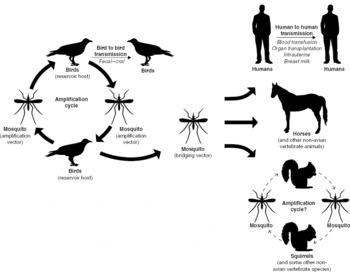
WNV is maintained in nature in an enzootic transmission cycle that primarily involves Culex species mosquitoes and birds (Fig. 2) (Komar, Reference Komar2003; Hayes et al., Reference Hayes, Komar, Nasci, Montgomery, O'Leary and Campbell2005a; Kramer et al., Reference Kramer, Styer and Ebel2007). Mosquito species that participate in this cycle are referred to as amplification vectors, and are strongly ornithophilic (feed almost exclusively on avian blood). Mosquito species with more general feeding habits can transmit WNV to humans, horses and other non-avian vertebrates after feeding upon viremic birds. These mosquito species are known as bridging vectors. Humans, horses and other non-avian vertebrates are incidental (dead-end) hosts because they usually, although not always, produce viremias of insufficient magnitude to infect susceptible mosquitoes. Generally, an infected vertebrate must produce a viremia of ≥105 pfu ml−1 to serve as a reservoir (amplification) host (Turell et al., Reference Turell, O'Guinn and Oliver2000; Sardelis et al., Reference Sardelis, Turell, Dohm and O'Guinn2001). WNV can infect a remarkably large number of vertebrate and arthropod species and this is a major reason why the virus has successfully spread over such a large geographic region. Evidence of WNV infection has been detected in >300 species of birds, >30 species of mammals, several reptilian and amphibian species, >60 species of mosquitoes and several other arthropod species.
Overview of the WNV transmission cycle. Thick, solid arrows denote common routes of transmission. Thin, solid arrows denote routes of transmission that occur infrequently. Thin, broken arrows denote proposed routes of transmission that have not been confirmed in nature.

Birds
Birds are the natural reservoir hosts for WNV (McLean et al., Reference McLean, Ubico, Docherty, Hansen, Sileo and McNamara2001; Komar, Reference Komar2003; Hayes et al., Reference Hayes, Komar, Nasci, Montgomery, O'Leary and Campbell2005a). Passeriformes (song birds) are considered to be the principal reservoir hosts, although competent birds have also been identified in several other orders, including Charadriiformes (shorebirds), Falconiformes (hawks) and Strigiformes (owls). In contrast, Anseriformes (ducks), Columbiformes (pigeons) and Piciformes (woodpeckers) usually generate viremias insufficient to infect mosquitoes. One species that plays a particularly important role in the primary WNV transmission cycle is the house sparrow (Komar et al., Reference Komar, Langevin, Hinten, Nemeth, Edwards, Hettler, Davis, Bowen and Bunning2003a; Langevin et al., Reference Langevin, Brault, Panella, Bowen and Komar2005). This species is considered to be a major reservoir host in both North America and Europe because it is highly abundant in those regions, frequently seropositive for WNV in field studies and develops high and prolonged WNV viremias in laboratory studies. Antibodies to WNV were detected in 60% of house sparrows sampled in New York City in 1999 (Komar et al., Reference Komar, Panella, Burns, Dusza, Mascarenhas and Talbot2001). Experimental infection studies have shown that house sparrows develop WNV viremias that exceed 1010 pfu ml−1, and maintain viremias above 105 pfu ml−1 for five days (Komar et al., Reference Komar, Langevin, Hinten, Nemeth, Edwards, Hettler, Davis, Bowen and Bunning2003a; Langevin et al., Reference Langevin, Brault, Panella, Bowen and Komar2005). Other avian species that develop exceptionally high viremias (>1010 pfu ml−1) include the blue jay, American crow and common grackle (Komar et al., Reference Komar, Langevin, Hinten, Nemeth, Edwards, Hettler, Davis, Bowen and Bunning2003a; Reisen et al., Reference Reisen, Fang and Martinez2005).
It is often assumed that an avian species that is susceptible to WNV infection must be resistant to WNV illness or death to be considered an important reservoir host. However, under some conditions, avian die-off may actually enhance WNV transmission because it reduces the likelihood of infected mosquitoes feeding on immune hosts (Foppa and Spielman, Reference Foppa and Spielman2007). Furthermore, dying birds are relatively immobile and therefore provide an easy source of blood for mosquitoes. The susceptibility of a bird to WNV disease is dependent upon various factors including its species and age, and the strain of the virus. Crows, jays and other members of the family Corvidae suffer extremely high mortality rates following WNV infection. Several studies have demonstrated 100% mortality in American crows experimentally infected with New York strains of WNV (Komar et al., Reference Komar, Langevin, Hinten, Nemeth, Edwards, Hettler, Davis, Bowen and Bunning2003a; Brault et al., Reference Brault, Langevin, Bowen, Panella, Biggerstaff, Miller and Komar2004, Reference Brault, Huang, Langevin, Kinney, Bowen, Ramey, Panella, Holmes, Powers and Miller2007; Bunning et al., Reference Bunning, Fox, Bowen, Komar, Chang, Speaker, Stephens, Nemeth, Panella, Langevin, Gordy, Teehee, Bright and Turell2007). The overall American crow population in the USA has declined by an estimated 45% since the introduction of the virus in 1999 (LaDeau et al., Reference LaDeau, Kilpatrick and Marra2007). However, the detection of antibodies to WNV in a subset (16.5%) of American crows in Georgia in 2002–2004 suggests that resistant populations have emerged (Wilcox et al., Reference Wilcox, Yabsley, Ellis, Stallknecht and Gibbs2007). House sparrows exhibit mortality rates of approximately 16% (Reisen et al., Reference Reisen, Fang and Martinez2005). In contrast, WNV infection has no apparent adverse effect on many other avian species; for example, no signs of illness were observed in 17 of 25 North American bird species experimentally infected with a New York strain of WNV (Komar et al., Reference Komar, Langevin, Hinten, Nemeth, Edwards, Hettler, Davis, Bowen and Bunning2003a).
Viremic migratory birds are widely regarded to be the major long-distance dispersal agents of WNV (Peterson et al., Reference Peterson, Vieglais and Andreasen2003), although the non-directional movement of viremic resident birds also contributes to the spread of the virus (Rappole et al., Reference Rappole, Compton, Leimgruber, Robertson, King and Renner2006). The movement of migratory birds is also a critical determinant of the timing and severity of WNV outbreaks. For example, the migratory behavior of the American robin influences the transmission dynamics of WNV in the northeastern USA (Kilpatrick et al., Reference Kilpatrick, Kramer, Jones, Marra and Daszak2006). American robins are the preferred source of blood for Cx. pipiens in this region; more than half of the engorged Cx. pipiens collected in May and June had fed on this avian species. However, by September, there is a 7-fold increase in the proportion of Cx. pipiens that have fed on humans. This shift in feeding behavior coincides with a sharp decrease in the abundance of American robins in the northeastern USA as a result of long-distance migration, as well as a dramatic increase in the number of human cases in the same area. American robins are also a common source of blood for Culex spp. mosquitoes in other regions of the USA (Molaei et al., Reference Molaei, Andreadis, Armstrong, Anderson and Vossbrinck2006; Savage et al., Reference Savage, Aggarwal, Apperson, Katholi, Gordon, Hassan, Anderson, Charnetzky, McMillen, Unnasch and Unnasch2007).
Mammals
Naturally-acquired WNV infections have been reported in a diverse range of mammalian species (Hayes, Reference Hayes and Monath1988; van der Meulen et al., Reference van der Meulen, Pensaert and Nauwynck2005). Mammalian species susceptible to WNV infection, as indicated by the detection of WNV antibody, antigen or nucleic acid in serum or tissues, include the alpaca, baboon, bat, black bear, brown bear, camel, cat, cow, coyote, dog, goat, horse, human, jaguar, lemur, pig, pigtail macaque, mouse, opossum, rabbit, raccoon, rhesus macaque, rat, reindeer, sheep, skunk, squirrel, white-tailed deer and wolf. Most mammalian species do not contribute to the WNV amplification cycle because they develop low WNV viremias of short duration. The highest viremia detected in horses experimentally infected with a USA strain of WNV was 103.0 pfu ml−1 (Bunning et al., Reference Bunning, Bowen, Cropp, Sullivan, Davis, Komar, Godsey, Baker, Hettler, Holmes, Biggerstaff and Mitchell2002). The peak WNV viremias reported in experimentally-infected cats, pigs and dogs were 104.0, 103.1 and 102.2 pfu ml−1, respectively (Austgen et al., Reference Austgen, Bowen, Bunning, Davis, Mitchell and Chang2004; Teehee et al., Reference Teehee, Bunning, Stevens and Bowen2005). However, golden hamsters, eastern cottontail rabbits, eastern chipmunks and fox squirrels can develop WNV viremias sufficient to infect mosquitoes (Tesh et al., Reference Tesh, Siirin, Guzman, Travassos da Rosa, Wu, Duan, Lei, Nunes and Xiao2005; Tiawsirisup et al., Reference Tiawsirisup, Platt, Tucker and Rowley2005; Tonry et al., Reference Tonry, Xiao, Siirin, Chen, da Rosa and Tesh2005; Root et al., Reference Root, Oesterle, Nemeth, Klenk, Gould, McLean, Clark and Hall2006; Platt et al., Reference Platt, Tucker, Halbur, Tiawsirisup, Blitvich, Fabiosa, Bartholomay and Rowley2007). For example, Platt and colleagues reported viremias as high as 107.8 pfu ml−1 in eastern chipmunks experimentally-infected with WNV and demonstrated that these viremias were sufficient to infect Culex and Aedes spp. mosquitoes. Root and colleagues reported maximum viremias of 105.0 pfu ml−1 in fox squirrels experimentally-infected with WNV. Surveillance studies have demonstrated that fox squirrels exhibit high seroprevalence rates to WNV; for example, 49% of tree squirrels sampled in a WNV serosurvey in the central and eastern USA in 2003 had antibodies to WNV (Root et al., Reference Root, Hall, McLean, Marlenee, Beaty, Gansowski and Clark2005). Golden hamsters experimentally-infected with WNV develop viremias up to 105.0 pfu ml−1 and can persistently shed WNV in urine for months (Tesh et al., Reference Tesh, Siirin, Guzman, Travassos da Rosa, Wu, Duan, Lei, Nunes and Xiao2005; Tonry et al., Reference Tonry, Xiao, Siirin, Chen, da Rosa and Tesh2005). Taken together, these experimental infection data suggest that several mammalian species contribute to the WNV amplification cycle, although this has not been confirmed in nature.
Reptiles and amphibians
Experimental infection studies have provided evidence that some species of ectothermic vertebrates contribute to the WNV amplification cycle. For instance, American alligators develop viremias that exceed 105.0 pfu ml−1 (Klenk et al., Reference Klenk, Snow, Morgan, Bowen, Stephens, Foster, Gordy, Beckett, Komar, Gubler and Bunning2004; Jacobson et al., Reference Jacobson, Ginn, Troutman, Farina, Stark, Klenk, Burkhalter and Komar2005). Lake frogs have also been demonstrated to develop WNV viremias capable of infecting mosquitoes (Kostiukov et al., Reference Kostiukov, Alekseev, Bulychev and Gordeeva1986). WNV viremias were also detected in green iguanas and North American bullfrogs following WNV inoculation, although the maximum titers were 103.2 and 102.2 pfu ml−1, respectively, suggesting that these species are incompetent reservoir hosts (Klenk and Komar, Reference Klenk and Komar2003). Red-ear sliders and garter snakes failed to develop detectable WNV viremias. Antibodies to WNV have been detected in healthy farmed crocodiles in Israel and Mexico, but their role in WNV transmission has not been studied (Steinman et al., Reference Steinman, Banet-Noach, Tal, Levi, Simanov, Perk, Malkinson and Shpigel2003; Farfan-Ale et al., Reference Farfan-Ale, Blitvich, Marlenee, Lorono-Pino, Puerto-Manzano, Garcia-Rejon, Rosado-Paredes, Flores-Flores, Ortega-Salazar, Chavez-Medina, Cremieux-Grimaldi, Correa-Morales, Hernandez-Gaona, Mendez-Galvan and Beaty2006).
Mosquitoes
Several criteria must be fulfilled for a mosquito species to be considered an important vector of WNV, including (1) demonstration that WNV efficiently infects and is transmitted by the mosquito species after receiving an infectious blood meal under laboratory conditions, (2) a high relative abundance of the species in the field and (3) frequent isolation of WNV from the species in the field (Turell et al., Reference Turell, Sardelis, Dohm and O'Guinn2001). The frequency at which WNV is detected in mosquitoes in the field, known as the minimal infection rate (MIR), is expressed as the number of positive mosquito pools per 1000 mosquitoes tested. The MIR of WNV in mosquitoes provides an indicator of the intensity of virus transmission in a given area and often is related to the risk of human disease (Hayes et al., Reference Hayes, Komar, Nasci, Montgomery, O'Leary and Campbell2005a). In surveillance studies, mosquitoes are usually assayed for the presence of WNV by RT-PCR or virus isolation in cell culture; MIRs calculated by the former approach are usually 2–6-fold greater (Nasci et al., Reference Nasci, Savage, White, Miller, Cropp, Godsey, Kerst, Bennett, Gottfried and Lanciotti2001, Reference Nasci, Komar, Marfin, Ludwig, Kramer, Daniels, Falco, Campbell, Brookes, Gottfried, Burkhalter, Aspen, Kerst, Lanciotti and Moore2002; Shi et al., Reference Shi, Kauffman, Ren, Felton, Tai, Dupuis, Jones, Ngo, Nicholas, Maffei, Ebel, Bernard and Kramer2001; White et al., Reference White, Kramer, Backenson, Lukacik, Johnson, Oliver, Howard, Means, Eidson, Gotham, Kulasekera and Campbell2001). As already noted, the feeding preference of a mosquito species is also a critical determinant of its role in WNV transmission. Mosquito species that feed readily on reservoir hosts are involved in the primary amplification cycle, whereas those that feed primarily on incidental hosts are involved in the secondary transmission cycle.
Culex species mosquitoes are the major amplification vectors of WNV, although the virus has been isolated from mosquitoes belonging to at least 11 other genera: Aedes, Aedemomyia, Anopheles, Coquilletidia, Culiseta, Deinocerites, Mansonia, Mimomyia, Orthopodomyia, Psorophora and Uranoteania (Hayes, Reference Hayes and Monath1988; Zeller and Schuffenecker, Reference Zeller and Schuffenecker2004; Hayes et al., Reference Hayes, Komar, Nasci, Montgomery, O'Leary and Campbell2005a). The principal amplification vectors of WNV in Europe and Africa are Cx. pipiens, Culex univittatus and Culex antennatus. In Asia, members of the Culex vishnui complex, such as Culex tritaeniorhynchus, Cx. vishnui and Culex pseudovishnui, are major vectors. In Australia, the principal vector is Culex annulirostris. In the USA, the major amplification vectors are Cx. pipiens and Culex restuans in the northeast, Culex tarsalis in the west and Culex quinquefasciatus in the south.
Cx. pipiens and Cx. restuans populations in the northeastern USA are highly competent laboratory vectors of WNV and are strongly ornithophilic; the ratio of blood meals taken from birds and mammals by Cx. pipiens and Cx. restuans in New York City was 23:1 and 6:1, respectively (Turell et al., Reference Turell, O'Guinn and Oliver2000; Sardelis et al., Reference Sardelis, Turell, Dohm and O'Guinn2001; Apperson et al., Reference Apperson, Harrison, Unnasch, Hassan, Irby, Savage, Aspen, Watson, Rueda, Engber and Nasci2002). Because of their high abundance, both species have also been implicated as major bridging vectors of WNV in this region (Kilpatrick et al., Reference Kilpatrick, Kramer, Campbell, Alleyne, Dobson and Daszak2005). Culex salinarius is an important bridging vector of WNV in the northeastern USA; it is a highly competent laboratory vector and an opportunistic feeder (Sardelis et al., Reference Sardelis, Turell, Dohm and O'Guinn2001; Apperson et al., Reference Apperson, Hassan, Harrison, Savage, Aspen, Farajollahi, Crans, Daniels, Falco, Benedict, Anderson, McMillen and Unnasch2004). Seventy-two percent of engorged Cx. salinarius from New Jersey had fed on mammals; 25% had fed on birds (Apperson et al., Reference Apperson, Hassan, Harrison, Savage, Aspen, Farajollahi, Crans, Daniels, Falco, Benedict, Anderson, McMillen and Unnasch2004). The WNV MIR in Cx. salinarius in New York State in 2000 was 1.6 (calculated using RT-PCR data), exceeded only by Cx. pipiens which had a MIR of 3.5 (Bernard et al., Reference Bernard, Maffei, Jones, Kauffman, Ebel, Dupuis, Ngo, Nicholas, Young, Shi, Kulasekera, Eidson, White, Stone and Kramer2001). In this study, the authors considered a county or borough to be in the epicenter of the WNV outbreak if the MIR for any mosquito species in that region was ≥1.0. In Connecticut in 2000, the overall MIR in Culex spp. mosquitoes was 0.7 (cell culture data), and the MIRs in Cx. restuans, Cx. pipiens and Cx. salinarius were 1.8, 1.4 and 0.5, respectively (Andreadis et al., Reference Andreadis, Anderson and Vossbrinck2001).
As WNV spread across the USA, its geographic distribution overlapped with that of other mosquito species. In 2003, almost one-third of the reported WNV-infected mosquito pools were composed of Cx. tarsalis (Hayes et al., Reference Hayes, Komar, Nasci, Montgomery, O'Leary and Campbell2005a). This species is considered to be the principal amplification vector of WNV in the western USA because it is highly abundant in that region and is one of the most efficient laboratory vectors of WNV (Goddard et al., Reference Goddard, Roth, Reisen and Scott2002; Turell et al., Reference Turell, O'Guinn, Dohm, Webb and Sardelis2002, Reference Turell, Dohm, Sardelis, Oguinn, Andreadis and Blow2005a). Cx. tarsalis is ornithophilic, but it also feeds on mammals, particularly in the latter part of the transmission season, and therefore it may also be an important bridging vector (Reisen and Reeves, Reference Reisen, Reeves and Reeves1990). The WNV MIR in Cx. tarsalis in Colorado in 2003 and 2004 was 34.5 and 8.7, respectively (RT-PCR data) (Bolling et al., Reference Bolling, Moore, Anderson, Blair and Beaty2007).
Cx. quinquefasciatus accounted for 51% of the WNV-infected mosquito pools reported in 2004 (Hayes et al., Reference Hayes, Komar, Nasci, Montgomery, O'Leary and Campbell2005a). This species, which is common in the southern USA, is a moderately competent laboratory vector of WNV (Sardelis et al., Reference Sardelis, Turell, Dohm and O'Guinn2001; Goddard et al., Reference Goddard, Roth, Reisen and Scott2002; Turell et al., Reference Turell, Dohm, Sardelis, Oguinn, Andreadis and Blow2005a). Cx. quinquefasciatus populations in the southern USA feed readily on both birds and mammals. For instance, 50% of engorged Cx. quinquefasciatus in Arizona had fed on humans, 32% had fed on birds and 12% had fed on dogs (Zinser et al., Reference Zinser, Ramberg and Willott2004). Cx. quinquefasciatus populations in Louisiana fed most frequently (69%) on dogs, followed by birds (16%) and humans (11%) (Niebylski and Meek, Reference Niebylski and Meek1992). The MIR in Cx. quinquefasciatus in Florida in 2001 was 4.8 (cell culture data) (Blackmore et al., Reference Blackmore, Stark, Jeter, Oliveri, Brooks, Conti and Wiersma2003). Culex nigripalpus is also an important vector in the southern USA (Turell et al., Reference Turell, Sardelis, Dohm and O'Guinn2001).
The efficiency with which mosquitoes transmit WNV is dependent upon various environmental factors, particularly temperature and rainfall (Epstein, Reference Epstein2001). Laboratory studies have shown that Cx. pipiens and Cx. tarsalis held at high (28–30°C) temperatures are more vector competent for WNV than those held at lower (14–22°C) temperatures (Dohm et al., Reference Dohm, O'Guinn and Turell2002; Reisen et al., Reference Reisen, Fang and Martinez2006). In this regard, the outbreaks of WNV that took place in Romania in 1996, Russia in 1999 and the USA in 2002–2004 occurred during periods of above-average summer temperatures (Han et al., Reference Han, Popovici, Alexander, Laurentia, Tengelsen, Cernescu, Gary, Ion-Nedelcu, Campbell and Tsai1999; Platonov et al., Reference Platonov, Shipulin, Shipulina, Tyutyunnik, Frolochkina, Lanciotti, Yazyshina, Platonova, Obukhov, Zhukov, Vengerov and Pokrovskii2001; Reisen et al., Reference Reisen, Fang and Martinez2006). Shaman and colleagues reported that extreme drought, which brings avian hosts and mosquito vectors into close contact, can also increase the intensity of WNV transmission (Shaman et al., Reference Shaman, Day and Stieglitz2005). Drought-induced transmission has also been described for SLEV (Shaman et al., Reference Shaman, Day and Stieglitz2002, Reference Shaman, Day and Stieglitz2003). Additionally, above-average rainfall can also lead to increased transmission of WNV and other mosquito-borne pathogens, particularly if the availability of larval habitat is limited (Takeda et al., Reference Takeda, Whitehouse, Brewer, Gettman and Mather2003; Landesman et al., Reference Landesman, Allan, Langerhans, Knight and Chase2007).
Other arthropods
WNV has occasionally been isolated from various species of field-collected argasid (soft) and ixodid (hard) ticks (Hubalek and Halouzka, Reference Hubalek and Halouzka1999; Mumcuoglu et al., Reference Mumcuoglu, Banet-Noach, Malkinson, Shalom and Galun2005). Laboratory transmission of WNV has been demonstrated for soft ticks but not hard ticks (Anderson et al., Reference Anderson, Main, Andreadis, Wikel and Vossbrinck2003; Lawrie et al., Reference Lawrie, Uzcategui, Gould and Nuttall2004; Hutcheson et al., Reference Hutcheson, Gorham, Machain-Williams, Lorono-Pino, James, Marlenee, Winn, Beaty and Blair2005). WNV has also been isolated from mites, and WNV RNA has been detected in hippoboscid flies, but the roles of these arthropods in WNV transmission have not been studied (Farajollahi et al., Reference Farajollahi, Crans, Nickerson, Bryant, Wolf, Glaser and Andreadis2005; Mumcuoglu et al., Reference Mumcuoglu, Banet-Noach, Malkinson, Shalom and Galun2005).
Non-vector-borne transmission
Although WNV is primarily transmitted to vertebrates by arthropod vectors, various non-vector-borne modes of transmission have been documented (Fig. 2). For example, WNV has been transmitted to humans as a result of organ transplantation, blood transfusion, breast feeding, intrauterine transmission and needle-stick injury (CDC, 2002a, b, c; Iwamoto et al., Reference Iwamoto, Jernigan, Guasch, Trepka, Blackmore, Hellinger, Pham, Zaki, Lanciotti, Lance-Parker, DiazGranados, Winquist, Perlino, Wiersma, Hillyer, Goodman, Marfin, Chamberland and Petersen2003; Mather et al., Reference Mather, Takeda, Tassello, Ohagen, Serebryanik, Kramer, Brown, Tesh, Alford, Chapman and Lazo2003). Oral transmission of WNV has been reported for the American crow, common grackle, great horned owl, house finch and house sparrow (Komar et al., Reference Komar, Langevin, Hinten, Nemeth, Edwards, Hettler, Davis, Bowen and Bunning2003a). Direct transmission has been documented with the American crow, blue jay, black-billed magpie and ring-billed gull. American crows can shed >108.8 pfu g−1 of WNV in their feces which suggests that exposure to contaminated fecal material is a potential source for direct WNV transmission (Kipp et al., Reference Kipp, Lehman, Bowen, Fox, Stephens, Klenk, Komar and Bunning2006). The consumption of WNV-infected horse meat was implicated as the source of the WNV outbreaks in the alligator farm in Georgia in 2001–2002 (Miller et al., Reference Miller, Mauel, Baldwin, Burtle, Ingram, Hines and Frazier2003). Alligators can also become infected via direct contact with infected tank-mates (Klenk et al., Reference Klenk, Snow, Morgan, Bowen, Stephens, Foster, Gordy, Beckett, Komar, Gubler and Bunning2004). Cats have become infected via the ingestion of infected mice (Austgen et al., Reference Austgen, Bowen, Bunning, Davis, Mitchell and Chang2004). Taken together, these data suggest that WNV transmission can occur in the absence of mosquito vectors.
Conclusions
In the last decade, WNV has undergone a dramatic expansion of its geographic range, and has emerged as a major pathogen of humans, horses and birds. This should serve as a reminder of the ongoing threat that vector-borne pathogens present to human and animal health, and highlights the need for continual and improved surveillance, diagnosis and treatment for WNV.
Acknowledgments
The author gratefully acknowledges Dr Jim Roth and Daniell Ausen for graphic design, and Dr Francisco Diaz for constructing the phylogenetic tree.