Introduction
The genus Thaumeledone comprises benthic octopods known from relatively deep waters in the Southern Hemisphere. Thaumeledone are small, squat bodied octopuses and possess a single row of suckers on their arms. They possess a distinctive deep purple pigmentation on the oral surface of the web (Allcock et al. Reference Allcock, Collins, Piatkowski and Vecchione2004). The terminal organ of the hectocotylised arm has a large calamus, giving the terminal organ a club-like appearance.
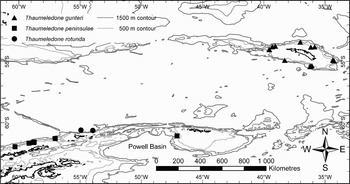
Six species of Thaumeledone are currently recognized (Allcock et al. Reference Allcock, Collins, Piatkowski and Vecchione2004). One species, T. brevis (Hoyle 1885), is known only from the type material which was captured in deep water off Montevideo, Uruguay, in 1876. Many other specimens have been previously identified as T. brevis, particularly from very deep water in the Southern Ocean, but Allcock et al. (Reference Allcock, Collins, Piatkowski and Vecchione2004) recognized these to be distinct from the type material of T. brevis and re-identified these specimens as T. rotunda (Hoyle 1885). Two species, T. marshalli O'Shea, 1999 and T. zeiss O'Shea, 1999 are known only from New Zealand waters. The remaining two species, T. gunteri Robson, 1930 and T. peninsulae Allcock et al. Reference Allcock, Collins, Piatkowski and Vecchione2004 occur south of the Polar Frontal Zone in Antarctic waters (Fig. 1). Thaumeledone gunteri is known only from around South Georgia, whilst T. peninsulae was previously only known from the continental slope of the Antarctic Peninsula and adjacent islands. Both species are restricted to slope waters, neither occurring at the extreme depths at which T. rotunda is found.
Map of the Scotia Arc showing capture locations of Thaumeledone during recent cruises (ANTARKTIS XIV/2 in 1996, EASIZ III in 2000, ANDEEP I in 2002, BIOPEARL in 2006 and South Georgia Fish Surveys, 1994, 1997, 2003, 2004).

Nothing is known of the evolutionary history within the genus Thaumeledone. A single specimen (of unknown species) was used within a phylogenetic study of the Octopoda (Carlini et al. Reference Carlini, Young and Vecchione2001) and found Thaumeledone sp. to be the sister taxa to Megaledone setebos (Robson 1932), a large octopus species restricted to Antarctic waters.
Recent trawling programmes aboard RRS James Clark Ross, RV Polarstern and fisheries surveys around South Georgia have yielded a collection of individuals of the Southern Ocean species of Thaumeledone (Allcock et al. Reference Allcock, Collins, Piatkowski and Vecchione2004). Tissue samples were collected from a number of these individuals upon capture and provide a unique opportunity to undertake a molecular phylogenetic study of the group.
The aim of this study was to resolve the phylogenetic relationships within Southern Ocean Thaumeledone species.
Materials and methods
A large proportion of specimens used within this study were collected from a number of research cruises to the Antarctic Peninsula, the Scotia Sea and South Georgia over the past ten years aboard RV Polarstern particularly during the EASIZ and ANDEEP programmes, and aboard RV Dorada and MV Cordella as part of the annual fish surveys around South Georgia (Fig. 1). Details of these cruises can be found in Allcock et al. (Reference Allcock, Collins, Piatkowski and Vecchione2004). In addition to this, as part of the BIOPEARL expedition, RRS James Clark Ross fished in the Scotia Sea between February and April 2006. A specimen of T. peninsulae was captured from ~1500 m from the Powell Basin using an Agassiz trawl. This specimen has been deposited in the National Museums of Scotland under catalogue number NMSZ 2007009. A specimen of Velodona togata Chun, 1915 was also obtained for the study and was captured by a commercial prawn trawler off the coast of Durban, South Africa from 400–500 m in February 2005. This specimen was included in the study because a larger phylogenetic study of the Octopodiformes found it to be a suitable outgroup (data not shown).
Specimens were examined either alive, when possible, or freshly dead. Tissue samples were taken from a small number of Thaumeledone specimens and from specimens of other closely related species in the vicinity and preserved in 70% ethanol for subsequent application of molecular techniques. Where possible, these specimens were then fixed in 4% formalin and deposited in either the Natural History Museum, London (BMNH), the Smithsonian Institute (USNM) or the National Museums of Scotland (NMSZ).
Morphological analysis
Standard counts and measurements are recommended for morphological description of octopus species and these were recorded for the newly captured specimen of T. peninsulae from the Powell Basin. These counts and measurements have already been published for several specimens of T. rotunda, T. peninsulae and T. gunteri (Allcock et al. Reference Allcock, Collins, Piatkowski and Vecchione2004) and for T. zeiss and T. marshalli (O'Shea, 1999). From the recorded and published information, a range of morphometric indices (see Roper & Voss Reference Roper and Voss1983) were calculated: mantle width index (MWI), head width index (HWI), funnel length index (FuLI), free funnel length index (FFuLI), arm width index (AWI), arm sucker index (ASI), web depth index (WDI), arm length index of arms 1, 2, and 3 (ALI1, ALI2, ALI3; ALI4 was not used because of a number of damaged 4th arms), mantle arm index (MAI), opposite arm index (OAI), ligula length index (LLI), calamus length index (CaLI), and spermatophore length index (SpLI). Two matrices of counts and indices were then compiled including information from Southern Ocean species only. In the first, the number of indices and counts used was maximized by including only mature male specimens. This matrix comprised 16 variables (all the indices mentioned above plus the hectocotylised arm sucker count) for nine individuals: four T. peninsulae (including the Powell Basin specimen), three T. gunteri and two T. rotunda. In the second matrix the number of individuals included was maximized at the expense of variables. Missing values are not permitted in the analysis so variables must be dropped if individuals are included for which these variables are not available. The second matrix comprised 11 variables (OAI, LLI, CaLI, SpLI and hectocotylised arm sucker count were excluded) and 21 individuals: ten T. peninsulae (including the Powell Basin specimen), seven T. gunteri and four T. rotunda. A third matrix was then compiled which also included data from the New Zealand species. It comprised 11 variables (MWI, HWI, FuLI, FFuLI, ASI, WDI, ALI1-4 and MAI) and 29 individuals: ten T. peninsulae (including the Powell Basin specimen), six T. gunteri, four T. rotunda, four T. zeiss and five T. marshalli. Matrices were imported into the statistical package Primer, normalized, and the Euclidean distance between samples was calculated. The multivariate distance between individuals was visualized in a non-metric multidimensional scaling (MDS) plot. ANOSIM was used to test for significant differences between species. The table of pairwise ANOSIM test statistics summarizes the distances between species based on the combined influence of a number of morphological variables. We used these pairwise test statistics to generate a morphological distance matrix. Mantel tests were used to test for significance congruence between the morphological and genetic distance matrices.
Molecular analysis
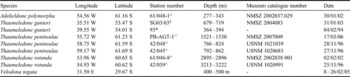
DNA was extracted from a selection of the tissues samples taken (Table I) and used in molecular sequence analysis. The DNA extraction protocol followed that of Taggart et al. (Reference Taggart, Hynes, Prodöhl and Ferguson1992). Briefly, 375 µl of 0.2M EDTA, 0.5% sodium lauroylsarcosine (pH 8.0) and 10 µl proteinase K (20 mg ml-1) were added to the tissue sample (~0.1 g) and incubated overnight at 55°C. The following day 10 µl RNAse (20 mg ml-1) was added to each tube and incubated for 1 hour at 37°C. The solution was extracted once with phenol and once with chloroform:isoamyl alcohol (99:1). DNA was precipitated using 3 volumes of 92% ethanol and then washed overnight in 70% ethanol before being resuspended in 30 µl of sterile TE (pH 8.0) and stored at 4°C.
Cephalopod tissue samples used in this study.

* = MV Cordella, ^ = RV Polarstern, § = RV Dorada, < = RV James Clark Ross.
Primers for five mitochondrial genes (12S rDNA, 16S rDNA, COI, COIII, cytochrome oxidase b) were taken from the literature (Simon et al. Reference Simon, Paabo, Kocher, Wilson, Clegg and O'Brian1990, Reference Simon, Franke, Martin, Hewitt, Johnston and Young1991, Reference Simon, Frati, Beckenback, Crespi, Liu and Flook1994, Folmer et al. Reference Folmer, Black, Hoeh, Lutz and Vrijenhoek1994, Strugnell et al. Reference Strugnell, Norman, Drummond and Cooper2004, Guzik et al. Reference Guzik, Norman and Crozier2005) with the 12S rDNA and COI primers modified slightly to match cephalopod sequences on GenBank. Primers used for the nuclear gene, rhodopsin, were designed in the conserved regions of cephalopod and invertebrate sequences of this gene present on GenBank and are available from the authors on request.
PCR reactions were carried out in 25 µl volumes. Thermal cycling conditions consisted of a denaturation step at 94°C for 2 min, followed by 35 cycles at 94°C for 40 sec, 50°C for 40 sec, and 72°C for 90 sec. A final extension step of 72°C for 10 min was added in each case. Annealing temperatures varied according to the primers used and are available from the authors on request. Amplified products were purified using the QiaGen PCR purification kit (QiaGen Ltd., UK) following manufacturers instructions. Purified PCR products were commercially sequenced by Macrogen Inc (Korea) in both directions using the same primers used for PCR amplification.
DNA sequences were compiled and aligned by eye in Se-Al v2.0a11 Carbon (Rambaut Reference Rambaut2002). It was necessary to introduce gaps to align sequences of 12S rDNA, 16S rDNA and rhodopsin. The sequence data for each gene were concatenated into a single dataset. Of the 2612 characters used in the analysis, 350 (13.4%) were found to be variable.
PAUP v4.0b10 (Swofford Reference Swofford1998) was used to perform full heuristic searches. Starting trees were generated by neighbour joining (NJ) (Saitou & Nei Reference Saitou and Nei1987). A GTR (Γ+I) likelihood model incorporating rate heterogeneity (six rate categories) was used. Branch swapping was performed using TBR (tree-bisection-reconnection). Parameters were then re-estimated and finally branch swapping was performed using NNI (nearest-neighbour interchange). Substitution model parameter values were A = 0.33, C = 0.14, G = 0.14, T = 0.39, A↔C = 2.21, A↔G = 13.54, A↔T = 4.69, C↔G = 1.56, C↔T = 23.36 G↔T = 1.00, I = 0.71, Γ = 3.72. ML bootstrap values of clade support were generated using the above parameters using 1000 replicates.
MrBayes v3.1.2 (Ronquist & Huelsenbeck Reference Ronquist and Huelsenbeck2003) was used to calculate marginal posterior probabilities using the GTR+I+Γ model of nucleotide substitution for each partition. Model parameter values were treated as unknown and were estimated in each analysis. Random starting trees were used and analyses were run 1 million generations, sampling the Markov chain every 100 generations. The analysis was performed twice, in each case starting from a different random tree to ensure the analyses were not trapped in a local optima.
The program Tracer v1.3 (Rambaut & Drummond Reference Rambaut and Drummond2003) was used to ensure that the Markov chains had reached stationarity and to also determine the correct ‘burn-in’ for the analysis (i.e. the number of initial generations that must be discarded before stationarity is reached).
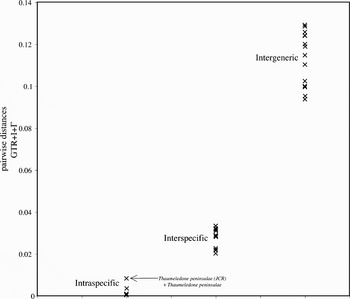
Pairwise distances were calculated using the values for GTR+I+Γ calculated during the maximum likelihood analysis using PAUP v4.0b10 (Swofford Reference Swofford1998) and were separated into three categories: 1) difference among individuals in the same species, 2) differences among species in the same genus (not including intraspecific differences), 3) differences among species in different genera. For each of these categories, values were plotted against the proportion pairwise distance.
Results
Morphological analysis
The recently captured specimen of T. peninsulae caught from the RRS James Clark Ross (NMSZ 2007009) from the Powell Basin region is a mature male (dorsal mantle length 47 mm, total length 110 mm) and has been well preserved. The arms are approximately equal in length (c. 60 mm each) and width (6 mm). The suckers are small (3 mm) with c. 33 suckers on each arm. The web depth per sector ranges from 22–31 mm. The funnel organ is VV shaped. Gills are 8–9 mm in length and have 5–6 lamellae per demibranch. The third right arm is hectocotylised and is slightly shorter than its opposite number (52 mm) with 22 suckers. The hectocotylus is club-like in appearance. The ligula is 7 mm in length and the calamus is 4 mm. The reproductive system contained three large spermatophores, one of which was measured (55 mm).
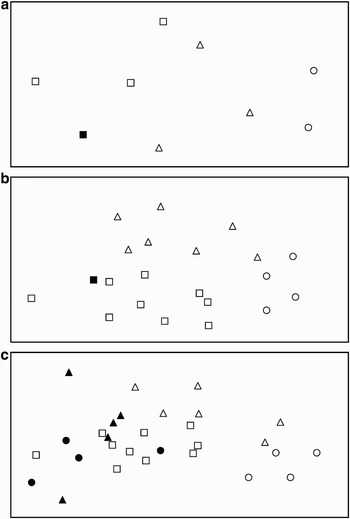
Multivariate combinations of morphological variables can apparently distinguish among Southern Ocean species of Thaumeledone (Fig. 2a & b). When data were maximized for variables (Fig. 2a), the newly captured T. peninsulae appears to be slightly separated from other T. peninsulae specimens. When data were maximized for number of individuals (Fig 2b), the newly captured T. peninsulae is on the edge of the T. peninsulae cluster, but clearly still within this grouping. There are insufficient data points to give significant pairwise differences between species when only males are included, however ANOSIM reveals significant pairwise differences between all species pairs in the dataset maximized for number of individuals. A distance matrix based on these pairwise differences showed no significant congruence with a matrix based on genetic distance (test statistic rho = -0.5, P = 0.845).
a. MDS ordination based on 16 counts and morphometric indices from mature male specimens. b. MDS ordination based on 11 morphometric indices from male and female specimens of a range of maturities. c. MDS ordination based on 11 morphometric indices from male and female specimens of a range of maturities. □ = Thaumeledone peninsulae, ■ = T. peninsulae specimen from the Powell Basin, Δ = T. gunteri, ○ = T. rotunda, • = T. zeiss, ▴ = T. marshalli.

Multivariate combinations of morphological variables do not appear to distinguish between all Thaumeledone species once the New Zealand species are included (Fig. 2c). Although the global ANOSIM test statistic is significant (global test statistic = 0.499, P < 0.001), pairwise tests show that there are no significant differences between T. peninsulae and T. zeiss (test statistic = 0.175, P = 0.126), between T. peninsulae and T. marshalli (test statistic = 0.23, P = 0.081) and between T. marshalli and T. zeiss (test statistic = 0.125, P = 0.159). All other pairwise comparisons are significant.
Molecular analysis
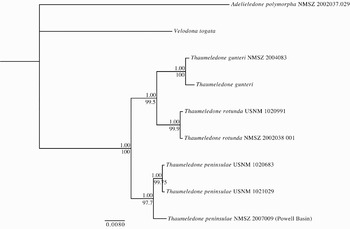
Sequences generated in this study are available from GenBank under accession numbers EU086512-086515, EU071456-071459, EU071438-071440, EU071432-071434, EU071445-071447, EU071443, AF299266, AY557521, EF102113, EF102215, EF102194, EF102173, EF102153 and EU148453-EU148478. The phylogenetic tree is rooted using Adelieledone polymorpha (Robson 1930) as additional phylogenetic analyses also containing the species, Vampyroteuthis infernalis Chun, 1903, Octopus vulgaris Cuvier, 1797 and Enteroctopus dofleini Wülker, 1910, found Adelieledone to be basal to Thaumeledone (data not shown). Furthermore, previous phylogenetic studies (Carlini et al. Reference Carlini, Young and Vecchione2001, Strugnell et al. Reference Strugnell, Norman, Drummond and Cooper2004) have confirmed the basal position of Adelieledone. All relationships within the phylogenetic tree are highly supported by Bayesian posterior probabilities (PP) and maximum likelihood bootstrap (BS) values (Fig. 3). Velodona togata is basal to the Thaumeledone clade. The Thaumeledone species are divided into two clades (PP = 1.00, BS = 1.00). The first of these clades is highly supported (PP = 1.00, BS = 99.5) and comprises a sister taxa relationship between T. gunteri and T. rotunda.
Bayesian analysis tree depicting the phylogenetic relationship of five species (nine individuals) of Octopoda. The analysis employed five mitochondrial (12S rDNA, 16S rDNA, COI, COIII, cytochrome oxidase b) and one nuclear gene (rhodopsin). Bayesian support values are indicated above the nodes, maximum likelihood bootstrap values are indicated below the nodes.

The second clade contains a sister taxa relationship between two T. peninsulae individuals (USNM 1020683, USNM 1021039) from off the South Shetland Islands (PP = 1.00, BS = 99.75) and the T. peninsulae individual (NMSZ 2007009) from the Powell Basin (PP = 1.00, BS = 97.7).
Proportional pairwise comparisons (GTR+I+Γ) between genera were markedly higher (0.094–0.130) than comparisons of species within genera (0.020–0.033). Intraspecific pairwise comparisons ranged from 0.0006 within T. rotunda to 0.008 for comparisons between T. peninsulae from off the South Shetland Islands and the T. peninsulae individual from the Powell Basin (Fig. 4).
Pairwise distances (GTR+I+Γ) among five species and nine individuals of Antarctic octopods.

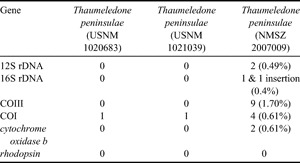
Molecular sequences for five of the six gene fragments sequenced were identical between the two T. peninsulae individuals from off the South Shetland Islands (Table II). These two individuals differed only in one base pair in the gene COI. Interestingly, these two T. peninsulae individuals possessed some sequence difference from the T. peninsulae individual from the Powell Basin for each of the five mitochondrial genes, ranging from 0.4% sequence difference for 16S rDNA to 1.7% difference for COIII. For COI the difference was 0.61% or four base pairs. The molecular sequence of the nuclear gene rhodopsin was identical among all three T. peninsulae individuals.
Nucleotide differences between individuals of T. peninsulae (percentage difference is shown in brackets).

Discussion
This study provides the first molecular phylogenetic analysis of the genus Thaumeledone. All relationships within the phylogeny are highly supported. The sister taxa relationship of T. gunteri and T. rotunda is intriguing. Allcock et al. (Reference Allcock, Collins, Piatkowski and Vecchione2004) suggested a close phylogenetic relationship between T. peninsulae and T. gunteri, citing the shared features of large irregular papillae covering the body surface, similar arm and web formulae, a similar funnel organ and loop in the rectum. Furthermore, T. peninsulae and T. gunteri have been previously captured from relatively close geographical locations and from similar depths. In contrast, T. rotunda is known from significantly deeper waters and is thought to be circumpolar in distribution. It also differs morphologically from the other two species in a number of features including the possession of a W shaped funnel organ, no loop in the rectum and notably smaller posterior salivary glands (Allcock et al. Reference Allcock, Collins, Piatkowski and Vecchione2004). When discussing unpublished T. brevis records from the Southern Ocean (i.e. T. rotunda using the latest taxonomic revision), Voss (Reference Voss, Clarke and Trueman1988) stated ‘T. gunteri is probably a synonym’. However, the morphology of these species differs widely (see Allcock et al. Reference Allcock, Collins, Piatkowski and Vecchione2004) and there is no evidence that Voss had examined the type material. At that time T. gunteri was known only from type material.
Despite some morphological similarities between T. peninsulae and T. gunteri, the molecular phylogenetics show a close sister taxa relationship between T. gunteri and T. rotunda. This suggests that at least some of the morphological features unique to T. rotunda may have evolved in conjunction with its distribution in deeper waters. For example the reduction in posterior salivary gland size (associated with paralysis of prey) may be due to the greater propensity of small and soft bodied prey items in the deep sea than in shallower depths (Voss Reference Voss, Clarke and Trueman1988), and thus a reduced requirement for toxic agents to subdue these prey items. Reduction of such features in T. rotunda is consistent with the concept that reductions and losses of characters in many deepwater octopods has occurred convergently (Voight Reference Voight1993).
The amount of sequence divergence between Thaumeledone species (ranging from 2–3.3%) is a relatively small level of congeneric divergence compared to other published studies. For example Moore (Reference Moore1995) found 6.5% average sequence divergence within genera for the gene COI for moths, whilst Hebert et al. (Reference Hebert, Stoeckle, Zemlack and Francis2004) reported 7.93% average divergence within genera for birds. However, the congeneric divergence of Thaumeledone is consistent with other Southern Ocean octopodid genera, with the genus Pareledone possessing a 1–2% sequence divergence (Allcock et al. Reference Allcock, Strugnell, Prodöhl, Piatkowski and Vecchione2007).
That differences were seen in the sequences of COI however, is worthy of comment. The gene COI has been chosen as the DNA barcoding marker. If sequence differences commonly occur in this gene in species with restricted larval dispersal, it may prove less than ideal for this purpose. Only further sequencing of individuals drawn from several populations of such species will reveal the suitability of COI as a barcoding marker for Thaumeledone.
A number of other taxa in the Southern Ocean have been reported to have undergone a recent radiation, for example groups of notothenoioid fish, (e.g. Trematomus), isopods, amphipods, pycnogonids and ascidians (see Rogers Reference Rogers2007 for a review). It has been suggested that much of this diversification may have occurred as recently as the last 100 000 years and has resulted from climatic changes associated with expansion and contraction of ice sheets generating cycles of population fragmentation, allopatric speciation and secondary contact (Rogers Reference Rogers2007).
The phylogenetic tree and the plot of pairwise comparisons shows a clear difference is present between the T. peninsulae specimens from off the South Shetland Islands and the T. peninsulae individual from the Powell Basin. The overall percentage sequence difference between the Powell Basin specimen and those from off the South Shetland Islands is greater than that between other intraspecific comparisons but is less than the interspecific comparisons. It is also notable that the overall pairwise sequence divergence among these three specimens (0.8%) is greater than average intraspecific sequence differences observed for other species (e.g. moths 0.25%, Moore Reference Moore1995). However, we believe these differences to be due to population level divergence and we do not believe that the differences observed are great enough to warrant erecting a new species. The morphological evidence mirrors the molecular genetic evidence. Although the MDS plots place the Powell Basin T. peninsulae (NMSZ 2007009) on the edge of the T. peninsulae cluster, (particularly when maximized for variables), this specimen is still within the T. peninsulae grouping. That it appears slightly more distinct in Fig. 2a could potentially be attributed to slightly greater differences between the male characters used in this analysis. However, additional analysis (not shown) indicates that including more specimens simply extends the spread of the cluster and the Powell Basin specimen therefore appears to be slightly less peripheral in Fig. 2b.
Differences between populations might be expected over these geographic distances in this species. T. peninsulae is known to produce large eggs (13 mm reported by Allcock et al. Reference Allcock, Collins, Piatkowski and Vecchione2004) and it is likely that they produce demersal, crawl away young (Hochberg et al. Reference Hochberg, Nixon, Toll, Sweeny, Roper, Mangold, Clarke and Boletzky1992) which have limited dispersal capabilities. Given that the Powell Basin specimen was captured 300 nautical miles to the east of the other T. peninsulae specimens, it is likely that the differences observed reflect a relatively small amount of genetic mixing between these two locations.
Obtaining additional DNA specimens of the two New Zealand species of Thaumledone, T. marshalli and T. zeiss will greatly aid in our understanding of the evolutionary history of the genus. Morphometric analysis fails to separate the two New Zealand species from one another and from T. peninsulae and it is unlikely that such data would prove phylogenetically useful, even if they provided separation among species, since there was no congruence between morphological and molecular matrices for the Southern Ocean species. Codeable morphological characters are scarce and many (e.g. the size of the salivary glands) seem to reflect environmental influences (e.g. habitat depth) rather than evolutionary history. The addition of molecular sequences for these taxa is therefore essential to determine the origins and the genetic divergence within the genus. Bearing in mind the population level differences seen over relatively small distances in this study, it is also likely that future trawling efforts in the Southern Ocean, particularly on the slope waters of sub-Antarctic islands, will discover further species of Thaumeledone.
Acknowledgements
We would like to thank the organisers and leaders of all the cruises we took part in to collect these specimens, particularly Wolf Arntz, Gerhard Kattner, Karl Herman Koch, Angelika Brandt and Katrin Linse. The Alfred Wegener Institute kindly provided sea time aboard RV Polarstern, and the British Antarctic Survey kindly provided sea time aboard RRS James Clark Ross. The South Georgia Government, the British Antarctic Survey and MRAG kindly facilitated collections during the South Georgia Fish Surveys. We would also like to thank the Captain and crew of the Polarstern, James Clark Ross, the Dorada and the Cordella. Amelia MacLellan (BMNH), Mike Vecchione (USNM) and Sankurie Pye (NMSZ) kindly facilitated access to type material and registration of new material. JS is supported by a Natural Environment Research Council Antarctic Funding Initiative grant (NE/C506321/1) awarded to LA. This work is a contribution to the Census of Antarctic Marine Life (CAML), Evolution and Biodiversity in the Antarctic: the Response of Life to Change (EBA) (Scientific Committee on Antarctic Research) and the International Polar Year (IPY). It is ANDEEP publication number 91 and CAML publication number 8.