


Introduction
Auditory verbal hallucinations (AVHs) can be defined as a sensory experience in the absence of any external stimulation, whilst in a fully conscious state (Beck and Rector, Reference Beck and Rector2003). AVHs are most commonly experienced as voice-hearing, with the two terms used interchangeably. AVHs are typically associated with psychotic disorders (Waters et al., Reference Waters, Allen, Aleman, Fernyhough, Woodward, Badcock and Laroi2012); however, there is evidence to suggest that they occur within the general population (Linscott and van Os, Reference Linscott and van Os2013) and by individuals diagnosed with other mental health difficulties (Kingdon et al., Reference Kingdon, Ashcroft, Bhandari, Gleeson, Warikoo, Symons and Mehta2010). Some individuals experience AVHs as extremely distressing and disabling. Conversely, others report feeling reassured and may therefore seek contact with their voices (Chadwick and Birchwood, Reference Chadwick and Birchwood1994).
Cognitive models of AVHs suggest that the types of appraisals and beliefs about voices influence the level of reported distress and disability. In particular, explanatory beliefs about voice intent (i.e. malevolent or benevolent) and voice power (i.e. omnipotence), as well as metacognitive beliefs about the self-related implications of voice-hearing, have been proposed as key mechanisms in understanding the development and maintenance of voices. Chadwick and Birchwood (Reference Chadwick and Birchwood1994) proposed that it is an individual’s appraisal of voice intent and resulting beliefs about voices that mediate voice-related distress and predict behavioural responses to voice-hearing (e.g. compliance with AVHs). The model proposed by Morrison et al. (Reference Morrison, Haddock and Tarrier1995) highlights the central position of metacognitive beliefs about the voice-hearing experience. In particular, Morrison et al. (Reference Morrison, Wells and Nothard2002) suggested that positive beliefs held about the value of AVHs (e.g. ‘they make me special’) may be associated with the maintenance of hallucinatory experiences. Self-related negative appraisals of AVHs as a threat to the physical or psychological integrity of the individual are associated with increased distress (Morrison, Reference Morrison1998; Morrison, Reference Morrison2001). Research has also found associations between voice content and beliefs about voices. In particular, where voice content was positive individuals appraised their voices as benevolent, whereas malevolent appraisals were made where voice content was negative (Close and Garety, Reference Close and Garety1998; van der Gaag et al., Reference van der Gaag, Hageman and Birchwood2003).
Whilst beliefs about voices are important mediators of the affective, cognitive and behavioural response to AVHs, it is evident that these beliefs involve the hearer making interpretations beyond the content of the voice alone (Close and Garety, Reference Close and Garety1998). Within cognitive models of AVHs it is suggested that the formation of such beliefs is shaped by more generalised cognitive representations of the self (e.g. ‘I am worthless’) and others (e.g. ‘others are hostile’), referred to as schemas. Researchers suggest that early adversity may create an enduring cognitive vulnerability, characterised by negative schemas, which contribute to the development and maintenance of AVHs (Garety et al., Reference Garety, Kuipers, Fowler, Freeman and Bebbington2001; Garety et al., Reference Garety, Bebbington, Fowler, Freeman and Kuipers2007). As such, self and other-schema have been deemed important cognitive mechanisms when explaining the formation of beliefs about voices.
In a sample of 34 voice-hearing participants with diagnoses of schizophrenia or schizoaffective disorder, Thomas et al. (Reference Thomas, Farhall and Shawyer2015) reported that schemas significantly predicted malevolent, omnipotent, metaphysical, loss of control, and positive beliefs about voices. After controlling for negative voice content, schemas were estimated to predict between 9 and 35% of the variance in the six measured beliefs about voices, with negative-self schema being the strongest predictor. As such, schemas, particularly those regarding the self, may be important mechanisms in the development of a range of clinically relevant beliefs about voices.
Given the emerging evidence to indicate an association between beliefs about voices and self and other-schema, it might be expected that schemas may also influence the way an individual relates to their voice. There is evidence that the hearer’s relationship with their voice mirrors wider patterns of social relating (Hayward, Reference Hayward2003), thus conceptualising the experience of voice-hearing as a person-like stimulus that the hearer has a relationship with, rather than simply a perceptual experience (Hayward et al., Reference Hayward, Berry and Ashton2011). Birtchnell (Reference Birtchnell1996, Reference Birtchnell2002) proposed that individuals relate to their voice along two dimensions: proximity and power. Proximity is represented by the distance and degree of intimacy between the hearer and their voice, whilst power is represented by the amount of influence one has over another. Early research indicated that where voice-hearers experienced powerless and inferiority in social relationships, they felt powerless and subordinate relative to their voice (Birchwood et al., Reference Birchwood, Meaden, Trower, Gilbert and Plaistow2000; Birchwood et al., Reference Birchwood, Gilbert, Gilbert, Trower, Meaden, Hay, Murray and Miles2004; Gilbert et al., Reference Gilbert, Birchwood, Gilbert, Trower, Hay, Murray, Meaden, Olsen and Miles2001).
Voice-hearing has been understood as an experience that involves ‘interrelating’; a combination of the hearer relating to their voice and being related to by their voice (Hayward, Reference Hayward2003). To measure interrelating, the Voice and You (VAY; Hayward et al., Reference Hayward, Denney, Vaughan and Fowler2008) self-report questionnaire was developed, which assesses the hearer’s perception of the relating of their voice (i.e. as dominant or intrusive) and how the hearer relates to their voice (i.e. from a position of distance or dependence). Empirical findings highlight specific associations between each of the VAY relating subscales and distress (Sorrell et al., Reference Sorrell, Hayward and Meddings2010). Individuals who perceived their voice to relate more dominantly, intrusively, and therefore related to their voice from a distance, reported higher levels of distress. These associations, however, were not independent of appraisals of voice malevolence and omnipotence, possibly suggesting that these beliefs were influencing the strength of the reported associations. Perhaps intuitively, those who related to their voice more dependently were least distressed by their voice-hearing experience (Sorrell et al., Reference Sorrell, Hayward and Meddings2010).
To date, there is no known empirical evidence exploring potential associations between core schemas and the relationship between the hearer and their voice. Based on the available research, it is reasonable to predict that an individual who holds increased negative schemas about others (e.g. believing others to be hostile or bad) may perceive their voice as relating to them through a similar lens. Additionally, it is reasonable to expect that the position from which the hearer relates to their voice (e.g. distance) is influenced by schemas about themselves (e.g. believing one’s self to be worthless or weak).
The primary aim of the current study was to determine associations between schemas and beliefs about voices. Hypotheses were made with the aim of testing the preliminary findings reported by Thomas et al. (Reference Thomas, Farhall and Shawyer2015). The current study also explored potential associations between schemas and the perceived relationship between the hearer and their predominant voice. Specifically, the following hypotheses were tested:
Hypothesis 1: Negative beliefs about voices (i.e. malevolent, omnipotent, metaphysical, and loss of control subscales) will be associated with negative-self schema; malevolent and loss of control beliefs will be associated with negative-other schema; and positive beliefs will be associated with positive-self schema.
Hypothesis 2: Schema scales will predict beliefs about voices, after controlling for the amount and degree of negative voice content.
Hypothesis 3: Voice dominance and intrusiveness will be associated with negative-other schema.
Hypothesis 4: Hearer distance and dependence will be associated with negative-self schema.
Method
Participants
Correlational analyses effect sizes reported by Thomas et al. (Reference Thomas, Farhall and Shawyer2015) ranged from medium (r = .38) to large (r = .57). We primarily based our power analyses on our correlation tests, which indicated for the current study that to have 80% power (α = .05), 21 participants were required for detecting large effect sizes equivalent to r = .57, and 52 participants were required for detecting medium effect sizes equivalent to r = .38. Note that for a power analysis based on our linear regression tests (80% power, α = .05) with six predictors, 46 participants were required for detecting large effect sizes equivalent to f 2 = 0.35, and 98 participants were required for detecting medium effect sizes equivalent to f 2 = 0.15.
A total of 44 participants were recruited from adult community, acute adult in-patient, early intervention in psychosis, and child and adolescent mental health services across rural and urban areas of North Wales. Eligible participants were: (a) aged 16 years and above; (b) currently experiencing AVHs; (c) had a history of voice-hearing of at least 1 year; and (d) sufficient literacy and cognitive ability to complete self-report questionnaires.
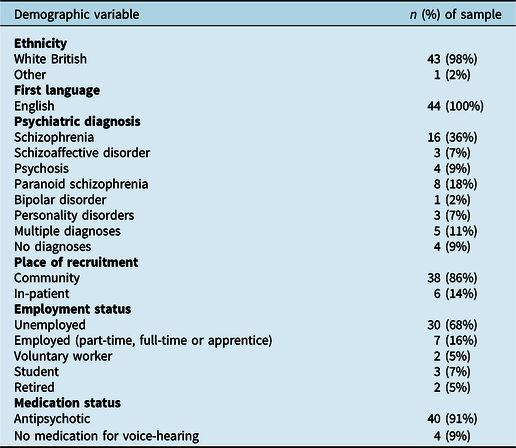
Six (14%) participants were recruited from in-patient services and 38 (86%) from community teams. Nine (21%) participants were in paid or voluntary employment and 22 (50%) were male. Participants reported hearing voicesFootnote 1 for between 1 and 52 years (mean = 13.45, SD = 11.84) and the overall mean age for the sample was 38.9 years (SD = 14.57). Demographic characteristics are provided in Table 1.
Participant demographics

n = 44; percentages are rounded and may not total 100%.
Procedure
Health board and university ethical approval was obtained. Local clinicians were informed of the research, and individuals who met the eligibility criteria were approached during routine clinical appointments. Interested participants returned the initial contact form to the first author or informed their treating clinician if they wished to take part. Once written consent was given, questionnaire measures were administered during one appointment.
Measures
The Psychotic Symptom Rating Scales-Auditory Hallucinations Subscale (PSYRATS; Haddock et al., Reference Haddock, McCarron, Tarrier and Farragher1999)
The PSYRATS is a widely used 11-item clinician-rated scale that measured the severity of different dimensions of participants’ voice-hearing experience (e.g. frequency, content, distress). Participants rated their experience over the previous week on a 5-point scale of increasing severity (0–4). The PSYRATS has good psychometric properties (Drake et al., Reference Drake, Haddock, Tarrier, Bentall and Lewis2007; Haddock et al., Reference Haddock, McCarron, Tarrier and Farragher1999).
The Interpretation of Voices Inventory (IVI; Morrison et al., Reference Morrison, Wells and Nothard2002)
The IVI is a 26-item self-report questionnaire that assessed metacognitive beliefs about voices. Three subscales are derived, reflecting three beliefs about voices: negative metaphysical beliefs (e.g. ‘they mean I have done something bad’), loss of control beliefs (e.g. ‘they will make me go crazy’), and positive beliefs (e.g. ‘they make me important’). Participants rated their agreement with each item on a 4-point scale (1–4) ranging from ‘not at all’ to ‘very much’. The IVI has shown good test–re-test reliability (coefficients ranged from 0.73 to 0.84) and internal consistency (Cronbach’s α all ≥0.80; Morrison et al., Reference Morrison, Wells and Nothard2002).
The Revised Beliefs about Voices Questionnaire (BAVQ-R; Chadwick et al., Reference Chadwick, Lees and Birchwood2000)
The BAVQ-R is a 35-item self-report questionnaire that was used to measure beliefs about voices. Three subscales are derived: malevolence (e.g. ‘my voice is punishing me for something I have done’), benevolence (e.g. ‘my voice wants to protect me’), and omnipotence (e.g. ‘my voice seems to know everything about me’). Participants rated items on a 4-point scale (0–3) ranging from ‘disagree’ to ‘strongly agree’. The measure has good psychometric properties with Cronbach’s α for each subscale ≥0.74 (Chadwick et al., Reference Chadwick, Lees and Birchwood2000).
The Voice and You (VAY; Hayward et al., Reference Hayward, Denney, Vaughan and Fowler2008)
The VAY is a 29-item self-report questionnaire that assessed participants’ interrelating with their predominant voice. Four subscale scores are derived: two concerning the hearer’s perception of the relating of the voice (‘voice dominance’ and ‘voice intrusiveness’) and two concerning the relating of the hearer (‘hearer distance’ and ‘hearer dependence’). Participants rated items on a 4-point scale (0–3) ranging from ‘rarely true’ to ‘nearly always true’, with higher scores indicating a greater tendency to relate negatively from that position. The subscales have shown good internal consistency (Cronbach’s α all ≥0.78) and test–re-test reliability (coefficients ranged from 0.72 to 0.91; Hayward et al., Reference Hayward, Denney, Vaughan and Fowler2008).
The Brief Core Schema Scales (BCSS; Fowler et al., Reference Fowler, Freeman, Smith, Kuipers, Bebbington, Bashforth and Garety2006)
The BCSS is a self-report questionnaire that was used to assess self and other-schema. The measure includes 24 items rated on a on a 5-point rating scale (0–4). Four subscale scores are obtained relating to negative and positive self (e.g. ‘I am vulnerable’; ‘I am successful’) and other (e.g. ‘other people are devious’; ‘other people are supportive’) schema. The potential range of scores for each subscale is 0–24; higher scores represent greater endorsement of a particular schema. The BCSS has shown good internal consistency (Cronbach’s α all ≥0.78) and construct validity across both psychosis and high-risk samples (Addington and Tran, Reference Addington and Tran2009; Fowler et al., Reference Fowler, Freeman, Smith, Kuipers, Bebbington, Bashforth and Garety2006).
Data analysis
Statistical analyses were performed with IBM SPSS version 25 (IBM Corporation, 2017). The distributions of all continuous demographic and clinical variables were assessed for normality using the Shapiro–Wilk test and visual inspection of Q–Q plots. The majority of variablesFootnote 2 were non-normally distributed. Following square, square root and bimodal transformations as appropriate, the variables remained non-normal and therefore the non-transformed variables were selected for all subsequent analyses.
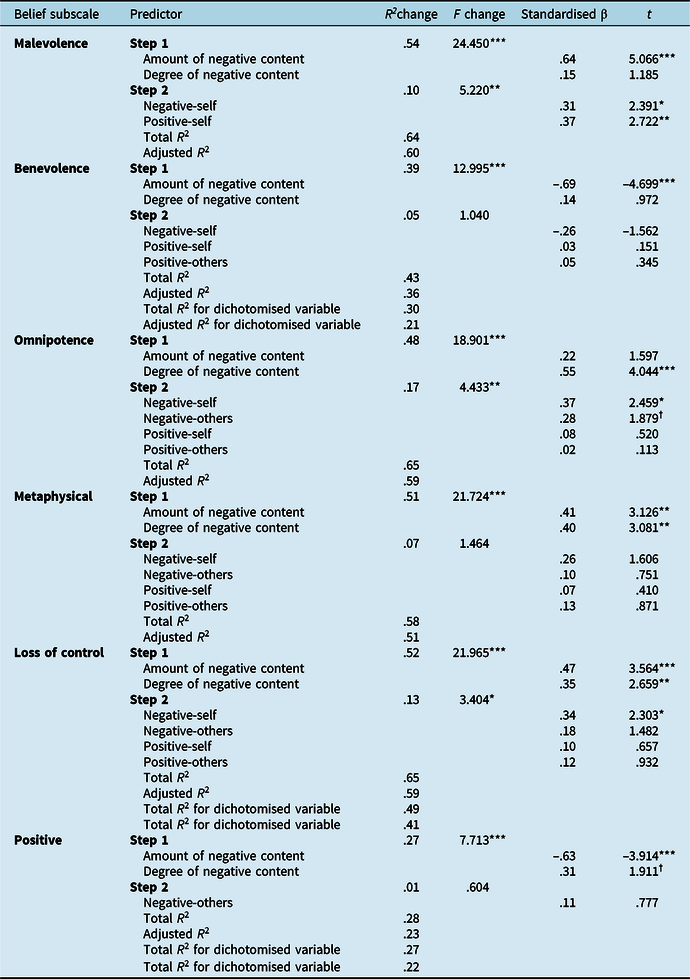
To test Hypotheses 1, 3 and 4, Spearman’s rho correlational analyses examined associations between beliefs about voices, negative voice content (amount and degree), schema subscales, and relating subscales. To test Hypothesis 2, a series of hierarchical regression analyses were conducted for each of the six beliefs about voices. In each analysis the two negative voice content variables measured on the PSYRATS were entered as predictors in step 1 and the schema scales identified as holding a bivariate correlation with that belief at p≤.10 (see Table 3) were entered as predictors in step 2. For each regression analysis the data were screened for multicollinearity (no predictor variables were intercorrelated r > .9), normality, linearity and homoscedasticity. Heteroscedasticity was observed for the benevolence subscale, whilst loss of control and positive beliefs were non-normally distributed. These variables were therefore recoded using a median split and the regressions re-run using the recoded variables. Based upon the existing literature suggesting associations between beliefs about voices and associated distress (e.g. Chadwick and Birchwood, Reference Chadwick and Birchwood1994; Morrison et al., Reference Morrison, Nothard, Bowe and Wells2004), regressions were re-run to examine whether the inclusion of these potential confounding variables (i.e. PSYRATS amount and intensity of distress) changed the pattern of results.
Results
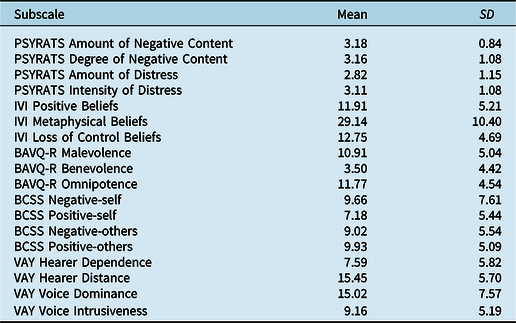
The mean scores and standard deviations for each of the main measures are presented in Table 2. High rates of endorsement of negative-self and other-schema were observed, similar to those reported by Fowler et al. (Reference Fowler, Freeman, Smith, Kuipers, Bebbington, Bashforth and Garety2006).
Mean scores on the main measures

n = 44; PSYRATS, Psychotic Symptoms Rating Scales; IVI, Interpretation of Voices Inventory; BAVQ-R, Revised Beliefs about Voices Questionnaire; BCSS, Brief Core Schema Scales; VAY, the Voice and You.
Hypothesis 1
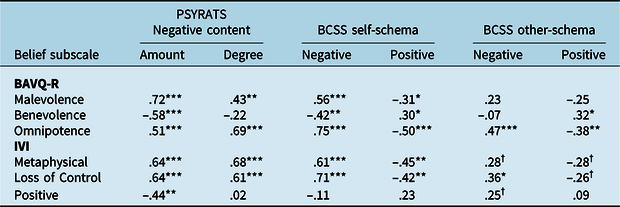
Correlations between beliefs about voices and schema scales were analysed (see Table 3). Five of the beliefs showed significant correlations with one or more of the schema scales, with the exception of positive beliefs about voices. As predicted, all four negative beliefs about voices were associated with negative self-schema and loss of control beliefs were associated with negative-other schema. Contrary to our predictions, the malevolence scale was unrelated to negative-other schema, whilst positive beliefs were unrelated to positive-self schema.
Significant relationships were also found between schemas and beliefs about voices that had not been predicted. In particular, the benevolence subscale was associated with positive-self and other-schema, and showed a negative association with negative-self schema. All four negative beliefs about voices correlated negatively with positive-self schema. The omnipotence subscale was associated with negative-other schema and showed a negative relationship with positive-other schema. All six beliefs about voices were associated with either the amount and/or degree of negative voice content (see Table 3).
Correlational analyses between beliefs about voices, negative voice content, and schema scales
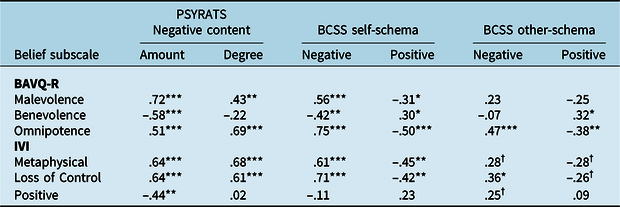
n = 44; †p ≤ .10; *p ≤ .05; **p ≤ .01; ***p ≤ .001. Note that a Bonferroni correction for multiple correlations (n comparisons = 36) would lead to a significance criterion of 0.0014; therefore, if applying this correction, only those correlations marked *** would be deemed significant. PSYRATS, Psychotic Symptoms Rating Scales; IVI, Interpretation of Voices Inventory; BAVQ-R, Revised Beliefs about Voices Questionnaire; BCSS, Brief Core Schema Scales.
Hypothesis 2
To examine the degree to which negative voice content and schemas predicted beliefs about voices, including after controlling for negative voice content, a series of hierarchical linear regressions were conducted. The amount and degree of negative voice content PSYRATS variables were entered as a first step, and the schema scales identified as correlated with that belief as a second step (see Table 4). Although the regressions using the dichotomised data were slightly less predictive (see Table 4), the differences were modest and therefore the regression results reported in text are based on the non-dichotomised variables. The estimated proportion of variance explained by negative voice content alone ranged from 27 to 54%. Entering schemas in the second step explained statistically significant additional variance for three of the six beliefs, namely malevolent, omnipotent, and loss of control beliefs. The estimated proportion of additional variance explained by schemas ranged from 1 to 17%, with the total variance explained by negative voice content and schemas combined ranging from 28 to 65%.
Hierarchical multiple regression analyses predicting beliefs about voices from negative voice content and schema scales

n = 44; †p ≤ .10; *p ≤ .05; **p ≤ .01; ***p ≤ .001. Note that a Bonferroni correction for several multiple regression tests (n regressions = 6) would lead to a significance criterion of 0.008.
On the basis of the observed bivariate correlations, more than one schema scale was entered as a predictor in five of the beliefs about voices regressions, with positive beliefs being the only exception. For the omnipotence, metaphysical, and loss of control regressions, all four schema scales were entered as predictors. Standardised regression coefficients for each of the schema scales are presented in Table 4. Negative-self schema emerged as an independent predictor for omnipotent and loss of control beliefs. Both negative-self and positive-self schema emerged as independent predictors of malevolent voice appraisals. No schema scale predicted benevolent, metaphysical, or positive beliefs about voices. To control for the effect of voice-related distress, the regressions were re-run including the PSYRATS amount and intensity of distress subscales as covariates. This did not change the pattern of results.
Hypotheses 3 and 4
Correlational analyses examined potential relationships between VAY subscales and schemas. All VAY subscales showed significant relationships with one or more of the schema scales (see Table 5). In line with predictions, the hearer’s perception of their voice relating dominantly and intrusively was associated with negative-other schema, whilst the hearer relating to their voice from a position of distance and dependence was associated with negative-self schema. Further unexpected relationships were also observed. Specifically, voice dominance and intrusiveness were associated with negative-self schema, whilst voice intrusiveness and hearer distance negatively correlated with positive-self and other-schema.
Correlational analyses between relating subscales and schema scales

n = 44; †p ≤ .10; *p ≤ .05; **p ≤ .01; ***p ≤ .001; BCSS, Brief Core Schema Scales; VAY, the Voice and You.
Discussion
The primary study aim was to explore associations between self and other-schema and beliefs about voices, in light of preliminary evidence to suggest that schemas may be important cognitive mechanisms when considering voice appraisals (Thomas et al., Reference Thomas, Farhall and Shawyer2015). Hypothesis 1 predicted a range of relationships between schemas and beliefs about voices and overall, it can be concluded that schemas were relevant when considering all but one of the measured beliefs, with effect sizes ranging from medium to large. The exception, however, was positive beliefs about voices measured by the IVI (Morrison et al., Reference Morrison, Wells and Nothard2002); this insignificant finding contradicted previous research which found that the endorsement of more positive beliefs was associated with elevated positive-self schema (Thomas et al., Reference Thomas, Farhall and Shawyer2015). Overall, the results support cognitive models and suggest that schemas are key in the development of beliefs about voices.
As predicted, the endorsement of increased negative-self schema was associated with having more negatively orientated beliefs about voices, in line with previous findings (Thomas et al., Reference Thomas, Farhall and Shawyer2015). The largest effect sizes were observed between negative-self schema and the omnipotence and loss of control belief subscales. The association between omnipotence and negative-self schema is consistent with earlier findings indicating that the reported power and status differential between the hearer and the voice is associated with appraisals of the hearer’s perception of their power and status in the social world (Birchwood et al., Reference Birchwood, Meaden, Trower, Gilbert and Plaistow2000). The current study showed an additional novel relationship suggesting that those who endorsed increased negative-self schema also held fewer benevolent voice appraisals. Our findings provide further support to conclude that negative-self schemas are relevant when considering beliefs about voices and are elevated in voice-hearers who hold negatively orientated beliefs about voices.
Previous research has indicated that further clarity regarding the role of negative-other schema was desirable as this had not been found to be widely associated with beliefs about voices in comparison with negative-self schema (Thomas et al., Reference Thomas, Farhall and Shawyer2015). Thomas et al. found associations between negative-other schema and both malevolent voice appraisals and loss of control beliefs. In the current study the association with loss of control beliefs was replicated; however, we were unable to replicate the association with malevolence. This is surprising as we might intuitively expect that viewing other people as hostile or untrustworthy would relate to appraisals of malevolence (e.g. perceiving the voice as evil or wanting to cause harm). A novel and significant finding suggests that endorsing more negative-other schema was associated with more omnipotent voice appraisals. These findings potentially create further uncertainty regarding the precise role of negative-other schema in beliefs about voices, and further research is warranted with a larger sample size. Nevertheless, this suggests that negative-other schema may play a role when considering beliefs about voices, although their role with specific beliefs remains unclear.
Findings indicated that the endorsement of increased positive representations of others was significantly associated with more benevolent and fewer omnipotent voice appraisals. This suggests that positive-other schema is important when considering how an individual appraises their voices, in contrast with Thomas et al. (Reference Thomas, Farhall and Shawyer2015) who found no associations between positive-other schema and beliefs about voices. In relation to positive representations of the self, a number of novel findings emerged. In particular, positive-self schemas were associated with benevolent voice appraisals and fewer negatively orientated beliefs. In the current sample, males had more benevolent beliefs and positive-self schema than females, therefore, there may have been a gender effect. This differed from Thomas et al. who found only one significant association between positive-self schema and positive beliefs about voices, which was not replicated in the current study. In sum, this suggests that increased positive-self and other-schema may impact upon the formation of benevolent voice appraisals.
In line with previous studies (e.g. Close and Garety, Reference Close and Garety1998; Smith et al., Reference Smith, Fowler, Freeman, Bebbington, Bashforth, Garety and Kuipers2006; Thomas et al., Reference Thomas, Farhall and Shawyer2015) beliefs about voices were found to be influenced by negative voice content. All the measured beliefs about voices were related to either the amount or degree of negative voice content and a significant proportion of the variance in beliefs was predicted by negative voice content. Contrary to Thomas et al. (Reference Thomas, Farhall and Shawyer2015), there were stronger relationships between the amount of negative content and beliefs about voices with large effect sizes observed, as opposed to the degree of negative content. Thus, the frequency of negative voice content was the strongest predictor of beliefs about voices rather than the degree of negativity. In line with previous research (e.g. Close and Garety, Reference Close and Garety1998; Thomas et al., Reference Thomas, Farhall and Shawyer2015), positive and benevolent beliefs about voices increased when the amount of negative content was lower, suggesting that appraising voices positively is less likely when there is a significant proportion of negative voice content. These findings provide further evidence that negative voice content and beliefs about voices are meaningfully related and controlling for voice content is important for future studies.
Regression analyses were conducted to test Hypothesis 2, which stated that schemas would predict beliefs about voices after controlling for negative voice content. When controlling for the effect of negative voice content, only malevolent, omnipotent, and loss of control beliefs were significantly predicted by schemas. This differed from Thomas et al. (Reference Thomas, Farhall and Shawyer2015) who reported that five of the six beliefs about voices were significantly predicted by schemas when controlling for negative voice content. In the current study both negative and positive-self schema emerged as significant predictors of malevolent voice appraisals, whilst negative-self emerged as a predictor of omnipotent voice appraisals and loss of control beliefs. In sum, schematic beliefs influenced the formation of beliefs about the voice power and control (omnipotence), appraisals of malevolent voice intent and beliefs about loss of control or impending madness (i.e. loss of control beliefs), and these findings were independent of negative voice content. When controlling for associated distress, none of the observed results changed, suggesting that these particular schemas independently predicted beliefs about voices.
The second study aim was to explore associations between schemas and the perceived relationship between the hearer and their predominant voice. To our knowledge, this had not been studied before. Overall, a number of associations were found and Hypotheses 3 and 4 were supported, suggesting that schemas may underlie both the hearer’s relating to their voice and their perception of the voices relating to them. In terms of the relating of the hearer to the voice, relating from a position of distance was associated with elevated negative-self schema and fewer positive-self and other-schema. Participants who rated themselves as more dependent upon their voice showed increased negative-self schema. This finding possibly lends support to research suggesting that voice-hearers who perceive themselves as inferior to others – reflected here in elevated negative-self schema scores – also feel inferior to their voice and therefore relate accordingly (e.g. Birchwood et al., Reference Birchwood, Meaden, Trower, Gilbert and Plaistow2000; Birchwood et al., Reference Birchwood, Gilbert, Gilbert, Trower, Meaden, Hay, Murray and Miles2004; Gilbert et al., Reference Gilbert, Birchwood, Gilbert, Trower, Hay, Murray, Meaden, Olsen and Miles2001). In terms of the hearer’s perception of the relating voice, perceiving their voice to relate dominantly was associated with more negative-self and other-schema, whereas participants who perceived their voice as intrusive had more negative and fewer positive schemas. These findings suggest that schemas guiding interpersonal interactions also govern the relationship between the hearer and their voice. These findings should, however, be interpreted with caution, as three of the VAY subscales showed a similar pattern of relationship with schemas with only hearer dependence showing a distinctive pattern. That is, the pattern of results in this study indicates a more general relationship between negative schema and negative voice experience. It is also possible that the VAY subscales are not measuring distinct constructs. This will require further evaluation in future studies.
Study strengths and limitations
Recruitment took place in in-patient services in addition to community services, and therefore the sample included voice-hearers with a range of levels of disorder accessing mental health treatment. This recruitment method resulted in a representative but heterogeneous sample which possibly reduced external validity.
The cross-sectional design does not allow any changes in schemas and other variables to be assessed over time and it is not possible to infer the direction of causality between variables. It is probable that the use of self-report measures may have led to response bias in participants. Although we controlled for negative voice content and distress, it is possible that other variables contributed to our findings that we did not assess and therefore control for, such as depression, which previous research has concluded is associated with omnipotent and malevolent voice appraisals (Birchwood and Chadwick, Reference Birchwood and Chadwick1997).
Strengths of this study were the increased sample size and power to detect medium to large effect sizes in comparison with previous studies (e.g. Thomas et al., Reference Thomas, Farhall and Shawyer2015). Nevertheless, it is likely that the current study was underpowered to detect small effect sizes due to a slightly smaller sample size than indicated by the power analysis. Participants were recruited from a wide geographical area and gender was well balanced across the sample. In summary, this study has enabled firmer conclusions to be made regarding the role of schemas in the voice-hearing experience and offers important implications for clinical practice and future research.
Suggestions for future research
Schemas have been found to have a mediating role in early adversity and psychotic symptoms (Hardy et al., Reference Hardy, Emsley, Freeman, Bebbington, Garety, Kuipers and Fowler2016); there is therefore potential for a mediating role in beliefs about voices, which our study did not consider. Future research may benefit from utilising a measure of early traumatic experiences and assessing whether schemas mediate the relationship between trauma and voice appraisals.
Given the preliminary evidence to suggest that schemas are associated with beliefs about voices, the evidence base may be enhanced by conducting a pilot intervention study targeting self and other-schema in voice-hearers, as opposed to directly targeting beliefs about voices. Freeman et al. (Reference Freeman, Pugh, Dunn, Evans, Sheaves, Waite and Fowler2014) utilised a cognitive behavioural therapy intervention to target self-schema in individuals with persecutory delusions. Findings evidenced short-term non-significant reductions in negative-self schema, a significant increase in positive-self schema, and non-significant improvements in psychotic symptoms. Freeman and colleagues’ research illustrated the potential of therapeutic intervention and also the difficulty of altering schemas, particularly using a brief intervention. Given that cognitive models of psychosis propose that there may be trauma underlying core schema that requires further therapeutic work (e.g. Garety et al., Reference Garety, Kuipers, Fowler, Freeman and Bebbington2001), to enable psychological intervention to focus on schema a more in-depth and lengthier approach may be more productive and should be a focus of future research.
It may be worthwhile for future studies exploring beliefs about voices to assess for both neutral and positive voice content, which may also contribute to the formation of beliefs about voices and therefore would allow further investigation in relation to schemas. Finally, the studies to date have been cross-sectional and longitudinal designs are preferable to allow insight into how our observed associations may change over time.
Clinical implications
Assessing schemas may assist clinicians in formulating the mechanisms that may be contributing to or maintaining an individual’s voice-hearing experience. Our findings suggest that schemas may be supporting beliefs about voices and therefore may offer a parallel focus of intervention or an alternative intervention target, as opposed to directly challenging voice appraisals. A schema-focused cognitive behavioural therapy approach would enable existing schemas to be evaluated and modified, whilst developing more functional schemas. Our findings suggest that positive schemas underpin benevolent voice appraisals and there are ways of working with voices, such as compassion-focused and acceptance-based therapies, that may be well suited to building positive schema rather than attempting to reduce negative schema (e.g. Mayhew and Gilbert, Reference Mayhew and Gilbert2008; Thomas et al., Reference Thomas, Morris, Farhall, Shawyer, Morris, Johns and Oliver2013).
This study tentatively concludes that the way in which the hearer relates to their predominant voice may reflect underlying schemas. Assessing relating styles may enable individuals to make connections between their voice-hearing experience and their social relationships (Hayward and Fuller, Reference Hayward and Fuller2010). Although therapies have been used to directly modify the relationship between the hearer and their voice (e.g. relating therapy; Birtchnell, Reference Birtchnell2002), our findings support an alternative route to modifying relating, through accessing schemas. This study was, however, the first to directly explore schemas and the relationship between the hearer and the voice, and further studies are necessary prior to suggesting firm changes in clinical practice.
Acknowledgements
This research study was conducted as part of a DClinPsy thesis at Bangor University. The study was therefore supported by the North Wales Clinical Psychology Programme and Betsi Cadwaladr University Health Board, North Wales. The authors thank Dr Chris Saville for statistical input to this research.
Financial support
This research received no specific grant from any funding agency, commercial or not-for-profit sectors.
Conflicts of interest
The authors have no conflicts of interest with respect to this publication.
Ethical statements
The authors have abided by the Ethical Principles of Psychologists and Code of Conduct as set out by the APA. Ethical approval was granted by the School of Psychology Bangor University (2018-16274), and the Betsi Cadwaladr University Health Board Research Ethics Committee and HRA and Health and Care Research Wales (REC reference: 18/WA/0264).




Comments
No Comments have been published for this article.