

This article aims to explain a process of institutional change in national financial systems by focusing on three prominent East Asian emerging markets: South Korea (henceforth Korea), Malaysia and Taiwan. In East Asia, as in many other developing regions, the liberalization and globalization of financial markets in the past two decades have led to the exponential growth of stock markets in traditionally bank-based systems. The increased importance of equity markets has fuelled incentives for industrial firms to resort increasingly to stock markets instead of banking institutions for external financing. The collective outcome of these individual choices has manifested itself in a rapid and sustained shift towards a more market-oriented financial architecture in the region.
However, salient cross-country variations have remained in the key macrostructural dimensions of East Asian national financial systems. More specifically, Korea, Malaysia and Taiwan have differed in the magnitude of equity market growth, as illustrated in Figure 1. Over the past two decades, the size of the Malaysian and Taiwanese stock markets, measured by stock market capitalization to gross domestic product (GDP), has been much larger than that of their Korean counterpart. The Korean stock markets remained virtually stagnant during much of the 1990s; they only came to life in the mid-2000s. Equally importantly, both Korea and Malaysia have had a larger and more robust corporate bond market than Taiwan, as shown in Figure 2. How can these varied patterns of financial market development in East Asia be explained?
Stock Market Capitalization as a Percentage of GDP Source: Author calculations based on data provided in Beck and Al-Husainy (Reference Beck and Al-Hussainy2010).

Private Bond Market Capitalization as a Percentage of GDP Source: Author calculations based on data provided in Beck and Al-Husainy (2010).
The central proposition of this article emphasizes the causal importance of political coalitions in shaping financial market development. An emerging body of scholarship (Carney Reference Carney2010; Gourevitch and Shinn Reference Gourevitch and Shinn2005) has focused on interest group alliances as a primary determinant of financial market structures. These works typically start by modelling the formation of alliances among societal actors who are a priori assumed to have different preferences vis-à-vis financial systems. Which alliances are able to defend or change existing market institutions is contingent upon their respective access to and relative power in policy processes that are in turn defined by broader political structures, such as electoral rules, patterns of interclass conflicts or party systems. While accepting the basic contention of this body of scholarship, this article makes two key claims that depart from the social alliance perspective.
The first claim is that societal actors do not work alone in the formation and change of financial market institutions and must operate through the state to achieve specific policy outcomes. Interest group alliances among farmers, workers or capitalists do not by themselves produce regulatory rules and market changes. State institutions and action not only structure the articulation of societal interests but also shape the translation of these interests into policy processes. More crucially, state agencies make policy choices and formulate reform strategies in line with their own preferences. This point is particularly relevant in East Asia, where the state has been traditionally identified as the crucial source of institutional changes in the political economy. However, this does not imply that the state singularly articulates collective policy preferences in the transformation of market institutions. Rather, it is the dominant coalitions that state elites deliberately forge with key societal actors that impinge decisively on the process of institutional changes.
The second and more important claim is that the emphasis on dominant coalitions should not obscure the dynamics of realignments between state elites, economic policymakers and societal actors. These dynamics are likely to be elided in the conventional assumption that the state and the coalitions that they form with sociopolitical groups are marked by organizational unity and stability. Just as societal groups are often internally divided, so are states ‘fragmented into numerous quarrelling parts’, in the words of Moran (Reference Moran1990). Divisions within societal groups and state agencies suggest that the lines of conflicts and compromises over regulatory and institutional reforms may be drawn not between the integrated state and the unified private sector but between political coalitions of different state agencies and actors and their constituent social allies. Pro-reform politicians and technocrats may be united in coalitions with societal actors with similar policy preferences against other coalitions made up in the same way that benefit from existing rules and institutions. Cross-country variations in financial market changes are thus an important function of the changing composition, policy preferences and relative power of these coalitions.
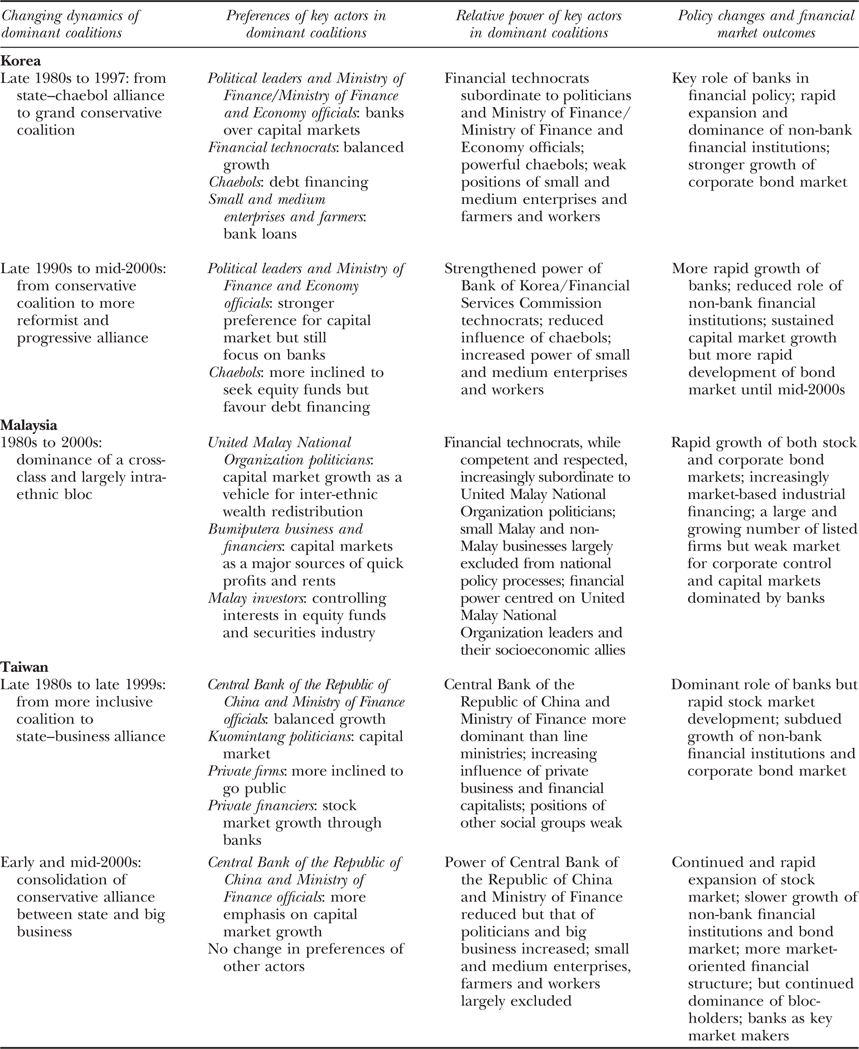
Table 1 summarizes the changing dynamics of the dominant coalition in Korea, Malaysia and Taiwan over the past decades. In Korea, the chaebol–state alliance was transmuted into a much broader coalition against the backdrop of democratization in the 1980s and 1990s. This coalition had a strong pro-bank bias, reflecting the desire of chaebol firms, small industrialists, farmers, powerful industrial bureaucrats and ruling politicians to pursue their policy interests through debt financing (Hundt Reference Hundt2009: 75–80; Laeven Reference Laeven2002). In the decade that followed the Asian crisis of the late 1990s, while market pressures and neoliberal reforms set the stage for the more rapid growth of the stock market, the overall tendency of key actors in the coalition to favour bank-based rules and institutions persisted. The position of small and medium enterprises (SMEs) and labour as crucial counter-chaebol forces became significantly stronger in the dominant coalition. The chaebols, although structured and humbled, remained key development agents. Reform-minded financial technocrats enjoyed moments of rising influence, but industrial bureaucrats were often able to exercise veto authority over financial policy (Kim and Lee Reference Kim and Lee2006). Despite their reformist credentials, political leaders continued to favour the development of banks and bond markets on which they depended for calling the chaebols to account and implementing redistributive schemes.
Dominant Coalitions and Financial Market Structures
In Malaysia, the coalition that had rested on the intersection of race and class in the early post-war period changed after the 1969 racial riots to a cross-class and largely intra-ethnic bloc that centred on politicians of the United Malay National Organization (UMNO), bumiputeraFootnote 1 business and the Malay masses but marginalized Chinese and non-Malay interests (Crouch Reference Crouch1996). Within this coalition, which has reigned supreme to this day, big business that had core interests in property, construction, finance and other industries with short-term horizons and that had arm’s length relations with the manufacturing sector were the champions of stock market growth (Gomez Reference Gomez2004). As government controls over banks were progressively weakened in the 1980s and 1990s, United Malay National Organization leaders increasingly turned to the stock market to widen corporate shareholding among Malay individuals and institutions and helped them to acquire controlling interests in the securities industry (Chin and Jomo Reference Chin and Jomo2001). The ostensible agenda of inter-ethnic redistribution thus promoted sociopolitical elites to develop the capital market vigorously to ensure ‘indigenous’ dominance in the commanding heights of the national economy.
In Taiwan, financial capitalists, public financiers and Kuomintang (KMT) elites formed a dominant coalition to promote market-oriented policy and institutional changes in the 1980s and 1990s, as summarized in Table 1. The 2000 presidential election that ushered in the Democratic Progressive Party (DPP) realigned the dominant coalition but did not change its basic institutional parameters, composition and policy preferences (Lee and Chu Reference Lee and Chu2008). Despite the progressive bent of the Democratic Progressive Party, farmers and small industrialists who pressed for credit support and pro-bank policies lacked political resources with which to contend with financial capitalists and remained on the fringes of the power structure in Taiwan (Cooper Reference Cooper2009).
Coalitional Dynamics, Power Structures And Financial Market Changes
This section examines the political process through which the Korean, Malaysian and Taiwanese capital markets have changed before and after the Asian crisis of 1997–8 on the basis of the argument developed in the section above. The purpose is not to trace the evolution of their capital markets, which is well beyond the scope of this article, but to illustrate the causal links between the dynamics of the dominant coalitions and changes in the financial market structure of the three East Asian economies.
Korea
Having registered rapid growth on the back of a robust economic recovery and current account surpluses in the mid-1980s, the Korea Stock Exchange (KSE) fell into the doldrums through 1993. While part of the overall financial liberalization programme, capital market reforms were invariably on the backburner. In the late 1980s and much of the 1990s, successive governments failed to enact any long-term policy and institutional changes to put capital market growth on a sustained footing. Instead, they resorted to highly ad hoc and dirigiste measures to control market conditions. The Ministry of Finance (MOF)/Ministry of Finance and Economy (MOFE) arm-twisted financial institutions into buying shares when the market tumbled and cajoled them to sell when prices shot up. These measures, often designed to achieve political objectives, such as boosting the electoral prospects of the incumbent president (Paisley Reference Paisley1993: 70), were inimical to capital market development.
In the late 1980s and 1990s, the government also moved to open the capital account. The US exerted pressure for greater financial openness; these pressures accelerated against the backdrop of the Kim Young Sam government’s effort to gain OECD membership. However, the patterns of capital account opening were not dictated by external pressures; rather, they reflected the preferences of the dominant coalition. Fearful of destabilizing portfolio movements but eager to tap overseas capital markets, the government restricted portfolio inflows and the entry of foreign securities firms but liberalized short-term trade credits. This uneven liberalization approach also reflected private interests. While the chaebols were keen to access overseas funds, they also wanted to keep at bay foreign investors who were likely to weaken their managerial controls. By the same token, merchant banks mediated massive capital inflows at the behest of their chaebol owners (Lee et al. Reference Lee, Lee and Lee2002) whereas stockbrokers and big industrialists allied against the deregulation of entry barriers to foreign firms and lobbied for restrictions on their operations (Clifford Reference Clifford1990: 44).
While the government liberalized capital inflows, it was keen to keep banks on a short leash. Ministry of Finance/Ministry of Finance and Economy bureaucrats perceived equity funds as ancillary to debt financing and relied on banks to implement development policies and expand their regulatory power (Holloway and Clifford Reference Holloway and Clifford1991: 64–5). More important, political leaders saw banks as a crucial instrument with which not only to rein in the chaebols but also to sustain the coalitional basis of their support. Through the banking sector, successive governments enacted various redistributive schemes targeted at small industrialists, farmers and workers. For example, the Roh Tae-Woo regime launched a 2 million unit housing programme for these social groups, which sucked in massive bank funds in the early 1990s. Similarly, the governments of both Roh and Kim made concerted efforts to press banks to channel credit to the export-oriented, agricultural and, most important, small and medium enterprise sectors that demanded policy loans (Hahm Reference Hahm2003). As shown in Figure 1, bank loans to small and medium enterprises grew rapidly and took the lion’s share of corporate loans. As in the past, the Bank of Korea (BoK) was bombarded with instructions to support policy-based lending and to relieve bad loans in banks.
Financial policies that prioritized the banking sector and capital account liberalization led to a systematic under-attention to capital market reforms. The supply of tradable shares remained volatile and shallow; the number of listed firms virtually stagnated during the 1990s. These problems persisted despite the effort of the government to cajole more large firms to seek equity funds from the stock market. Chaebols that had enhanced access to overseas capital markets and continued to benefit from policy loans to the export-oriented sector were not inspired to go public or increase capital through rights offerings. To the extent that they needed to raise long-term and direct finance, they tended to favour corporate bonds. This was not only because bonds saved them the trouble of having to listen to outside shareholders but also because more than 80 per cent of bonds were guaranteed by banks and non-bank financial institutions (NBFIs) (Park Reference Park1999: 209).
To deepen the supply of shares and diversify the trading of shares that clustered around a handful of listed chaebol firms, the government resorted to the divestment of state assets. In the mid- and late 1980s, the privatization of a few large state-owned enterprises did increase the market capitalization of the Korean Stock Exchange. During much of the 1990s, however, the divestment programme proceeded by fits and starts for several reasons. First, the Ministry of Finance/Ministry of Finance and Economy and line ministries that depended heavily on state-owned enterprises for managing national assets, maintaining regulatory power and securing career advancement had little incentive to push for rapid privatization (Park Reference Park2009). Second, labour unions, which were increasingly engaged by Roh Tae-Woo and Kim Young Sam in their grand conservative coalition and upon which they relied for ensuring industrial peace, were opposed to the divestment programme. Third, the Roh and Kim governments that sought to curb the power of big business were deeply worried that the cash-rich chaebols would gobble up privatized enterprises. They thus had no choice but to exercise extreme caution with privatization, particularly in the telecom and energy sectors that the chaebols had long craved to control (Economist Intelligence Unit 1997: 24–5; Jin Reference Jin2006).
The same logic of Korea’s dominant coalition also undermined the cultivation of a stable and broad demand for shares. In Korea, as in many other emerging markets, individual investors typically owned more than 70 per cent of tradable shares in the stock market while institutional investors, mainly bank trust accounts, securities houses, investment trust companies and insurance firms, owned about 15 per cent. This narrow and homogeneous investor base rendered market liquidity low and share trading volatile, as poorly informed individuals were often subject to panic and jittery behaviour. With banks pressed to provide policy loans and non-bank financial institutions directed to support the excessive investment of their chaebol owners, institutional investors were only weakly able to foster a strong demand for shares. In 1990, the government mobilized 5 trillion won from institutional investors to buttress the sagging stock market. This paled into insignificance beside massive loans worth 51 trillion won supplied to the manufacturing sector by non-bank financial institutions alone in that year (Till Reference Till1990: 63). Securities houses, the main providers of margin loans, and the Korea Securities Finance Corporation, the only institution permitted to specialize in securities financing in the early and mid-1990s, faced a chronic shortage of funds and played a limited role in the financing of share purchases (Hogan and Abiko Reference Hogan and Abiko1996).
The Asian financial crisis of 1997–8 wrought dreadful havoc with banks, non-bank financial institutions and the capital market in Korea. The Kim Dae-jung and Roh Moo-hyun governments emphasized bank rescues and restructuring as the key to restoring financial system stability. Massive public funds were mobilized from the state budget and from the asset management and deposit insurance corporations to purchase bad loans from banks and strengthen their capital bases. The recapitalization of banks, which had cost the Korean government more than 168 trillion won by mid-2006, was widely dubbed as one of the most expensive in recent history. Banks were privileged partly because a sound banking system gave the government a powerful instrument in restructuring the chaebols, a central plank in the post-crisis reform programme (Park Reference Park2003). Moreover, policymakers were eager to put banks on a healthy footing so that they could be sold to foreigners and the proceeds could buttress the increasingly fragile state coffers. However, the driving forces behind the bank-centred restructuring strategy were deeper than these policy considerations and reflected the changing dynamics of coalitional building in Korea.
In the first place, the strategy was a function of the enhanced position of small and medium enterprises in the dominant coalition. Both Kim Dae-jung and Roh Moo-hyun came to office with a long-standing belief that small industrialists had long been slighted by government policy. Elected on the platform of tackling distributive injustices and imbalanced industrial structures, they saw the promotion of small and medium enterprises through state-directed bank financing as an important way to fulfil their electoral mandates. The small and medium enterprise-promoting approach bore a discernible resemblance to the dirigiste and activist industrial finance system of the 1970s. In the wake of the crisis, the government pressed banks to roll over small and medium enterprise debts repeatedly; it then instituted a variety of funding schemes to provide the enterprises with stable, preferential and long-term financing (Kim Reference Kim2004: 19; Kim Reference Kim2006a: 5; Park Reference Park2002: 11; Sohn Reference Sohn1998a: 1). The chaebols promptly endorsed the small and medium enterprise policy, hoping to cement mutually supportive alliances with the enterprises across a range of industrial sectors (Sohn Reference Sohn1998b: 12).
Furthermore, workers and farmers who had benefited from the housing loan programmes of the Roh Tae-Woo and Kim Young Sam governments pressed hard for the expansion of the programmes in the late 1990s and 2000s. Many workers and farmers saw their disposable incomes decline sharply following the crisis and had to resort increasingly to bank borrowings (Chung Reference Chung2009: 87–90). Kim Dae-jung and particularly Roh Moo-hyun, who saw farmers and workers as key counteracting forces against the chaebols, were strongly inclined to encourage banks to assist them. While foreign-owned banks were reluctant to make policy-directed lending, state-controlled and specialized institutions deferred (Hahm Reference Hahm2007). The extension of bank loans to these social groups reinforced the growing dominance of household debts in the asset structure of banks and complicated monetary policy-making and prudential regulation. Bank of Korea and Financial Services Commission (FSC) technocrats urged the introduction of new regulatory constraints, but Ministry of Finance and Economy bureaucrats and their political masters refused to budge until surging household debts threatened financial system stability (Kim and Lee Reference Kim and Lee2006).
While the development of banks was privileged, capital market reforms were relegated further down the list of priorities. To be sure, many post-crisis financial reforms boded well for market-oriented institutional changes. Further capital decontrols removed most restrictions on foreign portfolio investments in the stock market and considerably lowered entry barriers to international securities firms, for instance; foreign-owned banks that had more operational autonomy shifted their asset portfolios away from the manufacturing sector and towards more liquid and securities-based transactions; vigorous corporate governance reforms along neoliberal lines held the prospects of strengthening capital market rules and reducing transaction costs (Zhang Reference Zhang2010). However, the government failed to show a well-planned and long-term effort to broaden and deepen equity financing and sustain the trajectory of stock market growth.
Despite the noticeable increase of stock market capitalization in the early and mid-2000s, the supply of tradable shares was far from stable and sturdy. The increased market value derived not so much from the main board of the Korea Stock Exchange, where the number of listed firms stagnated and even declined (Figure 2), as from the more vibrant Korean Securities Dealers Automated Quotations (KOSDAQ) that attracted export-oriented and high-tech firms. This in large part reflected the ambivalent preference of the chaebols vis-à-vis equity financing. In the post-crisis period, large firms were more inclined to seek equity funds, partly because they had to issue more shares to meet the stringent requirement for reducing debt–equity ratios and partly because the lending capacity of banks and non-bank financial institutions was severely constrained by their fragile asset positions. However, chaebol firms still preferred debt financing through corporate bonds in order to retain managerial and control rights (Yoo Reference Yoo2000: 8). Official efforts to structure capital market reforms around the development of the bond market also fostered this preference. The collapse of the Daewoo Group in late 1999 and the accounting scandal in the SK Group in early 2003 wrecked the corporate bond market and landed many large firms in liquidity crises. The government initiated a variety of funding schemes that provided partial guarantees on bond issues and restored liquidity to the market (Kim Reference Kim2004).
The reluctance of chaebol firms to resort to equity financing was also encouraged by the prospects of their securing privileged access to bank and non-bank financial institution credits. Despite its aggressive chaebol reform efforts, the government was not ready to allow systemically important business groups to fail. Nowhere was this more manifest than in the bailout of three Hyundai flagship companies through debt rollovers and fresh bank loans in early 2001 (Yoo Reference Yoo2001: 1). Whenever investments sagged and exports declined, policymakers were apt to provide chaebol firms with financial support in the hope that they would lead the national economy out of the slump.Footnote 2 Furthermore, the chaebols tightened their grip on non-bank financial institutions and relied even more heavily on them for debt financing. While many insolvent non-bank financial institutions were closed down and the sector shrank following the financial crisis, they still controlled a sizeable share in the loan and deposit markets and continued to channel credits to the chaebol-dominated manufacturing sector (Kim Reference Kim2001: 12; Kwak Reference Kwak1999: 8).
With large chaebol firms clinging to debt financing, the government turned to the privatization of state-owned enterprises as an alternative strategy to boost the supply of tradable shares. In the late 1990s and early 2000s, when external pressures were acute, the chaebols kept a relatively low political profile and workers were more willing to cooperate through the newly established Tripartite Commission. Korea witnessed its hitherto most forceful privatization drive under Kim Dae-jung (Lim Reference Lim2003: 39–61). The divestment of some of the largest state-owned enterprises played a key role in increasing the market capitalization of the Korea Stock Exchange. However, plans to privatize big state-owned enterprises in the utilities and infrastructural sectors were postponed or suspended under Roh Moo-hyun in the mid-2000s when the worst of the crisis waned, labour became more militant and the chaebols flexed their muscles again (Economist Intelligence Unit 2004: 21–2; Park Reference Park2009).
The government also had a mixed record in diversifying the investor base. The financial crisis restricted the ability of institutional investors to trade securities actively and to contribute to the liquidity of equity markets. Instead of financing share trading, many chaebol-owned investment trust companies and securities firms helped listed chaebol firms to buy back their shares in order to fend off hostile takeover bids, particularly from foreign investors (Kim Reference Kim2006b: 6). In the circumstances, financial authorities moved to expand the securities investments of the country’s public pension funds in 2005. Reflecting the desire of the government to prioritize the bond market, however, more than 80 per cent of these funds’ assets was invested in bonds while merely 11 per cent was invested in shares in 2005 (Ko Reference Ko2005: 5). At the same time, market regulators loosened restrictions on the establishment and operation of private equity funds to promote them as important institutional investors and, more important, to counter the extensive presence of foreign investors in the capital market (Park Reference Park2006: 6). But the penchant of the Kim and Roh governments for fostering public pension funds as welfare-enhancing and redistributive instruments squeezed the growth of private equity funds. By the early 2000s, private pension assets only accounted for 13 per cent of Korea’s GDP, well below the average level for many OECD and emerging market countries (Gourevitch and Shinn Reference Gourevitch and Shinn2005: 217).
Malaysia
After having experienced an upsurge in the early 1980s, the Kuala Lumpur Stock Exchange (KLSE) remained depressed for much of the decade, amid the protracted recession, corporate failures and domestic banking crises. The economic downturns that exposed the structural weaknesses of bank-dominated institutions prompted public financiers to implement market-oriented regulatory changes as an important part of the broader financial liberalization programmes (Zainal et al. Reference Zainal, Hussin, Alowi, Lim and Singh1994). In the late 1980s, financial technocrats in the central bank (Bank Negara Malaysia, BNM) and the Finance Ministry led the effort to turn the stock market around by relaxing rulings on new share issues, reducing corporate tax to enhance equity investment and allowing banks to increase lending for share purchases. These were accompanied by longer-term policy changes that liberalized the institutional framework for the issuance and trading of shares, improved the operation of the stock-broking industry and modernized the trading system of the Kuala Lumpur Stock Exchange (Bank Negara Malaysia 1994: 382–3).
Reform efforts to rejuvenate the stock market were aligned closely with the wealth restructuring considerations of United Malay National Organization elites. Earlier attempts to allocate corporate shares to bumiputeras failed to achieve the sociopolitical objective of increasing wealth in bumiputera hands, mainly because such shares could simply be sold. In the 1980s government-owned and -financed investment funds and unit trusts began to acquire shares in the interest of the bumiputera community (Gomez and Jomo Reference Gomez and Jomo1997: 34–9). To promote the growth of these funds and trusts as an institutional tool for redistributing wealth, financial authorities set the prices of new shares below market prices in order to ensure positive returns for them and exempted them from corporate income tax (Chin and Jomo Reference Chin and Jomo2001: 234). But the stock market downturn depressed the investment operations of investment funds and trusts and undermined their role as the vehicle for accelerating the acquisition of corporate assets by bumiputeras. As a result the government was particularly keen to revive the stock market.
Pro-market regulatory changes set the stage for stock market growth in the late 1980s and early 1990s when macroeconomic conditions improved significantly. What actually heralded the stock market boom rested with two policy developments. The first was related to the decision of the Malaysian government to cease to allow joint listings of Malaysia-incorporated companies on the Stock Exchange of Singapore in October 1989. This partly reflected the intention of the governing elite to use foreign economic policy to consolidate domestic political support in the wake of serious internecine conflicts within the United Malay National Organization (Almeida Reference Almeida1989: 17–18). The move carried widespread appeal to national pride and helped to offset the negative impact such conflicts generated in the ruling coalition. The decision was also designed to enhance the competitive position of Malaysian stockbrokers vis-à-vis their Singaporean rivals (Balakrishnan Reference Balakrishnan1989: 82). Following the stock market split, Malaysian brokers were overwhelmed with orders, and the trading activity of the Kuala Lumpur Stock Exchange surged.
The second policy development that greatly boosted stock market growth lay with the renewed efforts of the government to privatize state-owned enterprises, culminating in the promulgation of the Privatization Masterplan in early 1991. The privatization programme was envisioned as a new tool for speeding up stock market development as well as for facilitating ethnic redistribution. Private bankers, institutional investors, stockbrokers and big industrialists, who benefited handsomely from the preferential allocation of new share issues, supported these policy objectives (Gomez and Jomo Reference Gomez and Jomo1997: 75–116). Privatization deepened and broadened the stock market considerably. By June 1992, for instance, the public listing of 13 privatized entities on the Kuala Lumpur Stock Exchange accounted for 28 per cent of total market capitalization (Menon Reference Menon1992: 9); between late 1992 and early 1994, the listing of 15 privatized enterprises raised market capitalization by nearly 30 per cent (Lim Reference Lim1994: 22).
The stock market dipped significantly in the mid-1990s, largely under the double impact of the Mexican peso crisis and growing domestic macroeconomic instabilities. Financial authorities implemented swift yet carefully crafted rescue strategies. One strategy was to allow foreign investors to buy more equity in Malaysian companies by further removing barriers to portfolio investments and reducing or eliminating withholding taxes on their capital gains and dividends. Together with the relatively open capital account, these changes made Malaysia one of the most liberalized markets in emerging economies (Chin and Jomo Reference Chin and Jomo2001: 235) and attracted enormous portfolio inflows. To boost the confidence of investors – particularly foreign investors – in the stock market, the financial authorities actively encouraged the appreciation of the Malaysian ringgit against the US dollar over the period 1994–6.
Despite their efforts to attract foreign investors, financial policymakers were fully aware of the perils of rapid capital flows. Such dangers were brought home in the Mexican peso crisis. To cushion the financial system against the sudden withdrawal of foreign funds, the major thrust of their strategy for stock market promotion was to foster the growth of domestic institutional investors. Financial authorities allowed the Employee Provident Fund (EPF) to invest up to 20 per cent of its more than RM80 billion funds in the stock market. More significant, they encouraged merchant banks, finance companies and stockbrokers to establish and operate more privately owned unit trusts and investment funds. As stockbrokers effectively diversified into unit trust schemes and other investment banking businesses, commercial and merchant bankers successfully lobbied regulators to allow them to engage in the whole spectrum of broking and underwriting services in the ever-expanding equities markets (New Straits Times 1996: 31).
In the wake of the East Asian financial crisis, the stock market tumbled amid the plummeting ringgit, banking weaknesses and massive unloading of shares, particularly by foreign investors. Financial authorities moved swiftly to rescue the stock market by increasing the market stabilization fund, rehabilitating stockbroking firms and directing both government-controlled and privately owned funds to bolster share prices. However, these efforts failed to stem the downward spiral of the market, as underlying economic conditions continued to worsen. The looming conflicts between Prime Minister Mahathir Mohamad and his deputy, Anwar Ibrahim, over a range of economic and political issues further unnerved investors and depressed markets (MacIntyre Reference MacIntyre2003: 79–90). The political uncertainty was short-circuited in September 1998 when Anwar was ousted and Mahathir centralized policy-making power in his own hands. The government quickly introduced capital controls, the core elements of which eliminated the offshore ringgit market and prohibited the repatriation of portfolio funds for 12 months.
While the economic effects of the capital controls might have been mixed at best (Jomo Reference Jomo2004), there is little doubt that among the agendas pursued through these controls lay an explicit political agenda as well as an economic one: reviving the stock market. Mahathir himself made it very clear that he intended to rescue the stock market through capital controls and was obviously elated when the market rose an astonishing 38 per cent following the announcement of the controls (Mahathir Reference Mahathir2003). The controls were successfully installed in part because they had a political constituency in the broad financial community that made them feasible. They had the support of technocrats in the central bank and the Finance Ministry who were eager to restore the stability of foreign exchange and stock markets (Sun Reference Sun1998: 6–8). Private financiers, whose assets were wrecked and profits reduced by the battered stock market, acclaimed the capital controls that enlivened stock transactions (Johnson and Mitton Reference Johnson and Mitton2003).
With the capital controls in place, financial authorities deployed their administrative capacities to undertake a bank recapitalization scheme and developed an institution for managing non-performing loans. These efforts aimed to revive not only the banking sector but also the stock market, given the inextricable ties between banking institutions, stockbrokers and securities industries. To further strengthen the pivotal role of banks in the revitalization of the financial market, the central bank pushed for a bank merger plan that would consolidate over 70 commercial banks, merchant banks and finance companies into 30 institutions under 10 anchor groups. Big banks, which successfully lobbied to be designated as the anchor institutions by dint of their significant government ownership or close connections to United Malay National Organization politicians, saw the consolidation as a good opportunity to expand their business scope and enhance their control of the financial sector (Gomez Reference Gomez2002: 109; Jomo Reference Jomo2003: 224).
The stock market gained ground steadily in early and mid-1999, against a backdrop of ample liquidity in the financial system as well as encouraging progress achieved in bank recapitalization and consolidation. However, the stock market recovery proved short-lived. The market began to dip again in late 1999 and remained bearish in 2000, despite an impressive economic growth figure of 8.3 per cent for that year. Apart from contagion effects from the major regional and US markets, the slow pace of corporate reforms and the selective bailouts of business elites dampened the confidence of investors, particularly foreign investors, as they felt insecure about the future of their investments in such climates. Despite the easing of capital controls in 2000, foreign investors, who had bolstered the earlier vigour of the Malaysian bourse, now shied away from it (Rodan Reference Rodan2004: 128–31).
The political costs of the dismal stock market were looming large in the minds of top United Malay National Organization politicians. Millions of bumiputera investors in unit trusts, many of whom were poor villagers, saw their investments and life savings being eroded by the swelling losses of these trusts. The bailouts of business elites, contrasting with the anxieties and hardships endured by unit investors, fuelled widespread discontent. This came at the worst possible moment, when the government was confronted by an increasingly strong reform movement that was galvanized by popular outrage over the ousting of Anwar. The opposition rode on this social and political ferment to make surprisingly large gains in the general election held in late 1999. For Mahathir and his associates, the key to placating disgruntled bumiputera investors, stemming the opposition’s electoral gains and maintaining the hegemonic position of the United Malay National Organization, rested with getting the stock market back on the high-growth track. This in turn required the resurrection of investor confidence. For all his ranting about the iniquities of the global financial system, Mahathir worked to lure back foreign portfolio investors by accelerating corporate reforms.
In early 2001 there was a flurry of policy developments pertaining to the speedy reform of corporate governance practices. The government introduced stronger regularized procedures in the corporate sector that emphasized transparency and good governance (Rodan Reference Rodan2004: 131–6). To implement regulatory reforms, Mahathir appointed young technocrats to the major regulatory and corporate restructuring agencies while edging out the finance minister, Daim Zainuddin, who had been closely associated with unpopular bailout deals and became a political liability (Jaysankaran Reference Jayasankaran2001: 24–8). This paved the way for the government to strip business elites who had benefited from bailouts of their positions and assets, force major shareholders of big conglomerates to bear their own losses and direct state-owned enterprises to reform the management structures that spawned corruption. In acknowledging the reform initiatives, leading US credit rating agencies upgraded their evaluation of sovereign risk in Malaysia and foreign portfolio investors flocked back during the second half of 2001, sparking an 18 per cent rally on the stock market by early 2002 (Jaysankaran Reference Jayasankaran2002: 42).
Financial technocrats followed up with more market-oriented changes in order to place the stock market on a more sustained growth trajectory. In parallel with corporate restructuring, they prepared a Financial Sector Masterplan (FSM) during 2000, in close and direct consultation with private financiers (New Straits Times 2000: 26, 2001: 23). The document charted strategic plans for financial markets for the next 10 years and began its staged implementation in March 2001. Several key regulatory changes, which were implemented in the first stage of the Financial Sector Masterplan during 2001–3, allowed banks, finance companies and stockbroking firms within banking groups to engage fully in investment banking and fund management under an integrated legal entity and well-capitalized banking institutions to lend, virtually without limits, for share purchases (Bank Negara Malaysia 2002: 115–22, 2003: 116–19, 2004: 207–8). These changes not only greatly facilitated the efforts of banking groups to attain higher levels of efficiency and economies of scale but also enabled them to provide a wide range of banking and securities-related products and services.
The market-oriented reforms reflected the long-running interest of bankers in controlling the securities industry as well as the desire of public financiers to improve banking efficiency and stock market performance. As the ownership structure of financial markets became ever more concentrated, private financiers gained enhanced political leverage. Policy favours were provided to them as quid pro quos for their cooperation in the design and implementation of the Financial Sector Masterplan. They now had full access to all the market segments of the securities industry and committed more loanable funds to share purchases, unit trusts and other securities investments. Combined with steady foreign portfolio inflows, this greatly enhanced the liquidity and trading activity of the stock market. The merger of the Malaysian Exchange of Securities Dealing and Automated Quotation, the exchange established in 1997 for high-tech and high-growth companies, with the Kuala Lumpur Stock Exchange in early 2002 and the further streamlining of listing procedures encouraged an unprecedented number of firms to go public. Over the next three years, the Malaysian bourse remained buoyant, with the steady increase of market capitalization. Even Mahathir’s shock announcement in mid-2002 that he was resigning from the premiership with effect from October 2003 did not disrupt the upswing in the stock market.
While post-crisis policy and institutional reforms appear to have put capital market growth on a sustained footing, they did not signify unreserved convergence towards the liberal market model. Nowhere was this more manifest than in the continuation of concentrated corporate structures in which controlling shareholders remained dominant and minority and institutional investors subordinate (Gourevitch and Shinn Reference Gourevitch and Shinn2005: 232–7). This prevented the development of an active market for corporate control and an outside model of corporate governance. Market-oriented changes were initiated in response to external pressures and development imperatives, but the enactment of these changes reflected the political dynamics of the interest coalition in which United Malay National Organization leaders were beholden to influential bumiputera bankers and business tycoons who were eager to keep outsiders at bay. Efforts made by Abdullah Badawi, Mahathir’s reform-minded successor, to change the oligarchical corporate structure often hit snags when they conflicted with business interests (Walter Reference Walter2008: 120–5).
Taiwan
The Taipei Stock Exchange (TSE), which had remained lacklustre for many years, sprang to life in the late 1980s, thanks to propitious economic conditions and, more importantly, regulatory reforms. Financial technocrats undertook reform measures to promote the growth of the Taipei Stock Exchange as an important way to channel swelling funds caused by Taiwan’s large trade surpluses into industrial investment and to control the money supply more efficiently (Woo and Liu Reference Woo and Liu1994). Curb market crises that were associated with the underdeveloped state of securities markets also opened a window of opportunity for private bankers to push for the liberalization of the securities industry (Moore Reference Moore1988a, Reference Moore1988b). For two years until 1990, financial authorities promulgated numerous amendments to the Securities and Exchange Law (SEL) and implemented a wide range of liberalizing measures that removed the regulatory barriers that segmented the securities industry and restricted the entry of new firms and allowed securities firms and banks to lend on margin. These regulatory reforms resulted in the Taiwanese bourse experiencing the hitherto strongest and longest boom over the period 1988–90.
The Taipei Stock Exchange was traditionally plagued by the dominance of small, poorly informed investors and by an associated narrow investor base. To foster the stable growth of the stock market, central bankers and finance ministry officials made joint efforts to promote institutional investment by liberalizing the rules governing the operations of institutional investors and removing entry barriers into the asset-management industry in the early and mid-1990s (Semkow Reference Semkow1994: 166–9). Official efforts also reflected the interests of private actors. Banks and securities firms, having gained the licence to engage in margin financing, craved to expand into the asset-management segment of the market by running their own investment and mutual funds. Their policy demands were reinforced by many business groups that came to dominate the financial sector in the 1990s (Baum Reference Baum1991).
Public and private interests in market-oriented reforms pushed through amendments to the Securities and Exchange Law that permitted the licensing and establishment of many new equity investment funds. For instance, the number of securities investment trust companies rocketed from 18 in 1990 to 200 in 1998. The ownership of Taipei Stock Exchange-listed companies by institutional investors, comprising government-run pension and trust funds, financial institutions and securities investment companies, increased from no more than 6 per cent of market capitalization in 1990 to nearly 25 per cent in 1998 (Taipei Stock Exchange 1999: 21). Unlike their Korean counterparts, Taiwanese securities firms and finance companies that were affiliated with cash-rich private banks, finance-centred business groups or the ruling Kuomintang were better positioned to provide ample liquidity to the financing of share purchases (Tashiro and Osman Reference Tashiro and Osman1996). Institutional investors played an important part in stabilizing and broadening the demand for shares. This was demonstrated in their role in pulling the Taipei Stock Exchange out of the doldrums in early 1993 and cushioning the market against massive sell-offs in mid-1995 when China–Taiwan relations deteriorated sharply.
To encourage and sustain the interest of individual and institutional investors, financial authorities streamlined and reduced taxes on investment activities and earnings in the early and mid-1990s. Apart from the desire of public financiers to promote capital market growth, this policy change also stemmed from persistent pressures from financial firms and corporate groups (Economist Intelligence Unit 1994: 18–19; Friedland Reference Friedland1988: 107). The Kuomintang, which owned an increasing number of securities investment companies, had a stake in seeing taxes reduced (Guo et al. Reference Guo, Chen and Huang2000). Consequently, capital gains tax was scrapped in 1991; the securities transaction tax was reduced to 0.3 per cent in 1993 and further halved a year later. In early 1996 Kuomintang legislators foiled the attempt by the opposition to reimpose capital gains tax (Economist Intelligence Unit 1996: 10, 23).
The weaknesses of bank-based financing exposed by the Asian crisis of 1997–8 and the looming domestic banking crisis in 1999–2000 heightened the importance of avoiding excessive reliance on bank credit and developing a more market-based corporate capital structure. There was a renewed consensus among key policymakers that a well-developed capital market would help Taiwan cope better with pressures created by globalization (Shen Reference Shen2005). The economic rationale for further market-oriented changes was reinforced by the desire of political leaders to promote the Taipei Stock Exchange as a foreign policy tool for boosting the international visibility and status of Taiwan. These considerations generated bipartisan interest in the further development of the stock market and rendered the ruling and opposition parties willing to cooperate on major reform policies designed to improve and strengthen market-oriented institutional changes.
Enhanced official interests in market-oriented reforms tied in strongly with the efforts of banks and securities firms to advance their own policy agenda. Following the financial crisis, private banks further scaled down their lending to the manufacturing sector (Chen and Wang Reference Chen and Wang2005) but they pushed for official efforts to bolster declining share prices and actively contributed to a stock market stabilization fund, given that a large proportion of their assets was tied up in stock market transactions (Chen Reference Chen2001: 154). They took sides with financial technocrats against industrial and planning officials who were opposed to the launching of the fund and wanted to direct more funds to small firms (Economist Intelligence Unit 1999: 21).
As securities-related businesses became an increasingly important source of their incomes and profits, private financiers pressed for full access to the securities industry. Leaders of finance-based business groups had long craved bringing various banking, finance and securities subsidiaries under centralized management and ownership controls. Under the Democratic Progressive Party regime, the legislature was dominated by the opposition, and the government was thus divided. This gave rise to stalemates and gridlocks in policy-making processes and bogged down important legislation. However, backed by powerful financial capitalists, the Democratic Progressive Party government pushed through the financial bills that cleared the way for the establishment of financial holding companies in June 2001 (Wang et al. Reference Wang, Chen and Chou2008). These companies were structured around leading banks and allowed their subsidiaries to operate right across the financial services spectrum.
Despite official and private efforts to boost share prices, the Taipei Stock Exchange remained largely depressed for more than a year after the Asian crisis, amid growing financial sector weaknesses, political uncertainties created by the electoral alternation of power and global economic downturns. Given that a large proportion of Taiwan’s population owned listed shares,Footnote 3 the continued underperformance of the stock market had huge political consequences. The economic woes significantly undermined the public credibility of the new government under the Democratic Progressive Party (Wu Reference Wu2002). Up until the late 1990s, Taiwan had operated a tightly controlled capital account and maintained extensive restrictions on foreign portfolio inflows, primarily because of policymakers’ concerns about the impact of foreign capital inflows on macroeconomic stability (Zhang Reference Zhang2003). However, when domestic investors shied away from the Taipei Stock Exchange due to market uncertainties and politicians were under strong pressure to revitalize the stock market, the government had little choice but to turn to foreign investors.
Domestic pressures were sufficient to produce policy change, but this did not preclude a role for external forces. Following the financial crisis, foreign investors, many of whom had had their fingers severely burned in the crisis, were hesitant to flock back. To revive their stock markets, many Asian states engaged in the competitive deregulation of restrictions on foreign portfolio inflows. This inter-country rivalry forced the Taiwanese government eventually to abolish the system of only allowing qualified foreign institutional investors to buy shares and to scrap the investment cap for foreign institutional investors in 2003. The policy shift prompted Morgan Stanley, a leading international investment bank, to increase the weighting of Taiwanese stocks in its regional stock indices that many global investors used as an investment guide (Wall Street Journal 2004: 6). Foreign portfolio investment began to flow back in during 2001–2.
In parallel with their efforts to stabilize the demand side of the stock market, financial authorities moved to broaden the supply of trade shares. Trading in Taipei Stock Exchange-listed securities was traditionally concentrated narrowly on a small set of large companies, mainly because of the reluctance of major shareholders to trade their control shares away. In the early and mid-1990s the government enforced stricter shareholding dispersal requirements, but these achieved only a modicum of success. Frustrated in their attempts to open up closely held companies, policymakers turned to fiscal incentives as an alternative way to promote listings and increase tradable shares in the post-crisis period. In 1998 the Ministry of Finance eliminated the taxation of company dividends paid to shareholders; this was followed by the integration of business taxes that removed the double taxation of shareholders and investors, as part of overall official efforts to boost investment activities.
However, there was a limit to the extent to which the government could resort to further tax cuts to promote listings, mainly due to Taiwan’s rising budget deficits, which became worse in the aftermath of the financial crisis and the ensuing recession (Chen Reference Chen2005). Consequently, securities market regulators explored the possibility of easing strict listing requirements and streamlining cumbersome application procedures for listings. The regulatory change also reflected the growing demands for the reforms of listing rules from high-profile Taiwanese companies that increasingly resorted to the capital market for long-term financing and from private financiers who stood to benefit from a broader market (Shi and Chen Reference Shi and Chen2003).
The impact of fiscal incentives and listing deregulation on the breadth of stock trading was further magnified by the renewed efforts of the government to privatize state-owned enterprises. In late 1996 the bipartisan National Development Conference made a decision to accelerate the privatization process, with a view to broadening the capital market as well as boosting the state coffers and improving the declining competitiveness of the Taiwanese economy. Business groups that saw privatization as a good opportunity to expand the scope and size of their empires actively pushed for the rapid divestment of state assets (Chu Reference Chu2004). Despite its pro-labour stance, the Democratic Progressive Party government persisted with the reform programme and saw through the privatization of many major state-owned enterprises in defiance of strong protests from trade unions (Wu Reference Wu2003). Between 1998 and 2004 the government transferred six large-scale manufacturing and transport companies to private hands and sold its shares in nine financial institutions to the public, significantly increasing the market capitalization of the Taipei Stock Exchange (Council for Economic Planning and Development 2005).
Conclusions And Implications
Financial market changes that have been unfolding in Korea, Malaysia and Taiwan over the past two decades clearly illustrate the political and coalitional dynamics of institutional reforms. Since the early 1990s, the well-entrenched, bank-based institutions of financial governance have been transformed and significant structural changes have taken place across the three economies. However, crucial differences have remained between them. While financial market changes in Korea have centred on the development of banks, non-bank financial institutions and corporate bond markets, those in Malaysia have prioritized the growth of both stock and bond markets, and those in Taiwan have been structured around finance-based groups and the securities industry. As summarized in Table 1, this varied pattern of regulatory and institutional reforms has reflected cross-country variations in the composition, power structures and policy references of the dominant coalitions in Korea, Malaysia and Taiwan.
What does this comparative analysis of capital market changes imply about the power of finance and, equally importantly, about the political underpinnings of financial governance in an era of global economic crises? While the case selection is not broad enough to allow fully generalizable conclusions, these three examples of national market reforms provide a number of tentative observations on this question. The seemingly hegemonic influence of globalized finance on governments, firms and ordinary citizens has been well documented in the literature of international and comparative political economy. Seminal publications have, for example, highlighted the effects of financial markets on national systems of corporate governance (Rajan and Zingales Reference Rajan and Zingales2003), on the behaviour of policymakers and market players (Underhill et al. Reference Underhill, Blom and Mugge2010) and on the sustainability of the social welfare apparatus (Langley Reference Langley2008). In response, governments have sought ways of protecting and realizing their interests through various market-oriented institutional reforms. Nothing illustrates this phenomenon more strongly than the rapid and sustained growth of capital markets.
While the marketization of national financial systems implies acceptance by the state of the power of finance, it is, however, also an attempt by state and societal actors to leverage financial markets and tame the transformative forces of global capitalism. As clearly demonstrated in this article, the institutional diversity of national interest and power structures embedded in political coalitions shapes these strategic policy responses and thus reform outcomes. While the corporate sector in Korea, Malaysia and Taiwan has undergone significant institutional reforms, the outsider model of corporate governance through the enforcement of shareholder rights and through the market for corporate control has not materialized; controlling shareholders and their political allies have tended to dominate corporate decision-making processes. By the same token, the key market regulatory agencies have operated under the direct influence of powerful state and societal actors who have attempted to harness capital market reforms to pursue their policy interests, despite the formal regulatory authority and independence of these agencies.
This suggests that in these three economies, as in many other emerging markets, market-oriented changes may not preclude nationally distinctive policy paradigms and regulatory regimes that are not amenable to homogenizing systemic forces. National and international policymakers must thus adequately recognize the ways in which common external stimuli for national institutional reforms are mediated by the incentives, preferences and strategies of domestic political actors. When such mediations are factored into the analysis of national capitalisms, it seems far from inevitable that market changes will converge towards a universal model of financial development and governance. Institutional changes, even in response to forceful external factors, are likely to involve complicated and differentiated political processes shaped by power structures and coalitional processes. A legitimate and effective approach to financial governance thus needs to take into account these structures and processes.