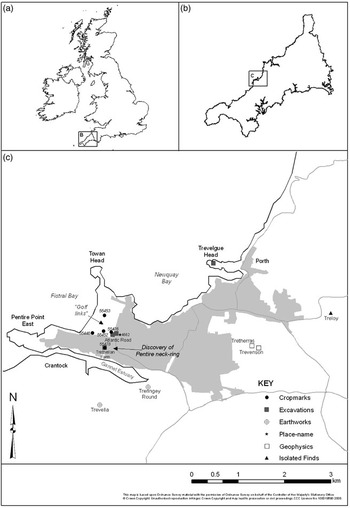
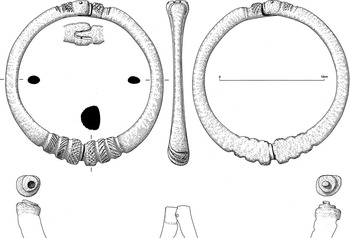
During a public open day organized by the Historic Environment Service of Cornwall County Council in August 2007, the author (JN) was handed a metal neck-ring and a small stone bowl.Footnote 1 Both had been discovered some ten years previously by Mike Salter in the Pentire district of Newquay (fig 1), and recently donated to the Newquay Old Cornwall Society. Peter Hicks, its chairman, brought the objects to the HES event for expert advice. Recognizing that the neck-ring, in particular, was a potentially important find, its discovery was reported to the Royal Cornwall Museum, Truro, and advice and expert opinion was sought from the British Museum in London. Following surface examination and metallurgical analysis, the team at the British Museum confirmed that the object was a neck-ring of later Iron Age date.Footnote 2 As such, it is an important discovery. To date, only one other neck-ring has been recorded in Cornwall and this was an isolated find recovered from tin-working streamworks more than 200 years ago (see below). In September 2008 the neck-ring was formally donated to the county and is now in the collections at the Royal Cornwall Museum, Truro (fig 2).
Newquay, Cornwall: later prehistoric and Roman sites in the Newquay area. Drawing: Jane Powning

Leaded bronze neck-ring from Pentire, Newquay, Cornwall: internal diameter 127mm. Drawing: Stephen Crummy; © Trustees of the British Museum

Description
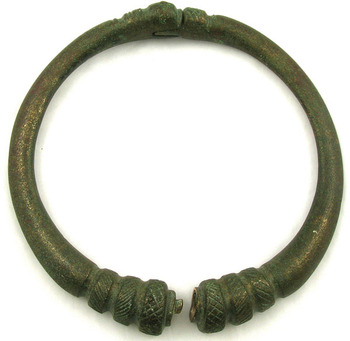
The Pentire neck-ring is complete (fig 3). It is oval and made of two separately cast metal sections. These are held together with a hinge at the back and fastened at the front by a push-fit mechanism. Although small, it is relatively heavy, weighing 540g. Metal analysis has confirmed that it is made of leaded bronze. The total diameter is relatively small, measuring 127mm internally and 158mm externally. With the hinge fully extended, the width of the front opening is capable of some expansion as there is considerable leeway in the hinge. The push-fit mechanism at the front was designed to hold the neck-ring closed when worn. Overall the neck-ring is in a remarkably fresh condition, and was so when found. The finder restricted cleaning to the removal of soil with a toothbrush when the ring was first discovered.Footnote 3
The Pentire neck-ring, Newquay, Cornwall: front view. Photograph: © John Gould; reproduced with kind permission of the Royal Institution of Cornwall, Truro

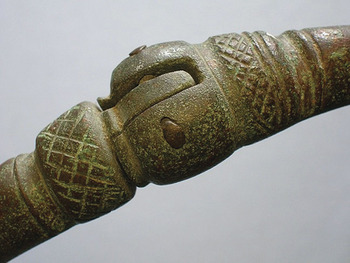
The two parts of the neck-ring are of solid metal and are both rounded on the upper side. When turned over, the neck-ring has a partly flattened underside which is oval in section. The beaded terminals at the catch are D-shaped in section. Decoration occurs on each side of the hinge and on the beaded terminals of the catch at the front, where it partly continues on to the underside of the neck-ring (figs 4 and 5).
The Pentire neck-ring, Newquay, Cornwall: hinge detail. Photograph: © John Gould; reproduced with kind permission of the Royal Institution of Cornwall, Truro

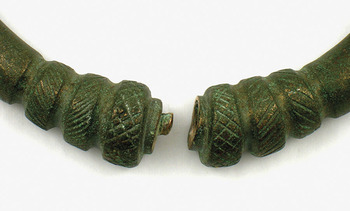
The Pentire neck-ring, Newquay, Cornwall: detail of the front push-fit mechanism. Photograph: © John Gould; reproduced with kind permission of the Royal Institution of Cornwall, Truro

The push-fit catch mechanism comprises a tenon (5mm in diameter), cast and fashioned as part of the right-hand section of the neck-ring, which is lipped and designed to fit into a hollowed socket in the left-hand terminal. The beaded terminals are each decorated with three chunky bands, all of which may originally have been cast, after which some work was done with a file to sharpen the grooves. The bands are separated by deep grooves (fig 5). While the bands vary in width and give a rough-and-ready effect, some attempt at symmetry can be detected: on each side of the fitting are single inner bands of criss-cross motifs, accompanied on both sides by two narrower bands decorated with simpler slashed (irregular) herring-bone lines.
At the hinge the two parts are held together by a 19mm-long iron pin. The hinge is of mortise-and-tenon type, where the tenon (4mm wide and 17mm long) has been cast in the narrower left-hand terminal, which neatly fits into a narrow slot (5mm to 7mm wide) filed into the bulbous right-hand terminal (fig 4). On either side of the hinge, decoration comprises single bands of criss-cross incisions contained by deeply incised grooves. At the hinge, decoration follows through to the flattened (hidden) underside of the object (fig 2). (JN)
Technological study
Scientific examination of the neck-ring was carried out to determine its relation to a known group of neck-rings from western Britain. The techniques deployed in this investigation were optical microscopy, with X-ray fluorescence analysis (XRF) of the metal. The corrosion products were analysed by X-ray diffraction (XRD) and energy dispersive X-ray analysis (EDX) in a scanning electron microscope, together with Raman spectroscopy.
The surface condition of the neck-ring is excellent. There is some corrosion pitting, with green and red corrosion products, but only a thin layer of corrosion on the surface, and bare metal is visible in some places. There is little corrosion inside the hinge or the catch, which are both in good working order. There are scrape marks under the corrosion products in the deeply incised decoration and some marks of abrasion over the corrosion on the smooth areas of the neck-ring. The latter may be from post-excavation cleaning. XRD analysis of the patina identified the red corrosion products as cuprite (Cu2O). The green is not one of the common copper corrosion products. Energy-dispersive X-ray analysis indicates that the corrosion contains lead and chlorine as well as copper. Raman analysis was able to identify lead carbonate as well as cuprite, together with an unidentified component.Footnote 4 Examination at high magnification of an area on the inside of the hinge, abraded and polished for study, indicates that the cuprite corrosion has penetrated significantly below the surface of the metal.
An area, hidden when the neck-ring is closed, was cleaned down to bright metal for X-ray fluorescence analysis, which identified the neck-ring alloy as a leaded bronze with less than 1 per cent zinc and low levels of other impurities (see table above). This analysis has a precision (a measure of reproducibility) and accuracy of c ±2 per cent relative for copper, c ±5 per cent relative for lead and tin and c ±20–50 per cent relative for the other elements.
The pin is made of an alloy (sometimes called gunmetal) of copper with zinc, tin and lead (see Table 1). It could not be cleaned down to bright metal, so the analysis includes the corroded surface, and it is therefore not possible to quantify the accuracy of the measurement. However, it is clearly a very different alloy from the neck-ring metal.
X-ray fluorescence analysis of the metal composition of the Pentire neck-ring

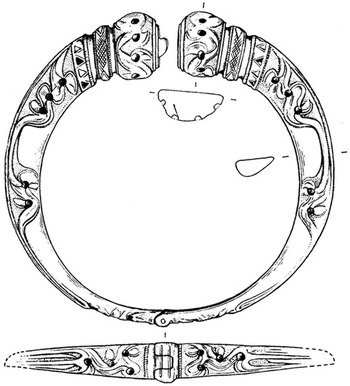
The neck-ring is a leaded bronze casting with low levels of impurities in the metal. An Iron Age copper-casting alloy would be expected to be leaded bronze, but the presence of zinc is not uncommon for British metalwork after Roman contact commenced. An unprovenanced, cast neck-ring, probably from Dorset and now in Dorset County Museum (fig 6), was analysed by Paul Craddock by polarography and atomic absorption spectrometry and found to have 13.2 per cent zinc, 6.3 per cent tin and 1.3 per cent lead in the alloy.Footnote 5 The metal of an enamelled neck-ring of uncertain provenance, now in the British Museum (BM 1963, 0407.1), is brass (copper-zinc alloy) with 13 per cent zinc, 3.2 per cent lead, and only 0.8 per cent tin, but a third cast neck-ring from the Isle of Portland (BM 1889, 0715.1) is leaded bronze with 4.5 per cent tin and 11.3 per cent lead and no detectable zinc.Footnote 6 A neck-ring from Trenoweth, Cornwall, is also of brass, but is perhaps a less useful metallurgical comparison as it is not cast.Footnote 7
Unprovenanced neck-ring, possibly from Dorset. Above: front and back; below: detail of the catch mechanism of the cast brass collar; internal diameter 122mm. Drawing: Philip Compton; © Trustees of the British Museum

It could be argued that the hinge pin, with about 11 per cent zinc in the alloy, is a later replacement; this is a component that would suffer considerable strain when the neck-ring was taken on and off. It does, however, appear integral to the design, and the choice of a different-coloured alloy for the pin may have been made for deliberate decorative effect. This alloy composition was certainly available in Roman Britain.
In summary, while this neck-ring is by no means identical to neck-rings already recognized as belonging to this distinctive western group, it has enough characteristics in common with them to allow it to be firmly placed within the group. The zinc content of the pin (if original) on this neck-ring and composition of some of the other neck-rings in the group indicate a later Iron Age or Romano-British date for manufacture. (SLaN)
Stylistic and typological affinities
Several late Iron Age neck-rings with a predominately south-western distribution have been placed within a ‘Wraxall’ group, named after one of the finest known examples.Footnote 8 These neck-rings were largely classified on typological and technological, rather than stylistic, grounds, and here we are concerned only with those rings that are closest to the Pentire example on all three counts.Footnote 9
The feature that all these rings have in common is the rear hinge; they also have variations on what we have previously referred to as a ‘joggle’ joint. Otherwise, there is considerable variation in the style and competence of execution. For example, the exception to a D-shaped cross-section are two widely separated rings – another recent find from Boverton, Vale of Glamorgan (see below), and the splendid ring from Stichill, Roxburghshire, with its pin-fastening matching that of Pentire.Footnote 10 But while Boverton and Stichill also share the application of additional riveted plates, their decorative schemes could not be more different. Stichill is notable for its assured low-relief ‘swash N’ motif, which has its closest parallel in a group of so-called ‘casket ornaments’:Footnote 11 repoussé or die-stamped sheet bronze plaques with a wide distribution extending from Scotland to south-eastern England and Ireland.Footnote 12 We have suggested that this ‘tourist art’ may have evolved to meet the taste of the new Roman population and we remain of the opinion that Stichill must have originated much further south and west than its place of discovery (though a possible Irish link seems less possible now than some forty years ago!). Either way, Stichill has even now perhaps not received the attention – or the thorough technical examination – it so richly deserves.Footnote 13
The decorative features of Pentire hardly match in quality any others in our group, but simple hatching and cross-hatching both occur on the Dorchester example and the unprovenanced neck-ring, also probably from Dorset (fig 6). On the other hand, while Pentire has more or less the D-section and plain rear of the majority of our south-western rings, it has an approximately equal diameter, like the Portland Island neck-ring.
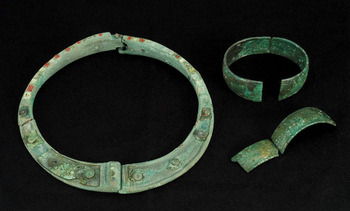
In reviewing the comparative evidence, it is useful to touch upon the recent discovery of a neck-ring from Boverton, Vale of Glamorgan (fig 7).Footnote 14 This cast bronze neck-ring is virtually complete, with an internal diameter of 120mm and an external diameter of 140mm.Footnote 15 Each of the connecting half-sections is wide and flat at the front, narrowing and thickening towards the back and rear, to provide a widened, vertical back face. The two halves are held together with a sturdy rear hinge and an interleaving pin-in-perforation mechanism. The front join has a tongue-and-recess mechanism. The outer faces of the front and back segments were recessed, and four flat and highly polished and reflective copper-alloy plates were riveted into them.Footnote 16
Collar and bracelet pair from the Boverton burial group; internal diameter of neck-ring 110–20mm. Photograph: © The National Museum of Wales

The upper surface of each plate has sixteen rectangular and square recesses in a single-width line. Polychrome enamel was set into these, forming a geometric pattern of red enamel alternating with enamel of another colour (possibly blue or white), now heavily degraded. One front terminal is slightly extended and has four circular recesses in a front–back line, containing different coloured enamels. A strongly defined and moulded rectangular border surrounds this on three sides, the fourth side completed on the connecting terminal. This border is elaborated with pointillé work. The effect is that the eye is drawn to the central enamel, while the offset join is concealed. The associated bronze bracelets are a matching pair of sheet construction, with C-shaped cross-sections. They are decorated with incised chevrons and pointillé work.Footnote 17
In stylistic terms, this neck-ring captures the spirit of experimentation and ‘showiness’ that comes with the increasing use of new Romanizing materials and techniques, yet is still executed in the native Iron Age tradition.Footnote 18 Jope includes within his ‘heavy neck-ring’ category those more helpfully termed ‘beaded torcs’, with a strong concentration between the Humber and the Forth.Footnote 19 Both the enamel work of the Boverton example and the antithetical triple-hatched ornamentation on the Pentire neck-ring strongly recall the ‘beads’ of this more northerly group. Although it is true that none of this class has been found in the south west, one should not forget the neck-ring from Lambay Island, Co Dublin.Footnote 20
In sum, despite its relative simple form and decoration, Pentire seems to be related in particular to the neck-rings from Portland Island and (possibly) Dorset, but also to have decorative elements that recall the ‘beaded torcs’ group. At present, owing to the lack of definite association, nothing can be added about the sex of the wearers, except for the uncertain evidence from Boverton of a gracile adult burial, possibly female.Footnote 21 The continuing lack of evidence for closed finds and regional workshops prevents a more certain conclusion. (JVSM, with a contribution from AG)
Discussion and conclusions
Local context and significance
Nothing is known about the actual burial context of the Pentire neck-ring. It was discovered during the resurfacing of a garden in Pentire Road in 1996. All that can be remembered is that it came out of a sandy layer probably no more than 300mm below the garden surface at that time.Footnote 22 This sandy context is significant, however, and may go some way to explaining the pristine condition of the neck-ring.
The Pentire area of Newquay is dominated by two headlands: Pentire Point East commands the western exposed side of Fistral Bay in Newquay, shadowing Pentire Point West to the south. Both embrace the wide sandy beach that forms the mouth of the Gannel estuary. Pentire Point East, on the northern side of the Gannel, has long been open, cliff, grassland and is today classified as ‘coastal rough ground’.Footnote 23 Pentire Road was first laid out as an unmetalled lane in 1907, and this led into Esplanade Road, which gave access to the headland. Residential housing and hotels began gradually to appear in the wider area known as Pentire East throughout the 1920s and 1930s.Footnote 24 During the early nineteenth century the Pentire headland was called ‘The Warren’,Footnote 25 and the area spanning each side of the magnificent Fistral Bay, between Pentire and Towan Head, still comprises massive sand dunes, now stabilized by turf, in an area known since the mid-twentieth century as the ‘Golf Links’.Footnote 26 Over the past thirty years the area has witnessed a dramatic expansion in residential housing, particularly so at Trethellan Farm, which is situated immediately downhill from Pentire Road on the northern side of the Gannel estuary.
Mesolithic flints, early Bronze Age barrows and Roman coins have all been recorded on the headland. Recently, the slight remains of a small, undated, rectangular enclosure (prn 55032) was detected by aerial photography.Footnote 27 In 1987 a late Iron Age cemetery was discovered during excavations at Trethellan Farm, located approximately 200 to 300m downhill and to the south of Pentire Road. The cemetery comprised at least twenty-one unlined grave pits, clustered in two groups. Although preservation of the individual human remains was generally very poor, there was evidence to show that the individuals had been clothed when interred and their bodies placed in crouched positions. Small personal items of jewellery – principally bronze brooches (with one exception, an iron involute brooch) – were found in each grave. These objects date the burials to the later Iron Age and early Roman period, c 200 bc to c ad 100. There were no highly distinctive pieces of metalwork in the assemblage as a whole and it has been suggested that the site could be interpreted as part of a much larger cemetery.Footnote 28 The only ‘exotic’ object found during excavations at Trethellan was a bow brooch with coral inlay; the coral was clearly not local but was highly valued as raw material in the later Iron Age.Footnote 29
In 1998, well-preserved land surfaces dating to the later Iron Age (c 100 bc) and the Roman period (second to third centuries ad) were found sealed beneath wind-blown sand up to 400mm deep during archaeological investigations running parallel to Atlantic Road, just to the east of Pentire Road and approximately 100m from the Pentire neck-ring findspot.Footnote 30 Here, during the construction of a water pipeline, a long transect sliced through the remains of a multi-period site. Footings for small circular stone buildings, along with hearths, artefact-rich middens and evidence for arable cultivation, were found sealed between layers of wind-blown sand. Well-preserved linear ploughmarks were found and these, along with most of the data from this excavation, date to the Roman phase. Eighty-three metal objects – including two copper-alloy brooches, a lead weight and an iron wool-carding comb – were found together with glass beads, worked animal bone, stone spindle whorls and whetstones. The majority of the ironwork assemblage comprised nails, although drill bits, a hook and parts of knives have also been identified.Footnote 31 Eight Roman coins, all in good condition, were found in the cultivated soil layer; these date to the mid- to late third to mid- to late fourth centuries ad. The site is difficult to classify given the restricted nature of the excavation, although the richness of the data suggests a landscape with an active history of occupation during the Roman period but with some evidence for earlier activities during the later Iron Age – all of which were clearly part of a much wider local scene, to which the discovery of the neck-ring at Pentire must now belong.
On the Golf Links, the cropmarks of at least three circular ditched enclosures (prn 55446; prn 55452; prn 55476) associated with a possible field system (prn 5543) have been detected by the National Mapping Programme.Footnote 32 To date, none of these sites has been investigated and their association with the apparently open site at Atlantic Road is unknown. When Atlantic Road was constructed in 1911 a number of slate-lined coffins – possible slate cists – were discovered (prn 4660),Footnote 33 though their true date and character were not established. Other burials were discovered during road widening in the 1950sFootnote 34 and these discoveries all add to the intriguing spread of later Iron Age and Roman activity in the vicinity.Footnote 35
The Gannel estuary: evidence for later prehistoric settlement
Within the area of the Gannel estuary, there are several candidates for later prehistoric settlement. One – Treringey Round (sw 8114 6037; prn 4667) – lies on the southern side of the estuary to the north of present-day Treringey Farm. The date of this large multi-vallate enclosure is unknown.Footnote 36 Another earthwork – again perhaps the site of a round or enclosure – is recorded on the south-east side of Trevella Farm (sw 8002 6002; prn 4598), where a modern field boundary appears to incorporate the curve of a rampart.Footnote 37 A third possible site is suggested by place-name evidence: ‘Castle Meadow’ is recorded on the tithe map in the area of St Piran’s Road, Newquay (sw 8046 6153; prn 4662).Footnote 38 This area is now a modern cemetery, but the site lies very close to those of Atlantic Road and Pentire Road. Isolated finds of Iron Age and Roman coins have been recorded from fields in the area – particularly on the Crantock side of the estuary (prn 4673) – and others were discovered by metal detectorists during the construction of the Gannel link road in the 1990s.Footnote 39 A polygonal enclosure (sw 8013 6125; prn 55478) is visible on aerial photographs as a cropmark on the upper northern slopes of the Gannel estuary just above Trethellan Farm.Footnote 40
The wider Newquay area
Within the wider Newquay area, some evidence for Iron Age and Roman activity was found during the 1939 excavations at the complex, multi-vallate, cliff castle of Trevelgue Head, to the east of the town at Porth. The exact character of Roman activity at Trevelgue is difficult to pin down with certainty, as the 1939 investigations were limited in scale and the main discoveries are now dated by a scientific dating programme to the middle to late Iron Age (c fourth to first centuries cal bc). Evidence for a possible late first- and early second-century ad building (Structure 313) was, however, found alongside a possible later earthwork (Rampart 8). The headland does, therefore, appear to have been important throughout the earlier and later Roman period when earlier foundations, particularly a large ruined round house, were infilled with a jumbled mass of finds of Iron Age and Roman date, including a large dispersed late Roman coin hoard.Footnote 41
Inland geophysical surveys carried out in 1982 and 1994 at the round at Tretherras (sw 833613) confirmed the presence of related rectilinear and curvilinear enclosures, suggesting late prehistoric or Romano-British settlement.Footnote 42 A small-scale site evaluation by the Cornwall Archaeological Unit in November 2002 confirmed settlement activities, with some well-made pottery, daub fragments, whetstones and a possible hammerstone.Footnote 43 A small curvilinear earthwork located less than 750m to the east at Trevenson (sw 8341 6125) shows up on aerial photographs, although this too remains to be closely dated.Footnote 44 Among the dense spread of small enclosures in the wider area beyond modern Newquay, these sites represent random investigations prompted by recent development.Footnote 45
Isolated finds of Roman date have also been found in the wider area. At Treloy streamworks, upstream from Porth, a tin bowl with a flat cover was found in 1826 in loose association with an enamelled disc brooch.Footnote 46 The bowl has been ascribed to the third or fourth century ad.Footnote 47 Miscellaneous finds of ‘Roman coins, ancient rings and brooches’ have also been recorded.Footnote 48 The other significant local find is the Carnanton tin ingot, discovered about five kilometres north east from Trevelgue and apparently not from a tin ground.Footnote 49
From what has just been described, the discovery of the neck-ring at Pentire may be set against a background in the Newquay area of a rich history of settlement during the later prehistoric and Roman periods. The excellent preservation of the neck-ring must arise from exceptional burial conditions, and this highlights the potential for the survival of later prehistoric and Roman sites across the wider Newquay area.
Two examples of this small class of neck-ring have now been found in Cornwall, with another four (five including the unprovenanced example) coming from Dorset. The other Cornish neck-ring is that from Trenoweth, which was found by chance in a streamwork in 1802.Footnote 50 The craftsmanship of the Trenoweth ring is technically distinctive and although it is also made of leaded bronze, it is a predominantly copper-alloy object made on a lead core, with a brass front plate, comprising several heavily decorated sections as well as eyelets for glass settings.Footnote 51
Nothing useful may be added about the possible wearer of the Pentire neck-ring. There is evidence throughout the insular and continental Iron Age, both archaeological and historical, that the neck-ring was worn as a status symbol by both men and women and as such is frequently found on the Continent in graves.Footnote 52 In contrast, the evidence from Britain is most commonly from either isolated finds or hoards. However, it is worth noting that the ring from Dorchester was found with human remains, and Boverton was definitely associated with a burial; the fragment from Greenhill, Weymouth, by contrast, was associated with a range of bronzes suggestive of a smith’s hoard.Footnote 53
Compared with all the other ‘Wraxall’ class rings, the decorative scheme of Pentire is extremely restrained. It is tempting to claim a shared origin on stylistic and technical grounds for the Portland and unprovenanced (?Dorset) rings, both of which exhibit variations on the continuous broken-wave pattern, not to mention the circular insets, which can be seen on Wraxall itself. However, in the absence of knowledge about workshop practice, let alone the significance of decorative elements in the later Iron Age, one can go no further than to add Pentire to a well-defined regional group. With Wraxall in mind, and in the light of an extension of the general class into Wales provided by Boverton, there is also the splendid – if unfortunately incomplete – segment of a D-sectioned ring from Llandysul, Ceredigion.Footnote 54
The unique discovery of a mirror and sword buried in a late Iron Age cist on Bryher, in the Isles of Scilly, has strengthened the possibility of a flourishing and independent south-western school of Celtic craftsmanship, as proposed half a century ago by Cyril and Aileen Fox.Footnote 55 The Bryher mirror,Footnote 56 and the Trelan Bahow mirror from St Keverne,Footnote 57 may be amongst the earliest ornamental objects in the later Iron Age of south-west Britain, though ‘early’ must be regarded as a relative term. As Dungworth has also noted, the use of brass or copper alloys containing zinc is a late – that is, first-century ad – marker, though it is possible that brass first entered Britain pre-Conquest in the form of such objects as brooches and certain coin types.Footnote 58 A recent survey of Cornwall and Devon emphasizing what might be regarded as foreign or ‘different’ in the Iron Age, concludes that ‘the Iron Age of Cornwall was a complex and apparently diverse period, where society was organised primarily at [the] local level, horizontally stratified but perhaps not hierarchical’.Footnote 59 To the present writers there is nothing strange in an absorption of ritual within the everyday – if not the reverse – since this is a view we have long held with regard to the nature of Celtic art.Footnote 60
In recent years there has been a marked increase in archaeological evidence for an early Roman military presence in Cornwall, although the implications of this are still far from clear. In addition to Nanstallon, near Bodmin, excavated in the 1960s,Footnote 61 two new Roman ‘forts’ have been identified: at Restormel, Lostwithiel (sx 10250 61068),Footnote 62 and at Calstock, in south-east Cornwall (sx 43625 69182).Footnote 63 In addition to being located on key navigable routes, all three sites are located close to rich mineral resources, which may be significant, because of the implications for the control of metal resources. The socio-economic relationship between the Roman military and local communities requires further research but, apart from creating demands for basic resources, social interaction may have offered new contexts for the introduction of new technology and even influenced changes in fashion.Footnote 64 Fraser Hunter concludes his study of beaded torcs with the statement that ‘the idea of the torc as a restricted, status item … was recreated as a wider habit, one regional expression of a broader tradition of neck ornaments which drew on indigenous traditions but reinvented them as part of the creation of Romano-British identities. Wearing a torc became part of being Romano-British, for at least some people in at least some places.’Footnote 65 Forty years ago, one of us (following Roy Hodson’s overview of cultural groupings in the British Iron Age)Footnote 66 considered that the Trenoweth ring (and now we may add others of the ‘Wraxall’ group) demonstrates a picture of peripheral archaism.Footnote 67 Perhaps today one might prefer to say ‘one aspect’ of native cultural response in the period of Roman occupation. This, we suggest, would be a suitable verdict concerning both the Pentire neck-ring and that from Boverton. (JVSM and JN)
Dedication
This paper is dedicated to Charles Thomas, Gwas Gothian, Bard and Cornish archaeologist extraordinaire.
Abbreviations
- HES, CCC
Historic Environment Service, Cornwall County Council
- NOCS
Newquay Old Cornwall Society
- PRN
Primary Record Number, Historic Environment Record
Acknowledgements
Our thanks are extended to Adam Gwilt, FSA, and Mary Davis of Amgueddfa Cymru – National Museum Wales, and Mark Lodwick, the Portable Antiquities Scheme Co-ordinator for Wales, who kindly offered information on the Boverton neck-ring in advance of full publication. Our thanks also go to Peter Hicks, Chairman of Newquay Old Cornwall Society, for bringing the Pentire neck-ring to our attention, and to Mike Salter for all the information he supplied about its discovery. Members of the NOCS committee – Chris Shinner, Shelia Jenkin and Chris Borkett – gave permission to study the object.
Anna Tyacke, Finds Liaison Officer for the Portable Antiquities Scheme, helped arrange expert advice and authentication by J D Hill and Jody Joy at the British Museum. Stephen Crummy, also of the British Museum, provided an excellent illustration of the neck-ring and Jane Powning, of the Historic Environment Service, drew the location map. Thanks are extended to Ann Reynolds at HES for access to unpublished information on the excavations at Atlantic Road. Fraser Hunter helped with discussion and access to unpublished material. Thanks are also due to the referees who offered constructive comments on the initial draft of this paper. Charles Thomas offered generous advice and help, and Jane Marley, Curator of Archaeology and World Cultures, facilitated discussions regarding the donation of the neck-ring to the Royal Cornwall Museum, Truro.