Diagnostic and interventional cardiac catheterisation is a common procedure used to evaluate and treat children with CHD and cardiovascular disease. However, information related to paediatric care and assessment in the post catheterisation period is insufficient to guide a standardised practice. Literature relating to paediatric catheterisation is primarily focussed on procedures and outcomes related to intervention.Reference Hoerl, Tafeit and Leschnick 1 , Reference Odegard, Bergersen and Thiagarajan 2 For the care of the adult patient undergoing diagnostic and interventional cardiac catheterisation, evidence is available to guide methods in achieving haemostasis and required time of immobilisation post procedure.Reference Chair, Thompson and Li 3 – Reference Chhatriwalla and Bhatt 8 The Association of periOperative Nurses practice guidelines for post anaesthesia care provides a generalised description of clinical assessment for patients across the lifespan, with the aid of sedation scoring tools guiding the determination of the patient’s return to baseline. 9
Paediatric patients differ from adult patients because of their ability to understand and cooperate with instructions to how their bodies respond to similar procedures.Reference Bashore, Balter and Barac 10 Paediatric patients differ in size, body surface area, vessel compliance, co-morbidities, and frequency of repeat catheterisations. In addition, cardiac catheterisation for CHD is a different procedure than diagnostic heart catheterisation or percutaneous coronary interventions most commonly performed on adults. The American College of Cardiology Foundation Task Force reports that three-fourths of all paediatric cardiac catheterisations are therapeutic, rather than purely diagnostic, and involve procedures that are unique to paediatrics such as an atrial septostomy.Reference Bashore, Balter and Barac 10 Diagnostic catheterisations performed in the paediatric congenital heart patient are more extensive than for patients with normally structured hearts because they are used to define the anatomic structures and abnormalities. This often results in multiple interventions, numerous sheath exchanges/sizes, and longer procedures, all of which contribute to the greater instability and risk of adverse events. To address this gap in the literature, an inter-professional team was convened to explore the current state of practice for post paediatric catheterisation care used by cardiovascular programmes.
Materials and methods
In the fall of 2013, an electronic survey was e-mailed to the Congenital Cardiovascular Interventional Study Consortium Listserv representing 113 institutions. Congenital Cardiovascular Interventional Study Consortium is a “not-for-profit organization dedicated to the advancement of science and treatment of infants, children, and adults requiring surgical/interventional procedures for the treatment of congenital heart disease”. 11
The 36-question survey included multiple-choice and open-ended questions. Before distribution, the survey was piloted among internal staff and two external programmes to establish reliability and validity. Of the 36 questions, 12 were demographic and the remaining 24 were divided into the following subtopics: care and management at the end of the procedure including achievement of haemostasis; catheterisation site dressings; use of vascular closure devices; care practices around post procedure bed rest; and post catheterisation recovery care and length of stay among paediatric patients. All questions were specific to the care and management of paediatric patients.
Survey responses were collected through Research Electronic Data Capture (REDCap). REDCap is a secure, web-based software designed to support data capture for quality improvement projects and research studies. For analysis, data were summarised descriptively using SPSS statistical software with count and frequency or median and range reported for each question.
Results
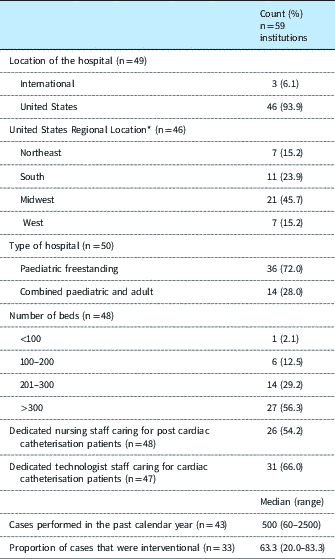
Of the 113 institutions invited to participate, 59 institutions responded for a 52% response rate. The majority of respondents represented hospitals within the United States of America (93.9%) (Table 1). Among hospitals located in the United States America, the majority were located in the South and Midwest (23.9 and 45.7%, respectively). Respondents represented a heterogeneous cross-section of patient care facilities with 72% being paediatric facilities and 28% are combined paediatric and adult facilities. The majority of respondents represented large hospitals with more than 300 beds that have dedicated nursing and technologist staff caring for cardiac catheterisation patients.
Demographic information for participating programmes.

*Northeast: New England/Mid-Atlantic; South: East South Central/West South Central/South Atlantic; Midwest: East North Central/West North Central; West: Mountain/Pacific
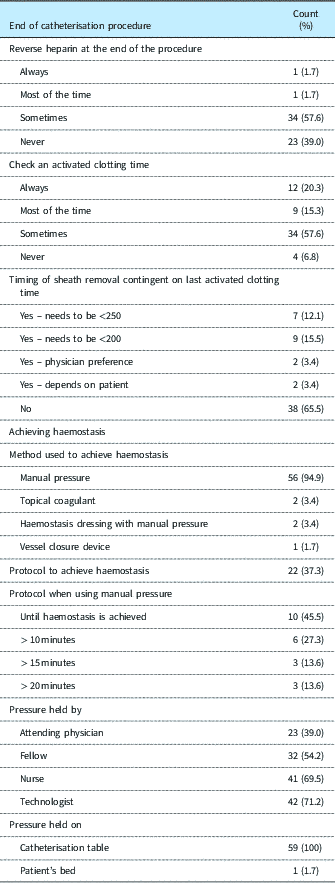
At the end of the catheterisation procedure, heparin reversal was not a standard practice and there was wide variation in use of activated clotting time to guide sheath removal (Table 2). Manual pressure was the primary practice (94.9%) used to achieve haemostasis and was performed before leaving the procedure table (100%). Most facilities did not report having an established protocol to achieve haemostasis. Of those who had a protocol, 45% held pressure until haemostasis was achieved rather than using a predetermined length of time. The majority of the facilities reported using nurses, technologists, and/or fellows to hold manual pressure.
Questions regarding end of a catheterisation procedure/achieving haemostasis.

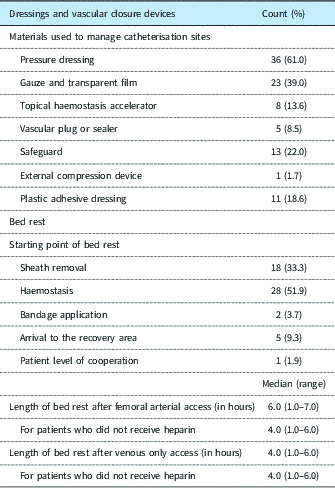
Standard pressure dressings consisting of gauze and surgical foam tape were used by the majority of facilities (61.0%); however, gauze with transparent film, topical haemostatic accelerators, vascular plugs, Safeguard® dressings, and plastic adhesive dressings were used regularly as well (Table 3). External compression devices were rarely used in the paediatric population represented in this survey.
Questions regarding dressings, vascular closure devices, and bed rest.

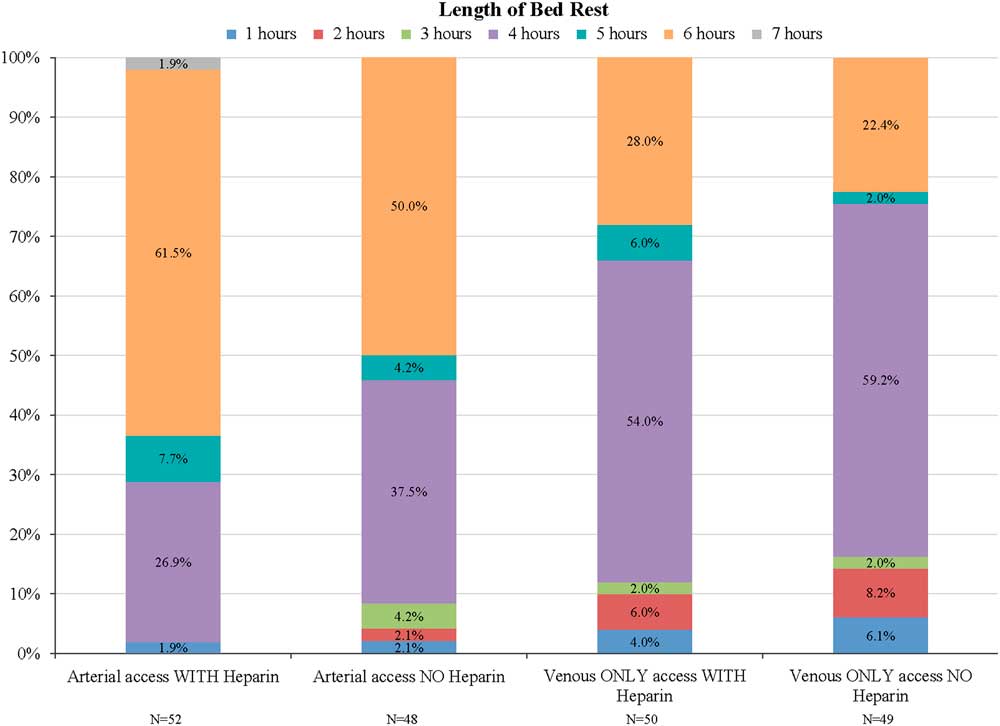
The starting point of bed rest varied among respondents. Reported factors that influenced the length of bed rest included sheath size, patient age, and use of a vascular closure device. Length of bed rest following catheterisation varied from 1 to 7 hours, with a median of 6 hours for arterial access and 4 hours for venous access (Fig 1).
Length of bed rest following catheterisation.

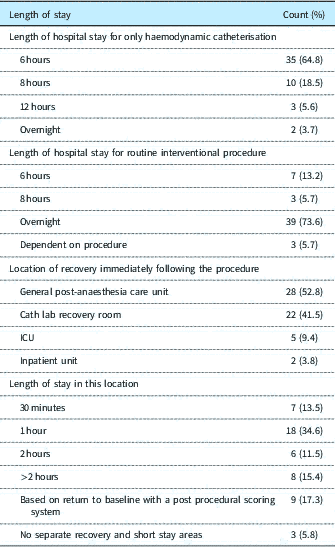
At 64.8% of institutions, the hospital stay for only haemodynamic catheterisations was 6 hours; 73.6% required overnight hospitalisation for routine interventions (Table 4). The majority of post catheterisation patients recovered in a general post anaesthesia care unit (52.8%) or a catheterisation lab recovery room (41.5%).
Questions regarding post catheterisation recovery care and length of stay.

Immediate recovery stays in the post anaesthesia care unit or recovery room varied. Approximately 35% reported a 1 hour stay and 17.3% reported the length of stay was determined by the patient’s return to baseline based on Aldrete or a similar post sedation score (Table 4).
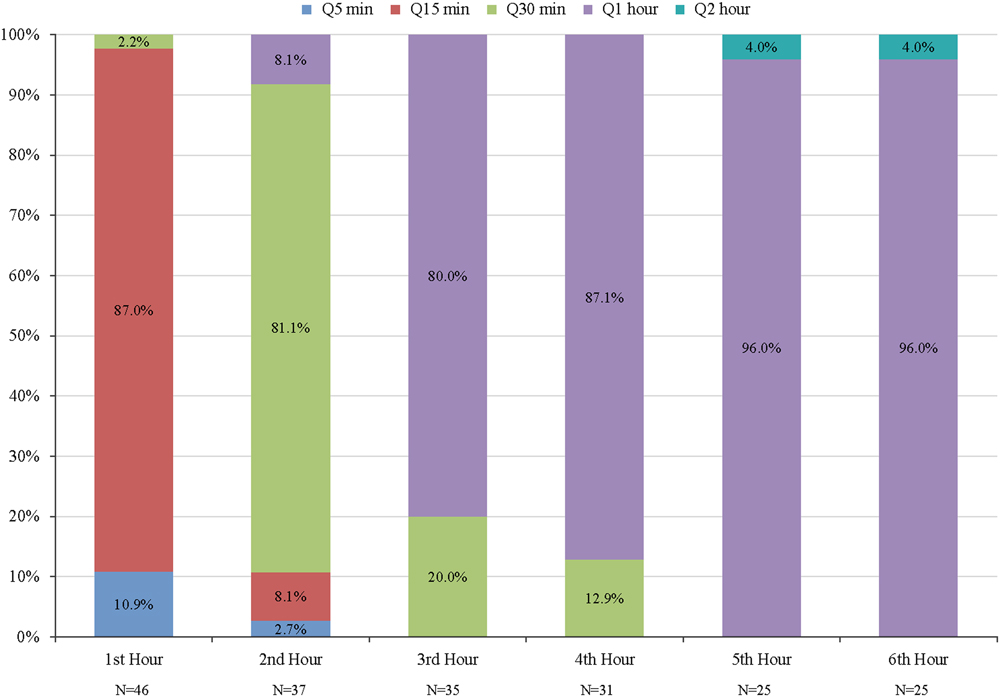
Routine protocol for vital signs post anaesthesia and procedural sedation varied. The majority responded that vital signs were assessed every 15 minutes for the first hour (87.0%), every 30 minutes the second hour (81.1%), and then hourly starting at hour three (Fig 2). Approximately 11% reported vital signs assessed every 5 minutes during some portion of the first hour. Approximately 26% of the respondents reported using the following routine protocol: assessment every 15 minutes for 1 hour, every 30 minutes for the second hour, and then every hour after 4 hours.
Frequency of vital sign assessment per hour. *Frequencies are based on the number of institutions that assess vital signs within each hour.

Discussion
Results generated from this assessment provide a description of the state of practice and care of paediatric patients post cardiac catheterisation across a number of cardiology programmes. The results identify variation in both post catheterisation care and assessment practices for paediatric patients. These variations included timing of sheath removal with activated clotting time status, approach to achieving haemostasis, materials used to cover femoral site, and length of monitoring/bedrest.
It was a standard practice among respondents to use manual pressure on the catheterisation table when establishing haemostasis post cardiac catheterisation. Practices varied among programmes regarding checking an activated clotting time before sheath removal, timing of sheath removal based on activated clotting time result, and use of heparin reversal at the end of a procedure. In the absence of published evidence guiding best practices in the paediatric cardiac catheterisation population, our results highlight the variation in dressing methods, vital sign assessment protocols, and length of bed rest.
Research suggests that the clotting ability of paediatric patients is markedly more affected by cardiac catheterisation than their adult counterparts and places them at greater risk for both bleeding and clotting complications post cardiac catheterisation.Reference Hoerl, Tafeit and Leschnick 1 Given this finding, timing sheath removal with a prescribed activated clotting time value may reduce the potential for blood loss post catheterisation. Despite this evidence, routine testing of activated clotting times at the end of procedures before removing sheaths was not reported by most respondents. In centres where sheath removal was contingent on the last activated clotting time, the activated clotting time value varied and was sometimes reliant on age or size of patient or physician preference. In addition, most respondents did not have a set protocol for obtaining haemostasis.
Complication rates are reported to be higher in paediatric patients because of compromised haemodynamic states and the nature of the interventions.Reference Odegard, Bergersen and Thiagarajan 2 , Reference Bashore, Balter and Barac 10 Adverse events in paediatric catheterisation cases are reported in 16% overall, 10% related to diagnostic catheterisations, 19% related to interventional procedures, and death is reported in 0.9%.Reference Bashore, Balter and Barac 10 Paediatric catheterisations as compared with adult catheterisations are more likely to involve deep sedation or anaesthesia and typically require an overnight hospitalisation.Reference Bashore, Balter and Barac 10 Our results are in agreement with the literature where the majority of respondents in our study indicated overnight hospital admissions as a standard of care for paediatric patients after interventions. Though longer stays were also noted, length of stay post haemodynamic catheterisation was typically 6 hours and are longer than bed rest times for adults following left heart catheterisation.Reference Best, Pike, Grainger, Eastwood and Carroll 6 , Reference Mohammady, Heidari, Akbari Sari, Zolfaghari and Janani 12 The literature for bed rest times among adults greatly varies between 1 and 24 hours and typically use only femoral arterial access as opposed to arterial and venous access.Reference Best, Pike, Grainger, Eastwood and Carroll 6 , Reference Doyle, Konz, Lennon, Bresnahan, Rihal and Ting 7 , Reference Mohammady, Heidari, Akbari Sari, Zolfaghari and Janani 12 In addition to variance in overnight stays in paediatric versus adult patients, the location of recovery post catheterisation in paediatric patients was also variable. Most reported using either a generalised multi-disciplinary post-anaesthesia care unit or designated catheterisation laboratory recovery room with the remainder in the ICU or inpatient unit. Establishing evidence-based guidelines regarding the minimum level of care will help guide bed rest requirements, duration of observation, and optimal location for recovery post catheterisation.
Given the wide variation in post catheterisation practice and care of the paediatric patient, there is opportunity to determine the rationale behind the current practice across cardiology programmes. Evaluating the similarities among programmes performing cardiac catheterisations in the congenital heart patient will allow for the benchmarking and standardising of practice. Once a standard practice can be identified, outcomes such as the frequency of access site bleeding after haemostasis can be achieved.
Limitations
The survey was distributed to the Congenital Cardiovascular Interventional Study Consortium Listserv, which is comprised solely of physicians at the various participating institutions. Further, while the survey requested that nursing leadership or nursing educators respond, the survey did not query the role of the individual who responded.
Conclusion
Paediatric post catheterisation care and assessment practices vary across cardiovascular programmes. This data may serve to inform efforts to standardise post catheterisation care, particularly in methods used to achieve haemostasis, required time of immobilisation, frequency of patient assessment, and duration of observation.
Acknowledgements
The investigators acknowledge the following for their contributions and support: Sandra Coombs for working as a research assistant on the project, Dr Sonja Ziniel for reviewing and editing the survey tool, and members of the Congenital Cardiovascular Interventional Study Consortium Listserv who made this project possible.
Financial Support
This project received no specific grant from any funding agency, or from commercial or not-for-profit sectors.
Conflicts of Interest
None.