Journalists, scholars, and members of the mass public frequently ask whether Supreme Court nomination hearings provide any public value. During Neil Gorsuch’s 2017 confirmation hearings, for example, a Supreme Court reporter asked, “Were the Gorsuch hearings as pointless as they seemed?” (Lithwick Reference Lithwick2017). Similarly, a constitutional law scholar watching John Roberts’s hearings remarked, “These hearings today don’t provide any real substance. It just gives Senators a chance to grandstand, and nominees take a ‘less is more’ approach in answering questions” (quoted in Competitive Enterprise Institute 2005). Even Elena Kagan (Reference Kagan1995) famously called confirmation hearings a “vapid and hollow charade” more than 10 years before she found herself answering those questions as a nominee. We disagree with assessments like these. Instead, we contend that members of the Senate Judiciary Committee use the hearings to engage in constituent maintenance while also fulfilling their constitutional duties to advise and consent on the nominees. The Senate confirms most of the president’s nominees to the Supreme Court (Nemacheck Reference Nemacheck2008), meaning senators opposed to confirmation rarely secure a policy victory for constituents when it comes to staffing the Court. They can, however, still represent their constituents’ interests by questioning the nominee in a manner congruent with voter preferences.
To examine this facet of senatorial behavior, we systematically analyze senators’ question-asking behavior in 11 Supreme Court confirmation hearings that occurred between 1981 (Sandra Day O’Connor) and 2010 (Elena Kagan). Then, utilizing new data, we consider senator behavior during the Neil Gorsuch and Brett Kavanaugh hearings. We find that senatorial power dynamics and constituent preferences influence senators’ behavior during the hearings. Specifically, our results suggest that senators modify their level of engagement with the nominee as the government shifts from unified to divided. Nominees presented during unified government experience a coronation. In-party senators (i.e., those in the nominating president’s party) ask only enough questions to showcase the nominee’s qualifications and reinforce the president’s narrative that this nominee is the best nominee, while out-party senators engage in more intense conversations with the nominee as they seek to mitigate the damage caused by the inevitable successful confirmation. Under divided government, however, the out-party can threaten a nomination, and both parties consequently partake in more contentious hearings with significantly more exchanges. We also show that public opinion in a senator’s state can temper this behavior; in-party senators from states that support the nominee draw less attention to themselves and engage with the nominee less frequently, regardless of the institutional setup.
Our findings make three significant contributions. First, we expand the literature on constituent maintenance by considering Supreme Court confirmation hearings. Electoral considerations, like constituent needs, motivate congressional representatives’ behavior (Mayhew Reference Mayhew1974; Fenno Reference Fenno1978; Grimmer Reference Grimmer2013; Jacobson and Carson Reference Jacobson and Carson2016). When policy outcomes fail to placate constituents, congressional representatives pursue alternative means of pleasing them. Typically, extant literature focuses on how senators mitigate constituent anger over legislative policy using some part of the legislative process (Bickers and Stein Reference Bickers and Stein1996; Hill and Hurley Reference Hill and Hurley2002; Madonna Reference Madonna2011). Supreme Court confirmation votes are not like other legislative votes, however, as many of the common means of constituent mollification are unavailable, and positive outcomes are often preordained (Krutz, Fleisher, and Bond Reference Krutz, Fleisher and Bond1998). We show that the senators on the Judiciary Committee, at least, can attempt to use the hearings’ trappings to manage constituent anger toward a displeasing nominee and her actions once on the Court.
Second, our findings suggest that studying question-asking behavior is crucial to understanding the confirmation process. Farganis and Wedeking (Reference Farganis and Wedeking2014) show that nominees are reasonably forthcoming in their responses despite the myth that nominees refuse to answer senators’ questions. They also point out that senators voice frustration about obfuscatory responses to their questions but do not consider their frustration when voting on that nominee’s confirmation. We suggest this disconnect occurs because the act of engaging with the nominee is more important for a senator’s reputation with constituents than extracting a forthcoming answer from a nominee. In fact, a vague response can benefit a senator, providing him with another opportunity to engage with the nominee as he attempts to secure an answer. Senators can look demanding or friendly when questioning a nominee, and their question-asking behavior can shape this perception. Essentially, confirmation hearings unfold the way they do because senators want them to unfold that way.
Finally, we argue this behavior may ultimately lead to better representation. Although congressional representatives are generally responsive to public preferences (Wlezien Reference Wlezien1995), including on matters pertaining to the Supreme Court (Kastellec, Lax, and Phillips Reference Kastellec, Lax and Phillips2010; Collins and Ringhand Reference Collins and Ringhand2013), senators simply cannot guarantee policy outcomes congruent with constituent demands when confirming Supreme Court nominees. They can, however, represent their constituents through actions purposefully tailored toward only their constituents, engaging in what Carey and Shugart (Reference Carey and Soberg Shugart1995, 417) call “cultivat[ing] a personal vote.” For members of the Senate Judiciary Committee, confronting a displeasing nominee means using different techniques to signal constituent representation when they are unable to represent constituents by blocking a nomination. We suggest that senatorial grandstanding during Supreme Court confirmation hearings forces senators, at the very least, to align their rhetorical behavior with constituent needs.
Senatorial Behavior and Motivations in Confirmation Politics
Owing to their salience and visibility, senators have historically treated Supreme Court confirmation hearings as a unique type of executive branch nomination. The media, interest groups, and the general population pay the most attention to these hearings (Cameron, Kastellec, and Park Reference Cameron and Kastellec2013; Collins and Ringhand Reference Collins and Ringhand2013), and senators have historically behaved as though inaction or disruption of the confirmation process is politically untenable (Chiou and Rothenberg Reference Chiou and Rothenberg2014). In fact, the Republicans’ refusal to consider Merrick Garland’s nomination in 2016 and the Democrats’ later decision to use the filibuster during Gorsuch’s 2017 confirmation are the rare exceptions to this general rule and remain controversial decisions precisely because these actions seriously violated senatorial norms (Berenson Reference Berenson2017; Flegenheimer Reference Flegenheimer2017). Traditionally, however, senators acting on a nomination to the Supreme Court tend to avoid the dilatory tactics typical of other, less visible, nominations—holds (Howard and Roberts Reference Howard and Roberts2015), blue slips (Black, Madonna, and Owens Reference Black, Madonna and Owens2014), filibusters (Binder and Maltzman Reference Binder and Maltzman2009), or any other procedural move intended to delay action on nominees (Bond, Fleisher, and Krutz Reference Bond, Fleisher and Krutz2009)—and schedule hearings for the nominees regardless of the political environment surrounding the nomination (Farganis and Wedeking Reference Farganis and Wedeking2014). Because the president selects the nominee with an eye toward successful confirmation, the end result of these hearings is almost always a new Supreme Court justice (Krutz et al. Reference Krutz, Fleisher and Bond1998; Moraski and Shipan Reference Moraski and Shipan1999; Nemacheck Reference Nemacheck2008). The numbers underscore the uniqueness of Supreme Court nominations: between 1993 and 2018, the Senate confirmed 100% of Supreme Court nominees who had a hearing while confirming only about 77% of executive branch nominees (Eilperin Reference Eilperin2014), and 94% of the Supreme Court nominees who made it to the Senate floor in the past century eventually made it to the bench (Heritage Foundation 2017; McMillion and Rutkus Reference McMillion and Steven Rutkus2018).
While nominees are effectively ensured a floor vote and confirmation is essentially assured, the nomination and confirmation process remains politicized and contentious. Presidents select more ideologically extreme nominees in the modern era (Cameron et al. Reference Cameron and Kastellec2013), senators are more hostile toward the nominee when they question her (Farganis and Wedeking Reference Farganis and Wedeking2014), and nominee qualification for the job, once an important predictor of confirmation, is now a secondary consideration as ideological similarity has grown in importance to senators’ decision-making calculus (Epstein et al. Reference Epstein, Lindsadt, Segal and Westerland2006). Partisanship matters as well. Senators who are not in the president’s party are more likely to band together and vote against a nominee in the modern era (Cottrill and Peretti Reference Cottrill and Peretti2013); after all, a confirmation (or a successful block) is a policy win for all party members (Smith Reference Smith2007; Lee Reference Lee2009). In short, senators put Supreme Court nominees through a difficult and contentious process before letting them take their seats.
The Senate Judiciary Committee organizes and executes the contentious confirmation hearings for Supreme Court nominees. In theory and practice, members’ collective goal is to provide a service to their colleagues by collecting and dispersing information about the nominee so that senators who are not on the committee can make a knowledgeable decision regarding confirmation (Hamilton Reference Hamilton2003; Collins and Ringhand Reference Collins and Ringhand2016). Senators on the committee ask the nominee about civil liberties, judicial decision making, legal philosophy, and previous Court rulings (Farganis and Wedeking Reference Farganis and Wedeking2011; Solberg and Waltenburg Reference Solberg and Waltenburg2015), all with an eye toward collecting and sharing basic information. Senators on the committee can also use their investigative power to simultaneously pursue political interests—a desirable pursuit given legislators’ focus on reelection (Mayhew Reference Mayhew1974). Senators, individually and as a party, decide which questions to ask, how to ask them, and how hard to push for answers. Consequently, senators can use their information-gathering duties to engage with the nominee in a way that can elevate or devastate her chances of securing confirmation. Short of that, senators can tailor their questions to mirror constituents’ concerns. And while the nominees do not always engage with senators’ questions (Farganis and Wedeking Reference Farganis and Wedeking2014), we contend it is the questioning that matters. Even if nominees avoid answering questions, Judiciary Committee members can use the hearings to publicly show constituents that their needs receive consideration and attention.
Consider the Judiciary Committee’s 1993 review of Ruth Bader Ginsburg and the Senate’s subsequent 96–3 confirmation vote. As a longtime law professor and experienced federal judge, Ginsburg was decidedly qualified for the position; her perfect qualification rating from Segal and Cover (Reference Segal and Cover1989), who rate nominees based on newspaper editorials, underscores her worthiness for the role. She was also politically well placed for confirmation, as a Democratic president nominated her and she faced a Democratic Senate. Yet, despite her near guarantee of a successful confirmation, Ginsburg still faced opposition-party haranguing during her hearing. Republican Senator Orrin Hatch, for example, used his time to lambaste Ginsburg about her support for a constitutional right to abortion (US Senate 2016, 269) and her opposition to the death penalty (Andrews Reference Andrews1993), despite having suggested Ginsburg’s name to President Clinton in the first place (Burr Reference Burr2018). Hatch would ultimately vote to confirm Ginsburg, whom more than 70% of Utahans supported. But before he did, he utilized his time to ask her about what he disliked about her record, rather than underlining what he liked about it, as his Democratic colleagues spent the hearings doing. We believe Hatch did this because he wanted to show Utahans that he would support all of their interests—they might like Ginsburg as a nominee, and he would support that, but he knew they also disagreed with Ginsburg about the legacy of Roe v. Wade (1973), and he stated on record that he represented that interest too.
As Hatch’s behavior with Ginsburg highlights, participation in the hearings as a member of the Judiciary Committee provides benefits that other senators do not have. Across all legislative activities, senators have two avenues through which they can act on constituent interests: making policy and engaging with the public in a way that indicates senators know what they should do, even if they cannot produce the desired policy (Grimmer Reference Grimmer2013). For the typical senator voting on a nominee, this means casting a vote and later explaining that decision. There is evidence of this policy-making variant of representation during Supreme Court confirmations, as citizens’ support for a nominee’s confirmation increases the probability that their senator will cast a yea vote (Kastellec et al. Reference Kastellec, Lax and Phillips2010). Regarding the rhetorical variant, senators are able to control oratorical narratives by strategically using public speeches to reach constituents (Hill and Hurley Reference Hill and Hurley2002). Membership on the Senate Judiciary Committee provides a third avenue for representation, however: engaging with a nominee during the hearings in a way pleasing to constituents. Televised confirmation hearings provide senators with a prime opportunity for grandstanding and constituent maintenance. While all senators on the Judiciary Committee can utilize their questioning for constituent maintenance, institutional arrangements (i.e., divided vs. unified government), political positions within the Senate (a senator’s position in the president’s party or the opposition party), and constituent support for the nominee should influence the extent to which different senators do so.
As members of the party seeking and able to derail a nomination during divided government, opposition-party senators use their majority status to instigate contentious confirmation hearings. In this situation, these out-party senators have the numbers and political will to block a nomination; that is, they have an opportunity to deliver a policy victory to constituents. Realistically, however, blocking the nominee is nearly impossible. The well-established presumption of confirmation success puts the pressure on the opposition party to prove the nominee’s unworthiness, and, barring a scandal, out-party senators rarely manage to do this (Krutz et al. Reference Krutz, Fleisher and Bond1998). We argue that upon losing the ability to represent their constituents through policy, out-party senators turn to rhetorical representation instead. In this situation, out-party senators seek to mitigate the damage of a confirmed nominee by repeatedly engaging with the nominee, typically about issues important to constituents. Thus, we expect that the out-party senators on the Judiciary Committee should attempt to inundate the nominee with questions during confirmation hearings in a divided government.
In response to the majority’s interrogation, members of the president’s party combat the out-party onslaught by engaging with the nominee equally as much. Because the president carefully selects his nominee and then uses his bully pulpit to establish the nominee’s credibility and qualifications for the position (Moraski and Shipan Reference Moraski and Shipan1999; Johnson and Roberts Reference Johnson and Roberts2004; Nemacheck Reference Nemacheck2008; Gibson and Caldeira Reference Gibson and Caldeira2009), the in-party should merely shepherd the nomination home. They even have a built-in advantage for doing so, as they work with an existing narrative and need only confirm and encourage it. With that said, maintaining a narrative gets more difficult when the opposition party holds a theoretical ability to overturn the nomination and uses that position to tear into that narrative with their interrogation of the nominee. We consequently suggest that during divided government, in-party senators must fight for the nominee, engaging with her as much as their out-party counterparts do as a way to combat the majority’s grandstanding.
Conversely, when the government is unified and the president’s party controls the Senate as well, the out-party senators are generally forced to watch a nominee’s coronation with little ability to stop it. They lack the numbers to overturn the nomination and, short of scandal, have no way to obtain that policy victory. Consequently, we suggest that during unified government out-party senators again engage in rhetorical representation of their constituents but to a lesser degree when compared to the contentiousness of a divided-government hearing. They will dominate the conversation during these hearings, asking significantly more questions than their in-party counterparts, but they do this in order to mitigate the preordained damage that comes with guaranteed policy failure. Out-party senators thus still engage with the nominee with frequency and vigor, but they do so less frequently than they would under divided government.
During unified government, the in-party controls the confirmation and consequently does not respond to the out-party’s questioning. The combination of the president’s narrative advantage and majority status in the Senate nearly guarantees victory. In-party senators merely need to reinforce the president’s positive depiction of the nominee, so their engagement with the nominee should be minimal. We suggest that in-party senators under unified government engage with the nominee less than they would during a contentious divided government confirmation and less than their out-party counterparts do during a hearing during unified government. Here, in-party senators allow their out-party counterparts to dominate the proceedings precisely because they have the numbers to win at the end of the process. Table 1 summarizes our expectations for these situations.
Senatorial Motivations and Expectations for Grandstanding

While institutional arrangements and political positions within the government should drive senators’ approach to questioning the nominee during the confirmation hearings, citizens’ thoughts about the nominee should also influence senator behavior. Constituents care about who sits on the Court and will punish their senators for voting “the wrong way” on a nomination (Kastellec et al. Reference Kastellec, Lax and Phillips2010). Such actions force senators to consider public support for a nominee before casting a vote. The support-building process begins long before the vote, however; on average, the Senate Judiciary Committee has, since 1981, started hearings about 46 days after the president first announced the nomination (McMillion and Rutkus Reference McMillion and Steven Rutkus2018), giving citizens time to form initial opinions and interest groups ample time to engage in grassroots lobbying intended to influence constituents’ opinions about the nominee (Cohen Reference Cohen1998; Caldeira, Hojnacki, and Wright Reference Caldeira, Hojnacki and Wright2000). Citizens have opinions about the nominees, and senators have electoral motivations to listen to them.
We argue that constituent opinion within a senator’s state can modify some senators’ approach to confirmation hearings. Out-party senators always have an incentive to question the nominee to the fullest extent possible. At a basic level, out-party senators want to reject a nominee selected by the other party. Their constituents should dislike the nominee, a defeat makes their party look good (Smith Reference Smith2007; Lee Reference Lee2009), and the next nominee might better reflect their own preferences. In such cases, the out-party senator should aggressively engage with the nominee to show constituents they are on the same page. But some constituents might like the nominee—after all, people tend to like Supreme Court nominees on a personal level (Gibson and Caldeira Reference Gibson and Caldeira2009). Here, senators can either work to persuade constituents this nominee is not the right nominee or follow Hatch’s example and interrogate a nominee about the parts of her record that constituents will grow to despise. Essentially, out-party senators will interrogate the nominee regardless of how much their constituents like her.
In-party senators, however, have a reason to change their question-asking behavior when their constituents like the nominee. In this case, the constituents like the nominee, and the confirmed nominee will work to uphold constituents’ interests. These senators are virtually guaranteed a policy win, and they only have to reinforce the president’s narrative to do it. Under divided government, this should mean that in-party senators from high-support states sit back and let the existing narrative do the talking. In-party senators from low-support states can take the spotlight, emphasize the nominee’s credentials, and fight to show how well the nominee will represent constituent interests. Alternatively, when the government is unified, in-party senators have every incentive to speak as little as possible, although senators from high-support areas perhaps cannot resist taking a victory lap and engaging with the nominee on a few extra questions whose answers have little effect on the nomination itself. Putting our overall argument more simply, we suggest that senators grandstand in order to please constituents and therefore must also consider their audience’s opinion on the nomination before doing so. We consider such possibilities in what follows.
Data and Measures
To examine senatorial behavior during Supreme Court confirmation hearings, we use Farganis and Wedeking’s (Reference Farganis and Wedeking2014) data on senator behavior during confirmation hearings. Because we are analyzing the relationship between each senator on the Judiciary Committee and the Supreme Court nominee undergoing the interrogation, our unit of analysis is the senator-nominee dyad. The number of observations for each nomination is equivalent to the number of senators on the Judiciary Committee who engaged with the nominee during that hearing. Senators can appear in multiple dyads, as Senators Grassley, Hatch, Leahy, and Specter do, given that they sat on the Judiciary Committee for all Supreme Court confirmation hearings that occurred between 1981 and 2010. The data cover 11 of the 13 nominations that received a confirmation hearing between O’Connor’s hearing in 1981 and Kagan’s in 2010, resulting in an N of 185.Footnote 1 The decision to begin with O’Connor is a conscious one on our part. Her hearing is the first in the televised era, and as Farganis and Wedeking (Reference Farganis and Wedeking2014) show, senators modified their question-asking behavior when stations began broadcasting the hearings live. Starting with O’Connor also allows us to focus on hearings conducted in a polarized Senate, which began in the late 1970s (McCarty Reference McCarty2014).Footnote 2 Our decision to stop with Kagan, however, is data driven; as we discuss later in the article, we use different data to examine Gorsuch’s hearings in 2017 and Kavanaugh’s in 2018.
In choosing our dependent variable, we considered how best to measure a senator’s behavior during the hearings, particularly his engagement with the nominee during questioning. Ideally, we want to measure the intensity of a senator’s questioning of the nominee during the hearings. That is, we want to examine how demanding or forceful the senator is when engaging with the nominee, looking for indications that he is using his time to the fullest possible extent as he attempts to secure answers on the nominee’s positions. One way to do this would be to use text analysis methods, particularly sentiment analysis, to analyze a speaker’s behavior, a technique scholars use with increasing frequency (Grimmer and Stewart Reference Grimmer and Stewart2013). These tools overwhelmingly focus on individual word choices and the frequency with which they get used (e.g., Monroe, Colaresi, and Quinn Reference Monroe, Colaresi and Quinn2008; Black et al. Reference Black, Treul, Johnson and Goldman2011; Owens and Wedeking Reference Owens and Wedeking2012). Problematically for the present purposes, however, these tools fail to capture the force with which a senator questions a nominee (see Collins and Ringhand Reference Collins and Ringhand2013; Farganis and Wedeking Reference Farganis and Wedeking2014). Constituents can see and process the expressions or nonverbal cues of the senators and nominee and hear the tones of voice tied to the exchanges. Given that constituents are likely to consume the hearings at some point (Overby et al. Reference Overby, Henschen, Strauss and Walsh1994), it is not surprising that senators utilize any strategy available to make their questions memorable, including theatrical flourishes to their speech.
Consider, for example, Senator Al Franken’s questioning of Judge Neil Gorsuch in 2017. Democrats on the committee repeatedly asked Gorsuch about his ruling in the so-called Frozen Trucker Case (Shugerman Reference Shugerman2017). Franken, the third Democrat to mention the case, used nearly one-third of his time to discuss Gorsuch’s dissent in the case. His tone and hand gestures grew more frustrated and excited with each subsequent exchange despite the factual nature of his words as he restated the case facts and outcome (CNN Reference Shugerman2017). A dictionary-based text analysis program would likely register little of the intensity and emotion that Franken conveyed as he attempted to extract a satisfying answer from Gorsuch. Accordingly, we turn to other measures to answer our question.
We instead use the number of exchanges between the senator and the nominee to examine a senator’s willingness to engage, question, and interrupt a nominee. That is, we use the number of exchanges to measure a senator’s question-asking intensity. While all Judiciary Committee members in the modern era ask the nominee questions and use most of their equally allotted time to do so (Farganis and Wedeking Reference Farganis and Wedeking2014), our data suggest that out-party senators typically engage with the nominee more frequently than in-party senators do, despite the out-party having fewer seats on the committee (see also Farganis and Wedeking Reference Farganis and Wedeking2011). Additionally, because senators utilize the prehearing nominee questionnaire to gather basic information about the nominee, Farganis and Wedeking (Reference Farganis and Wedeking2014, 26) suggest senators have the space to ask “more difficult and probing questions” during the hearings. Given that these more difficult questions are also the questions the nominees are less likely to answer (Collins and Ringhand Reference Collins and Ringhand2013; Farganis and Wedeking Reference Farganis and Wedeking2014), the questioning senator would presumably respond to evasion with force, attempting to extract a constituent-pleasing answer from the nominee. This would result in more exchanges.
Senator Franken’s hostile questioning provides face validity to this measure. To turn again to his questions about the Frozen Trucker Case, anyone who watched the hearing saw Franken’s questioning turn into a rapid-fire back-and-forth with Gorsuch, with the senator volleying with the nominee five times in less than 30 seconds as he pushed Gorsuch to defend his position (CNN 2017). He packed in questions to get his point across. Beyond anecdotes and conjecture, however, we also used content analysis to verify the validity of using this measure. We hand-coded a random sample of 277 senator questions from the uncontroversial hearings for David Souter and Stephen Breyer. We asked research assistants to code the tone of each question as positive (softballs or questions in the nominee’s area of expertise), neutral (fact-based questions about past Court precedent or the nominee herself), or hostile (questions that demand responses regarding problematic past rulings or a poorly answered question). The data reveal that out-party senators ask more hostile questions than their in-party counterparts (
 , one-tailed test). That is, our content analysis verifies that the senators who ask the most questions are also asking intense, probing questions.
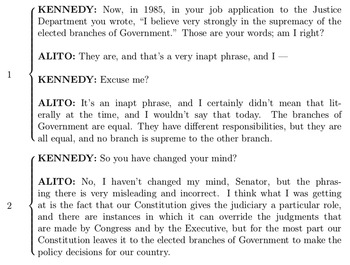
To operationalize our dependent variable, we adopt Farganis and Wedeking’s (Reference Farganis and Wedeking2011, 528) definition of an exchange, which is the senator’s initial statement or question and the nominee’s response to it. This question-and-answer unit includes any back-and-forth that involves the senator and nominee talking over each other or speaking at the same time as part of a single exchange (Farganis and Wedeking Reference Farganis and Wedeking2014, 32). Figure 1 displays a set of exchanges between Senator Ted Kennedy and then-judge Samuel Alito during Alito’s 2006 confirmation hearing. This example is recorded as two separate exchanges. In the first exchange, Kennedy asks Alito about his job application to the Department of Justice, and Alito begins to answer before he gets interrupted, after which he answers the question. Notice that the cross-talk is part of the exchange and does not indicate the beginning of a new exchange, as Alito did not complete his answer before Kennedy interrupted him. The second exchange is Kennedy asking for clarification about Alito’s position and Alito responding that his word choice on the job application was “very misleading and incorrect.”Footnote 3
Two separate exchanges between Senator Ted Kennedy and then-judge Samuel Alito during his 2006 confirmation hearing.

On average, senators have 38 of these exchanges during a hearing. The vast majority span between 11 and 68 exchanges (10th–90th percentile).Footnote
4
As we pointed out earlier, in-party senators converse with the nominee less than their out-party counterparts, averaging 30 exchanges compared to the out-party’s 48 (
 , two-tailed test).
As we expect that institutional arrangements influence how partisan senators approach the nomination proceedings, we consider two dichotomous variables: the presence of divided government and the senator’s status as a member of the president’s party. Because our theory suggests that the combination of these variables is more substantively interesting than each individually, we place each senator into one of four mutually exclusive categories: (1) in-party member under divided government, (2) out-party member under divided government, (3) in-party member under unified government, and (4) out-party member under unified government. This arrangement allows us to examine the engagement level of each situation separately.
To measure representational concerns, our other area of interest, we estimate constituency support for the nominee. State-level estimates of public opinion toward a Supreme Court nominee are difficult to obtain, as researchers typically cannot use disaggregation to get valid state-level measures from nationally representative surveys that ask about Supreme Court nominees (Kastellec et al. Reference Kastellec, Lax and Phillips2010, Reference Kastellec, Lax, Malecki and Phillips2015). Inventively, Kastellec et al. (Reference Kastellec, Lax and Phillips2010, 771) employed multilevel regression and poststratification on a combination of national polls with 500 or more observations, geographic information, and demographic data to obtain state-level estimates of support for a nominee. Their estimates reflect public opinion at the time of the confirmation vote; however, we need estimates of public opinion at the time of the hearings (i.e., before the vote). We thus utilize a variation of their measure to produce state-level estimates of support for the nominee before the senators began questioning the nominee in the hearings.Footnote 5 No outlet conducted a national poll with sufficient data on the favorability of Scalia or Kennedy, so we omit their hearings from our analysis, but we are able to use Kastellec et al.’s (Reference Kastellec, Lax, Malecki and Phillips2015) data to include estimates of constituent support for Kagan’s 2010 nomination. Additionally, because we believe institutional arrangements and representational concerns concurrently influence senator behavior, we include multiplicative terms for each variant of institutional arrangement and public opinion.
Finally, we also include five control variables for factors that are known to influence senators’ behavior during the confirmation process. First, because senators approaching reelection in the near future could be grandstanding more than colleagues with more distant electoral concerns, we control for the time to each senator’s next election, measured in years.Footnote 6
Second, given the importance of ideological congruence for confirmation voting (Epstein et al. Reference Epstein, Lindsadt, Segal and Westerland2006), we expect that senators who are ideologically distant from the nominee will be more hostile toward her, and we therefore control for the ideological distance between the senator and the nominee. For this measure, we use the squared Euclidean distance between a senator and the nominee ideal points in Common Space (Farganis and Wedeking Reference Farganis and Wedeking2014, 64), with larger values indicating greater ideological distances.
Third, we use Segal and Cover (Reference Segal and Cover1989) scores to control for the nominee’s qualification for the job, as a nominee’s qualifications to be a Supreme Court justice influence the likelihood of confirmation (Epstein et al. Reference Epstein, Lindsadt, Segal and Westerland2006). Segal and Cover analyze preconfirmation newspaper editorials about the nominee to create this qualification score, which ranges from 0 to 1. Of our 11 justices, Justice Rehnquist is considered the least qualified (Segal-Cover score of 0.4), while Justices Ginsburg and O’Connor are the most qualified (Segal-Cover scores of 1.0).
Fourth, we control for interest group opposition to the nominee, measured as the percentage of total interest groups that opposed the nomination via written or oral testimony (Epstein et al. Reference Epstein, Martin, Segal and Westerland2007; Farganis and Wedeking Reference Farganis and Wedeking2014). Interest groups are increasingly involved in the confirmation process (Cameron et al. Reference Cameron and Kastellec2013). They actively seek to draw attention to a nomination (Bell Reference Bell2002; Scherer, Bartels, and Steigerwalt Reference Scherer, Bartels and Steigerwalt2008; Steigerwalt Reference Steigerwalt2010) and influence senators’ approaches toward a nomination (Caldeira and Wright Reference Caldeira and Wright1998; Caldeira et al. Reference Caldeira, Hojnacki and Wright2000), and their support or opposition can influence a Judiciary Committee member’s decision to send a nominee to the Senate floor for a full vote (Farganis and Wedeking Reference Farganis and Wedeking2014). Crucially, we focus on the level of interest group opposition because such opposition is most salient before a nomination makes it to the floor (Krutz et al. Reference Krutz, Fleisher and Bond1998).Footnote 7
Finally, we include a dichotomous control variable for whether or not a member of the Judiciary Committee was an attorney before joining the Senate. Research suggests that “lawyer-legislators” exhibit different behavior than their nonlawyer counterparts in the Senate (Miller Reference Miller1995). Additionally, attorneys should have experience with questioning people about their past behavior, which should give these senators an experiential advantage before Supreme Court nominees. Essentially, former attorneys should be better at engaging with nominees. We expect that senators who were attorneys will ask the nominee more questions than their nonattorney counterparts.Footnote 8
Methodology and Empirical Results
Our dependent variable, the number of exchanges between the senator and the nominee, is a count. Owing to overdispersion of the dependent variable (i.e., the conditional mean is not equal to the conditional variance), we employ a negative binomial regression (Long Reference Long1997). Because senator-nominee exchanges are nested within confirmation hearings, multilevel modeling techniques could be appropriate here, but after careful consideration of the structure of our data and with the aid of statistical tests, we determined they are not.Footnote 9 We instead estimated our model with standard errors clustered by nomination.
The results of the negative binomial regression model of senatorial exchanges with a Supreme Court nominee are shown in table 2. Because of the nonlinear nature of our model, we use predicted values to address our results rather than looking strictly at the coefficients. We begin with figure 2, which addresses the estimated number of exchanges a senator will have with the nominee on the basis of institutional arrangements.
Negative Binomial Regression Results, Senator-Nominee Exchanges

* p < .05.
** p < .01.
*** p < .001.
Circles are the estimated number of exchanges a senator will have with the nominee. Vertical lines around that estimate are 95% confidence intervals. a, Effects for the in-party; b, out-party estimates. Within each panel, unified government appears on the left, and divided government on the right. All continuous variables are held at their means, and categorical variables are held at their modes.

Beginning with figure 2a , we find that in-party senators engage with the nominee significantly more under divided government than they do under unified government. We believe this is because in-party senators should enforce the president’s narrative of the nominee more vigorously during divided government’s more contentious hearings. The more a president advocates for a nominee’s confirmation, the more likely he is to experience legislative failure on major policy initiatives (Madonna, Monogan, and Vining Reference Madonna, Monogan and Vining2016); the in-party consequently has an incentive to advocate for the nominee in the president’s place so they do not suffer legislative consequences. Figure 2 a confirms that in-party senators do modify their behavior based on institutional arrangements; an in-party senator asks only approximately 29 questions during a coronation but engages with the nominee 92 times during contentious divided-government nominations.
Moving to the examination of the out-party in figure 2b , we theorized that out-party senators engage more frequently with a nominee because they must provide political cover for their failure to block a counterpartisan president’s nominee. The data bear this out. Our results show that out-party senators engage with the nominee significantly more under divided government than they do under unified government. An out-party senator on the losing side of a coronation should engage with the nominee 44 times, while an out-party senator engaging in a contentious fight during divided government should engage with the nominee approximately 73 times during a hearing.
Importantly, as we expected, there is a statistically significant difference in the question-asking behavior of in-party and out-party senators during unified government (i.e., comparing the left plotting symbol in fig. 2a
to the left plotting symbol in fig. 2b
). When confirmation is a certainty, in-party senators are significantly less likely to ask the nominee questions than their out-party colleagues who are working to extract answers and mitigate damage. In-party senators have a policy victory for constituents, and out-party senators offer their constituents fervent symbolic representation. Conversely, there is not a statistically significant difference in the question-asking behavior of in-party and out-party senators during divided government. That is, out-party senators do not appear to question a nominee any more (or less) than their in-party counterparts when the president’s party does not also control the Senate (
 ). When confirmation is still reasonable but less certain, in-party senators grandstand to protect their nominee, and out-party senators again grandstand to protect their reputations with constituents. Both sides ask the nominee more questions and press the nominee for more answers. This result reinforces our theory that senators in both parties engage in grandstanding.
Institutional arrangements alone do not predict senator behavior during Supreme Court confirmation hearings, however. We turn to figure 3 to examine the role of constituent support. Again, we expect that constituents’ support of the nominee will alter an in-party senator’s behavior but may not have the same influence on the out-party. Beginning with the out-party senators—in the top half of figure 3—we find support for our hypothesis. Figure 3a
shows that under divided government, as public support for the nominee in a senator’s state increases from 53% on the low end to 90% on the high end (covering 95% of the data), the number of exchanges decreases slightly, although the difference is not statistically significant (
 ). As we expected, out-party senators who control the Senate are willing to lambaste a nominee whether constituents like her or not.
Solid lines indicate predicted senator exchanges across level of state public opinion support for the nominee. Dashed lines are 95% confidence intervals around those estimates. a, Effects for out-party senators under divided government; b, for out-party senators under unified government; c, for in-party senators under divided government; d, for in-party senators under unified government. All continuous variables are held at their means, and categorical variables are held at their modes.

Turning next to figure 3b
, we see that out-party senators are similarly unaffected by public opinion when questioning a nominee under unified government. Again, as public support for the nominee increases, the number of questions the out-party asks decreases a slight but statistically insignificant amount (
 ). When the government is unified and the out-party is sure to lose on the nomination, out-party senators are willing to question a nominee regardless of how much their constituents support her.
Turning to figure 3c , we see that an in-party senator’s propensity to interact with the nominee wanes as state support for the nominee increases. In-party senators should engage with the nominee an astounding 132 times when constituent support is low, and this number drops to 39 exchanges when support is high.Footnote 10 This, again, shows senators engaging in constituent maintenance. When their constituents are not completely behind a nominee, the in-party senators push the president’s agenda to make the nominee look likable and qualified. For example, constituents in Senator Chuck Grassley’s home state of Iowa showed lukewarm support of Judge Robert Bork’s nomination, with only 59% of his constituents supporting the nomination. Grassley, a Republican who ultimately voted in favor of Bork’s confirmation, prefaced several questions with statements underscoring their similar approaches to issues, including the death penalty (US Senate 2016).
Conversely, when the government is unified, constituents’ positive opinion of the nominee appears to actually increase the number of questions that in-party senators ask. Figure 3d shows the small but statistically significant positive influence that public opinion has on an in-party senator’s behavior during unified government. As constituent support for the nominee increases, in-party senators ask more questions. An in-party senator in a state with low support for the nominee asks about 25 questions in a hearing, while an in-party senator in a state with high support asks about 31. Anecdotal evidence suggests senators in this case are offering nominees softball questions that play well on television the next day; for example, Senator Ben Sasse asked Neil Gorsuch how he could answer questions for so long without taking a bathroom break (Hulse Reference Hulse2017), a moment well covered by major media outlets. When coronation is evident, in-party senators ask as few questions as they can while still showing constituents how great the nominee is (and, consequently, how great the senator is for supporting the nomination).
Finally, regarding the remaining variables that are statistically significant in our model, our results align with expectations in the literature. As ideological distance between the senator and the nominee grows, the senator engages with the nominee more frequently. The effect is statistically significant across in-party and out-party senators and exists regardless of unified or divided government. We also find that as a higher percentage of interest groups oppose the nomination, senators engage with the nominee more. This result aligns with Cameron et al.’s (Reference Cameron and Kastellec2013) finding that interest group mobilization is one of the main sources of modern-day contentiousness in Supreme Court confirmations. Logically, this also makes sense, as interest groups introduce information into the lexicon that senators will eventually need to address with the nominee. Additionally, our results suggest that senators who were attorneys before joining the Senate ask the nominee more questions. This, again, aligns with our expectations that attorneys have more experience with questioning people about their lives and are better prepared for interrogation of a Supreme Court nominee as a result.
The Gorsuch and Kavanaugh Hearings
After Elena Kagan’s confirmation in 2010, the Supreme Court’s membership remained stable until Justice Antonin Scalia’s death in 2016. President Obama, a Democrat, nominated Merrick Garland to the seat, but, in an unprecedented move, Republican Senate majority leader Mitch McConnell refused to act on the nomination until after the presidential election (Kaplan Reference Kaplan2018). Republican Donald Trump won, Garland never received a hearing or a vote, and the president nominated Neil Gorsuch to fill Scalia’s seat (Elving Reference Elving2018). The confirmation hearing was contentious, but the Republican-controlled Senate confirmed Gorsuch to the bench (Elving Reference Elving2018). In the process, the Senate voted to eliminate the filibuster and confirm Supreme Court nominees by a simple majority (Kaplan Reference Kaplan2018). When the Senate Judiciary Committee interrogated Brett Kavanaugh to replace Justice Anthony Kennedy in 2018, the out-party Democrats pushed hard against the nominee, with several senators heatedly pressing the nominee to answer their questions (Seidman and Tamari Reference Seidman and Tamari2018; Zhou Reference Zhou2018), while in-party senators went out of their way to ask easy questions that required long and easy answers (Cohrs Reference Cohrs2018). Afterward, a U.S. News and World Report writer wondered whether the Kavanaugh hearings had “irreparably changed the whole [confirmation] process” (Williams Reference Williams2018). And, for all intents and purposes, the Supreme Court confirmation process did fundamentally change between Kagan and Gorsuch. But did the Senate Judiciary Committee members change their approach to questioning nominees, too?
To answer this question, we read through the Gorsuch and Kavanaugh confirmation hearing transcripts and, following the definition of an exchange we outlined earlier, counted the number of exchanges that each senator had with each of the nominees. Because both hearings took place under unified government, we examined the difference in how in-party and out-party senators under unified government questioned the nominees in the pre- and post-Garland nomination era. To do so, we employ difference-in-means tests.Footnote 11 The results, shown in figure 4, suggest the members of the Senate Judiciary Committee have not changed their overall approach to the hearings. While both sides ask significantly more questions overall in this new era—fitting the trend suggested by political commentators—opposition-party senators still engage significantly more with the nominee. The in-party asks as few questions as possible, and the out-party repeatedly engages with the nominee.
Circles are the estimated number of exchanges a senator in a unified government will have with the nominee. Vertical lines around that estimate are 95% confidence intervals. a, Mean number of exchanges for the hearings that occurred during unified government between O’Connor in 1981 and Kagan in 2010; b, estimates for the Gorsuch and Kavanaugh hearings. Within each panel, the in-party appears on the left and the out-party on the right. All continuous variables are held at their means, and categorical variables are held at their modes.

Turning first to figure 4a , we see the same trend originally outlined in figure 2. Between the O’Connor hearings in 1981 and the Kagan hearings in 2010, an in-party senator whose president selected the nominee asks about 23 questions, while an out-party senator in the same hearing asks about 41, which is significantly more. Figure 4b tells the same story for the Gorsuch and Kavanaugh hearings; an in-party senator engages with the nominee about 37 times, while an out-party senator engages with the nominee at almost double the rate, asking about 60 questions per hearing.Footnote 12 This, too, is a statistically significant difference. Importantly, however, the relationship remains the same: in-party senators do the minimum necessary to protect their nominee, while out-party senators push to either make him look bad or overturn his nomination outright.
Discussion
When Senator Ted Kennedy questioned Clarence Thomas during his 1991 Supreme Court confirmation hearings, he packed 23 questions into 30 minutes of interrogation. As a member of the majority party questioning someone nominated by the opposing party’s president (i.e., as a senator stymied by divided government), Kennedy spoke to Thomas in quick questions and comments, rephrasing questions when Thomas dodged and interrupting his answers with clarifying questions if necessary (US Senate 2016). Given the opportunity to overturn a nomination, Kennedy modified his question-asking behavior. Three years later, when Kennedy found himself questioning his own party’s nominee, Stephen Breyer, his behavior changed. Kennedy asked a total of six questions in his 30 minutes. He asked Breyer about his record on women’s rights and his book and read into the record a letter about Breyer’s pro-environment rulings (US Senate 2016). While some could suggest Kennedy was simply propping up his former protégé (Toobin Reference Toobin2008), he engaged in the same sort of easygoing behavior the year before, asking Ruth Bader Ginsburg eight long questions about her work as a women’s rights advocate and giving her the time to give eight complete and thoughtful responses (US Senate 2016). Working his way to assured coronations, Kennedy took his time advertising Breyer’s and Ginsburg’s credentials and letting them do the same. He wanted to reinforce the president’s message about these judges’ qualifications for the job. These examples, which, as we demonstrate, are not anomalous, show how senators modify their behavior based on institutional arrangements and the electoral opportunities they provide.
In this article, we set out to determine whether senator behavior during Supreme Court confirmation hearings is a function of institutional arrangements and constituent support. We find that it is. Senators in both parties engage with the nominee more frequently when the government is divided (i.e., when the president’s party does not hold the majority of Senate seats). When the opposition party can theoretically block a nomination, those senators engage with the nominee enough to either block the nomination or (more likely) mitigate the damage caused by a successful confirmation by asking symbolically important questions. In this situation, senators from the in-party ask as many questions as the out-party does, seeking to reinforce the president’s narrative and get the nominee confirmed. If, however, the president’s party also has the Senate majority, senator behavior changes. Members of the president’s party engage with the nominee as little as possible, asking enough questions to highlight qualifications but not enough to cause problems. Those in the opposition party do the opposite, engaging with the nominee frequently in an attempt to rhetorically represent constituents who will dislike the nomination’s final outcome. Support for the nominee in an in-party senator’s state can alter this behavior, leading in-party senators to approach the nomination differently if their constituents really like the nominee.
These findings expand our understanding of how potential justices are questioned and what influences members of the Senate Judiciary Committee’s behavior during confirmation hearings. Previous scholarship noted that hearings are an increasingly confrontational ordeal that, despite a highly likely outcome (i.e., confirmation), play an important role in our constitutional order (Collins and Ringhand Reference Collins and Ringhand2013; Farganis and Wedeking Reference Farganis and Wedeking2014). Additionally, scholarship has long noted that legislators represent their constituents in different ways (Wlezien Reference Wlezien1995; Hill and Hurley Reference Hill and Hurley2002), including on matters of the judiciary (Kastellec et al. Reference Kastellec, Lax and Phillips2010; Ura and Wohlfarth Reference Ura and Wohlfarth2010). We contribute to these lines of inquiry by bridging the gap between these two literatures and demonstrating that legislators use confirmation hearings as a way to salvage some representative function even when they cannot secure a policy victory for their constituents. While some Court observers may regard hearings as a “charade” or “pointless,” senators on the Judiciary Committee do not appear to view them as such. Instead, they appear to be legitimate opportunities to score points with their electorate. We demonstrate that legislators not only alter the style of representation to their advantage but also seem to consider the venue and institutional dynamics when attempting to represent their constituents.
There are, of course, limitations to our findings. First, it is difficult to separate contentiousness, polarization, and time. As Farganis and Wedeking (Reference Farganis and Wedeking2014) note, contentiousness and polarization on the Senate Judiciary Committee have increased over time (see their fig. 5.4), as has polarization in the Senate as a whole (McCarty, Poole, and Rosenthal Reference McCarty, Poole and Rosenthal2006). We do not make an explicit argument about how the changes in the Senate as a whole might affect Supreme Court confirmation hearings, and that is because our results suggest that the Senate Judiciary Committee has not dramatically altered its question-asking behavior over the period of our study. Institutional arrangements and public opinion explain committee members’ question-asking behavior as well as or better than any time or polarization explanation (see the appendix for more details). We feel this argument is facially valid; consider, for example, that when the Republican-led Senate refused to schedule hearings for Obama-nominated Merrick Garland in 2016, the majority party used procedural warfare, rather than the trappings of a confirmation hearing, to overturn a Supreme Court nominee (Kaplan Reference Kaplan2018). But that is not to say that polarization or changes over time are unimportant to the process as a whole. Question-asking intensity may simply be a function of affective polarization, in which, for example, Republicans come to loathe Democrats (e.g., Iyengar and Westwood Reference Iyengar and Westwood2015). We argue, however, that the hearings would still serve a representative capacity even if this were true. Indeed, some suggest that individuals derive more satisfaction from irking those across the aisle than achieving true policy victories (e.g., Coaston Reference Coaston2017).
While we examine only confirmation hearings for the Supreme Court, we believe the framework developing electoral motivations for congressional behavior other than yea and nay votes is important and a promising area for future research. Because we focus on the electoral motivations for senatorial behavior on one committee, we are curious about the occurrence of grandstanding during other confirmation hearings. Cabinet nominees, for example, are high-profile presidential nominees whose confirmation hearings go through the Senate committee with jurisdiction over their department. The committees vote on nominees and send the nominations to the full Senate for votes, creating a similar environment to that of a Supreme Court confirmation hearing. At the same time, however, senators subject these other executive nominations to the dilatory tactics they eschew during Supreme Court confirmation hearings (Ostrander Reference Ostrander2016), adding a potential new wrinkle to senators’ grandstanding opportunities. Examining senators’ engagement behavior in these situations may be a fruitful avenue for later research.
Additionally, future studies on any type of nomination should include a clear measure of the hostility or intensity of exchange. As we mention earlier, we look at the frequency of exchanges partially owing to the difficulty of obtaining a valid and direct measure of the intensity of an exchange. With machine learning techniques consistently improving to better analyze language, a useful measure of hostility cannot be far behind. This measure would allow for a more direct analysis of senator behavior during confirmation hearings and build on Hill and Hurley’s (Reference Hill and Hurley2002) original work on the kind of language senators employ and to whom they appeal with that particular type of language.