

Introduction
Cross-breeding native cattle, often of Bos indicus type, with exotic Bos taurus cattle is now a widely used method of improving reproduction and production of cattle in the tropics (VanRaden and Sanders, Reference VanRaden and Sanders2003). Although indigenous cattle are well adapted to local production conditions, they usually mature late and have poor growth rates and low milk yields (Syrstad, Reference Syrstad1988).
Reports on cross-breeding in the tropics date back to 1875 (Gaur, Garg and Singh, Reference Gaur, Garg and Singh2005), when shorthorn bulls were crossed to native cows in India. Other reports (Buvanendran and Mahadevan, Reference Buvanendran and Mahadevan1975) indicate that livestock improvement in the tropics using this method began more than 300 years ago when exotic cattle were introduced into what is today Sri Lanka. Results on the performance of such crosses in well-designed experiments have, however, only been available since 1930 and a great number of reports have been published since then. It has now become clear from studies carried out by Amble and Jain (Reference Amble and Jain1967); Mason (Reference Mason1974); Katpatal (Reference Katpatal1977); Kimenye (Reference Kimenye1978); Rege (Reference Rege1998); Demeke, Neser and Schoeman (Reference Demeke, Neser and Schoeman2004a) and Gaur, Garg and Singh (Reference Gaur, Garg and Singh2005) that where cattle management is good, the performance of cross-breds increases with the number of B. taurus genes, and that the breeds that have 50 or 75 percent of these genes perform better than all other levels of exotic inheritance. Animals with these levels of B. taurus blood calve earlier than the indigenous stock, produce more milk, and have longer lactations and shorter calving intervals (CIs). Cross-breeding is therefore a very attractive short-term livestock improvement tool as improvements can be made in a population within a single generation. However, despite the impressive results and high demand for milk in the tropics, well-organized and successful cross-breeding programmes remain few (McDowell, Wilk and Talbott, Reference McDowell, Wilk and Talbott1996). For example, in India only 12 percent of its 187 million head of cattle are cross-breeds (Ahlawat and Singh, Reference Ahlawat and Singh2005); similarly, in Bangladesh cross-bred cattle account for only 2 percent of all milking cows (Miazi, Hossain and Hassan, Reference Miazi, Hossain and Hassan2007). Reasons for this include (1) lack of strategies and policies to take advantages of crosses in most parts of the tropics (Rege, Reference Rege1998); (2) gaps in knowledge as to what the appropriate levels of exotic inheritance should be for a particular production system (Kahi, Reference Kahi, Ojango, Malmfors and Okeyo2002); (3) lack of in-depth analysis of the socio-economic and cultural values of livestock in the different production systems or production environments, which leads to wrong breeding objectives (Chagunda, Reference Chagunda, Ojango, Malmfors and Okeyo2002) and (4) small herd sizes that do not allow maintaining sufficiently large breeding stock for cross-breeding and often unknown exotic blood level.
This paper reviews the achievements that have been made in cross-breeding for milk production in the different climatic zones (climatic zones) in the tropics, and discusses the challenges and opportunities for its use in the future.
Cross-breeding: the genetic background and types of cross-breeding
Genetic background
The genetic basis of cross-breeding can be broadly divided into two components: additive and non-additive. The additive component is because of the average effect of the strains involved (breeds or parental lines), weighted according to the level of each parental breed in the cross-bred genotype. The non-additive component of cross-breeding is heterosis (Swan and Kinghorn, Reference Swan and Kinghorn1992). Heterosis is defined as the difference between the increase in cross-breeds' performance from the additive component based on the mean performance of the pure-bred parental lines. The levels of heterosis are presented as percentage values and can be used to calculate the expected performance of cross-bred individuals (Bourdon, Reference Bourdon2000). Heterosis is caused by dominance (interactions within loci) and epistasis (interactions between loci) effects of genes. The positive effects of dominance are the result of increased levels of heterozygosity, which allow an individual to react to environmental challenges in different ways (Swan and Kinghorn, Reference Swan and Kinghorn1992). Epistasis interactions can have a negative effect because of a breakdown of favourable interactions between loci in pure-bred animals, which prior to cross-breeding developed by both natural and artificial selection within breeds (Roso et al., Reference Roso, Schenkel, Miller and Wilton2005). These effects have been observed in cross-breeding studies for milk production in the tropics. Syrstad (Reference Syrstad1989) reviews results obtained from F1 and F2 B. indicus and B. taurus crosses for milk production. In his article, a deterioration in performance because of the breakdown of epistatic gene effects was found to occur between the F1 and F2 for all traits studied (age at first calving (AFC), calving interval (CI), milk yields and lactation lengths (LLs)).
Types of cross-breeding
Cross-breeding can be grouped into three types. They are grading up, rotational crossing or criss-crossing and formation of synthetic or composite populations (Cunningham and Syrstad, Reference Cunningham and Syrstad1987).
Grading up
This is a common cross-breeding strategy employed in most parts of the tropics. Usually an indigenous female animal is mated with an exotic male. The first cross generation (F1) performs very well in productive and reproductive traits: it has higher milk yields, shorter CIs and the animals calve at a younger age than the indigenous stock. Further upgrading, however, usually leads to mixed results (McDowell, Reference McDowell1985; Rege, Reference Rege1998). These results are because of a reduction in heterozygosity as the generations proceed (Cunningham and Syrstad, Reference Cunningham and Syrstad1987). Although the average performance of the F1 usually exceeds that of the indigenous breeds in milk yields, performance of the cross-breds can be variable. This could be because of the large variation in the environmental conditions that exist in the tropics, and a result of the two genotypes involved (Cunningham, Reference Cunningham1981; McDowell, Reference McDowell1985; Dhara, Ray and Sinha, Reference Dhara, Ray and Sinha2006).
Rotational crossing
Rotational crossing is used or widely advocated in different parts of the tropics as a strategy to maintain high levels of heterozygosity and at the same time achieve specific proportions of the domestic and exotic strains (Cunningham, Reference Cunningham1981; Gregory and Trail, Reference Gregory and Trail1981). Madalena (Reference Madalena1981) describes four forms of this method. In the first, two bulls (one exotic and one indigenous) are used in alternate generations; the exotic bull is bred to the indigenous cow, then the indigenous bull is bred to the resulting cross-bred cows, and so on. Within a few generations, the system stabilizes at two types of grades (2/3 and 1/3), which coexist on one farm at the same time. The second form also involves two breeds: one exotic and one indigenous bull. In this system, the indigenous bulls are only mated to cows with more than 75 percent exotic blood. This leads to a herd that is composed of three coexisting grades (3/7, 5/7 and 6/7). In other words, the exotic bull is used on two generations and followed by an indigenous bull for one generation. The third form is similar to the first one, but instead of an indigenous bull, a cross-bred bull is used. In the fourth form, three breeds are used: two exotic bulls and one indigenous bull. In the first stage, the exotic breed is mated with the indigenous breed to produce the F1 population. This new breed is mated to the second exotic breed to produce offspring with 75 percent exotic genes. To complete the cycle, these are mated to the local breed to produce offspring with 37.5 percent exotic genes.
Rotational cross-breeding also has some limitations. First, in the two-breed rotational system the genes contributed by the two breeds fluctuate between 1/3 and 2/3 between generations. This makes it difficult to harmonize adaptability and performance characteristics to appropriately match the management level or the prevailing natural environment. Second, regular cross-breeding as described in the previous section is expensive to maintain.
Synthetic breeds
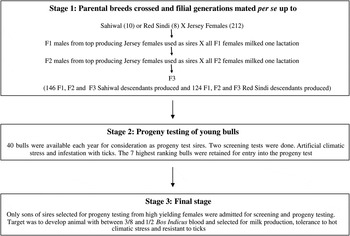
Synthetic breeds are made up of two or more component breeds, and are designed to benefit from hybrid vigour without crossing with other breeds (Bourdon, Reference Bourdon2000). Synthetic breeds can be formed in many ways. Cunningham and Syrstad (Reference Cunningham and Syrstad1987) describe two methods: the simplest form involves two parental breeds which are crossed to produce the F1 generation. Selected F1 individuals are then inter se mated to produce the F2 generation. This process is repeated in subsequent generations. Figure 1 shows a summary of the cross-breeding programme that is followed in the development of the Australian milking Zebu (AMZ), a Sahiwal:Jersey synthetic. There are also other methods of forming synthetic breeds. A programme using three breeds, for instance, could produce a synthetic with 25 percent local genes (B. indicus), 25 percent from one of the B. taurus breeds and 50 percent B. taurus genes from a second exotic animal.
Summary of the breeding programme used to develop the Australian Milking Zebu. Source: Developed from Hayman (Reference Hayman1974).

Materials and methods
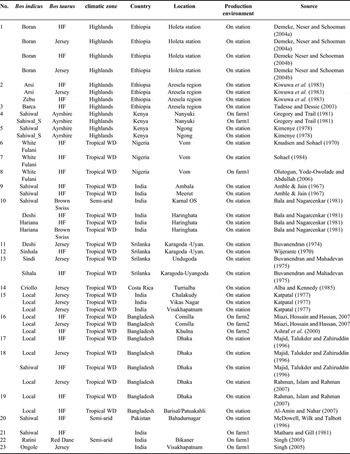
The relative performance of different grades of crosses with the indigenous genotypes from different climatic zones in the tropics was compared. The data used in the study were obtained from published records for different parts of the tropics, and grouped into climatic zones according to the classification used by World Book (2009). Data were compiled from several studies on cross-breeding for dairy production in the tropics (the complete data set is provided in Supplementary Tables S1–S3). From these, a subset of studies was extracted that evaluated the performance of different grades of cross-breeds in comparison with local breeds (B. indicus). Reports that did not have local breeds in their design were excluded. At the end of the process, 23 studies were obtained, as can be seen in Table 1. Data were further clustered into three production environment groups according to whether the study was conducted on stations or on farms, and according to the climatic zone in which the study was undertaken. Studies undertaken on large commercial farms are marked on-farm 1, and studies conducted on small-scale farms on-farm 2. The final data set comprised data obtained from three climatic zones: highlands, tropical wet and dry and semi-arid. Owing to the small differences between the tropical wet and dry climatic zones, and because of the small amount of data obtained from the tropical wet zone, the data from these two zones were merged into one tropical wet and dry zone. Traits compared in the study were milk yield per lactation (MYL), lactation length (LL), CI, AFC, services per conception (SPC), lifetime milk yield (LMY) and total number of lactations completed (TLC). Some of the studies used did not evaluate all these traits; in that case only the traits reported were considered. Relative performance of the different grade crosses was compared with that of local breeds by dividing the least squares mean (LSM) of a given trait in the different cattle grades by the LSM of the same trait in the local breeds. Finally, means and standard deviations of the relative performance ratios for the different grade crosses for a given climatic zone were computed. The ratios obtained for every study under analysis are given in Supplementary Tables S4 and S5.
Summary of data from 23 different studies used in the analysis.

Note: Tropical WD = tropical wet and dry.
Most available cross-breeding studies are based on single lactation records, and therefore do not account for lifetime productivity of cows, which is an important measure of overall profitability of dairy cattle (Matharu and Gill, Reference Matharu and Gill1981). For the purpose of this paper, reports on LMY and lactations completed (LC) were compiled (Supplementary Table S4) for indigenous cattle and the different grades of crosses. Unlike for the other traits, results from the different climatic zones were analysed together because of the low number of available studies.
Results
Grading up
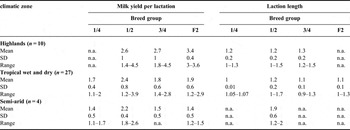
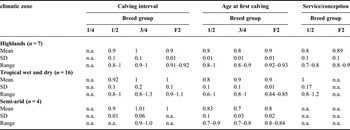
In all climatic zones, cross-breds had higher milk yields, increased LL, shorter CIs and lower AFC compared with the local breeds (Tables 2 and 3). In the highland climatic zone, it was observed that the mean MYL for cows with 50 percent B. taurus genes was 2.6 times higher than that of the indigenous cows. Cows at the next level of exotic inheritance with 75 percent B. taurus genes showed a similar performance, with an MYL 2.7 times higher than that of local cows. In the tropical wet and dry climatic zone, increasing the percentage of B. taurus genes beyond 75 percent resulted in lower milk yields than that observed in the 50 percent crosses. The F2 in this climatic zone performed significantly lower than the F1. In the semi-arid region, MYL increased by 2.2 times at the 50 percent B. taurus level. In all climatic zones, all cross-breds with the exception of the 25 percent cross in the tropical wet and dry climatic zone had longer LLs. The overall range of change for MYL was between 1.1 and 4.5. In the tropical wet and dry climatic zone, and in the semi-arid climatic zone, the F2 had lower MYL as compared with the 50 percent. With the exception of the semi-arid climatic zone, where LL increased by 1.87, mean LL ranged between 1 and 1.3 times in all the other climatic zones.
Relative performance of breed groups (F1 1/4 exotic; F1 1/2 exotic; F1 1/3 exotic; F2) in two selected production traits in different climatic zones.

Note: n.a = not available.
Relative performance of breed groups (F1 1/4 exotic; F1 1/2 exotic; F1 3/4 exotic; F2) in three selected reproduction traits in different climatic zones.

Note: n.a. = not available.
There were also some unexpected results: for example, MYL of the F2 in the highlands zone was higher than that of the F1. This observation is in contrast with findings from other studies (Syrstad, Reference Syrstad1989; Rege, Reference Rege1998), and could be because of the small amount of data used, and the fact that no correction was made for the different breed combinations used in the different studies. The widest mean range (1.4–4.5) for relative performance was observed in MYL for the F1 and 75 percent crosses in the highlands. This could be the result of the large differences in management between farms, or because of the different B. taurus and B. indicus breeds used in the various cross-breeding programmes providing the data. For example, in the highlands of Ethiopia a MYL of 529 litres was observed for Boran cattle, as compared with the 809 litres obtained from the Arsi breed in the same area (Kiwuwa et al., Reference Kiwuwa, Trail, Kurtu, Worku, Anderson and Durkin1983; Demeke Neser and Schoeman, Reference Demeke, Neser and Schoeman2004b). Holstein–Friesian (HF) crosses had the highest relative performance for MYL, followed by Jersey and Ayrshire crosses. Similar effects of B. taurus blood on performance (MYL and AFC) have been reported in other earlier studies. Cunningham and Syrstad (Reference Cunningham and Syrstad1987) compared production traits in different projects in which two or more B. taurus breeds were used simultaneously. The study included HF, Brown Swiss and Jersey cows. Jersey crosses were the youngest and Brown Swiss crosses the oldest at first calving, both differing significantly from Friesian crosses. Friesian crosses had the highest and Jersey crosses the lowest milk yields, and the differences between them were significant.
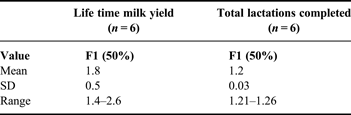
Cross-bred animals with 50 percent B. taurus genes had between 1.4–2.6 times higher LMY and 1.2 times more LC than the indigenous cattle. An increase in LMY and LC among cross-breds is also reported by Singh (Reference Singh2005), who reviewed lifetime parameters on two and three-breed crosses from different studies conducted on government and research farms in various parts of India involving several local and exotic breeds. HF crosses of 50 to 62.5 percent B. taurus genes had higher LMY and more LC than those above these levels of crossing (75 or 87.5 percent). These results were confirmed by a later study carried out by Goshu (Reference Goshu2005), who compared lifetime performance of different grades of crosses of HFs with Ethiopian Boran cattle under an intensive grazing system with supplementation at Chefa farm in Ethiopia. The level of crossing significantly affected herd life and LMY. The 50 and 75 percent B. taurus cross-breeds had significantly higher LMY and longer herd life than animals with higher levels of exotic inheritance (87.5 or 93.7 percent).
To enable proper overall comparison of the different genotypes, some studies on upgrading have focused on economic performance in different production environments. Madalena et al. (Reference Madalena, Lemos, Teodoro, Barbosa and Monteiro1990) undertook a study involving 65 commercial cooperative farms in the states of Minas Gerais, São Paulo, Rio de Janeiro and Espírito Santo, and two research centres (Santa Monica and USEPA São Carlos) in Brazil. Six red and white HF × Guzera crosses (25, 50, 62.5, 75 and 87.5 percent crosses and pure HF) kept under two types of management systems were compared, one with high and the other with low-level management and inputs. The F1 had a longer herd life, and better productive and reproductive performance than the other groups, and therefore yielded higher profits. The superiority of the F1 over all HF backcrosses was more pronounced at low levels of management.
In a more recent study, Haile et al. (Reference Haile, Joshi, Ayalew, Tegegne and Singh2007) conducted an economic comparison of Ethiopian Boran animals and their crosses of 50, 75 and 87.5 percent HF inheritance, which were all reared in an intensive, stall-feeding system in the central highlands of Ethiopia. The study covers one calendar year (2003) and collected its data from cattle kept on the Debre Zeit Research Station in Ethiopia. Returns per day and per cow were calculated from dung and milk production. Results showed that the cost of producing 1 litre of milk was significantly higher for the Ethiopian Borans than for the crosses. The 87.5 percent crosses returned a significantly higher profit per day per cow and profit per year per cow than the 50 percent crosses. The crosses of 75 percent, however, did not yield a significantly higher profit per day per cow and profit per year per cow than the 50 or 87.5 percent crosses. It was concluded that intensive dairy production with indigenous tropical breeds is not economically viable.
Variations in economic performance between crosses of different breeds have also been observed. Hemalatha, Prashanth and Reddy (Reference Hemalatha, Prashanth and Reddy2003) compiled reports in which Friesian crosses, Jersey crosses and local cattle kept in different parts of India were compared. These reports showed that the cross-breds produced higher profits per kilogram of milk produced than the indigenous Zebu animals. It was also observed, however, that maintenance costs were highest for Friesian crosses, followed by Jersey crosses and lowest for local cattle. The economic impact of cross-bred cows in smallholder farming systems has been demonstrated in a number of studies. Some of these studies (Patil and Udo, Reference Patil and Udo1997; Bhowmik, Sirohi and Dhaka, Reference Bhowmik, Sirohi and Dhaka2006; Policy Note, 2007) reported that in areas where cross-bred animals can be maintained, farmers incorporating them into their production systems had higher household incomes than those with pure indigenous breeds.
Rotational cross-breeding
One well-documented rotational cross-breeding programme is the one conducted at Kilifi Plantations in the humid lowlands of Kenya. The rotational cross-breeding programme on this farm dates back as far as 1939. Gregory and Trail (Reference Gregory and Trail1981) analysed data from two groups of cattle produced on this farm in a two-breed continuous rotational cross-breeding system. Group 1 consisted of 67 percent Sahiwal and 33 percent Ayrshire genes, whereas group 2 consisted of 67 percent Ayrshire and 33 percent Sahiwal genes. The records analysed were collected between 1972 and 1978. With regard to milk production, group 2 (463 observations) performed significantly better than group 1 in the following traits: AFC (1019 versus 1042 days), MYL (2843 versus 2662 kg) and annual lactation yield (2616 versus 2503 kg), but had significantly longer CIs (398 versus 390 days) than group 1. In a follow-up study, Thorpe, Morris and Kang'ethe (Reference Thorpe, Morris and Kang'ethe1994) analysed lifetime performance of the two groups and of the cross between them (interbreeds). LMY was 48 percent higher for group 2 (67 percent Ayrshire and 33 percent Sahiwal genes group) than for group 1. The interbreeds yielded 34 percent less than the average rotational cross (groups 1 and 2). This decline is thought to be because of recombination loss, which results from the breakdown of favourable epistatic interactions between genes in different loci (Table 4).
Relative performance of F1 with 50 percent exotic blood level in life time production traits summarized across all studies (n = 6) in which these traits have been assessed.

Later, two more breeds (Brown Swiss and HFs) were introduced into the breeding programme. Mackinnon, Thorpe and Barker (Reference Mackinnon, Thorpe and Barker1996) analysed data from a three-breed rotation programme consisting of Brown Swiss, Ayrshire and Sahiwal cattle in various combinations. The data contained 8447 observations. MYL for the herd was 3268 kg, and the LL and CI were 322 and 398 days, respectively. The improvement in performance of the three-breed crosses as compared with the two-breed crosses was attributed to the large amount of heterosis from crossing Sahiwal and the two B. taurus genomes. In a more recent study (Kahi et al., Reference Kahi, Nitter, Thorpe and Gall2000), performance of the herd was analysed after the introduction of HFs. The data set contained 25 cross-breed combinations of HF, Ayrshire, Brown Swiss and Sahiwal cattle. Overall herd MYL, CI and LL were 3446 kg, 402 and 326 days, respectively. Crosses with 50 percent HF genes had significantly higher MYL, longer LL and shorter CI than those with 50 percent Brown Swiss genes. It was concluded that, as farm management had not changed, the improvement in MYL for the herd relative to the earlier study (Mackinnon, Thorpe and Barker, Reference Mackinnon, Thorpe and Barker1996) was because of the introduction of the HFs.
Formation of synthetic populations
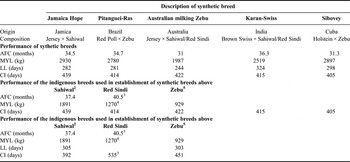
Several attempts have been made to form synthetic groups: Hayman (Reference Hayman1974), Katyega (Reference Katyega1987), Gaur, Garg and Singh (Reference Gaur, Garg and Singh2005), Singh (Reference Singh2005) and Cerutti, Alvarez and Rizzi (Reference Cerutti, Alvarez and Rizzi2006) give accounts of 13 synthetic breeds at varying levels of development from different parts of the tropics. McDowell (Reference McDowell1985) compared data of five of these groups and found that performance of each group was superior to that of the native breeds. Table 5 shows a summary of some of the traits that were compared. For comparison, the performance of the native breeds used is indicated in the same table. It should be noted that the figures given for the native breeds were selected from a few studies only to enable quick comparison. Performances of the same native breeds observed in different studies are summarized in Supplementary Table S1.
Description of origin and composition of selected synthetic breeds and overview of performance parameters of selected synthetic and indigenous breeds.

Source: 1McDowell (Reference McDowell1985), 2Amble and Jain (Reference Amble and Jain1967), 3Stonaker (Reference Stonaker1953), 4Acharya (Reference Acharya1970), 5Kiwuwa et al. (Reference Kiwuwa, Trail, Kurtu, Worku, Anderson and Durkin1983).
Note: AFC = age at first calving; MYL = milk yield per lactation; CL = calving interval; LL = lactation length
The Australian Friesian Sahiwal (AFS) is one of the successful synthetic breeds: the 50:50 Sahiwal:Friesian is a well-documented synthetic developed by the government of Queensland, Australia, from 1960 until 1994, when the programme was sold to a private company. The programme is now under the management of the AFS Association of Australia, which continues breed development, genetic management and progeny testing for AFS Bulls (Meat and Livestock Australia, 2006). The AFS was bred for milk letdown, tick resistance and milk yield. Under extensive grazing on tropical pastures, the AFS averaged 2556 litres of milk and 105 kg of fat, which compares favourably with the HF performance of 2291 litres of milk and 82 kg of fat (Alexander, Reference Alexander1986). Another equally successful synthetic is the Girolando, a 62.5:37.5 HF:Gir synthetic developed in Brazil. The Girolando produces 80 percent of the milk in Brazil and is characterized by an average of 3600 kg of milk with 4 percent fat content, and has a CI of 410 days (Girolando Associação Brasileira Dos Criadores de Girolando, 2005). In some parts of the tropics, where synthetic breeds have been successfully developed and reared by farmers, major increments in overall milk yields have been recorded. For instance, the Sunandini cattle have contributed greatly to the dairy economy of Kerala State in India. It is a synthetic breed developed by crossing nondescript local cows of Kerala State with Jersey, Brown Swiss and HF cows. It is estimated that through the active involvement of farmers in the breeding programme, milk production increased from 0.164 million tonnes in 1966 to 19.3 million tonnes in 1993 (Chacko, Reference Chacko, Ojango, Malmfors and Okeyo2005).
Breeding strategies of smallholder farmers
A study of Ethiopian smallholder farmers keeping cross-breds has shown that farmers make informed decisions about the blood level they keep on their farm. Above 85 percent of all respondents (n = 62) prefer cross-bred cows with an exotic blood level between 50 and 75 percent. Main reasons for their preference are good level of income, adaptation of animals to environment and acceptable management level. A similar number of farmers (80 percent) also prefer their bulls/artificial insemination (AI) semen between 50 and 75 percent of exotic blood. However, 47 percent of farmers prefer their bulls/AI semen to have even more than 75 percent exotic blood. The percentages do not sum up to 100 percent, because farmers were allowed to give more than one exotic blood-level group. They like having a choice of more than one blood levels to be able to use higher grade bulls/AI for mating with local and low-grade cross-bred cows and lower-grade bulls/AI for mating with high-grade cross-bred cows (Roschinsky et al., Reference Roschinsky, Sölkner, Puskur and Wurzinger2012). Madalena, Peixoto and Gibson (Reference Madalena, Peixoto and Gibson2012) also report that farmers with smaller herd sizes use bulls from different breeds in an often disorganized way in order to sustain their cross-bred herds.
Most farmers (88.7 percent) would advice other farmers to start with cross-breeding given proper management and accessible markets.
Challenges
In spite of the great potential of cross-breeding as a livestock improvement method, it has not led to a wide-spread increase in milk production in the tropics (Bayemi et al., Reference Bayemi, Bryant, Perera, Mbanya, Cavestany and Webb2005). Owing to several challenges, cross-breeding has yet to be successfully and sustainably adopted and practised in the region (Rege, Reference Rege1998; Kumar, Birthal and Joshi, Reference Kumar, Birthal and Joshi2003; Miazi, Hossain and Hassan, Reference Miazi, Hossain and Hassan2007). These include (1) limitations of cross-breeding methods; (2) mismatches between genotypes and production system, (3) intermittent funding of programmes and lack of appropriate policies and (4) lack of or limited involvement of farmers in the design of the interventions.
Limitations of cross-breeding methods
The many impressive results of grading up on record were mostly achieved at research stations and commercial farms, where the level of management and nutrition of stock is good (e.g. Katpatal, Reference Katpatal1977; Thorpe, Morris and Kang'ethe, Reference Thorpe, Morris and Kang'ethe1994; Tadesse and Dessie, Reference Tadesse and Dessie2003; Demeke, Neser and Schoeman, Reference Demeke, Neser and Schoeman2004a; Tadesse et al., Reference Tadesse, Dessie, Tessema, Degefa and Gojam2006). The smallholder sector in the tropics, which constitutes the majority of farmers, is at times unable to raise the levels of management and nutrition in line with the requirements of the new genotypes (Kahi, Reference Kahi, Ojango, Malmfors and Okeyo2002). This often leads to low productivity and high mortality among the animals (Chagunda, Reference Chagunda, Ojango, Malmfors and Okeyo2002; Philipsson, Rege and Okeyo, Reference Philipsson, Rege, Okeyo, Ojango, Malmfors and Okeyo2006).
Although results from rotational cross-breeding have shown a marked improvement in animal productivity, this improvement method can only be used on large-scale operations, where management is good. The programmes associated with it are not practical for small-scale farmers, whose herd sizes may not justify keeping more than one bull. In the two-breed rotation system, there is great variability in genotypic composition from generation to generation, depending on the sire breed used. This is not practical for small-scale operations (Trail and Gregory, Reference Trail and Gregory1981; Syrstad, Reference Syrstad1989; Madalena, Peixoto and Gibson, Reference Madalena, Peixoto and Gibson2012). The most widely reported success, the Kilifi Plantation rotation programme (Mackinnon, Thorpe and Barker, Reference Mackinnon, Thorpe and Barker1996; Kahi et al., Reference Kahi, Nitter, Thorpe and Gall2000), has never been expanded beyond the single ranch programme or replicated elsewhere. Thus, this programme has had only limited impact as a source of improved genetics to the wider dairy farming community in the hot and humid coastal region of Kenya.
The development of synthetic populations has its drawbacks, too. First, it takes many years to develop a synthetic population, during which the production environment could change. Second, the development can be expensive. For example, the development of the AFS started in the 1960s and the costs amounted to $30 million Australian dollars. The breeding programme was later sold off to a private company, which has continued commercial development since 1994 (Chambers, Reference Chambers2006; Meat and Livestock Australia, 2006). During the development period of the AFS, there were drastic changes in Australia's infrastructure. As a result, milk production systems changed and the synthetic could not compete with breeds such as HF or Jersey under the new intensive production systems. It is now estimated that only 250 pure-bred AFS cattle remain in Australia, but exports of AFS cattle continues to many tropical countries including Mexico, Brunei, Thailand, India and Malaysia (Chambers, Reference Chambers2006). However, as will be later discussed in the section ‘Opportunities’, the innovative combination of emerging assisted reproductive technologies (ART), genomics and dense single nucleotide polymorphism (SNP) marker technologies can significantly speed up the development of synthetics.
Production environment and production system
Poor infrastructure and market access are major obstacles to the successful implementation of cross-breeding programmes, especially in rural areas with lower agricultural potential. In addition, pricing policies for milk in some countries are often poor. Prices paid to the farmers are low and cannot support the purchase of feeds or investment in the necessary infrastructure, all of which are necessary to make the production system economically viable (McDowell, Reference McDowell1985). The failure to recognize the different needs of different production systems has also affected the success rate of cross-breeding programmes. In many tropical countries, past, and, in some cases, ongoing cross-breeding programmes have often been based on a one-genotype-combination-fits-all premise, with HFs being the preferred improver breed even in the hot and humid tropics and under production systems such as stall feeding (zero grazing), where other breeds might be better suited (King et al., Reference King, Parsons, Turnpenny, Nyangaga, Bakari and Wathes2006). Such genotype ×production system mismatches that ignore the important genotype-by-environment interaction effects are partly responsible for the largely disappointing and poor performance of cross-bred cattle in the tropics and their often insignificant impact (McDowell, Reference McDowell1985; King et al., Reference King, Parsons, Turnpenny, Nyangaga, Bakari and Wathes2006; Philipsson, Rege and Okeyo, Reference Philipsson, Rege, Okeyo, Ojango, Malmfors and Okeyo2006). The assumption that production systems can easily be changed and adapted to fit the needs of cross-bred animals seems in many circumstances wrong. In these cases the genetic improvement of local breeds should be considered a more realistic approach.
The choice of B. taurus breeds and the level of crossing for different production systems should not only be based on the genetic potential for milk yield, but also on farmers' ability to follow adequate husbandry practices as well as on the available healthcare services and markets. In addition, the availability of adequate, good-quality feeds and water needs to be taken into account, too. Increasing the genetic potential of the animals alone is not enough, the above factors must be considered as well for the full beneficial heterotic effects to be realized (Ansell, Reference Ansell1985; Chantalakhana, Reference Chantalakhana1998).
Intermittent funding of programmes and lack of appropriate policies
A well-planned cross-breeding programme requires adequate funding (Kumar, Birthal and Joshi, Reference Kumar, Birthal and Joshi2003). However, funds in the required amount are not always available, which has caused the interruption of many programmes (Shem and Mdoe, Reference Shem and Mdoe2003; Cardoso and Vercesi Filho, Reference Cardoso and Vercesi Filho2006; Shem, Reference Shem2007). In addition, a lack of supportive national breeding policies and appropriate strategies has contributed greatly to the failure of many programmes. Rege (Reference Rege1998) and Chantalakhana (Reference Chantalakhana1998) observed that there is hardly a country in the tropics that has developed appropriate policies to take advantage of cross-breeding. This issue is of major concern to both farmers and technical personnel who are constantly seeking answers on how to maintain the appropriate level of crossing or determine which level of crossing is appropriate for a given production environment (Ansell, Reference Ansell1985; Chantalakhana, Reference Chantalakhana1998). The lack of proper guidelines has led to undesirable consequences, especially at smallholder units where indigenous breeds are upgraded to higher exotic grades without following a defined cross-breeding programme (Kahi, Reference Kahi, Ojango, Malmfors and Okeyo2002).
Participation of farmers
Ownership of farmers of any breeding programme, either for improving local breeds or cross-breeding with exotic breeds, is a crucial point for the success for any livestock improvement intervention. Farmers must have the right to express their opinion and should be involved in decision-making processes. This can ensure that new procedures such as data recording can be easily implemented, and that animals that better fit to the management of the individual farmers are bred.
Opportunities
Certain advantages exist to assist in addressing the challenges discussed in the previous section. These include: (1) availability of a large base population of indigenous tropical cattle; (2) advancements in ART; (3) availability of alternative recording methods; and (4) advances in genomic technology. Well-planned programmes using all or a combination of the existing advantages may lead to a large number of productive cross-bred animals in the tropics. In this section, the potential and impact of the advantages given above are discussed.
Availability of large base populations
A considerable number of cattle are found in the tropics. It is estimated that of the 1.4 billion cattle in the world, more than two-third are found in the tropics (Wint and Robinson, Reference Wint and Robinson2007). Most of these are indigenous cattle and belong to the Zebu type. The Zebu can be classified into a number of sub-groups according to external traits, such as size, origin or utility. It has been proposed that improvement in tropical cattle should be made by selective breeding within the B. indicus race. This has however been shown to be a slow way to meet the fast-growing need for production (Ansell, Reference Ansell1985). The large number of existing animals with unique qualities provides an opportunity to make rapid improvements over a short period, if breeding programmes that cross-breed large numbers of animals with B. taurus milk breeds can be successfully implemented.
Assisted reproductive technologies
Recent developments in ART provide an opportunity for rapid multiplication of cross-bred populations. ART are defined as techniques that manipulate reproductive-related events and/or structures to achieve pregnancy with the final goal of producing healthy offspring in bovine females (Velazquez, Reference Velazquez2008). ART began with the development of AI about 50 years ago. Widespread use of AI has been greatly enhanced by the possibility to freeze semen. In well-structured cross-breeding programmes in the tropics, AI has the potential of increasing the rate at which genetic change happens in the local population by increasing the reproductive rates of the bulls (Cunningham, Reference Cunningham1999). Through AI it has been possible to transfer exotic genes to the tropics through imported semen. In some parts of the tropics, the persistent use of AI has yielded impressive results. In India, a well-planned cross-breeding programme resulted in the formation of the Sunandini synthetic breed. By 1993, Sunandini cattle had contributed greatly to the increase in milk production in Kerala State, India (Chacko, Reference Chacko, Ojango, Malmfors and Okeyo2005).
A successful example for the use of AI for cross-breeding in the tropics is the dairy husbandry programme of the non-governmental organization (NGO) BAIF Development Research Foundation in India. Established in the 1970s in Maharashtra, India, with support from various international development agencies and the government of India, BAIF has built up a successful AI programme. BAIF's programme has served over 4.4 million families by establishing over 3500 cattle development centres across most states of India. The centres provide doorstep AI services to farmers accompanied by training and support concerning all aspects of dairy cattle farming (BAIF, 2011b). Farmers buy high-quality semen collected at BAIFs own bull station which houses 300 bulls of various exotic and indigenous breeds (BAIF, 2011a). The joint efforts of an NGO, the government of India, private sponsors and farmers benefitting from and recognizing the value of this ART have led to a successful, sustainable cross-breeding programme.
Following the success of AI, other methods of recovering, storing and implanting embryos, for instance multiple ovulation and embryo transfer (MOET), were developed. This opened up new possibilities for genetic improvement. It has been shown in some studies (e.g. Mapletoft and Hasler, Reference Mapletoft and Hasler2005) that well-organized MOET programmes can result in increased selection intensity and reduced generation intervals, which eventually lead to higher genetic gains. It is for example estimated that if nucleus herds are established and heifers subjected to juvenile MOET (before first breeding), genetic gains twice than those obtained through traditional progeny testing programmes can be achieved. Since the middle of the 1990s, another important technique has been developed: ovum pick-up followed by in vitro embryo production (OPU-IVP). In this method, oocytes are harvested from females and fertilized in vitro (Cunningham, Reference Cunningham1999; Van der Werf and Marshall, Reference Van der Werf and Marshall2003). Through OPU-IVP, reproductive rates in females can be increased. For example, if two OPU-IVP sessions are carried out per week, up to 150 embryos and 70 calves per donor can be produced every year. There are two benefits for cross-breeding programmes: The number of females required in the programme is significantly reduced, and it is possible to multiply the number of animals with the required qualities rapidly (Cunningham, Reference Cunningham1999). If sexed semen is used for in vitro fertilization, the sex of the offspring can be predetermined. This opens up additional opportunities for repeatedly and rapidly producing cross-breds of specific breed combinations and preferred sex (Wheeler et al., Reference Wheeler, Rutledge, Fischer-Brown, VanEtten, Malusky and Beebe2006). It has also been proposed (Rutledge, Reference Rutledge2001) that OPU-IVP be used widely as a method for continuous production of F1s by using oocysts from spent dairy cows and semen from adapted breeds. In this method, lactation in F1 cows can be initiated by transfer of F1 in vitro produced embryos. This strategy eliminates the loss of the heterosis effect and increases the phenotypic variation that results when F1 cattle are bred to either a pure-bred or cross-bred sire (Hansen, Reference Hansen2006). Wide-scale use of the technologies mentioned above (MOET, OPU-IVP and AI) is, however, not possible in the tropics at the moment because of the high costs involved, the poor infrastructure in many countries and the shortage of technical personnel (Kahi et al., Reference Kahi, Nitter, Thorpe and Gall2000). Madalena, Peixoto and Gibson (Reference Madalena, Peixoto and Gibson2012) report that there is one large cooperative in Brazil that offers to members F1 heifers pregnant with F1 or other female embryos.
Alternative recording methods
It has been pointed out (Cunningham, Reference Cunningham1981) that any cross-breeding programme adopted for a population requires at some point in the programme an indigenous selection operation. A serious constraint on this is that performance records are not readily available in the tropics. The sort of extensive milk recording programmes which support dairy breeding in the temperate regions are virtually non-existent in the tropics (Syrstad and Ruane, Reference Syrstad and Ruane1998; Kahi et al., Reference Kahi, Nitter, Thorpe and Gall2000; Kosgey, Kahi and Van Arendonk, Reference Kosgey, Kahi and Van Arendonk2005). The reasons for this have been outlined by different authors (Ansell, Reference Ansell1985; Islam, Rahman and Faruque, Reference Islam, Rahman and Faruque2002; Singh, Reference Singh2005) and include: small herd sizes, scattered herds, poor communication, low level of farmer education, lack of incentives for farmers to record data, poor facilities for collecting and processing data and great diversity in feeding and management regimes. Mason and Buvanendran (Reference Mason and Buvanendran1982) argue that recording systems in the tropics do not have to be as elaborate as in the temperate regions. They propose the following approaches, which are simpler, cheaper and easier to adopt for the farmers, but would still allow progeny testing to be done: (1) bi-monthly recording: in this system, the recorder visits the farm every alternate month and records the milk yield obtained during a 24-hour period; (2) AM–PM sampling: in this method, the morning milk is weighed one month, and the evening milk the next month. It maintains monthly visits but is cheaper; and (3) sampling at particular stages of lactation: sampling during early, mid or late lactation. This system is difficult to adopt for herds calving all year as the cows will always be at different stages of lactation.
Another approach that could be employed to reduce sampling costs is to contract selected herds in a given region to produce the desired cross-breeds. In this approach, detailed recording would only take place for the contracted herds. Farmers could be familiarized with these recording systems through community-based organizations for general improvement of livestock (CBOGIL), which have been established by several groups of farmers. Kahi et al. (Reference Kahi, Nitter, Thorpe and Gall2000) define CBOGIL as organizations owned by farmers in a community with the objective of improving livestock production through use of animal genetic resources. Other authors (Sölkner, Nakimbugwe and Valle-Zarate, Reference Sölkner, Nakimbugwe and Valle-Zarate1998; Wurzinger et al., Reference Wurzinger, Willam, Delgado, Nürnberg, Valle Zarate, Stemmer, Ugarte and Sölkner2008) refer to this livestock improvement approach as village breeding programmes. CBOGIL ensure effective participation of the local communities and other stakeholders, which can lead to the establishment of successful recording systems and breeding programmes, either for pure or cross-breeding programmes (Kahi et al., Reference Kahi, Nitter, Thorpe and Gall2000).
Genomic technology: current and future opportunities
Recent development in molecular genetics and the powerful new tool genomic selection are profoundly changing dairy cattle breeding in developed countries. Genomic selection refers to selection decisions based on genomic estimated breeding values (GEBV) or genomic breeding values (Hayes et al., Reference Hayes, Bowman, Chamberlain and Goddard2009). GEBV are the sum of the effects of dense genetic markers or the haplotypes of these markers across the genome (Hayes et al., Reference Hayes, Bowman, Chamberlain and Goddard2009). Genomic selection is now becoming feasible because of the availability of large numbers of SNP markers. In the case of cross-breeding, pure-breds can be selected for performance of cross-breds by estimating the effects of SNPs on cross-bred performance using phenotypes and SNP genotypes evaluated on cross-breds, and applying the results estimates to SNP genotypes obtained on pure-breeds (Dekkers, Reference Dekkers2007). This is a major achievement because B. taurus breeds used in most cross-breeding programmes in the tropics are selected in the temperate regions under different management conditions. Owing to genetic differences between pure-breds and cross-breds, and the environmental differences between the two production systems, the performance of pure-bred parents is not a good predictor for that of their cross-bred descendants. This development now makes it possible to identify pure-breed parents whose descendants will perform best as cross-breds. Other benefits of genomic selection for cross-breeding include: (1) it does not require pedigree information on cross-breds; (2) once estimates of the SNP effects have been made, the genotype and phenotypic data can be used for several generations, and (3) it reduces the rate of inbreeding (Ibáñez-Escriche et al., Reference Ibáñez-Escriche, Fernando, Toosi and Dekkers2009).
The availability of large numbers of SNP makers has other benefits as well. It is, for example, possible to use certain techniques to accurately determine the breed composition of cross-bred animals without prior pedigree information. This is important because recording systems in the tropics are rare, and as a result many cross-bred populations exist whose breed compositions are unknown. Determining the breed composition of an animal enables inclusion of animals of unknown genotypes into breeding programmes and allows farmers to find out the accurate breed composition of the animals they wish to buy or sell.
The use of genomic technology in combination with ART opens up new possibilities of speeding up the formation of synthetic breed populations by taking advantage of reduced generation intervals and thereby multiplying the animals of the required breed combination (e.g. synthetic breeds) faster than is currently possible. The costs of these new technologies must, however, come down before they can be used on a wide scale.
General discussion
Results from over 60 years of research confirm that cross-breeding is the fastest way to improve milk production, but not necessarily to long-lasting genetic improvement of livestock, with the exception of the formation of synthetic breeds. However, results obtained at the various research centres have not been widely transferred to the farming community. This review has provided some reasons for this failure and proposed solutions for overcoming the still widespread problems. Results from a study point to the fact that the milk production performance of the F1 could be close to being the optimum, but other factors such as reproductive performance also need to be considered to give recommendations on the right combination of exotic inheritance for a particular production system. Maintaining the suitable breed inheritance through grading up and rotational breeding still remains a challenge. Implementing the proposal of continuous production of F1s (Rutledge, Reference Rutledge2001) as described in subsection ‘Assisted reproductive technologies’ can only be guaranteed if technical and financial issues limiting the use of ART are addressed. Another way to acquire animals of the required breed combination could be through special contracts with rotational breeders who supply smallholder farmers at an agreed price. The impact of such a move, however, would be limited, as there are only a few large-scale rotational breeders in the tropics. What is more, this approach cannot guard against genetic variation when offspring are mated to animals of different breed composition. It appears, therefore, that maintaining the suitable breed combination from generation to generation will be best achieved through developing synthetic breeds for the different production environments. This approach ensures the creation of a self-replacing population. It also ensures that the farmers deal with one kind of animal, which makes management easier, especially in harsh production environments. The combination of ART with advanced molecular genetics plus the availability of simple recording schemes provide great opportunities for developing and multiplying synthetic breeds at a much faster rate than in previously conducted breeding programmes. Success of this kind of programme requires farmer involvement already at the development stage and long-term financial commitment of governments and funding bodies in the tropics. Innovative ways should be found to help deal with the high costs associated with ART and the use of genomic technology. The newly developed methods could, for example, initially be targeted at farmers that have established a community-based breeding programme in which recording and breeding information is shared. This approach also enables efficient use of technical personnel and equipment as it is available in a single place.
More and more exhaustive studies on the various merits of indigenous tropical genotypes still need to be undertaken. The findings of these studies will help determine which combinations of exotic and indigenous breeds to use, and the level of exotic blood to maintain in the new genotypes. The conservation of indigenous breeds should not only not be ignored but become part of national breeding programmes as this group of animals possesses qualities that make them a valuable resource for present and future generations.
Conclusion
Cross-breeding remains an attractive option for livestock improvement in the tropics because of the quick results that can be obtained by its use and the potential benefits it has for farmers. Nevertheless, careful assessment should be made on whether or not appropriate intervention strategies need to be put in place for each individual case. The required infrastructure for improved management and market access has to be secured. In most cases, the F1 crosses perform better than other genotypes, but the continuous production of F1s and animals of required genetic combinations for the different production environment still remains a big challenge. Production and multiplication of synthetic breeds is perhaps a solution to this problem. The success of any strategy followed to improve results obtained from cross-breeding depends greatly on long-term financial commitment of governments, active involvement of the beneficiary farming communities in the design as well as operationalization of the breeding programmes, and on the successful combination of advances in ART and molecular genetics in breeding programmes.
Supplementary material
Supplementary online material is available at http://cambridge.journals.org/agr.