Introduction
Blackberry is a fruiting berry species of the genus Rubus of the Rosaceae family (Thompson, Reference Thompson1997). Rubus species are mostly perennial (in the temperate areas) with a long-lived stem crown and short-lived biennial shoots fruiting in their second year. Blackberries contain numerous phytochemicals and polyphenolic compounds that have antioxidant effects (Halvorsen et al., Reference Halvorsen, Carlsen and Phillips2006). Because of the high antioxidant activitiesblackberry fruits have received increased attention (Thompson, Reference Thompson1997).
Plant breeding requires genetic variation of useful traits for crop improvement. Often, however, the desired variation is lacking. Mutagenic agents, such as radiations and certain chemicals, can then be used to induce mutations and generate genetic variations from which the desired mutants may be selected (Predieri et al., Reference Predieri, Bertazza and Gennari1998; Van Harten, Reference Van Harten1998). Genetic diversity (GD) estimates among genotypes are helpful in selecting parental combinations for creating segregating populations so as to maintain GD in the classification of a germplasm into heterotic groups for hybrid crop breeding (Menz et al., Reference Menz, Klein, Unruh, Rooney, Klein and Mullet2004).
The inter-simple sequence repeats (ISSRs) are a new kind of molecular markers involving polymerase chain reaction (PCR) amplification of DNA by a single primer that is 16–18 bp long composed of a repeated sequence anchored at the 3′ or 5′ end by two to four arbitrary nucleotides (Russel et al., Reference Russel, Fuller, Macaulay, Hatz, Jahoor, Powell and Waugh1997). They are easy to handle, highly informative and repeatable. As repeated sequences are abundant throughout the genome, simple sequence repeat primers anneal in several regions typically giving a complex amplification pattern in which fragments are often polymorphic between different individuals (Russel et al., Reference Russel, Fuller, Macaulay, Hatz, Jahoor, Powell and Waugh1997; Esselman et al., Reference Esselman, Jianqiang, Crawford, Winduss and Wolfe1999).
In this study, we evaluated the level and organization of the GD and relationship among mutants derived from γ-ray and N-methyl-N′-nitrosourea (MNU) treatments using an ISSR marker to establish a base line to assist in future conservation and a blackberry breeding programme.
Materials and methods
A total of 56 blackberry germplasms were used in this study. V-9 (no. 1) is a mother variety derived from Black V-3 by γ-ray treatment. Fifty-two (nos. 2–53) lines were derived from the γ-ray treatment and three (nos. 54, 55 and 56) lines from the MNU treatment (Table S1, available online). In vitro cultured sprouts were treated with 20, 40, 60 and 80 Gy of γ-ray irradiation (60Co) in the Korea Atomic Energy Research Institute (KAERI) at Jeongeup-si, Republic of Korea. For the 0.05% MNU treatment, five-hundred-matured seeds were used. The plants were regenerated in a breeding farm at Bioplus (Wanju-gun, Jeonbuk, Korea) by M6 generation. Among them, 55 mutant lines exhibiting good agronomic traits such as high sugar content, low-temperature resistance and high fruit yield compared with the mother variety were selected for this study.
Total DNA was isolated from leaves of the 55 mutant lines and mother variety according to the procedure of Fang et al. (Reference Fang, Hammar and Grumet1992). A total of 30 ISSR primers from the Biotechnology Laboratory, University of British Columbia (UBC set no. 9), were used to screen the 56 genotypes. However, only five ISSR primers exhibiting clear and polymorphic band patterns were used to analyse GD. PCR amplification procedure followed for the ISSR marker was the same as that described previously (Marulanda et al., Reference Marulanda, López and Aguilar2007). The samples were fractionated in a LapChip GX electrophoresis system (Caliper Life Sciences, Hopkinton, Massachusetts, USA).
The ISSR bands were scored using a binary scoring system that recorded the presence and absence of bands as 1 and 0, respectively. The discrimination potential of the ISSR primers for the identification of each mutant line was assessed by calculating the GD, polymorphism information content (PIC), effective multiplex ratio (EMR) and marker index (MI) values. The resulting matrix of genetic similarity was calculated on the basis of a simple-matching coefficient. The genetic distance matrix was estimated using the Unweighted Pair Group Method with Arithmetic Mean (UPGMA).
Results and discussion
Polymorphism detected by ISSR marker
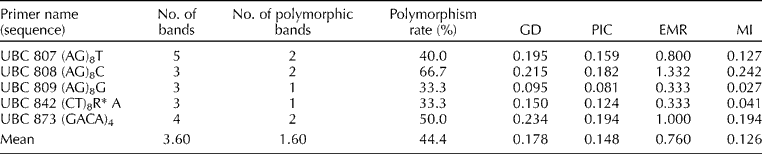
An ISSR analysis was conducted to compare the GD and variation of blackberry germplasms including 52 γ-ray treatment lines and three MNU treatment lines. The total number of bands and the number of polymorphic bands of blackberry germplasms are given in Table 1. A total of 18 bands were generated from the five ISSR primers, and eight of them were polymorphic bands representing 44.4% of the total generated bands with an average of 1.6 polymorphic bands per primer pair. The UBC 808 primer combination gave the highest percentage of polymorphic bands (Fig. S1, available online), while the UBC 809 and UBC 842 primers gave the lowest percentage of polymorphic bands (33.3%). Marker attributes for the ISSR primers are summarized as GD, PIC, EMR and MI. The GD value for each primer ranged from 0.095 to 0.234, with a mean of 0.178. The PIC value for each primer varied from 0.081 to 0.194, with an average of 0.148. The maximum values of GD and PIC were obtained with the UBC 808 primer and the minimum values with the UBC 809 primer. In addition, the other marker attributes, EMR and MI, exhibited the same patterns. Among all the γ-ray treatment populations, the 60 Gy-irradiated population exhibited the highest number of alleles, effective number of alleles and GD (Table S2, available online). In addition, the GD values were higher in the γ-ray treatment populations than in the MNU treatment population. These results were similar to that reported for Chrysanthemum (Kang et al., Reference Kang, Lee, Sung, Ha, Kim, Kim, Kim and Kang2013).
Attributes of markers produced and genetic diversity (GD) information of five populations obtained with inter-simple sequence repeat primers across a blackberry gemplasm

PIC, polymorphism information content; EMR, effective multiplex ratio; MI, marker index.
Genetic relationship among the mutant lines in blackberry
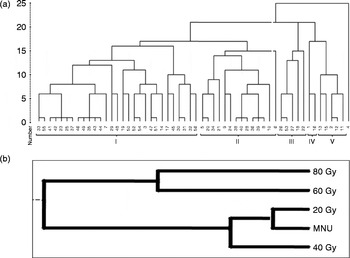
A cluster analysis was carried out using the simple-matching coefficient among the 56 blackberry germplasms, and a dendrogram was generated using an average linkage method (Fig. 1(a)). All the mutant lines can be classified into five categories and one independent group (no. 4) at a genetic similarity level of 82.3%. The genetic similarity among the mother variety and mutant lines ranged from 61.1% (no. 37) to 94.4% (no. 16) with an average of 74.2%. The dendrogram revealed an unclear pattern of division among the mutant lines based on mutagen treatments.
(a) Dendrogram illustrating genetic relationships among the mutant lines generated by cluster analysis with an average linkage method. (b) Unweighted Pair Group Method with Arithmetic Mean dendrogram of the γ-ray and N-methyl-N′-nitrosourea (MNU) treatment populations.

Based on the five populations treated with different doses (20, 40, 60 and 80 Gy) of γ-rays and MNU, a distance matrix of ISSR data was calculated, and the dendrogram constructed through a UPGMA analysis showed two main groups (Fig. 1(b)). The genetic distance among the five populations varied from 0.009 (between the 40 Gy and MNU treatment populations) to 0.109 (between the 20 and 80 Gy treatment populations). The genetic distance was greatest between the 80 Gy-irradiated population and other populations (Table S3, available online).
In this study, high levels of GD were found during the various mutagen (γ-ray and MNU) treatments. Based on these results, it can be concluded that the mutant breeding technology is a good method to induce new genetic variations and create new breeding materials in blackberry. This study will also help in understanding the dosage effects of γ-irradiation to induce mutations in blackberry.
Supplementary material
To view supplementary material for this article, please visit http://dx.doi.org/10.1017/S1479262114000537
Acknowledgements
This study was supported by Jeongeup-si and a grant from the KAERI, Republic of Korea.