1. Introduction
In this paper I want to consider two things together that may, at first sight, have little direct connection to each other: the topic of a well-articulated curricular sequence to enhance instructed language learning and the Standards for Foreign Language Learning (National Standards in Foreign Language Education Project 2006), arguably the document that has dominated pedagogical thinking in US foreign language education for the past decade or so. More precisely, I want to consider whether, and how, the culture content standards, one of five components within the overall Standards document, might help the language community address what are perhaps its most urgent questions in the age of multilingualism and multiculturalism, migration and globalization: can we find principles for assuring that the culture or content of a second cultural area and the second language are learned simultaneously and with reference to one another, and can we imagine that intricate linkage in a manner that would, within a reasonable length of time, enable learners to develop levels of ability in that language that would approach a competent L2 literacy, perhaps even a competent L2 cultural literacy?
Let me provide some additional context for this interrelated set of questions, thereby further motivating not only my choice of focus but my belief that a joint consideration of articulated instructional sequences and cultural content in L2 learning would be a significant step forward in our professional discussion. Not only would it benefit our own field but it would appropriately acknowledge the societal responsibilities that applied linguistics, and language teaching and learning in particular, has always claimed in matters pertaining to language (Byrnes Reference Byrnes and Sanz2005).
With regard to the first aspect, a focus on articulation, even a cursory survey of professional discussion over the last two to three decades shows that the call for articulated sequences of instruction is among the most persistent and long-lived demands in US language education. Reasons for that state of affairs are obvious. After all, if there is one thing about language learning we can all agree on it is this: it takes a long time. A challenge for instructed language learning is therefore to use the usually limited time in a maximally efficient and effective way, and that means in a way that assures continued language development through carefully articulated curricula within a particular program.
In the United States the topic of articulation takes on additional urgency because language instruction is not a core curricular subject. That is, not only can one not assume learners’ long-term engagement with language study, language learning can begin and unfortunately also abruptly end at almost any level of education. As a result, whenever languages are in fact taught, smooth transitions from one grade level to the next and from one educational context to the next (e.g., from primary to secondary to tertiary education) are particularly crucial factors in the success of language teaching and learning. Also as a result of the perilous position of language programs in pre-collegiate education, US higher education, by comparison with other countries, has unusually high responsibilities for ensuring a citizenry that is competent in more than one language.
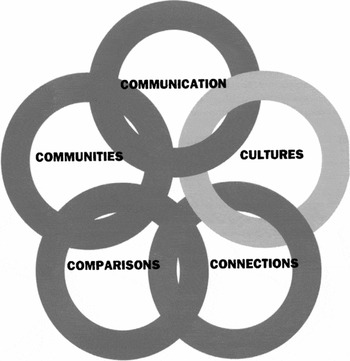
With regard to the second aspect, my focus on the Standards, the Standards framework has embraced the goals and approaches of communicative language teaching, which, for over three decades, has been seen as highly appropriate for multilingual societies in the information age. Its can-do orientation, summarized in the phrase ‘what students should know and be able to do with another language’ has become the shorthand descriptor of the overall Standards project, no matter the specific goals area. But it envisions much more than ‘mere communication’ when it foregrounds the so called five Cs as the vision of contemporary language pedagogy – communication, cultures, connections, comparisons, and communities. It embraces the lively exchange of ideas, the appreciation and understanding of others’ history, belief systems, ways of interacting, and customs, and the opportunity to re-evaluate and enrich one's own positions and those of others in communities of various sizes – dispositions, beliefs, and praxes that are highly suited to an age of migration and globalization.
At the same time, the Standards document remains largely silent on precisely how those learning goals are to be attained. In a curious two-step it presents itself as ‘a framework for the reflective teacher to use in weaving [these] rich curricular experiences into the fabric of language learning’ (p. 28) while restricting itself to pedagogical guidance and offering little explicit treatment of curricular issues.
Without just such guidance, however, the Standards project can easily underestimate the need for principled, well specified and well articulated curricular sequences. More troubling, without such guidance, it exposes teachers to two kinds of pressures: first, the pressure to pretend that instructional articulation can somehow be handled on the basis of content and culture without a thorough reconsideration of professional beliefs about the nature of language; and, second, the pressure to subtly revert to grammar instruction, though perhaps stealthily and insecurely, because the nature of the required ‘new grammar’ and ‘new grammar teaching’ is far from clear.
To sum up, for the shift envisioned by the Standards to be more than an enticing promise, teaching professionals need new conceptual anchors. Four areas require particular attention if we are to create a content-language acquisition-rich environment. (i) We must find a principled and comprehensive, rather than an ad hoc and compartmentalized, way of linking the culture or content of a second language/cultural area with second language learning. (ii) That approach must be amenable to and adjustable within diverse educational settings for different learners and different languages. (iii) It must be translatable into different curricular progressions that recognize the peculiarities of particular educational settings, most especially different learners and different languages. (iv) It must be possible to make whatever approach is recommended transparent for both teachers and learners so that they can actively participate in making meaning in the second language. For teachers, that transparency is intended to enable flexible and yet principled pedagogical action. For learners, it should facilitate engaged, attentive, conscious learning, the kind of meta-awareness that is increasingly being seen as a central aspect of language development that assures sophisticated access, through language, to higher forms of cognition and consciousness (Lantolf & Thorne Reference Lantolf and Thorne2006). In all these steps the goal is to devise a trajectory toward the development of a competent and confident L2 cultural literacy. Reflecting on these issues is at the heart of my deliberations.
2. Exploring the Standards’ learning goals: communication and culture
Over the last decade, the US language profession has become very familiar with the image of five interlocking circles which represent the five content goals (the five Cs), as the logo for the Standards project (see Figure 1). However, closer inspection reveals a more complex relationship among the components. In the center, and seen as inseparable from one another, stand communication and cultures or, following Lantolf (Reference Lantolf and Byrnes2006), who adopts this term from Michael Agar, in the center stands languaculture (Agar Reference Achugar, Colombi, Ortega and Byrnes1994). That means that the Standards challenge us to find ways of imagining and specifying just how language and culture coexist even in beginning instruction, with sociocultural interactions providing both content and context for the possibility of language-based meaning-making.
The five C's of the Standards.

What is the core of that meaning-making activity? The eminent British-Australian linguist Michael Halliday, in his systemic-functional linguistic theory (SFL), has described the metafunctions of language like this:
[L]anguage use is about our intention and our ability to understand our environment – its ideational metafunction; it is about our intention and ability to act on others and to relate to others in that environment – its interpersonal metafunction; and that ability occurs in situated texts, both oral and written – its textual metafunction. (Halliday Reference Halliday1994)
In that case, the remaining circles of the Standards visual – connections, comparisons and communities – actually pertain to diverse facets of language use, among them intentions we pursue in communicating within a particular environment or context, both ideational and interpersonal. Specifically, the Standards point to the possibility of expanding disciplinary knowledge, acquiring information, and recognizing other viewpoints as ways of making connections in L2 study; they highlight an understanding of the concept of culture and of the nature of language as part of the learning goals targeted with the term comparisons; and they foreground life-long learning in and through and with language, personal enjoyment and enrichment, and engagement in public life with language as the role of languages in communities.
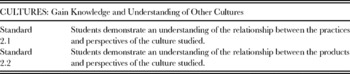
The Standards approach culture in terms of perspectives, which refers to meanings, attitudes, values and ideas, and emphasizes two sites of inquiry: practices, which seek to uncover patterns of social interaction; and products, such as books, tools, foods, laws, music, or games, which constitute the material manifestations that allow us to enter into the other culture's world. The results are two broadly-worded content standards in the area of culture learning, presented in Table 1.
Culture Standards.

There is little doubt that the Standards constitute an innovative accomplishment in how the profession should view language and, by extension, language teaching. That innovative focus can be summarized in the following interrelated points regarding language as being inseparable from language use:
• the primacy of culture and sociocultural context for language use;
• the significance of a larger sociocultural environment for language to function as a meaning-making semiotic;
• the importance of probing language use in its sociocultural context;
• a meaning focus for language use;
• the functionality or intentionality of language use.
And yet, the Standards also harbor unresolved issues. In identifying the three meaning dimensions of the interpersonal, interpretive and the presentational, and associating the interpersonal primarily with oral dialogic language, the interpretive primarily with reading and listening, and the presentational with monologic language use, oral or written, the Standards appear to revert to an old division by skills. Its terms can suggest that interpersonal and interpretive aspects of language use are somehow aligned with particular modes of communication, rather than characterizing all language use. In associating interpersonal features with spoken language, the document underestimates the synchronic and diachronic dialogicality of all language use. Reading and writing, central for a schooled environment even in a second language, are not seen as an important context for enabling learners to develop literate language use and, along with speaking, an identity as a competent non-native user of the language. But the Standards’ real limitation and hindrance to implementation is this: the framework's conceptual tools, even when they are understood as a heuristic and presented as interrelated, leave unaddressed how they would provide a foundation on which curricular articulation for the development of L2 cultural and content knowledge in the second language can be built.
3. Facilitating language educational goals in the age of culture
Stating the issue like this may be an unfair critique of the Standards project. After all, the issue is neither new nor something that the Standards created. Three vignettes in our professional history demonstrate that fact and highlight the practical, theoretical and intellectual challenges brought on by foregrounding content and culture in language teaching and learning.
First, as the debates at the beginning of the communicative era indicate, not only did the old grammar-based syllabus become unsatisfactory, innovative proposals encountered difficulties of their own as Johnson's (1982) encompassing discussion of the pros and cons of broadly functionally or semantically oriented syllabuses (e.g., functional, notional, communicative, procedural or process syllabuses) readily shows. Problems begin with determining units of organization for such syllabuses: one may have reached consensus on the inventory of content areas to be taught, but that agreement is vastly different from decisions about ordering. Similarly, one may be interested in conveying cultural information; but does that necessarily translate into a functional syllabus? Is a syllabus that makes communicative settings the organizational principle that much better at fostering language learning than is a grammatical syllabus, all the more so as settings clearly do not equate with functions, and functional and notional designs can become needlessly abstract? Small wonder that Johnson, agreeing with David Wilkins, one of the foremost scholars on curriculum design, cautions that it was ‘decidedly premature’ that ‘in the present state of the art functional syllabuses should replace grammatical ones’ (Johnson Reference Johnson1982: 91). As long as ‘the uses to which the structures introduced are put, the settings they are introduced in, and the topics they are used to talk about’ (p. 113; emphasis in the original) are favorably affected by a semantic/communicative orientation, perhaps that would achieve the desired learning goals.
Impasses of another type arise about the relation between formal features of language and culture. One of the best-known statements in that regard is that by Saussure about the arbitrariness of the sign, by which he meant that, regarding the two aspects of the sign, the signifier itself ‘has no natural connection with the signified’ (1959: 69). While Saussure's discussion pertains to the phonological characteristics of the signifier, extending that insight – even if only implicitly – into issues of meaning-making in texts forecloses the opportunity, much less the need, for exploring links between language and culture. When such a theoretical stance is paired up with a largely individualistic, innatist notion of language development and use, for a long time favored by theoretical and applied linguistics, little room is left for an exploration of language-culture links.
Finally, the complexity of the project can also be gauged by observing how ‘culture’ has entered the reshaped intellectual identity of foreign language departments. On the one hand, the ‘discovery of culture’ has provided considerable intellectual ferment in nearly all areas of social and intellectual thought. On the other hand, it may actually downgrade the role of languages in the newly formed (literary-)cultural studies departments when they trade in a focus on language for the vantage point of culture (Byrnes Reference Byrnes2002a). Many have made that shift with a strong sociological and anthropological bent and an interest in literary theories that seems more enamored with various ideological stances than with the actual language of the text.
Such a preoccupation with social rather than textual phenomena can result in departments forfeiting their particular academic niche, even their particular form of self-identification – the fundamental engagement, indeed preoccupation, with the link between textual language and cultural representations and identities. Often that loss is accompanied by a reduced need and desire to teach language toward high levels of ability, even the expertise to do so competently. Language teaching is then outsourced with impunity to a language center that retains only a tenuous connection to the intellectual life of a department, thereby sealing its fate as a service enterprise.
Turning such developments around will require concerted efforts on the part of the entire language profession, from theoreticians, to empirical researchers, to teaching professionals. To begin with, the project would have to assure an understanding of culture that relates culture to language, no matter how insightful or valid other approaches might be. That means seeking out systematic, patterned, probabilistic relationships between cultural meaning and textual language. More specifically, culture-language relationships will need to be explored for principles that support creating extended instructional sequences that are suitable for different learners, languages, age groups, learning goals and programmatic constraints and opportunities. Furthermore, such links would need to be probed for their greater or lesser learnability based on theoretically viable arguments and empirically derived evidence. Only then can one develop a credible decision-making basis for a curricular progression. Only then can one propose pedagogies that would foster learners’ ability to develop the kind of semiotic capacity in oral and written texts in the L2 that would be recognized as culturally situated – and therefore meaningful practice in the L2 cultural context.
4. Challenges in linking language and culture
With that as background, I return to the questions posed at the beginning of this paper, exploring possible recommendations for creating a content-language acquisition-rich environment from four perspectives with their attendant challenges.
4.1 The challenge of arriving at suitable theories of culture and language
The first challenge is to arrive at theories of culture and language that are intellectually compatible with each other. To that end, I turn to the noted anthropologist Clifford Geertz who, in one of his more famous formulations, describes culture in the following fashion: ‘believing . . . that man is an animal suspended in webs of significance he himself has spun, I take culture to be those webs, and the analysis of it to be therefore not an experimental science in search of a law but an interpretive one in search of meaning’ (Geertz Reference Geertz and Geertz1973: 5).
A theory of language that takes a similarly explicitly interpretive and meaning-oriented position, that is, a semiotic position, is SFL. Viewing language and culture as inseparable, such that ‘the very existence of one is the condition for the existence of the other’ (Hasan Reference Hasan, Fries and Gregory1995: 184), Hasan counter-argues a position frequently taken in both linguistics and philosophy, that language depicts reality. Instead, it construes reality. In turn, social activities have the meaning they do have because of their particular forms of being construed in and through and with language.
Halliday (1994: xxxi) expands on the social-semiotic link between culture and language when he poses and answers the following question:
What is the relation between the code and the culture which creates it, and which it transmits to the next generation? . . . Just as each text has its environment, the ‘context of situation’ in Malinowski's terms, so the overall language system has its environment, Malinowki's ‘context of culture’. The context of culture determines the nature of the code. As a language is manifested through its texts, a culture is manifested through its situations; so by attending to text-in-situation a child construes the code, and by using the code to interpret the text he construes the culture.
As a result, texts become the unit of analysis for linking forms of language, the code, to a particular situation and, beyond that, to its larger cultural context. That includes the possibility for learners, through an evolving rich repertoire of situated texts, to develop both an understanding of culture and the ability to use situationally and culturally appropriate language.
Finally, and strengthening the developmental trajectory already present in the previous description, Halliday (1994: xxxii) adds this about the relation of code and culture:
We have as yet no comprehensive semantics. But we can attempt a comprehensive view of grammar; and for any code-oriented investigation this is essential. You cannot interpret a text in its context of culture without an overall picture of the grammar through which it is encoded.
I suspect that such emphatic foregrounding of grammar may be a bit jarring. It makes sense only if one assumes an understanding of grammar that differs decidedly from that found in so much language instruction. Indeed, Halliday considers grammar a privileged part of language inasmuch as it gives language its ‘energy’ (1996: 4), in other words, is not primarily about rule adherence. It does so because, as an entirely abstract semiotic construct, it has emerged between the content plane (‘meanings intended’) and the expression plane (‘words chosen’) of a postulated earlier and simple closed, one-to-one semiotic system such as that of traffic lights. It is this stratum of the lexicogrammar, at the interface between the two systems, which affords an indefinite amount of ‘play’ for language – what we call its infinite meaning-making capacity (1996: 5f.).
As Halliday observes, the discussion of different words characterizing different cultural-linguistic communities (Arabs having many words for camels, Eskimos differentiating many forms of snow) is almost comical in its misrepresentation of the real issue, namely that ‘the grammatical system as a whole represents the semantic code of a language’ (1994: xxxi). Therefore, a key need is to ‘confront one part of it with another . . . whether the text is literature, or classroom discourse, or political or commercial propaganda, the basic grammar of the clause complex, the clause, the prepositional phrase, verbal and nominal group, and information unit, will always be involved’ (1994: xxxi–xxxii). It goes without saying that the majority of grammatical treatments we have of the languages we teach fall seriously short of that demand, a considerable challenge to language theorists.
4.2 The challenge of linking culture and language in an educational setting: texts and registers
The previous arguments introduce a second challenge, reshaping a textual focus in a fashion that is translatable into curricular and pedagogical decision-making. While the notion of text is rather too capacious and, also, too nebulous to suit those needs, another central notion in SFL, that of register, understood as preferred ways of bundling language features, may prove advantageous. Registers are constellations of lexicogrammatical features that construe a particular situational context. They are also the first level at which the three metafunctions of language come together: the ideational function in terms of features of field; the interpersonal function in terms of features of tenor; and the textual function in terms of features of mode. Indeed, it is that confluence of linguistic features which construes the situational context, thereby making it different from the physical setting for a particular communicative event. Earlier discussion about principles for communicative language teaching had failed to make that critical distinction. In short, not only is the link between language use and cultural conventions obvious; attentiveness to registers and their characteristic features may provide a useful conceptual step in our search for translating those insights into educational environments.
4.3 The challenge of translating the culture–language link into a curricular progression: the centrality of curricular thinking
If a complex notion like register is to inform educational practice, it must be nurtured in extended sequences, a curriculum. Only then can one offer the necessary opportunities for breadth, depth and exploration of diverse linkages within the language system. Only then is it reasonable to expect learners to gain insight into and use of language as a resource for meaning-making in accordance with a trinocular perspective of lexicogrammar. It construes experience:
(i) ‘from above’ – similarity of function in context;
(ii) ‘from below’ – similarity of formal make-up; and
(iii) ‘from the same level’ – fit with the other categories that are being construed in the overall organisation of the system (Halliday Reference Halliday, Hasan, Cloran and Butt1996: 16, bold in original)
Deep down, all three perspectives are about making choices, an orientation that is possible only when learners relate their evolving understanding of the resources a language system makes available to their attempts ‘to realize specific intentions that they may wish to communicate relative to events and states in the world’ (Lantolf & Thorne Reference Lantolf and Thorne2006: 307).
The long-term nature of developing this ability requires us to consider more closely the nature of curriculum, a topic that is remarkably underrepresented in professional discussion. There is curriculum as wishful intention, at times as imposed prescription of ‘what should happen’; and there is curriculum as reality, ‘what does happen’, where all too often neither addresses the affordances that reside within a particular educational setting. For that reason, the well-known curriculum specialist Lawrence Stenhouse suggests we think of a curriculum as ‘an attempt to communicate the essential principles and features of an educational proposal in such a form that it is open to critical scrutiny and capable of effective translation into practice’ (Stenhouse Reference Stenhouse1975: 4). Narrowing down ‘text’ to the level of ‘register’ recommends itself as a first crucial step toward developing such a proposal for linking content and language learning.
A subsequent step would recognize that curriculum development is about selection and sequencing. Three scholars might provide general principles for that task. The first is Mikhail Bakhtin, the Russian philologist and philosopher of language, whose insights regarding voice and multivoicedness or heteroglossia present language learning as evolving participation in the discourse of another culture. Bakhtin's central insight is the dialogicality of conversation (1986b) as the prototypical form of language use. As a result, the words used in conversations never belong solely to the speaker but are already part of a multivoicedness of utterances. Also, the dialogue is not focused on explanation and information being exchanged between autonomous knowers and communicators, but is characterized by the reciprocity of conversation and, with that, the centrality of understanding. This makes each utterance both unique and relational. How the individual learner can be supported in finding a voice within the relatively stable types of utterances that have developed in a speech community, the speech genres, becomes a fruitful area of inquiry and pedagogical action.
Superimposed on that task in curricular and pedagogical action is a second one, gradually moving learners from the overt dialogicality of conversations to the covert dialogicality of the entire language system. Beyond the unique utterance or text, what Wertsch calls ‘local dialogue’, there is language as ‘generalized collective dialogue’, which concerns ‘how utterances reflect the voice of others, including entire groups, who are not present in the immediate speech situation’ (2006: 61). Indeed, Wertsch turns such an encompassing view of language, which includes sedimented aspects of culture, into a way of describing language learning at an advanced level: it ‘requires mastery of a generalized collective dialogue’ (p. 64).
A last step in these Bakhtinian considerations affirms what is already implicit, namely the centrality of heteroglossia. Language use is situated at the intersection of centrifugal forces of flux, at work in every unique utterance, and centripetal forces, diverse social forces that are ‘at work in the verbal-ideological evolution of specific social groups . . . [and] serve to unify and centralize the verbal-ideological world’ (Bakhtin Reference Bakhtin1981: 270, italic in original). It must be described and pedagogically presented in that fashion.
The second scholar, the US literacy expert James Gee (Reference Gee, Schleppegrell and Colombi2002), shows considerable affinity to Bakhtin and Halliday. For Gee, the origin of language use lies in particular interactional patterns and activity types that construe those settings themselves, a position he projects provocatively by saying that we do not learn ‘language’ but, instead, learn various ‘social languages’ or registers. Some of us are exposed to a narrow, restricted band of such social languages; others have the privilege of being exposed, through their life experiences and, importantly, through education and, more generally, literacy events, to a considerable range of such social languages.
Important for the present search for principles for a curricular progression is Gee's distinction between primary and secondary discourses. Terminologically it is reminiscent of Bakhtin's distinction of primary and secondary speech genres. Yet, while Bakhtin's reflections focus on the role and place of the individual as a not completely free agent within stable forms of language use, Gee associates with primary discourses ‘the culturally distinctive way of being an everyday person, that is, a nonspecialized, nonprofessional person’ (2002: 160) and calls secondary discourses ‘all the Discourses we acquire later in life, beyond our primary Discourse, we acquire within a more public sphere than our initial socializing group’ (p. 161).
In retrospect we can say that communicative language teaching expended its energies on fostering the development of the primary discourses while nearly completely disregarding the development of a secondary discourse capacity. If we now want learners to develop a strong sense of, and engagement with, the breadth of resources that a language makes available for relating lexicogrammatical features to both private and public social settings, a trajectory that includes both forms of engagement is critical. Only then can we avoid misrepresenting the nature of any of the language features learners are gradually internalizing. Bakhtin goes as far as to warn about ‘a vulgarization of the entire problem’ if only one side were attended to (1986a: 60). Only then can we hope to make language learning a project that enables learners to develop valid new identities as non-native users of another language.
For a third approach to arriving at macro-decisions for a curricular progression, I return once more to Halliday and his explication of the nature of meaning-making that characterizes different discourses and registers. Two sample sentences provide a first glimpse of the two kinds of semiosis Halliday distinguishes:
(1) While they visited Paris they bought lots and lots of souvenirs and so their suitcases weighed much more than they were allowed.
(2) Because of their prolific purchases of souvenirs during a visit in Paris the travelers’ suitcases exceeded the weight limit.
The first sentence exemplifies congruent semiosis, a way of conceptualizing reality in terms of actors and actions that foregrounds functions, processes and flow. The second sentence, by contrast, is an instance of non-congruent, synoptic or metaphorical semiosis with its focus on stasis and structure, what Halliday (Reference Halliday1993) calls the ‘thinginess’ of the world. Importantly, both forms of semiosis, both perspectives, are available in our construal of reality; they are not mutually exclusive, though appropriate in different registerial environments for different topics and communicative settings. Equally important, noncongruent semiosis is not necessarily a ‘natural’ stage in language development, but is fostered and learned under the influence of educational systems (Halliday Reference Halliday1993, Reference Halliday1994, Reference Halliday, Berry, Asker, Hyland and Lam1999a, Reference Halliday and Ghadessyb), what we generally refer to as the language of schooling or academic language use (Schleppegrell Reference Schleppegrell2004).
The decisive lexicogrammatical feature for the semiotic shift toward schooled language is what Halliday refers to as grammmatical metaphor. It is a kind of technologizing of our commonsense, congruent experience of the world, particularly through nominalizations, which results in our experiencing the world from the outside, synoptically, like a text (cf. Halliday Reference Halliday1993, Reference Halliday, Martin and Veel1998, Reference Halliday and Webster2002). As a linguistic resource this reconstrual of reality in metaphorical terms that are in the grammar, as contrasted with traditional notions of metaphor as residing in the lexicon, has distinct consequences: it foregrounds the textual function over the ideational function, allowing structured and ‘crystalline’ sculpting of the status of different aspects of meaning conveyance in discourse. The extended nominal group, along with its consequences for the verbal group, has become the hallmark of this form of semiosis and, by extension, for various disciplinary discourses (Halliday Reference Halliday and Webster2002).
Of particular interest in that regard is emerging evidence that the progression uncovered in L1 seems also to apply to L2 learning, even when adult learners have already developed these semiotic abilities in their L1 as part of their educational histories (Byrnes Reference Byrnes and Byrnes2006b, and several data-based contributions in Byrnes Reference Byrnes2006c). If that is so, then detailed understanding of the nature of this shift and devising curricular occasions and pedagogical moves is a requisite for advancing learners from familial ways of expressing themselves to competent participants in the public venues of the L2 culture. For example, research has shown how heritage speakers are able to expand their expressive repertoires (Colombi Reference Colombi and Byrnes2006) and also to construct new identities for themselves (Achugar & Colombi, in press).
4.4 The challenge of making a curricular progression transparent for pedagogy: the role of genre
With a textual and register orientation providing primarily conceptual anchors for linking content and language in a culture-oriented treatment of language, a final step remains to be taken. Experience, particularly in the context of Australian L1 literacy schooling, has shown that teachers and learners need yet greater specificity. For that reason we turn to the construct of genre.
Among the most enduring categories in literary analysis, ‘genre’ is, at once, a very familiar term and, in its past practice, nearly as unsuited to long-range educative decision-making as ‘text’ and ‘register’ have been. The following considerations are intended to address that shortcoming. Beginning with Bakhtin, we find a conception of genres as ‘relatively stable thematic, compositional, and stylistic types of utterance’ (1986a: 64). They tend to be ‘inseparably linked to particular thematic unities and – what is especially important – to particular compositional unities: to particular types of construction of the whole, types of its completion, and types of relations between the speaker and other participants in speech communication (listeners or readers, partners, the other's speech, and so forth)’ (p. 64).
Coming from an SFL perspective, Martin (Reference Martin, Benson and Greaves1985) expressed a similar interest in compositional wholeness by characterizing genre as staged activity-types. Of particular interest is the fact that ‘one of the principal descriptive responsibilities of genre is to constrain the possible combinations of field, mode and tenor variables used by a given culture. No culture makes use of all possible combinations. In western culture for example, one does not lecture about typing, bicycle maintenance or house cleaning’ (p. 250).
But beyond legitimizing certain combinations of field, tenor and mode, genre and the verbal strategies that enact them ‘can be thought of in terms of stages through which one moves in order to realize a genre’ (Martin Reference Martin, Benson and Greaves1985: 251). In an example that draws on the wellknown analysis of narratives of personal experience by Labov, Martin refers to the move from an Abstract, through an Orientation, Complication, the insertion of an optional Evaluation, the presentation of a Resolution and its ending with a Coda. He claims that ‘all genres have a beginning-middle-end structure of some kind; these structures will be referred to here as schematic structures . . . Schematic structure represents the positive contribution genre makes to a text: a way of getting from A to B in the way a given culture accomplishes whatever the genre in question is functioning to do in that culture’ (Martin Reference Martin, Benson and Greaves1985: 251, italic in original). While schematic structures (in contrast, for example, with clause structures) are somewhat variable, they nevertheless lend themselves to be represented in something like an ‘elaborated decision tree or flow chart’ (p. 258). Its actual realization over time allows one to see the interrelationship of both product and process, ‘as two distinct but symbiotically interacting potentials’ (p. 259). Such a feature should be particularly advantageous for a pedagogy of scaffolding.
Genres can be organized in various ways that can inform a curricular progression. One can differentiate between primarily personal and private genres and more public genres. For some genres, literary and non-literary, including genres for education, narrativity is central. Finally, a focus on genres that are prominent in educational contexts is inherently of interest. For example, Rothery's (Reference Rothery, Hasan and Williams1996) research indicates that procedure, report, explanation, exposition and discussion are genres that carry considerable importance across the primary school curriculum. In the secondary curriculum, narrative genres are increasingly differentiated, moving from simple narratives, to science fiction narrative, projective narrative, thematic narrative, and subversive narrative. At the same time, genres instantiate forms of disciplinary inquiry or, worded the other way around, disciplines show preferences for certain genres. Thus, in the area of history, Martin (Reference Martin, Schleppegrell and Colombi2002) proposes a progression from personal recount, autobiographical recount, biographical recount, historical recount, historical account, factorial explanation, consequential explanation, exposition, challenge/rebuttal, multi-sided discussion, and, ultimately, post-colonial discourse. Within the overall progression of genre moves that characterize this sequence, the shift from congruent to non-congruent forms of semiosis is central.
A genre orientation within which learners are encouraged to explore the relatively stable characteristics of different genres is fundamentally different from rule-based, even template-like approaches to the development of literacy; it is not an affirmation of existing social power relationships nor a return to old formalisms. On the contrary, as Cope & Kalantzis (Reference Cope, Kalantzis, Cope and Kalantzis1993a) emphasize, a genre-based pedagogy establishes a dialogue between the culture and the discourse of institutionalized schooling, uses cultural linguistic difference as a resource and reinstates teachers as professionals in a text-oriented way of approaching language. In that sense it is a pedagogy of inclusion and access, a way of overcoming, through explicit text-oriented teaching, the hidden curriculum that otherwise continues to privilege learners whose socioeconomic status and, by extension, literacy practices, provide them with unfair advantages in the educational process (Cope & Kalantzis Reference Cope, Kalantzis, Cope and Kalantzis1993b).
5. The culture Standards and the goal of developing advanced levels of L2 literacy
Throughout this paper I have emphasized that the culture Standards project an educational vision of teaching second/foreign languages that intends to enable learners to become culturally literate in a second language. At the same time, the culture Standards, like much other discussion about language and culture, shortchange the language-based nature of such a cultural literacy and present goals in terms of knowledge and beliefs that do not differ appreciably from the learning goals espoused in the majority of undergraduate curricula under the rubric of intercultural education.
But what is unique about the language field is its potential to investigate the intricate link between culture and language or, in reverse, language and culture. A differentiated understanding of those phenomena could contribute to educating a citizenry for the opportunities and challenges of the 21st century. Those include the ability to be full participants in the discourse of diverse L2 cultures, an ability that I have described as the practical command of the generic forms in a range of culturally and linguistically construed settings that circumscribe in a probabilistic fashion what can be meant in certain contexts, how it can be meant, and how persons can gain and retain voices within those varied discursive contexts.
That critique notwithstanding, the Standards have provided important stimuli that, with appropriate elaboration, justify the hope that their intentions can be implemented. In particular, an approach to constructing an integrated curriculum on the basis of major textual genres, along with devising genre-oriented materials and pedagogical tasks, makes possible the desired integration of cultural content and language. By linking language use at a time and language development over time it can enable learners to become multiply literate users of language who understand themselves and others through engaging with them in their physical and social environment.
That admittedly lofty goal is possible only if we pledge ourselves to conceptualizing language teaching within a trajectory toward advanced competencies. Contrary to received beliefs that an instructed setting is unlikely to enable learners to reach such ability levels, there are indicators that this is, in fact, possible – though not under a ‘business-as-usual’ approach. As an aside, it is plausible that a truncated communicative approach, such as that instantiated in the United States particularly through the proficiency guidelines, may have created its own glass ceiling for learner development (Byrnes Reference Byrnes, Leaver and Shekhtman2002c).
Just that possibility has, over the last decade, emerged in my home department in conjunction with a curriculum renewal project called Developing Multiple Literacies that links content and language in an integrated four-year undergraduate program (Developing Multiple Literacies 2000). Within that effort the entire teaching staff has suggested new pedagogies, such as those that reshape ‘task’ from a primarily oral communicative activity to a genre-based task (Byrnes et al. Reference Byrnes, Crane, Maxim and Sprang2006). General principles for the development of materials have been proposed (Byrnes Reference Byrnes, Galloway and Cothran2006a; Rinner & Weigert Reference Rinner, Weigert, Byrnes, Weger-Guntharp and Sprang2006). Even assessment, particularly in the area of writing, has been reconfigured to give prominence to the acquisition of both cultural content and the development of genre-appropriate language abilities (Byrnes Reference Byrnes2002b).
More recently, Swaffar & Arens (Reference Swaffar and Arens2005) have presented a richly detailed proposal that allows educators in various contexts to apply similar principles to diverse facets of college programs, including at the graduate level. Building on earlier work by Swaffar in particular (e.g., Reference Swaffar1998), the authors provide numerous ways in which their genre-based approach can be tied into the project associated with the culture Standards. I mention these developments because they affirm the conviction expressed by Rothery (Reference Rothery, Hasan and Williams1996: 120) that, ‘if we want our students to develop high levels of literacy and a critical orientation, we must engage them, at all levels, in an explicit focus on language. Not just language, but explicitness about how language works to mean’.
I conclude with the response of a student to the question of what the Developing Multiple Literacies curriculum has meant to him/her: ‘Developing Multiple Literacies suggests the capacity to understand the world in multiple ways, insomuch as each language redefines and linguistically portions out the world in its own way.’ Perhaps the issues, conceptual categories and educational practices I have described will better enable programs to answer for themselves and for their students how and to what extent they have contributed to developing in their students such a differentiated understanding of themselves as languaging beings.
Heidi Byrnes is George M. Roth Distinguished Professor of German at Georgetown University, where she has been a faculty member since 1977. Her research focus is the acquisition of academic literacy in a second language by adult instructed learners. Under her initiative, her department revamped its undergraduate program by linking content and language acquisition within an integrated four-year curricular sequence that uses genre-based approaches. As Associate Editor of the Modern Language Journal, she edits a semiannual column ‘Perspectives’ which deals with contemporary issues in language education and policy. Recent edited and co-edited volumes include: Advanced language learning: The contribution of Halliday and Vygotsky (Continuum, 2006), Educating for advanced foreign language capacities: Constructs, curriculum, instruction, assessment (with Heather Weger-Guntharp & Katherine Sprang; Georgetown University Press, 2006) and The longitudinal study of advanced L2 capacities (forthcoming with Lourdes Ortega).